Home Blog Page 8917

Amended currency swap deal takes effect, PHL can borrow up to $23B

THE amended Chiang Mai Initiative Multilateralization (CMIM) agreement took effect Tuesday, offering an improved currency swap arrangement and financial safety net among Association of Southeast Asian Nations (ASEAN) countries and the bloc’s regional partners.

In a statement Tuesday, the Finance department said the amended CMIM has been signed by finance ministers and central bank governors of ASEAN, South Korea, Japan, China, as well as the Hong Kong Monetary Authority.

Through the Bangko Sentral ng Pilipinas, the Philippines has a contribution commitment of $9.104 billion to the CMIM and can borrow up to 2.5 times its contribution commitment, or around $22.76 billion.

The agreement, which started in 2010, aims to help members get through short-term crises.

“Under the CMIM, each member-state can swap its local currency with US dollars based on certain conditions when faced with short-term liquidity or BoP problems,” the Finance department said.

The amended version took effect Tuesday after all 27 signatories approved the document on June 16.

Features of the new version include a more flexible supporting period for financing linked to lending conditions of the International Monetary Fund (IMF) and adjustments of other financing terms such as disbursement dates.

Currently, it said the size of the CMIM has been doubled to $240 billion while the IMF-delinked portion was increased to 30%. Member-countries can now obtain up to 30% of their borrowing cap without being subjected to IMF’s lending conditions.

“The amended agreement also strengthened the CMIM’s coordination with the IMF by establishing a set of operational guidelines, which aims to create a shared view on economic and financial situations, financing needs and policy recommendation for co-financing,” it added. — Beatrice M. Laforga

PHL to initiate safeguard measures probe into iron, zinc imports

THE Philippines has notified the World Trade Organization (WTO) about its plan to investigate proposed safeguard measures on various iron and zinc imports at the request of its steel industry.

The Department of Trade and Industry (DTI) is evaluating possible safeguards on imported aluminum zinc sheets, coils and strips; prepainted galvanized iron and prepainted aluminum zinc; and galvanized iron sheets, coils, and strips.

The WTO was notified about the three possible investigations on June 19, the DTI said in a statement Tuesday.

Sonic Steel Industries, Inc. applied to the DTI for import safeguards on the aluminum zinc products, and Puyat Steel Corporation applied for safeguards on the galvanized iron products. Both companies applied for safeguards on the prepainted products.

Their applications claim that increased imports of the products have injured the local industry.

The Safeguard Measures Act or Republic Act 8800 authorizes the government to impose temporary safeguard duties on imports deemed to have injured domestic industry.

The DTI estimates that imported aluminum zinc products increased to 125,933 metric tons (MT) in 2018 from 770 MT in 2014. Import volumes rose to 98,386 MT in 2016 from 24,571 MT in 2015.

In the first 11 months of 2019, imports hit 122,232 MT.

Galvanized iron imports totaled 115,910 MT in 2015 from 18,500 MT a year earlier. Imports then increased to 237,633 MT in 2017, then to 299,142 MT in 2018.

In the eleven months to November, imports were at their peak of 355,000 MT.

Imports of the prepainted products fell to 143,735 MT in 2015 from 152,528 MT a year earlier. Import volumes then rose to 209,600 MT in 2016, dropped to 178,748 MT in 2017 before rising to 191,039 MT in 2019.

Import volumes in the first 11 months of 2019 hit 174,256 MT.

The companies claim declines in domestic employment and market share, with the exception of increased employment in galvanized iron production. — Jenina P. Ibañez

Sanofi eyes approval of COVID-19 vaccine by first half of 2021

PARIS — French drugmaker Sanofi SA said on Tuesday it expects to get approval for the potential COVID-19 vaccine it is developing with Britain’s GlaxoSmithKline Plc by the first half of next year, faster than previously anticipated.

Sanofi, which is hosting a virtual research and development event, and GSK had said in April the vaccine, if successful, would be available in the second half of 2021.

“We are being guided by our dialogue with regulatory authorities,” Sanofi research chief John Reed told reporters, when asked about the accelerated time frame.

There are currently no vaccines to prevent the coronavirus that has infected more than 9 million people and killed over 469,000 globally, and only a couple of medicines that have demonstrated benefit in hospitalized COVID-19 patients in clinical trials.

Many drugmakers are racing to come up with a safe and effective vaccine that can be produced at large scale.

Moderna Inc, the University of Oxford in collaboration with AstraZeneca Plc, and an alliance of BioNTech and Pfizer Inc grabbed headlines by moving to human trials as early as March.

Sanofi Chief Executive Paul Hudson said the firsts in the race now were not assured of securing victory.

“There are companies moving faster, but let us be brutally clear, speed has three downsides,” he said of competition.

“They are using existing work, in many cases done for SARS; it is likely not to be as efficacious; and there is no guarantee on supply in large volumes,” Mr. Hudson said.

The probability of success for Sanofi is “higher than anybody else,” the CEO said.

The comments echoed those of GSK, whose chief medical officer for vaccines told Reuters on Friday the company was aiming at quality before speed.

Sanofi, whose Pasteur vaccines division has a long-established reputation, notably in flu, is currently working on two vaccine projects.

One uses an adjuvant made by GSK to potentially boost its efficacy. It has received financial support from the US Biomedical Advanced Research and Development Authority (BARDA).

The other, being developed with U.S. company Translate Bio Inc, relies on a different technology known as mRNA, similar to the Moderna approach.

Clinical trials of the vaccine developed with GSK, described as a recombinant vaccine because of the use of GSK’s boosting adjuvant, are to start in September. Trials of the mRNA vaccine candidate should begin around the end of the year, the company said.

Sanofi said it had capacity to produce up to 1 billion doses a year of its recombinant vaccine, and that it would be able to supply up to 360 million doses of its mRNA vaccine annually.

In April, Sanofi said it had manufacturing capacity for 600 million doses for its recombinant vaccine, with the ambition to double production by mid-2021.

The company also said it would expand its collaboration with Translate Bio on developing vaccines, in a deal which will give the US group $425 million in upfront payments. — Reuters

An epidemic of contaminated waste is following the coronavirus

The world is struggling to deal with the spread of another medical problem created by the coronavirus — a deluge of contaminated waste.

During the peak of the crisis, Wuhan, the city where the outbreak began, generated 240 tons a day of medical refuse — six times the normal level, according to the nation’s Environment Ministry.

Manila produced an additional 280 tons a day of medical trash, while Jakarta generated 212 tons, the Asian Development Bank estimated.

Only a few countries have the capacity to handle the additional volumes, the bank said.

“A significant increase in medical waste generation is probably happening in different parts of the world as we encounter the peak of the crisis, as we’ve seen in emerging data from Wuhan and other cities in Asia” said Shardul Agrawala, head of the environment and economics integration division at the Organization for Economic Cooperation and Development.

The pandemic reignited demand for plastic packaging as well as boosted production of single-use items like masks, gloves, and test kits in which plastic is a key component. That’s undone years of work by governments and environmentalists to try wean consumers off single-use plastics and cut the poisonous emissions of urban incinerators.

By April, 50 tons of infectious waste were piling up each day in Thailand’s medical centers, which only had the capacity to effectively incinerate 43 tons, according to the Thailand Environment Institute. In Wuhan, the imbalance was even worse, with only 49 tons of capacity per day to deal with nearly five times the level of contaminated waste during the peak of infection. With lockdowns in many cities hampering recycling efforts for normal municipal waste, authorities often had to rely on already overstretched furnaces to keep garbage from piling up.

“Incineration might be an emergency solution to deal with the rapid increase in medical waste, but it’s not necessarily the best solution,” Mr. Agrawala said in an interview. “Air quality and public health consequences are certainly aspects which we need to look at carefully.”

The result is that in many countries, medical waste such as used masks is ending up in landfills as mixed waste, or simply being discarded to end up in the sea or wash up on beaches. OceansAsia said it has discovered a growing number of masks on the Soko Islands, a small cluster off the coast of Hong Kong, during its plastic pollution research.

Public concern triggered by the pandemic has prompted many big retailers to also reverse other sustainability efforts. Target Corp. and Trader Joe’s Co., are among those who are not allowing shoppers to bring reusable bags, while Starbucks Corp. has suspended accepting customers’ reusable cups over fears of transmission.

The resurgence of disposable plastic is an urgent issue that governments need to include, as they plan a recovery from the economic effect of the virus to avoid wasting decades of progress in the global battle against plastic pollution, Mr. Agrawala said.

“The real environmental impact would be determined by how we emerge from the crisis,” he said. “If the virus is going to be part of our lives, we have to find longer-term, more sustainable solutions.” — Bloomberg

‘Everything is expensive’ as global stock valuation debate rages

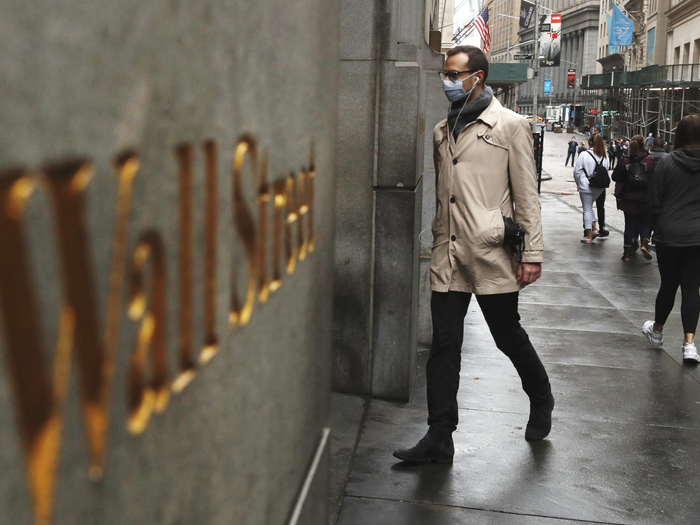
Three months after the sharpest sell-off in history, Wall Street is freaking out about valuations once more. Image courtesy of Reuters.

Three months after the sharpest sell-off in history, Wall Street is freaking out about valuations once more.

Bank of America Corp. clients are sounding the alarm on stock prices like never before — nearly 80% of them said in a survey the market is overvalued even as they sink cash into the market in droves. Bears are finding new reasons to bristle at forward price-to-earnings ratios at historic extremes, while bulls hit back with more reasonable interpretations of multiples, often relative to other asset classes.

“Everything is expensive,” wrote Chris Watling, chief market strategist at Longview Economics, in a note Friday. “80% of the markets we track have a valuation in the upper quartile relative to the market’s history — the greatest percentage on record using data since the mid-1990s.”

While renewed signs of global growth could push multiples even higher, strategists at Goldman Sachs Group Inc. including Christian Mueller-Glissmann concede that “elevated valuations will likely become a speed limit for returns again.” The question is, just when will those fundamental thresholds have been breached?

Here are some of the measures investors are debating:

DOTCOM DEJA VU
After a more than 40% climb in stocks from the trough of the coronavirus-driven slump in March, global equity valuations have surged to their highest since the dotcom bubble of the new millennium.

The MSCI AC World Index is trading close to a commanding 20 times forward estimates for the next year, according to data compiled by Bloomberg.

US PREMIUM
While valuation concerns are not limited to the world’s biggest stock market, multiples in the US are getting the bulk of the attention.

For good reason. If you slice and dice equal-weight gauges of the S&P 500 and MSCI World Indexes, the premium for an “average” US share surged to the highest in at least a decade after the peak of the coronavirus outbreak. It has yet to come back to its historical range.

HISTORY LESSON
There’s no need to reignite old arguments over the use of Yale professor Robert Shiller’s cyclically adjusted price-to-earnings ratio — the newer debate is over how to interpret it. Bears would point to the gauge of US stock prices relative to 10-year average earnings as being at levels synonymous with the dotcom bubble and roaring ’20s. Bulls would note the measure is well off peak levels from 20 years ago.

MONEY SUPPLY
Given the truly unprecedented level of monetary policy support fueling financial markets, some commentators have suggested traders should heed different measures to value equities to incorporate central bank largesse. Tom McClellan, editor of the McClellan Market Report, chooses to look at US stocks relative to the level of money supply — M2. Broadening this approach to include the increase of such a measure in Europe and Japan shows global stock valuations are bang on their average of the last 18 years.

VERSUS BONDS
This year’s risk-asset sell-off and rush to havens saw a surge in the spread of global dividend yields to benchmark Treasuries, a closely watched gauge for income investors. But that was before a spate of dividend cuts as companies sought to bolster their balance sheets to deal with the impact of the pandemic. Now that analysts have had time to adjust their dividend expectations, the measure of attractiveness of global equities over Treasuries has fallen back, but remains at levels favorable to stock bulls.

VERSUS CREDIT
Comparing the world’s stocks to their credit cousins suggests valuations are more or less back to normal. The spread between the yield-to-worst on the Bloomberg Barclays Global High Yield Index and the dividend yield on the MSCI AC World Index, which soared at the height of the crisis, has retreated to just above its average of the last 10 years. — Bloomberg

‘Total disaster’: Phantom billions plunge Wirecard into chaos

FRANKFURT/MANILA — Wirecard said on Monday that 1.9 billion euros ($2.1 billion) it had booked in its accounts likely never existed, a black hole that threatens to engulf the payments company and tarnish the reputation of Germany’s financial watchdog.

The one-time investor darling is holding emergency talks with its banks, which are owed roughly 1.75 billion euros, to avert a looming cash crunch triggered by the missing money.

The episode marks a dramatic turn in the fortunes of a homegrown tech firm that attracted some of the world’s biggest investors before a whistleblower alleged that it owed its success in part to a web of sham transactions.

Wirecard said last week that auditor Ernst & Young (EY) had refused to sign off its 2019 accounts as it was unable to confirm the existence of 1.9 billion euros in cash balances in trust accounts, about a quarter of its balance sheet.

On Monday, the company was frank.

“The Management Board of Wirecard assesses … that there is a prevailing likelihood that the bank trust account balances in the amount of 1.9 billion EUR do not exist,” it said.

State prosecutors in Munich investigating the case are now considering issuing arrest warrants for its former CEO, Markus Braun, and Jan Marsalek, a board member fired on Monday, according to two people familiar with the matter.

Messrs. Braun and Marsalek could not be immediately reached for comment, and their lawyers declined to comment.

The furor has also damaged Germany’s image.

Felix Hufeld, head of Germany’s financial watchdog Bafin, described the crisis, which has seen around 11 billion euros wiped off Wirecard’s market value in recent days, as a “total disaster,” conceding his agency and others had made mistakes.

“It is a scandal that something like this could happen,” Mr. Hufeld said.

REGULATOR UNDER FIRE

Bafin’s own record has come under fire as Wirecard’s share price has imploded, hitting retail investors and some large money managers.

The regulator had focused on probing so-called short-sellers and journalists behind reports which questioned Wirecard’s accounts, prompting criticism over its inaction against the company.

German lawmaker Fabio De Masi said that Bafin had failed in its duty over Wirecard, whose credit rating was ultimately withdrawn by agency Moody’s.

Wirecard, which started out handling payments for adult entertainment and gambling websites and now processes payments for companies including Visa and Mastercard, has appointed investment bank Houlihan Lokey to help assess its options.

More than a dozen banks, including ABN Amro and Commerzbank, are forming a creditor committee and have hired law firm Allen & Overy, two people close to the talks said.

Houlihan Lokey, A&O and the banks declined to comment.

Wirecard also said it is looking at the sale or closure of parts of its business, but its creditor banks are not interested in a fire sale, especially as litigation risks may put off buyers, one person close to talks told Reuters.

The company, which has long been held up as a rare German technology success, also withdrew its financial statements for 2019 and said it was examining cost cuts.

HUNT FOR MISSING CASH

EY had regularly approved Wirecard’s accounts in recent years, and its refusal to sign off for 2019 confirmed failings found in an external investigation by KPMG in April, which in turn followed investigative reports by the Financial Times.

Wirecard’s latest announcement follows the exit on Friday of former chief executive Braun, who was replaced by James Freis, an ex-compliance officer at Germany’s stock exchange.

The company has been under scrutiny since the whistleblower alleged the web of sham transactions. This culminated in a search for the missing cash, which last week hit a dead end in the Philippines.

The Philippine central bank said none of the money appeared to have entered the country, after Bank of the Philippine Islands (BPI) and BDO Unibank said documents purporting to show Wirecard had deposited funds with them were false.

BPI Chief Executive Cezar Consing said a certificate purporting to be for a Wirecard deposit was “spurious.”

Wirecard, which operates both as an issuer of real and “virtual” payment cards, had marketed itself as a universal payments platform positioned to profit from the growth in digital payments. Its future is now uncertain. — Reuters

Philex Mining sets virtual annual stockholders’ meeting on July 15

PHILEX MINING CORPORATION
Notice of 2020 Annual General Stockholders’ Meeting

TO OUR STOCKHOLDERS:

Please be informed that the Annual General Stockholders’ Meeting (“AGM” or the “Meeting”) of PHILEX MINING CORPORATION (the “Company”) will be held on Wednesday, 15 July 2020 at 4:00 p.m., and will be presided at TV 5 Media Center, Reliance St. Mandaluyong City. The meeting will be conducted virtually, and attendance at the meeting will be via remote communication only.

The order of business at the Meeting will be as follows:

  1. Call to Order;
  2. Proof of required notice of the meeting;
  3. Certification of quorum;
  4. Reading and approval of the Minutes of the 26 June 2019 annual stockholders’ meeting and action thereon;
  5. Presentation of annual report and audited financial statements for the year ended 31 December 2019 and action thereon;
  6. Ratification and approval of the acts of the Board of Directors and Executive Officers during the year 2019;
  7. Appointment of independent auditors;
  8. Election of directors, including independent directors;
  9. Other matters;
  10. Adjournment.

For purposes of the Meeting, only stockholders of record as of the close of business on 8 April 2020 are entitled to notice of, and to vote at, the Meeting.

The Definitive Information Statement for the Meeting is posted on the Company’s website. To access the Definitive Information Statement, with the attached Management Report, Audited Financial Statements for the period ended 31 December 2019 and Proxy Form, please go to (http://www.philexmining.com.ph/).

Attendance via remote communication. Stockholders who will attend the Meeting should email the Corporate Secretary at bcmigallos@philexmining.com.ph not later than 5 July 2020. Certificated shareholders must indicate in the email their Stockholder ID number and submit a scanned copy of a valid current government ID. Uncertificated shareholders (shareholders who hold their shares through a PCD Nominee account), should submit a certification from their broker attesting that the stockholder is the beneficial owner of shares of stock of the Company (the number of shares must be indicated) and a valid government ID.

Clarificatory questions regarding attendance via remote communication maybe sent via email to bcmigallos@philexmining.com.ph.

Stockholders can be represented and vote at the Meeting by submitting the said proxy by email to bcmigallos@philexmining.com.ph or by sending a physical copy to the Office of the Corporate Secretary at the Company’s principal office at 2/F LaunchPad, Reliance corner Sheridan Streets, Mandaluyong City, Metro Manila. The deadline for submission of proxies is 5 July 2020. Proxy validation will be on 8 July 2020 at 10:30 a.m. at the Company’s office address indicated above.

On-line voting. Secured on-line or electronic voting will be available for stockholders. Stockholders who have pre-registered attendance via remote communication may vote online by logging on to http://www.philexmining.com.ph/investor-relations/vote-online to cast their votes. On-line voting instruction are attached to the Notice as Annex “B”. On-line voting will close at 12:00 noon on 13 July 2020.

Open Forum. There will be an Open Forum during the Meeting. Stockholders who will attend via remote communication should send their questions via email to bcmigallos@philexmining.com.ph on or before 12:00 noon of 13 July 2020.

PXP Energy sets virtual annual stockholders’ meeting on July 15

PXP ENERGY CORPORATION
(formerly Philex Petroleum Corporation)

Notice of Annual General Stockholders’ Meeting

Please be informed that the Annual General Stockholders’ Meeting (“AGM” or “Meeting”) of PXP ENERGY CORPORATION (the “Company”) will be held on Wednesday, 15 July 2020 at 1:30 p.m., and will be presided at TV 5 Media Center, Reliance St., Mandaluyong City. The meeting will be conducted virtually, and attendance at the meeting will be via remote communication only.

The order of business at the Meeting will be as follows:

  1. Call to Order;
  2. Proof of required notice of the meeting;
  3. Certification of quorum;
  4. Reading and approval of the Minutes of the 21 May 2019 annual stockholders’ meeting and action thereon;
  5. Presentation of annual report and audited financial statements for the year ended 31 December 2019 and action thereon;
  6. Ratification and approval of the acts of the Board of Directors and Executive Officers during the year 2019;
  7. Appointment of independent auditors;
  8. Election of directors, including independent directors;
  9. Other matters;
  10. Adjoiurnment

For purposes of the Meeting, only stockholders of record as of the close of business on 12 March 2020 are entitled to notice of, and to vote at, the Meeting. The Definitive Information Statement with the attached Management Report, SEC Form 17-A with the Audited Financial Statements for the period ended 31 December 2019, and the Minutes of the Annual General Stockholders’ Meeting of the Company held on 21 May 2019 may be accessed at the Company’s website https://www.pxpenergy.com.ph/.

The Meeting will be via remote communication only. Stockholders who will attend the Meeting should email the Corporate Secretary at bcmigallos@pxpenergy.com.ph on or before 5 July 2020. Certificated shareholders must indicate their Stockholder ID number and submit a scanned copy of a valid current ID. Uncertificated shareholders (shareholders who hold their shares through a PCD Nominee account), should submit a certification from their broker attesting that the stockholder is the beneficial owner of shares of stock of the Company (the number of shares must be indicated) and a valid current ID. Clarificatory questions regarding attendance via remote communication may be sent via email to bcmigallos@pxpenergy.com.ph.

Once the Company successfully verifies the stockholder’s status, the Company will reply to each stockholder with (1) a link through which the Meeting may be accessed; and (2) with an online ballot or SECURITY CODE to be used for online voting. Questions relating to the Meeting materials may also be sent to bcmigallos@pxpenergy.com.ph on or before on or before 12:00 noon of 13 July 2020. Due to time considerations, questions that will not be addressed at the Meeting will be responded to via email.

Proxies. A proxy form that is compliant with the requirements of the Securities and Exchange Commission is attached to the Definitive Information Statement. Stockholders can be represented and vote at the Meeting by submitting the said proxy by email to bcmigallos@pxpenergy.com.ph or by sending a physical copy to the Office of the Corporate Secretary at the Company’s principal office at 2/F LaunchPad, Reliance corner Sheridan Streets, Mandaluyong City, Metro Manila. The deadline for submission of proxies is 5 July 2020. Proxy validation will be on 8 July 2020 at 10:30 a.m. at the Company’s office address indicated above.

On-line voting. Secured on-line or electronic voting will be available for stockholders. Stockholders who have pre-registered attendance via remote communication may vote on-line by logging on to https://www.pxpenergy.com.ph/agmvote2020/ to cast their votes. On-line voting instruction are attached to this Notice as Annex “B”. On-line voting will close at 12:00 noon on 13 July 2020.

Open Forum. Stockholders should send their questions via email to  bcmigallos@pxpenergy.com.ph on or before 12:00 noon of 13 July 2020. Officers of the Company will endeavor to answer all questions during the Meeting.

BSP likely to keep rates steady — poll

By Luz Wendy T. Noble, Reporter

THE Bangko Sentral ng Pilipinas (BSP) will likely keep benchmark rates untouched at its review this week, although some economists are pricing in another easing in the latter part of 2020 when the extent of the pandemic’s economic impact becomes clearer.

Ten out of 13 analysts polled by BusinessWorld expect the central bank to leave rates steady when the policy-making Monetary Board meets on Thursday (June 25).

“With public spending already picking up and more fiscal support underway, the BSP is likely to take a pause to assess the impact of this spending, previous measures to improve systemic liquidity and interest rate cuts,” Thatchinamoorthy Krshnan, an economist from Oxford Economics said.

Noelan Arbis, an economist from HSBC Global Research, said fiscal stimulus is “more necessary” at this point, rather than another rate cut.

Several economic stimulus measures designed to address the impact of the pandemic are still pending in Congress. These include the P1.3-trillion Accelerated Recovery and Investment Stimulus for the Economy of the Philippines (ARISE) bill, and the P1.5-trillion COVID-19 Unemployment Reduction Economic Stimulus 2020 (CURES) measure.

Analysts’ expectations on policy rates (June 25)

Economists also said current liquidity levels seem to have picked up already after the BSP implemented measures to unleash more funds into the financial system.

BSP’s latest data showed domestic liquidity or M3, which is the broadest measure of money supply in an economy, rose by 16.2% year on year in April, quicker than the 13.3% pace in March. This is also the fastest since the 16.4% growth logged in September 2014.

“Adjusting it (policy rates) again might cause unnecessary impacts on liquidity which may do more costs than benefits,” Asian Institute of Management economist John Paolo R. Rivera said.

So far this year, the BSP has slashed rates by 125 basis points (bps) in an effort to shield the economy from the pandemic’s impact. This has reduced the key policy rate or overnight reverse repurchase as well as lending and deposit rates to record lows of 2.75%, 3.25%, and 2.25%, respectively.

The BSP implemented an off-cycle 50-bp cut on April 16, in the midst of the Luzon lockdown. The scheduled May 19 meeting was canceled.

For University of Asia and the Pacific economist Victor A. Abola, there will likely be a pause in easing on Thursday, but expects a “cut next meeting when the real bad numbers for Q2 start coming out.”

Mr. Abola cited recent signals of a pause in easing from BSP Governor Benjamin E. Diokno.

Earlier this month, Mr. Diokno said they are “happy” with “where the current policy rate is” but assured the BSP continues to have ammunition ready when things get worse.

“Will there be a rate cut in the June to August meeting? We’re looking at it and we’re looking at information,” Mr. Diokno said early Monday in an interview with ABS-CBN News Channel.

After June 25, the central bank’s next policy-setting meeting is scheduled on Aug. 20.

The economy contracted by 0.2% in the first quarter, and is expected to fare even worse in the second quarter. The government’s projections show gross domestic product will shrink by 2-3.4% this year.

Meanwhile, three economists expect a rate cut of 25 bps at Thursday’s meeting, given the benign inflation environment and the widening impact of the COVID-19 pandemic on the economy.

“While BSP Governor Diokno’s recent comments suggest the bank may save its ammunition for later, we believe earlier action remains likely given softening inflation and downside risks to growth. A 25-bp rate cut remains on the table at the [central] bank’s upcoming meeting,” Jiaxin Lu, an economist at Continuum Economics, said.

Inflation in May was at a six-month low of 2.1% on the back of lower food and transport prices due to the lockdown. This is slower than the 2.2% in April as well as the 3.2% seen a year earlier. It brought average inflation from January to May to 2.5% so far.

The BSP’s inflation target for the year is 2-4%, while it gave a 1.75-3.75% projection taking into account the impact of the crisis.

ING Bank N.V. Manila Senior Economist Nicholas Antonio T. Mapa sees possible easing as part BSP’s efforts to further support economic recovery.

“Economic data suggests that the Philippines will enter a recession in Q2 and almost all data points to a loss of potential output due to the coronavirus lockdowns,” he said.

A rate cut on Thursday will be a “final move in terms of rate cuts for this year,” Mr. Mapa said, adding that cuts on the reserve requirement ratio (RRR) is also likely to be on the side given the rise in liquidity.

The BSP this year has slashed reserve requirement ratio for universal and commercial banks by 200 bps to 12% in a bid to boost liquidity during the lockdown. Reserve requirement for rural and thrift banks were kept at four percent and three percent, respectively.

The Monetary Board has authorized Mr. Diokno to cut RRR by up to 400 bps this year.

Analysts’ expectations on policy rates (June 25)

THE Bangko Sentral ng Pilipinas (BSP) will likely keep benchmark rates untouched at its review this week, although some economists are pricing in another easing in the latter part of 2020 when the extent of the pandemic’s economic impact becomes clearer. Read the full story.

Analysts’ expectations on policy rates (June 25)

Fragile kings of the Philippine road no match for coronavirus

By Arjay L. Balinbin, Reporter

DENNIS O. CLEDERA, 36, has been living in a two-decade old jeepney he used to drive since the main Philippine island of Luzon was locked down in mid-March, forcing many of his kind out of the roads and out of work.

“This is my bread and butter,” the driver, who lives in a village called Progress near Manila, the capital, said in an interview in Filipino, teary-eyed. “We’re poor and I can’t shift to becoming a construction worker because I don’t have the skills and a backer.”

BW Bullseye 2020-focusMr. Cledera now lives off daily food rations from his operator while old jeepneys and most buses remained banned to contain a novel coronavirus pandemic that has sickened more than 30,000 and killed at least 1,169 people in the Philippines.

President Rodrigo R. Duterte locked down Luzon on March 17, suspending work, classes and public transportation to contain the pandemic. People should stay home except to buy food and other basic goods, he said.

The lockdown in many parts of the country including the capital region where infections are mostly concentrated has since been relaxed, but the wildly painted jeepney that has become a Philippine cultural icon remained banned.

Transportation Secretary Arthur P. Tugade on June 2 said the ban on jeepneys, where passengers closely sit next to and in front of each other, was in keeping with state efforts to “balance our responsibility to make sure the spread of the virus is contained.”

“Does it mean we won’t be using traditional jeepneys anymore? No,” he told a news briefing. He added that in the “hierarchy of transportation,” jeepneys may be allowed to operate soon as long as they’re roadworthy.

At the top of this hierarchy are high-capacity vehicles such as trains, buses and modern public utility vehicles (PUVs), Mr. Tugade said.

Under the plan, mass transport will resume in two phases. Under the first phase from June 1 to 21, trains, limited buses, taxis, ride-hailing services and shuttle services, point-to-point buses and bicycles were allowed with limited capacity.

Provincial buses are still barred from entering Manila and nearby cities. The decision to allow tricycles in many villages to move people rests on local governments.

Under the second phase from June 22 to 30, modern jeepneys, public utility buses and public vans will be allowed with a limited capacity. Transport vehicles must follow the one-meter physical distancing rule for passengers.

INADEQUATE
There’s also a plan to build dedicated lanes for bicycles, which was unheard of before the lockdown except for certain cities near Manila.

Jose Regin F. Regidor, a research fellow at the University of the Philippines National Center for Transportation Studies, said government action on public transportation had been inadequate.

“Why can’t they quickly provide safe paths when there’s a clamor for bike lanes?” he said by telephone. “The government is overanalyzing the situation. Why not allot one of the 10 lanes for bicycles since you can’t provide public transportation?”

Transport expert Rene S. Santiago said allowing buses to resume operations without jeepneys, which is the vehicle of choice of 40% of Filipino commuters, was impractical. He noted that when the government experimented with its bus augmentation project for trains, few passengers used these buses.

“Not all have access to modern vehicles such as the LRT and MRT,” Mar S. Valbuena, president of the Samahang Manibela Mananakay at Nagkaisang Terminal ng Transportasyon, said by telephone “What about the secondary roads where only jeepneys have access to? If you take out the jeepneys, where will those commuters go?”

“We are only talking about Manila where you have buses and trains,” Mr. Santiago said. He noted that Cebu in central Philippines has no rail — as much as 95% of public vehicles there are jeepneys — while buses in Davao are virtually nonexistent.

While the country’s jeepneys do pose a risk to spreading the coronavirus, “there are ways to get around it,” Mr. Santiago said.

Operators can put plastic barriers in the middle of their jeepneys and raise the roofs to increase ventilation. An electric fan in the middle could also force the wind out, he said. The government could also require jeepney passengers to wear face shields instead of just face masks.

A cashless payment system could also limit infections, he said. Mr. Santiago said banning jeepneys cripples mobility, which in turn limits economic growth.

‘FLAT BROKE’
Mr. Valbuena said the government must address the plight of the country’s half-a-million jeepney drivers, 140,000 of whom are in the capital region.

“Jeepney drivers are flat broke and living hand to mouth,” he said. “Then the lockdown happened and they were unprepared. They don’t have any savings and not all of them were given cash aid.”

Presidential spokesman Harry L. Roque, Jr. earlier said the government was seeking to repurpose idle jeepneys into delivery vehicles. He also said jobless jeepney drivers would get cash aid again under the second tranche of the program.

There is also a plan for the government to hire transport operators to serve some areas during the lockdown.

“That is a disaster in the making,” Mr. Santiago said, adding that it could lead to favoritism. A better solution is to allow all modes of public transportation to operate again, he added.

If this happens, jeepneys and buses could lose a lot because only half their capacity will be filled. The Land Transportation Franchising and Regulatory Board has also ruled out fare increases.

“If they don’t want to increase the fares by 25% or 30%, they can subsidize the riders,” Mr. Santiago said. “Give them an e-card with a loaded amount for their trips. But you have to subsidize not just jeepneys but all modes including air and water transport. That’s the tricky part,” he added.

On June 2, police arrested six jeepney drivers in Caloocan City after they protested their continued ban under a relaxed lockdown. One of them was a 72-year-old man named Elmer Cordero. The Commission on Human Rights has expressed “deep concern” about the arrests.

“They were seeking government support and they got arrested instead. There’s something wrong with that,” Mr. Valbuena said.

He said the government might be using the pandemic to push its agenda of phasing out old jeepneys. The regulator has said the deadline for the modernization for jeepneys would proceed by the end of the month.

Under the modernization program launched in June 2017, operators must stop using 15-year-old units and older, and replace these with new ones in three years.

To date, only 4% of about 370,000 old jeepneys nationwide have been replaced, Mr. Valbuena said.

More than 300 modern jeepneys were allowed this week to serve 15 routes in Manila and nearby cities.

“If only modern jeepneys are allowed, where will the commuters go? And what will happen to displaced jeepney drivers?” Mr. Valbuena said.

Mr. Regidor, the academician, said this might not be the right time to push the modernization program.

“We need to think about the demand for transportation now,” he said. “Vulnerable people will suffer. Jeepney drivers have been jobless for the past three months and then you will threaten them with a phase-out?”

Mr. Cledera, the jeepney driver mentioned at the outset, got an P8,000 cash aid from the Social Welfare department in April that he sent to his family in Bicol right away. “I’m penniless and I still have a four-year-old child to feed.”


Economic recovery to start in 4th quarter, Diokno says

ECONOMIC RECOVERY is likely to start by the fourth quarter, with growth seen in key sectors such as agriculture and construction, Bangko Sentral ng Pilipinas Governor Benjamin E. Diokno said on Monday.

“I expect to see some growth in Q4 — agriculture, construction, manufacturing, and public administration,” Mr. Diokno said in a text message to BusinessWorld.

The economy contracted by 0.2% in the first quarter of the year, weighed down by the Taal eruption, the coronavirus outbreak and the subsequent lockdown.

The second quarter is expected to be worse, with the economy seen slipping into a recession. A recession is defined as two straight quarters of negative economic growth as measured by gross domestic product (GDP).

Despite easing of lockdown and resumption of business activity, Mr. Diokno still expects a GDP contraction, albeit slower, in the third quarter.

“I think the recovery will start in the fourth quarter. I think economic contraction could persist until Q3, although at a slower pace compared to the second quarter as business operations gradually resume,” he said in an interview with ABS-CBN News Channel.

The government sees GDP shrinking by 2-3.4% this year, before bouncing back in 2021 with a growth of 8-9%.

Mr. Diokno, a former Budget secretary, previously said the government will need to focus on the labor market to rescue the economy. He suggested a supplemental budget could better support this effort in order for fiscal stimulus to catch up with the monetary measures by the central bank.

The Congress has yet to approve key stimulus bills. The COVID-19 Unemployment Reduction Economic Stimulus (CURES) bill sets aside P1.5 trillion for infrastructure projects that will create jobs. Projects will focus on priority areas such as health, education, agriculture, local roads and infrastructure and livelihood.

The Accelerated Recovery and Investment Stimulus for the Economy of the Philippines (ARISE) bill, on the other hand, allotts P1.3 trillion for COVID-19 response.

“As economic growth is expected to contract significantly for the year, an expanded fiscal policy response will play an important role in stabilizing the economy and nudge more industries into recovery mode,” Security Bank Corp. Chief Economist Robert Dan J. Roces said in a text message.

He said fiscal policy moves will be a “good complement” to the monetary policy response, which could in turn boost consumption that will benefit both the private and public sector.

UnionBank of the Philippines, Inc. Chief Economist Ruben Carlo O. Asuncion said a recovery by the fourth quarter is possible taking into account the efforts to reopen the economy and the continuation of the government’s infrastructure program.

However, Mr. Asuncion said a possible second wave of infections should also be priced in when talking about economic recovery.

“The swift recovery hinges on how the government handles the health aspect of the containment efforts. If the spread of the virus is effectively contained, economic recovery will be brisk,” he said in a text message. — Luz Wendy T. Noble