THE LIFTING of the suspension of exploration activities in the West Philippine Sea will help in the country’s economic recovery, the Energy secretary said during an Association of Southeast Asian Nations (ASEAN) regional energy forum on Thursday.
“This development would augur well for our economic recovery in the midst of the COVID-19 pandemic, given that the resumption of work would infuse our economy with fresh investments and help generate high-skill employment opportunities,” Department of Energy (DoE) Secretary Alfonso G. Cusi was quoted as saying in a statement Friday.
This comes about a month after President Rodrigo R. Duterte told the DoE to lift the moratorium on activities and resumption of petroleum exploration in the parts of the West Philippine Sea.
During the forum, Mr. Cusi also asked the ASEAN Council on Petroleum to revisit existing sharing agreements on oil and gas exploration and production, and make recommendations on new measures that can be adopted. According to him, this will “fast track the ASEAN’s goal of reaching energy security.”
He also encouraged national oil companies based in the ASEAN to “explore joint oil and gas exploration and development.”
The DoE this month reminded Philippine exploration companies that they do not need to seek China’s approval in surveying and drilling in parts of the West Philippine Sea.
Last month, Mr. Cusi said that service contractors (SC) 59, 72 and 75 in the West Philippine Sea were issued “resume-to-work” notices. The state-led Philippine National Oil Co.-Exploration Corp. operates SC 59. Forum Ltd. and PXP Energy Corp. operate SC 72 and SC 75, respectively. — Angelica Y. Yang
THE BOARD of Investments (BoI) has approved a P45-million hotel investment project in Cebu City.
The 63-room SureStay Plus Hotel is expected to create 32 direct and indirect jobs in the first five years of its operations, BoI said in a press release on Friday.
The project is the Cebu Quad Management Corp.’s second premium economy hotel with SureStay Plus Hotel by Best Western. The first hotel was in Angeles, Pampanga.
BoI added the hotel will use information technology systems for contact tracing, online booking, and digital payments.
“The tourism sector has been one of the worst affected of all the major sectors of the economy due to the current health crisis,” Tourism Secretary Bernadette Romulo-Puyat said.
“By providing investment incentives, we hope that the sector, which was a major driver of the economy’s growth pre-COVID-19, will stay afloat, continue business operations, and recover the soonest while ensuring the health, safety and wellness of tourists.”
Tourism establishments looking to improve or modernize facilities for health safety may apply to register for incentives under the BoI. The board will grant a three-year income tax holiday and will allow duty-free importation of capital equipment for the projects.
“Even tourism facilities in Boracay, which currently do not qualify for incentives for new and expansion projects because of locational restrictions, may qualify for this special type of incentives for COVID modernization/upgrade projects,” Ms. Puyat said.
The Philippines may only see a significant rise foreign tourist arrivals starting late 2021 or early 2022 as uncertainty over the pandemic continues, Fitch Ratings said last month. — Jenina P. Ibañez
THE GOVERNMENT took back P153.13 million in tax credits granted to textile firms due to their engagements in illegal transactions, the Department of Finance (DoF) said on Friday.
“The four errant textile companies had illegally acquired the TCCs (tax credit certificates) over a four-year period from 2008 to 2012,” the agency said in a statement on Friday.
The Commission on Audit (CoA) issued notices of disallowances to Capital-Roll Knit Corp., Uni-Glory’s Knitting Corp., Primeknit Manufacturing Corp. and Tai-Cheng Integrated Resource Inc. The firms were earlier found to have gotten away with P605.98 million in illegal tax perks. This brought their combined tax credit rejections to P759.12 million.
Under Executive Order 226 or the Omnibus Investments Code, tax credits are available to exporters and manufacturers of products registered with the Bureau of Investments. This could be used by exporters that have paid duties and taxes on the raw materials and supplies they used in manufacturing their goods.
Once applications for TCCs are approved, firms can get refunds on duties paid.
However, TCCs are sometimes issued to ghost exporters and bonafide companies that do not deserve the tax credits.
Aside from the four business establishments, two other firms had their TCCs worth P59.5 million junked by the CoA.
“Several officials and employees of the DoF, BoI (Board of Investments), Bureau of Customs (BoC) and OSS (One-Stop Shop Inter-Agency Tax Credit and Duty Drawback Center) who were responsible for processing and approving the illegal TCCs in the past, as well as their recipients and claimants from the four companies, were held liable by COA in various instances when the TCCs were issued,” the DoF said. — LWTN
THE BANGKO SENTRAL ng Pilipinas (BSP) made a full award of the 28-day securities it offered on Friday amid excess liquidity in the financial system and following the latest reduction in key policy rates.
The BSP awarded P60 billion in its one-mont bills as planned as the offering was oversubscribed, with bids hitting P123.8 billion, going beyond the P88.9 billion in demand a week ago, data from the central bank’s website showed.
The BSP has made a full award of its short-term bills for 10 consecutive weeks since its maiden issuance in September.
Accepted rates for the one-month papers tanged from 1.68% to 1.75%, a lower margin compared to the 1.875% to 2% band logged a week ago. This caused the average yield to settle at 1.7135%, 24.86 basis points (bps) lower than the 1.9621% recorded the previous auction.
The 28-day bills are part of the central bank’s tools to gather excess liquidity and to better guide short-term interest rates.
The lower yields came following the latest easing move of the central bank, Rizal Commercial Banking Corp. Chief Economist Michael L. Ricafort said.
The BSP Monetary Board on Thursday unexpectedly slashed benchmark interest rates by another 25 bps, citing a critical need for policy support amid a slower pace of recovery and continued uncertainty as coronavirus infections surge anew in certain economies.
This brought down the rates on the BSP’s overnight reverse repurchase, lending and deposit facilities to new record lows of 2%, 2.5%, and 1.5%, respectively.
“It is important to note that the 28-day BSP securities yield of 1.7135% is unusually below the key overnight policy rate of 2% and the latest inflation rate of 2.5%, evidently amid excess liquidity in the financial system,” Mr. Ricafort said in a text message. — L.W.T. Noble
THE PESO strengthened versus the dollar on Friday following the central bank’s decision to cut benchmark interest rates to fresh record lows.
The local unit closed at P48.23 against the dollar on Friday, rising by 8.5 centavos from its P48.315 finish on Thursday, data from the Bankers Association of the Philippines showed.
The peso opened Friday’s session at P48.27 to a dollar which was also its weakest showing. Its intraday best was logged at P48.21 against the greenback.
Dollars traded declined to $660.6 on Friday from $692.3 million the previous day.
Rizal Commercial Banking Corp. Chief Economist Michael L. Ricafort said the peso rose after the Bangko Sentral ng Pilipinas (BSP) slashed key interest rates to new record lows.
“This will help boost economic recovery prospects in terms of further reducing borrowing costs, spur greater demand for loans that boost investments, jobs, economic opportunities, and more gains in the local financial markets,” Mr. Ricafort said in a text message.
The BSP Monetary Board on Thursday unexpectedly slashed benchmark interest rates by another 25 basis points (bps), citing a critical need for policy support amid a slower pace of recovery and continued uncertainty as coronavirus infections surge anew in certain economies.
This brought down the rates on the BSP’s overnight reverse repurchase, lending and deposit facilities to new record lows of 2%, 2.5%, and 1.5%, respectively.
The latest easing move followed a “prudent pause” by the BSP since its June meeting. The central bank has already cumulatively lowered interest rates by 200 bps this year.
Another trader said the rate cut increased demand for the peso. — KKTJ
A LAWMAKER on Friday pushed for the passage of several measures aimed to modernize the country’s banking sector.
During a virtual hearing of the House Banks and Financial Intermediaries Committee, House Ways and Means Chair Jose Maria Clemente S. Salceda pushed for the passage of House Bill No. 5193 or the Virtual Banking Act, which will help the entry of digital banking players and provide a framework that would encourage traditional banks to participate.
“Physical banking services have declined in accessibility, and during a pandemic, operating them poses some risk to consumers and employees. Banks also have a tendency to provision excessively in times of crisis, as opposed to expanding services in sectors in heightened need of capital,” he said.
Mr. Salceda said HB 7660 or the proposed Financial Technology Industry Act would also help and encourage the development of new financial technologies (fintech) in the country. The measure creates a Financial Technology Office in the Bangko Sentral ng Pilipinas (BSP) to institutionalize the fintech industry and formulate a Financial Technology Industry Roadmap.
The lawmaker is also pushing for the passage of HB 7864 or the Blockchain Technology Development Act to help encourage the study and application of distributed ledger technology, “which could make services cheaper and more efficient.”
Mr. Salceda likewise called for the passage of HB 7863 or the Fair and Inclusive Credit Reporting Act, which encourages credit transmission to underserved sectors by encouraging the use of “big data” to improve credit risk assessment and relationship management.
Mr. Salceda said the Congress would be able to create “a policy environment that incentivizes and compels traditional banks to innovate” by passing his proposed measures.
These reforms constitute a “creative disruption of a seemingly unchanging sector,” he added.
Industry associations like the Bankers Association of the Philippines and the Chamber of Thrift Banks expressed support for the bills. The BSP, Securities and Exchange Commission, and the Department of Information and Communication Technology also expressed support for various provisions of the bills. The Credit Information Corp. has also expressed support for HB 7863.
Committee chair Junie E. Cua said a technical working group which he will chair will be created to study the bills.
BSP Monetary Board member Bruce J. Tolentino, meanwhile, said the modernization of the banking sector won’t be possible without improving the country’s digital infrastructure. — K.A.T. Atienza
In conjunction with World Pneumonia Day which was held on 12 November 2020, Etiqa Philippines, in its constant pursuit to Make The World A Better Place, has distributed free 6-months coverage for pneumonia related hospitalization expenses, including those caused by Covid-19, to the Philippine National Police’s (PNP) 28,000 strong police force, through the Company’s innovative E-ZY Pneumonia Plan. The plan covers up to P50,000 worth of room/ board and general hospital services and up to P10,000 accidental death and dismemberment benefits to the insured.
With this, Etiqa Philippines hopes to help mitigate any anxieties that police officers might have for their health and well-being, and to provide peace of mind for providing protection to our citizens, as they face not only common criminal threats, but also put their health and lives on the line with the continuing pandemic.
This program, which was spearheaded by Ms. Diana binti Mohamad, was borne out of the company’s continuing advocacy for the community: “Our previous CSR initiative involves the donation of much needed PPE sets to our medical front liners from major hospitals across Metro Manila. Now, we express our solidarity with the country’s PNP front liners by providing them with financial protection from medical expenses should pneumonia strike. We believe that the Filipino people can always rise to the occasion during times of difficulties with the help of their fellow citizens.”
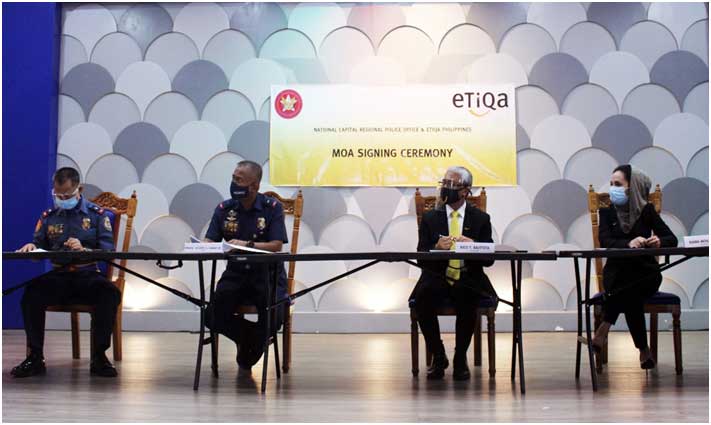
On 18 November, 2020, a formal signing of the memorandum of agreement was held at the Hinirang Hall, NCRPO Regional Headquarters at Camp Bagong Diwa, Taguig City. This event was led by Etiqa Philippines’ President and CEO, Mr. Rico T. Bautista; Executive Vice President and head of Strategic Division, Ms. Diana binti Mohamad; newly appointed Regional Director of the PNP’s NCRPO, Brigadier General Vicente Danao Jr. and Southern Police District Director PBGEN Emmanuel Peralta.
During the signing ceremony, Brigadier General Danao expressed his thanks to Etiqa Philippines: “On behalf of the Philippine National Police, particularly the NCRPO, we would like to express our utmost gratitude to our benevolent friends from Etiqa for sponsoring this insurance coverage for our police force for 6 months. This would be of great help to our front liners, especially so as the NCR remains under GCQ from the pandemic.”
Mr. Rico T. Bautista reiterated the company’s commitment to the PNP: “As society confronts the realities of the current pandemic, our police plays an ever more important part in protecting our communities during this stretch of quarantine. In the spirit of bayanihan, we want to show our appreciation to them by offering coverage for one of the most common complications of severe COVID-19. We hope that this allows them to carry on their important work while lessening their worries from any unforeseen medical needs.”
Etiqa Philippines embodies the spirit of Humanizing Insurance through employee volunteers, CSR programs, and commitment to give back to community and country with initiatives such as this.
BEIJING — China has extended debt relief to developing countries worth a combined $2.1 billion under the G20 framework, the highest among the group’s members in terms of the amount deferred, the country’s Finance Minister Liu Kun said on Friday.
Mr. Liu’s comments come as African countries, hammered by the COVID-19 pandemic, face another debt crisis, and will need more long-term help than the latest G20 Debt Service Suspension Initiative (DSSI) offers them to ward off trouble ahead and keep much-needed investments coming in.
The China International Development Cooperation Agency, the country’s aid agency, and the Export-Import Bank of China, the official bilateral creditors, have suspended debt service payments from 23 countries, worth a total of $1.353 billion, Mr. Liu said in a statement on the ministry’s website.
The China Development Bank, as a commercial creditor, signed agreements with developing countries involving $748 million by the end of September, said Mr. Liu.
However, that is tiny compared with the debt developing countries owe China. The poorest countries’ official bilateral debt to G20 countries reached $178 billion in 2019, with 63% of the total owed to China, a World Bank study showed.
A third of the $30.5 billion of public debt service payments due in 2021 by DSSI-eligible sub-Saharan African nations is owed to official Chinese creditors while a further 10% is linked to the China Development Bank, according to the Institute of International Finance.
The United States, China, and other G20 countries have offered the world’s poorest countries— many of which are in Africa—relief until at least mid-2021 and will decide if another six months of extension is needed in April next year.
Mr. Liu said China was willing to step up financial help for developing countries and more support will be given to those hardest hit by the pandemic and under heavy stress, and it will also prioritize COVID-19 vaccine supply to poor economies.
China will also consider making donations to a multilateral debt relief facility if the World Bank decides to set one up, Mr. Liu said. — Reuters
Passive engagement on social media is just as important as active engagement when it comes to quantifying success, according to Hootsuite, a social media management platform.
Passive engagement is defined as a consumer’s consumption of online content, such as reading a post or watching a video. Metrics for this form of engagement include video completion rates, link clicks, and website traffic. Active engagement, on the other hand, is often more popular among marketers, who measure success by the number of a post’s likes, shares, and comments.
“[Marketers are] still chasing virality and vanity metrics like retweets, comments, and shares, when the data tells us that the majority of online content is consumed passively,” said Sarah Dawley, content manager at Hootsuite.
Ms. Dawley cited Hootsuite’s digital data forOctober 2020, which found that the average Facebook user shared only one post a month and that Twitter’s unique website traffic was three times larger than its monthly active users—meaning there are a lot of people who passively consume content on these platforms (sometimes without even signing up).
To engage this large but silent audience, marketers should explore the lighter side of their brand, said Ms. Dawley, who cited astudy by Global Web Index which found that finding funny or entertaining content is one of the top reasons people use social media.
“I’m not saying you desperately have to be funny… or go against your brand tone or personality… Just remember that creativity, fun, and lightheartedness is what will help your content really break through that wall of indifference that people have towards brands on social media,” she said.
In the United States, for example, Coors’ Light asked customers to nominate someone who #CouldUseABeer to cope with the “sucky, suck, suck, suckiness” of the pandemic. At the end of the social media campaign, they sent 500,000 beers to customers.
“You’re asking people to go out of their way to engage with your brand… You really need to give them a reason to engage with you if you are asking them to do that,” said Ms. Dawley.
2021 Social Trends is a webinar hosted by Hootsuite on November 19. — Mariel Alison L. Aguinaldo
He still wakes up at 4 a.m., as he usually does, to prepare the kids for school. And he half-expects to see her in her corner of the room, painting, doing calligraphy, recording songs, or editing videos. He is the early riser between them, but when his wife gets an urgent call in the middle of the night, she finds it hard to go back to sleep, so she indulges her hobbies.
But Dr. Kathlynne Anne Abat-Senen is no longer in her corner. She is no longer singing or writing or taking hospital calls. And her husband, Dr. Jerome Senen, is still waking up early and trying very hard to live the life she had wanted for them.
Dr. Kathlynne Senen
“It’s still a bit surreal for me. Every time I wake up, I still half-expect that I will see her next to me. That’s one of the first things I missed—’yung may katabi ako sa pagtulog and ‘yung routine namin na we have breakfast with the kids, then attend to our patients,” Jerome said.
Jerome is a pediatric pulmonologist while his wife Karen, as she is called by family and friends, was a neonatologist and lecturer at the Philippine General Hospital (PGH). They have a private clinic in Valenzuela City and in several hospitals in Bulacan. When the pandemic hit and doctors began to get infected, the couple decided to continue attending to their patients, despite the risk, because that was what they were called to do as doctors.
“Sabi namin, it would be a disservice to everybody kung magtatago tayo, so we continued seeing patients,” Jerome said. “We did extra precautions: naka-full PPE (personal protective equipment) kami kahit sobrang pawis, hindi kami makainom, maka-CR, makahubad kasi ang init ng PPE. It’s a good thing our house has a small shower outside so we would clean up before seeing the kids.”
Because many pregnant women were unable to have their regular check-ups during the lockdown, there were a lot of premature and complicated births, which meant Karen’s services as a neonatologist were very in-demand. This took a toll on her health.
In late June, Karen was one of the medical frontliners infected with COVID-19. She recovered in July and remained in high spirits, even recording a song to celebrate her discharge from the hospital. But just a week later, she tested positive for COVID-19 again and had to be readmitted to PGH but this time, her situation did not look good.
In August, after 44 days in the hospital’s intensive care unit (ICU), Karen lost her battle with COVID-19.
To honor Karen’s memory and fulfill their promise of service, Jerome will continue to be a doctor to the kids who need him.
Her parents and siblings, who had last seen her in March before the government-enforced lockdown, could not hold her. Her children could not say goodbye and even her husband, who stayed at the hospital the entire 44 days, could count the times he was allowed to see her in the ICU.
“Ito yung hindi nakikita ng regular na tao. It’s not only the dread na baka mamatay ka. There’s also the emotional stress of family members—being away, not being able to say goodbye except through a video call,” Jerome said.
“The price of the virus is not just the life of the person but also the people that she will leave behind. My kids are still small, 8 and 11 (years old), at lalaki silang walang mom. Doon ako naiiyak eh,” he said.
Moved by the outpouring of love from fellow Filipinos, the Senen family will continue to live the life Karen wanted for them.
The children have received counseling and support from their school, and are currently preoccupied with their online classes. Jerome’s mother, a retired teacher, and his brother, an IT specialist, help look after them. On weekends, they visit Karen’s parents in Las Piñas to play with their cousins, or they bring flowers to Karen’s resting place.
Outpouring of love
Karen’s was one of the high-profile COVID-19 cases among medical frontliners, not just because it raised the issue of COVID-19 reinfection, but because in the darkest of times, it showed the amazing ways people came together to support her family.
“Sa financial, thankful kami na andami- daming tumulong sa amin. Lahat ng networks ng mga kilala namin or kilala namin in passing, or even mga hindi namin kilala at all, even from the other side of the world, helped us in their own little ways—mga small things that if you add up have helped us tremendously,” Jerome said.
His classmates from Philippine Science High School volunteered to make digital portraits to raise funds for Karen’s medical bills, as did Karen’s friends from grade school and high school. A Facebook group of fountain pen collectors, of which he and Karen were members, did a fundraising auction of their collectible pens. A pediatrician’s artist friend did caricatures and donated the proceeds to them, as did a batchmate in medical school (University of the Philippines Manila) who sold her paintings for Karen.
A US-based ninong and friends abroad raised $25,073 through GoFundMe for the ECMO (extracorporeal membrane oxygenation) machine Karen needed. The machine had to be rented from the National Kidney and Transplant Institute for PHP 750,000, plus PHP 20,000 per day of use. Karen used the ECMO machine for over 30 days. She was also hooked to a ventilator and had to undergo dialysis using another machine that was not available in PGH and hence, had to be rented. These are on top of the daily medication and blood transfusions Karen required.
“The cost is very, very staggering. Good thing talaga na andaming tumulong sa amin,” Jerome said. “Parang nagkaroon ng spirit of bayanihan, not just sa finances but even in other aspects like blood donation. One example: meron kaming medication na hindi mahanap anywhere, so we posted on Facebook asking for help. Meron na lang nag-contact sa amin—friend namin ni Karen na doctor na matagal na naming hindi nakikita—she bought the medicines from St. Luke’s (Medical Center),” he said.
Jerome was also grateful to PGH for giving him a place to stay while Karen was in the ICU, and for coordinating with other hospitals for everything they needed. He also mentioned Sen. Richard Gordon, who through the Philippine Red Cross, provided blood supply for Karen’s needs.
Above all, Jerome said he could not have done it without Karen’s siblings. They sought and facilitated assistance through Facebook, driving people to PGH to donate blood. While they knew how friendly their sister was, even they were astounded by the outpouring of love from strangers. They realized it was the payback for the earnest service Jerome and Karen had given people through the years.
“We had no regrets seeing our patients kasi kung di kami titingin, paano na sila?” Jerome said. The parents of premature babies Karen had helped save have sent not just financial aid but also letters and prayers for their doctor.
“Minsan may magpapadala sa GCash namin ng PHP 50, mga hindi mo aakalain na magpapadala kasi alam ko naman na mahirap din buhay nila. Baka yung PHP 100 or 200 na padala sa akin iyon ay pantawid na nila ng meal, but they opted to send it to us,” he said.
Help health workers
Karen’s case has turned the spotlight on health workers fighting a battle that seems to have no end in sight. Jerome is thankful for all the post-humous recognition Karen had received, especially from the Valenzuela City government and its congressional office. But his biggest desire is for the country’s leaders to realize that health workers need help, and for the people to do their part to prevent the spread of COVID-19.
“Medical frontliners really, really need help kasi hindi lang kami ang kailangan to stop the virus. Everybody has to do their part; if we don’t, walang mangayayari sa Pilipinas,” he said.
“Don’t go out of the house if not needed,” Jerome practically pleaded. “The story of Karen is a precautionary tale, na kahit gaya ni Karen na grabeng pag-iingat na, sinunod lahat ng precautions, pero tinamaan pa rin and hindi sya naka-recover. It’s a lesson na dapat matutunan ng lahat.”
Jerome, who chairs the pediatric department of Marymount Hospital in Meycauayan, plans to resume working in November when he’s done with Karen’s paperwork. Some have questioned this decision but it was what Karen would have wanted him to do, he said.
“It’s a promise I made to Karen—that I would continue to be a doctor to the kids who need me. It’s my way of honoring her memory and the pact we made during the pandemic,” he said.
Is he scared?
“Yes, but if magpapadala ka sa takot—if every physician ay matatakot—walang mangyayari sa atin. Pupulutin tayo kung saan-saan, magkakasakit tayo pare-pareho,” he said. “I just have to be prepared mentally, spiritually, psychologically, emotionally because that’s what Karen wants me to do— to work but to also be prepared.”
Dr. Kathlynne Anne Abat-Senen was one of the InLife Sheroes featured by Insular Life for its Mothers’ Day 2020 special: Mothers on the Frontline. When asked what it is that drives her to do what she does, she answered: “I have always been motivated by Ralph Waldo Emerson’s quote ‘The purpose of life is not to be happy. It is to be useful, to be honorable, to be compassionate, to have it make some difference that you have lived and lived well.’ I am fortunate to have a family that encourages me to live a life of purpose.”
The central bank cut policy rates to a record-low 2%, as the economy continued to struggle with the impact of the pandemic and recent typhoons. — PHILIPPINE STAR/MICHAEL VARCAS
By Luz Wendy T. Noble, Reporter
THE Bangko Sentral ng Pilipinas (BSP) unexpectedly cut benchmark rates to new record lows on Thursday, the fifth reduction this year, citing the continued uncertainty caused by a fresh surge in coronavirus cases globally and the impact of recent typhoons on the struggling economy.
The Monetary Board on Thursday trimmed the rates on the BSP’s overnight reverse repurchase, lending, and deposit facilities by 25 basis points (bps) to 2%, 2.5%, and 1.5%, respectively.
“With a benign inflation environment and stable inflation expectations, the Monetary Board sees enough policy space for a reduction in the policy rate at this juncture to uplift market sentiment and nurture the country’s economic recovery amid increased downside risks to growth,” BSP Governor Benjamin E. Diokno said in an online briefing.
The latest easing move followed a “prudent pause” by the central bank since its June meeting. The central bank has already cumulatively lowered interest rates by 200 bps this year.
“The Monetary Board assessed that there remains a critical need for continuing policy support measures to bolster economic activity and boost market confidence,” Mr. Diokno said.
Mr. Diokno said uncertainty remains high amid a resurgence of coronavirus disease 2019 (COVID-19) cases around the world.
“However, the Monetary Board also observed that global economic prospects have moderated in recent weeks. At the same time, the Monetary Board noted that while domestic output contracted at a slower pace in the third quarter of 2020, muted business and household sentiment and the impact of recent natural calamities could pose strong headwinds to the recovery of the economy in the coming months,” he said.
A BusinessWorld poll last week showed five out of 16 analysts expected the BSP to cut rates by 25 bps.
BSP Deputy Governor Francisco G. Dakila, Jr. said the latest easing will provide support to hasten the economy’s recovery by boosting bank lending.
“What this interest rate cut does is provide the impetus so that people will be much more likely to have confidence to get into the financial system again, when interest rates are on the accommodative side,” Mr. Dakila said.
Despite the BSP’s rate cuts earlier this year, lending growth eased to 2.8% in September, the slowest in more than 13 years or since the 2.4% seen in June 2007, as banks tightened their credit standards while borrowers’ confidence remained low due to the pandemic.
“So we emphasize that controlling the virus would be the most important factor that would lead to a pickup in the loan demand, but should that happen, the necessary liquidity is there in the system,” Mr. Dakila said.
INFLATION OUTLOOK REVISED Meanwhile, the central bank upgraded its inflation forecast this year to 2.4% from the 2.3% it gave in the October meeting, Mr. Dakila said.
“We have revised it upwards by 0.1 percentage point due to the transitory impact of the higher-than-expected inflation in September end of this year,” Mr. Dakila said, noting higher inflation was seen in the food and non-alcoholic beverage component of the consumer price index.
On the other hand, the inflation outlook for 2021 and 2022 were lowered to 2.7% (from 2.8%) and 2.9% (from 3%), respectively, due to the slower-than-expected pickup in domestic activity, the decline in global crude oil prices, and the strengthening of the peso.
For UnionBank of the Philippines, Inc. Chief Economist Ruben Carlo O. Asuncion, the third- quarter gross domestic product (GDP) data may have been the crucial factor for the rate cut call.
“I guess the signs were on the wall: a lower-than-expected third-quarter GDP print, a quintet of unexpected destructive storms and a coronavirus that is still there. We expected a continuation of the BSP’s prudent pause, but it seems an overflow of warning signs may be too much to handle if a cut is not done,” he said in a text message.
GDP declined by 11.5% in the third quarter, slightly better than the record 16.9% contraction seen in the April to June period.
Analysts said near-term recovery prospects appeared bleaker.
“Despite the fresh round of easing, we are not confident that bank lending will pick up anytime soon given the dimming growth outlook with unemployment elevated and consumer sentiment still negative,” ING Bank N.V. Manila Senior Economist Nicholas Antonio T. Mapa said in a note.
Meanwhile, Alex Holmes, an economist from Capital Economics, said recovery prospects for the Philippines are still hinged on how well the government controls the spread of COVID-19.
As of Thursday, the Health department reported 1,337 new COVID-19 cases, bringing the total to 413,430.
“With the virus still not under control, restrictions will need to remain in place for longer, which will further hold back the recovery. Promising news on vaccine development looks unlikely to change the situation in the near term,” he said.
“Given the likely weakness of the economic recovery, we suspect the BSP will cut rates further next year.”
Republic Act No. 11494 or the Bayanihan to Recover as One Act allocated around P9 billion to assist the transportation industry, which was affected by the pandemic. — PHILIPPINE STAR/EDD GUMBAN
THE BUDGET department has released less than two-thirds of the P140-billion stimulus package under Republic Act No. 11494 or the Bayanihan to Recover as One Act (Bayanihan II), a month before the law expires.
At the same time, an economist warned further delays in the release of stimulus funds would hamper economic recovery this quarter.
Data from the Department of Budget and Management (DBM) showed it released P87.907 billion or 62.8% of the P140-billion budget under Bayanihan II. The funds were released between Oct. 1 and Nov. 17.
President Rodrigo R. Duterte signed Bayanihan II into law on Sept. 11.
Bayanihan II, which expires on Dec. 19, allocates P140 billion for relief programs for sectors hit hard by the pandemic and another P25 billion in standby funds.
The latest tally inched up by 0.02% from P87.892 billion released at the end of Nov. 10, after P15 million was released for the establishment of a computational research laboratory in the University of the Philippines (UP).
So far, the government spent P481.634 billion for its pandemic response.
Colegio de San Juan de Letran Graduate School Dean Emmanuel J. Lopez said the slow pace of the release of stimulus funds will hurt the economy’s recovery.
“It will not only directly affect the people and citizens who will be severely affected by both the pandemic and other disasters but likewise the much needed injection of funds needed that should generate employment and bring back the economy into normal activity,” Mr. Lopez said in an e-mail Thursday.
“The delay in release, if not immediately addressed, will negatively affect local economic performance that will hinder the growth in our GDP which as of the last quarter is still experiencing a double-digit contraction,” he said.
The release of Bayanihan II funds was delayed when the DBM had to seek the President’s approval. Mr. Duterte then gave the DBM the authority to release the funds without prior approval from his office to speed up the process.
“The release of funds under the Bayanihan II will depend on the submission of the departments/agencies of their Special Budget Request with supporting documents. The DBM will make sure to act within 24 hours upon receipt of the request of departments/agencies,” Budget Assistant Secretary Rolando U. Toledo said in a Viber message on Thursday.
Government spending, which contributes around 20% of the total economic output, failed to give the needed boost to the gross domestic product (GDP) in the third quarter. Growth in state expenditures eased to 5.8% from 8.8% in the second quarter.
The economy remained in a recession in the third quarter after contracting by 11.5% to follow the record 16.9% slump in the previous three months.
Meanwhile, the government’s economic recovery package should focus on helping people, instead of banks, especially after the country has been hit by several typhoons, former National Socioeconomic Planning Secretary Cielito F. Habito said in an online forum on Thursday.
“The way to have much impact is to put it on the demand side. Put it in the people’s hands or pockets and not in the banks, where we expect the banks to lend it to small businesses who are not even in the mood to borrow perhaps, because their customers aren’t even back,” Mr. Habito said, of the current administration’s stimulus package.
Mr. Habito said there should be more cash transfers to low-income families, particularly those affected by the recent typhoons.
He said the stimulus funds should be used to invest in effective testing, tracing and treatment for COVID-19-cases, as well as purchasing domestic goods so money can circulate within the economy. — withAngelica Y. Yang