Home Blog Page 855

Gunman’s deadly spree in midtown Manhattan spawns evening of fear in New York City

A NEW YORK Police Department officer at the scene of a shooting. — VICTOR J. BLUE/BLOOMBERG

WORK was winding down at 345 Park Avenue on Monday when a man strode across the public plaza just outside the Midtown Manhattan tower with an assault rifle in his hand.

Within minutes, at least four people were dead, as well as the gunman, in a mass shooting in the epicenter of American finance. The harrowing scene unfolded in the 44-story, dark-glass tower that houses the offices of private equity giant Blackstone Inc., consultant KPMG, the National Football League (NFL) and building landlord Rudin Management.

Shane Tamura, a 27-year-old who last resided in Las Vegas, shot and killed a uniformed police officer in the lobby and made his way to the 33rd floor before dying of an apparent self-inflicted gunshot wound, authorities said. The attacker previously worked as a security guard at a Las Vegas casino and held a concealed carry permit for Nevada, according to law enforcement officials.

Mr. Tamura, who has a documented history of mental-health troubles, drove across the country before entering New York City earlier Monday, Police Commissioner Jessica Tisch said at a press briefing, adding that officials are still working to figure out his motive.

The shooting shut down a large stretch of Midtown Manhattan and drove employees at several nearby firms — including hedge fund Citadel and investment bank Jefferies Financial Group, Inc. — to go into lockdown. Park Avenue now houses more major financial firms than actual Wall Street, with JPMorgan Chase & Co.’s massive new headquarters a few blocks south of Blackstone’s base.

Videos from inside the tower showed people huddled in cramped rooms, some crying in fear, and workers leaving with their hands in the air as police cleared floors. Blackstone employees described sharing and receiving conflicting information on what was happening, while some scrambled to barricade doors and entry points.

Workers streamed out of 345 Park Avenue to a chaotic scene of flashing police cars. One was crying and embracing another. Meanwhile, Blackstone sent staff a flurry of texts asking them to confirm they were safe.

A Blackstone employee was among those killed, according to a person briefed on the matter. The company is the world’s largest private markets firm, with more than $1.2 trillion in assets under management and roughly 5,000 employees.

One Blackstone employee shared a photo that showed couches piled close to the ceiling as a barricade. Two of the firm’s employees told friends they were hiding in the office pantries, according to people who received the messages. When they got the all-clear sign, some refused to leave spaces where they had barricaded themselves, petrified that they were still in danger.

Blackstone declined to comment while awaiting further details on the status of employees. Representatives for the NFL and Rudin, a 100-year old real estate firm that owns major office buildings in the city, had no immediate comment or didn’t respond to messages.

The slain police officer, Didarul Islam, was an immigrant from Bangladesh who had been on the job for three years, authorities said.

“He was a true blue New Yorker,” Mayor Eric Adams said at the briefing late Monday. “He was a hero, and we admire him for putting his life on the line.”

The attack — fewer than eight months and five blocks from the fatal shooting of a UnitedHealth Group executive on a Midtown Manhattan street — prompted questions about the gunman’s motive and his ability to get so far into the building.

A surveillance video shows the gunman left a black BMW doubled-parked and entered the building carrying a rifle, Police Commissioner Tisch said.

He then opened fire in the lobby, hitting several people including the police officer. A security guard taking cover at a desk near the elevator bank was also shot.

The gunman made his way to an elevator, where he let a woman exit. He then rode up to the 33rd floor, which is occupied by Rudin. There, he fired more rounds, killing a woman, authorities said. He then turned the gun on himself.

“The city is in mourning for the innocent lives lost,” Ms. Tisch said, adding that one person who was shot in the lobby is being treated.

As the chaos subsided, employees who work in Midtown Manhattan wondered about the status of their offices on Tuesday. A text message sent to JPMorgan employees said their campus is expected to operate under normal conditions on Tuesday, but employees should anticipate some disruption in near the Midtown office. — Bloomberg

Global hunger falls but conflict and climate threaten progress, UN says

PALESTINIANS wait to receive food cooked by a charity kitchen amid shortages of food supplies in Rafah in the southern Gaza Strip, Jan. 16, 2024. — REUTERS

ADDIS ABABA — The number of hungry people around the world fell for a third straight year in 2024, retreating from a COVID-era spike, even as conflict and climate shocks deepened malnutrition across much of Africa and western Asia, a United Nations (UN) report said on Monday.

Around 673 million people, or 8.2% of the world’s population, experienced hunger in 2024, down from 8.5% in 2023, according to the State of Food Security and Nutrition in the World report, jointly prepared by five UN agencies.

They said the report focused on chronic, long-term problems and did not fully reflect the impact of acute crises brought on by specific events and wars, including Gaza.

Maximo Torero, the chief economist for the UN Food and Agricultural Organization, said improved access to food in South America and India had driven the overall decline but cautioned that conflict and other factors in places such as Africa and the Middle East risked undoing those gains.

“If conflict continues to grow, of course, if vulnerabilities continue to grow, and the debt stress continues to increase, the numbers will increase again,” he told Reuters on the sidelines of a UN food summit in Ethiopia.

“Conflict continues to drive hunger from Gaza to Sudan and beyond,” UN Secretary-General Antonio Guterres said in remarks delivered by video link to the summit. “Hunger further feeds future instability and undermines peace.”

In 2024, the most significant progress was registered in South America and Southern Asia, the UN report said.

In South America, the hunger rate fell to 3.8% in 2024 from 4.2% in 2023. In Southern Asia, it fell to 11% from 12.2%.

Progress in South America was underpinned by better agricultural productivity and social programs like school meals, Mr. Torero said. In Southern Asia, it was mostly due to new data from India showing more people with access to healthy diets.

The overall 2024 hunger numbers were still higher than the 7.5% recorded in 2019 before the COVID pandemic.

The picture is very different in Africa, where productivity gains are not keeping up with high population growth and the impacts of conflict, extreme weather and inflation.

In 2024, more than one in five people on the continent, 307 million, were chronically undernourished, meaning hunger is more prevalent than it was 20 years ago.

Africa is projected to account for nearly 60% of the world’s hungry people by 2030, the report said.

The gap between global food price inflation and overall inflation peaked in January 2023, driving up the cost of diets and hitting low-income nations hardest, the report said.

Overall adult obesity rose to nearly 16% in 2022, from 12% in 2012, it added.

The number of people unable to afford a healthy diet dropped globally in the past five years to 2.6 billion in 2024 from 2.76 billion in 2019, the report said. — Reuters

Two rights groups are first Israeli voices to accuse Israel of genocide

Supporters of bereaved family members and the families of hostages who were kidnapped during the deadly Oct. 7 attack by Palestinian Islamist group Hamas, protest on a Day of Disruption by anti-government protest groups outside the Knesset, Israel’s Parliament in Jerusalem, May 20, 2024. — REUTERS

JERUSALEM — Two Israeli human rights organizations said on Monday Israel was committing genocide against Palestinians in Gaza, the first major voices in Israeli society to level the strongest possible accusation against the state, which vehemently denies it.

Rights group B’Tselem and Physicians for Human Rights Israel released their reports at a press conference in Jerusalem, saying Israel was carrying out “coordinated, deliberate action to destroy Palestinian society in the Gaza strip.”

“The report we are publishing today is one we never imagined we would have to write,” said Yuli Novak, B’Tselem’s executive director. “The people of Gaza have been displaced, bombed and starved, left completely stripped of their humanity and rights.”

Physicians for Human Rights Israel focused on damage to Gaza’s healthcare system, saying: “Israel’s actions have destroyed Gaza’s healthcare infrastructure in a manner that is both calculated and systematic.”

Israel has fended off accusations of genocide since the early days of the Gaza war, including a case brought by South Africa at the International Court of Justice in the Hague that Prime Minister Benjamin Netanyahu condemned as “outrageous.”

Israel has consistently said its actions are justified as self-defense, and Hamas is to blame for harm to civilians, for refusing to release hostages and surrender, and for operating in civilian areas, which the militant group denies.

A spokesperson for the Israeli government called the allegation made by the rights groups on Monday “baseless.”

“There is no intent, (which is) key for the charge of genocide… it simply doesn’t make sense for a country to send in 1.9 million tons of aid, most of that being food, if there is an intent of genocide,” said spokesperson David Mencer.

Israel’s military also rejected the reports’ findings as “baseless.” It said it abides by international law and takes unprecedented measures to prevent harm to civilians while Hamas uses them as “human shields.”

Israel launched its war in Gaza after Hamas-led fighters attacked Israeli communities across the border on Oct. 7, 2023, killing 1,200 people, mostly civilians, and taking 251 hostages back to Gaza. Israel has often described that attack, the deadliest day for Jews since the Holocaust, as genocidal.

Since then, Israel’s offensive has killed nearly 60,000 people in Gaza, mostly civilians, according to Gaza health officials, reduced much of the enclave to ruins, and displaced nearly the entire population of more than two million.

Accusations of genocide have particular gravity in Israel because of the origins of the concept in the work of Jewish legal scholars in the wake of the Nazi Holocaust. Israeli officials have in the past said using the word against Israel was libelous and antisemitic.

When Amnesty International said in December that Israel had committed genocidal acts, Israel’s foreign ministry called the global rights group a “deplorable and fanatical organization.”

The 1948 Genocide Convention, adopted globally after the mass murder of Jews by the Nazis, defines genocide as “acts committed with intent to destroy, in whole or in part, a national, ethnic, racial or religious group.”

PALESTINIAN PLIGHT GAINING ATTENTION
At a Jerusalem cafe, Carmella, a 48-year-old teacher whose grandparents survived the Holocaust, said she was distressed over the suffering an hour’s drive away, inside Gaza.

“It feels difficult to me as an Israeli, as a Jew, to watch those images and feel anything but tremendous compassion and horror, to be honest. I feel horror.”

International attention to the plight of the Palestinians in Gaza has intensified in recent weeks, with United Nations (UN) agencies saying the territory is running out of food.

Israel, which controls all supplies in to Gaza, says it has let enough food in, and blames the UN for failing to distribute it.

Israel shut off all supplies in March for nearly three months, reopening the territory in May but with restrictions it says are needed to prevent aid from ending up in the hands of fighters. Since then, its forces have shot dead hundreds of Gazans trying to reach food distribution sites, according to the UN.

Israel has announced measures in recent days to increase aid supplies, including pausing fighting in some locations, allowing airlifts of food and safer corridors for aid.

Throughout the conflict, Israeli media have tended to focus mainly on the plight of Israeli hostages in Gaza. Footage widely broadcast in other countries of destruction and casualties in Gaza is rarely shown on Israeli TV.

That has been changing, with recent images of starving children having a little more impact, said Oren Persico from The Seventh Eye, a group that tracks trends in Israeli media.

“It’s very slowly evolving,” he said. “You see cracks.”

But he did not expect the genocide allegation would spark a major shift in attitudes: “The Israeli perception is: ‘what do you want from us? It’s Hamas’ fault, if it would only put down its weapons and (release) the hostages this could all be over.’”

In an editorial in the Jerusalem Post on Sunday, Dani Dayan, the chairman of Israel’s Yad Vashem Holocaust memorial, said it was not accurate to accuse Israel of committing genocide.

“But that does not mean we should not acknowledge the suffering of civilians in Gaza. There are many men, women, and children with no connection to terrorism who are experiencing devastation, displacement, and loss,” he wrote. “Their anguish is real, and our moral tradition obligates us not to turn away from it.” — Reuters

DigiPlus, BingoPlus Foundation deepen commitment to crisis relief, support DSWD’s new satellite center

DSWD Assistant Secretary Paul Ledesma receives the donation of 1,034 chairs and 204 long tables from DigiPlus and BingoPlus Foundation for use in the DSWD Crisis Intervention Unit new satellite office in Commonwealth, Quezon City.

DigiPlus Interactive Corp., through its social development arm BingoPlus Foundation, has once again extended support to the Department of Social Welfare and Development (DSWD) by helping expand its reach to individuals in urgent need. As the DSWD opened a new Crisis Intervention Unit (CIU) satellite office in Quezon City, BingoPlus Foundation contributed essential furniture and logistical support to enhance the agency’s capacity to deliver fast, inclusive, and compassionate services.

Located at Paragon Place along Commonwealth Avenue, the new satellite CIU office was established to better accommodate beneficiaries of DSWD’s Assistance to Individuals in Crisis Situations (AICS) and Ayuda para sa Kapos ang Kita Program (AKAP). These programs offer immediate financial relief to Filipinos affected by natural disasters, medical emergencies, displacement, and other life-altering events. The expanded facility allows for greater accessibility and a safer, more comfortable experience for clients.

The DSWD Crisis Intervention Unit in Commonwealth, Quezon City facilitates assistance for clients in need due to disasters and disadvantaged circumstances. 1,034 chairs and 204 long tables donated by DigiPlus and BingoPlus Foundation are in place to support the agency’s services.

Ahead of the center’s opening on June 26, 2025, the Foundation donated 1,034 chairs and 204 tables, which now serve as vital equipment for waiting areas, consultation rooms, and administrative functions. The donation was formally received by DSWD Assistant Secretary Paul Ledesma.

“At DigiPlus, we believe that support shouldn’t just be available, but should also feel accessible,” said Angela Camins-Wieneke, executive director of BingoPlus Foundation. “We’re glad to contribute to this expansion and help create a space that truly meets Filipinos where they are, especially during their most difficult moments.”

This is not the first time that DigiPlus has partnered with the DSWD. In 2024, BingoPlus Foundation supported the agency’s disaster response efforts through major rice donations and a P37-million emergency relief following Typhoon Kristine, one of the strongest storms to hit the country that year. The Foundation has also worked with regional DSWD units to serve vulnerable sectors through feeding programs, medical aid, and digital learning support.

BingoPlus Foundation, in partnership with DigiPlus Interactive’s BingoPlus retail branches, donate 1,034 chairs and 204 long tables for the new satellite office of the DSWD Crisis Intervention Unit in Commonwealth, Quezon City. The donations support the bureau’s operations, including assessing and serving clients and beneficiaries of the DSWD for the agency’s AICS and AKAP programs.

The new CIU donation forms part of the Foundation’s P150 million commitment for 2025, which spans four core pillars: Technology Education, Accessible Healthcare, Community Resilience, and Responsible Digitalization. These initiatives are made possible by the continued success of DigiPlus’ leading digital entertainment brands, BingoPlus, ArenaPlus, and GameZone, which help fuel lasting social impact at scale.

“This isn’t just about providing tables and chairs. It’s about making sure people in crisis feel seen, served, and supported,” added Ms. Camins-Wieneke. “Every Filipino deserves a system that works for them. Through our work with the DSWD and other agencies, we’re doing our part to build that system.”


Spotlight is BusinessWorld’s sponsored section that allows advertisers to amplify their brand and connect with BusinessWorld’s audience by publishing their stories on the BusinessWorld Web site. For more information, send an email to online@bworldonline.com.

Join us on Viber at https://bit.ly/3hv6bLA to get more updates and subscribe to BusinessWorld’s titles and get exclusive content through www.bworld-x.com.

US airlines oppose new limits on facial recognition at airport checkpoints

STOCK PHOTO | Image by Tumisu from Pixabay

 – Groups representing major U.S. airlines, travel companies and airports on Monday urged the Senate to reject a bill that would limit the ability of the Transportation Security Administration to use facial recognition software at security checkpoints.

The Senate Commerce Committee is set on Wednesday to consider bipartisan legislation to protect Americans’ ability to opt out of TSA facial recognition screenings at airports and prevent abuse of passenger data.

Airlines for America, which represents American Airlines, United Airlines, Delta Air Lines, Southwest Airlines and others, along with U.S. Travel and two airport groups, opposed the bill in a letter seen by Reuters saying it could “increase wait times considerably by slowing down identity verification at every airport security checkpoint.”

Democratic Senator Jeff Merkley and Republican John Kennedy, two of the bill’s sponsors, did not immediately respond to a request for comment.

“The TSA subjects countless law-abiding Americans to excessive facial recognition screenings as they travel, invading passengers’ privacy without even making it clear that they can opt out of the screening,” Mr. Kennedy said in May.

Mr. Merkley said in May “folks don’t want a national surveillance state, but that’s exactly what the TSA’s unchecked expansion of facial recognition technology is leading us to.”

The bill would restrict TSA’s current authority to use biometrics and facial recognition technology. TSA would be required to provide passengers with the option to have their identity verified without use of facial recognition and prohibit TSA from subjecting travelers choosing not having their faces scanned to discriminatory treatment or less favorable screening conditions.

“Restricting TSA’s use of biometrics is a step backward for our national security,” the airlines and others said, adding it would “prevent TSA from achieving staffing efficiencies through technology automation by requiring officer-based interactions – forcing 75% of TSA’s budget to remain tied to staffing rather than technology investment.”

The airlines also said it could obstruct innovation in the aviation system like automated e-gates and TSA PreCheck Touchless ID and “create an overwhelming and chaotic environment at every airport security check.” – Reuters

China unveils childcare subsidies in push to boost fertility

STOCK PHOTO | Image by dongyun bai from Pixabay

 – China rolled out on Monday an annual childcare subsidy of 3,600 yuan (about $500) until age three, as authorities look to spur a flagging birth rate with fewer young people choosing to have children.

The high cost of childcare and education as well as job uncertainty and a slowing economy are among the concerns that have discouraged many young Chinese from getting married and starting a family.

Subsidies will start from this year, with partial subsidies for children under three born prior to 2025, in a policy expected to benefit more than 20 million families of toddlers and infants, the official Xinhua news agency said.

The plan is an “important national livelihood policy” and direct cash subsidies would help “reduce the cost of family childbirth and parenting”, the National Health Commission said.

Demographers and economists said while the move was positive, the amount was likely to small to incentivize people to have children.

China’s population fell for a third consecutive year in 2024, with experts warning of a worsening downturn, after decades of falling birth rates following a one-child policy adopted from 1980 to 2015, coupled with rapid urbanization.

In the past two years provinces nationwide have started handing out childcare subsidies in amounts that vary considerably, from 1,000 yuan a child to up to 100,000 yuan, including housing subsidies.

The central government will fund the new national policy instead of local authorities, Xinhua said. Authorities are expected to announce more details on Wednesday.

Zichun Huang, China Economist at Capital Economics, said the sums involved were too small to have a near-term impact on the birth rate or consumption.

“But the policy does mark a major milestone in terms of direct handouts to households and could lay the groundwork for more fiscal transfers in future.”

Citi Research estimates a total lump-sum payout of 117 billion yuan in the second half of this year through the plan, saying the scheme is more meaningful as a consumption policy than as a population policy.

“As a population policy, it remains to be seen whether the national program can move the needle on fertility rate,” the research house said in a note.

Authorities in China unfurled a series of “fertility friendly” measures in 2024 to tackle the coming decade’s challenge of the entry into retirement of roughly 300 million people, equivalent to almost the entire U.S. population.

A nationwide scheme may offer some coordination and signal greater central commitment, said demographer Emma Zang, a professor at Yale University, but called for greater efforts.

“Without sustained structural investment in areas like affordable childcare, parental leave, and job protections for women, the effect on fertility is likely to remain minimal,” she added. – Reuters

North Korea says Trump must accept new nuclear reality

REUTERS

 – North Korea said on Tuesday the United States must accept that reality has changed since the countries’ summit meetings in the past, and no future dialogue would end its nuclear program, state media KCNA reported.

Kim Yo Jong, the powerful sister of North Korean leader Kim Jong Un who is believed to speak for his brother, said she conceded that the personal relationship between Kim and U.S. President Donald Trump “is not bad.”

But if Washington intended to use a personal relationship as a way to end the North’s nuclear weapons program, the effort would only be the subject of “mockery,” Kim Yo Jong said in a statement carried by KCNA.

“If the U.S. fails to accept the changed reality and persists in the failed past, the DPRK-U.S. meeting will remain as a ‘hope’ of the U.S. side,” she said. DPRK is short for North Korea’s official name, the Democratic People’s Republic of Korea.

North Korea’s capabilities as a nuclear weapons state and the geopolitical environment have radically changed since Mr. Kim and Mr. Trump held talks three times during the U.S. president’s first term, she said.

“Any attempt to deny the position of the DPRK as a nuclear weapons state … will be thoroughly rejected,” she said.

Asked about the North Korean statement, a White House official said Mr. Trump was still committed to the goal he had for the three summit meetings he held with Mr. Kim in his first term.

“The President retains those objectives and remains open to engaging with Leader Kim to achieve a fully denuclearized North Korea,” the White House official told Reuters.

At their first meeting in Singapore in 2018, Mr. Trump and Mr. Kim signed an agreement in principle to make the Korean peninsula free of nuclear weapons. The subsequent summit in Hanoi next year broke down due to a disagreement over removing international sanctions that had been imposed against Pyongyang.

Mr. Trump has said he has a “great relationship” with Mr. Kim, and the White House has said the president is receptive to the idea of communicating with the reclusive North Korean leader. – Reuters

Trump team hears pitches on access to Myanmar’s rare earths

STOCK PHOTO | By Elke Wetzig Elya - Own work, CC BY-SA 3.0, https://commons.wikimedia.org/w/index.php?curid=6248928
STOCK PHOTO | By Unknown author – http://images-of-elements.com/, CC BY 3.0, https://commons.wikimedia.org/w/index.php?curid=9084208

 – The Trump administration has heard competing proposals that would significantly alter longstanding U.S. policy toward Myanmar, with the aim of diverting its vast supplies of rare earth minerals away from strategic rival China, four people with direct knowledge of the discussions said.

Nothing has been decided and experts say there are huge logistical obstacles, but if the ideas are ever acted upon, Washington may need to strike a deal with the ethnic rebels controlling most of Myanmar’s rich deposits of heavy rare earths.

Among the proposals are one advocating talks with Myanmar’s ruling junta to get a peace deal with the Kachin Independence Army rebels and another calling for the U.S. to instead work directly with the KIA without engaging the junta. Washington has avoided direct talks with the country’s military leaders following their overthrow of the country’s democratically elected government in 2021.

The ideas have been proposed to administration officials by a U.S. business lobbyist, a former adviser to Aung San Suu Kyi, in indirect talks with the KIA and some outside experts, the sources said.

The conversations have not previously been reported.

Rare earths are a group of 17 metals used to make magnets that turn power into motion. So-called heavy rare earths are used to build fighter jets and other high-performance weaponry. The U.S. produces very small amounts of heavy rare earths and is reliant on imports.

Securing supplies of the minerals is a major focus of the Trump administration in its strategic competition with China, which is responsible for nearly 90% of global processing capacity, according to the International Energy Agency.

Engaging the junta would be a sharp departure for the United States, given U.S. sanctions on the military leaders and the violence committed against the Rohingya minority that Washington calls genocide and crimes against humanity.

Last week, the Trump administration lifted sanctions designations on several junta allies, but U.S. officials said this does not indicate any broader shift in U.S. policy toward Myanmar.

The ideas pitched to the U.S. administration also include easing U.S. President Donald Trump’s threatened 40% tariffs on the country, pulling back sanctions against the junta and its allies, working with India to process some heavy rare earths exported from Myanmar, and appointing a special envoy to execute these tasks, people familiar with the matter said.

Some of these suggestions were discussed in a July 17 meeting in Vice President JD Vance’s offices that included Adam Castillo, a former head of the American Chamber of Commerce in Myanmar who runs a security firm in the country, a person close to Mr. Vance’s office said. Among those present were advisers to Vance on Asian affairs and trade. Vance himself did not attend, the source said.

Mr. Castillo told Reuters he suggested to U.S. officials that the United States could play a peace-broker role in Myanmar and urged Washington to take a page out of China’s playbook by first brokering a bilateral self-governance deal between the Myanmar military and the KIA.

Myanmar’s ruling junta and the KIA did not respond to a request for comment.

While Vance’s office declined to comment on Castillo’s visit to the White House, one person familiar with the situation said the Trump administration has been reviewing policy on Myanmar, also known as Burma, since Mr. Trump’s January inauguration and had weighed direct discussions with the junta over trade and tariffs.

The White House declined to comment.


REVIEWING MYANMAR POLICY

The White House discussions were described as exploratory and in early stages by people familiar with them, who added the talks may result in no shift in strategy at all by Mr. Trump, given the administration’s wariness about intervening in foreign conflicts and in Myanmar’s complex crisis.

“The officials took this meeting as a courtesy to the American business community and to support President Trump’s efforts to balance the U.S. $579 (million) trade deficit with Burma,” a senior administration official said when asked about the July 17 meeting.

Mr. Castillo, who describes Myanmar’s rare earth deposits as China’s “golden goose,” said he told U.S. officials that key ethnic armed groups – particularly the KIA – were tired of being exploited by China and wanted to work with the United States.

Mines in Myanmar’s Kachin region are major producers of heavy rare earths that are exported to China for processing.

He said he had repeatedly urged officials in Washington to pursue a deal with the KIA that includes cooperation with U.S. partners in the Quad grouping – specifically India – for resource processing and eventual heavy rare earths supply to the United States. The so-called Quad grouping brings together the United States with India, as well as Australia and Japan.

India’s Ministry of Mines did not respond to an email seeking comment.

An Indian government official, speaking on condition of anonymity, said he was unaware of whether the Trump administration had communicated any such plan to India but stressed that such a move would take several years to materialize because it would require infrastructure to be built for processing rare earths.

Another pitch to the White House was more in line with the Myanmar policy Mr. Trump inherited from former President Joe Biden.

Sean Turnell, an Australian economist and former adviser to Suu Kyi, whose government the junta toppled in 2021, said his rare earths proposal was to encourage the Trump administration to continue supporting Myanmar’s democratic forces.

In a visit to Washington earlier this year, Mr. Turnell said he met with officials from the State Department, the White House National Security Council and Congress, and urged continued support for the country’s opposition.

“One of the pitches was that the U.S. could access rare earths via KIA etc,” he said, adding that the group wants to diversify away from China.

There have also been multiple discussions between U.S. officials and the Kachin rebel group on rare earths through interlocutors in recent months, said a person with knowledge of the talks, which have not previously been reported.


OBSTACLES

In the years since the coup, Myanmar has been ravaged by civil war and the junta and its allies have been pushed out of much of the country’s borderlands, including the rare earths mining belt currently under control of the KIA.

A rare earths industry source said that U.S. officials had reached out around three months ago, following the Kachin takeover of the Chipwe-Pangwa mining belt, to ask for an overview of the Kachin rare earths mining industry.

The person added that any new, major rare earths supply chain, which would require moving the minerals out of remote and mountainous Kachin State into India and onward, may not be feasible.

Swedish author Bertil Lintner, a leading expert on Kachin State, said the idea of the United States obtaining rare earths from Myanmar from under the nose of China seemed “totally crazy” given the unforgiving mountainous terrain and primitive logistics.

“If they want to transport the rare earths from these mines, which are all on the Chinese border, to India, there’s only one road,” Lintner said. “And the Chinese would certainly step in and stop it.”

For its part, the junta appears eager to engage with Washington after years of isolation.

When Mr. Trump threatened new tariffs on Myanmar’s U.S.-bound exports this month as part of his global trade offensive, he did so in a signed letter addressed personally to the junta’s chief, Min Aung Hlaing.

Min Aung Hlaing responded by lavishing praise on Trump for his “strong leadership” while asking for lower rates and the lifting of sanctions. He said he was ready to send a negotiating team to Washington, if needed. – Reuters

US Democrats, Republicans plan bills to pressure China as Trump pushes trade

COMMONS.WIKIMEDIA.ORG

 – U.S. senators from both major parties plan to introduce bills this week targeting China over its treatment of minority groups, dissidents and Taiwan, emphasizing security and human rights as President Donald Trump focuses on trade with Beijing.

The three bills, seen by Reuters ahead of their introduction, have Democratic and Republican sponsors, a departure from the fierce partisanship dividing Washington.

Mr. Trump’s push to reach economic agreements between the world’s two biggest economies has strong support in the U.S. Congress, especially from his fellow Republicans, but has prompted some China hawks to worry that the U.S. government is de-emphasizing security issues.

“It does appear that President Trump is keen to negotiate some kind of deal with China, and gaps are opening between his approach to China and the approaches of some members of his team, as well as with Congress, which overall has been quite hawkish on China,” said Bonnie Glaser, an Asia expert at the German Marshall Fund of the United States.

The desire for a hard line on China is one of the few truly bipartisan sentiments in the perennially divided Congress, even as many lawmakers support Mr. Trump’s efforts to rebalance the bilateral trade relationship.

“The United States cannot afford to be weak in the face of the People’s Republic of China and its aggression around the world,” said Democrat Jeff Merkley of Oregon, a lead sponsor of all three bills.

“No matter who is in the White House, America’s values of freedom and human rights must remain at the heart of a clear and principled vision that guides our leadership on the global stage,” Mr. Merkley said in a statement.

Trump administration officials have said that Trump remains fully committed to Asia-Pacific security issues as he pursues his trade agenda and a good personal relationship with Chinese President Xi Jinping.

Asked for comment on Monday, White House Deputy Press Secretary Anna Kelly said administration officials do not get ahead of the president on pending legislation.

“President Trump has publicly discussed his desire for a constructive relationship with China. He is focused on advancing American interests, such as leveling the playing field for American industries and getting China to stop the flow of fentanyl into our country,” she said via email.

The Chinese Foreign Ministry did not immediately respond to a Reuters query about the bills.


TRADE VS. SECURITY

One bill, co-sponsored by Republican John Cornyn of Texas, would deny entry into the United States of current or former Chinese government officials who were deemed to have engaged in the forced repatriation of members of China’s Uyghur minority.

Human rights groups accuse China of widespread abuses of Uyghurs, a mainly Muslim ethnic minority numbering about 10 million in its northwestern region of Xinjiang. Beijing denies any abuses.

Another bill, co-sponsored by Republican John Curtis of Utah, aims to help Taiwan as the island faces increasing pressure from China. It would support countries in Latin America and the Caribbean that maintain official diplomatic relations with Taiwan and would take other steps to deepen coordination with Taipei.

China claims the democratically governed island as its own and has never renounced the use of force to bring Taiwan under its control. Beijing has stepped up military and political pressure against the island in recent years.

A third bill, co-sponsored by Republican Dan Sullivan of Alaska, seeks to combat “transnational repression” – efforts by any foreign government to reach beyond its own borders to intimidate, harass or harm dissidents, journalists or activists.

Facing Mr. Trump’s August 12 deadline, top U.S. and Chinese economic officials will meet in Stockholm on Monday to try to tackle their longstanding disputes, hoping to extend a truce by three months and keep sharply higher tariffs at bay.

Trump “cares about opening foreign markets to American trade, and that’s what he’s always cared about. And that is going to run counter to a lot of national security imperatives,” said Michael Sobolik, who specializes in U.S.-China relations at the Hudson Institute.

Democrats and some of Trump’s fellow Republicans raised concerns about the announcement this month that Nvidia will resume sales of its H20 artificial intelligence chips to China, days after its CEO met with Mr. Trump. This reversed an AI restriction imposed in April that was designed to keep the most advanced AI chips out of Chinese hands. – Reuters

Marcos skips e-gaming, tariffs in SONA

Philippine President Ferdinand R. Marcos, Jr. delivered his fourth state of the nation address (SONA) before the joint session of Congress on Monday. — PHILIPPINE STAR/NOEL PABALATE

By Norman P. Aquino, Special Reports Editor

PHILIPPINE President Ferdinand R. Marcos, Jr. delivered his fourth State of the Nation Address (SONA) on Monday, notably omitting two controversial issues facing his administration: the proposed ban on online gambling and US tariff increases that threaten growth.

While the President spoke at length about economic growth, food security, energy reforms, and social services, he was silent on legislation seeking to outlaw or better regulate e-gaming.

The omission comes despite mounting concerns over e-gambling’s mounting toll on Filipino families with members grappling with addiction, and separate pending bills in the Senate and House of Representatives that seek to either ban or regulate the industry.

Mr. Marcos is facing growing public frustration as many Filipinos say the promises he made during his 2022 campaign remain largely unmet three years into his term.

He ran on a platform of economic revival, vowing to lower rice prices, strengthen agriculture and spark a new wave of industrialization. But for some Filipinos, those pledges have yet to translate into real improvements in daily life.

Mr. Marcos also made no mention of the 19% US tariffs on Philippine goods that will take effect on Aug. 1. Critics say the tariff increases disproportionately hurt low-income consumers already grappling with inflation, a concern that remains unaddressed in the administration’s economic narrative.

“Based on data, our economy is looking good,” the President said in his speech in Filipino that lasted an hour and 10 minutes, citing lower inflation and higher investor confidence.

But he acknowledged that these gains are meaningless “if our fellowmen struggle and are burdened.”

“The President’s SONA stumbled from the very start with the false premise of the economy doing well,” Jose Enrique A. Africa, executive director of IBON Foundation, said in a Viber message.

“This is in denial of slowing growth, high prices today after high inflation in his first three years, deficits and debt far above targets upon taking office, and jobs figures hiding worsening pay and quality of work,” he added.

The omission of legislative priorities is troubling and signals disinterest in growing poverty, hunger and joblessness, he added.

Philippine Chamber of Commerce and Industry Chairman George T. Barcelon said failure to act decisively on online gambling could lead to broader public safety concerns. “The government just has to be vigilant because normally when it comes to gambling, you attract the wrong kind of lawlessness,” he said by telephone.

“The SONA was a direct response to the midterms,” Ederson DT. Tapia, a political science professor at the University of Makati, said in a Facebook Messenger chat. “Most of the issues covered were those that mattered to the least, lost and last. He avoided topics that can be divisive too.”

The President reiterated his commitment to job creation, small business support and agriculture. He said the administration had proven that rice could be sold at P20 per kilo without hurting farmers, citing limited rollouts in select areas.

He vowed to expand the program nationwide through more so-called Kadiwa stores.

Despite the upbeat tone, some analysts found the speech lacking in urgency. There was no reference to more aggressive measures to protect consumers from price shocks due to tariffs.

“We commend the President for pushing his campaign promise of P20 per kilo of rice,” Jayson H. Cainglet, executive director of the Samahang Industriya ng Agrikultura, said in a Viber message.

‘NOT JUST LIP SERVICE’
He blamed the “self-inflicted disaster that is Executive Order No. 62,” which lowered rice import tariffs to 15%, as the principal culprit for the unprecedented drop in rough rice farmgate prices, noting that the landed cost of rice imports is now only P23 to P25 per kilo.

Mr. Cainglet said the government should raise the rough rice procurement budget to P50 billion and quickly grant cash incentives to rice farmers using the P4-billion excess funds under the Rice Competitiveness Enhancement Fund from last year.

Philippine Exporters Confederation, Inc. President Sergio R. Ortiz-Luis, Jr. said he was “happy” that Mr. Marcos mentioned initiatives to help small and medium enterprises including increased funding. “I hope that this is not just lip service,” he told BusinessWorld by telephone.

But he was hoping that the President would say something about exports. “Unfortunately, I think it wasn’t there. I’m not sure also if he mentioned anything about the tariffs.” 

Mr. Marcos also touted gains in renewable energy, education, digitalization and healthcare. He announced efforts to expand electrification, free dialysis treatment and digital learning tools for public school teachers and students.

“Compared with last year, his speech did not have that ‘wow’ moment when he would surprise or put the crowd in awe,” Arjan P. Aguirre, assistant professor of political science at the Ateneo de Manila University, said via Messenger chat. “No strong takes on the pressing issues of the day.”

“The closest that we can highlight here is the mention of the flood control project, which still did not sound convincing since everything would still depend on him — no mention of institutionalizing changes like mechanisms and safeguards in the process itself,” he added.

In his speech, the President ordered the Department of Public Works and Highways (DPWH) to investigate flood control projects that failed during recent storms, calling out widespread corruption in infrastructure spending and warning of criminal charges for those found guilty.

He cited his recent inspections after the onslaught of the southwest monsoon and tropical cyclones Crising, Dante, and Emong, which exposed the collapse and dysfunction of flood mitigation systems across the country.

“I saw firsthand that many flood control projects were poorly built, collapsed, or worse — never even existed,” the President said in Filipino. “Let’s stop pretending. The public knows there was racketeering in these projects.”

Mr. Marcos accused unnamed officials and contractors of pocketing public funds through “kickbacks, initiatives, errata, SOPs (standard operating procedures), for the boys,” and called out their lack of shame.

“You should be ashamed of yourselves in front of your fellow Filipinos… especially for what you’ve done to the families whose homes were swept away or submerged in floodwaters,” he said. “You should be even more ashamed for burdening our children with debt from money you simply stole.”

To address the issue, he said the DPWH must immediately submit a list of all flood control projects launched or completed in the past three years across all regions.

Second, regional project monitoring committees will review the list to identify incomplete, substandard or ghost projects.

“We will publish this list,” Mr. Marcos said. “The public, as witnesses to these projects, will be free to review them and share what they know to help with the investigation.”

He added that an audit and performance review would accompany the probe to trace how public funds were used. “In the coming months, everyone found guilty in this investigation — along with their contractor accomplices — will face charges.”

“The people deserve to know the full truth. There must be accountability for the damage and corruption,” he said.

In a further warning to lawmakers, Mr. Marcos declared he would not approve any 2026 national budget that deviates from his government’s national expenditure program.

“I will return any proposed general appropriations bill that is not fully aligned with the national expenditure program,” he said. “I’m willing to do this even if we end up with a reenacted budget.”

“I will not approve any budget that is not aligned with the government’s plans for the Filipino people,” he added.

Leonardo A. Lanzona, an economics professor at the Ateneo de Manila University, said a reenacted budget “would never happen” given all the promises Mr. Marcos made.

“This is a contradiction,” he said in a Messenger chat. “Without any accomplishments, the President has promised to bribe us with candies to get our approval and distract us from the problems, including the high tariffs we are facing.”

The President’s remarks marked one of the strongest condemnations of government corruption in his term so far, signaling a tougher stance ahead of the 2026 budget season.

But the absence of any statement on pressing regulatory issues raised questions about the administration’s priorities. With three years left in his term, analysts and lawmakers alike are watching to see whether the President will confront these concerns head-on — or continue to sidestep them.

Mr. Barcelon said the President deserves credit for addressing inefficiencies in public works spending, and welcomed his remarks on healthcare, education, and support for farmers, calling them “all good.”

But the government’s “very high” debt is concerning, he said by telephone. “And that is something that can only be resolved if our economy would be fast-tracked from 5-6%, probably to 7-8%.”

He warned that without faster growth, the country’s rising debt burden, which stood at P16.92 trillion as of May, could derail the President’s social pledges.

“This issue of incurring such a huge debt would continue. And that might make all his promises to the people on free education, free health — everything is almost free — very challenging.”

Mr. Barcelon also expressed surprise that Mr. Marcos made no mention of the country’s trade policy with the US, calling it a missed opportunity to clarify the direction of one of the Philippines’ most important economic partnerships.

He described the overall tone of the speech as “a pep talk for the people to hear,” and reiterated that the private sector remains committed to supporting the government.with Chloe Mari A. Hufana, Justine Irish D. Tabile, Kenneth Christiane L. Basilio and Adrian H. Halili


Auto sales inch up despite drop in demand for cars

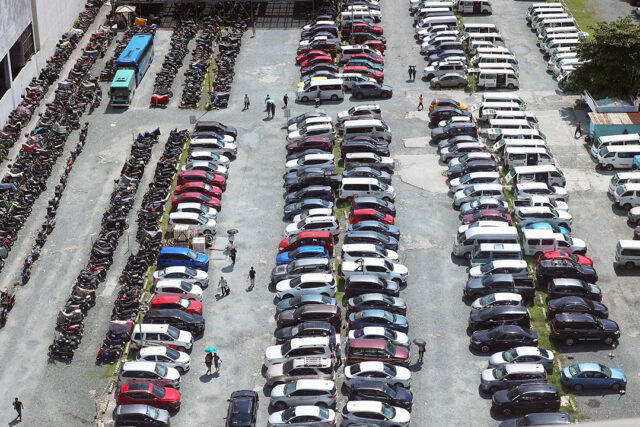
A FULL PARKING LOT is seen near a mall in Mandaluyong City. — PHILIPPINE STAR/MIGUEL DE GUZMAN

By Justine Irish D. Tabile, Reporter

NEW VEHICLE SALES inched up by an annual 3.6% in June as a double-digit surge in commercial vehicle sales helped offset a 35% decline in sales of passenger cars, an industry report showed.

A joint report by the Chamber of Automotive Manufacturers of the Philippines, Inc. (CAMPI) and the Truck Manufacturers Association (TMA) showed new vehicle sales increased to 40,483 units in June from 39,088 units in the same month a year ago.

Auto Sales (June 2025)Month on month, car sales went up by 1.8% from 39,775 units sold in May.

In June, passenger car sales slumped by 34.9% to 6,922 from 10,628 units sold in the same month in 2024. Month on month, sales went down by 12.32% from 7,895 units sold in May.

“While passenger car sales reached 6,922 units, ongoing market shifts and evolving buyer preferences present opportunities for innovation and recovery in this segment,” said CAMPI President Rommel R. Gutierrez in a statement on Monday.

Meanwhile, sales of commercial vehicles, which accounted for 82.9% of June sales, jumped by 17.9% to 33,561 from 28,460 units a year ago. Month on month, sales increased by 5.3% from 31,880 units in May.

Broken down, light commercial vehicle sales increased by 25.3% year on year to 25,501 units in June, while sales of Asian utility vehicles inched up by 0.3% to 7,199.

Sales of light-duty trucks and buses went up by an annual 6.4% to 532 units, while sales of large trucks surged by 41.5% to 58. Medium truck sales dropped by 30% to 271 units in June.   

For the January-to-June period, new vehicle sales increased by 2% to 230,912 units from 226,279 units a year ago.

Passenger car sales declined by 23.8% to 45,647 in the first six months from 59,875 in the same period last year.

Commercial vehicle sales grew by 11.3% to 185,265 units in the first half from 166,404 a year ago.

“As the industry heads into the second half of the year, manufacturers and dealers remain focused on enhancing customer experience, introducing updated vehicle lineups, and supporting market recovery across all segments — including passenger cars,” Mr. Gutierrez said.

Philippine Institute for Development Studies Senior Research Fellow John Paolo R. Rivera said that the decline in passenger sales reflects consumers’ concern over elevated interest rates, high pump prices and overall economic uncertainty.

“High interest rates, elevated fuel and maintenance costs, and economic uncertainty are likely dampening demand for big-ticket purchases like cars,” he said in a Viber message.

“At the same time, we may be seeing a structural shift in mobility preferences as more Filipinos are relying on shared, digital, or more affordable transport options instead of buying new vehicles,” he added.

Meanwhile, Rizal Commercial Banking Corp. Chief Economist Michael L. Ricafort said that there could be some demand shift from passenger cars to motorcycles amid global economic uncertainties due to Mr. Trump’s tariffs.

“(Motorcycles) are more affordable to acquire and maintain with much lower costs, can better navigate through heavy traffic, and require less space in parking areas at residences as well as in commercial areas,” he said in a Viber message.

“[There is] also increased demand for motorcycle taxis and delivery services as an alternative to passenger cars and commercial vehicles,” he added.

Meanwhile, Mr. Ricafort said that electrified vehicles (EVs), including hybrids, are new sources of demand for the industry.

More EV players coming into the country means consumers have more choices in terms of price, technology and quality, he added.

“It becomes more responsive to customers ever-changing requirements… with better terms and prices,” he added.

In June, the industry booked 3,057 EV sales, down by 15.4% from the 3,613 units sold in May, as sales of battery EVs fell by 17.5% to 660 and hybrid EVs dropped by 15.7% to 2,355 units. Plug-in hybrid EVs posted a 110% increase month on month to 42 units in June.

For the first six months, EV sales stood at 13,490 units, accounting for a 5.84% market share.

Toyota Motor Philippines Corp. remained the market leader, with sales of 111,276 units in the January-to-June period, up 6.6% from 104,350 units a year ago. It accounted for a 48.19% share of the market.

Mitsubishi Motors Philippines Corp. ranked second with a market share of 19.06% after posting a 3.3% annual increase in sales to 44,021 units in the first six months.

In third spot was Nissan Philippines, Inc., whose sales dropped 14.9% to 11,859. It had a market share of 5.14%.

Rounding out the top five were Ford Motor Co. Phils., Inc., which saw a 24.3% drop in sales to 10,953, and Suzuki Phils., Inc., which saw an 11.2% increase in sales to 10,732 units.

For this year, CAMPI has set a sales target of 500,000 units. Last year, the industry sold 467,252 units.

MUFG sees room for further policy easing

A customer buys fresh produce at the public market in Marikina. — PHILIPPINE STAR/ WALTER BOLLOZOS

THE BANGKO SENTRAL ng Pilipinas (BSP) could further lower interest rates this year to bolster economic growth amid benign inflation and global trade uncertainties, MUFG Global Markets Research said.

“Growing trade headwinds will keep many regional central banks in a policy easing cycle to support growth, amid contained inflation,” it said in a recent report.

“We expect BSP to cut the policy rate by another 50 bps (basis points) in the rest of this year, given rapidly moderating inflation.”

If realized, this would bring the benchmark rate to 4.75% by end-2025, the lowest in nearly three years.

The central bank has lowered borrowing costs by a total of 125 bps since it began its rate-cutting cycle in August last year.

The Monetary Board’s next policy review is set for Aug. 28.

MUFG also noted the latest signals from BSP Governor Eli M. Remolona, Jr., who had said there is room for two more rate cuts this year due to manageable inflation.

MUFG expects headline inflation to average 1.8% this year, slightly higher than the central bank’s projection of 1.6%.

Headline inflation picked up to 1.4% in June from 1.3% in May but slowed from 3.7% a year ago. This brought the six-month average inflation to 1.8%.

However, MUFG warned that the BSP “could be constrained in an oil price shock scenario.”

In a separate report, MUFG said it expects a “dovish bias” from the BSP due to “risks tilted slightly to more cuts” amid the tariffs.

The tariff rate was a downside surprise for MUFG’s foreign exchange and macroeconomic forecasts, MUFG said, as it expected the Philippines to strike a better trade deal with the US.

“We were implicitly expecting a trade deal between the US and the Philippines with a small bilateral trade deficit between the two countries,” it said.

The US set a 19% tariff on Philippine goods, following a meeting between US President Donald J. Trump and President Ferdinand R. Marcos, Jr. last week. This will take effect on Aug. 1.

“Over the medium term, with tariff rates closer to 20%, the marginal incentive to shift some manufacturing to the Philippines also becomes less compelling, even as we highlight that we were not assuming a substantial manufacturing shift for the Philippines as our base case to begin with.”

“In other words, relatives matter, but so do the opportunity costs for the Philippines,” it added.

The US is a top export destination for Philippine goods, accounting for around 16% of total exports in the five-month period, primarily semiconductors and electronic products.

“We also note that the US is quite an important export market for the Philippines in many sectors including leather, furniture, toys and sports equipment, and textiles, but conversely, the Philippines is not a dominant supplier for the US across different product categories.”

“Put differently, if tariff rates were to rise meaningfully higher relative to other countries, the incentive for US importers to substitute across countries from the Philippines may start to weigh on exports.”

Meanwhile, MUFG expects the peso to settle at P56 against the dollar in the third quarter and P55.5 in the fourth quarter.

“Beyond tariffs, the positive factors we highlighted previously including rising foreign direct investment approvals, manageable inflation and domestic rice prices, coupled with forecast of further US dollar weakness are still supportive of the Philippines peso.” — Luisa Maria Jacinta C. Jocson