Home Blog Page 8491

CDC chief warns it’s too soon to lift COVID-19 mask mandates

NEW YORK — The head of the US Centers for Disease Control (CDC) and Prevention said on Sunday it is “absolutely” too soon to lift mask mandates, citing daily coronavirus disease 2019 (COVID-19) case numbers that despite recent declines remain more than double the levels seen last summer.

Dr. Rochelle Walensky’s warning that face-covering requirements are still critical came just days after governors in Iowa and Montana lifted long-standing mask mandates in their states.

Appearing on NBC’s Meet the Press, Ms. Walensky said preventing further surges of infection is key to safely reopening schools and regaining some level of social normalcy until collective COVID-19 immunity can be achieved through mass vaccinations.

Whether Americans can look forward to walking down the street without wearing a mask by the end of the year “very much depends on how we behave right now,” she said. Asked if it was still too early for states to eliminate rules requiring the use of face masks in public, Ms. Walensky replied, “Absolutely.”

While COVID-19 infection rates and hospitalizations appear to be waning, the United States has a long way to go before it can safely return to a mask-less normal, she said.

“The cases are more than two-and-a-half-fold times what we saw over the summer,” said Ms. Walensky, who was sworn in as CDC director last month after President Joseph R. Biden took office. “It’s encouraging to see these trends coming down but they’re coming down from an extraordinarily high place.”

Health experts say population-wide mask wearing is one of the most effective ways of pushing COVID-19 transmission down to controllable levels.

Continued adherence to social distancing and face coverings remains especially urgent given the risks posed by new coronavirus variants found to be more transmissible, and possibly more resistant to antibodies, than the original strain.

COVID-19’s grip on the United States remained strong on Sunday, with 27.6 million cases confirmed and more than 484,600 lives lost to the highly contagious respiratory virus to date, according to a Reuters tally.

The US inoculation campaign has gained considerable momentum since a sluggish start in December, with 52.9 million total vaccines administered so far, according to the CDC.

As the United States continues wrestling to ramp up vaccine supplies and distribution, an unusually broad swath of wintry weather in recent days caused the latest setback, forcing mass vaccination centers from Texas to Virginia to suspend operations. —  Reuters

‘Overjoyed’ Harry and Meghan expecting second child

Britain’s Prince Harry and his wife Meghan, the Duke and Duchess of Sussex, are expecting their second child, a spokesperson for the couple said on Sunday. — PHOTO BY MISAN HARRIMAN VIA INTSAGRAM

LONDON — Britain’s Prince Harry and his wife Meghan, the Duke and Duchess of Sussex, are expecting their second child, a spokesperson for the couple said on Sunday.

Harry, 36, and Meghan, 39, stepped back from royal duties in January 2020 and moved with their first son Archie to Southern California to live a more independent life and escape the British media.

“We can confirm that Archie is going to be a big brother. The Duke and Duchess of Sussex are overjoyed to be expecting their second child,” the spokesperson said.

Archie was born in May 2019.

The Valentine’s Day announcement was accompanied by a black and white photograph of a visibly pregnant Meghan lying on grass with one hand on her stomach and her head resting on the smiling prince’s leg. The photo was taken by longtime friend and photographer Misan Harriman.

Queen Elizabeth and her husband Prince Philip, Harry’s father Prince Charles and the whole family were “delighted” and wished the couple well, a Buckingham Palace spokesman said.

Since ending their royal duties, Harry and Meghan have continued charity work and signed TV and other media deals, launching their debut podcast in December.

Last year, Meghan revealed that she had a miscarriage in July, in an extraordinarily personal disclosure coming from a high-profile British royal.

The couple married in a glittering ceremony in 2018 that captured the world’s attention but later gave up their official royal roles following disagreements with other family members and in the face of huge media attention.

Their relationship with the British press swiftly soured and the couple have launched legal cases against several newspapers.

Last week Meghan won a privacy claim against Associated Newspapers after its Mail on Sunday paper had printed extracts of a letter she wrote to her father in August 2018. —  Reuters

Pegula and Brady set up all-US quarterfinal at Australian Open

Medvedev sets up all-Russian Rublev clash in Melbourne

MELBOURNE — Jessica Pegula continued her dream run at the Australian Open on Monday with a (6-4, 3-6, 6-3) win over fifth seed Elina Svitolina to set up an all-American quarterfinal against Jennifer Brady, who beat Croatia’s Donna Vekić in straight sets.

Pegula struggled badly in the second set at Rod Laver Arena but regrouped in the decider, breaking former Wimbledon and US Open semifinalist Svitolina in the fourth game before locking down her first win over a top 10 opponent.

Matching Svitolina’s power off the baseline, Pegula rushed the net to knock her opponent off her stride and sealed the win on the first match point when the Ukrainian netted a return.

Pegula, who considered giving up tennis after being sidelined for long spells due to knee and hip injuries earlier in her career, will play her good friend Brady for a place in the semis after the 25-year-old beat Vekić (6-1, 7-5).

“Jen is an awesome person,” Pegula told a news conference. “She was texting me, ‘I’m so happy, I’m so proud. This is awesome’.

“We’ve all been pushing each other. Why not push each other into a quarterfinal, then one of us be in the semis?”

Vekić was hampered by an injury to her right leg and took a medical time out at the start of the second set after being blitzed by Brady in the opener.

She emerged with fresh strapping above and below her knee and though she managed to take the fight to Brady in the second set the Croatian was barely moving in the final two games.

With the score tied at 5-5, Vekić surrendered her serve to love, a double fault handing Brady the chance to serve for the match.

The American made no mistake, sealing victory when her opponent fluffed a forehand.

ALL-RUSSIAN CLASH
Russian Daniil Medvedev firmed as an Australian Open title contender when he brushed aside Mackenzie McDonald (6-4, 6-2, 6-3) on Monday to reach the quarter-finals for the first time and extend his winning streak to 18 matches.

Medvedev will play compatriot Andrey Rublev for a spot in his third Grand Slam semifinal after the seventh seed was gifted a place in the last eight, also for the first time, when Casper Ruud retired injured.

“At least one of us will be in semis, that’s good news,” said Rublev, who was leading (6-2, 7-6(3)) when Ruud called it quits. “Last time, he beat me in the quarterfinal of the US Open and now we meet in the quarterfinals of Australian Open, we’ll see what happens.

“I hope we can show great level and it will be a great battle.”

Fourth seed Medvedev won his first career five-set match in the third round, but there was no need for a prolonged spell in the sun on Monday as he saw off McDonald in less than 90 minutes on Margaret Court Arena.

World number 192 McDonald had some luck going to the net, but could not match the power of Medvedev’s serve or the intensity the Russian brought to bear on big points.

“I played a great match, was feeling the ball great, serving great, hit some good winners,” said the 25-year-old Medvedev. “I was feeling really good out there. That’s the most important thing.”

Rublev spent only 80 minutes on court in the clash of two former junior world number ones because of Ruud’s retirement, which came after the Norwegian lost the second set tie-break.

“I feel sorry for Casper,” said 23-year-old Rublev. “I hope he recovers real quick. I did not expect it to end this way, but this is sport.

“I’m feeling perfect,” he added. “I’m feeling physically great.”

Qualifier Aslan Karatsev could make it two Russians in the last four if he beats Grigor Dimitrov in the quarterfinals on Tuesday. — Reuters

Wesley So tops Magnus Carlsen to win Opera Euro Rapid chess title

CHESS Grandmaster Wesley So of the United States defeated world champion Magnus Carlsen to win the Opera Euro Rapid chess championship on Monday.

Mr. So, 27, who hails from Bacoor, Cavite, defeated Norwegian Carlsen, 2.5-1.5, built on a victory and three draws on the final day of their two-set, four-game finale to win the $30,000 top prize (P1.5 million).

The win marked the second time Mr. So beat Mr. Carlsen in the Meltwater Champions Chess Tour, with the first coming last Nov. 30 at the Skilling Open on the date of the Norwegian’s birthday at that.

Mr. So took every opportunity he got throughout the match to fortify his push en route to the victory.

“I’m so happy. I apologize to Magnus for ruining Valentine’s Day. It’s big. It’s totally unexpected to beat Magnus in any matches. It’s a huge honor…” said Mr. So after his victory.

In defeat, Mr. Carlsen was gracious, being quoted after as saying “Losing is OK, to Wesley. He clearly had the most convincing tournament coming up to today.”

While born in the Philippines, Mr. So has been representing the US since 2014. — Michael Angelo S. Murillo

NSAs updated on do’s and don’ts in the Olympics — Araneta

By Michael Angelo S. Murillo, Senior Reporter

AMID the uncertainties around the staging of the Olympic Games because of the coronavirus pandemic, organizers of the quadrennial sporting spectacle are making sure that proper health and safety protocols are in place, coming up with a “playbook,” which all participants need to follow.

And these “do’s and don’ts” have been relayed to the country’s national sports associations (NSAs), which have athletes who have qualified for the rescheduled Olympics in Tokyo this year and are still qualifying.

“We were actually given a playbook by the organizing committee, all of us chefs de mission. We gave the NSAs a playbook as well for those who have qualified and those still trying to qualify to make sure that they can compete safely and help protect the Games from any untoward incidents related to the coronavirus,” said Philippine chef de mission to the Olympics Mariano Araneta on The Chasedown program last Saturday.

“All the protocols must be followed. They (organizers) are very strict about it,” added Mr. Araneta, also president of the Philippine Football Federation.

He shared that among those covered in the playbook concerns designated transportation during the Games and taking public transportation is not allowed; shopping and sightseeing are greatly discouraged; and need for social distancing and proper hygiene, among others.

Currently, the Philippines has four athletes who have qualified from three NSAs, namely: pole-vaulter EJ Obiena, gymnast Caloy Yulo, and boxers Eumir Felix Marcial and Irish Magno.

Mr. Araneta, however, said that number could still rise with a number of athletes on the verge of qualifying.

He cited Hidilyn Diaz (weightlifting), Margielyn Didal (skateboarding), and golfers Yuka Saso and Bianca Pagdanganan as among the athletes with an inside track on Olympic qualification.

The local sports official further said organizers are not making coronavirus vaccines for athletes competing in the Games mandatory, but said he believes if athletes could get them prior, it would be better.

Mr. Araneta also reiterated that as per their briefing with organizers last week, the Olympics, set for July 23 to Aug. 8, is still a go and nothing has changed as far as the number of sports and participants.

The briefing with the different officials of participating countries was attended by International Olympic Committee president Thomas Bach.

Alvarez says ONE’s The Apprentice edition experience to remember

ONE of 16 contestants chosen to compete on The Apprentice: ONE Championship Edition, Filipino Lara Alvarez said the experience was to remember and has taught her a lot.

Born and raised in Baguio City, single parent Alvarez said the show thrusts her to a world different from what she was used to, but only served to strengthen her as she moves on in life.

“Participating on the show was incredible. The production was topnotch and it was nothing like I had ever experienced before. Getting to visit Singapore and see the way locals live, see the beauty of the country, it gave me a deeper sense of pride for my own country. It gave me hope, not just for my own life, but for everyone else as well with all the difficulties we’re dealing with today. I definitely learned a lot from my time in the boardroom,” said Ms. Alvarez in a statement.

Ms. Alvarez is no stranger to adversity, having worked for long hours even as a child on her father’s farm, where she harvested crops and sold them at the local market.

She works as an accountant and trains martial arts with Baguio’s own Team Lakay and she is looking to take things higher by winning it all in the reality TV show and be an apprentice to ONE Chairman and CEO Chatri Sityodtong.

Also a motivation for Ms. Alvarez is providing a better life for her son, whom she had when she was 22 years old.

She admitted she had reservations in joining at first, but eventually decided to give it a go.

“I just wanted to give my son a better life, that’s what compelled me to try and audition for The Apprentice. At the time, I didn’t really imagine I could get in. But I was determined to give it a shot. So when I got the news that I was accepted, I was in shock. I just couldn’t believe it. But I was super happy I got in, and from there, I was motivated to succeed,” she said.

Ms. Alvarez is one of two Filipinos representing the Philippines in the show filmed entirely in Singapore, the other being champion mixed martial arts (MMA) fighter-turned-corporate executive Louie Sangalang from Manila.

“Up to now, I still can’t believe I was on The Apprentice. I’m glad I took a chance. It’s made me a stronger person, and a better mother today. I’ve gained more confidence in myself. I think I’ve proven that being a single mother is not a setback. It is far from a setback. It’s a blessing because I was able to push myself harder. It gave me the strength to push past my limits,” said Ms. Alvarez while also expressing hope that viewers can learn things from her journey.

The Apprentice: ONE Championship Edition has 16 people competing for a US$250,000 job offer to work directly under Mr. Sityodtong for a year as his protege in Singapore.

The participants are asked to solve business problems in real time, but a twist — in the form of physical challenges with MMA stars — is also involved.

To make the challenges well-rounded for the participants, it has invited executives from top companies to join the show.

It is set for airing in Asia beginning March 18 over AXN. It will have 13 episodes and will also be available on other platforms and TV networks across Asia, including TV5 here in the Philippines. — Michael Angelo S. Murillo

Nikola Jokić triple-double helps Denver Nuggets past LA Lakers

NIKOLA Jokić had 23 points, 16 rebounds and 10 assists, Jamal Murray scored 25, and the host Denver Nuggets beat the Los Angeles (LA) Lakers (122-105) on Sunday night.

Zeke Nnaji had 16 points, Facundo Campazzo scored 15 and Monte Morris and Paul Millsap had 10 each for the Nuggets.

LeBron James had 22 points, 10 rebounds and nine assists for Los Angeles, which lost forward Anthony Davis when he aggravated a right Achilles injury.

Davis left with 2:39 left in the second quarter after he bumped legs with Jokić. He stayed in to shoot free throws, but left with tendonosis of the right Achilles. ESPN reported he will have an MRI done on Monday.

Davis, who finished with 15 points in 14 minutes, missed two games last week with an Achilles injury.

Kyle Kuzma scored 19 and Alex Caruso 11 for the Lakers, who had their seven-game winning streak snapped.

Denver played without Gary Harris (adductor), P.J. Dozier (hamstring), and Will Barton (personal), and then lost Millsap after he was hit in the thigh on a screen by Caruso late in the second quarter.

Despite the shortened rotation, the Nuggets led by 12 at halftime and increased it in the third quarter. After Marc Gasol hit a corner 3-pointer, Denver went on a 9-2 run, capped by a five-point trip. Campazzo was fouled on a 3-pointer and hit the free throw and Murray hit a technical free throw to make it 97-79.

Denver led by as many as 21 in the fourth quarter and cruised to the win.

The game was tied at 33 after the first quarter and the Lakers grabbed a 49-42 lead on a three-point play by Davis midway through the second, but the Nuggets came back strong in the final 6:19 of the half.

Campazzo and Michael Porter Jr. hit 3-pointers and Jokić made four free throws in a 15-2 run that put Denver ahead 60-53. Davis then was fouled by Jokić and after hitting two foul shots, gingerly walked to the locker room.

Denver then scored 10 straight points and took a 73-61 lead into the break.

CAVS FALL TO UNDERMANNED CLIPPERS
Lou Williams had a season-high 30 points and 10 assists, and the shorthanded Los Angeles Clippers pounded the visiting Cleveland Cavaliers (128-111) on Sunday.

Serge Ibaka added 21 points on 9-of-14 shooting with nine rebounds and six assists for the Clippers, who played without Kawhi Leonard (lower leg contusion) and Paul George (foot). George missed his fifth consecutive game.

Marcus Morris, Sr. had 23 points, hitting four 3-pointers, and six rebounds, and Patrick Beverley contributed 16 points, six rebounds and five assists. Beverley converted 5 of 8 shots, including 4 of 6 3-pointers. Luke Kennard chipped in 12 points. — Reuters

Former national boxer Dargantes, 24 

The Association of Boxing Alliances in the Philippines (ABAP) announced Monday that one of its former national athletes passed away Saturday evening in Baguio City. 

Alexcel Dargantes, 24, was a member of the ABAP women’s team from 2013-2017. 

She was from General Santos City but had stayed on in Baguio, where the Boxing Training Center was, until her untimely demise. 

ABAP president Ricky Vargas expressed sorrow at Dargantes’ passing and assured that the national association would take care of the arrangements and expenses of bringing the remains back to her hometown in Mindanao. 

ABAP secretary-general Ed Picson also coordinated with Philippine Sports Commission executive Marc Velasco who assured that the PSC would also provide financial assistance for the former national athlete’s funeral arrangements. 

Educational tech platform helps upskill jobless Filipinos 

Course Belt, an online learning platform that offers courses and resources, helps unemployed Filipinos and freelancers acquire skills relevant to the job market. 

Born at the beginning of the community quarantine and patterned after Udemy, an American online course provider, the platform has thus far attracted 21,000 students. A majority of the learners are between the ages of 20 to 40 years old, according to the company, and reflects the Filipino workforce’s demand to upskill for jobs in the digital space.

Course Belt founder Paolo R. Isyasa started as a one-man team with a one-page website offering a single course. The founder realized the potential of e-learning when the website got 1,000 paying students after a month of pre-selling. 

“When I launched Course Belt, I only spent P1,000,” he said. “I used it to buy the domain name and run paid ads. I then used all the revenues I got at the beginning to reinvest on the business and allot more budget on marketing to scale the business faster.”

CIIT College of Arts and Technology, a multimedia arts school, has since invested and contributed to Course Belt’s initial fund of P2 million for setting up the business.

“Eight months ago, I was severely burdened to see some of my friends lose their jobs because of the pandemic. So I asked myself, how can I help? That’s how Course Belt was born,” Mr.  Isyasa. “It’s a platform for learning new skills at one’s own pace. Filipinos have the guts and skills. We just need to empower them.” 

The learning platform has self-paced courses in copywriting, digital marketing, web development, SEO (search engine optimization) writing, Facebook Ads, graphic design, and social media management, among others. The price of each ranges from P199 to P499.

“Two of our most popular courses are the WordPress and marketing course, which teaches students to develop websites with a marketing touch, and the social media management course, which enables them to manage social media for personal brands or businesses,” Mr. Isyasa said.

“We currently don’t have partnerships with other businesses yet since most of the students who complete our courses apply to foreign companies,” he added, “so from our end, we make sure they have the skills foreign employers need in their businesses.”

According to the International Labor Organization, the economic recession due to the pandemic has led to 81 million jobs lost in the Asia Pacific region. Meanwhile, the Asian Development Bank  estimated that at least 2.1 million Filipino workers may have lost their jobs in 2020 due to the pandemic. — Patricia B. Mirasol

Millennials’ great potential in the C-suite and the work force

Next-gen executives discuss leadership lessons on last leg of BusinessWorld Insights Leadership Series

By Adrian Paul B. Conoza, Special Features writer

Millennials, defined by Pew Research as anyone born between 1981 and 1996, are starting to take over executive roles once held by previous generations. In their entry into the C-suite, millennials are bringing fresh perspectives and ideas into their organizations. Yet, there is still much room for them to learn from senior individuals as well as from their day-to-day experiences in directing their companies.

The third and last session of the BusinessWorld Insights Leadership Series, held last February 3, shone the spotlight on some of the millennial leaders among the business community. Each shared their experiences as executives in their companies, particularly the skills and realizations they learned along the way.

Building a level-playing field

As he moved around different roles, Brian Gregory T. Liu, chief financial officer of Cirtek Holdings Philippines Corp., learned the significant role relationships play. “Moving around different levels allowed me to build goodwill amongst team members, and this actually eased in the transition to the position in which I’m serving at the moment,” Mr. Liu said.

He believes that while managerial roles often entail tension between employees in the workplace, millennials have the skills to mitigate such tension since they are naturally people persons and team players.

Building relationships is considered by Mr. Liu as a fitting way to deal with the pressures of working with senior team players, which he metaphorically called ‘barrier to entry’. “There’s always going to be a barrier to entry, but there’s always a way to solve that,” he said.

The CFO considers himself as an “enabler that allows individuals to let their lights shine through a level playing field.” He finds it important to allow his employees to contribute and have their voices heard.

“You need to create a less biased playing field by acting as the enabler and improving human resource management to identify [individuals’ strengths] in order not to ostracize [them],” Mr. Liu said.

He also shared that open communication must be maintained in the workplace — letting employees, regardless of position, to express their thoughts — as this can ease the anxieties arising from office politics.

“Open communication and a new culture of reduced politics are what we need to improve mental health in the workplace,” Mr. Liu stressed.

For Mr. Liu, a generalization about millennials that should be debunked is that they are supposedly lazy, noting that the freedom they enjoy and cherish enables them to become creative.

“Creativity is how millennials exhibit their productivity and their results, and that’s why they need their freedom,” he said.

Attitude, consistency, and patience

George Royeca, chief transport advocate at Angkas, pointed out that millennials — growing up appreciating issues such as climate change and equality — are distinct for bringing a ‘mindset of solving problems’.
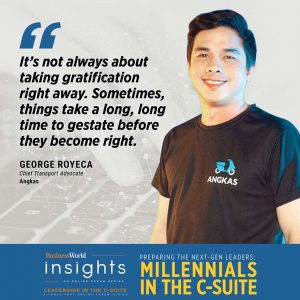
“Millennials care too much,” Mr. Royeca said, “but that is one of the major strengths of millennials… They want to put a lot of passion and energy into making things right.”

“The future generation is lucky to have this generation take on the world’s biggest problems, and I think they have the recipe to solve them,” he later added.

This is the kind of community that built the ride-hailing service, Mr. Royeca observed.

“Without millennials, Angkas would not have gotten off the ground,” he said. “Millennials have found a way to cut through different markets and develop the whole Angkas community.”

Describing himself as results-oriented, Mr. Royeca finds consistency and attitude as important traits leaders and team players should have.

“Attendance doesn’t matter to me so much as long as you are in the critical meetings and you know your KPIs (key performance indicators) and you deliver time and time again,” he said.

“You can be the smartest person in the room. But if your attitude sucks and you are arrogant as hell, then you’ll never be going to be a team player and move the company forward,” he added.

Moreover, Mr. Royeca finds it crucial for millennials to learn from past generations about patience. “It’s not always about taking gratification right away. Sometimes, things take a long, long time to gestate before they become right,” he said.

For the Angkas chief, patience, resilience, and grit are good arsenals to include in someone’s ‘war chest’ to move forward very successfully.

Mr. Royeca also shared that while it matters to understand seniors and listen to them, millennial leaders should also be firm enough to make their stand so that they will be taken more seriously.

“You need to be able to appeal to both sides, and you can only do so if you’re nimble enough to shift approaches,” he said.

Embracing both modernity and tradition

Marvin Tiu Lim, chief growth and development officer at Mega Global Corp., shared that given the tools, resources, and cards that millennials have been dealt with, they can achieve things that they can’t even imagine for now.

“Hopefully, we can use our youthfulness to our advantage, to make an impact in the world,” Mr. Tiu Lim said.

Three characteristics helped him the most as a leader: respect for elders, empathy, and integrity.  “I didn’t want to come in as a boss, so I started as van salesman. I knew how [my co-workers] felt… I knew their pain points and what was needed to be done to improve their lives,” he shared.

Mr. Tiu Lim describes his leadership style as ‘high-energy’. “I like the work to be fun. I plan company trips and cruises. I want people to enjoy their life in and out of work,” he explained.

Nonetheless, he finds that this high energy, coupled with an openness to constant change, must fuel his co-workers to become more adventurous, think out of the box, and learn from other businesses.

“It’s the ability to mix and balance both being outspoken and also being conservative at times, he added. “That nimbleness that millennials have should be put in the workplace.”

He stressed that a balance must be constantly struck between modern and traditional perspectives, “swaying left and right and making sure you find the right balance between the two”.

This can be applied, for instance, on taking points of view of senior leaders into consideration. “You have to listen [to them] because they are more patient than us… Sometimes, as millennials, our fault is we think we know everything,” Mr. Tiu-Lim said.

Advice to the millennial workplace

The panel also shared some advice to their fellow millennial leaders and team players.

Mr. Liu encourages leaders to stay creative and passionate as well as to never stop learning. “Our passion to explore the unknown and discover new things, learn new skillsets — these are what will fuel us to the future,” he said.

He also warned against obsolescence, which can be prevented by keeping an open mind and embracing disruption and innovation. “When you are transformative, you are ever-changing, immune to obsolescence,” Mr. Liu said.

Mr. Royeca, meanwhile, encourages working individuals to be entrepreneurs. “Learn from your work and apply that to your business,” he said, adding that entrepreneurs should also strive to market their ideas since nothing markets itself.

On the other hand, Mr. Tiu Lim reminded the millennial workforce to be prepared for the rapid growth of exponential technology.

“You won’t know what is coming until it is there,” he said, “But in your journey, have fun, embrace the changes, and make a positive impact.”


Bitcoin pulls back from brink of $50,000

cryptocurrency bitcoin
Once on the fringes of finance, bitcoin is fast gaining legitimacy as an asset class and has leapt 20% in the week since electric carmaker Tesla Inc. announced it had $1.5 billion in bitcoin and would accept the currency as payment. Image via Reuters

SINGAPORE — Bitcoin pulled back from a record high on Monday and other cryptocurrencies slipped, as investors took profits from a record-breaking rally that had pushed bitcoin close to $50,000.

Bitcoin fell as much as 5.6% to $45,914 in Asian trading hours after posting a record peak of $49,714.66 on Sunday, while rival crypto ethereum slid more than 8%.

Once on the fringes of finance, bitcoin is fast gaining legitimacy as an asset class and has leapt 20% in the week since electric carmaker Tesla Inc. announced it had $1.5 billion in bitcoin and would accept the currency as payment.

It is up more than 60% for the year to date and has gained more than 1,100% since hitting a one-year low last March.

“There’s this unadulterated wave of big players (buying) that has continued to push the price higher,” said Chris Weston, head of research at Melbourne brokerage Pepperstone. “We might be seeing one or two big funds just cashing out,” he said.

“The big question is: OK, you want to buy the pullback, but how big is the pullback that we are talking about?”

Besides Tesla’s investment, Bank of NY Mellon last week said it formed a new unit to help clients own and trade digital assets.

Bloomberg reported on Saturday that Morgan Stanley’s investment arm is weighing a bet on bitcoin. — Reuters

Herd immunity is the end game for the pandemic, but the AstraZeneca vaccine won’t get us there

There’s been some confusion over the efficacy of the AstraZeneca vaccine, because of a dosing mistake in one of the early trials. But what’s clear is that its efficacy with a standard, two-dose schedule is 62%.

By Zoë Hyde

In the past fortnight, two vaccine stories made headlines around the world.

Novavax announced spectacular results for its phase 3 trial, while preliminary data suggest the AstraZeneca vaccine is ineffective against the South African variant.

These two vaccines comprise the bulk of Australia’s vaccine portfolio, and the results should prompt an urgent rethink of our vaccination strategy.

Australia won’t reach herd immunity with the current plan.

AUSTRALIA’S STRATEGY
Australia has secured access to 20 million doses of the Pfizer/BioNTech vaccine, 53.8 million doses of the Oxford/AstraZeneca vaccine, and 51 million doses of the Novavax vaccine. All of these require two doses for maximum effectiveness.

The federal government plans to begin vaccinating groups at high risk with the Pfizer/BioNTech vaccine, then use the AstraZeneca vaccine for the remainder of the population.

The Novavax vaccine may be used at a later date.

But the efficacy of these vaccines is very different.

There’s been some confusion over the efficacy of the AstraZeneca vaccine, because of a dosing mistake in one of the early trials. But what’s clear is that its efficacy with a standard, two-dose schedule is 62%.

In comparison, the efficacy of Pfizer/BioNTech’s vaccine is 95%, while interim results suggest the Novavax vaccine has an efficacy of 89%.

These differences matter, because if vaccine efficacy is below a certain level, it’s not possible to achieve herd immunity.

If we don’t achieve herd immunity, Australia could be dealing with outbreaks indefinitely.

Herd immunity is the only sustainable, long-term strategy to prevent the virus from spreading throughout the community.

The proportion of the population needing to be vaccinated to achieve herd immunity depends on both how contagious a disease is, and how effective the vaccines for it are.

The contagiousness of the virus which causes coronavirus disease 2019 (COVID-19), given by its basic reproduction number (R₀), is thought to be around 2.5. That means, on average, a person with COVID-19 will infect 2.5 people. Of course, some people infect nobody, while others infect many more in super-spreading events.

We’d need to vaccinate almost everyone in Australia to achieve herd immunity with the AstraZeneca vaccine, which isn’t feasible.

Some people have medical conditions that prevent vaccination. We also won’t be able to vaccinate children for a while, because vaccines aren’t yet approved for this age group, although trials are underway.

However, we’d perhaps only need to vaccinate 63% of the population with the Pfizer/BioNTech vaccine, or 67% if we used the Novavax vaccine. This is achievable.

Using the planned combination of the Pfizer/BioNTech vaccine and the AstraZeneca vaccine will still require an unfeasibly large proportion of the population to be vaccinated, because children and teenagers make up about one-fifth of Australia’s population.

In practice, we’ll probably need to vaccinate slightly more people than these figures suggest, because vaccines likely protect against symptomatic disease better than they do against any infection. The figures for efficacy quoted above are for symptomatic disease.

But further unpublished results from the ongoing AstraZeneca trials, and data collected during the trial of the Moderna vaccine, suggest efficacy against infection may be reasonably close to that for symptomatic disease.

NEW VARIANTS THREATEN HERD IMMUNITY
New viral variants have complicated the picture. They can threaten our ability to achieve herd immunity in two ways. More transmissible variants (with a higher R₀) mean more people will need to be vaccinated.

They can also directly affect vaccine efficacy, which we’ve seen in South Africa.

Preliminary data suggest the AstraZeneca vaccine is unable to prevent mild to moderate disease caused by the South African variant, and the efficacy of the vaccine dropped to 22%.

South Africa paused the rollout of the AstraZeneca vaccine, and will use the Johnson & Johnson and Pfizer/BioNTech vaccines instead.

The South African variant has also affected the efficacy of the Novavax vaccine, which was reduced to 60%. We don’t yet know how the variant might affect the efficacy of the Pfizer/BioNTech vaccine, but some reduction is likely.

WHAT DOES THIS MEAN FOR AUSTRALIA?
Australia is in an incredibly fortunate position, with almost no community transmission. Breaches in the hotel quarantine system are now the major source of outbreaks in Australia.

An increasing proportion of cases in Australian hotel quarantine are infected with variants. At least 18 cases of the South African variant have been detected so far.

Variants of concern are becoming dominant globally. These are what our vaccination strategy must prevent. AstraZeneca’s vaccine won’t protect us against the South African variant, but high-efficacy vaccines like those made by Novavax and Pfizer/BioNTech probably still will.

If Australia rolled out the AstraZeneca vaccine, we’d be starting behind the eight ball, and we’d have to do a second rollout to protect everyone against the South African variant.

But vaccination is going to be a mammoth task. To meet the government’s target of vaccinating all adults by October, Australia will need to vaccinate around 200,000 people per day.

Realistically, we’re only going to get one shot at achieving maximum population coverage, and so it’s critical that we get this right.

IS THE ASTRAZENECA VACCINE STILL USEFUL?
Australia’s Chief Medical Officer, Paul Kelly, argued the AstraZeneca vaccine is still useful because it can prevent death and severe illness 100% of the time.

In reality, that’s not a claim supported by science, because the AstraZeneca trial lacked statistical power to evaluate this endpoint. In fact, only two severe cases occurred during the trial, including one death (both of which were in the placebo group).

We’d need a much larger trial to understand how well the AstraZeneca vaccine prevents severe disease. This would provide the larger number of events needed to distinguish a significant difference between the placebo and vaccine group.

However, we can expect COVID-19 vaccines to be better at preventing serious outcomes than mild ones, and so the AstraZeneca vaccine might still do quite well against severe disease.

But we don’t yet know what the efficacy will be, and death isn’t the only outcome to consider. Vaccines must also be able to prevent the debilitating condition known as “long COVID,” which is relatively common, even in people who initially had mild COVID-19.

The Office for National Statistics in the UK estimates that 1 in 10 people experience persistent symptoms lasting at least 12 weeks.

The AstraZeneca vaccine will still be very useful for countries battling second waves caused by the original strain of the virus. In this context, the vaccine will save lives.

It’s also very important to note that no safety concerns have been identified with the AstraZeneca vaccine.

AUSTRALIA SHOULD GO FOR HERD IMMUNITY
With no widespread community transmission, Australia can afford to prioritize a long-term herd immunity strategy, rather than focusing on a short-term goal of saving lives.

In addition to expected overseas supplies of the Pfizer/BioNTech vaccine, Australia has the capacity to manufacture the high-efficacy Novavax vaccine domestically.

Unlike the Pfizer/BioNTech vaccine, the Novavax vaccine can be kept in a refrigerator, making it ideal for use in urban, rural, and remote Australia.

Australia must not squander this opportunity by proceeding with the rollout of a vaccine that’s already been proven ineffective against one of the world’s most concerning variants. Rather, we must use high-efficacy vaccines to build herd immunity, and secure Australia’s long-term future. — The Conversation


Zoë Hyde is an epidemiologist at the University of Western Australia.


This article is republished from The Conversation under a Creative Commons license. Read the original article.

ADVERTISEMENT
ADVERTISEMENT