Home Blog Page 844

Trio win Nobel prize for revealing quantum physics in action

WWW.NOBELPRIZE.ORG

STOCKHOLM – US-based scientists John Clarke, Michel Devoret and John Martinis won the 2025 Nobel Prize in Physics for “experiments that revealed quantum physics in action”, paving the way for the development of the next generation of digital technologies.

“My feelings are that I’m completely stunned. Of course it had never occurred to me in any way that this might be the basis of a Nobel Prize,” Clarke told the Nobel press conference by telephone on Tuesday.

“I’m speaking on my cell phone and I suspect that you are too, and one of the underlying reasons that the cell phone works is because of all this work.”

‘NEW SURPRISES’ IN CENTURY-OLD FIELD OF QUANTUM MECHANICS
Quantum mechanical behaviors are well studied at the level of the incredibly small – atoms and sub-atomic particles – but are often seen as bizarre and unintuitive compared with classical physics and its far larger scale.

The Nobel winners carried out experiments in the mid-1980s with an electronic circuit built of superconductors and demonstrated that quantum mechanics could also influence everyday objects under certain conditions.

“It is wonderful to be able to celebrate the way that century-old quantum mechanics continually offers new surprises. It is also enormously useful, as quantum mechanics is the foundation of all digital technology,” Olle Eriksson, chair of the Nobel Committee for Physics, said.

Quantum technology is already ubiquitous, with transistors in computer microchips an everyday example.

“This year’s Nobel Prize in Physics has provided opportunities for developing the next generation of quantum technology, including quantum cryptography, quantum computers, and quantum sensors,” the Royal Swedish Academy of Sciences, which awards the prize, said in a statement.

Quantum computers use principles of quantum mechanics to make complex calculations, predict outcomes and perform analysis that in some cases could take traditional computers millions of years.

The field is considered to have the potential to help solve some of humanity’s most pressing concerns, such as tackling climate change. But it also faces challenges, including improving the accuracy of its chips, and timelines for commercially viable quantum computing remain disputed.

TWO OF WINNING TRIO HAVE LINKS TO GOOGLE
British-born Clarke is a professor at the University of California, Berkeley, in the United States.

Devoret, who was born in France and was congratulated on X by French President Emmanuel Macron, is a professor at Yale University and the University of California, Santa Barbara, also in the United States, where Martinis is also a professor.

Martinis, an American, headed Google’s Quantum Artificial Intelligence Lab until 2020. At Google, Martinis was part of the research team who in 2019 said they had achieved “quantum supremacy”, in which a computer harnessing the properties of sub-atomic particles did a far better job of solving a problem than the world’s most powerful supercomputer.

Devoret, besides his professorship, is also the chief scientist of Google Quantum AI. It is the second straight year that a Nobel has been won by scientists with Google ties. The 2024 chemistry prize was awarded to Demis Hassabis and John Jumper at Google DeepMind while Geoffrey Hinton, who worked for Google for more than a decade, won for physics the same year.

PHYSICS SECOND NOBEL PRIZE AWARDED THIS WEEK
The Nobel physics prize is awarded by the Royal Swedish Academy of Sciences and includes a prize sum totalling 11 million Swedish crowns ($1.2 million) that is shared among the winners if there are several, as is often the case.

The Nobel Prizes were established through the will of Alfred Nobel, who amassed a fortune from his invention of dynamite. Since 1901, with occasional interruptions, the prizes have annually recognised achievements in science, literature, and peace. Economics was a later addition.

Physics was the first category mentioned in Nobel’s will, likely reflecting the prominence of the field during his time. Today, the Nobel Prize in Physics remains widely regarded as the most prestigious award in the discipline.

Past winners of the Nobel physics prize include some of the most influential figures in the history of science, such as Albert Einstein, Erwin Schrodinger, Max Planck and Niels Bohr, the latter three all pioneers of quantum theory.

In keeping with tradition, physics is the second Nobel to be awarded this week, after two American and one Japanese scientist won the medicine prize for breakthroughs in understanding the immune system. The chemistry prize is due next, on Wednesday.

The science, literature and economics prizes are presented to the laureates by the Swedish king at a ceremony in Stockholm on December 10, the anniversary of Alfred Nobel’s death, followed by a lavish banquet at city hall.

The peace prize, which will be announced on Friday, is awarded in a separate ceremony in Oslo. — Reuters


Marcos signs eight petroleum service contracts worth $207 million

PHILSTAR FILE PHOTO

President Ferdinand R. Marcos, Jr. has signed eight petroleum service contracts representing a potential investment commitment of about $207 million over a seven-year exploration period, the Department of Energy (DoE) said on Wednesday.

The awarded contracts cover exploration areas in the Sulu Sea, Cagayan, Cebu, Northwest Palawan, East Palawan, and Central Luzon, the DoE said in a statement.

The service contractors may now begin their respective work programs, which include geological and geophysical studies, seismic surveys, and drilling activities as applicable.

“These service contracts signify not only our determination to secure new energy sources, but also our readiness to embrace innovation and sustainability while reducing import dependence,” Energy Secretary Sharon S. Garin said.

“From conventional petroleum to native hydrogen, we are expanding the frontiers of Philippine energy exploration,” she added.– Sheldeen Joy Talavera

BIR files P7.18-B tax evasion cases tied to flood-control scandal

PHILIPPINE STAR/KRIZ JOHN ROSALES

The Bureau of Internal Revenue (BIR) on Wednesday filed tax evasion complaints worth P7.18 billion against two contractors implicated in the Philippines’ flood-control scandal.

The cases lodged before the Department of Justice cover unpaid income, excise and documentary stamp taxes of Cezarah Rowena C. Discaya and her husband Pacifico F. Discaya from 2018 to 2021. Also named was a corporate officer of St. Gerrard Construction Gen. Contractor & Development Corp., the agency said in a statement.

Internal Revenue Commissioner Romeo D. Lumagui, Jr. said the complaints stem from the couple’s failure to file income tax returns and pay excise taxes on nine luxury vehicles, as well as their nonpayment of documentary stamp taxes on the transfer of shares in four construction companies.

“Although we have already discovered P7.1 billion in tax deficiencies, today’s filings are merely the tip of the iceberg,” Mr. Lumagui said in the statement. He added that further audits of the Discaya-owned companies — St. Gerrard, St. Timothy, St. Matthew and Alpha & Omega — could uncover more liabilities.

The BIR said the spouses’ failure to pay taxes on share transfers nullified their supposed divestment from the firms. The agency cited Land Transportation Office data showing they did not pay excise taxes for vehicles under their names.

Mr. Lumagui said contractors working on government-funded projects must meet their tax obligations, warning that more cases could follow once audits are finished. — Erika Mae P. Sinaking

US air traffic control staffing hit for second day, delaying flights

STOCK PHOTO | Image from Pixabay

WASHINGTON – Air traffic control staffing issues are delaying flights for a second straight day at numerous US airports as the government shutdown reaches its seventh day, the Federal Aviation Administration said in a notice on Tuesday.

More than 3,000 flights have been delayed, according to flight tracking data, as staffing shortages have impacted a widening number of airports, including Houston, Nashville, Dallas, Chicago O’Hare and Newark.

The FAA is reducing the number of arriving flights per hour at Chicago O’Hare, citing staffing, with average delays of 41 minutes, and there are also staffing issues at Atlanta Air Route Traffic Control Center.

Arriving flights were being held for up to 30 minutes at Newark due to the staffing issues, the FAA said, while Washington Reagan might see new slowdowns due to low staffing on Tuesday.

Nashville air traffic control is facing significant staffing issues and will curtail operations later on Tuesday, the FAA said. Approach control will be taken over later by Memphis Center, it added.

Both political parties are pointing the finger at each other for the impacts. White House press secretary Karoline Leavitt said Democrats were to blame for the aviation slowdown, while California Governor Gavin Newsom, a Democrat, said President Donald Trump was responsible.

Severe weather is also impacting flights across the country.

Some 13,000 air traffic controllers and about 50,000 Transportation Security Administration officers must still turn up for work during the government shutdown, but they are not being paid. Controllers are set to receive a partial paycheck on October 14 for work performed before the shutdown.

Transportation Secretary Sean Duffy said on Monday the FAA had seen a slight increase in controllers taking sick leave and air traffic staffing has been cut by 50% in some areas since the shutdown started last week.

“If we don’t have controllers, we’re going to make sure the airspace is safe. So what we do is we’ll slow traffic,” Duffy said on Tuesday on Fox News’ “Fox and Friends.”

FlightAware, a flight tracking website, said more than 3,000 US flights had been delayed on Tuesday, including 225 at Nashville, or 20% of its flights, and more than 570 flights at Chicago O’Hare, or more than 20% of its flights.

Southwest Airlines has delayed more than 500 flights and American Airlines 400 flights, FlightAware data showed.

In 2019, during a 35-day shutdown, the number of absences by controllers and TSA officers rose as workers missed paychecks, extending checkpoint wait times at some airports. Authorities were forced to slow air traffic in New York, which put pressure on lawmakers to quickly end the standoff.

The US has faced air traffic control shortages for more than a decade, and many controllers had been working mandatory overtime and six-day weeks even before the shutdown. The FAA is about 3,500 air traffic controllers short of targeted staffing levels. — Reuters

In lieu of government data, investment firm Carlyle reports subdued US hiring

The Wall Street sign is pictured at the New York Stock exchange (NYSE) in the Manhattan borough of New York City, March 9, 2020. — REUTERS/CARLO ALLEGRI/FILE PHOTO

NEW YORK – Carlyle Group released its own measure of US economic data on Tuesday, including a sharply lower estimate for September jobs growth despite rising economic output, to a market left wanting official releases because of the government shutdown.

The global investment firm estimated that US employers added just 17,000 jobs last month, far below the 54,000 expected in the nonfarm payrolls report, which had been scheduled for release last week.

The firm’s internal indicators showed GDP growth running at a 2.7% annualized pace in September, a 3.8% drop in energy prices, and a 3.3% increase in prices for services, excluding shelter.

‘DISCONNECT’ BETWEEN EMPLOYMENT, ECONOMY
“If you look solely at implied payroll employment growth, you’d think this was an economy on the cusp of recession or that has already fallen into recession,” Jason Thomas, head of global research and investment strategy at Carlyle, told Reuters.

“We have seen a big rebound in household consumption and ongoing business spending fueled by the AI boom. It’s a really interesting time to see the disconnect between employment and broader measures of economic health.”

With official statistics delayed, investors are increasingly turning to alternative sources for real-time insights, and data-rich firms are positioning themselves as stopgap providers of economic intelligence.

The US government shutdown has entered its seventh day and is showing little sign of resolution.

Private data providers are seeing a sharp uptick in demand. Research website Bigdata.com saw a 175% surge in usage after the shutdown, its founder, Armando Gonzalez, said in an interview.

“When the official data channels go dark, investors are going to continue going for alternatives,” Gonzalez said.

Carlyle drew the data from its portfolio of 277 companies, which employ just under 730,000 people, and 694 real estate investments.

Thomas said the boom in spending on artificial intelligence was also out of step with the rest of the economy.

“All the oxygen is being sucked by AI,” Thomas said, pointing to booming demand for X-rays and other key semiconductor components. This growth is “uncorrelated,” he added. “It reflects the secular technological shock.”

Other private data released in recent days also point to weak hiring. Job search firm Challenger, Gray & Christmas said last week planned hiring in September hit its lowest since 2009, when the industry was reeling from the financial crisis. — Reuters

Philippines’ August jobless rate declines

By Chloe Mari A. Hufana, Reporter

The Philippines’ unemployment rate fell to 3.9% in August, reflecting stronger hiring momentum as the labor market recovered from midyear slack.

The number of jobless Filipinos fell to 2.03 million from 2.59 million in July and 2.07 million a year earlier, the Philippine Statistics Authority said on Wednesday.

The employment rate improved to 96.1% from 94.7% in July, with total employed persons rising to 50.1 million. The jobless rate was 4% a year earlier and 5.3% in July.

The labor force participation rate climbed to 65.1% from 60.7% in July, equivalent to 52.13 million Filipinos aged 15 and older either working or seeking work.

On average, employees worked 41 hours a week, up from 40.7 hours in August last year.

The service sector remained the country’s biggest employer, accounting for 61.5% of total jobs, followed by agriculture at 20.4% and industry at 18.1%. Wholesale and retail trade, agriculture and forestry, and construction were the top employing subsectors.

Underemployment eased to 10.7% from 14.8% in July, with 5.38 million workers saying they wanted more hours or an additional job. Of the underemployed workers in August, 62.4% worked less than 40 hours a week, while 37.6% worked 40 hours or more a week.

Youth employment also improved, with the employment rate among those aged 15 to 24 rising to 88.3% from 81.9% in July, the local statistics agency said

Puregold CinePanalo 2026 short-lists 33 out of 203 full-length entries

The Puregold CinePanalo Film Festival has announced the 33 short-listed full-length films from 203 entries submitted by emerging, established, and even iconic local filmmakers.

Of the 33 films entering the next stage of selection, only seven will receive the record-breaking P5-million production grant that stands as the biggest, to date, in Philippine film festival history.

“This has been the most competitive year of the Puregold CinePanalo yet as we drew a wide variety of both up-and-coming and veteran directors,” said Ivy Hayagan-Piedad, Puregold senior marketing manager and festival chair. “With the removal of genre and narrative restrictions, we received the boldest and most creative pool of applications. We appreciated seeing the complexity and fearlessness of more unconventional stories that still rang true with genuine, lived experiences.”

For Ms. Hayagan-Piedad, the overwhelming number of applicants shows how the Puregold CinePanalo has become an institution in the local filmmaking industry. “We received 203 applications this year, nearly double the 125 entries submitted in our inaugural year. We are immensely grateful for the support of the local community of filmmakers, producers, and students that have entrusted their dream projects to us and helped us grow in credibility year on year.”

The Top 33 films in the full-length category are as follows:

The filmmakers behind the Top 33 will go on to submit pitch decks to the festival’s selection committee. From there, a short list of 15 filmmakers will pitch directly to festival officials for the chance to be part of the final festival lineup of seven.

The final lineup of films will screen at the 2026 Puregold CinePanalo Film Festival at the Gateway Cineplex 18 on Aug. 7 to 18, 2026. These will join the ranks of internationally acclaimed films that have premiered at the Puregold CinePanalo such as Kurt Soberano’s Under a Piaya Moon, Sigrid Bernardo’s Pushcart Tales, and TM Malones’ Salum.

Meanwhile, submissions for the festival’s student shorts category are ongoing. Participants must turn in their applications at https://tinyurl.com/PCPFFShorts before 11:59 p.m. on Nov. 25, 2025.

For further inquiries, applicants may email thesecretariat@cinepanalo.com or message its official Facebook page @puregoldcinepanalo.


Spotlight is BusinessWorld’s sponsored section that allows advertisers to amplify their brand and connect with BusinessWorld’s audience by publishing their stories on the BusinessWorld Web site. For more information, send an email to online@bworldonline.com.

Join us on Viber at https://bit.ly/3hv6bLA to get more updates and subscribe to BusinessWorld’s titles and get exclusive content through www.bworld-x.com.

Hamas says on war anniversary it’s ready to reach a Gaza deal, but conditions remain

REUTERS

SHARM EL-SHEIKH, Egypt – Hamas said on Tuesday it was ready to reach a deal to end the war in Gaza based on President Donald Trump’s plan but still has demands, as Qatar’s prime minister and senior US mediators headed to Egypt to join indirect negotiations between the Palestinian militant group and Israel.

On the second anniversary of Hamas’ attack on Israel that triggered the Gaza war, Trump expressed optimism about progress toward a Gaza deal. A US team including special envoy Steve Witkoff and Jared Kushner, Trump’s son-in-law and his Middle East envoy during his first term, left for the talks.

“I think there’s a possibility that we could have peace in the Middle East” beyond just Gaza, the US president told reporters in the Oval Office.

A source close to the talks said they had adjourned for the day and the atmosphere had been better than on Monday. Negotiations on Wednesday would be a decisive indicator of whether progress was possible given the presence of the senior mediators, the source said.

Prime Minister Sheikh Mohammed bin Abdulrahman al-Thani of Qatar, which has been one of the key mediators, will join the talks on Wednesday, an official told Reuters, “with the aim of pushing forward the Gaza ceasefire plan and hostage release agreement”.

On the second day of talks in the Egyptian resort of Sharm el-Sheikh, top Hamas leader Khalil Al-Hayya told Egyptian state-affiliated Al Qahera News TV the group had come “to engage in serious and responsible negotiations.”

He said Hamas was ready to reach a deal, yet it needed a “guarantee” to end the war and ensure “it is not repeated”.

According to Gaza authorities, some 67,000 people have been killed and Gaza devastated since the October 7, 2023 attack by Palestinian militants on Israel. Israel says 1,200 people were killed and 251 were taken back to Gaza as hostages on that day.

The talks appeared to hold the most promise yet of ending the war. But officials on all sides urged caution over the prospects for a rapid agreement, as Israelis remembered the bloodiest single day for Jews since the Holocaust and Gazans voiced hope for an end to the suffering brought by the war.

Even if a deal is clinched, questions will linger over who will govern Gaza and rebuild it, and who will finance the huge cost of reconstruction. Trump and Israeli Prime Minister Benjamin Netanyahu have ruled out any role for Hamas.

HAMAS SETS OUT CONDITIONS
Trump met Witkoff and Kushner, who will join the talks on Wednesday, for an update on the negotiations before they departed for Egypt, a senior US official said. They discussed issues such as ensuring the safety of the hostages and security guarantees, the official added.

“The (Hamas) movement’s delegation participating in the current negotiations in Egypt is working to overcome all obstacles to reaching an agreement that meets the aspirations of our people in Gaza,” senior Hamas official Fawzi Barhoum said in a televised statement.
He said a deal must ensure an end to the war and a full Israeli withdrawal from the Gaza Strip – conditions that Israel has never accepted. Israel, for its part, wants Hamas to disarm, something the group rejects.

Hamas wants a permanent, comprehensive ceasefire, a complete pullout of Israeli forces and the immediate start of a comprehensive reconstruction process under the supervision of a Palestinian “national technocratic body”, he said.

Underlining the obstacles at talks, an umbrella of Palestinian factions including Hamas issued a statement vowing a “resistance stance by all means” and saying “no one has the right to cede the weapons of the Palestinian people”.

Netanyahu did not immediately comment on the status of the talks. But in a statement on X, he told Israelis they were in “fateful days of decision.”

“We will continue to act to achieve all the war’s objectives: the return of all the hostages, the elimination of Hamas’s rule, and the assurance that Gaza will no longer pose a threat to Israel,” he said.

US officials have suggested they want to initially focus talks on a halt to the fighting and the logistics of how the hostages and Palestinian prisoners in Israel would be freed.
In the absence of a ceasefire, Israel has pressed on with its offensive in Gaza, which has increased its international isolation.

Opponents of Israel’s actions in Gaza held protests in Sydney, Australia and a handful of European cities on the anniversary of Hamas’ attack, despite denunciations by some politicians who said such marches risked glorifying violence.

HOPES OF A BREAKTHROUGH BY CIVILIANS ON BOTH SIDES
On the anniversary, some Israelis visited the places that were hit hardest that day.

Orit Baron stood at the site of the Nova music festival in southern Israel beside a photo of her daughter Yuval, who was killed with her fiance Moshe Shuva. They were among 364 people who were shot, bludgeoned or burned to death there.

“They were supposed to get married on February 14th, Valentine’s Day,” said Baron. “They are buried next to each other because they were never separated.”

Israelis are hoping the talks will soon lead to the release of the 48 hostages still held in Gaza, 20 of whom are believed to still be alive.

“It’s like an open wound, the hostages, I can’t believe it’s been two years and they are still not home,” said Hilda Weisthal, 43.

In Gaza, 49-year-old Palestinian Mohammed Dib hoped for the end of a conflict that has caused a humanitarian disaster and displaced many Palestinians multiple times.

“It’s been two years that we are living in fear, horror, displacement and destruction,” he said.– Reuters

Philippine inflation quickens to 6-month high in September

Vegetable prices spiked in September as typhoons and floods affected several provinces. — PHILIPPINE STAR/EDD GUMBAN

By Katherine K. Chan

HEADLINE INFLATION accelerated to a six-month high in September, mainly due to costlier fuel and vegetables, but remained below the central bank’s 2-4% target, the Philippine Statistics Authority (PSA) said on Tuesday.

Preliminary data from the PSA showed the consumer price index  quickened to 1.7% in September from 1.5% in August, but eased from 1.9% in September 2024.

This was the fastest inflation rate since 1.8% in March.

Inflation Rates in the Philippines

It was also within the Bangko Sentral ng Pilipinas’ (BSP) 1.5-2.3% forecast for the month, but below the 1.9% median estimate in a BusinessWorld poll last week.

September also marked the seventh straight month that inflation settled below the BSP’s 2-4% target.

In the nine months to September, inflation averaged 1.7%, easing from 3.4% in the same period last year.

Meanwhile, core inflation, which excludes volatile prices of food and fuel, eased to 2.6% in September from 2.7% in August. Still, it was faster than the 2.4% clip a year earlier.

Core inflation averaged 2.4% in the nine-month period, slowing from 3.1% in the same period last year.

National Statistician Claire Dennis S. Mapa said the September inflation print was “not a surprise” as recent typhoons drove vegetable prices higher.

“This September, there were no surprises because, of course, we expected the large increase to be in vegetables, but we already saw that in August; it just continued into the month of September,” Mr. Mapa said in mixed English and Filipino. “This is still the effect of the flooding and typhoons we experienced in July. There were really many typhoons then.”

According to the PSA, the transport index was the main driver of faster inflation in September, picking up to 1% from a 0.3% decline the previous month. In September, gasoline declined at a slower pace of 0.9% from 6.1% in the previous month, while diesel quickened to 5.1% from  a 0.8% fall.

The heavily weighted food and nonalcoholic beverage index rose to 1% in September, picking up from 0.9% in August.

Food inflation quickened to 0.8% in September from 0.6% the previous month, but slower than 1.4% a year ago.

This was mainly driven by a year-on-year rise in vegetables, tubers, plantains, cooking bananas and pulses at 19.4% in September from 10% in August. This was the fastest pace in vegetable inflation in nine months or since 21.1% in January.

On the other hand, corn saw a slower annual decline of 4.5% from 11.8% in August.

“What we really saw were rain and flooding, particularly in our vegetable-producing provinces,” Mr. Mapa said. “So, this had an impact in August and continued into September.”

“We see that this may continue in the coming months because we have had storms again in the past month. It is possible that our inflation rate will remain somewhat elevated,” he added.

Last month, typhoons Mirasol, Ragasa (locally known as Nando) and Bualoi (Opong), coupled with the southwest monsoon, brought heavy rains and flooding in parts of the country.

“The slight uptick in inflation underscores the sensitivity of domestic food prices to supply disruptions,” Department of Economy, Planning, and Development Secretary Arsenio M. Balisacan said in a statement. “We are working closely with various agencies to stabilize supply, keep essential goods affordable, and safeguard household welfare.”

RICE DEFLATION CONTINUES
Meanwhile, the decline in rice prices moderated in September, with the annual rate easing to -16.9% from -17% in August. September marked the ninth straight month of rice deflation.

“Rice prices generally continued to decline due to adequate supply, lower international rice prices, and government measures to stabilize prices,” the BSP said in a statement.

The average price of local regular milled rice slipped by 1.02% month on month to P37.79 per kilo in the last week of September from P38.18 per kilo, based on data from the Agriculture department.

Well-milled rice also dropped by nearly 1% to P43.10 per kilo from P43.52, while special rice rose by 0.2% to P57.10 per kilo from P56.99.

On Sept. 1, the National Government implemented a 60-day import ban on regular and well-milled rice to address falling farmgate prices of unmilled rice.

On the other hand, meat inflation slowed to 6% from 7.1% in August, while fish and other seafood prices also cooled to 7.9% from 9.5%.

Meanwhile, inflation in the National Capital Region (NCR) slowed to 2.7% in September from 2.9% in August. However, it was quicker than 1.7% in September 2024.

Outside NCR, inflation accelerated to 1.5% from 1.1% in August, but slower than the 2% clip a year ago.

Central Visayas remained the region with the highest inflation rate at 4.1%, while the Bangsamoro Autonomous Region in Muslim Mindanao saw the biggest decline in prices at -1.5%.

For the bottom 30% of income households, inflation saw a slower annual decline to -0.2% from -0.6% in August. The nine-month average stood at 0.3% from 4.6% a year ago.

OUTLOOK
Despite emerging risks to inflation, the central bank said inflation will likely average below the 2-4% target this year, mainly due to easing rice prices.

“Nonetheless, higher rice tariffs and rising global food prices could raise supply-side pressures over the policy horizon. Meanwhile, higher electricity rates could be offset by expectations of subdued global oil prices owing to a stable production outlook,” the BSP said.

The BSP sees inflation averaging 1.7% this year.

Union Bank of the Philippines Chief Economist Ruben Carlo O. Asuncion said the below-expectation inflation print could prompt the BSP to cut interest rates on Thursday.

“Growth has been especially uncertain lately and we think that the BSP would be delivering a cut to pre-empt downside risks to growth in general,” he said. “So, lower-than-expected (inflation) gives more reason for BSP to cut now and not run the risk of being behind the curve.”

However, Chinabank Research sees emerging inflation risks as a signal for the central bank to pause at its upcoming meeting.

“While overall price growth is still expected to remain low for the rest of the year, increased upside risks to the inflation outlook could prompt the BSP to adopt a more cautious stance and keep interest rates on hold at Thursday’s policy meeting,” it said in a note.

John Paolo R. Rivera, a senior research fellow at the Philippine Institute for Development Studies, said developments in rice supply and transport costs will continue to drive inflation in the coming months.

“In the coming months, inflation may continue to edge higher due to risks such as weather-related supply disruptions, holiday spending, the global oil price situation, and a weak (peso) that could raise import costs,” he said in a Viber message.

A BusinessWorld poll showed 10 of 16 analysts expect the Monetary Board to keep rates steady at 5% on Thursday.

BSP Governor Eli M. Remolona, Jr. earlier said the policy rate is now at their “Goldilocks” rate or “sweet spot” for both inflation and output. However, he said last month that they are open to cutting rates again this October if the country’s economy weakens due to slow demand.

Philippines’ dollar reserves jump to $108.8 billion at end-September

US dollar bills are seen on a light table at the Bureau of Engraving and Printing in Washington in this Nov. 14, 2014 file photo. — REUTERS

THE PHILIPPINES’ dollar reserves rose to its highest in 11 months at end-September, driven by higher global gold prices, earnings from the central bank’s investments and the National Government’s foreign currency deposits.

Preliminary data from the Bangko Sentral ng Pilipinas (BSP) showed that gross international reserves (GIR) reached $108.805 billion as of end-September, up 1.6% from $107.098 billion in August.

This was the highest GIR level in nearly a year or since the $111.084 billion seen in October 2024.

However, it was 3.5% lower than $112.707 billion in September last year.

“The Philippines’ gross international reserves rose in September 2025 due to higher global gold prices, income from Bangko Sentral ng Pilipinas’ investments, and foreign currency deposits by the National Government with the BSP,” the BSP said in a statement.

Dollar reserves are the central bank’s foreign assets held mostly as investments in foreign-issued securities, foreign exchange and monetary gold, among others.

These are supplemented by claims to the International Monetary Fund (IMF) in the form of reserve position in the fund and special drawing rights (SDRs).

BSP data showed the level of dollar reserves in the nine-month period is enough to cover about 3.6 times the country’s short-term external debt based on residual maturity.

It is also equivalent to 7.3 months’ worth of imports of goods and payments of services and primary income, well above the three-month standard.

“The latest GIR level provides a robust external liquidity buffer,” the central bank said in a statement.

Ample foreign exchange buffers protect the country from market volatility and ensure that it is capable of paying its debts in the event of an economic downturn.

The BSP’s foreign investments inched up by 0.3% to $87.243 billion as of end-September from $86.987 billion in the previous month. However, it went down by 8.4% from $95.199 billion in the same period a year ago.

Central bank data also showed that its gold holdings were valued at $16.385 billion, jumping by 12.8% from the $14.523 billion seen at end-August and by 50.9% from $10.86 billion last year.

Meanwhile, foreign exchange holdings slumped by 44.9% to $505.1 million in September from $916.1 million in August and by 75.3% from $2.042 billion a year earlier.

The Philippines’ reserve position in the IMF edged up by 0.2% to $737.7 million at end-September from $736.4 million in August. It climbed by 0.9% from $731.1 million in September 2024.

SDRs — or the amount the Philippines can tap from the IMF’s reserve currency basket — were unchanged month on month at $3.935 billion. Year on year, it was 1.5% higher than $3.875 billion.

The BSP also reported that net international reserves inched up by 1.6% to $108.8 billion as of end-September from $107.1 billion as of end-August.

Net international reserves refer to the difference between the BSP’s reserve assets (GIR) and reserve liabilities, including short-term foreign debt, and credit and loans from the IMF.

“This GIR uptrend appears to be above expectations as the end-September GIR already exceeds the BSP’s year-end target of $105 (billion),” Security Bank Corp. Chief Economist Angelo B. Taningco said in an e-mail.

However, Mr. Taningco noted that a weakening peso could pose risks to the country’s dollar reserves in the coming months.

“Potential risks on GIR in upcoming months include persistent peso depreciation pressures induced by foreign capital outflows and higher (United States) Treasury yields,” he said.

At end-September, the local currency closed at P58.196 per US dollar, falling by P1.066 from its P57.13 finish on Aug. 29.

Rizal Commercial Banking Corp. Chief Economist Michael L. Ricafort also noted a $411-million month-on-month decline in the central bank’s foreign exchange holdings amid the foreign exchange market volatility and “political noises.”

Earlier this month, the BSP revised its GIR projection for this year to $105 billion, slightly higher than its previous forecast of $104 billion. In 2026, it expects GIR to reach $106 billion. — Katherine K. Chan

World Bank keeps PHL GDP forecasts unchanged

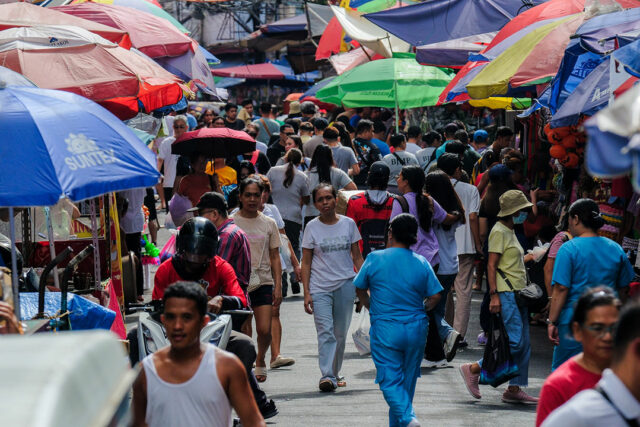
People shop for goods in Divisoria, Manila. — PHILIPPINE STAR/RYAN BALDEMOR

THE WORLD BANK maintained its Philippine gross domestic product (GDP) growth forecasts for this year and 2026, amid heightened uncertainty and slowing global growth.

In its latest East Asia and Pacific Economic Update released on Tuesday, the multilateral lender kept its growth outlook for the Philippines at 5.3% this year and 5.4% for 2026, unchanged from its projections in June.

These forecasts are below the government’s 5.5-6.5% target for this year, and 6-7% for next year.

The Philippines is expected to be the region’s fourth fastest-growing economy in the East Asia and Pacific this year, trailing Vietnam (6.6%), Mongolia (5.9%), and Palau (5.7%).

For 2026, the Philippines is projected to post the third-fastest growth after Vietnam (6.1%) and Mongolia (5.6%).

The country’s growth forecast is above the regional average, with East Asia and the Pacific expected to expand by 4.8% this year and 4.3% in 2026.

“East Asia and Pacific region growth remains relatively high, but it is slowing down,” World Bank East Asia and Pacific Chief Economist Aaditya Mattoo said in a virtual briefing on Tuesday.

“At the same time, domestic policy choices, especially the reliance in some countries on fiscal stimulus rather than structural reform, are likely to shape near and longer-term growth outcomes. Turning to the reasons why growth is slowing down, we identify three main factors — trade restrictions, increased economic policy uncertainty, and slowing global growth,” he said.

The US imposed a 19% tariff rate for Philippine-made goods starting Aug. 7.

Mr. Mattoo noted that most economies in the region now face higher tariffs, but the Philippines, Thailand and Vietnam are less affected since electronics and semiconductors are exempted from tariffs for now.

The World Bank noted that economies in the region have lowered tariffs exclusively on US imports and pledged to increase purchases of specific American goods, in response to higher tariff rates.

“In some cases, countries have engaged with other trading partners to pursue greater diversification of their trade. These actions may be costly but necessary in an uncertain trading environment,” it said.

The Philippine government has vowed to adopt a zero-tariff scheme on selected US goods, but the move could cost the government P27 billion to P30 billion in forgone revenues. However, negotiations with the US have yet to be finalized.

RISE OF DIGITAL INFORMALITY
Meanwhile, the Philippines is seeing a shift in informal work from agriculture to digital platforms like ride-hailing applications, the World Bank said. However, poor education may prevent workers from capitalizing on tech-driven jobs, it added.

“Now there is the new informality, which is informality of these new platform-based services, which are growing in Thailand and in the Philippines,” Mr. Mattoo said.

However, Mr. Mattoo said regulation and taxation of the informal sector can be reformed to ensure fewer people are marginalized from the economy.

“I think the Philippines is in a position to benefit (from emerging jobs due to technology) if it deals with the huge deficit in human capital,” he said.

“It is stunning that a country that punches above its weight in services, exports, still has feet of clay when it comes to basic education.”

Mr. Mattoo noted that companies in the Philippines are actively involved in the artificial intelligence (AI) economy but see a lack of skills in workers due to poor basic educational foundation.

“East Asia’s export-oriented labor-intensive growth lifted a billion people out of poverty in the last three decades, but the region now faces the twin challenges of trade protection and job automation,” he said.

Mr. Mattoo called for reforms in the business climate and education system to foster a “virtuous cycle between opportunity and capacity,” which would lead to stronger growth and better-quality jobs.

The World Bank also called for reforms and investments in human capital and digital infrastructure, greater competition in services, and policies to ensure a match between job opportunities and people’s skills.

It noted that rapid advances in AI, robotics, and digital platforms require greater agility from firms, workers, and policymakers.

Meanwhile, Mr. Mattoo also flagged the Philippines’ slow industrialization compared with regional peers such as Vietnam, citing the country’s continued reliance on trade tariffs.

“Trade taxes are the simplest way of limiting revenue especially in countries with low administrative capacity,” he said, as it diverting resources away from sectors where the country holds an advantage.

The Philippine government lowered the rice import tariff to 15% from 35% in July 2024 to curb inflation. Agriculture groups have since called for the restoration of the original rate, citing adverse effects on local farmers and an estimated P4.3-billion revenue loss for the government.

“I think non-discriminatory instruments like value-added taxes, better and more effective income taxes and perhaps even the more controversial wealth taxes might be the more effective way of meeting revenue needs,” Mr. Mattoo said.

Finance Secretary Ralph G. Recto has downplayed the urgency of a wealth tax, but said he would support the measure if passed by Congress. — Aubrey Rose A. Inosante

PHL manufacturing output expands in August

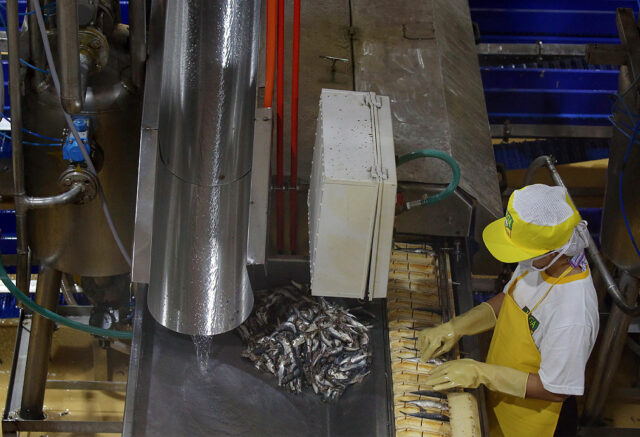
A worker is seen inside a manufacturing plant in Sto. Tomas, Batangas, March 1, 2023. — PHILIPPINE STAR/KRIZ JOHN ROSALES

By Isa Jane D. Acabal

FACTORY OUTPUT expanded in August, driven by higher production of food products, machinery and equipment, and a slower annual decline in basic metals, the Philippine Statistics Authority (PSA) reported.

Preliminary results of the PSA’s latest Monthly Integrated Survey of Selected Industries showed factory output, as measured by the volume of production index (VoPI), rose by 1.4% year on year in August. This was slightly faster than the 1.3% growth in the same month last year, and a turnaround from the 1.8% drop in July.

The August reading was the fastest growth since the 1.6% expansion in June.

In the eight months to August, factory output growth averaged 0.5%, slower than the 2.5% average in the same period last year.

On a monthly basis, August’s output picked up by 0.1%, slower than 2.6% in July. Stripping out seasonality factors, it fell by 3.2%.

According to the PSA, the faster year-on-year growth rate of VoPI for manufacturing in August was primarily driven by food products, which jumped by 20.2% from 11.4% in July.

There was also an uptick in machinery and equipment except electrical (6.7% in August from 3.1% in July), and a slower annual decline in basic metals (-9.6% from -26.8%).

Nine other divisions recorded expansions, while 10 saw declines.

The PSA also said that the top three industry divisions that contributed to the overall year-on-year growth in the VoPI were food products, transport equipment (6.5% in August from 9.5% in July), and electrical equipment (19.5% from 21.2%).

Average capacity utilization, or the extent to which industry resources are used in producing goods, averaged 77.3% in August. This was a tad higher than the revised 77.2% in July and the 75.6% posted last year.

In comparison, the Philippines in the S&P Global Manufacturing Purchasing Managers’ Index (PMI) expanded to 50.8 in August from 50.9 in July.

PMI is a leading indicator for factory activity, reflecting the volume of materials purchased in advance of manufacturing operations weeks or months down the line. A reading above 50 separates expansion from contraction.

Ruben Carlo O. Asuncion, chief economist at Union Bank of the Philippines, said the expansion in food production can be attributed to producers’ anticipation of strong holiday demand.

“Inflation was still relatively low overall, so consumer purchasing power remained intact, supporting demand for processed food,” he said in a Viber message.

Mr. Asuncion also said the immediate impact of the US tariffs on the Philippines was limited as food and machinery production is mostly domestic-focused or exempted from tariffs.

“However, exports slowed significantly, and US-bound shipments fell, signaling that the tariff’s full effect will likely hit in the fourth quarter 2025. Sectors like garments and footwear faced pressure, but they contribute less to overall manufacturing output compared with food and machinery,” he said.

US President Donald J. Trump imposed a 19% tariff on Philippine goods, which took effect on Aug. 7.

Sergio R. Ortiz-Luis, Jr., president of the Philippine Exporters Confederation, Inc., said in a phone interview that manufacturers may have ramped up production ahead of the implementation of US tariffs.

“For food products, there was frontloading for the US tariff… Double time in manufacturing food products,” he said.

Meanwhile, Mr. Asuncion said manufacturing output is expected to “grow moderately” in the remaining months of the year, driven by food demand ahead of the holidays, infrastructure-linked machinery production, and further monetary easing by the central bank.

“However, risks remain from US tariffs, global trade slowdown, weather-related disruptions, and local political risks. If BSP delivers another rate cut and fiscal spending accelerates, output could rebound toward yearend despite external and internal headwinds,” he said.