Home Blog Page 835

Clark airport, FTI sign deal to build P3.6-B food hub

FACEBOOK.COM/FTIGOVPH

THE Clark International Airport Corp. (CIAC) said it signed an agreement with state-run Food Terminal, Inc. (FTI) to develop a P3.6-billion food hub.

The project, known as the Bagsakan ng Bayan Mega Food Hub (BBM Food Hub), will rise on a 46-hectare site in Clark with FTI leasing the Clark property for 25 years, CIAC said in a statement on Monday.

The partnership also covers the development, operation, and maintenance of a wholesale food hub, it said

The FTI will begin developing the first 10 hectares of the hub by early next year, it said.

It added that a 40-hectare site will be constructed in Bukidnon to serve Mindanao, while another hub of 30 hectares will rise in Quezon province to support the Southern Tagalog region and Bicol.

CIAC President and Chief Executive Officer Joseph P. Alcazar said the project represents a commitment to strengthening the agriculture logistics value chain.

The hub will serve the Clark Freeport Zone, New Clark City, Metro Manila, as well as the northern and central Luzon, with the potential to access global markets.

The Clark hub is being positioned to offer services like distribution, storage, and the processing of high-value produce for domestic and overseas markets.

The government earmarked P2.1 billion for the project next year. — Beatriz Marie D. Cruz

PHL cold storage market deemed ‘attractive’

REUTERS

INCREASING DEMAND for perishable goods makes the Philippines an attractive market for the cold storage industry, according to a global infrastructure investor.

“The Philippines is an emerging and attractive market for the cold storage industry due to the rising demand for perishable goods,” I Squared Capital told BusinessWorld.

According to the company, the demand is driven by rapid urbanization and growing population.

“With over half the roughly 120 million population living in urban areas, there is a large and concentrated consumer base for fresh and frozen products that continues to grow,” it added.

Meanwhile, increasing purchasing power, growth in the food processing sector and the expansion of e-commerce were also among the drivers.

In the next few years, the company expects demand to be driven by quick-service restaurants and the protein-based food sector, “as consumer preferences continue to evolve with rising income.”

“(This is expected to fuel) the import and consumption of more meat, seafood, and other products requiring cold storage,” it said.

Further, it said that as agricultural continues to evolve and modernize, especially for quality-focused export markets, demand for more cold storage for fruit, vegetables, and grains will grow.

The company also expects demand to come from the expansion of online grocery shopping and food delivery services, the expansion of high-value non-food products such as vaccines and pharmaceuticals, as well as stricter food safety regulations.

Last week, I Squared Capital broke ground for the expansion of Royale Cold Storage’s facility in Plaridel, Bulacan, which will add 1.5 hectares to the current five-hectare site.

Royale Cold Storage is among the portfolio companies of I Squared Capital.

In the Philippines, the company has committed to invest $2 billion across energy, digital, logistics, and food sectors. — Justine Irish D. Tabile

PSEi sinks to seven-month low on selling pressure

BW FILE PHOTO

PHILIPPINE STOCKS closed lower on Monday due to selling pressure and as the peso weakened further against the dollar.

The benchmark Philippine Stock Exchange index (PSEi) fell by 0.9% or 54.26 points to close at 5,933.76, while the broader all shares index dropped by 0.73% or 26.38 points to 3,581.73.

This was the PSEi’s worst finish in nearly seven months or since it closed at 5,822.85 on April 7.

“The market continued to track lower following last week’s breach below the key resistance at 6,000,” AP Securities, Inc. said in a market note on Monday.

“The Philippine market declined by nearly 1% as selling pressure persisted throughout the trading session. The depreciation of the Philippine peso against the US dollar continued to make investors trade cautiously,” Regina Capital Development Corp. Head of Sales Luis A. Limlingan said in a Viber message.

On Monday, the peso plunged by 27.50 centavos to close at P58.90 against the dollar from P58.625 on Friday, data from the Bankers Association of the Philippines’ website showed, extending its losing run to an eighth consecutive session.

This was an over 10-month low for the peso as this marked its weakest showing since it finished at P59 on Dec. 19, 2024, which was also its record low.

“Moreover, the release of some companies’ earnings also influenced today’s market performance,” Mr. Limlingan added.

Listed companies that released their financial results on Monday included lenders BDO Unibank, Inc., Union Bank of the Philippines, Inc., and Philippine National Bank.

All sectoral indices closed in the red. Mining and oil sank by 2.87% or 378.24 points to 12,796.37; services dropped by 1.25% or 28.80 points to 2,272.66; financials fell by 1.08% or 21.3 points to 1,948.20; industrials went down by 0.78% or 69.86 points to 8,796.55; property retreated by 0.76% or 16.87 points to 2,198.93; and holding firms decreased by 0.53% or 26.06 points to 4,804.82.

Market breadth was negative as decliners overwhelmed advancers, 131 to 55, while 59 issues were unchanged.

Value turnover went down to P18.77 billion on Monday with 11.82 billion shares changing hands from Friday’s P26.28 billion with 2.89 billion issues traded.

Net foreign selling decreased to P313.66 million on Monday from P648.37 million on Friday.

Meanwhile, global stocks bounced on Monday as signs of cooling trade tensions between China and the US encouraged investors, Reuters reported. Top Chinese and US economic officials on Sunday hashed out the framework of a trade deal for US President Donald J. Trump and his Chinese counterpart Xi Jinping to decide on later this week at a meeting in South Korea.

That sent stocks sharply higher in Asia, with indexes in South Korea, Taiwan and Japan hitting record highs. The upbeat mood spread to Europe, where shares rose modestly across the board, leaving the STOXX 600 up 0.1% around record highs. — A.G.C. Magno with Reuters

Drawing the line between intra-group transactions

Multinational enterprise (MNE) groups almost always require a broad range of services to support their operations — covering administrative, technical, financial, and commercial needs. These services often involve management, coordination, and control activities that cut across borders and business units. And just as an independent enterprise can choose to perform a service in-house or outsource it to a specialist, an MNE member may acquire services externally or from capable associated enterprises within the group.

This decision, whether to source services internally or externally, raises deeper questions beyond cost and convenience. Are these services truly adding value within related-party arrangements, and does an actual intra-group transaction exist in the first place? Or are charges being made for services that offer no benefit at all? Answering these questions requires more than operational considerations; it calls for strict compliance with transfer pricing principles to ensure that intercompany transactions are carried on at arm’s length.

Fortunately, the Bureau of Internal Revenue (BIR), through Revenue Audit Memorandum Order (RAMO) No. 1-2019, and the Organization for Economic Cooperation and Development (OECD), via its Transfer Pricing Guidelines, offer a framework to help businesses draw the line on what constitutes a valid intra-group transaction.

In this edition of Let’s Talk TP, we discuss how to determine whether an intra-group service is chargeable, what activities fall outside the scope of chargeable services, and why the “Benefits Test” and proper documentation are critical to aligning business practices with regulatory expectations.

WHAT ARE INTRA-GROUP SERVICES?
Under Philippine transfer pricing regulations outlined in RAMO No. 1-2019, intra-group services are defined as activities supplied by one party within a business group that provide benefits for one or more other members in the business group. These services may take the form of management services, administration services, technical services, support services, purchasing services, marketing services, distribution services, and other commercial services provided in connection with the nature of the group’s business.

Similarly, the OECD Guidelines state that pursuant to the arm’s length principle, the question of whether an intra-group service has been rendered should depend on whether the activity provides a respective group member with economic or commercial value to enhance or maintain its business position.

WHAT IS THE ‘BENEFITS TEST’?
The “Benefits Test” is a key principle under transfer pricing guidelines for determining whether an intra-group service should be charged. It considers whether the service rendered provides economic benefit or commercial value that improves the commercial position of the company receiving it, such as increasing profit or enhancing efficiency by reducing operating costs. The process and results of the provision of the services must be supported with documentation and evidence.

Another simple but critical question is — Would an independent enterprise, under comparable circumstances, be willing to pay for the service if it was performed by an unrelated party?

If the answer is yes, the service likely provides economic or commercial value and qualifies as an intra-group service. If the answer is no, the activity may be considered non-chargeable.

Applying this test in practice requires more than a theoretical question; it demands a careful look at the nature of the service, the economic benefit it provides, and whether the recipient would realistically seek it from an external provider. For example, imagine a parent company that develops a sophisticated cybersecurity system and deploys it across all subsidiaries. This service strengthens operational resilience, mitigates risks, and ensures compliance with data protection laws — services that independent service providers are capable of and benefits that an independent enterprise would almost certainly pay for.

While the Benefits Test sounds simple, applying it in practice can be challenging. It requires not only asking whether an independent enterprise would pay for the service but also demonstrating that the benefit is real, measurable, and documented.

ACTIVITIES NOT CONSIDERED INTRA-GROUP SERVICES
RAMO No. 1-2019 also defined activities which are not considered intra-group services; hence, no service fees may be charged:

a. Shareholder activity

This pertains to activities which are performed by a member of an MNE group (usually the parent company or a regional holding company) solely because of its ownership interest in other group members. These activities are undertaken to fulfil the parents’ own obligations and do not provide a direct benefit to subsidiaries.

Examples of these include the preparation of consolidated financial statements and costs relating to the compliance of the parent company with the relevant tax laws. The costs associated with this type of activity should be borne by the shareholder and should not be recharged to subsidiaries who do not directly benefit from such.

b. Duplicative services

Duplicative services occur when a member of an MNE group performs activities that replicate functions already carried out by the taxpayer or by a third party.

An example of this is if a subsidiary has its own Human Resources (HR) team managing payroll and recruitment, but its parent still charges it for similar services. Since the subsidiary already performs this function internally, the additional charge represents duplication and fails the arm’s length test.

c. Incidental benefits

These refer to activities performed by one member of an MNE group primarily to meet the needs of a specific group entity, which incidentally benefits other members. These incidental benefits arise without deliberate intention or direct provision of services to the other entities. Under transfer pricing rules, costs associated with such incidental benefits cannot be charged to the benefiting entity because, at arm’s length, an independent enterprise would not agree to pay for a service it did not specifically request or require.

Consider a group with a centralized IT function. Company A installs a new computerized system to handle orders for Company B, an affiliate that sells products to third parties and to Company C (another affiliate). The new system improves Company B’s efficiency, which indirectly enables Company C to reduce overhead costs by downsizing its purchasing department. Although Company C benefits from the improved system, the service was intended for Company B. Therefore, Company C should not bear any portion of the cost for implementing the system, as the benefit was incidental and not the result of a service directed to it.

d. Passive association

This refers to situations where a taxpayer benefits from its affiliation with the group, such as enjoying a stronger reputation or higher credit rating but does not receive any specific service from the parent or related entity.

Take a well-known multinational group with a strong global reputation and financial standing. A subsidiary benefits from this by obtaining a higher credit rating and easier access to financing than it would on its own. While this advantage is real, it is incidental to group affiliation and not the result of a service rendered. Therefore, no service fee should be charged.

e. On-call services

On-call services are arrangements where a member of the group, often the parent company, keeps certain resources or personnel available for other entities at any time, regardless of whether the service is actually used. Unless an independent party would pay a premium for guaranteed availability, these standby costs should not be allocated to group members.

An example of this is if the parent company maintains a legal team on standby for all subsidiaries but does not provide any legal advice during the year. Charging subsidiaries for this availability is inappropriate because no actual service was rendered, and the cost would not be borne under arm’s length conditions.

KEY TAKEAWAYS
The BIR has the power to redistribute or reallocate income and expenses among related parties (whether local or foreign) if it determines that such adjustments are necessary to reflect the true income of a business. This underscores the importance of identifying potential intra-group transactions and ensuring they are priced at arm’s length.

Accordingly, while intra-group services are common in multinational setups, they shouldn’t be charged without careful consideration. Think of it this way: in real life, you wouldn’t pay for a service you didn’t ask for or benefit from, right? Conversely, you wouldn’t do work for free or without just compensation either, especially if it takes time, effort, and resources. The same logic holds true in transfer pricing.

Tax authorities expect companies to demonstrate that intercompany services provide genuine value and are priced fairly. But even a sound analysis isn’t enough without proper supporting records. Hence, it is prudent for taxpayers to prepare detailed transfer pricing documentation that delineates the nature of intercompany transactions, substantiates the value provided, and supports the pricing methodology applied. This not only serves as a compliance tool but also acts as a safeguard in the event of tax audits or disputes, helping affirm the integrity of the company’s transfer pricing practices.

So, the next time your company provides intra-group services, pause and reflect: Is there real value being delivered? Would anyone outside the group pay for this? Because in transfer pricing, it’s not just about doing the work, it’s about proving the worth. To charge or not to charge? That is the question.

Let’s Talk TP is an offshoot of Let’s Talk Tax, a weekly newspaper column of P&A Grant Thornton that aims to keep the public informed of various developments in taxation. This article is not intended to be a substitute for competent professional advice.


Patrick Manuel R. Olarte is a manager from the Tax Advisory & Compliance division of P&A Grant Thornton, the Philippine member firm of Grant Thornton International Ltd.

pagrantthornton@ph.gt.com

Innovation meets dessert in Miele, ‘Dubai Chocolate Chef’ collaboration 

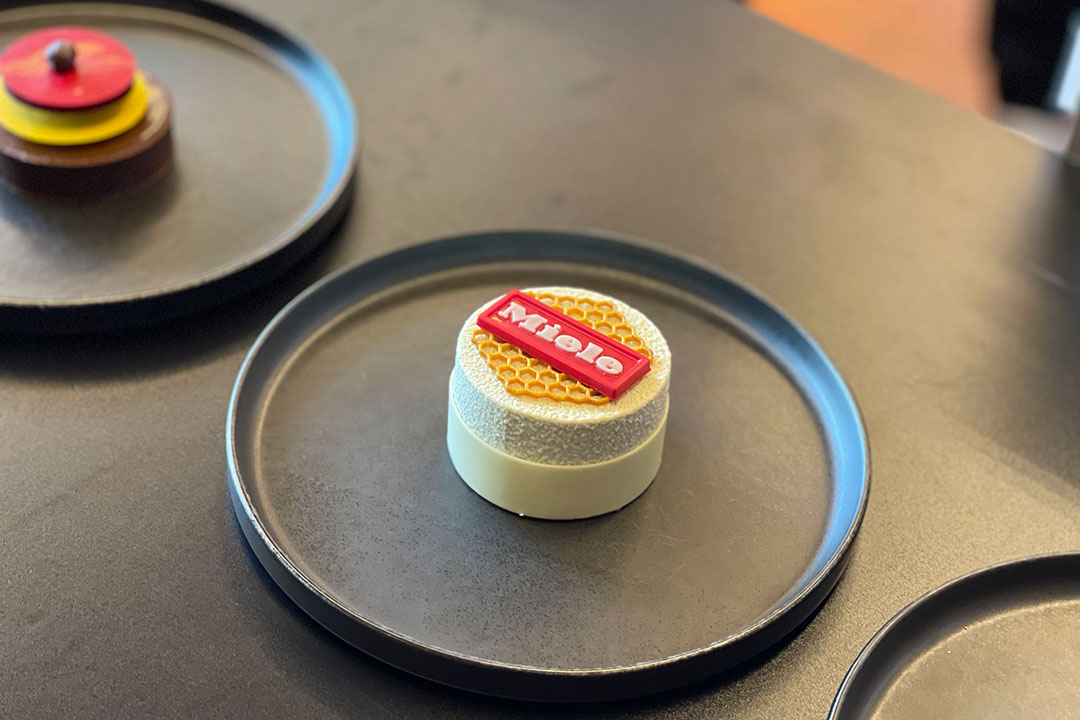
Miele, in collaboration with Chef Nouel Catis, launches a limited edition dessert trio for its Innovation Series. — Almira Martinez

German manufacturer Miele collaborated with the viral ‘Dubai chocolate’ chef Nouel Catis in a limited-edition dessert trio that bridges two heritages together through uniquely crafted sweet treats.    

“Since it’s all about innovation, we have to rethink how we create desserts that are flavor forward and that’s also very approachable,” Dubai-based Filipino pastry chef Nouel Catis told reporters at the sidelines of the collaboration’s launch.    

“As I always say, innovation keeps you relevant; it keeps you very flavor-forward as a chef,” he added.     

Mr. Catis noted that the innovative recipes of the desserts were rooted in the “nostalgia factor” of both the European and Filipino cultures.    

“The key to creating something that resonates with all of us is nostalgia,” he said. “I was really looking into aspects that remind us of being Filipino, but also take you to Germany, and that in itself is already innovation.”    

The three desserts included in Miele’s Innovation Series are Barako-Dalandan Torte, Miele Honey Cake, and The Green Forest.     

The shared passion and fondness for coffee in both countries inspired Mr. Catis to create the Barako-Dalandan Torte. The viral chef elevated the German Torte by using Barako, a strong and aromatic coffee from the Philippines.     

The boldness of barako complemented the salted caramel and subtle citrus flavor of Dalandan, making it a perfect mood booster after a long day or even during a midday work break.     

The sandy texture of its crumbs also resembles that of ground coffee, which adds to the overall eating experience of the finely-crafted dessert.     

The Miele Honey Cake, on the other hand, is a “crowd favorite”, said Mr. Catis. Although small, the cake draws inspiration from the German apple strudel, offering a wide range of flavors ranging from cinnamon, nut, vanilla, and chocolate.    

The white confection has a crunchy texture outside that balances the silky and smooth filling inside.     

Meanwhile, the Green Forest is a light dessert that combines a flaky croissant with Mr.Catis’ take on the classic Black Forest cake.    

“Black Forest contains what liqueur? Cherry. So, we blended cherry liqueur into the pistachio,” Mr. Catis said.     

The faint savory flavor of the croissant, combined with the crunch of pistachio and topped with a thin chocolate disk, strikes the right balance between sweet and delicious.   

Although each pastry varies from one another, they all share Mr. Catis’ signature ingredient – chocolate and texture, which makes them all cohesive yet still distinctive.    

“Chocolate is only 10% of my being as a chef. The 90% also covers…beverages, desserts, pastries,” the internationally renowned chef said.     

“This gave me an opportunity to actually showcase my other skill in terms of flavor combination,” he added.     

Miele, which manufactures domestic appliances for the kitchen, the laundry room, and floor care, was founded in 1899. According to its partner in the Philippines for two decades, Focus Global Inc., the Innovation Series follows the brand’s “Forever Better” promise.    

“The Innovation Series was born from the same idea, to show how technology and creativity can come together to create something new,” Angela Sy, head of finance and strategy at Focus Global Inc., said at launch.     

The limited-edition desserts are available at the Miele showroom in Bonifacio Global City (BGC), Taguig, until Nov. 6, 2025. Almira Louise S. Martinez

IS Philippines champion Tabuena sets eyes on big league — LIV Golf

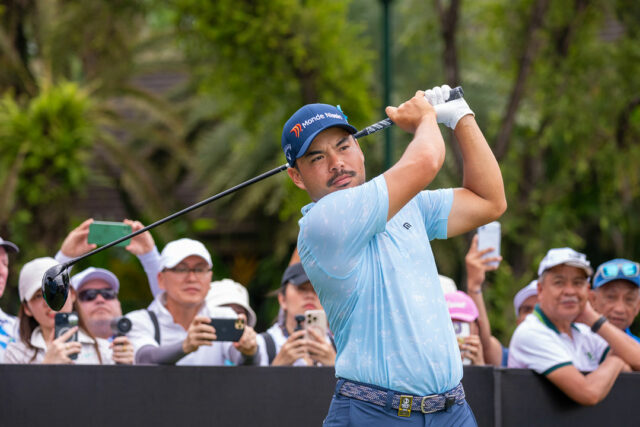
MIGUEL TABUENA during Round Three of the 2025 International Series Philippines at Sta. Elena Golf Club. — ASIAN TOUR/GRAHAM UDEN

THE landmark triumph at the International Series (IS) Philippines presented by BingoPlus has only made Pinoy ace Miguel Tabuena hungry for more.

And the newly-minted IS champion has set his eyes on the big league — LIV Golf.

“That’s the goal. We want to be in there,” said Mr. Tabuena, who is now in a strong position in the chase for the golden ticket to LIV Golf via the IS pathway.

The topnotcher of the IS rankings at the end of 2025 will make the LIV circuit outright and thanks to his four-shot victory at Sta. Elena Golf Club, Mr. Tabuena zoomed to No. 2 with 210.89 points from 48th.

He has three IS tournaments left — Link Hong Kong Open (Oct. 30 to Nov. 2), Moutai Singapore Open (Nov. 6 to 9) and PIF Saudi International (Nov. 19 to 22) — to scoop up ranking points and eventually overtake current leader Scott Vincent of Zimbabwe (318.99).

“I didn’t have that (LIV stint) in mind (initially). But to be able to get it done brings me so much confidence. I believe in myself that I can actually win one of these events. And I hope to be able to do it next year,” he said.

“We have three more IS events and I’m in a pretty good position to set myself up next year.”

After ruling the biggest golf event on Philippine soil, both field-wise and purse-wise, there was little time to celebrate for Mr. Tabuena. He was off to Hong Kong on Monday to take the next part of his journey.

“There are still many big tournaments to come so I’ll just keep doing the same things — just stay patient, stick to my process and try to win again. That’s the most important goal,” he said. — Olmin Leyba

Rico Hoey finishes solo second in Bank of Utah Championship

FIL-AM RICO HOEY — BW FILE PHOTO/PGATOUR.COM

RICO HOEY delivered another great news for Philippine golf as he finished solo second in the $6-million Bank of Utah Championship in the PGA Tour on Sunday.

Continuing his strong charge in the second half of the season, the Manila-born pro assembled 18-under 266 to take runner-up finish behind American Michael Brennan, who scored his breakthrough triumph with a 262.

It was the third Top 10 finish of the month and fourth overall in 2025 for Mr. Hoey, who virtually secured his playing status for next season with his solid showing at Black Desert Golf Course in Ivins.

From No. 91 in the FedExCup Fall Standings, the 30-year-old Fil-Am vaulted to 61st to get well inside the safe zone of the 100-man cutline.

Mr. Hoey banked $654,000 (around P38.44 million) as he matched his best finish on the PGA Tour to date.

The 30-year-old parbuster previously came close to a maiden victory at the 2024 ISCO Championship in Kentucky, where he made it to a five-man playoff for the title but eventually settled for tied second.

In Utah, Mr. Hoey made a run at the title but his closing four-under 67 was not enough to topple Mr. Brennan, who shot a 66 to keep his chasers at bay.

The Pinoy ace managed to cut the American’s lead to three with a birdie at No. 10. But Mr. Brennan stayed steady down the stretch, collecting two more birdies to offset a bogey at the 18th and secure his first Tour title by four strokes.

Mr. Brennan became the first sponsor exemption to win since Nick Dunlap took The American Express in January 2024 as an amateur. — Olmin Leyba

PSC Chairman Gregorio pushes for unification of Batang Pinoy and Palarong Pambansa

PSC CHAIRMAN PATRICK GREGORIO — BW FILE PHOTO/PHILIPPINE ROWING ASSOCIATION

GENERAL SANTOS CITY — The biggest Batang Pinoy edition in history may just be the prelude to an even better national youth sports program.

Led by Chairman Patrick “Pato” Gregorio, the Philippine Sports Commission (PSC) pushes for a unification of the grassroots development program with the Department of Education (DepEd) for the annual youth competition like the Batang Pinoy and the Palarong Pambansa.

As of now, Batang Pinoy which is under PSC and Palaro under DepEd are held separately every year with some students juggling their acts in both tournaments that have almost the same qualification.

Under Mr. Gregorio’s proposal, Batang Pinoy could be open to eight to 15 years old while Palaro could be from those 16 to 21 years old.

The PSC will oversee the implementation of sporting events with the National Sports Associations (NSAs) while DepEd takes over the administration, operations and logistics, given their nationwide network in different regions compared to PSC’s limited hubs in Manila and Pasig.

Batang Pinoy this year is boasting the biggest edition in history with almost 25,000 delegates including over 18,000 athletes from across 188 local government units (LGUs), duking their hearts out across 27 sports.

Once the coordination with DepEd pushes through, it’s nowhere to go but up with an ultimate goal of establishing a national youth training pool — like the elite team — featuring the standouts from Batang Pinoy and Palarong Pambansa.

“Batang Pinoy will never be the same again. It will be more beautiful and exciting from here on aligned with the Palarong Pambansa with the PSC and DepEd working together for the national grassroots sports development program,” he beamed. — John Bryan Ulanday

Pitcher Max Scherzer eyes World Series history as Blue Jays, Dodgers clash in pivotal Game 3

BLUE JAYS right-hander Max Scherzer. — KEVIN NG-IMAGN IMAGES-REUTERS

LOS ANGELES — After the long 32-year wait to return to Canada, the World Series shifts back to Los Angeles, where memories remain thick from its visit just one year ago.

All even at one game each, the Toronto Blue Jays and Los Angeles Dodgers will duel to get the upper hand in the best-of-seven matchup when Game 3 arrives on Monday night.

In Game 1 at Los Angeles last year, the Dodgers’ Freddie Freeman hit a game-ending grand slam against the New York Yankees on the way to becoming the first player to hit a home run in each of the first four games of a World Series.

A different kind of history is set to unfold in the opening inning on Monday. Blue Jays right-hander Max Scherzer is set to become the first pitcher to take the mound for four different teams in the World Series.

After already appearing in a World Series for the Detroit Tigers (2012), Washington Nationals (2019), and Texas Rangers (2023), Scherzer is chasing his third career title. He will enter off a strong 5 2/3-inning start in Game 4 of the American League Championship Series when he helped the Blue Jays past the Seattle Mariners.

The outing came after he went 1-3 with a 9.00 ERA over his last six starts in the regular season.

“This is what you play for, to be able to get to this spot, to get to this moment, to have a shot at it,” said Scherzer, who is 1-1 with a 2.70 ERA in four postseason appearances (three starts) against the Dodgers. “… Just so fortunate to have another crack at this. There’s so many great players that have never gotten to a World Series.”

Scherzer pitched for the Dodgers in 2021, when they fell in the National League Championship Series to the Atlanta Braves. He was scratched from a scheduled start in a decisive Game 6 of the NLCS, saying his arm was “locked up.”

After the Blue Jays dominated Game 1 on Friday by scoring 11 runs, the Dodgers responded with Yoshinobu Yamamoto’s complete game in a 5-1 victory that evened the series.

Los Angeles is now 9-0 this postseason when a starter goes at least six innings.

Los Angeles right-hander Tyler Glasnow will follow Yamamoto’s command performance with a start in Game 3. After going 4-3 with a 3.19 ERA in 18 regular-season starts, Glasnow has been impressive in the postseason.

Glasnow gave up one run over 5 2/3 innings of a Dodgers win in Game 3 of the NLCS against the Milwaukee Brewers and has a 0.68 ERA in three appearances (two starts) this postseason with 18 strikeouts over 13 1/3 innings.

“I’m trying to just go into it like it is any other game,” said Glasnow, a Los Angeles-area native. “Obviously, it’s the World Series for a hometown team, and it’s awesome. I think for me… simplify it in your workday and simplify it while you’re out there on the mound. I think a lot of the other stuff is just kind of noise.”

In 11 career regular-season starts against the Blue Jays, Glasnow is 1-4 with a 5.82 ERA, last facing them at home Aug. 10 when he allowed two runs with eight strikeouts over 5 2/3 innings of a no-decision.

After returning from a broken hand in the NL Division Series victory over the Philadelphia Phillies, the Dodgers’ Will Smith had his best game of the postseason when he hit a home run and had three RBIs in the Game 2 victory.

“I feel that we’re back into a little bit of a rhythm offensively that it should show itself here these next three games,” Roberts said.

Toronto infielder Bo Bichette, who has been dealing with a left knee issue since early September, is expected to make it back to the starting lineup in Game 3, playing second base, after pinch hitting in Game 2. A two-time All-Star at shortstop, Bichette went 1-for-2 with a walk in Game 1. — Reuters

New York Jets get first win in wild fashion, shock Cincinnati Bengals

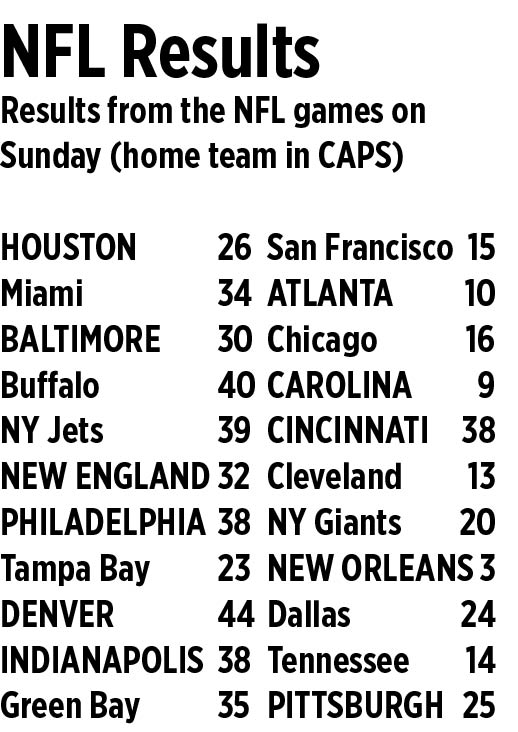
CINCINNATI — Breece Hall rushed for 133 yards and two touchdowns and also tossed the go-ahead 4-yard scoring pass to Mason Taylor with 1:54 left to lift the New York Jets to their first win of the season, 39-38, over the shocked Cincinnati Bengals on Sunday.

The Jets (1-7) ran up 502 yards of total offense in becoming the last NFL team to register a win this season.

Chase Brown ran for a score and caught a touchdown pass while Samaje Perine added 94 yards on nine carries for the Bengals (3-5), who blew a 38-24 lead with 10:21 left in the game. Ja’Marr Chase had 12 receptions for 91 yards.

Brown finished with 73 yards on 12 carries as the Bengals (3-5) had their biggest game on the ground this season. Making his third start, Joe Flacco finished 21-of-34 for 223 yards for the Bengals.

After a week of wondering if he would be the starting quarterback, Justin Fields played a nearly perfect first half, completing his first six pass attempts for 72 yards and a touchdown. Fields, who started after Tyrod Taylor was ruled out with a knee injury, finished the game 21-of-32 passing for 244 yards.

New York moved within 38-32 on Hall’s 27-yard touchdown run and an ensuing two-point conversion pass to Isaiah Davis with 7:52 remaining.

The Jets forced a three-and-out and drove 58 yards, and just after the two-minute warning, Hall took a pitch from Fields and tossed the ball 4 yards to Taylor in the back corner of the end zone for the go-ahead score.

The Jets played without leading receivers Garrett Wilson (knee) and Josh Reynolds (hip) and top corner Sauce Gardner (concussion).

The Bengals lost defensive end Trey Hendrickson to a hip injury just before halftime. Hendrickson, who returned on Sunday after missing the Thursday night win over Pittsburgh with the same injury, did not return in the second half.

The Bengals opened the game with a promising drive, highlighted by a 22-yard run from Brown that set them up at Jets’ 12-yard line. But the drive stalled from there, with a 4-yard run and two incompletions over the middle. The Bengals settled for a 26-yard field goal from Evan McPherson and a 3-0 lead.

Flacco scored on a 1-yard sneak and threw touchdown passes to Tee Higgins and Brown to build a 24-13 Cincinnati halftime lead.

At halftime, the Bengals honored their 11th and 12th inductees to the Ring of Honor. Former offensive lineman Dave Lapham and former defensive back and star punt returner Lemar Parrish saw their names and numbers go up on the east facade of Paycor Stadium while receiving their Ring of Honor jackets.

Before the game, the Jets received word that former center and team Hall of Famer Nick Mangold died at the age of 41, after a battle with kidney illness. — Reuters

Austin Reaves’ career-best 51 points boost Lakers past Kings

AUSTIN REAVES exploded for a career-high 51 points, Deandre Ayton complemented 22 points with a game-high 15 rebounds and the Los Angeles Lakers, playing without injured stars Luka Doncic and LeBron James, downed the host Sacramento Kings 127-120 on Sunday night.

Taking the leading role after Doncic was a late scratch due to finger and lower-leg injuries, Reaves surpassed his previous NBA best of 45 points set last February against the Indiana Pacers.

He also found time for 11 rebounds and nine assists, missing what could have been his fourth career triple-double by a single assist.

Reaves drilled six 3-pointers, including three during a fourth-quarter run that allowed the Lakers to flip a four-point deficit into an 11-point lead.

Seeking a second straight win after a season-opening loss to Golden State, the Lakers trailed 101-97 after a Domantas Sabonis 3-pointer with 9:50 remaining before scoring 20 of the game’s next 25 points to extend into a 117-106 advantage at the 4:18 mark.

Reaves triggered the uprising with consecutive 3-pointers, then added a third following an Ayton hoop to complete an 11-0 burst that produced a 108-101 lead.

Rui Hachimura added two hoops, Ayton another and Jake LaRavia a 3-pointer to finish off the flurry, which created a deficit from which the Kings never fully recovered.

Zach LaVine’s 3-pointer got the hosts as close as 122-119 with still 1:30 to play, but Reaves kept the Kings at arm’s length with four late free throws that capped a 21-for-22 night at the line.

Getting 28 more opportunities, the Lakers outscored the Kings 41-12 from the stripe.

Hachimura finished with 18 points, while LaRavia and Marcus Smart chipped in with 11 apiece for the Lakers, who played a third straight game without James, out with a back issue.

LaVine paced Sacramento with 32 points, while Sabonis (10 points, 14 rebounds) and Dennis Schroder (18 points, 12 assists) posted double-doubles.

DeMar DeRozan added 21 points, Russell Westbrook 18 and Malik Monk 15 for the Kings, who lost despite outscoring the visitors 54-24 from beyond the arc. — Reuters

Time to take profit on gold, says Philippine central banker

STOCK PHOTO | Image from Freepik

The Philippine central bank should sell some of its “excessive” gold holdings with the precious metal set to retreat further from record highs as safe-haven demand eases, according to a policymaker.

Gold accounts for about 13% of the Bangko Sentral ng Pilipinas’ (BSP) gross international reserves, Monetary Board member Benjamin E. Diokno said in an interview on Monday in Kuala Lumpur. That’s already more than other central banks in the region, he said on the sidelines of the Bloomberg Business Summit at ASEAN.

“Our holdings of gold are already excessive,” said Mr. Diokno, a former BSP governor. Ideally, he said the precious metal should be anywhere between 8%-12% of the central bank’s reserves, which stood at about $109 billion as of September 2025, the most in almost a year.

With the BSP having bought gold at around $2,000 an ounce, and bullion hitting a record high at nearly $4,400, “shouldn’t you sell already?” Mr. Diokno said. “What will happen if the price goes down?”

Gold fell to near $4,053 an ounce on Monday as progress on a US-China trade deal sapped demand for safe-haven assets. While gold’s blistering rally to just above $4,380 has tapered amid signs it has become overbought, bullion is still up 55% this year, with central-bank buying helping provide support.

Mr. Diokno, who is currently a member of the BSP’s rate-setting body, said there was still debate at the BSP on whether it should accumulate more gold or if it was time to take profit.

Earlier this year, BSP Governor Eli Remolona said the central bank doesn’t bet on gold price movements, pointing out that it’s a very poor investment. “It’s risky and the average return is negative,” Mr. Remolona said in March. But as part of a large portfolio, holding gold provides a good hedge, he said then.

In 2024, the BSP sold gold which later rallied, triggering criticism from the public over what some say was opportunity cost. The BSP responded, saying the move was part of its active management of the country’s gold reserves.

Mr. Diokno said the BSP has started to spread out where it keeps its gold holdings. The central bank recently shifted a small portion to France while the bulk remains in London.

The BSP is also looking to diversify currencies in its foreign exchange reserves. While most of its war chest is still denominated in US dollars, Mr. Diokno said they could explore having euros too. It also previously held Japanese yen and Australian dollars. — Bloomberg