Home Blog Page 8242

Arts & Culture (04/07/21)


Character illustration workshop with Myle Villareal

THE BGC (Bonifacio Global City) Arts Center will hold a character illustration workshop with artist Myle Villareal on April 10 (10 a.m. to noon) via Zoom. Ms. Villareal will share her techniques on how she creates character illustrations using Adobe Illustrator. The workshop is open to participants ages 12 and above. The application to the workshop includes a requested donation of P500 per participant (the contribution will support programs that champion the arts in the community). Register at https://docs.google.com/forms/d/e/1FAIpQLSek3NSWNuQ7FIztFhPzkwiDrpiA5kPR34EIdT8zWsDbWOWobw/viewform?gxids=7628. For inquiries, e-mail programs@artsatbgc.org.

Webinar on Pigafetta and Philippine history and heritage

THE PHILIPPINE Italian Association presents a webinar on Antonio Pigafetta and Philippine History and Heritage on April 12, 2 p.m. Pigafetta chronicled the first encounter between Europeans and the people who would become Filipinos. Speakers in the webinar are Danilo Madrid Gerona, PhD., from the Magellan-Elcano Studies Center — Partido State University, who will talk about Pigafetta’s participation in the Magellan expedition and questions on his purposes; and sculptor Juan Sajid Imao, son of the late National Artist Abdulmari Asia Imao, who will talk about his father’s stories on when he was working on the monument to Pigafetta mounted in Cebu. To register for the webinar, visit https://us02web.zoom.us/webinar/register/WN_TVmAw0cgSNy_XIl0G456OA.

Atlantis’ virtual workshop continues in May

LAST year’s Atlantis Virtual Workshop proved to be a huge success, which is why Atlantis Theatrical is bringing it back with another intensive yet fun-filled training program for young, aspiring musical theater artists. The workshop will tackle the necessary topics and activities to develop and hone children’s talents in performing arts. Kids from ages seven to 12 and teens from 13 to 18 can enter this safe online space. And because it’s online, even kids from different parts of the world can join. Song analysis, storytelling techniques, vocal techniques, and basic jazz are just four of the many topics that will be explored. Classes are an hour to an hour and 15 minutes long, and will only have two to three students per time slot. All classes will be held live via Zoom from Mondays to Fridays. There are two 15-session schedules to choose from: May 10 to 28 with a recital on May 29, and July 5 to 23, with a recital on July 24. Visit www.atlantistheatrical.com/workshops for more details. Contact Atlantis Theatrical at info@atlantistheatrical.com or at 0917-838-1534 to sign up.

The Not So Ugly Duckling dance showcase

A NEO-CLASSICAL version of the literary fairy tale “The Ugly Duckling” takes shape in the form of online film The Not So Ugly Duckling, which encapsulates the beauty of ballet as a performance art. It will be livestreamed for free from April 10 to 17, from 10 a.m. to 11 a.m. on https://www.facebook.com/TNSUD2021. The dance showcase follows the journey of Cacciatore, a duck from a small town in pursuit of her Hollywood dream. The modern interpretation of the iconic story speaks of self-love, acceptance and appreciation. The Not So Ugly Duckling is written by De La Salle-College of Saint Benilde Dance Program Chairperson and dancer Nina Anonas-De Santos, directed and choreographed by contemporary dancer Ruthame Hurtado. It features emerging classical ballet dancers and performers including Nika Villarin, Yella Carlos, Jireh Cariaso, Anthony Peñaranda, Agatha Yulo, Jessa Aquino, Jharexa Myze Carvajal, Trisha Galang, Esabel Galang and Athena De Guzman.

Instituto Cervantes presents 4 contemporary Spanish filmmakers

THIS APRIL, Instituto Cervantes de Manila will screen online the work of four contemporary Spanish filmmakers. The film series, Del corto al largo, will be streaming two works (a short and a feature film) by each of the selected filmmakers: directors, Álex Montoya, Belén Macías and Juanjo Giménez, and the producer María del Puy Alvarado. The films will be shown through the Instituto Cervantes channel on the Vimeo platform (vimeo.com/institutocervantes) and will be freely accessible for 48 hours from their start date and time. The series will kick off on April 7, at 2 a.m., with the online screening of Lucas, directed by Alex Montoya in 2016. Available anytime for 48 hours, the short can be watched for free and with English subtitles through this link: https://vimeo.com/519053672. The comedy Asamblea, directed by Alex Montoya in 2018, will be available on April 10 and 11 through this link: https://vimeo.com/518996347. Other films in the series are Mala espina (2001), a short film by Belén Macías; Juanjo Giménez’ Rodilla and Nos hacemos falta (2001); and María del Puy Alvarado’s Pulse (2013) and Antonio Muñoz Molina, el oficio de escritor (2014). The films, presented by Instituto Cervantes in collaboration with ALCINE, the Alcalá de Henares Film Festival (Spain), and the Embassy of Spain in the Philippines, will be in Spanish with English subtitles. Admission is free. For further information on the film series, check out the event page on Instituto Cervantes de Manila Facebook site: https://www.facebook.com/events/355457229118138.
SMC packaging unit partners with gov’t for milk feeding initiative

THE PACKAGING unit of San Miguel Corp. (SMC) has partnered with the Philippine Carabao Center (PCC) for a nationwide milk feeding program that will utilize its new packaging solution.

SMC President and Chief Operating Officer Ramon S. Ang said in a statement that the company’s San Miguel Yamamura Packaging Corp. (SMYPC) will be a third-party toll packer that will use its retort process to package 40,000 liters of carabao milk from farmer cooperatives in Nueva Ecija.

Equivalent to 4 million cans of sterilized carabao milk, Mr. Ang said the products will be distributed in Ilocos Region, Cagayan Valley, Central Luzon, and areas in the Cordillera Administrative Region as part of the school-based feeding program under the Department of Education and Department of Social Welfare and Development.

“We are very happy that almost one year since we promised to help the carabao cooperatives, we will now see both farmers and our school children benefit from this worthy endeavor,” Mr. Ang said in the statement.

Mr. Ang said that with the use of retort process, the shelf life of carabao milk will last up to six months without preservatives, compared to a previous shelf life of seven days using flexible packaging.

He added that carabao milk can reach more children in need of nutritional support due to the longer shelf life of the product, adding that it can be easily transported and can be stored under ambient temperature.

“At the same time, this will boost the livelihood of local dairy farmers who have always been looking for ways to keep carabao’s milk fresh and prevent spoilage,” Mr. Ang said.

According to SMC, carabao milk will be consolidated by PCC from dairy cooperatives in Nueva Ecija and will be delivered to SMYPC’s facility in San Fernando, Pampanga for sterilization and packaging.

From the Pampanga facility, the milk will be delivered to schools division offices to be distributed to the beneficiaries.

In 2020, dairy cooperatives assisted by the PCC committed to give milk to 503,955 children. Currently, some 1.01 million children are benefiting from carabao milk provided by the cooperatives, with supply set to increase after SMC’s initiative.

Previously, SMC also helped dairy farmers by purchasing excess carabao milk used for donation to poor communities and promised to help create a packaging format to make the product more marketable.

“It is through meaningful and sustainable programs like this that we will empower various sectors to not just weather the impacts of the pandemic, but have more opportunities to grow in the future,” Mr. Ang said. — Revin Mikhael D. Ochave

IMF upgrades economic outlook amid vaccine rollouts

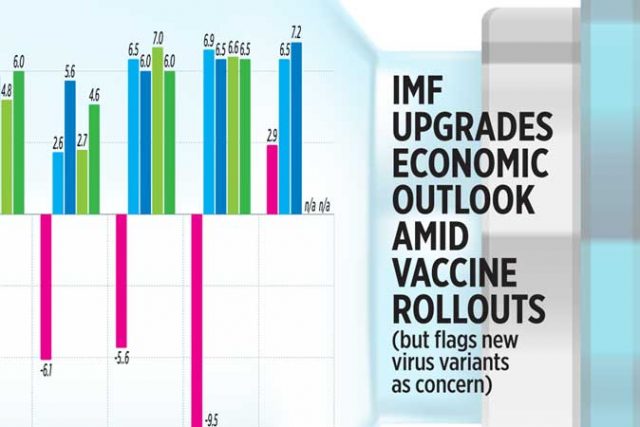
THE International Monetary Fund (IMF) sees the Philippine economy bouncing back slightly faster than previously expected this year, but noted it is “critical” to contain the surge in coronavirus disease 2019 (COVID-19). Read the full story.

Real GDP growth of select Asian and Pacific Economies

Patient safety is at the heart of COVID‑19 vaccine development

In a previous column, we talked about the four types of COVID-19 vaccines and how they work (“No one is safe unless everyone is safe,” BusinessWorld, Feb. 24, 2021). In today’s column, we will discuss how vaccine manufacturers and regulatory agencies work together to make these all-important vaccines safe and effective.

Patient safety is central to the research and development of every vaccine. Vaccine makers must follow very strict scientific and health authority processes to bring a new vaccine to the public, even during the current pandemic. With vaccine development moving so quickly, it is understandable why some people are asking whether a vaccine for coronavirus disease 2019 (COVID-19) will be safe and effective.

Like all vaccines, the COVID-19 vaccines go through many stages of approval, including exploratory “proof of concept” stage, pre-clinical stage, clinical development (which include human clinical trial phases 1 to 3), health authority review, authorization or approval, and finally, manufacturing and quality control.

COVID-19 vaccines are only authorized or approved for use with the general public after a rigorous process. Clinical trials thoroughly test candidate vaccines on tens of thousands of people. An independent group of experts work with health authorities to carefully review all the scientific and clinical trial data results. They will only authorize said vaccine for use with the general public if the benefits of the vaccine far outweigh the known and possible risks of getting a COVID-19 infection.

Clinical trials also help find adverse events that may happen shortly after getting a vaccine. The health authorities also check for very rare side effects, or side-effects that may become apparent only after long-term use. This is why researchers and health authorities will continually monitor that use to check that no safety concerns surface and the vaccines continue to work well in different groups of people over time.

Health authorities review all the scientific and clinical trial data and decide if the vaccines can be authorized or approved for use in their region or countries. They review all the preclinical, clinical, and manufacturing process data, including the safety and efficacy (i.e., how well it works) data. These health authorities include regional regulatory authorities like the European Medicines Agency (EMA) in the European Union, and national regulatory authorities such as the Food and Drug Administration (FDA) in the US and the Pharmaceuticals and Medical Devices Agency (PMDA) in Japan. In the Philippines, scientific and clinical data are reviewed by the Food and Drug Administration and expert panels convened by the government.

COVID-19 vaccines follow international standards for vaccine development and approval. Like all new medicines or treatments, vaccines must pass a thorough set of tests that show their quality, safety, and efficacy in tens of thousands of volunteers before being approved or authorized by independent, scientific experts who work for health authorities.

Due to the public health emergency, the authorization and manufacturing of COVID-19 vaccines have been quicker than with previous vaccines. There has been a unique level of preparation and collaboration among researchers, vaccine makers, governments, and health authorities, as well as unprecedented funding for vaccine development and manufacturing. These partnerships accelerated the safe and effective development and authorization of COVID-19 vaccines, without compromising on any of the safety or authorization processes.

There were other factors as well that shortened the development timeline. Vaccine makers carried out clinical trials and making vaccines in parallel instead of doing one after the other. This avoided long wait times between trials. Given the high spread of the virus, it has been easier to have clinical trial volunteers and easier to test the efficacy of vaccines. Vaccine makers gave health authorities access to the clinical trial results throughout the process (“a rolling review”), rather than waiting until the end, to help them carry out ongoing reviews of results. Even before final authorization, vaccine makers started manufacturing preparations to shorten the time it would take to distribute vaccines.

Vaccine makers have worked around the clock to update facilities and hire and train more staff to make the huge number of vaccines needed. Suppliers making vials, syringes, and stoppers are working overtime and in close partnership with the vaccine makers. Health authorities set up dedicated task forces made up of independent experts and rapid review processes to evaluate high-quality applications from vaccine makers. This allows the shortest possible timeframes while ensuring robust scientific opinions.


Teodoro B. Padilla is the executive director of the Pharmaceutical and Healthcare Association of the Philippines (PHAP). PHAP and its member companies represent the research-based pharmaceutical and healthcare industry. For more information about vaccine development, please go to teamvaccines.ifpma.org. #TeamVaccines   

Financial firms told to guard vs risks from payments, e-money companies

FINANCIAL INSTITUTIONS must practice risk management in doing business with e-money and payment players to ensure financial stability and security against “dirty money” activities, the Bangko Sentral ng Pilipinas (BSP) said.

Memorandum No. M-2021-021 signed by BSP Deputy Governor Mamerto E. Tangonan on April 5 said the central bank’s directive to impose sound risk management policies when dealing with operators of payment systems (OPS) and nonbank electronic money-issuers (EMIs) is in line with their mandate under Republic Act 11127 National Payment Systems Act.

BSP-supervised financial institutions (BSFIs) were told to limit their transactions to only OPS and nonbank EMIs that have secured licenses with the central bank.

The central bank also reminded BSFIs to assess observable business activities and transactions of OPS and EMIs and to ensure they perform customer due diligence measures when dealing with them.

“Where a BSFI is unable to comply with the relevant customer due diligence measures, it shall not open the account, not commence business relations, business relations, refuse to perform the transaction or terminate the business relationship; and consider filing a suspicious transaction report…,” the memorandum said.

Transaction monitoring of personal accounts of beneficial owners of OPS or nonbank-EMIs is also expected from BSFIs that have business relationships with these firms.

Financial institutions are likewise expected to have systems in place to trace unusual movements of funds and transactions of the OPS or nonbank EMIs, as well as appropriate risk assessment and due diligence of these firms. This includes assessing their risk profile and other factors, including business, operations, customer profile, activities rendered, distribution channels, and exposed jurisdictions.

Financial institutions are also expected to establish policies and guidelines with criteria on anti-money laundering and counter-terrorism financing obligations, covered and suspicious transaction reporting.

The central bank last year put in place a new system for assessing dirty money and terrorism financing risks which uses a four-point rating scale to gauge risks ranging from low to high. The move was done as part of reforms to strengthen the country’s guard against money laundering and terrorism financing. — LWTN

China asks major lenders to curtail credit growth this year

THE PEOPLE’S Bank of China asked banks to curtail loan growth for the rest of this year amid bubble risks. — REUTERS

CHINA’S CENTRAL BANK asked the nation’s major lenders to curtail loan growth for the rest of this year after a surge in the first two months stoked bubble risks, according to people familiar with the matter.

At a meeting with the People’s Bank of China (PBoC) on March 22, banks were told to keep new advances in 2021 at roughly the same level as last year, said the people, asking not to be identified as the matter is private. Some foreign banks were also urged to rein in additional lending through so-called window guidance recently after ramping up their balance sheets in 2020, one of the people said.

The comments give further detail to what the central bank stated publicly after the meeting, when it said it asked representatives of 24 major banks to keep loan growth stable and reasonable. In 2020, banks doled out a record 19.6 trillion yuan ($3 trillion) of credit, with about a fifth directed to inclusive financing such as small business loans. Lending the same amount this year would bring the outstanding balance to about 192 trillion yuan, an annual increase of about 11%, the slowest pace in more than 15 years.

“On the one hand, there will be slowdown in loan growth, and on the other hand, the slowdown is quite moderate,” said Lu Ting, chief China economist at Nomura Holdings Inc., adding that the pace is line with the PBoC’s stance of making no sharp policy turns.

With the coronavirus largely contained and the economy rebounding, Chinese policy makers have renewed a campaign to curb risks, especially in the financial and real estate sectors. Even if credit growth eases, the prospect of higher interest rates and fewer soured assets may boost the profitability of banks, which saw earnings slump after they were enlisted to help borrowers obtain cheap financing during the pandemic.

The PBoC didn’t immediately comment.

Chinese banks advanced 4.9 trillion yuan of new loans in the first two months, 16% more than the same period last year, official data show. The central bank told banks in February to keep new lending in the first quarter roughly at the same level as last year, if not lower, the Financial Times reported earlier.

Credit curbs will drain liquidity from the stock market and pressure sectors with high valuations, said Ken Chen, a Shanghai-based analyst at KGI Securities.

Kweichow Moutai Co., the Chinese liquor giant, led a sell-off in blue-chip shares on Tuesday, falling as much as 2.8%. WuXi AppTec Co. slid as much as 5.4%.

The PBoC wants banks to focus on lending to areas such as innovative technology and the manufacturing sector, it said at the March gathering. Earlier in the month, Guo Shuqing, chairman of the China Banking and Insurance Regulatory Commission, warned about bubbles in the property and financial markets, fueling concerns policy makers will begin tightening monetary policy.

China’s government is taking advantage of the economic recovery to deleverage, a long-standing goal shelved during the trade war with the US and further delayed by the pandemic. Last year’s stimulus pushed debt to almost 280% of annual economic output.

The economy accumulated much of its record debt pile after the global financial crisis, when it binged on credit to avoid the economic slumps ravaging the West. Efforts in 2017 to restrain debt growth, especially in the shadow-banking industry, led to higher money-market rates and a slump in government bonds. — Bloomberg

Headline inflation rates in the Philippines (March 2021)

INFLATION eased in March after five straight months of acceleration, as food prices increased at a slower pace, the government’s statistical agency reported on Tuesday. Read the full story.

Headline inflation rates in the Philippines (March 2021)

How PSEi member stocks performed — April 6, 2021

Here’s a quick glance at how PSEi stocks fared on Tuesday, April 6, 2021.


Peso rebounds on decline in oil prices, inflation

THE PESO rebounded versus the greenback on Tuesday as oil prices fell while inflation eased.

The local unit closed at P48.57 per dollar yesterday, gaining 6.5 centavos from its P48.635 finish on Monday, data from the Bankers Association of the Philippines showed.

The peso opened Tuesday’s session at P48.58 versus the dollar. Its weakest showing was at P48.60 while its strongest was at P48.53 against the greenback.

Dollars exchanged dropped to $559.3 million on Tuesday from $637.2 million on Monday.

The peso gained on the back a decline in oil prices, said Rizal Commercial Banking Corp. Chief Economist Michael L. Ricafort.

“[This] could help reduce the country’s oil import bill and the demand for dollars to pay for oil imports,” Mr. Ricafort said in a text message.

Reuters reported that global oil prices dropped 4% on Monday amid expected increase in output major exporting economies and with the threat of a new infection wave being a risk to recovery in the US. Brent crude for June was down by $2.71 or 4.2% to $62.15 per barrel on Monday. Meanwhile, the US West Texas Intermediate price fell 4.6% or $2.80 to $58.65 a barrel.

Meanwhile, a trader attributed the peso’s appreciation to data showing slower inflation in March.

Inflation eased in March after climbing for five consecutive months, the Philippine Statistics Authority reported on Tuesday.

Headline inflation was at 4.5% in March, slowing from the 4.7% print in February but faster than the 2.5% seen in March last year.

It fell within the 4.2-5% estimate given by the Bangko Sentral ng Pilipinas (BSP) for the month

Inflation averaged at 4.5% for the first quarter, beyond the BSP’s 2-4% target range as well as its 4.2% forecast for 2021.

For today, Mr. Ricafort expects the local unit to move within the P48.53 to P48.63 levels versus the dollar, while the trader gave a forecast range of P48.45 to P48.65. — LWTN with Reuters

Stocks climb as inflation eases slightly in March

PHILIPPINE shares closed higher on Tuesday as market sentiment improved following the release of data showing that headline inflation eased in March.

The 30-member Philippine Stock Exchange index (PSEi) improved by 94.96 points or 1.46% to close at 6,590.11 on Tuesday, while the all shares index gained 55.54 points or 1.4% to 4,003.

“Local equities ticked higher after March 2021’s inflation print hit 4.5%, coming in slightly lower than the midpoint of the Bangko Sentral ng Pilipinas’ (BSP) projection range [of] 4.6% and BusinessWorld consensus of 4.8%,” China Bank Securities Corp. Research Associate Jason T. Escartin said via e-mail.

“In our view, downward valuation pressures from the inflation narrative started easing as pork imports ramped up in March,” Mr. Escartin said. “Market sentiment may improve further as the odds of higher quotas on pork imports increase in the next several weeks.”

Inflation eased in March after climbing for five consecutive months, the Philippine Statistics Authority reported on Tuesday.

Headline inflation was at 4.5% in March, slowing from the 4.7% print in February but faster than the 2.5% seen in March last year.

It fell within the 4.2-5% estimate given by the Bangko Sentral ng Pilipinas (BSP) for the month

Inflation averaged at 4.5% for the first quarter, beyond the BSP’s 2-4% target range as well as its 4.2% forecast for 2021.

Meanwhile, Philstocks Financial, Inc. Research Associate Claire T. Alviar said the PSEi’s close also reflected “positive sentiment from the US market overnight.”

“Other positive catalysts that have affected the trading were the continued expansion of PMI (Purchasing Managers’ Index) which stood at 52.2 in March and the statement of the Malacañang that the extension of ECQ (enhanced community quarantine) is unlikely,” Ms. Alviar added.

All sectoral indices closed in the green on Tuesday. Holding firms gained 132.8 points or two percent to 6,756.52; industrials went up by 169.24 points or 1.94% to 8,891.29; mining and oil increased by 97.14 points or 1.14% to 8,582.10; property improved by 28.86 points or 0.9% to finish at 3,231.41; services gained 7.38 points or 0.51% to 1,433.63; and financials inched up by 3.55 points or 0.25% to close at 1,384.74.

Value turnover went up to P5.85 billion on Tuesday with 2.42 billion shares switching hands, from the P5.36 billion seen on Monday with 1.85 billion issues traded.

Advancers outnumbered decliners, 159 versus 61, while 39 names closed unchanged.

Net foreign selling, however, grew to P551.88 million on Tuesday from the P267.25 million seen on Monday.

“Coupled with the prospects of a steady improvement in COVID-19 case counts, a manageable inflation trend may buoy markets towards the higher end of our current 6,300-6,600 trading range,” China Bank Securities’ Mr. Escartin said.

He said the market will monitor the BSP’s consumer and business expectations surveys and February remittances data for leads. — Keren Concepcion G. Valmonte

Palace asked to call special session to pass third stimulus

THE PRESIDENT has been urged to call Congress in from its break to pass a third stimulus bill that will distribute more aid to those affected by the renewed quarantine following a surge in coronavirus infections.

“I urge the President to call a special session of Congress to pass the proposed Bayanihan III and expand the government’s cash subsidy program amid the spike in COVID-19 cases,” Senator Franklin M. Drilon said in a statement Tuesday.

He was referring to the third of the stimulus packages, known as Bayanihan III, for which legislation is pending in both houses of Congress. Legislators are currently on break until May 17.

Mr. Drilon said the strictest phase of the 2020 lockdown left millions out of work and without means to buy food, after unemployment spiked to 17.7%.

“This is the situation that we have to prepare for. We cannot let another 7.6 million Filipino families go hungry this year. Our inaction or delayed action can make another 7.3 million Filipinos lose their jobs again this month. We cannot let businesses permanently shut down,” he said.

In a radio interview Tuesday, Mr. Drilon said some funds in the national budget could be realigned to fortify the pandemic response, targeting in particular the P19-billion anti-insurgency fund and the P9.5-billion confidential and intelligence funds.

Wala na raw extension dahilan wala nang pera. Sa akin, mali iyan. Dapat bigyan ng ayuda ang ating mga kababayan dahilan sa sila ay naghihirap dahilan naman sa hindi maayos na pagpapatakbo nitong pandemic response (There will be no more third Bayanihan because there is no more money. That’s a mistake. We need to aid people who are suffering because of the poor management of the pandemic),” he said in an interview with DZRH.

Kailangan tugunan ito. Sa akin, kailangang tumawag ng special session ang Pangulo para po matugunan ito. Mag-realign ng mga items na hindi kailangan (This needs to be addressed with a special session, to realign funding from unnecessary programs),” he added.

Senator Panfilo M. Lacson said that the plan to call for a special session is positive but noted that the Department of Budget and Management has said there are no funds available.

“Our best option is to have a sense of urgency and allow the private sector more participation with better flexibility in the vaccination program — true to the government’s ‘whole-of-nation approach’ theme, which is turning out to be a platitude and lip service,” he said in a statement.

Mr. Lacson also said that if Bayanihan III is passed, both the national and local governments “must get their act together” to update the database of aid recipients.

Speaker Lord Allan Jay Q. Velasco said in a statement that the House will comply and convene a special session if the Palace certifies Bayanihan III as urgent.

He said the measures related to Bayanihan III are pending at the economic affairs and social services committee and the panel will have finished studying it by the resumption of session in May.

“However, if Malacañang certifies the bill as urgent, we will comply,” he said.

President Rodrigo R. Duterte initially placed Metro Manila and the provinces of Bulacan, Rizal, Laguna, and Cavite under enhanced community quarantine (ECQ) from March 29 to April 4 and extended it until April 11 to curb the spike in coronavirus infections.

The government’s current aid plan is to provide P1,000 per person and up to P4,000 per household in areas under ECQ.

The President’s spokesman Herminio L. Roque, Jr. said in an online briefing Monday that the subsidy is not enough, but cited Budget Secretary Wendel E. Avisado in describing it as a “one-time” aid measure.

Senator Ralph G. Recto in December filed Senate Bill No. 1953 or the proposed Bayanihan to Rebuild as One Act, calling for P485 billion to support the recovering economy and to mitigate the impact of the late-2020 typhoons. This was a counterpart measure to the bill filed by Marikina Representative Stella Luz A. Quimbo in November, providing some P400 billion.

The Senate bill proposes to allocate some P100 billion for wage subsidies to employers to keep their workforces employed, and P100 billion for capacity-building in hard hit sectors. It sets aside P70 billion for a further round of Social Amelioration Program cash handouts and P20 billion for households affected by the typhoons.

Senator Emmanuel D. Pacquiao last month filed a P335-billion stimulus bill, with P100 billion in aid earmarked for low-income individuals. — Vann Marlo M. Villegas

Payouts for hog farmers doubled to encourage swine fever reporting

THE INDEMNIFICATION payout for hog farmers with herds affected by African Swine Fever (ASF) has been doubled to P10,000 per animal, to incentivize early reporting of infected hogs, the Department of Agriculture (DA) said.

Agriculture Secretary William D. Dar said in a statement Tuesday that increased payouts by the Philippine Crop Insurance Corp. (PCIC) will ultimately control ASF, repopulate herds, and stabilize pork prices.

“We are doubling the indemnification payout for every pig that contracts ASF from P5,000 to P10,000. With the increased indemnity, hog raisers are encouraged to report affected pigs, thus controlling the ASF from spreading,” Mr. Dar said.

PCIC President Jovy C. Bernabe said premium-free coverage will be offered to backyard hog raisers, while discounts on premiums will be extended to commercial hog raisers.

“For backyard farmers, the PCIC (normally charges a) 1.75% premium for fatteners and 3.5% for breeders, which are waived. Commercial farmers will pay the same rates, discounted from the regular rates of 2.25% and 4%,” Mr. Bernabe said.

Mr. Bernabe said the insurance policy pays out P10,000 per head for fatteners, P14,500 per head for breeders, and P34,000 per head for parent stock.

He also confirmed that the insurance program will cover local government units and state colleges and universities which run hog fattening and breeding programs.

“The hog farms must be registered with the local government unit, which in turn, must have organized (under) the Bantay ASF sa Barangay surveillance program. Also, their operations must be compliant with the biosecurity Level 1 standards or a level of farm biosecurity in compliance with minimum standards set by the Philippine College of Swine Practitioners (PSCP),” Mr. Bernabe said.

“The provincial and municipal governments that have jurisdiction over the farms of the beneficiaries must have adopted harmonized ordinances relevant to the prevention of ASF. Likewise, the municipal government must implement and regularly update the municipal ASF control and prevention plan, aligned with the initiatives of the DA regional field office,” he added.

DA Spokesman Noel O. Reyes said in a virtual briefing Tuesday that talks are ongoing on whether the department will recommend an extension of the price caps on pork and chicken, which are set to end on April 8.

“We are still studying it. The DA and the Trade Department will announce in the next few days updates regarding the price ceiling,” Mr. Reyes said.

Executive Order (EO) No. 124 was implemented on Feb. 8 that set price controls on pork and chicken products for 60 days.

Under the EO, the market price for pork shoulder (kasim) was capped at P270 per kilogram, pork belly (liempo) at P300 per kilogram, and whole chicken at P160 per kilogram. Retail prices had surpassed P400 per kilogram due to limited supply as a result of the outbreak. — Revin Mikhael D. Ochave