Home Blog Page 8221

Government agencies’ cash usage slows in Q1


PHILIPPINE STAR/ MICHAEL VARCAS
The government agencies’ usage of cash allocations slowed in the first quarter of 2021. — PHILIPPINE STAR/ MICHAEL VARCAS

THE rate at which government agencies use their cash allocations slipped in the first quarter, which an expert said may reflect the slow rollout of coronavirus vaccines and pandemic relief measures.

Latest data from the Department of Budget and Management (DBM) showed state offices, local government units and government-run firms used P788.8 billion out of the P810.7 billion in notice of cash allocations (NCAs) released to them between January and March. This left P21.8 billion worth of unused NCAs.

This resulted in a lower cash utilization rate of 97% in the first quarter, compared with the 99% in the first three months of 2020.

NCA refers to the disbursement authority issued by the DBM to state agencies that allows the latter to withdraw funds from the Treasury to cover expenditures for their programs and projects.

Line departments used 97% or P522.7 billion of the P536.2-billion NCAs issued to them in the first quarter.

“We need to understand that lower or declining NCA utilization rate indicates a slow pace of line agencies to disburse in a timely manner their allocated funds to implement their initiatives, programs, and projects. These disbursements are noted up to the last working day of the period covered,” Asian Institute of Management economist John Paolo R. Rivera said on Saturday.

“In the context of our pandemic situation, potential but may not be ultimate, reason for this, in my opinion, is the relatively slower disbursement of funds towards pandemic response such as vaccine acquisition and release of succeeding rounds of social amelioration,” he added.

Mr. Rivera said the government should work to ramp up spending. He noted slower state spending and subsequent delay in rollout of projects could have an impact on the first-quarter gross domestic product (GDP).

“Partial response does not maximize the accelerator effect on the economy. Hence, the economy may not also reap the benefits of programs in a timely manner. Timeliness is very crucial especially as we are racing towards economic recovery,” he said.

Government spending is one of the major growth drivers of the Philippine economy, accounting for around 25% of the overall economic output.

Official data on first-quarter GDP will be released on May 10.

Economic managers are currently reviewing the 6.5-7.5% growth target for the year, after the reimposition of strict lockdown measures in the capital region and adjacent provinces is expected to dent the full-year print by 0.8 percentage point.

The DBM has released 78% or P3.5 trillion of this year’s P4.5-trillion spending plan as of end-March. — Beatrice M. Laforga

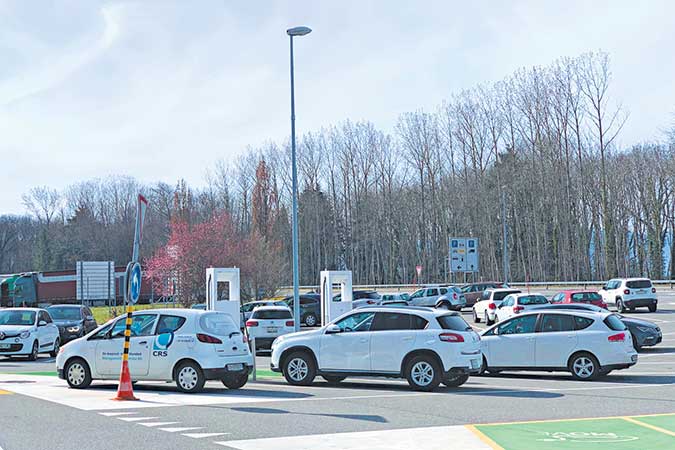
Geneva cruise

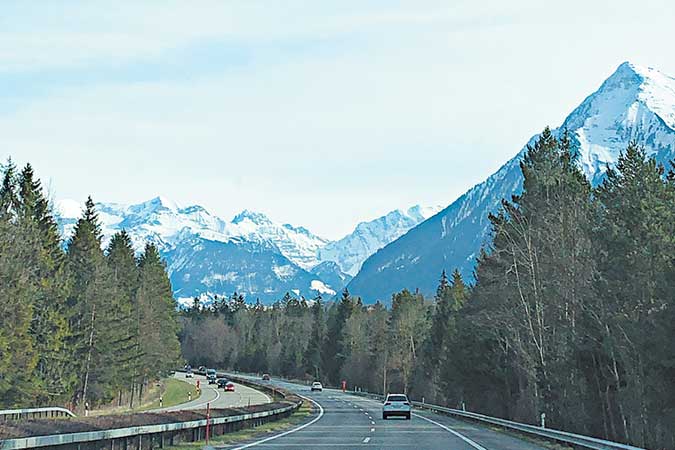
PHOTO BY JAKOB KURC

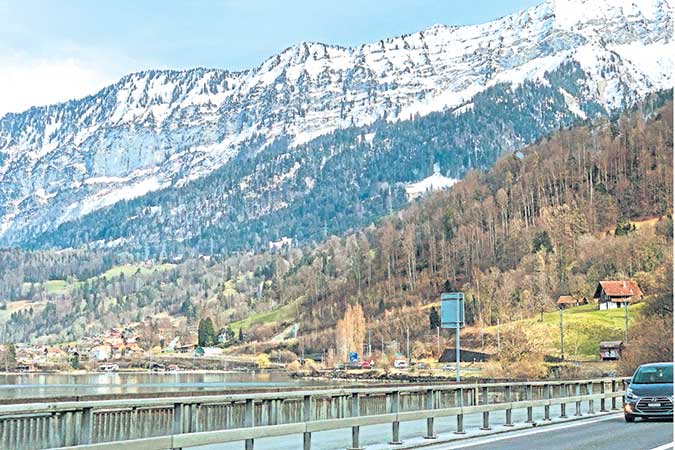
Mulling over mobility in Switzerland

GENEVA, SWITZERLAND — We often hold up North America as the ideal when it comes to highways, motoring, and public transportation.

But how about if we study the transportation model of Switzerland? After all, it’s often highlighted as the gold standard in efficient public transportation and timeliness of services. What could be among their secrets, aside of course, from the glaring fact that the country is extremely wealthy, and the standard of living of its constituents is extremely high? Could it boil down to a culture of discipline and mindfulness, where tardiness is generally frowned upon, and the values of peace and serenity are held up so high that there actually exist laws that prohibit people from making any noise in residential neighborhoods past 10 p.m. — including any toilet flushing or water splashing noises from taking a shower in the middle of the night?

I’m not quite sure. Inherently, culture will certainly always play its part — but was the culture cemented in the first place, because of the high (financial) penalties set by the government for disobedience, combined with the strict enforcement of its laws? Clearly, that plays a part, too.

One of the most striking differences Switzerland has from the Philippines — no, I’m not thinking Alps versus islands here — is its population density. Heck, the entire country’s population is far less than the population of Metro Manila alone. And this is probably why it’s a lot easier and more straightforward to make mass transportation work, because the inhabitants are still within the capacity of the infrastructure. But yes, we of course need the infrastructure in the first place.

Switzerland is undoubtedly one of the top-ranked states in mobility efficiency in all of Europe. That says a lot, considering that it is still a relatively small country whose economic might does not match those of the likes of Germany and the UK. And yet, its public transport network boasts a total of about 24,500 kilometers of length, supported by over 2,600 stations and stops.

The money used to fund its road networks comes from vehicle taxes and road tolls. But the way their toll system works is by having motorists pay an annual fee (starting at 40 Swiss Francs per annum, depending on your vehicle type), which is acknowledged by a car sticker that has to be displayed while using the highways. It makes the collection system simpler, and removes the potential for traffic buildup at toll booths. Don’t you think the Philippines might benefit from a similar model? What if we had a special lane for vehicles who paid an annual subscription so that they would no longer have to enter any queues along the way?

But one of the greatest strengths of the Swiss transportation network is its ever-reliable, albeit extremely expensive, Swiss National Railway. We must not forget that the tenacity of this railway is the kind that traverses the mighty Swiss Alpine mountain ranges that divide Northern Europe from the South. Imagine the economic value of that. The Alpine railway routes began with the Gotthard Railway in 1882, and was later expanded via several more tunnels built, cutting through the mountains.

We, Filipinos, have long acknowledged that Metro Manila has become more than gruesomely overpopulated and congested in the last few decades, and many have chorused that the only true way out of this is via expanding economic centers far outside of the city.

Perhaps people and companies will more easily warm up to the idea if only it were a tad bit easier to travel from NCR to other key economic centers, such as the fast-rising economic center of Clark.

So, yes, it does make a lot of sense to invest and build more transportation infrastructure (Mindanao Railway, do I hear you coming soon?). But that is with the assumption that our tax money will not be compromised, and that the build quality of our country’s investments will be of an undeniably high standard. Is this determination or plain old daydreaming? Who knows? I just wish I get to see and enjoy a more connected Philippine archipelago in my lifetime.

ECQ, safeguard duties lead to 21.1% auto sales dip in Mar.

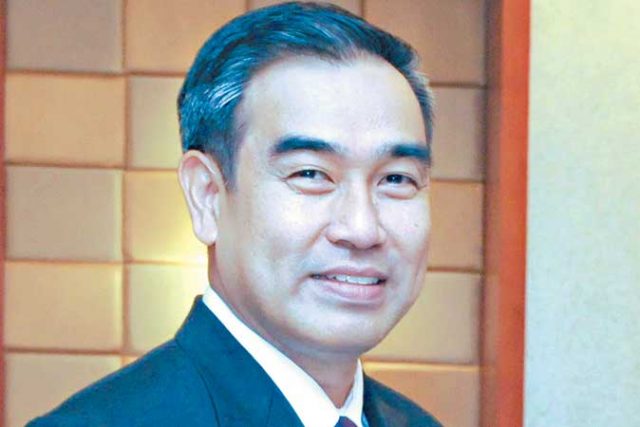
CAMPI President Atty. Rommel Gutierrez

THE PROVISIONAL safeguard duty and the imposition of a two-week enhanced community quarantine (ECQ) across the contiguous so-called NCR Plus territory eventually led to an unsurprising decline in vehicle sales in the month of March.

The Chamber of Automotive Manufacturers of the Philippines, Inc. (CAMPI) and Truck Manufacturers Association, Inc. (TMA) revealed in a joint report that its member companies registered a free-fall of 21.1% in total sales for the month with 20,702 units — versus 26,230 units moved in February.

In a press statement CAMPI President Atty. Rommel Gutierrez said, “The auto industry felt the slowdown in sales due to the reluctance of buyers with the additional deposit for some imported vehicles because of the provisional safeguard duty. The lockdown also forced dealers to close operations that badly hit the already struggling auto industry.”

Versus March last year, the figure is still 87.8% higher — although it must be mentioned that the lockdown imposed around that time resulted in member companies yielding a consolidated total of only 11,029 units.

With sales shrinking 29.6% from 13,074 to 9,201 units, Toyota Motor Philippines Corp. still led all companies, cornering 44.44% of the market. In second place is Mitsubishi Motors Philippines Corp. (accounting for 15.45% of units sold) even as month-on-month sales also fell by 36.9% — from 5,072 to 3,198). In third is Ford with 1,705 units (down by 3.6% from 1,769). Completing the top five are Suzuki Philippines, Inc. with 1,626 (up by 7.5% from 1,513), and Nissan Philippines, Inc. with 1,558 units in sales (up by 18.1% from 1,319).

CAMPI/TMA Q1 sales reached 70,312 units, growing by 8.9% versus the 64,542 total during the same period in 2020. — Kap Maceda Aguila

BMW PHL opens new flagship facility in Greenhills

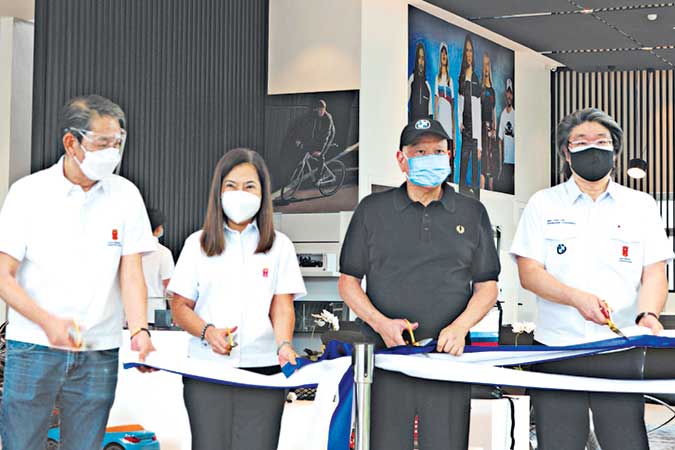
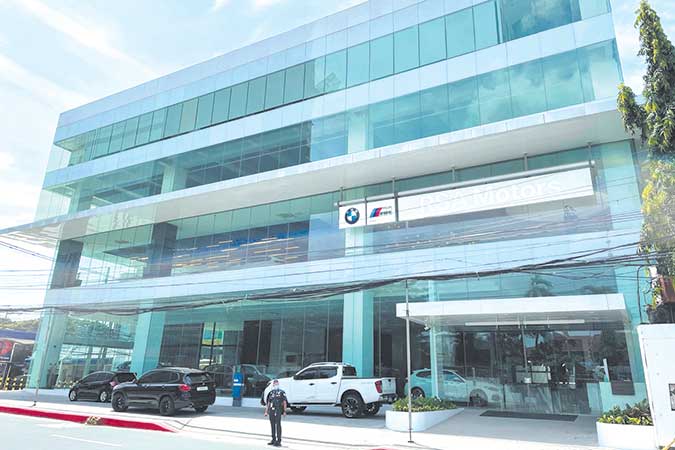
San Miguel Corp. (SMC) President and Chief Operating Officer Ramon S. Ang (second from right) leads the ribbon-cutting ceremony for the opening of the RSA Motors Greenhills. With him are (from left) SMC Senior Vice-President and Head of Infrastructure Business Atty. Lorenzo G. Formoso, SMC Director and Senior Vice-President and Senior Executive Assistant to the President and Chief Operating Officer Aurora T. Calderon, and SMC Asia Car Distributors Corp. President Spencer Yu. — PHOTO FROM BMW PHILIPPINES

SMC ASIA Car Distributors Corp. (BMW Philippines) has a new flagship dealership in the country, RSA Motors Greenhills.

The largest local BMW facility is comprised of four floors and is located on Connecticut St. corner Florida St., Barangay Wack-Wack in Mandaluyong City — just a short distance from EDSA. The building stands on a 1,800-sq.m. parcel of land and each floor measures around 1,500 sq.m.

RSA Motors Greenhills is “one of only two in the world that follow the unique ‘Fit to BMW’ standards, offering a more personalized customer experience together with signature furniture pieces and design elements.” BMW Philippines in a release continued that, “This creates an atmosphere that’s unmistakably BMW while still ensuring every guest feels right at home. These features ensure that RSA Motors Greenhills proudly stands as the flagship dealership in the country, offering the most comprehensive lineup of BMW vehicles combined with key services, for a complete brand experience.”

On the ground floor is the main showroom floor which, according to BMW Philippines President Spencer Yu, can accommodate up to nine vehicles. There’s also a lounge and the Isetta Café. The Car Delivery Room, on the other hand, is where new BMWs are turned over to their owners — which puts a special touch to the event.

BMW Lifestyle merchandise is also available for purchase — BMW toys, bicycles, luggage, and other branded items.

The second floor is also a showroom, which displays “BMW’s growing fleet with M vehicles as well as the BMW 7 Series and X7.” Another lounge and café area are on this level.

Under the current modified enhanced community quarantine, RSA Motors Greenhills will be open from Monday to Saturday from 8:30 a.m. to 5:30 p.m. until April 30. “Once local government guidelines lift the necessary restrictions, operating hours will then be subject to change,” the company said. For more information, call the RSA Motors Greenhills Customer Relations Hotline at 0917-127-1311 or follow the official Facebook page at https://www.facebook.com/RSAMotorsGH for announcements.

AG&P takes on $550-M construction projects in PHL

AGPGLOBAL.COM

Construction contracts include LNG terminal, edible oil depot, petrochemical complex

By Angelica Y. Yang, Reporter

ATLANTIC Gulf and Pacific Co. (AG&P) has entered the second quarter with five construction contracts in the Philippines worth $550 million, including a project to build a liquefied natural gas (LNG) terminal in Batangas province, a company official said.

Alex P. Gamboa, AG&P senior vice-president for business development, said the amount is part of a record backlog of contracted projects worth more than $700 million, including those in India and the US.

“The 770 million [dollars] will be realized in terms of revenue in the next two to three years,” he told BusinessWorld in a phone call on Wednesday. “A big chunk of the amount will go to five projects in the Philippines and four projects abroad.”

Aside from the LNG terminal in Batangas, AG&P’s construction projects in the Philippines are an edible oil depot, a petrochemical complex, a modularized oil refinery, and an LNG bunkering vessel.

AG&P develops and runs LNG and gas logistics and distribution solutions globally. It owns and operates a 100-hectare heavy fabrication and assembly yard on Batangas Bay.

Mr. Gamboa said the remaining $200-million worth of contracted projects are three floating storage and regasification units (FSRU), which will be used for the Asian market, and a project in the US that will involve sending workers from the Philippines to the US.

AG&P Chairman Augusto Gan was quoted as saying in a press release on Wednesday that the firm’s construction business is projected to have its “best year” in its 121-year history, owing to its total contracted backlog.

“It is a groundbreaking year for AG&P as it participates in critical infrastructure projects particularly in Asia-Pacific, that will accelerate commercial development, create jobs, clean air, and trigger overall economic and social progress,” he said.

AG&P said that it expects to secure additional projects in the LNG and power sectors this year. It holds a “notice to proceed” from the Philippines’ Department of Energy for a floating storage unit and onshore gasification terminal.

“AG&P is awaiting approval of its ECC (environmental compliance certificate) and permit to construct, but preparations for the LNG terminal including engineering and procurement activities have commenced,” Mr. Gamboa said.

As low as P2,500 monthly with Malayan Bank Moto Loan

Malayan Bank makes it easier for people who plan to acquire a motorcycle through a loan. The motorcycle loan product, one of the bank’s “many products and services available,” is highlighted by an online selection of brand-new and used units. Malayan Bank’s quick and simple “search, select, and submit” process online features brands like Kawasaki, Honda, Suzuki, and Yamaha — available at competitive rates and flexible 12-, 18-, 24-, or 36-month payment schemes. For the full list of available motorcycle units and information on the loan requirements, visit http://properties.malayanbank.com/motorcycle-requirements/. For more information, call the customer care team at (02) 8841 -7800, send an e-mail to customercare@malayanbank.com.ph, or visit any of Malayan Bank’s 21 branches across the country (check out https://www.malayanbank.com/branches for a list).

SEC readies investor education unit as scam cases rise

DYLAN GILLIS-UNSPLASH

By Keren Concepcion G. Valmonte

THE Securities and Exchange Commission (SEC) will be setting up an office dedicated to helping the public gain financial literacy following the rise in unauthorized investment schemes during the pandemic.

“Chairperson Emilio B. Aquino plans to establish an Office on Investor Education to address the growing problem of investment scams in the country,” the commission told BusinessWorld in an e-mail interview.

The SEC described 2020 as a “record-breaking year” after the corporate watchdog issued 127 advisories against easy money schemes, 95% higher than the total 65 advisories issued in the previous year.

“The Commission has seen more unauthorized investment schemes amid the pandemic, at a time when many of our fellow Filipinos have lost their jobs and would be willing to take any chance at earning a living,” the SEC said.

In the first quarter of 2021, the commission released 15 advisories on entities offering unauthorized investment schemes.

Last week, the SEC also issued warnings against the following: WONKACASH or WONKA Cash App Financial Consultancy Services, Investrade Marketing or Investrade Digital Marketing Services, Learn and Earn Online, CryptoTrading FX, 247 Cryptotrade Online, ExchangeStock, Binary Options Trading, Wolves Options, and IX Trade.

Some investors find stock, bond, and other organized markets intimidating and fraudsters are taking advantage of the investment landscape via new concepts such as digital assets and cryptocurrencies, the commission said.

Schemes are often disguised as donations, educational packages, online gaming, online marketing or advertising, multi-level marketing, reseller business, cryptocurrency mining, and foreign exchange trading.

Ponzi schemes, pyramid schemes, and boiler room operations were identified as the three most widely used investment scams in the country.

In Ponzi schemes, groups “lure” new investors by offering programs that generate high returns with little to no risk.

“In reality, such schemes have little or no legitimate earnings, thus requiring a consistent flow of money from new investors in order to continue,” the SEC explained.

Earnings from pyramid schemes, just like Ponzi schemes, rely on recruitment fees gathered from new investors. However, organizers may ask investors to sell products as a cover.

“Usually, they offer products as a front to make their operations look legitimate. But the products are usually overpriced, worthless, or nonexistent,” the commission said.

However, this is not the same as multi-level marketing, which offers actual products.

Meanwhile, boiler room operations “use high-pressure sales tactics to sell illegitimate investment products such as unreasonable rates of returns and promises of profit.”

Boiler room operators also use “encouraging lines” to attract investors, such as: “This investment opportunity is ‘once-in-a-lifetime’ and you would be stupid to miss out on it!”

“The commission attributes the prevalence of investment scams to people’s lack of awareness of the legitimate investment options available to them, and of the laws, rules and regulations governing investment solicitations,” the SEC said.

It added that the problem highlights the need for financial literacy, inclusion, and sustained enforcement.

The SEC has a financial literacy webinar series, various resource courses, and held its first “Investor Protection Week” last year, which will now be observed every second week of November.

The investing public is reminded to look for a license from groups offering investment opportunities before giving into their offer.

“A certificate of incorporation from the SEC does not automatically authorize a company to take investments from the public,” the commission added.

Registered stock corporation Bill Ford VIP Trading, Inc. had its SEC registration revoked last week for offering unauthorized investment programs.

The commission tells investors: “Ask for a prospectus, offering circular, financial [statements], or other similar [documents] before you even consider investing. Then read the small print carefully, particularly on refund, and make sure you understand the terms thoroughly before signing any kind of commitment.”

Foton Tornado Ref Van positioned for vaccine transport

PHOTO FROM FOTON PHILIPPINES

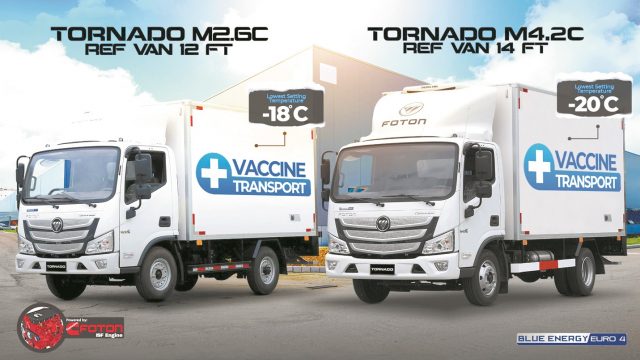
FOTON MOTOR Philippines, Inc. (FMPI), cognizant of the pressing need for refrigerated transport of the COVID-19 vaccines, is proffering truck trims predicated on its Foton Tornado for the job.

The Foton Tornado Ref Van variants are equipped with “the best technologies to bring the vaccine fast, safe, and in its optimal condition to its intended recipients.” These are powered by the reliable US-designed Cummins turbo-diesel engine, and are fitted with Thermo King, which pioneered transport refrigeration 80 years ago.

Two models are available. The Foton Tornado M4.2C Ref Van comes with a refrigerated storage area that can go as low as -20 degrees Celsius — said to be a critical temperature for the special purpose of transporting temperature-sensitive vaccines. It can accommodate a payload of 4.2 tons within its 14-foot long body. Its Cummins 3.8L ISF diesel engine generates 154hp at 2,600rpm and 500Nm at 1,200 to 1,900rpm.

Meanwhile, the 12-foot-long Foton Tornado M2.6C Ref Van can maintain temperatures as low as -18 degrees Celsius. The truck is powered by a Cummins 2.8L ISF diesel engine producing maximum power of 129hp at 3,200rpm and maximum torque of 310Nm from 1,300 to 3,200 rpm. Its payload capacity is 2.6 tons; enabling it to “carry thousands of vaccines in a single drive without much hassle and swiftly deliver them to different destinations.” Foton added that cargo “will also be properly spaced and placed within its spacious refrigerated body storage secured by a durable mechanical lock.”

For more information, call a Foton dealer or the sales hotline at 0999-999-9998 or visit https://linktr.ee/FOTONPhilippines.

Lucio Tan hospitalized for COVID-19; family asks for prayers for speedy recovery

LT GROUP, Inc. Chairman and Founder Lucio C. Tan is in “stable” condition and “recovering” after he was hospitalized for coronavirus disease 2019 (COVID-19), according to his daughter Vivienne K. Tan.

“Thank you for all your concern and prayers. My dad was admitted to the hospital after he tested positive for COVID-19,” Ms. Tan said in an Instagram post this late Saturday. “He is in stable condition, responding well, and recovering.”

“We would like to request some privacy at this time. Please continue to pray for his speedy recovery. Thank you,” Ms. Tan, who is also a director of LT Group, added.

Mr. Tan is 925th on the Forbes rich list, with a net worth of $3.3 billion, almost double from last year’s $1.7 billion.

LT Group is involved in banking, airline, property development, and tobacco.

In February last year, the board of directors of PAL Holdings, Inc., the listed operator of flag carrier Philippine Airlines, appointed Mr. Tan as the company’s president “on concurrent capacity” to his position as chairman, more than three months after his eldest son Lucio K. Tan, Jr., who served as PAL president and chief operating officer, passed away. — Arjay L. Balinbin

Time does not stop

CALATRAVA

WHILE most of us have lamented the strange passing of time this past year, time doesn’t stop for brands like Patek Philippe. Founded in 1839, the brand has been seen on some of the world’s most famous wrists; in fact, they can lay claim to inventing the first wristwatch in 1868, setting a tiny watch in place of a central jewel on a bracelet owned by Hungary’s Countess Koscowicz. Last week, they launched their new pieces via an online press conference from their new building in Geneva, one they began to occupy last year.

Thierry Stern, President of Patek Philippe, briefly discussed their new working situation during the press conference. They have been in the new building for about a year now, and it now boasts of what he calls a “TV studio,” in order to communicate during these socially distanced times.

“Today I have to speak about Patek, about the watches, from Geneva, through a camera. This is something quite new for us, but I think, like any other brand, we have to adapt,” he said.

Apparently, last year, they had to close down the factory for two months, owing to the pandemic. Still, “Business was not that bad, to be frank.” They used to aim for a target of 60,000 watches annually, but, “Sadly, this year, we close the factory for two months, so of course, we couldn’t achieve the right number that we expected,” he said.

Stil,that did not halt the development of the new watches.

There’s the new Calatrava, first launched in 1932 as the Ref. 96, established in legend as the first to come out of their factories with a reference number. The new Calatrava is slightly bigger at 39mm. Black lacquered Roman numerals on a white background in the 3919 and 5119 models have been replaced by faceted obus markers in 18K gold (with double markers at 12 o’clock). The hands have a resemblance to the original Ref. 96, but have three, instead of two facets. The round bezel is decorated with a guilloched hobnail pattern, thus showcasing an elegant and immediately noticeable texture, and exhibits a slightly wider chamfered profile as well as a thin, polished fillet that frames the box-form sapphire crystal.

Meanwhile, they’ve also launched the Complications 49471A. This one has a painted Annual Calendar that boasts that it only requires one correction per year (as opposed to other calendar watches that need to be wound again during a month that ends in either 30 or 31). It has a self-winding mechanical movement, using the Caliber 324 S QA LLU; displays the day and month with hands, and displays the phases of the moon in a tiny window above the 6 o’clock mark. It’s made of steel with a sapphire crystal caseback, and has a blue dial with gold numerals.

Its grander sister, the Grand Complications 5236P, is made of platinum, and the day, date, and month appear in a large single aperture at 12 o’clock. It also boasts of a perpetual calendar, with a self-winding mechanical movement using the Caliber 31‑260 PS QL. It has an elegant dial with a blue-black gradient with a vertical satin finish, and gold applied hour markers.

One of Patek Philippe’s flagship products, the Nautilus, favored by many celebrities, gets a new look. The Nautilus Haute Joaillerie appears in a new rose gold version, entirely paved with diamonds snow-set on the case, bezel, and bracelet. The diamonds total to about 2,553 brilliant-cut stones. The new Nautilus has luminescent-coated hands, applied hour-markers and Arabic numerals. —  J.L. Garcia

Rates of Treasury bills, bonds expected to move sideways

BW FILE PHOTO

THE RATES of government securities on offer this week will likely move sideways as US Treasury yields continue to ease.

The Bureau of the Treasury (BTr) is looking to raise P25 billion via its offer of Treasury bills (T-bills) on Monday, broken down into P5 billion in 91-day debt, P8 billion in 182-day papers and P12 billion in 364-day securities.

On Tuesday, the BTr will offer P35 billion in fresh seven-year Treasury bonds (T-bonds).

Two bond traders said the yields of the T-bills will move sideways with a slight upward bias at Monday’s auction.

Meanwhile, the first trader expects the seven-year bonds to fetch a coupon rate of between 3.625% and 3.875%, while the second trader gave a higher forecast range of 3.75-4%.

“For the factors to consider, the market is looking at the movement of the US Treasury so they take directions from there. On the T-bills, there is still strong demand while the seven-year bonds could be oversubscribed by two times,” the first trader said by phone on Friday.

The second trader said the market will “continue to demand higher yield for longer tenors.”

The rate of the benchmark 10-year US Treasuries went down by 8 basis points (bps) to 1.59% on Friday from 1.67% the week before.

The BTr made a full P25-billion award of the T-bills it auctioned off last week even as the rates of some tenors went up. Total tenders reached P54.74 billion.

Broken down, the Treasury raised P5 billion as planned via the 91-day debt from P11.032 billion in bids. The three-month papers fetched an average rate of 1.325%, up from the 1.295% seen during the April 5 auction.

The BTr also borrowed the programmed P8 billion from the 182-day T-bills. The average rate of the six-month papers rose to 1.695% from 1.646% previously.

Lastly, the government made a full P12-billion award of the 364-day debt at an average yield of 1.903%, down from the previous week’s rate of 1.912%.

Meanwhile, the last time the Treasury offered the seven-year tenor was on Jan. 21, 2020, when it awarded P27.203 billion in reissued papers out of the P30-billion program. The bonds were quoted at an average rate of 4.322%.

At the secondary market on Friday, the 91-, 182-, and 364-day T-bills were quoted at 1.3804%, 1.6197%, and 1.8961%, respectively, while the seven-year bond fetched a rate of 3.7233%, based on the  PHL Bloomberg Valuation Reference Rates published on the Philippine Dealing System’s website.

The government wants to raise P170 billion from the local debt market this month: P100 billion via weekly offers of T-bills and P70 billion from fortnightly auctions of T-bonds. It is looking to borrow P3 trillion this year from domestic and external sources to help fund a budget deficit seen to hit 8.9% of gross domestic product. — Beatrice M. Laforga

All-new Harley-Davidson Pan America 1250 Special now available from P1.4 million

PHOTO FROM HARLEY-DAVIDSON

THE ALL-NEW Harley-Davidson Pan America 1250 Special has made its way into the country. The first in the brand’s portfolio of adventure touring motorcycles and an extension into a new segment, the bike is designed with premium features, outstanding performance, and innovative technology — and is priced from P1.4 million.

Globally unveiled last Feb. 22, the bike is now available at local dealerships, while participating Harley-Davidson showrooms across the country will host an open house exclusively for the Pan America 1250 Special on May 2.

“We are excited for our fans and motorcycle enthusiasts in the Philippines to meet the Pan America. More than a century ago when many roads were little more than dirt trails, Harley-Davidson stood for adventure and continues to do so until today as we present our first adventure touring motorcycle in the Philippines. Offering a differentiated riding experience, we invite adventure seekers to find their freedom across new terrains and experience the world on a motorcycle,” said Harley-Davidson Managing Director for Asia Emerging Markets and India Sajeev Rajasekharan in a release.

The Pan America 1250 Special is powered by the new Revolution Max 1250 engine, a liquid-cooled 1,250cc-displacement V-Twin. The bike is “designed to offer a broad powerband that builds to a rush of high-RPM power.” This Harley-Davidson also gets an industry-first Adaptive Ride Height, “a revolutionary new suspension system which automatically transitions between a low stopped position and optimal ride height when the motorcycle is in motion.”

The adventure touring motorcycle also boasts tubeless laced wheels which save on weight by nixing the inner tube. The Pan America 1250 Special is available in Vivid Black; Gauntlet Gray Metallic; Deadwood Green, two-tone Baja Orange and Stone Washed White Pearl; all with Split Graphic.

ADVERTISEMENT
ADVERTISEMENT