Home Blog Page 8160

Applying psychology to people management

I’m an engineer tasked with performing the Human Resources (HR) function for our small company. Obviously, I have no technical background to perform my current assignment. The HR departments of our client-companies are headed by people with psychology, business management, accounting, and law degrees. I’m getting cold feet knowing this, though I try to do my best, except that I can’t understand how psychology can be applied to managing people. Could you please give me some examples? — Round Peg.

Psychiatrists say that in the process of thinking, blood is drawn from the feet to the brain, suggesting that this may explain why, when we think very long and hard about something, we get cold feet. Some people like you may quibble about doing something that is not in line with your training. There’s nothing wrong with that.

As long as you have the interest to learn, unlearn, and relearn, you can go a long way in understanding and even excelling in your work as HR head. It’s only a matter of time. That is if you would like to continue doing that job.

One of the best approaches to running an HR department is to read as much as you can about general management. You don’t have to limit yourself to HR topics. If you’ve taken management engineering or similar courses, then I believe that is a good starting point.

SEVEN EXAMPLES
I will not confuse you with psychological terms to avoid intimidating you. I’m not a psychologist either, but I’d rather be practical than theoretical. Not only will this better prepare us for learning, but it may also help you to pinpoint areas where you want to improve your performance as an HR department head. You can explore the following uses of psychology in managing people:

One, promote and practice employee empowerment. When your workers come to you about an operational issue, tell them you know the solution (even if you don’t), because you don’t want to spoon-feed them. Ask for their top three recommendations in order of priority. That way, you’ll teach them how to analyze problems. You may be surprised to find your expectations exceeded while also identifying which workers can be relied upon.

Two, admit you don’t know many things. When you accept a weakness, people will understand and respect you for your humility. If a worker comes to you to challenge the rationale and practical application of a long-held management policy, accept that you don’t have a ready answer. Then, promise to review the contested policy, validate your conclusions, and with the consent of top management give the answer to the inquirer.

Three, be energetic and happy in talking to workers. If you do this habitually, your workers will view you as an approachable and positive person, instead of the corporate police. When you’ve established rapport and are conscious of your body language, it should be easy for you to establish two-way communication, which is essential in uncovering potential issues.

Four, ask for assistance from your timid workers. Such an approach will help you build their self-confidence. That way, people will feel valued. It’s a good way for you to fatten your emotional bank account with them. Ask for help even when you don’t need it. It’s also an excellent way to manifest your trust and break the ice with difficult personalities. It may be difficult at first, but it’s not exactly impossible.

Five, acknowledge a person for admitting his mistake. When a worker comes to you volunteering information about a blunder he made, say something like this: “Thank you for your admission. It’s a sign that you can be trusted and are willing to correct your errors.” Such a reply is better than saying “it’s OK” when deep in your heart and mind that it really is not. Your style will also encourage people to take calculated risks, instead of being reluctant to explore other things.

Six, encourage people to challenge your ideas. When giving out instructions, don’t just solicit questions. Instead, ask them if they have a better solution than the one you’re presenting. Or else, ask the workers about any potential problems they foresee. Some workers may feel uncomfortable giving an opposing view but others may take it as an opportunity to shine. Whatever they do, they will accept you as an effective HR leader.

Last, allow people to choose their work assignments. Give everyone many options suited to their capacity, style, taste, and timeline. Say something like this: “Here’s Easy Task A with a tight two-day deadline and Difficult Task B with a one-week deadline. Feel free to choose which one, then let me know.” They will feel in control; in reality, they don’t have much choice because you’ve limited their options.

PARTICIPATIVE MANAGEMENT
People management is an act of kindness with an expiration date. You need to practice kindness to everyone until such time that they’ve shown they are not deserving of it. Every step of the way, as an HR specialist, you should be the first to create and maintain a work environment in which everyone respects everyone else. You can’t go wrong with this basic premise.

One good example of this is Toyota’s “Respect for People” mantra which is founded on the basic belief that they have to “build good people first, before we build good cars.” Even without Toyota in mind, you can readily understand this by allowing the workers to share their ideas, suggestions, even complaints to management as a matter of routine.

If you really want to succeed as an HR professional even with your engineering degree, one of the basic tools that you need to practice is active listening. It is an imperative element of participative management that eliminates the traditional one-sided flow of direction from top to bottom in some organizations. Indeed, you can’t have proactive, two-way communication unless you become an expert in active listening to people at all levels.


Have a consulting chat with Rey Elbo on Facebook, Linked, or Twitter or you can send anonymous questions to elbonomics@gmail.com or via https://reyelbo.consulting
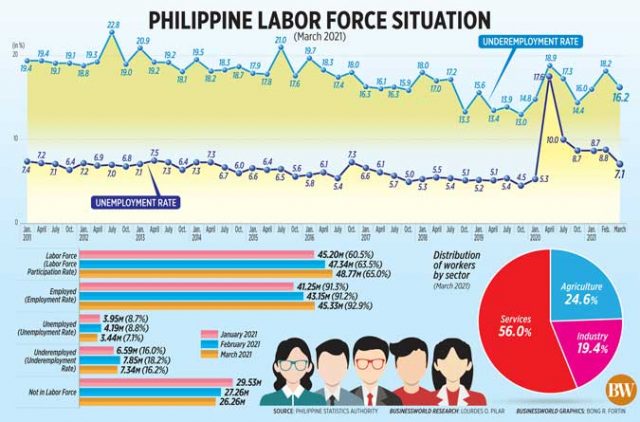
Philippine Labor Force Situation (March 2021)

THE COUNTRY’S jobless rate in March fell to its lowest level since the start of the coronavirus pandemic, the Philippine Statistics Authority (PSA) reported on Thursday. Read the full story.

Philippine Labor Force Situation (March 2021)

How PSEi member stocks performed — May 6, 2021

Here’s a quick glance at how PSEi stocks fared on Thursday, May 6, 2021.


Peso climbs further as PHL unemployment rate eases 

BW FILE PHOTO

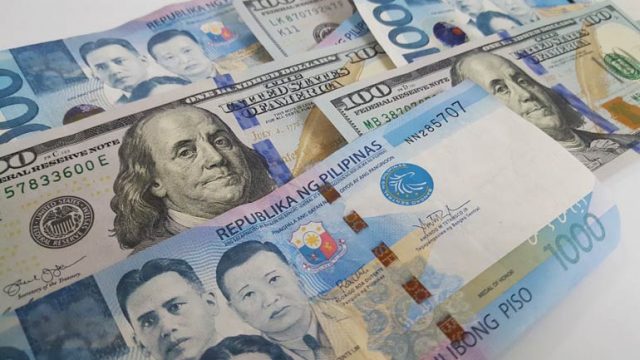
THE PESO appreciated further against the dollar on Thursday after latest data showed the country’s unemployment rate eased in March.

The local unit closed at P47.98 versus the greenback on Thursday, gaining 4.5 centavos from its P48.025-per-dollar finish on Wednesday, based on the data on Bankers Association of the Philippines’ website.

The peso opened the session at P48 per dollar and weakened to as low as P48.025. Meanwhile, its intraday high was at P47.935 versus the greenback.

The country’s improved unemployment rate boosted the peso versus the dollar, Rizal Commercial Banking Corp. Chief Economist Michael L. Ricafort said in a Viber message.

The Philippine Statistics Authority reported on Thursday that the number of jobless Filipinos went down to 3.441 million in March from 4.187 million in February.

This resulted in a 7.1% unemployment rate for that month, the lowest since the 5.3% in January 2020, as well as the record 17.6% in April 2020.

The underemployment rate, or the proportion of those already working but still looking for more work or longer working hours, likewise eased to 16.2% in March from 18.2% the month before.

Other positive developments also supported the peso, Mr. Ricafort said, such as the arrival of more coronavirus vaccines and the agreement lawmakers and the government’s economic team reached on pork import tariffs. 

The Agriculture department said senators and the economic team agreed that the tariff rates in Executive Order 128 will be raised to 10% for in-quota and 20% for out-quota imports for the first three months; and 15% in-quota and 25% for out-quota for the next nine months.

The two departments also agreed to reduce the minimum access volume threshold to 254,210 metric tons (MT) from 404,000 MT previously, in a bid to temper high inflation while preventing a serious hit to the local hog industry.

Mr. Ricafort expects the peso to range from P47.93 to P48.03 versus the dollar on Friday. — B.M. Laforga

Stocks drop further on fresh inflation concerns

PHILIPPINE STAR/KRIZ JOHN ROSALES

STOCKS continued to decline on Thursday as the possibility of an increased pork tariff rate caused renewed concerns over inflation, dampening market sentiment.

The benchmark Philippine Stock Exchange index (PSEi) declined by 16.91 points or 0.26% to close at 6,282.78 on Thursday, while the broader all shares index lost 2.78 points or 0.07% to end at 3,879.65.

China Bank Securities Corp. Research Associate Jason T. Escartin said market sentiment stayed weak due to the possibility of an increase in pork tariffs, “which may fan inflation concerns anew.”

“While the compromise agreement between local hog raisers and government is likely to hurt short-run market sentiment due to its impact on inflation expectations, we think this reduces the uncertainty around a sharper policy reversal in [the second half of the year],” Mr. Escartin said via e-mail.

The government’s economic managers the Senate have compromised to set the pork tariff rate at 10% should it be within the minimum access volume (MAV) quota in the first three months, with a five percent increase to 15% for the next nine months.

Meanwhile, pork tariff rates for imported goods beyond the MAV quota were recommended to be set at 20% for the first quarter, which will increase to 25% in the next nine months.

“Reports of additional doses of the AstraZeneca vaccine and the arrival of Pfizer vaccines this month, which almost doubles the expected number that will arrive in May, failed to generate optimism among investors,” AAA Southeast Equities, Inc. Research Head Christopher John J. Mangun said in a separate e-mail.

“Skepticism is the prevailing sentiment as most would prefer to wait for actual results rather than speculate on potential positive developments. Trading volumes picked up slightly but remained below the average,” he added.

Value turnover increased to P5.28 billion on Thursday with 13.84 million issues traded, from the P3.89 billion with 4.15 billion shares switching hands on Wednesday.

Sectoral indices were split on Thursday. Holding firms went down by 105.09 points or 1.64% to 6,269; mining and oil fell by 122.19 points or 1.27% to end at 9,451.47; and services inched down by 4.81 points or 0.33% to 1,425.42.

Meanwhile, property gained 44.33 points or 1.46% to close at 3,074.24; industrials went up by 53.68 points or 0.62% to 8,610.28; and financials improved by 3.71 points or 0.26% to finish at 1,397.79.

Net foreign selling went down to P460.67 million on Thursday from the P653.37 million seen in net outflows logged on Wednesday. Decliners outperformed advancers, 126 versus 77, while 44 names closed unchanged.

“The PSEi is currently down 1.5% for the week and it may continue lower towards its 6,180 support,” Mr. Mangun said.

“Current valuations offer an opportunity to buy into beaten-down blue chips, especially as recovery expectations pick up over the medium-term alongside vaccine arrivals,” China Bank Securities’ Mr. Escartin added. — Keren Concepcion G. Valmonte

Duterte orders police to arrest mask violators

PHILSTAR

By Kyle Aristophere T. Atienza and Vann Marlo M. Villegas, Reporters

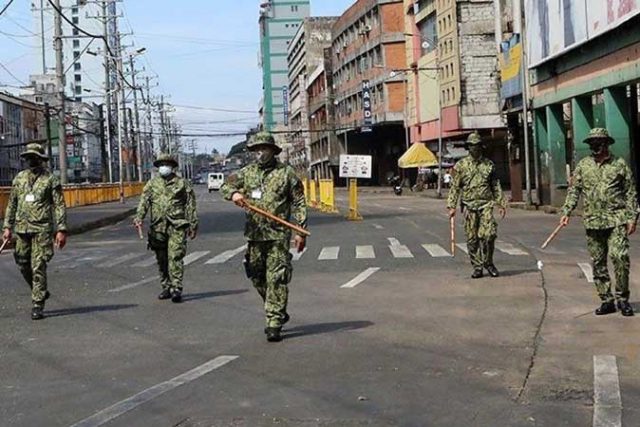
PHILIPPINE President Rodrigo R. Duterte ordered police to arrest anyone wearing a face mask improperly, as his government struggles to contain surging coronavirus infections.

“Arrest them and detain them, investigate them why they are doing it,” he said in a televised speech on Wednesday night. Violators could be detained for nine hours.

He said state efforts to contain the pandemic would fail if he doesn’t tighten the rules.

Thousands have been punished for violating pandemic rules since the capital region and nearby provinces were placed under a strict lockdown after a fresh surge in COVID-19 infections, according to the police.

The Justice department earlier asked law enforcers to just let violators perform community service after a man from the Southern Tagalog region died after police forced him to do 300 squats for breaching health standards.

But Mr. Duterte said police should arrest violators as hospitals get overwhelmed. He added that public funds were running out.

His spokesman Herminio “Harry” L. Roque, Jr. said rule breakers could be detained for as long as 12 hours.

“We need to enforce minimum health standards — that’s the President’s order,” he told a televised news briefing in Filipino on Thursday.

“The president’s directive is part of the government’s strategy of strictly implementing health protocols, such as wearing of face masks, so that the spread of the disease is put under control and the full opening of the economy is accelerated,” Justice Secretary Menardo I. Guevara told reporters in a Viber message.

He said the order takes effect immediately even without guidelines.

The arrest order is “brazenly unscientific and ineffective” and a “disproportionate use of force,” human rights group Karapatan said in a statement.

“The militarist and punitive framework of policing the pandemic in the form of policies resulting in mass arrests and detention of alleged violators runs counter to the purpose of quarantine protocols which is to protect and uphold people’s health,” it said.

The group said detaining hundreds of alleged violators in already cramped facilities where physical distancing is impossible could lead to more infections.

“Congestion and inhumane conditions in the country’s detention facilities already pose risks to the health of prisoners,” it added.

“That these pronouncements came from none other than President Rodrigo Duterte himself only shows that this policy of mass arrests under the quarantine is a state policy — and they should be a cause for alarm,” Karapatan said.

The policy  would lead to more human rights violations, it added.

CASE TALLY
The Department of Health (DoH) reported 6,637 coronavirus infections on Thursday, bringing the total to 1.08 million.

The death toll rose by 191 to 17,991, while recoveries increased by 6,091 to 999,011, it said in a bulletin.

There were 63,170 active cases, 1.2% of which were critical, 94.3% were mild, 1.9% did not show symptoms, 1.6% were severe and 1.03% were moderate.

The agency traced the low tally to fewer samples processed by laboratories on Tuesday.

DoH said 20 duplicates had been removed from the tally, 13 of which were tagged as recoveries. It added that 109 recoveries were reclassified as deaths. One laboratory failed to submit data on May 4.

About 11.3 million Filipinos have been tested for the coronavirus as of May 4, according to DoH’s tracker website.

The coronavirus has sickened about 155.9 million and killed 3.3 million people worldwide, according to the Worldometers website, citing various sources including data from the World Health Organization.

About 133.3 million people have recovered, it said.

Meanwhile, the Health department said 149 passengers with travel history to India arrived from April, citing data from the Bureau of Quarantine.

It said five of the 149 travelers had tested positive for the coronavirus, one of whom was isolated, while the four were still being verified.

A total of 137 people had tested negative, while the results of seven others were still being verified, the agency said.

Of the 149 travelers, 129 were Filipinos and 20 were foreigners.

The Philippines imposed a 16-day travel ban on India starting on April 29 due to a surge in cases there. 

Meanwhile, Mr. Roque said Mr. Duterte would still receive a second dose of the vaccine developed by China’s Sinopharm Group Co., Ltd, after he asked the Chinese government to take back the vials it donated.

Critics have slammed Mr. Duterte for getting the vaccine that was yet to be approved for emergency use in the Philippines.

Mr. Roque said the dose that the President received was covered by a compassionate use permit for 1,000 doses donated by China to presidential guards.

The local Food and Drug Administration earlier said the Chinese drug maker had not received an emergency use authorization from any stringent regulatory bodies in other countries.

Despite apologizing to health experts for receiving the shot, Mr. Duterte said he received the shot legally. He added that his decision was made upon the advice of his doctors.

Meanwhile, Senator Christopher Lawrence T. Go said the country would take delivery of about 1.5 million doses of the vaccine developed by China’s Sinovac Biotech Ltd. this week. The shipment was paid for by the Philippine government.

Vaccine czar Carlito G. Galvez, Jr. earlier said the country would take delivery of about 1.3 million doses of the vaccine developed by Pfizer, Inc. this month.

Of the total, about 193,000 doses will arrive next week, he said at the same briefing.

Mr. Galvez said as many as two million doses of the vaccine made by AstraZeneca, Plc would arrive this month. — with Bianca Angelica D. Anago

Duterte belittles UN ruling; Palace says remarks for critics

PCOO

PRESIDENT Rodrigo R. Duterte on Wednesday night belittled the country’s 2016 legal victory against China, saying an international tribunal’s decision rejecting China’s claim to more than 80% of the South China Sea was just a piece of paper that could end up in a trash bin.

“I pursued it but nothing happened,” he said in a televised speech in Filipino on Wednesday night. He added that between scalawags, one could always say that “it’s just a piece of paper and I would throw it in the waste basket.”

Mr. Duterte in September told the United Nations General Assembly he would reject any attempts to undermine the arbitral ruling.

“The award is now part of international law, beyond compromise and beyond the reach of passing governments to dilute, diminish, or abandon,” he said at the time.

Mr. Duterte had sought closer trade and investment ties with China since he came to power in 2016, including potential joint explorations for oil and gas in the South China Sea.

That speech should be the “most authoritative declaration of the Duterte administration’s policy on the West Philippine Sea,” his spokesman Herminio “Harry” L. Roque, Jr. told a televised news briefing on Thursday, referring to areas of the South China Sea within the country´s exclusive economic zone.

He said the President’s latest remarks were only aimed at critics including retired Supreme Court Justice Antonio T. Carpio and former Foreign Affairs Secretary Albert del Rosario, who have repeatedly urged the administration to stop its appeasement policy.

He said Mr. Duterte’s remarks about throwing the ruling in the waste basket were made from the viewpoint of the Chinese government that refuses to acknowledge it.

Meanwhile, Mr. Carpio said he had accepted Mr. Duterte’s challenge for a debate on the South China Sea dispute.

The President earlier accused Mr. Carpio of having been involved in the decision to withdraw Philippine Navy ships from the waterway during a standoff with China on the Scarborough Shoal in 2012.

He said he would resign if anyone could prove him wrong.

“President Duterte should now resign immediately to keep his word of honor,” Mr. Carpio said in a statement, adding that he was stating under oath that he was never involved in the decision.

“I was serving in the Supreme Court at that time and all I knew about the withdrawal of Philippine Navy ships was what I read in the newspapers,” he said.

“I call as my witnesses former President Benigno Aquino III and the Defense secretary, Foreign Affairs secretary and the chiefs of the Philippine Navy, Air Force and Coast Guard at that time.”

Mr. Carpio has questioned Mr. Duterte’s alleged failure to lobby for the enforcement of the 2016 Hague ruling.

The United Nations tribunal in July 2016 ruled China’s efforts to assert control over the South China Sea exceeded the law, rejecting its shared claims with Taiwan to more than 80% of the main waterway.

China rejected the decision of the international court, which has failed to halt its island-building activities in areas also claimed by the Philippines, Vietnam, Brunei, Malaysia and Taiwan.

The court rebuffed years of Chinese activity in the disputed sea under President Xi Jinping, whom Mr. Duterte will meet during a visit to China later this month.

Mr. Duterte’s predecessor sued China before the Hague tribunal. Mr. Aquino also strengthened Philippine alliance with the US to try to check China’s expansion in the main waterway. — Kyle Aristophere T. Atienza and Bianca Angelica D. Añago

Minority solons push for P10,000 cash aid per Filipino

REUTERS

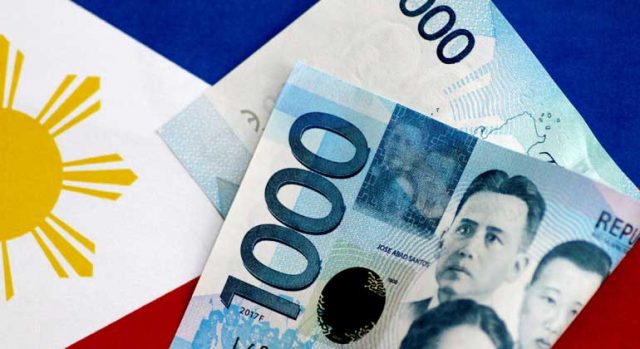
A MINORITY bloc of lawmakers called on their colleagues in Congress to increase the cash aid to P10,000 per Filipino under the proposed third law relating to the coronavirus pandemic.

“We urge the House leadership to consider raising the cash aid in the Bayanihan III substitute bill to a fixed amount of P10,000 from P1,000 as food and other basic commodities remain expensive while transport and fuel costs are soaring amid rising global oil prices,” Gabriela Women’s Party-list Rep. Arlene D. Brosas, a member of the Makabayan Bloc, said in a statement on Thursday.

House of Representatives members who are part of the technical working group drafting the bill said earlier this week that the planned cash aid is P2,000 per citizen, regardless of social status, to be distributed in two tranches of P1,000 each.

Previous cash aids were given only to the poorest households based on a list from the Department of Social Welfare and Development.

The Makabayan Bloc said their proposed higher financial aid can be funded by reallocating the budget of the National Task Force to End Local Communist Armed Conflict.

The third Bayanihan law was recently approved by three committees in the House. It’s passage will be the top priority of the House lawmakers once session resumes on May 17. — Gillian M. Cortez

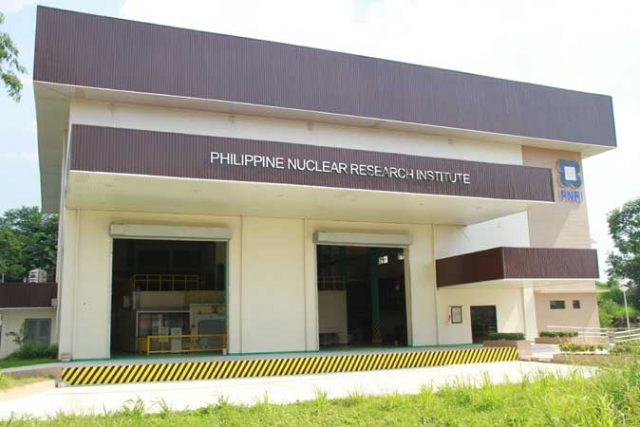
Gov’t directs nuclear energy education campaign on high school students, teachers

PNRI.DOST.GOV.PH

THE DEPARTMENT of Energy (DoE) and Department of Science and Technology’s Philippine Nuclear Research Institute (DOST-PNRI) have rolled out a series of educational materials on nuclear science and technology to broaden public awareness and improve public perception on the fuel source.

The learning materials, geared towards high school teachers and students, consist of online booklets and videos, and modules for exclusive use in the DOST-Science Education Institute’s Science Explorer Bus.

“I’m optimistic that through the projects… our youth will gain unbiased knowledge that would serve as a strong foundation before they proceed to higher levels of learning,” Energy Secretary Alfonso G. Cusi said in a taped message shown during the launch.

“We decided to develop this project (beginning in) 2019 as part of our efforts to promote nuclear energy awareness and improve public perception on the acceptance of the subject,” he added.

An advocate of integrating nuclear energy in the country’s power mix, Mr. Cusi said the mothballed Bataan Nuclear Power Plant (BNPP) has been “unfortunately demonized” into dormancy.

“In my opinion, had we been able to seize the opportunity to operate the BNPP, our present economic landscape would probably resemble those of our more industrialized neighbors like South Korea (and) countries that were able to pursue nuclear power programs despite the socioeconomic challenges of those times,” he said.

Mr. Cusi added that the decision on whether the country will go nuclear will entail a national consensus, including strong acceptance from the public on the fuel source.

He said the most effective way to get broader support is through education.

During the event, PNRI Director Carlo A. Arcilla said educating teachers and students under the K-12 curriculum was crucial in overcoming misunderstandings on nuclear power.

In December last year, the DoE said its nuclear energy program inter-agency committee had submitted its recommendations to President Rodrigo R. Duterte.

The group was tasked to conduct a study adopting a national position on a nuclear energy program. — Angelica Y. Yang

Duterte, Saudi crown prince tackle Kafala system, workers’ welfare

DFA-OUMWA
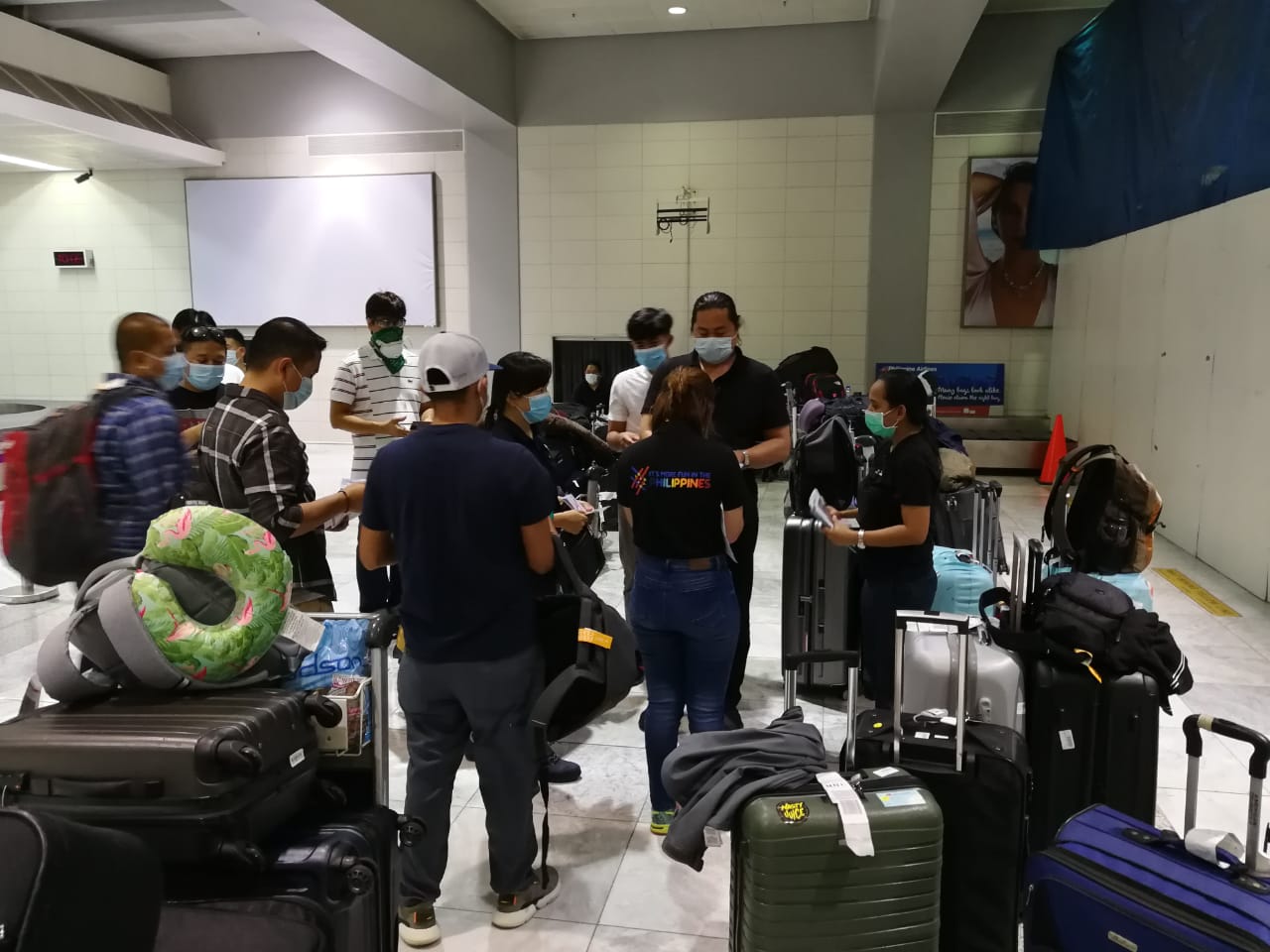
Employees of the Nasser S. Al Hajri Corporation in Dammam, shown here arriving in Manila in May 2020 with assistance from the Department of Foreign Affairs, are among the over 980,000 Filipinos working in Saudi Arabia. — DFA-OUMWA

PHILIPPINE President Rodrigo R. Duterte and Saudi Arabia Crown Prince Mohammed bin Salman spoke on the phone Wednesday night where they discussed the welfare of Filipino workers in the Middle Eastern country and the Kafala system, according to the presidential palace.

Presidential Spokesman Herminio “Harry” L. Roque, Jr. told a televised news briefing on Thursday that Saudi Arabia is leading the campaign against the Kafala system.

“So the discussion was centered on that and how to strengthen the protection given to Filipino workers in Saudi Arabia,” he said in Filipino.

The Council on Foreign Relations defines the Kafala as a sponsorship mechanism that gives private employers almost total control over the migration and employment status of overseas workers.

Mr. Duterte last month described Kafala as “unjust and exploitative” and called for its abolition.

There are more than 983, 000 Filipinos workers in Saudi Arabia, according to the Labor department.

Mr. Roque said the two leaders also talked about viable ways to end the pandemic, noting that the two leaders agreed that a “system” must be created to ensure that poor and rich nations will have access to vaccines. — Kyle Aristophere T. Atienza

Senate leader eyes hearing on ivermectin

SENATE.GOV.PH

THE SENATE might conduct a hearing on the use of anti-parasitic drug ivermectin as potential treatment for coronavirus.

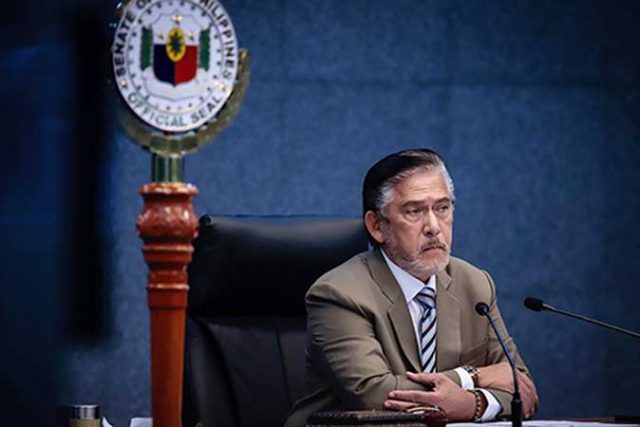
Senate President Vicente C. Sotto III, who admitted that he takes ivermectin every two weeks, said those who want to use the drug should be allowed to do so.

“Ang sinasabi ko, yung gustong gumamit, hayaang gumamit (What I am saying is, those who want to use it, let them use it),” he told an online briefing.

Ivermectin is authorized by the Philippine Food and Drug Administration (FDA) for animal use.

The FDA recently issued a so-called Compassionate Special Permit for its use as treatment for coronavirus patients, but only to six hospitals.

Mr. Sotto, speaking in a mix of English and Filipino, cited that there are many other “food and drugs” that do not go through the FDA but have long been used by “people worldwide.”

He questioned why there is a sudden heated debate over the drug, noting that some doctors recommend its use.

FDA and Department of Health officials as well as various groups of medical practitioners have said that there is no conclusive scientific evidence indicating ivermectin’s efficacy against the coronavirus.

Mr. Sotto said he might be “tempted” to deliver a privilege speech on the matter within the first or second week after Congress sessions resume on May 17.

“Maganda niyan magkaroon tayo ng hearing tungkol diyan (It would be good that we have a hearing on that),” he said. — Vann Marlo M. Villegas

Davao City airport reopens to all types of flights

BW FILE PHOTO/ LSDAVAL JR.

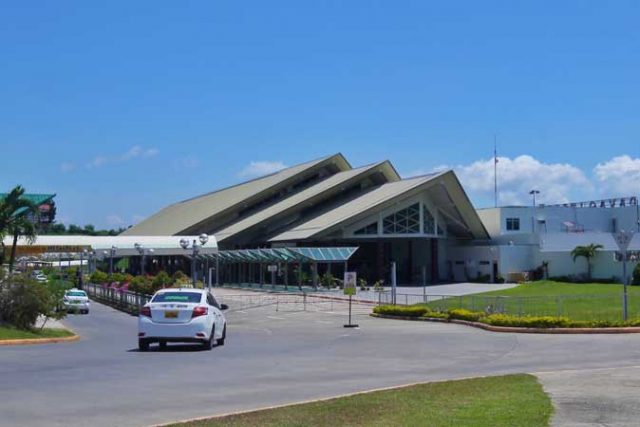
THE DAVAO International Airport is now open to all kinds of flights after the city government issued an order on May 5 lifting earlier restrictions imposed to mitigate the spread of coronavirus.

“The resumption of all kinds of flights, such as scheduled international flights, unscheduled domestic commercial flights (chartered), and other general aviation flights to and from Davao City is hereby allowed,” reads Executive Order No. 26 signed by Davao City Mayor Sara Duterte-Carpio.

The order comes after the Civil Aviation Authority of the Philippines, which manages the airport, requested in a May 4 letter to the mayor for a resumption of full operations to “allow for more economic activities insofar as civil aviation is concerned.”

All incoming passengers are still required to have a negative RT-PCR test result for coronavirus disease 2019 (COVID-19) taken within 72 hours before arrival.

Those who are unable to bring a result will be subject to testing at the airport and pay the P4,500 cost.

Passengers who present a false or tampered result will also be required to undergo testing at their own expense, placed in a quarantine facility, and pay fines based on local and national laws.

The Davao airport, formally named Francisco Bangoy International Airport, is the only one in Davao Region and serves as one of the main gateways in Mindanao.

Davao Region, with a population of at least five million, has managed to keep COVID-19 cases relatively low with 912 active patients as of May 5 out of the 23,613 total recorded since the start of the pandemic. There were 987 deaths and 21,752 recoveries.

Of the active cases, Davao City had the highest at 356, followed by Davao del Norte with 257 and Davao de Oro with 159. The rest are in Davao del Sur, 68; Davao Oriental, 23; and Davao Occidental, 11. — Marifi S. Jara