Home Blog Page 8087

Halston: The glittering rise — and spectacular fall — of a fashion icon

NETFLIX.COM

WALK into any department store, and you’ll get a sense of the powerful brands built by high-end American designers: Calvin Klein, Michael Kors, Ralph Lauren, Donna Karan. They created veritable fashion empires by leveraging their names to create lower-priced lines and sign profitable licensing agreements.

But before them all, there was Roy Halston Frowick — better known by the singular appellation Halston.

The subject of an eponymous Netflix miniseries starring Ewan McGregor, Halston became one of the earliest American designers to extend his brand to multiple price points. In doing so, he made designs that were normally out of reach for everyday Americans available to the masses.

But as fashion historians, we’ll often tell Halston’s story as a cautionary one. Though he made style seem effortless, his relationship with the fashion industry was anything but uncomplicated.

A born-and-bred Midwesterner, Halston found early success in hat design working as a custom milliner for Bergdorf Goodman. Halston soon became known as a trendsetter, and, in a notable triumph for the young designer, first lady Jacqueline Kennedy wore one of Halston’s signature pillbox hats at her husband’s inauguration.

Later in the 1960s, Halston made the foray into dress design. His success was equal parts talent and serendipity, and he once described his approach as “editing the mood of what’s happening.”

Although overt simplicity may seem incongruous with grandeur, Halston garments were both understated and luxurious.

Halston’s body-skimming silk chiffon caftans, jersey wraparound dresses and long cashmere sweaters were often constructed using just one piece of fabric. They covered the body fully, but through careful manipulation of the fabric — wrapping, draping and twisting — Halston’s pieces were sensuous and flattering.

Halston was even able to turn Ultrasuede — a soft, synthetic, machine-washable faux suede — into a status symbol, molding it into elegant shirtdresses and coats. These became popular despite — or maybe because of — their utter plainness. His garments were fitting for the 1970s, when a shaky economy made flagrant displays of wealth unseemly.

Yet the designer’s social life was the opposite of understated. In fact, the image of fashion design as a glamorous and exciting profession owes much to Halston. During his heyday, he was at “the top of the fashion show-biz heap,” as Women’s Wear Daily publisher John Fairchild once wrote.

At the legendary Studio 54, he mingled with Bianca Jagger and Andy Warhol. The world-famous disco club became both a showroom for Halston’s designs and a stage for the man himself, and Halston was often accompanied by an entourage of beautiful women known as “the Halstonettes.”

As his stature grew, Halston always looked for ways to expand his fashion empire.

Early in his career, he experimented with what’s known as “brand diffusion” — which is companies’ use of the same brand name on items at varying price points.

His high-end line was Halston Ltd., a made-to-order, ready-to-wear business. Located on New York City’s Madison Avenue, it catered to an exclusive list of private clientele that included film and television stars like Lauren Bacall, Greta Garbo, Liza Minelli, and Elizabeth Taylor.

Meanwhile, the Halston Originals boutique sold dresses to department stores across the country, with prices ranging from $150 to over $1,000. And with Halston International, the designer created “component” knit pieces — not outfits, but singular garments, turtlenecks, sweater sets, shirts, and coats that consumers could mix and match to their delight.

After the business conglomerate Norton Simon, Inc. acquired the Halston businesses in 1973, Halston remained lead designer of his many collections. He worked at a frenetic pace, creating all of the uniforms for the winter and summer 1976 US Olympic athletes and making costumes for Martha Graham’s ballet production Lucifer. Products bearing his name included perfumes, luggage, home linens, coats, rainwear, and even wigs. By 1983, Halston Enterprises was generating an estimated $150 million in annual sales.

Perhaps emboldened by his success or motivated by his heartland roots, Halston signed with JCPenney in 1983 for the creation of an exclusive line that was, as he put it, “for the American people.”

With items priced from $24 to $200, the “III line” marked a new era in fashion and retailing.

While high-end fashion designer Pierre Cardin pioneered this form of licensing in Europe, the project of pairing a high-fashion designer with a mass merchandiser best known for selling Levi’s, hardware, and household goods was unusual in the United States. While Halston contended it was immensely successful, claiming it generated $1 billion in sales, JCPenney’s executives were less enthusiastic. By the mid-1980s, industry insiders were suggesting that the garments were not selling as well as expected.

The JCPenney’s deal ultimately proved to be damaging for Halston. Wary high-end retailers, including his early employer, Bergdorf Goodman, were fearful that the prestige of the Halston name was sullied by its presence on the racks of a mass-market merchandiser. Bergdorf Goodman eventually dropped his line altogether.

Meanwhile, Halston’s growing reputation of excessive spending and erratic behavior increasingly left his brand to the decisions of businessmen and creative control to other parties. Halston was relegated to the sidelines, and his corporate deals effectively cost him the right to his own name.

In 1988, Halston was diagnosed with AIDS. He lived out of the public eye until his death in 1990.

Despite its eventual failure, Halston’s pairing with JCPenney was truly ahead of its time.

Citing the importance of creating practical, easy-care leisurewear for working women and young mothers, Halston tried to offer a fashionable wardrobe at reasonable prices that nearly everyone could afford.

Contemporaries such as Anne Klein, Calvin Klein, Ralph Lauren, and Kenzo Takada would immediately try out similar diffusion lines. All pulled it off without suffering the extraordinary professional cost that Halston endured.

These designers’ corporate and creative decisions were arguably more tightly controlled than Halston’s devil-may-care diffusion. Acquisitions of these companies by larger conglomerates occurred much later than Halston’s, often decades into the brand’s existence. Perhaps this gave additional time for these brands to arrive at a more singular vision.

Maintaining a consistent direction over such a diverse array of lines proved unfeasible for Halston, and something was lost along the way: the cachet and the allure that made a Halston a Halston.

Halston’s successes and ultimate downfall have provided a cautious inspiration. Isaac Mizrahi’s 2003 collaboration with Target — 20 years after Halston’s pairing with JCPenney — became a boon for both parties.

It was not, however, without trepidation. In 2019, Mizrahi reminisced that the partnership “was a very scary thing. Halston was my idol … and he had failed.”

Relationships between designers and retailers are now commonplace in a climate where the most fashionable and visible of women freely mix and match mass market and luxury items, and designers deftly jump between discount retail and the runway.

Halston’s brand lives on, but resuscitating it has been a long process. Fashion heavyweights Kevan Hall and Marios Schwab, as well as style figures Rachel Zoe and Sarah Jessica Parker, have lent their creativity and business acumen to the brand, with limited success.

With the release of Netflix’s Halston, a new revival is at hand: not of the line, but of the personality that for a comparatively brief but glittering — moment, ruled the fashion world with devastating simplicity.


Jennifer Gordon is a Lecturer of Apparel, Events and Hospitality Management at the Iowa State University. Sara Marcketti is a Professor of Apparel, Events, and Hospitality Management, at the Iowa State University


DITO Telecommunity launches mobile services in NCR

DITO Telecommunity Corp. has started offering its mobile services in the National Capital Region (NCR) and other parts of the country on Monday.

The move brings up the telco company’s presence to 100 cities and municipalities.

“We are now available in 16 cities and one municipality in NCR. Among these are Quezon City, Paranaque, Taguig, Makati, San Juan, Malabon, Valenzuela and Marikina,” DITO’s Chief Administrative Officer Adel A. Tamano said during a press briefing.

The company also announced that 29 more areas in Luzon and Visayas can now avail of DITO’s services. Some of these are Taytay, Cainta, Meycauayan, Subic, Olongapo, and Angeles.

Mr. Tamano said that subscribers can enjoy 25GB of high-speed data for 30 days from May 17 to June 30 for P199. The offer comes with free unlimited texts to all networks, unlimited DITO to DITO calls and free 300 minutes of calls to other networks.

The welcome offer will be available for purchase in various channels, including DITO stores, device retail partner outlets, the DITO online store, and Shopee and Lazada.

“DITO’s presence in the NCR can only mean a healthier competition among the country’s leading telcos, ensuring better telco services… for every Filipino,” Gamaliel A. Cordoba, the National Telecommunications Commission commissioner said during the briefing.

At present, DITO is available in more than 3,000 stores nationwide.

During the event, DITO Chairman and Chief Executive Officer Dennis A. Uy said that network optimization has been happening at “full-speed.”

“Tower and infrastructure rollout have continued unabated despite the pandemic to ensure that our subscribers numbering close to half-a-million Filipinos continue to enjoy top notch experience — speed and service we truly deserve,” Mr. Uy said.

The company will continue to expand to match its revenues to reach its 51% population coverage target in time for DITO’s second-year audit, Chief Technology Officer Rodolfo D. Santiago said.

“We would like to, of course, cover the rest of the country. By July of this year, we are expecting to meet the 51% population coverage as mandated. Next year, (our target is to reach) 70%,” Mr. Santiago said.

In the three months ending March, DITO’s attributable net income to its parent declined by around 70% to P8.24 million year on year.

Shares in DITO at the local bourse declined by 10% or 89 centavos to finish at P8.10 apiece on Monday. — Angelica Y. Yang

Huarong secures funding backstop from state banks through August

CHINA HUARONG Asset Management Co. has reached funding agreements with state-owned banks to ensure it can repay debt through at least the end of August, by which time the company aims to have completed its 2020 financial statements, people familiar with the matter said.

The liquidity support, arranged under the guidance of China’s financial regulator, means Huarong can obtain financing from lenders such as Industrial & Commercial Bank of China Ltd. (ICBC) if needed, the people said, asking not to be identified as the matter is private. The distressed debt manager has been effectively shut out of the offshore bond market since the end of March, when it spooked investors by missing a deadline to disclose 2020 results.

Huarong plans to finish its annual report before the end of August, the people said. It’s unclear whether the funding backstop from state banks will be extended beyond that point.

While big questions remain about Huarong’s long-term plans to overhaul its business, the funding arrangement suggests the embattled firm still enjoys near-term financial support from China’s government.

Authorities may be keen to avoid any major market disruptions around the politically sensitive 100th anniversary of the ruling Communist Party on July 1. Huarong has the equivalent of $2.83 billion in offshore and onshore bonds coming due through August, including a dollar bond that matures on Thursday, data compiled by Bloomberg show.

The company has become a closely watched proxy for China’s willingness to backstop government-owned borrowers amid a record wave of corporate defaults. Investors have grown concerned about Huarong’s financial health — and its level of support from Beijing — after an ill-fated expansion under former Chairman Lai Xiaomin, who was executed for crimes including bribery in January.

Market sentiment toward Huarong has deteriorated in recent days after Caixin Media’s WeNews reported that the company was urged by regulators to solve its financial issues on its own. While bond prices indicate investors are still betting Huarong will meet its near-term obligations, there’s far less certainty now than before the company’s earnings delay jolted the market.

Huarong’s $400 million bond maturing in July, which traded at par before the delay, is now priced at about 94 cents — an unusually steep discount for an issuer that’s still considered by the major international ratings firms to be investment grade. The company’s $1.5-billion perpetual bond is trading at about 63 cents, reflecting even bigger doubts about its long-term prospects.

Losses have recently spread from the offshore market to several of Huarong’s bonds onshore. A 2023 note issued by the company’s securities unit plunged 18.8 yuan to 80 yuan on Monday, according to Shanghai fixed-income trading platform prices compiled by Bloomberg. One of the company’s onshore notes due 2022 sank to a record low last week.

Huarong, the China Banking and Insurance Regulatory Commission (CBIRC) and ICBC didn’t immediately reply to requests for comment.

Huarong said in a response to questions from Bloomberg last week that it’s prepared to make future bond payments and has seen no change in support from China’s government. The company repaid its S$600-million ($452-million) bond due April 27 with funds provided by ICBC’s Singapore branch, people familiar with the matter said last month.

China’s government has so far been quiet about Huarong’s fate, apart from comments by the CBIRC last month that the company was operating normally and had ample liquidity. Defaults at state-backed firms have increased in recent years as President Xi Jinping dialed back support for weaker borrowers to reduce moral hazard, though none of those that missed payments were as systemically important as Huarong.

The company owes domestic and international bondholders the equivalent of about $41 billion and ranks among the biggest Chinese issuers in offshore markets. It is majority owned by China’s Ministry of Finance and is deeply intertwined with the nation’s $54-trillion financial industry.

Any default by Huarong would undermine a longstanding assumption that China’s government will always step in to help to important state companies in times of trouble. — Bloomberg

New condo to rise in Tagaytay Highlands

HIGHLANDS PRIME, Inc. unveiled the newest residential condominium in Horizon Terraces in Tagaytay Highlands.

The company in a statement said Garden Suites is a five-storey, low-density residential condominium sitting on 3.2 hectares of land, near the Midlands Golf Course.

Garden Suites offers one- and two-bedroom units with sizes from 43 to 68 square meters.

“Balconies on the higher floors of the Garden Suites offer the best vantage points for viewing Taal Lake & Volcano. Ground floor units, on the other hand, have terraces ideal for mindful communing with nature,” the company said.

Horizon Terraces has dedicated 70% of its land area to recreational and open garden spaces.

Similar to Tagaytay Highlands’ other themed residential projects, homeownership at Horizon Terraces’ Garden Suites comes with a membership to The Country Club, plus access to cable cars, sports facilities, and restaurants.

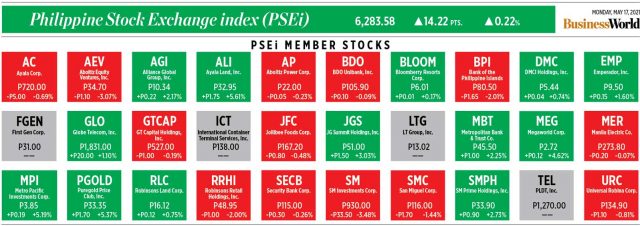
How PSEi member stocks performed — May 17, 2021

Here’s a quick glance at how PSEi stocks fared on Monday, May 17, 2021.


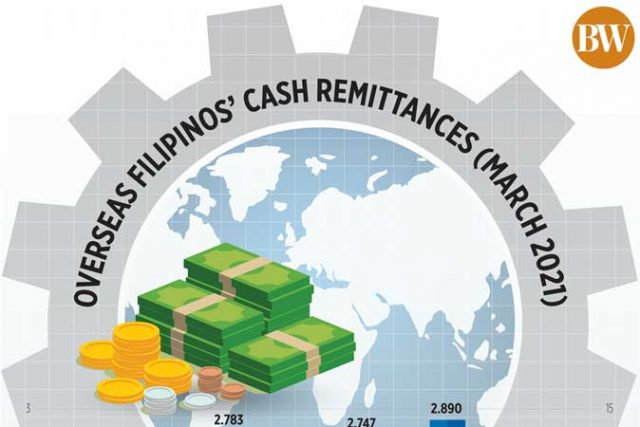
Overseas Filipinos’ Cash Remittances (March 2021)

CASH REMITTANCES from overseas Filipino workers (OFWs) rose by 4.9% in March as many host countries start to further ease pandemic-related restrictions as coronavirus disease 2019 (COVID-19) infections drop. Read the full story.

Overseas Filipinos’ Cash Remittances (March 2021)

Shares climb on bargain hunting ahead of data

PHILIPPINE shares posted gains on Monday on last-minute buying and as investors went bargain hunting ahead of the central bank’s release of latest remittance data.

The Philippine Stock Exchange index (PSEi) went up by 14.22 points or 0.22% to close at 6,283.58 on Monday, while the all shares index gained 10.43 points or 0.27% to end at 3,861.41.

“The PSEi managed to inch higher on last-minute buying, similar to last Friday’s trading,” AAA Southeast Equities, Inc. Research Head Christopher John Mangun said in an e-mail.

Mr. Mangun said market sentiment remained subdued, but there is now “more buying at the cheaper levels.”

“Investors are still very [cautious], but some traders are taking [advantage] by scooping up shares of companies that have been heavily oversold,” he added.

“Investors [are] doing slow accumulation on bargain hunting [because] you [have] cheap PSEi member stocks whose PE (price-to-earnings ratio) are near or even lower than their 10-year low but whose [first-quarter] earnings were above estimates and therefore currently unfairly priced,” First Metro Investment Corp. (FMIC) Head of Research Cristina S. Ulang said in a Viber message.

“Philippine investors are also awaiting the release of overseas remittances and foreign reserves [data] this year for market cues,” Regina Capital Development Corp. Head of Sales Luis A. Limlingan said in a separate Viber message.

Cash remittances from overseas Filipino workers rose by 4.9% to $2.514 billion in March from $2.397 billion in the same month last year, according to data released by the Bangko Sentral ng Pilipinas (BSP) after the stock market closed on Monday.

For the first quarter, cash remittances climbed by 2.6% year on year to $7.593 billion.

The BSP sees remittances growing by 4% this year versus last year’s 0.8% drop.

Most sectoral indices posted gains on Monday except for holding firms, which went down by 82.61 points or 1.3% to 6,262.26; and financials, which lost 4.11 points or 0.29% to finish at 1,395.19.

Meanwhile, property climbed by 106.31 points or 3.6% to 3,054.72; services went up by 6.65 points or 0.46% to 1,441.12; mining and oil increased by 24.51 points or 0.27% to 9,095.53; and industrials improved by 15.27 points or 0.17% to end at 8,573.98.

Value turnover went down to P5.02 billion on Monday with 2.31 billion shares switching hands, from the P11.06 billion seen on Friday with 4.18 billion issues traded.

Decliners outnumbered advancers, 99 versus 85, while 58 names closed unchanged.

Foreigners turned sellers anew, logging P354.07 million in net outflows on Monday versus the P2.04 billion in net purchases seen on Friday.

FMIC’s Ms. Ulang said she expects a “flattish market” this week, while AAA Southeast Equities’ Mr. Mangun said stocks may move higher in the coming sessions. — K.C.G. Valmonte

Peso drops vs dollar on oil prices

BW FILE PHOTO
THE peso dropped versus the dollar on Monday due to higher global oil prices seen last week. — BW FILE PHOTO

THE PESO weakened against the greenback on Monday as market sentiment took a hit from higher global oil prices seen last week after hackers shut down a major US pipeline.

The local unit finished trading at P47.855 per dollar on Monday, shedding 4.5 centavos from its previous finish of P47.81 against the greenback.

The peso opened Monday’s session at P47.80 per dollar, which was also its intraday best. Meanwhile, its weakest showing for the day was at P47.865 versus the greenback.

Dollars traded dropped to $567.19 million on Monday from $634.3 million on Friday.

The peso retreated versus the dollar due to higher global oil prices, which could increase the oil import bill of the Philippines and affect the local currency, Rizal Commercial Banking Corp. Chief Economist Michael L. Ricafort said in a text message.

Reuters reported that oil prices inched higher on Friday following Thursday declines. Brent crude oil futures rose 2.3% to $68.60 per barrel by 12:58 p.m. ET while West Texas Intermediate crude rose by $1.45 to $65.27.

On Monday, however, oil prices marked time after seesawing last week as the Colonial Pipeline restarted from a hacker shutdown.

Brent dipped 8 cents to $68.63 a barrel, while US crude lost 2 cents to $65.35 per barrel.

The dollar tracked the move in US yields, bouncing to 90.909 on a basket of currencies before steadying at its current 90.407.

Meanwhile, a trader attributed the peso’s weakness to preference for the dollar following release of key economic data abroad.

“The peso depreciated as global optimism dimmed following the weaker-than-expected Chinese retail sales report,” the trader said in an e-mail.

Chinese retail sales rose 17.7% in April on a year ago, short of forecasts for a jump of 24.9%, while industrial output matched expectations with a rise of 9.8%. The data, along with global inflation concerns, caused Asian markets to end mixed on Monday.

For Tuesday, Mr. Ricafort gave a forecast range of P47.80 to P47.90 per dollar, while the trader expects the peso to move within the P47.80 to P48 levels against the greenback. — LWTN with Reuters

PSE asked to report on SME participation in stock market

THE Philippine Stock Exchange (PSE) has been ordered to submit a progress report on the participation of small and medium enterprises (SMEs) in the stock market, amid a broader effort to encourage listings from small businesses.

In a statement Monday, the Department of Finance (DoF) said Secretary Carlos G. Dominguez III told Ramon S. Monzon, president and CEO of the PSE, to submit the report to the Capital Market Development Council. The report should tally the actual number of SMEs listed on the PSE, it said.

The PSE is currently rolling out a marketing campaign to inform small companies of the relaxed listing rules for initial public offerings, in a bid to encourage more small companies to go public.

Mr. Monzon said the PSE has been working with the Trade department and the Board of Investments to identify potential companies that are ready to go public.

The PSE in March relaxed listing requirements both for the main and the SME boards and has adopted “a measure that will gauge a company’s suitability for listing despite the challenges it is facing due to the pandemic.”

The changes include easier track record and operating history norms, with new guidelines for sponsor models in the case of those looking to list on the SME board through a sponsor company.

Mr. Monzon said more tools are available online for companies to assess their readiness to conduct IPOs. The same tools can also help investment houses make their own assessments of listing prospects.

Compliance struggles and the impact of the pandemic may have caused SMEs to shun listing on the exchange, Timson Securities, Inc. Trader Darren Blaine T. Pangan said in a Viber message.

“It may be the case that some SMEs still find it hard to satisfy the general criteria to be listed in the SME board, especially now that the pandemic may have severely impacted some of them,” Mr. Pangan said.

However, with some rules eased, he said more companies will likely be encouraged to go public in the coming quarters.

The PSE held an online forum on April 7 as part of its marketing campaign, in which 217 investment houses, law firms and other organizations participated to learn more about the amended listing rules.

A roundtable discussion is scheduled for May 25, he said, in which members of the Investment House Association of the Philippines, advisory firms, institutional clients and executives of leading targeted companies are expected to join.

Meanwhile, the government also provided technical support in preparing a capacity-building program for SMEs and startups, he said, with the help of the United States Agency for International Development.

Citing data from World Federation of Exchanges, the DoF said the Philippine stock market had only 268 listed firms, against 927 on Bursa Malaysia and 367 on the Hanoi Stock Exchange as of 2019.  — Beatrice M. Laforga

Comprehensive industry database needed to improve food production

JCOMP-FREEPIK

THE PHILIPPINES needs to develop a comprehensive farming-industry database to improve food production and GUIDE policy decisions, food advocacy group Tugon Kabuhayan said.

Tugon Kabuhayan co-convener Norberto O. Chingcuanco said in a virtual briefing Monday that especially for fisheries production, the government needs to compile updated information on volume and value of production in ponds, cages, and other areas where the commodities are located.

“Reliable data will guide us what and when to produce and help us evaluate whether imports are indeed necessary for a certain commodity and season,” Mr. Chingcuanco said.

He said food production can be improved by reducing the agriculture sector’s postharvest losses, noting that around 25% is usually lost in the supply chain.

He added that in terms of the fisheries subsector, the Philippines can produce more than it requires, with the surplus exportable.

“We can become a dominant exporter while still caring for and providing gainful economic growth to local communities. All these are possible if we produce efficiently, sustainably, and responsibly,” Mr. Chingcuanco said.

Mr. Chingcuanco added that the agriculture and fisheries sector can benefit from the development of better farm-to-market links while bringing to the mainstream value-added products and processing.

“A circuitous and relatively long multi-layered marketing chain in the fishing sector results in more losses and, of course, higher prices,” Mr. Chingcuanco said.

“If managed well, the industry will generate more jobs. We are also looking at promoting the consumption of processed commodities. This will definitely contribute to job creation. In our estimate, even if only half of the urban population patronizes deboned milkfish (bangus), this will create additional 7,000 jobs in a year. That is the beauty of value-adding,” he added.

Tugon Kabuhayan said it hopes the upcoming National Food Security Food Summit staged by the Department of Agriculture on May 18-19 will result in a clear plan for the farm sector.  

“The initiative is important to properly assess and plan for food security in light of the projected growth of the population and the many uncertainties brought about by the pandemic and the ongoing activities in the West Philippine Sea,” it said.  — Revin Mikhael D. Ochave

House committee approves tax breaks for companies hiring elderly workers

PHOTO FROM IREMIT.COM.AU

THE HOUSE Committee on Ways and Means approved tax measures on Monday that hope to encourage companies to provide work opportunities for older persons and former inmates via the grant of tax holidays for taking on such workers.

In a hearing Monday, the House tax panel approved the tax provisions with amendments for the unnumbered substitute bills that will, if passed, become the Former Prisoners Employment Act and the Mature or Older Workers Job Training Act.

The proposed Former Prisoners Employment Act consolidated House Bills No. 2774, 3322, 6044 and 6637 which will provide private-sector establishments incentives to hire former persons deprived of liberty (PDLs) to improve their chances of finding work.

The approved tax provision will grant businesses that employ former inmates a deduction from their gross income equivalent to 15% of the total salaries paid to former PDLs “provided, however that such employment shall continue for a period of at least six months: provided further that the annual threshold of income of the former prisoners shall be determined by the Department of Labor and Employment (DoLE) in consultation with the National Economic and Development Authority (NEDA) for that year.”

Albay Rep. Jose Ma. Clemente S. Salceda said in a statement Monday that the committee wants to improve the bill further to avoid potential employer abuse of PDL hires adding: “Under the current formulation, it’s very easy to hire, fire, and rehire PDLs to take advantage of deductions every year. We want a more airtight bill so that we can get this enacted.”

The panel also approved the tax provisions of the unnumbered substitute bill that will if approved become the Mature or Older Workers Job Training Act. The bill consolidated House Bills No. 1863, 1892, 4333 and 8349 which propose the creation of a job training program for workers over 40 years old who are unemployed; whose income does not exceed the poverty line; who have finished less than 10 years of schooling; or are homeless.

The committee approved a deduction from gross income for businesses that hire such workers equivalent to 15% of the total salaries paid to the mature workers provided that the employment lasts for at least six months, with the annual threshold of income determined by the DoLE and NEDA.

Separately, a bill proposing to cut taxes imposed on the honoraria and allowances of teachers serving as members of the Board of Election Inspectors hurdled committee on Monday.

Mr. Salceda said if the bill becomes law, it will result in the loss of about P56.8 million in withheld taxes, which he described as not threatening to the government’s revenue position. — Gillian M. Cortez

IPOPHL renews agreement with US patent office certifying it to assess international applications

THE UNITED STATES patent office has agreed to designate the Philippine intellectual property office a competent assessor of international patent applications.

The Intellectual Property Office of the Philippines (IPOPHL) recently renewed a 2015 partnership with the United States Patent and Trademark Office (USPTO).

Under the agreement, the two organizations cooperate on training, workshops, and information-sharing on best practices, IPOPHL said in a statement Monday.

The USPTO, through the renewed partnership signed on May 5, agreed to designate IPOPHL as a competent international searching and preliminary searching authority.

Such processes involve initial assessments to help applicants assess their chances of being granted international patents.

The USPTO also committed to help IPOPHL with intellectual property promotion, education, and commercialization.

“The first round of bilateral cooperation with USPTO had greatly benefited the IPOPHL as it enhanced our efficiencies in IP administration, management, patent and trademark examination and enforcement,” IPOPHL Director General Rowel S. Barba said.

“As we continue to carry out this partnership with added goals, IPOPHL and the USPTO will surely improve aligning our practices for the benefit of businesses in both countries and spur innovation at a time of crisis when it is most needed.”

The World Intellectual Property Organization has designated 23 international searching and preliminary searching authorities. IPOPHL is one of three in Southeast Asia. — Jenina P. Ibañez