Home Blog Page 7888

PXP Energy hopes to clinch service contracts in Sulu Sea, Recto Bank

PXP Energy Corp. is looking forward to securing service contracts for two areas in the Sulu Sea and Recto Bank as it hopes to revive petroleum activities and expand its portfolio, a top company official said on Friday. 

“With the aim to revitalize petroleum activities and to diversify the company’s asset portfolio, through the acquisition of new prospective areas, we look forward to being granted two new service contracts in the Sulu Sea and Recto Bank areas,” PXP Energy President Daniel Stephen P. Carlos said during the company’s annual stockholders meeting held virtually on Friday. 

The firm has applied for service contracts covering 40% of “Area 7” in Sulu Sea, and 100% of “Block A” in Recto Bank. 

PXP Energy’s existing portfolio includes the SC 74, SC 75 and SC 6A, all located in Northwest Palawan. 

Despite uncertainties brought about the pandemic, Mr. Carlos said the firm is seeing a slow but steady recovery in oil prices. 

“We look forward to a better second half of 2021 (as we) focus on the continuation and fulfillment of our work commitments in our operating and non-operating blocks, especially with the resumption of our offshore exploration activities in service contract 72 and 75,” he said. 

The Energy department previously allowed PXP Energy and its subsidiary Forum Energy Ltd. to resume work in the SC 75 and SC 72 blocks, respectively, after lifting the force majeure status in both areas. 

Shares of PXP Energy in the local bourse inched up by 3% or 23 centavos to finish at P7.93 apiece on Friday. 

PXP Energy is a unit of Philex Mining Corp., which in turn is one of the Philippine units of Hong Kong-based First Pacific Co. Ltd, the others being Metro Pacific Investments Corp. and PLDT Inc. 

Hastings Holdings, Inc., a unit of PLDT Beneficial Trust Fund subsidiary MediaQuest Holdings, Inc., has interest in BusinessWorld through the Philippine Star Group, which it controls. — Angelica Y. Yang 

Arthaland on track to complete projects

Company handout

Arthaland Corp. on Friday said it will be launching two new projects, one in Cebu City and another in Makati City, this year. 

Arthaland will launch Lucima, a residential condominium which will be built on a 2,245 square-meter (sq.m.) property close to the Ayala Center Cebu, within the third quarter. 

Lucima will offer around 263 residential units and will have a gross floor area of 28,000 sq.m.  

The company said the Makati luxury residential development  will also be launched in the third quarter. Located  in Legazpi Village, it will offer 37 residential units.  

“This pioneer residential project in Makati City will be a low-density, multi-certified, ultra-luxury development that will offer large, limited edition designer residences. Once completed, its future residents will enjoy exceptional white glove butler services,” Jaime C. Gonzalez, president of Arthaland, said.  

The company said its estimated construction cost for the year is around P4.5 billion.   

Mr. Gonzalez said most of its office and residential projects are on track for completion, despite challenges brought by the pandemic. 

“While our financial statements for 2020 do not reflect the extent of the work performed by the Arthaland team in completing the plans for these projects, it is nonetheless a substantial achievement for Arthaland because it ensures continuity of the pipeline of new projects,” Mr. Gonzalez.   

The company’s profits declined by 21% to P1.17 billion in 2020 from P1.49 billion the previous year. Arthaland recorded a topline of P3.3 billion, 14% lower than the P3.85 billion generated in 2019.  

Strict lockdowns last year led to a temporary halt in construction of its projects, which have since resumed.   

“We are very proud to report that phase 1 of Cebu Exchange was successfully handed over to buyers on its pre-pandemic delivery date,” Mr. Gonzalez said.   

The second phase of the office building is 88% complete as of this month and is expected to be operational by the fourth quarter this year. Arthaland expects to turn over units to buyers by the second quarter of 2022.   

Meanwhile, Savya Financial Center’s North Tower is now 48% complete. The company topped off the tower in February and is slated for completion by the fourth quarter. Its South Tower is expected to be completed by the fourth quarter next year. Structural work for its 9th floor is underway.   

Arthaland’s Sevina Park in Binan, Laguna is 93% completed. The first batch of Sevina Park Villas are being constructed. The company said it is on track to turnover the first set of units by the fourth quarter.  

Shares of Arthaland at the local bourse closed unchanged on Friday at 66 centavos each. — Keren Concepcion G. Valmonte  

PLDT, Smart secures 22,000 permits amid network expansion

PLDT Inc. and its wireless arm Smart Communications, Inc. said that it has secured 22,000 fixed and wireless permits since the government fast-tracked approvals last year. 

Local government units have been speeding up permit processing for projects aimed at improving telecommunications infrastructure. 

PLDT in a statement Friday said that the faster approvals helped improve internet speeds and customer experience. 

“Our nation-widest coverage through wireless and fiber footprint expansion strengthens our foundation as the only integrated telco in the country,” PLDT Inc. and Smart Communications President and Chief Executive Officer Alfredo S. Panlilio said. 

“Speed in the homes is strengthened by our ongoing fiber rollout, while 5G continues to lift the wireless experience.” 

PLDT fiber infrastructure by the end of March reached over 478,000 kilometers. 

Philippine internet speeds slightly increased in May, according to a report from US internet testing and analysis company Ookla. 

Average fixed broadband download speeds increased to 58.73 megabits per second (Mbps) in May from 49.31 Mbps a month earlier, Ookla said. Average mobile download speeds inched up to 31.97 Mbps in May from 29.12 Mbps in April.  

“The latest results placed the country at 77th and 65th, respectively, and represent significant improvements from the April 2021 rankings (7 places and 15 places up, respectively),” PLDT said.   

Hastings Holdings, Inc., a unit of PLDT Beneficial Trust Fund subsidiary MediaQuest Holdings, Inc., has a majority stake in BusinessWorld through the Philippine Star Group, which it controls. — Jenina P. Ibañez 

Discovery Hospitality to manage wellness destination in Negros Occidental

Company handout

Discovery Hospitality Corp. (DHC) said it has signed a management contract with Manami Resorts to launch a wellness destination in Sipalay City of Negros Occidental.   

Manami will be the first development under DHC’s newest brand called the Signature Collection, a curated portfolio of hotel and resort properties. It is set to be opened in early 2022.  

“We immerse ourselves fully when we envision the properties that will be a part of this. It’s a fully sensory experience for us, which is a vital component of being able to curate and design these experiences with much thought and care,” DHC Chief Operating Officer and Discovery World President Jose C. Parreno, Jr. Said.  

DHC is the property management company of listed Discovery World Corp., 

Manami will be built on the hillside overlooking the Sulu Sea, making it a “dreamy wedding destination” which may be accessed through Bacolod or Dumaguete.   

The resort will feature villas and suites with designs inspired by Spanish haciendas, Manami will also have spas and pools. Guests may join nature walks and meditation programs.  

“Every corner of this place is so beautiful, you’ll see nature celebrating with you for weddings and celebrations in an unusual way you’ve never seen before,” Mr. Parreno said.  

On Friday, shares of Discovery World at the stock market went down by 1.90% or six centavos to P3.10 each. — Keren Concepcion G. Valmonte   

8990 Holdings Q1 profit up 18%

8990 Holdings, Inc. reported its net income grew by 18% in the first quarter, driven by higher revenues from its low-cost, mass housing segment.   

In a disclosure to the exchange on Friday, the company said it generated a P1.56-billion net income in the first quarter from P1.32 billion during the same period in 2020.   

Consolidated revenues also rose by 29% to P4.48 billion from P3.47 billion.   

“The increase was mainly attributable to the increase in low-cost mass housing which posted a revenue of P2.34 billion in [the] three months ended March 31, 2021,” 8990 Holdings said.   

Aside from mass housing, the company also develops medium-rise and high-rise condominiums, as well as a hotel. 

Its first quarter results came as 8990 Holdings said it also recorded a “respectable performance” in 2020, amid challenges brought by the lockdowns due to the pandemic.  

The company saw its profit fall 16% to P4.83 billion in 2020, from P5.86 billion in 2019. Meanwhile, revenues declined by “a mere eight percent” to P14.23 billion from P15.4 billion.   

8990 Holdings Chairman Mariano D. Martinez, Jr. attributed this to the resilient mass housing segment of the country.   

“The buyers of our units are mostly end-users, and we know that the country still has around five to six million housing [backlogs]. This is why we continued to generate sales from supervisors and managers of various companies, as well as the spouses of overseas Filipino workers despite the effects of the pandemic,” Mr. Martinez said.  

On Friday, shares of 8990 Holdings at the stock market closed lower by 2.03% or 15 centavos at P7.25 each. — Keren Concepcion G. Valmonte  

EDC lists P5B worth of ASEAN green bonds

https://www.energy.com.ph/

Lopez-led Energy Development Corp. (EDC) listed P5 billion worth of ASEAN green bonds at the Philippine Dealing Exchange Corp. on Friday. 

In a statement, EDC said this was the first Securities and Exchange Commission (SEC)-registered ASEAN green bond issuance offered by a local power company. 

The bonds also made up the first tranche of EDC’s shelf registration of P15-billion worth of ASEAN green bonds. 

“Due to the strong demand from investors for the first tranche bonds, the issuance was more than 10 times oversubscribed, allowing EDC to exercise the oversubscription option and raise another P2 billion on top of the base issue size of P3 billion,” EDC said. 

The first tranche, composed of “Series A” bonds due 2024 and “Series B” bonds maturing on 2026, were priced at 2.8565% and 3.7305%, respectively. 

“Apart from supporting the implementation of our growth projects, the green bonds will also help us fund our other maintenance capital expenditure projects that will allow us to continuously provide our customers with an uninterrupted supply of baseload…power. These projects will provide cleaner, reliable energy to businesses, institutions, and other electricity consumers,” EDC President and Chief Operating Officer Richard B. Tantoco said during the virtual listing ceremony on Friday. 

By investing in the ASEAN Green Bonds, he said the public is able to support and participate in financing renewable energy projects. 

Prior to the green bonds, the firm’s last bond issuance took place eight years ago. 

Meanwhile, Mr. Tantoco said the company is expected to start work on the 120-megawatt Aya Pumped Storage project in Pantabangan, Nueva Ecija within the year.  

“Within the balance of the year, we are excited to issue a notice to proceed for our Aya Pumped Hydro project that will be a first of its kind in the north of the Philippines,” the EDC executive said, adding that the facility’s battery system can run for up to 12 hours compared to traditional three-hour lithium-ion systems. 

Last month, EDC’s parent firm First Gen Corp. said that around $60 million of its 2021 capital expenditures (capex) will fund the Aya hydro project. 

Shares in First Gen at the local bourse inched up by 2% or 60 centavos to finish at P31.30 apiece on Friday.  — Angelica Y. Yang 

Philippines, Germany see need to address internal migration in relation to climate change

PHILIPPINE STAR/ MICHAEL VARCAS

The Philippines’ National Economic and Development Authority (NEDA) agreed to the findings of a 2020 study funded by the German development organization GIZ that the Philippines needs to address the problem of internal migration, including in relation to the “slow-onset” impacts of climate change.

The study, conducted by the United Nations University and the Ateneo de Manila University, found that slow-onset effects of climate change, which occur over a longer period of time than sudden-onset effects such as strong typhoons, are degrading people’s livelihood and may drive them to migrate internally or to other areas in the country to look for other sources of income.

For example, the study pointed out that farming productivity is slowly declining in some areas in the country due to changes in weather patterns.

One research participant from Maypangdan, Borongan, Eastern Samar province said they “used to be able to expect the arrival of the northeast ‘amihan’ monsoon and the southwest ‘habagat’ monsoon in certain months, but they no longer follow their usual patterns.”

As such, she said it is harder for her and the other farmers in their area “to know when the harvest will be, especially those that do not have access to irrigation systems.”

“Some would plant their seeds expecting rains in December but only to witness sunny days…. Events like these make sustaining livelihoods very difficult,” she added.

Another respondent from Sulop, Davao del Sur province said the people in their area now harvest only once a year from four times a year in the past as “the high temperature leads to crop failure.”

After the study findings were presented at the 2021 Internal Migration and Development Summit on June 16 to 18, NEDA Cordillera Administration Region (CAR) assistant regional director Stephanie F. Christiansen said “(w)e agree with the observation on the absence of a policy framework that provides the authority and mandate, as well as necessary resources, to address human mobility or immobility and climate change.”

“The updated Philippine Development Plan mainly focuses on international migration…. Succeeding development plans at the national or regional level should also discuss factors affecting internal migration,” Ms. Christiansen added.

Commission on Population and Development (POPCOM) executive director Undersecretary Juan Antonio A. Perez III also agreed with the findings, saying that POPCOM does not yet have a program to handle migration within the country.

“Among all the components of change in the demographic balancing equation, migration shows the least stable trends over time and is the most difficult to measure. We really don’t have a program to monitor migration or to influence migration in this country,” Mr. Perez said.

NEDA also noted the study recommendation to further strengthen disaster risk reduction and management in the country in order to make internal migration unnecessary.

Another study funded by GIZ in April 2020 showed that local government units also need to prepare for internal migration.

It cited a NEDA finding in 2019 that Baguio City has reached the “critical level of its urban carrying capacity” after migrants ballooned its population to 12 times its intended size.

The critical level means the city will be unable to sustain its current population without further damaging its environment.

At the summit, local government representatives asked for support in enhancing their capability to track local migration data.

POPCOM said it is establishing a Registry of Barangay Inhabitants and Migrants to collect data on internal migration for planning and to improve migrant access to basic social services.

The Baguio study further pointed out the need to disperse development across regions. — Bianca Angelica D. Añago

COVID-19 cases up by 6,812

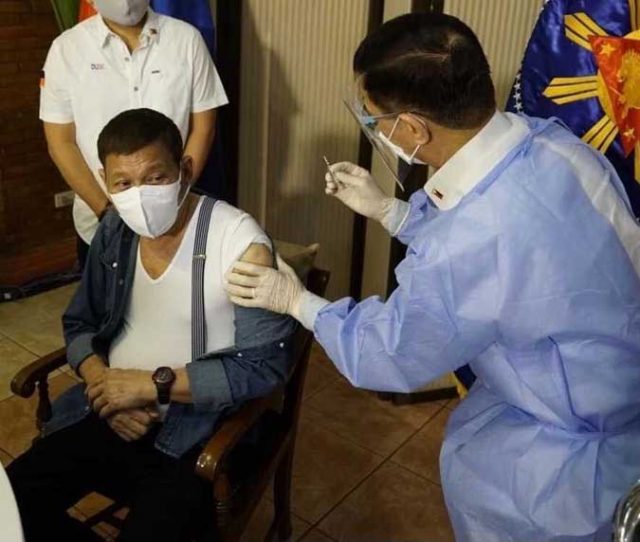
Health Secretary Francisco Duque III administers President Rodrigo Duterte’s first shot of Sinopharm vaccine in this photo taken on May 3. -- Photo credit: Philippine Star c/o Sen. Bong Go Facebook page

COVID-19 cases up by 6,812

Meanwhile, the Department of Health (DoH) reported 6,812 coronavirus infections on Friday, bringing the total number of cases since the pandemic started in 2020 to 1,385,053.

The death toll rose by 116 to 24,152, while recoveries increased by 2,867 to 1,305,608 million, it said in a bulletin.

There are currently 55,293 active cases according to the DoH, 4.6% of which are asymptomatic, 90.8% of which are mild, 1.35% of which are moderate, 1.9% of which are severe, and 1.3% of which are critical,

It said 19 duplicates had been removed from the tally, 12 of which were tagged as recoveries. Sixty-one recoveries were reclassified as deaths.

All labs were operational on June 23 and all labs were able to submit their data, the DoH said. — Kyle Aristophere Atienza

Senator asks PhilHealth to settle unpaid hospital claims ‘immediately’

A senator on Friday asked the state-owned Philippine Health Insurance Corp. (PhilHealth) to “immediately” settle unpaid claims of hundreds of hospitals so as not to jeopardize their operations amid the prolonged coronavirus pandemic.

The state health insurer should pay up as hospitals become “battlegrounds” amid surging coronavirus infections, Senator Grace Poe-Llamanzares said in a statement.

Citing reports, Ms. Poe-Llamanzares said in Western Visayas alone, including Iloilo City, claims of hospitals and laboratories have reached over P800 million.

“They need what’s due to them, especially in this time when a number of them are overwhelmed with patients due to the recent surge of infections,” Ms. Poe-Llamanzares said in a statement.

Local leaders have already informed the national government of “the lack of hospital beds, dwindling medical staff, inadequate vaccine supply, shortage of medicines, and the slack in PhilHealth’s settling its dues,” the senator, who heads the Senate public services committee, warned.

PhilHealth implemented a debit-credit payment method in April which was supposed to fast-track the payment of hospital claims.

Ms. Poe-Llamanzares said the state health insurer should review the new system to determine whether it’s “fast and efficient enough.”

“Lives are on the line every day. The people should be able to rely on the promises of the state health insurer amid the health crisis,” she said.

The Health department on Wednesday flagged increasing coronavirus infections in Western Visayas. Coronavirus cases in the region have increased by 27%, it said. — Kyle Aristophere T. Atienza

SC upholds Ombudsman ruling in graft charges vs Customs security guard

PHILSTAR

The Supreme Court (SC) has affirmed the decision of the Ombudsman in June 2017 to charge a former security guard of the Bureau of Customs (BOC) for not declaring eight personal real estate properties he acquired while he was still with the BOC.

In the Court’s decision dated Feb. 3 and published on June 22, it ruled that the former security guard be charged with violating Section 7 of Republic Act (RA) 3019 or the Anti-Graft and Corrupt Practices Act and Section 8 of RA 6713 or the Code of Conduct and Ethical Standards for Public Officials and Employees for failure to include in his Statement of Assets, Liabilities and Net Worth (SALN) from 2008 to 2014 seven residential lots totaling 3,232 square meters and a house and lot, all in Bulacan province.

The SC denied the petition of the original complainant, the Department of Finance (DoF), to charge the Ombudsman with grave abuse of discretion for excluding in the charges a 1,342-sq.m. lot titled to the daughter of the accused, a 36-sq.m. house and lot unproven to be that of the accused, and properties undisclosed in earlier SALNs for which the period of filing for legal action had already expired.

“The OMB (Ombudsman) properly considered the applicable laws and jurisprudence in dismissing the said charges. Hence, no grave abuse of discretion may be attributed to it,” the Court held.

The DoF also noted that the former security guard was involved in a criminal case for robbery but the case was dismissed by the Bulacan Regional Trial Court.

Nevertheless, the DoF said the accused “still made an untruthful statement” when he stated in his Personal Data Sheet (PDS) that he had not been criminally charged.

The Ombudsman, however, did not charge the security guard for falsification of his PDS as “the ‘facts narrated by the offender’ are not ‘absolutely false,’ hence, there exists no probable cause to charge private respondent of falsification.” — Bianca Angelica D. Añago

PHL bond market continues to grow in Q1

THE PHILIPPINE bond market logged the fastest quarter-on-quarter growth in emerging East Asia in the first three months of the year on increased government borrowings to fund its deficit and pandemic response, the Asian Development Bank (ADB) said on Friday.  

The June issue of the ADB’s Asia Bond Monitor showed the country’s bond market recorded the fastest expansion in the subregion, which is composed of the Philippines, China, Hong Kong, Indonesia, Malaysia, Singapore, South Korea, Thailand and Vietnam. 

Outstanding bonds grew by 6.5% to $188 billion in the first quarter from $178 billion in the fourth quarter of 2020. This was the fastest rate in the region, which was followed by Indonesia’s 6.2%. 

“Quarterly growth accelerated from 5.3% quarter on quarter in the fourth quarter of 2020, driven entirely by the government segment as the corporate segment saw contraction during the quarter,” the ADB said.  

Meanwhile, the local bond market expanded by 28.4% from the $140 billion recorded the first quarter of 2020. This was the second-fastest print in the region after Indonesia’s 36%. 

Broken down, government bonds made up 82.7% of the total issuances in the first three months of 2021 while corporate bonds accounted for the remaining 17.3%. 

ADB data showed outstanding government bonds reached $155 billion as of March, growing by 8.4% from the $145 billion seen in last three months of 2020. It also climbed by 36.5% from the $109 billion a year earlier.  

“Treasury bills and Treasury bonds primarily drove the increase, as the government continued to heavily borrow from the local market for its COVID-19 (coronavirus disease 2019) relief efforts and to support economic recovery,” the multilateral lender said. 

Meanwhile, outstanding corporate issuances were at $33 billion in the first quarter, slipping by 2% from the $34 billion logged in the previous three-month period.  

“The decline can be attributed to the maturation of bonds offsetting the new issuances during the quarter,” ADB said. 

Year on year, however, corporate bonds inched up by 0.01% from the $31 billion seen in the first quarter of 2020. 

Among industries, the banking industry held the largest share of outstanding corporate bonds at 41.8% of the total, followed by the property sector with 23.8%. 

However, even as it expanded faster than its peers, the Philippine bond market was the second smallest in emerging East Asia in the first quarter, beating only Vietnam’s $71-billion market. 

In contrast, the biggest issuers as of March were China ($15.799 trillion), South Korea ($2.382 trillion), and Thailand ($3443 billion). 

The local currency bond market in emerging East Asia continued to grow in the first quarter to reach $20.3 trillion as of March. This was higher by 2.2% quarter-on-quarter and by 15.9% year-on-year. 

“[The] overall growth of the bond market moderated somewhat in Q1 2021 as governments sought to balance fiscal policy and corporates weighed uncertainty over the economic recovery,” the ADB said. 

“Investor sentiment remained subdued amid looming uncertainties brought about by the COVID-19 pandemic and inflation fears in the United States. This led 

to volatilities in financial markets, especially in March… The COVID-19 pandemic remains the largest downside risk… Another potential risk is the possibility of tightening liquidity conditions globally, specifically that the Federal Reserve might tighten US monetary policy in response to growing inflationary pressure,” it added. — LWTN 

AUB targets P4 billion net income in 2021

ASIA UNITED Bank Corp. (AUB) targets to grow its net profit by 30% to P4 billion this year on hopes that improving consumer confidence will boost its lending business, it said in a statement on Friday. 

AUB’s net income dropped 38% to P736 million in the first quarter from a year earlier as it boosted its loan loss provisions. In 2020, the bank’s net profit was down by 32% to P3 billion from P4.4 billion in 2019. 

“2021 will definitely be a better year than 2020 as we expect the vaccine rollouts by the government and the private sector to improve consumer confidence and lead to increased economic activity. These, in turn, will boost our commercial and consumer lending business, which remain stable,” AUB President Manuel A. Gomez was quoted as saying. 

“We anticipate the new wave of loan bookings as the economy opens up. We are therefore cautiously optimistic that as the economy normalizes, the asset quality compared to 2020 will significantly improve, not only for AUB but for the entire banking industry,” he said at the bank’s virtual annual stockholders’ meeting on Friday. 

Mr. Gomez said the bank will continue to ramp up spending for its IT infrastructure, which was also its goal in the previous year. 

“That will remain as IT will always be essential in order for us to keep up with the changing environment,” he said.  

Even as he expects economic conditions to improve due to the gradual return of business activities, Mr. Gomez said the banking industry needs to continue to guard against risks that may arise due to the pandemic and the impending tightening of monetary policy measures. 

“We must also be prepared for tightening regulations and increasing credit costs as the Bangko Sentral [ng Pilipinas] tries to stave off inflationary pressures and significant stress on the banking system,” Mr. Gomez said. 

“We have yet to feel the full effects of the pandemic to personal incomes and business viability. We must still brace ourselves for some pockets of turbulence,” he added. 

AUB Chairman and Chief Executive Officer Abraham T. Co, for his part, said the bank will likely mix working from home and from the office as needed moving forward. 

“We have learned a lot how to work differently. Some people work better at home, some people don’t,” Mr. Co said. 

AUB’s shares closed at P43.80 apiece on Friday, down by 20 centavos or 0.45% from the previous day. — LWTN 

ADVERTISEMENT
ADVERTISEMENT