Home Blog Page 779

Philippine government’s outstanding debt slips to P17.46 trillion

BW FILE PHOTO

THE NATIONAL GOVERNMENT’S (NG) outstanding debt slid to P17.46 trillion at the end of September, but remained above the full-year projection, data from the Bureau of the Treasury (BTr) showed.

BTr data showed the outstanding debt dipped by 0.07% or P13.09 billion in September from P17.47 trillion at end-August.

September marked the second straight month of decline in outstanding debt.

National Government outstanding debt

However, this was still 0.6% above the projected year-end debt level of P17.36 trillion.

“The continued decrease reflects the government’s sound fiscal discipline, strategic borrowing strategy, and proactive liability management, supported by steady market conditions and robust domestic investor confidence,” the Treasury said.

Year on year, NG debt rose by 9.83% from P15.89 trillion at the end of September 2024, the BTr said.

NG debt is the total amount owed by the Philippine government to creditors such as international financial institutions, development partner countries, banks, global bondholders and other investors.

“The September figures affirm the Marcos, Jr. administration’s strong fiscal discipline and proactive debt management, ensuring that government financing remains sustainable, strategic, and supportive of the country’s growth priorities,” BTr said.

In September, the bulk or 68.6% of the total debt stock came from domestic sources, while the rest came from external sources. The BTr said this was “consistent with the government’s policy of reducing foreign exchange risk while deepening domestic capital market development.”

Domestic borrowings fell by 0.9% to P11.97 trillion at end-September from P12.09 trillion at end-August. This was lower than the P12.04-trillion year-end domestic debt projection.

“(The) government paid off more borrowings than it issued new ones… Total repayments exceeded new issuances by P117.29 billion, more than offsetting the P3.16-billion upward revaluation from the peso depreciation against the retail dollar bonds,” the Treasury said.

Year on year, domestic debt jumped by 9.48% from P10.94 trillion.

On the other hand, external debt rose by 1.9% to P5.48 trillion as of end-September from P5.38 trillion at end-August, mainly due to the weaker peso.

“This movement more than offset the P1.3-billion in net loan repayments and P2.1 billion in third-currency fluctuations,” the BTr said.

BTr data used a foreign exchange rate of P58.149 per dollar at end-September, weakening from P57.042 per dollar at end-August and P56.017 at end-September 2024.

Year on year, external debt increased by 10.6% from P4.96 trillion.

The latest external debt tally also exceeded the P5.31-trillion year-end projection by 3.16%.

Foreign debt was composed mainly of P2.79 trillion in global bonds and P2.69 trillion in loans.

External debt securities were made up of P2.36 trillion in US dollar bonds, P259.37 billion in euro bonds, P59.59 billion in Japanese yen bonds, P58.15 billion in Islamic certificates and P54.77 billion in peso global bonds.

As of September, the NG-guaranteed obligations inched up by 0.05% to P346.63 billion from P346.46 billion in August.

“This was attributed to a P1.75-billion upward revaluation of guarantees due to peso depreciation, partially offset by a P1.33 billion in combined net repayments, and downward adjustment from third-currency movements amounting to P0.25 billion,” BTr said.

Year on year, obligations fell by 7%.

“The decline in debt is primarily driven by a significant decline in government spending amid the corruption scandal. This caused government expenses to go down and some halted while scrutiny and checking are being done,” Reinielle Matt M. Erece, an economist at Oikonomia Advisory and Research, Inc., said in a Viber message.

Mr. Erece said the consistent repayment of existing debt also brought debt levels lower.

Rizal Commercial Banking Corp. Chief Economist Michael L. Ricafort said in a Viber message that the lower debt level in September was also due to a large volume of maturities in government securities during the month.

Mr. Ricafort said the weaker peso during the month “effectively increased the peso equivalent of the outstanding National Government foreign debts when converted to pesos.”

The peso weakened by 1.87% or P1.066 to close at P58.196 on Sept. 30 from P57.13 on Aug. 29.

Philippine Institute for Development Studies Senior Research Fellow John Paolo R. Rivera said outstanding debt is expected to increase by yearend.

“With continued infrastructure spending, external repayments, and elevated interest costs, the National Government debt is likely to rise moderately toward yearend, staying around 60-61% of GDP (manageable but still requiring vigilance to maintain fiscal sustainability),” Mr. Rivera said in a Viber message.

“This might reverse if exchange rate breaches P60 per dollar requiring more debt management,” he added.

At the end of the second quarter, NG debt as a share of gross domestic product stood at 63.1%, the highest since 2005.

The Department of Finance expects the NG debt-to-GDP ratio to ease to 61.3% by end-2025 and eventually fall to 58% by 2030. — Aaron Michael C. Sy

PEZA expects 14 additional ecozone proclamations before end-2025

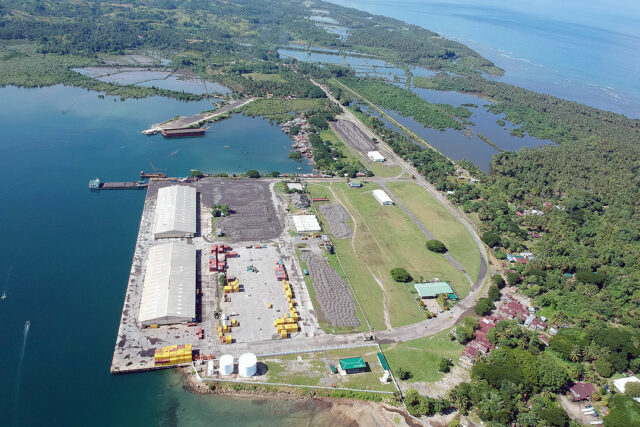
POLLOC FREEPORT AND ECOZONE — BARMM FACEBOOK PAGE

By Beatriz Marie D. Cruz, Reporter

THE PHILIPPINE Economic Zone Authority (PEZA) is expecting 14 additional economic zones (ecozone) to be approved within the year.

“We’re awaiting 14 more proclamations happening hopefully within the year,” PEZA Director-General Tereso O. Panga told reporters on the sidelines of an event on Tuesday.

“We’re still on track with the ambitious target of having 30 proclamations within the year,” he added.

The Office of the President issues the proclamation which officially designates specific parcels of land as special economic zones, upon the recommendation of PEZA.

Mr. Panga also noted that the Palawan Mega Ecozone is likely scheduled for ecozone proclamation “maybe by next year.”

“There’s an official turnover already by the Bureau of Corrections (BuCor) of an initial 4,000 hectares (ha) out of 28,000 ha. So, we will be doing the groundbreaking, and also the visit to Palawan, maybe by next month,” he said. 

The Palawan Mega Ecozone will be established within the 28,000-ha Iwahig Prison and Penal Farm in Puerto Princesa City, Palawan. It is scheduled to be operational by 2028.

According to PEZA, the ecozone is expected to attract emerging and high-value industries like electric vehicle production, advanced manufacturing, green ores processing and nano tech. It also seeks to attract knowledge-based and artificial intelligence-driven industries as well as those related to the medical field.

The initial 4,000 hectares turned over by the BuCor will cover the first phase of the development, PEZA said.

BuCor Director-General Gregorio Pio P. Catapang, Jr. also recently announced plans to develop a BuCor property in Sablayan, Mindoro Occidental into a township ecozone.

The Philippine government is banking on ecozones to attract more investments and generate jobs for the country.

In the first half of the year, President Ferdinand R. Marcos, Jr. approved four ecozones — the expansion of the Aboitiz-led Lima Technology Center in Lipa and Malvar, Batangas, as well as the IT parks in Bacolod City under Megaworld Corp., and the Tagbilaran Uptown IT Hub 2 in Bohol.

John Paolo R. Rivera, a senior research fellow at the Philippine Institute for Development Studies, said more ecozone approvals give investors predictability and confidence to invest in the country.

“Through fiscal incentives, infrastructure support, and streamlined regulation, ecozones create clusters that stimulate local supply chains and enhance productivity spillovers in surrounding communities,” he said in a Viber message.

Mr. Rivera added that stronger collaboration among PEZA, local government units, and infrastructure agencies can help expand ecozone development beyond traditional manufacturing to digital, green, and innovation-driven zones.

George N. Manzano, an economist from the University of Asia and the Pacific, said investors can rely on reliable power, roads, logistics, tax incentives and simpler rules in economic zones.

“In many developing countries like the Philippines, we often struggle with poor infrastructure, slow government processes, and even corruption. Ecozones were created partly to deal with these problems,” he said in a Viber message.

Mr. Manzano noted that having more ecozones could help boost regional development.

“They create jobs outside Metro Manila and bring in new technologies and business practices that local workers can learn from. In that sense, ecozones can be engines of both regional and national growth,” he said.

“Of course, there’s a risk too. If ecozones don’t connect with local suppliers or nearby industries, they can become isolated enclaves — productive, yes, but with limited benefits for the surrounding community. The challenge is to make sure the growth they generate actually spills over to the local economy,” Mr. Manzano added.

About 34 ecozones have been proclaimed since the beginning of the Marcos administration, accounting for P14.7 billion in capital investment, PEZA said.

AboitizPower to acquire 25% stake in Vietnam coal plant for P12.9B

VAN PHONG 1 Power Plant Project — CPCL.VN

ABOITIZ Power Corp. (AboitizPower) is set to acquire a 25% stake in Van Phong Power Company Limited (VPCL), operator of a 1,320-megawatt (MW) coal-fired power plant in Vietnam, from Japan’s Sumitomo Corp. for $220 million (around P12.9 billion).

In a regulatory filing on Thursday, AboitizPower said this marks its first significant investment outside the Philippines.

The Van Phong plant, located in Khánh Hòa Province, began commercial operations in January 2024 and delivers roughly 8.5 billion kilowatt-hours of electricity annually to Vietnam’s national grid.

It operates under a 25-year power purchase agreement with state-owned utility Vietnam Electricity and is the largest foreign-invested power plant in the Van Phong Special Economic Zone.

AboitizPower said the investment aligns with its strategy to maintain a “well-balanced portfolio of energy technologies” while pursuing renewable energy initiatives.

“This investment is in parallel with our renewable investment program and is aligned with our aspiration to ensure a balanced long-term energy transition, contributing to reliable and affordable energy systems,” the company said.

The completion of the transaction remains subject to regulatory approvals.

Sumitomo, a diversified Japanese conglomerate, is engaged in sectors including metals, automotive, infrastructure, real estate, digital media, chemicals, and energy transformation.

AboitizPower serves as the Aboitiz group’s arm for power generation, distribution, and retail electricity, as well as related energy solutions.

The company aims to expand its total attributable net sellable capacity to 9.2 gigawatts by 2030, maintaining a balance between renewable and thermal energy.

For the nine months ending September, AboitizPower reported a 15% decline in core net income, reflecting full-year depreciation and interest expenses for its 1,336-MW GNPower Dinginin Ltd. Co. coal plant in Bataan.

As of the first half of 2025, AboitizPower is the country’s leading power generator, holding a 23.86% share of the national grid, according to the Energy Regulatory Commission.

On Thursday, shares in the company fell 0.24% or 10 centavos, closing at P40.90 apiece. — Sheldeen Joy Talavera

PXP Energy eyes investments in producing oil fields as Galoc contract nears expiry

PXPENERGY.COM.PH

PANGILINAN-LED PXP Energy Corp. said it is exploring investments in new or near-ready producing oil fields that can generate earlier cash flow, as the term of the service contract (SC) governing its only producing oil field approaches expiration.

“With Galoc production approaching the end of field life, the company is also exploring opportunities to reinvest in producing or near-term development fields that could generate earlier cash flow, all while maintaining a clear focus on its upstream business,” PXP said in a regulatory filing on Thursday.

The SC covering the Galoc Oil Field in northwest Palawan, which has produced about 25 million barrels of oil since 2008, is set to expire on Dec. 17.

PXP noted that the field remains commercially viable despite natural production decline and can continue operations beyond the contract’s term.

The company said it is also ensuring sufficient financial flexibility as it advances early-stage petroleum exploration in the southwestern Sulu Sea.

PXP remains focused on “preserving liquidity and maintaining readiness while progressing early-phase technical assessments” under its recently awarded petroleum SCs, the company said.

Earlier this month, PXP and its joint venture partners secured three contracts, covering two Sulu Sea blocks — SC 80 and 81 — and SC 86, covering the Octon Block in northwest Palawan.

The Sulu Sea blocks are jointly administered by the Department of Energy and the Bangsamoro Autonomous Region in Muslim Mindanao through its Ministry of Environment, Natural Resources, and Energy.

“The Company continues to maintain prudent operations across its portfolio and is preparing to participate in technical work programs committed to the government under these newly awarded blocks,” PXP said.

The company also remains committed, together with Forum Energy Limited, to unlocking the long-term potential of assets in the West Philippine Sea amid ongoing maritime dispute suspensions, it said.

PXP awaits the final government review for two additional service contracts in the northwest Palawan basin, expected within the next few months.

For the nine months ending September, the company posted a wider attributable net loss of P39.8 million, up from P14.8 million a year ago.

Core net loss reached P32.8 million from P17.8 million, due to softer crude prices, lower Galoc production volumes, and higher interest charges.

Consolidated revenues fell 22.4% to P50.3 million, reflecting a 13.5% decline in sales volume to 414,124 barrels and a 13.8% drop in average realized crude price to $70 per barrel.

Costs and expenses rose 7.7% to P84.2 million, largely due to a one-off overhead increase from a foreign subsidiary.

On Thursday, PXP shares closed at P2.36, down six centavos or 2.48%. — Sheldeen Joy Talavera

SM Prime gets SEC approval to offer P17-B retail bonds

SM CITY FAIRVIEW’S ROOFTOP solar photovoltaic system. — SMPRIME.COM

SM PRIME HOLDINGS, INC. (SMPH) has secured approval from the Securities and Exchange Commission (SEC) to offer up to P17 billion in fixed-rate retail bonds, the third tranche of its P100-billion debt securities program.

In a regulatory filing on Thursday, the listed property developer said the SEC permit, dated Oct. 30, allows it to issue P12 billion in fixed-rate bonds, with an oversubscription option of up to P5 billion, under Series AB, AC, and AD.

The bonds will carry interest rates of 5.9096% for Series AB maturing in 2030, 6.0858% for Series AC due 2032, and 6.2855% for Series AD due 2035.

Proceeds from the issuance will fund 16 major redevelopment projects and 12 new lifestyle malls planned through 2030, as well as support the launch of new malls in Xiamen and Fujian, China.

Philippine Rating Services Corp. (PhilRatings) assigned the bonds its top rating of PRS Aaa with a “stable” outlook, indicating an “extremely strong” ability to meet financial commitments.

In September, SM Prime raised $350 million from its first dollar bond issuance and postponed a planned $1-billion real estate investment trust listing until after 2026 due to challenging market conditions.

On Thursday, SM Prime shares fell 1.32% or 30 centavos, closing at P22.40 apiece. — Alexandria Grace C. Magno

Hauntings, violence, and true crime: Series to binge on over Halloween

The Monster of Florence

IN TIME for the culmination of spooky season, horror and crime drama series are filling online streaming platforms. Here is a quick rundown of what you can catch this Halloween if getting shivers down your spine is your thing.

NETFLIX
From suspense-filled thrillers to natural and supernatural horror, there’s a lot to choose from on Netflix. There is True Haunting, an American docufiction series that looks into hauntings using immersive reenactments and interviews. With James Wan as one of its executive producers, the five episodes look into two tales of mysterious hauntings.

Meanwhile, the Italian true crime limited series The Monster of Florence delves into the case of a serial killer in 1960s Italy who targeted couples parked in lovers’ lanes. Based on a notorious true story, the four-episode limited series was directed by Stefano Sollima.

Other interesting titles are Nightmares of Nature, an animal documentary series that centers on the horrific beauty of nature from the perspective of prey; and Monster: The Ed Gein Story, the third in Ryan Murphy and Ian Brennan’s anthology of American serial killers, this time following the 1950s murderer Ed Gein.

HBO MAX
Another series about a real-life serial killer, this time on HBO Max, is Devil in Disguise: John Wayne Gacy. The miniseries first premiered on Peacock and dramatizes the life of Gacy who murdered young men and boys in the 1970s.

Then there’s the HBO original crime drama Task, created by Brad Ingelsby, which stars Mark Ruffalo as an FBI agent investigating violent robberies in stash houses. The seven-episode miniseries is a bleak and horrific look at the reality of crime.

For a more fun yet appropriately themed watch, check out the 11th season of Halloween Baking Championship, an entertaining battle between some of America’s top bakers who are seeking to create the spookiest treats and desserts.

DISNEY+
Disney+ has a lineup of horror and crime series fresh from Hulu. Murdaugh: Death in the Family is a five-episode miniseries that investigates a man accused of the murders of his wife and son. The platform also has the biographical miniseries The Twisted Tale of Amanda Knox, a true story that centers on an American college student studying in Italy who is wrongfully convicted of murder.

Riffing off the popularity of true crime these days, Hulu is also showing the fifth and latest season of the fictional comedy-drama Only Murders in the Building. The show is a must-watch, about a trio of neighbors (played by Steve Martin, Martin Short, and Selena Gomez) who have a shared interest in true crime podcasts and become friends while investigating a series of murders in their apartment building.

PRIME VIDEO
Over on Prime Video, the UK-set horror-thriller series Lazarus, created by Harlan Coben and Danny Brocklehurst, follows a forensic psychiatrist who looks into cold case murders after coming home for the death of his father. Meanwhile, the platform’s satirical superhero series Gen V, a spinoff of the famed and equally violent hit The Boys, has a new season.

Another fun watch is the brand-new second season of Hazbin Hotel, an adult animated musical series about Charlie Morningstar, the crown princess of Hell.

LIONSGATE PLAY
For older titles that aren’t necessarily spooky, but still horrific in their own, realistic way, Lionsgate Play has some gems worth revisiting. The 2018 UK drama miniseries A Very English Scandal has Hugh Grant play a charming and charismatic politician hiding a dangerously cruel interior.

Finally, there’s Mr. Robot, a show that ran from 2015 to 2019, starring Rami Malek as a cybersecurity engineer and vigilante hacker who exposes the scary global chaos of a world that is reliant on the internet. — Brontë H. Lacsamana

PHirst to spend P8.39B to build 13,150 more homes by yearend

A DRONE SHOT showing a completed PHirst community.

PHIRST Park Homes, Inc. (PPHI), the first-home brand of Century Properties Group, Inc. (CPG), said it has earmarked P8.39 billion to deliver 13,150 additional housing units nationwide by end-2025.

In a disclosure to the stock exchange on Thursday, the company said it has tapped its in-house construction arm, PHirst Build, and Saavedra-led Megawide Construction Corp. for the projects.

PHirst Build will construct 6,326 units across Luzon projects, including PHirst Park Homes Sto. Tomas and PHirst Park Homes Magalang East.

Megawide, for its part, will build 5,824 precast units in Cavite, Laguna, and Batangas.

About 1,000 more houses are under the contract awarding stage and scheduled for construction this year, the company said.

PPHI said it awarded 29,306 housing units to contractors in 2024 alone, bringing its total housing portfolio to 42,456 units since its establishment in 2017.

The developer has completed 15,000 housing units in the first half, of which 10,000 have been turned over to buyers. The number of units turned over is expected to reach 14,000 by yearend.

“Our initiatives, through innovative construction methods and strategic partnerships with contractors and suppliers, represent a strong continuation of our mission to provide affordable housing solutions,” PHirst Vice-President for Technical Operations Division Roy C. Lachica said.

“These also help us to continue our expansion into more locations nationwide as the company responds to the country’s growing demand for housing,” he added.

PHirst currently has 31 active projects located in Cavite, Laguna, Batangas, Quezon Province, Bulacan, Pampanga, Bataan, Nueva Ecija, and Bacolod City.

“Through innovative construction methods and strong partnerships, PHirst strives to make homeownership accessible for all Filipinos while actively contributing to community development,” the company said.

CPG reported a 14% growth in first-half net income to P1.22 billion, supported by its affordable housing segment.

At the local bourse on Thursday, CPG shares closed flat at 65 centavos apiece. — Beatriz Marie D. Cruz

DITO tops download speeds; Smart, Globe lead in coverage — Opensignal

BW FILE PHOTO

DITO Telecommunity Corp. has kept its lead in download speed performance, while Smart Telecommunications, Inc. and Globe Telecom, Inc. continued to dominate in coverage and upload speed, according to the latest report by independent analytics firm Opensignal.

In its October Mobile Network Experience Report, Opensignal said DITO remained ahead in overall download speed with an average of 39.8 megabits per second (Mbps), followed by Smart with 36.2 Mbps and Globe with 25 Mbps.

Smart, however, led in overall upload speed experience at 6.2 Mbps, trailed by DITO with 6.1 Mbps and Globe with 5.1 Mbps.

For 5G download speed experience, DITO also ranked first with an average of 253.9 Mbps, while Smart and Globe registered 144.6 Mbps and 93.6 Mbps, respectively.

Opensignal said that 5G download speed experience measures the average download speed experienced by users across an operator’s 5G network.

Meanwhile, Globe posted the highest coverage experience score at 7.4 points on a 10-point scale, ahead of Smart with 7.2 points and DITO with 3.8 points.

Opensignal said the metric reflects users’ experience as they move through areas where they would reasonably expect to have network coverage.

For 5G coverage experience, Smart led with 1.7 points, followed by Globe with 0.9 points and DITO with 0.4 points.

“This recognition highlights DITO’s rapid growth and reinforces its position as a top performer in the Philippine market,” Opensignal said. — Ashley Erika O. Jose

Liam Hemsworth leads The Witcher in season four ‘refresh’

Liam Hemsworth in The Witcher (2019)

LONDON — Netflix fantasy series The Witcher returns to screens after more than two years with a new lead actor and a fresh tone, its makers say.

The new installment, which started streaming on Thursday, sees Australian actor Liam Hemsworth taking over the role of Geralt of Rivia from Henry Cavill, who played the monster hunter since the series began in 2019 and stepped down after 2023’s season three.

The show is based on Polish author Andrzej Sapkowski’s books, and follows Geralt as he hunts monsters in a fantasy realm known as the Continent.

“It was definitely an interesting decision to make, it’s a unique situation,” Mr. Hemsworth said of taking over the role mid-series.

“It wasn’t lost on me that there’s a massive, passionate fan base that really cares about this character and this world. As a fan myself, I felt like I could bring something to it and I wanted to do justice to this world.”

Mr. Hemsworth came to the project with “a lot of ideas,” hoping to inject some levity into Geralt’s storyline.

“I’m playing my interpretation of what I think is going to be beneficial to this world, this story and his journey,” he told Reuters.

Creator Lauren Schmidt Hissrich said season four strikes a balance between the dry sense of humor brought by Mr. Hemsworth and “super dark moments.”

“It feels like a refresh for the show,” she said. “Liam brings a new energy and everyone rose to meet that, including how the show looks, how it sounds, how it moves.”

In season four, Geralt, who was last seen separated from princess Ciri and sorceress Yennefer, teams up with new travel companions and makes emotional connections.

Matrix actor Laurence Fishburne is another addition, playing vampire Regis. New to the fantasy genre, Mr. Fishburne was drawn by the diversity he saw in earlier seasons.

“The way that they cast this world was very non-traditional. This world looks like the world that we all live in,” he said.

Season four was filmed with the fifth and final season. Together they cover Mr. Sapkowski’s three remaining novels Baptism of Fire, The Tower of the Swallow, and Lady of the Lake. Reuters

BPI upgrading fraud systems to comply with anti-scam law

BW FILE PHOTO

BANK of the Philippine Islands (BPI) is working to comply with the enhanced fraud and risk management systems required under the Anti-Financial Account Scamming Act (AFASA), keeping it on track to meet the mid-2026 deadline.

“There are a lot of points that we need to [address] but by and large, we are already compliant. But… we need to make sure that we are compliant come day one of the implementation next year. That’s something the rest of the industry are all working towards,” BPI Enterprise Information Security Officer and Data Protection Officer Jonathan John Paz told reporters at an event last week.

“We are not totally compliant yet, but we are confident that we will be compliant.”

The Bangko Sentral ng Pilipinas (BSP) has given banks until June 25, 2026 to adopt new fraud management systems and upgraded security and authentication measures for consumers as part of the AFASA’s implementing rules. Lenders were also given six months to update their risk management frameworks.

Mr. Paz said as part of AFASA’s implementation, the banking industry as a whole also has to come up with common standards and rules, like terms and conditions for account openings, which are still being drafted.

“The thing is, the AFASA can only work when everyone is ready. Everyone has to be on the same page for AFASA to work. So, it’s not a matter of where is BPI in terms of compliance. The more important question is, is the whole industry ready for AFASA? Because we might be ready, but we can’t do anything if the other counterparties are not,” he said.

“The only thing left is really how the other banks will also respond. So, there are processes that can only be finalized once there’s an agreement among everyone… because we can’t word it in one way, and the other banks will word it differently. There will be gaps between banks.”

Fighting financial fraud requires collective effort, Mr. Paz said.

“Because if there is a weak link in the system, then that gets to be exploited. And then, fraud cannot be totally eliminated.

For example, if there’s a bank that is not able to properly screen their accounts… that exposes everyone to fraud risk. So, I understand where the BSP comes from. And definitely, we support these kinds of activities because fraud undermines the legitimacy of online commerce, of e-commerce. Online commerce, e-commerce, brought us along the path of inclusivity, financial products, innovation… It has done wonders for everyone in the Philippines,” he said.

“Fraud undermines the concept of online payments. And we can’t go back to where we were before… So, definitely, if you want this good thing to continue, we need to fight against what’s undermining it, which is fraud.” — AMCS

Cebu Pacific leases 2 aircraft from Bulgaria Air for peak travel season

AIR.BG

BUDGET CARRIER Cebu Pacific has entered into a damp lease agreement with Bulgaria Air to augment its fleet ahead of the expected surge in passenger traffic during the peak travel season.

“We are continuously exploring ways to expand our fleet and ensure operational resilience,” Cebu Pacific President and Chief Commercial Officer Alexander G. Lao said in a statement on Thursday.

Under the agreement, two Airbus 320 CEO aircraft from Bulgaria Air will service domestic routes between Manila and Cebu, Davao, Iloilo, and Cagayan de Oro from December 2025 to January 2026.

A damp lease allows the lessor to provide aircraft, crew, maintenance, and insurance to the lessee.

“This collaboration is yet another testament to the high level of trust and professionalism that our team delivers in the implementation of international leasing projects,” Hristo Todorov, chairman of the management board of Bulgarian Airways Group, said.

Each aircraft will have a 180-seat capacity. Bulgaria Air is the national carrier of the Republic of Bulgaria.

Cebu Pacific previously signed a similar agreement with Bulgaria Air in 2023 to service domestic routes such as Cebu and Davao from January to May 2024.

Cebu Pacific currently operates 37 domestic and 26 international destinations across Asia, Australia, and the Middle East.

For the third quarter, its listed operator Cebu Air, Inc. said passenger volume rose by 2.6% to 1.83 million, supported by strong domestic travel demand.

At the stock exchange on Thursday, shares in Cebu Air fell by 90 centavos, or 2.98%, to close at P29.30 each. — Ashley Erika O. Jose

Of monsters born from systemic cruelty

LEE BYUNG-HUN as Yoo Man-soo in No Other Choice.

By Brontë H. Lacsamana, Reporter

Movie Review
No Other Choice
Directed by Park Chan-wook
MTRCB Rating: R-13

GREED and self-preservation can devolve into carnage, be it in a metaphorical sense as men chase the necessity of capital, or in a literal sense as they seek to actually kill.

This movie takes us through that endless rat race.

No Other Choice follows veteran paper mill manager Yoo Man-soo (played by Squid Game antagonist Lee Byung-hun), who is laid off and humiliated by a ruthless job market. As he gets more and more desperate to reclaim his dignity and continue providing a comfortable lifestyle for his family, he gradually resorts to shocking acts of violence.

At the heart of this thriller is Lee’s riveting performance as a man who is fully subsumed by the endless climb to a stable career. Director Park Chan-wook, known for his creative and sometimes even playfully manic visual style, depicts this character’s wins bleakly as if they were losses. This film is the type where you wouldn’t know whether to laugh, feel sad, or gape at the screen in anguish or horror. Lee is perfectly cast, able to nail this precarious balance between humor and cruelty.

Ultimately, Park’s latest film does have echoes of the devilish heartbreak in Decision to Leave, the elaborate blossoming in The Handmaiden, and the brutal horseplay in Oldboy, but it stands on a unique platform of its own, as a singularly cutthroat capitalist tragedy. No Other Choice lives and breathes the exasperation of a man who refuses all other choices presented to him to keep climbing the ladder he is on, even as the journey disfigures him into something unrecognizable.

Son Ye-jin as his beautiful and lively yet dutifully loyal wife, Lee Mi-ri, also stuns. She conveys the full spectrum of emotion of a woman who will stand firm with the man she has married, even as he crosses the point of no return. In the hands of Park, both her and Lee’s acting talents shine.

Park Chan-wook doesn’t disappoint, though his usual formal playfulness is reeled in, even somewhat streamlined here to serve the story — like a match-cut transition from a family hug to water rushing down a drain, a cross-dissolve imposition of a man plotting over a bonfire and his wife searching for clues to his strange behavior — not as flashy as stuff from his previous work, but effective all the same.

The details are impeccable, reflected by the physical and mental tough love that goes into the characters’ care for plants, and the kinds of forests that are built on the extremes of this brutal nature. It’s no wonder this is South Korea’s official entry to the 98th Academy Awards.

Fans of director Park’s work will be impressed by how No Other Choice juxtaposes regular family struggles with the amoral actions that individuals have to make to prosper in a world of corporate greed. Perhaps the most striking thing about this film is how bleak and empty the successful moments feel, despite the main character’s visible triumph after each step of his elaborate scheme.

In the beginning, Min-soo talks a big game about justice and togetherness and the necessity of manual labor in their line of work. The ending, without spoiling, puts him in the largest and emptiest of spaces, thanks to the advancements of AI that have broken down the very principles he used to espouse.

This is about a man losing his soul, bit by bit, as he learns to adapt to the systemic cruelty that seeks to snuff him out, until he eventually regurgitates the same phrase that the higher-ups down to the middlemen have said to him time and again: that he simply has no other choice.

No Other Choice is now showing in Philippine cinemas nationwide.