Home Blog Page 7776

World number one Djokovic withdraws from Madrid Open on coronavirus travel concerns

NOVAK DJOKOVIC FB PAGE
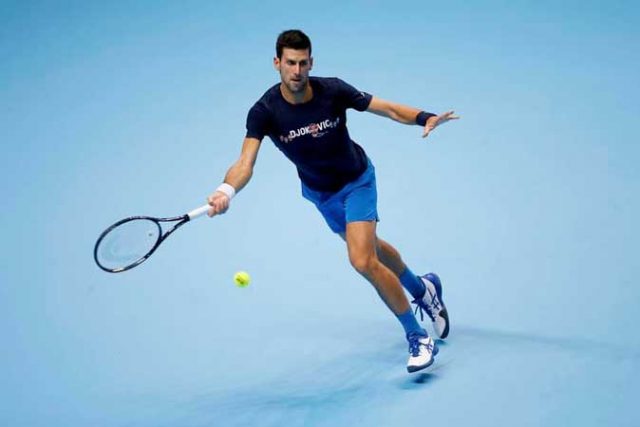
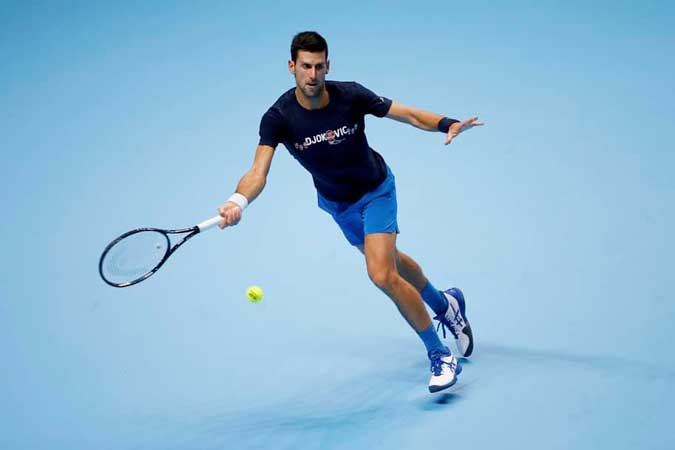
WORLD number one Novak Djokovic will not defend his Madrid Open title next week as he decided against traveling for the ATP Masters 1000 event, organizers said. — NOVAK DJOKOVIC FB PAGE

BENGALURU — World number one Novak Djokovic will not defend his Madrid Open title next week as he decided against traveling for the Association of Tennis Professionals (ATP) Masters 1000 event, organizers said on Wednesday.

The 33-year-old was last seen in action on his home soil at the Serbia Open last week, where he reached the semifinals before losing to Russia’s Aslan Karatsev.

“Sorry that I won’t be able to travel to Madrid this year and meet all my fans,” Djokovic said in a message shared by the Madrid Open organizers on Twitter.

“It’s been two years already, quite a long time. Hope to see you all next year!”

The coronavirus pandemic had forced the 2020 edition of the Madrid Open to be canceled, which means 2019 winner Djokovic is still the last champion at the event.

Djokovic is still expected to feature at next month’s Rome Masters and Belgrade Open in the lead-up to the claycourt major in Paris, which begins on May 30. — Reuters

Eduard Folayang falls to Shinya Aoki again in ONE; Dutch De Ridder new light heavyweight champion

ONE CHAMPIONSHIP
FILIPINO Eduard Folayang was submitted (armbar) by Japanese legend Shinya Aoki in the opening round of their battle of former lightweight champions in the final leg of the “ONE on TNT” series on Thursday. — ONE CHAMPIONSHIP

FILIPINO veteran mixed martial arts (MMA) fighter Eduard “Landslide” Folayang fell to Japanese Shinya Aoki once again in their third ONE Championship encounter on Thursday in Singapore.

Mr. Folayang, 36, of Team Lakay was submitted by Mr. Aoki in the opening round by way of armbar in their battle of former lightweight champions in the final leg of the “ONE on TNT” series.

It was the second straight win for Mr. Aoki over Mr. Folayang, taking a 2-1 lead in their trilogy.

Also winning was middleweight champ “The Dutch Knight” Reinier De Ridder of the Netherlands, becoming a two-division world champion by beating erstwhile light heavyweight champion Aung La N Sang of Myanmar by unanimous decision in the headlining fight.

Mr. Aoki was dominant against his familiar foe right at the onset.

Mr. Folayang tried hard in the early goings to avoid going to the ground, the strong suit of the Japanese, but eventually succumbed to the pressure.

On the ground, the Japanese legend triangled the Filipino’s legs and then slid up to mount before firing solid elbows. Mr. Folayang scrambled to escape, but Mr. Aoki was unrelenting, hooking his opponent’s left arm and spinning off for an armbar. No sooner, the referee stepped in to stop the fight after Mr. Folayang tapped at the 4:20 mark.

The loss was the third straight for Mr. Folayang in ONE and dropped him to 11 losses in his pro career as opposed to 22 wins.

Mr. Aoki, for his part, won his fourth straight in the promotion and improved to 47-9 in his career.

Despite another tough loss, Mr. Folayang’s Team Lakay said it is not yet over for its stalwart in MMA, highlighting the defeat was a continuation of the fighter’s growth.

“Positively, not the end for Eduard Folayang,” the team wrote on its official Facebook page.

Adding, “The match was not the end for Eduard, but an experience. There’s still a vision for the future. We learn, we continue for another. There’s still a lot of competition for the face of Philippines’ MMA… He will rise back again soon!”

DOUBLE CHAMP
Meanwhile, Mr. De Ridder doubled up on Aung La, also seizing the latter’s light heavyweight title.

The two previously met in October last year where the Dutch fighter snatched the Myanmar star’s middleweight belt in the opening round by submission (rear-naked choke).

While their recent title fight lasted the whole of five rounds, it was the same story with Mr. De Ridder dominating the contest on the ground.

Aung La tried to make things happen in the last round, but his opponent was not to give in en route to the title-clinching victory.

After the fight, Mr. De Ridder made it known his desire to be a three-division ONE world champion, calling out Filipino-American heavyweight champ Brandon “The Truth” Vera.

Also victorious at “ONE on TNT IV” was Filipino-American Jackie Buntan, who defeated Belarusian Ekaterina Vandaryeva by majority decision in their muay thai fight.

Winning, too, were American Colbey Northcutt in a catchweight MMA fight with Australian Courtney Martin by submission (armbar) in the opening round; Italian Kirill Grishenko over Nigerian Oumar Kane by TKO in the second round; and South Korean Ok Rae Yoon over American legend Eddie Alvarez by unanimous decision.

The “ONE on TNT” series was a four-part offering of ONE Championship for the whole month of April where its fights were broadcast across various platforms in the United States on prime time. — Michael Angelo S. Murillo

Men’s national volleyball team tryouts in Subic successfully held

PNVF
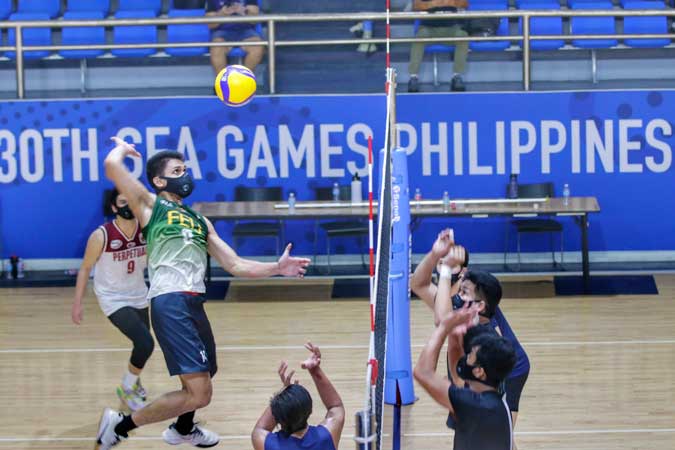
THE men’s tryouts for the national volleyball team were successfully held at the Subic Gym “bubble” on Thursday. — PNVF

THE men’s tryouts for the national volleyball team were successfully held at the Subic Gym “bubble” on Thursday.

Thirty-one of the 40 players invited participated in the tryouts, which is geared towards assembling a formidable team for the 31st Southeast Asian Games in Vietnam later this year.

Leading the players who tried out was Marck Espejo, a member of the silver medal-winning team in the 2019 Southeast Asian Games, and teammates Jessie Lopez and Josh Retamar.

Among those also on hand include long-time Philippine team skipper John Vic de Guzman, Mark Alfafara, Jao Umandal, JP Bugaoan, Kim Dayadante, Anthony Ekwenugo, Mark Enciso, Alche Gupiteo, Noel Kampton, Kim Malabunga, Rex Intal, Nico Almendras, Leo Aringo, Lloyd Josafat, Joeven dela Vega, Jack Kalingking, and Louie Ramirez. Notably absent though was veteran Bryan Bagunas, who arrived in the country from his stint in the Japan V.League only recently and had to complete a 14-day quarantine.

In the tryouts, the players were divided for the morning and afternoon sessions where they got to showcase what they can do on the court to be considered for a spot in the national squad.

The Philippine National Volleyball Federation, Inc. (PNVF) said they are satisfied with what they saw and expect the evaluation to be a tough one.

“I’m sure the coaches will have a hard time determining who to pick,” PNVF President Ramon Suzara said, adding that the men’s and women’s volleyball teams will be composed of 20 players each.

The women’s volleyball tryouts happened on Wednesday with the beach volleyball tryouts capping the federation’s activity on Friday.

As part of health and safety protocols agreed with national and local authorities, all participants underwent RT-PCR tests with the players wearing face masks all throughout the tryout proceedings. — Michael Angelo S. Murillo

Turkey replaces Canada on Formula One calendar

ANKARA — Turkey will replace Canada on this year’s Formula One calendar after the June 13 race in Montreal was canceled on Wednesday for the second year in a row due to the coronavirus pandemic.

Formula One said it had extended Montreal’s contract by two years to take into account the cancelations, securing the race until 2031.

The race had been scheduled for the Circuit Gilles Villeneuve on the weekend after the Azerbaijan Grand Prix and Turkey’s Istanbul circuit will be logistically convenient for air freight coming from Baku.

The Turkish race returned last year for the first time since 2011 and also at short notice to bolster a calendar ravaged by the pandemic.

Vural Ak, chairman of Istanbul circuit operator Intercity, said spectators would be welcome and hoped the race would lead to a long-term deal.

“We have one of the most exciting circuits in the world, we really want our people and our foreign guests to be part of this excitement as well,” he said.

“Thanks to the pandemic measures and efforts our state has carried out, we plan to put tickets on sale as soon as possible.”

There were no races in the Americas or Far East last year, with the reduced, 17-round season conducted entirely in Europe and the Middle East and some circuits holding more than one grand prix.

F1 BUBBLE
Formula One has operated in a bubble since the pandemic, with teams and staff regularly tested and many vaccinated while most races have been held behind closed doors, and is aiming for 23 grands prix this year.

More than 78,000 coronavirus tests conducted last season produced only 78 positive results and there have been 14 from more than 12,000 so far this year.

The sport had hoped to visit Canada without a mandatory 14-day quarantine, but a third wave of the virus thwarted those plans.

“I want to thank the promoter and authorities in Canada for all of their efforts in recent weeks, but the travel situation made our plans impossible,” said chief executive Stefano Domenicali.

“I equally want to thank the promoter and authorities in Turkey for their ongoing willingness to host a Formula One race that shows the huge interest in our sport and the hope from many locations to have a Grand Prix.”

Last year’s wet and slippery grand prix at Istanbul Park was held in November and produced one of the highlights of the season, with Mercedes’ Lewis Hamilton clinching his record-equaling seventh world title.

Formula One said it would work with the Canadian promoter to refund or transfer tickets.

The race is the second cancelation of the year, after China, while Australia has been moved from March to November. The next two races in Portugal, this weekend, and Spain are without spectators. — Reuters

Organizers say they could hold Olympics without spectators

“WE are prepared to hold the Games without spectators,” said Tokyo 2020 President Seiko Hashimoto.

TOKYO — Organizers of the Tokyo 2020 Olympics rolled out stricter coronavirus countermeasures on Wednesday, including a plan to test athletes daily, as they try to reassure a Japanese public made increasingly skeptical by the resurgent pandemic.

With just three months to go until the postponed Games, Japan has been encumbered by a slow-moving vaccination drive that has raised concerns about the viability of the Games. Some public ire has focused on Prime Minister Yoshihide Suga, who has repeatedly pledged that the event will go ahead.

Overseas spectators have already been ruled out and a decision on whether to allow domestic spectators will be taken in June, a few weeks before the Games begin on July 23.

Tokyo 2020 President Seiko Hashimoto said that while organizers wanted as many spectators as possible, they were ready to take every step needed to ensure safety.

“We are prepared to hold the Games without spectators,” she told a news conference following a meeting on the second draft of rule “playbooks” for the Olympics and Paralympics.

The organizers, which include the International Olympic Committee (IOC) and the Japanese government, said in a joint statement that they would “deploy all possible countermeasures and place the highest priority on safety.”

When it comes to safety, organizers wanted to reassure the Japanese public that they “walk the talk,” Christophe Dubi, an IOC official, told a news briefing via video link.

He also defended the decision not to make vaccines obligatory for visitors, saying not every country had access to vaccines against the coronavirus.

Athletes and close contacts will be tested every day, while all participants must have two negative tests before arrival, officials said.

Visitors will not be allowed to use public transport for their first 14 days and must eat in specific locations with special hygiene measures.

STATE OF EMERGENCY
Parts of Japan, including the capital Tokyo, were put under a new state of emergency at the weekend, and most of the Japanese public think the Games, postponed from 2020 because of the pandemic, should be canceled or delayed again.

The state of emergency, which is due to last until May 11, requires restaurants and bars serving alcohol to close along with large stores, cinemas and other commercial facilities.

Companies must let staff work from home and spectators are barred from major sports events.

Thomas Bach, the head of the IOC, told the organizers that he fully understood the decision to declare the emergency.

Speaking by video link, he said the rule playbooks would be strictly enforced and that the IOC was fully committed to the successful and safe delivery of the Games.

Tokyo 2020 Chief Executive Toshiro Muto echoed this, saying that in his view, it would be hard to delay the Games again.

An earlier version of the rules released in February banned singing and chanting during events and required athletes to wear masks at all times except when outdoors, sleeping or eating.

Even without foreign spectators, more than 10,000 athletes, coaches and support staff are expected to arrive in July.

Though Japan has not suffered as badly from the coronavirus as many countries, the infection rate has risen back to levels not seen since January, and more and more cases are from new variants.

On Wednesday, Tokyo reported 925 new cases. — Reuters

Looking for the obvious

Yesterday, the Pelicans lost to the Nuggets by a basket after Zion Williamson failed to dunk the ball following a successful contest by Nikola Jokić with 2.2 ticks left in the match. In the aftermath, he — and plenty of other quarters, head coach Stan Van Gundy included — noted that his attempt was foiled, but not after contact to the hand and head. To be sure, their contention was valid; replays showed the coverage wasn’t exactly clean, and the National Basketball Association’s Last Two Minute Report, issued whenever scores are within five points of each other in the crunch, will no doubt validate the eye test.

Not that the admission of the mistakes, even if by Jokić, will change the outcome; on the contrary, all it does for the Pelicans, and particularly for Williamson, is rub salt on open wounds. If nothing else, it underscores his point that “I’ve got to earn my respect. I’m only in Year 2. I’ve got to get a couple more years under my belt, and, hopefully, things change with that.” As if the definition of a foul changes with time and experience. And never mind that he already has tons of the “respect” he is alluding to; only three other players in the entire league shoot more free throws than he does every outing.

Which is not to say the game arbiters play favorites, or that they swallow their whistles at times. Action in the NBA comes so quickly and so impactfully that it’s downright irrational to expect them to get things right a hundred percent of the time. If anything, contact occurs with every play, and the mandate for the men in gray is not just to keep the proceedings in check; it’s to keep the proceedings moving along at a reasonable pace. Imagine if they called every infraction, real or perceived.

True, a foul is a foul, and it’s precisely what the Last Two Minute Report will show. Then again, there’s a reason officials are loath to decide outcomes by using their whistles; fans come to see the stars perform under pressure, not take anticlimactic charities. Of course, the counterargument is that the officials decide outcomes, anyway, by not using their whistles. As with just about anything else, however, the truth lies somewhere in between. Unless a foul is so obvious as to elicit vehement reactions if it’s not called, the preference is to let the action continue. It’s what happened yesterday, and it’s what will keep happening. Because people decide. And people are people.


Anthony L. Cuaycong has been writing Courtside since BusinessWorld introduced a Sports section in 1994. He is a consultant on strategic planning, operations and Human Resources management, corporate communications, and business development.

India weeps: Price of complacency and bad governance

Last Wednesday, the broadsheets reported the recommendation of the UP’s OCTA Research Group “to evaluate the surge capacity of densely populated Metro Manila as the threat of coronavirus disease (COVID-19) outbreak will remain while waiting for the arrival of the vaccines.” As we wrote this piece on Wednesday night, the Government extended the modified enhanced community quarantine (MECQ) in NCR, Bulacan, Cavite, Laguna and Rizal until May 14. This was a good decision.

India’s recent painful experience with the virus and its killer variants should serve as a cautionary tale to policy makers who faced yet again this seemingly difficult choice between life and jobs. There is really no trade-off because they are neither substitutes nor competitive. We need a healthy nation before we could even think of expanding business opportunities. At some point, we could attempt “dancing with the virus,” but we need the science of lockdown for proper guidance.

Worldometer’s latest update as of April 28 showed that of the world’s total cases of 149,414,444 some 17,997,267 came from India. That is a big 12%. India accounted for 201,187 of the world’s coronavirus deaths of 3,151,287 or 6.4%. The virus’ attack on the second most populous nation on earth peaked on April 25 with the highest ever daily infection of 354,880 with 2,809 deaths reported mostly in Maharashtra, Delhi, and Uttar Pradesh.

What makes India’s case truly crushing is its dismally low rate of vaccination compared to other economies. In turn, the early arrival of the limited vaccines might have contributed to the uptick in cases because people became more complacent. With limited vaccines available, Indians are now forced to protect themselves against the new variants. Otherwise, they face the grim prospects of treatment in overwhelmed public health facilities and a lack of oxygen supply.

In the east of Delhi, Reuters reported that a crematorium built funeral pyres in its parking lot to accommodate the burgeoning number of mortalities. A number of requests were also submitted to the authorities to fell trees in city parks to accommodate the need for isolation wards and hospital beds. India’s tattered healthcare system was simply stretched to the limit.

India is literally weeping.

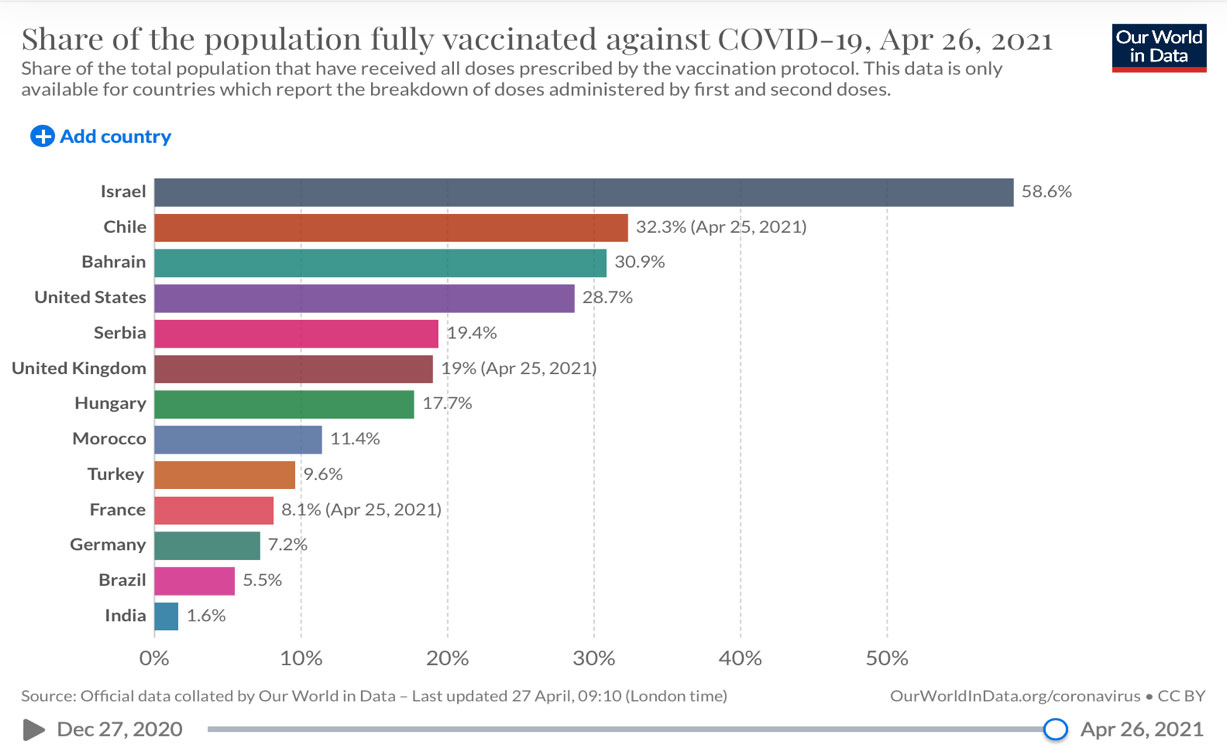
At the same time, their speed of daily inoculation is slow. When it comes to full protection, or the share of the population with a full dosage of the jabs, India ranked only 13th. Faster vaccination allows herd immunity to happen and contains the spread of the virus and its possible mutation into a second or third more infectious variant.

What is clear is that India is neither in the same boat as the US which has a higher level of infection, nor China which is as almost as heavily populated. While the US’ total incidence was almost twice and its total deaths nearly three times India’s, the US has already administered the full dosage of the vaccines to 28.7% of its population. India managed to roll out the vaccines fully to only 1.6% of its population.

China can afford to be more careful with the vaccines to be administered to its population because it ranked only 95th in terms of infection. As of April 28, China’s incidence stood at only 90,622 against India’s nearly 18 million with only 4,636 deaths while India sustained more than 201,000 deaths.

How did India end up in this tragic situation?

A health company executive was quoted by The Economic Times saying “complacency led to unanticipated shortages of medicines, medical supplies and hospital beds.”

Indeed, during last winter in India, warnings of a second wave were ignored by the authorities even as new variants were identified as early as January. Daily cases totaled lower at some 10,000 but despite the increasing trend, the Government lifted mobility and business restrictions. Prime Minister Narendra Modi agreed at first to impose extensive lockdowns because India’s public health facilities could not handle the ever-increasing daily cases. He was also made to understand the pandemic had peaked in India and that they could start exporting medical oxygen and vaccines. Listening to its business constituents, the Government yielded and prematurely eased the restrictions. They peddled the idea that economic costs of lockdown could be staggering.

In fact, a Hindu festival was given the green light at which millions gathered in rivers and broke face masks and social distancing protocols. The Government likewise allowed packed political rallies for local elections — some Indians in the northern city of Lucknow could only sigh “we are dying here, and they are holding rallies there.”

As a result, there was a massive surge which built into the second wave. Many Indians equated the second wave with complacency + mixing + mass gatherings. Ramanan Laxminarayan of New Delhi’s Center for Disease Dynamics, Economics and Policy wisely commented that India did not need a new variant to trigger the upsurge.

This sounds familiar. Yes, caution against premature claims at excellence in pandemic management was likewise sounded in public halls of India but it seems no one was listening. As Laxminarayan said: “If we declare success too soon, open up everything, give up on public health, and not vaccinate rapidly, the new variants can be devastating.”

And the new variant did devastate India.

Photos of sick Indians lying in their personal cars near hospitals are simply heart-rending. Aljazeera described the whole spectacle as COVID-19 “swallowing Indians” as crematoriums are maxed beyond capacity. India by itself cannot make it.

A whole-of-nation approach would be inadequate to tackle the problem like India’s. No less than global support is necessary. Themselves hamstrung by their own share of the pandemic, several nations including the United States, the United Kingdom, and Germany are supporting India’s demand for medical oxygen and hospital beds. France pledged to supply India with substantial medical aid while Russia will be shipping both vaccines and the antiviral drug Remdesivir by May. If such a populous and globally strategic country like India fails to bounce back, herd immunity on a large scale would be elusive. India’s downfall could be a big downside risk to global growth and recovery.

Thus, Indian-American billionaire and Sun Microsystems co-founder Vinod Khosla, and other Indian-American tech executives at Google, IBM, and Microsoft are closely working with the US Congress to mount a huge assistance package for India.

Such international cooperation is absolutely urgent because given the recent dynamics of the virus, the closely watched health model from the University of Washington projects a staggering toll of nearly one million deaths in India by Aug. 1. With around 200,000 deaths in April, that means the pandemic onslaught would multiply five times in around three months.

In the Philippines, therefore, that decision upholding the OCTA Research Group’s recommendation was the right course of action. We find it unnecessary for the President to seek the public’s understanding for the right decision of the Government. An apology would be in order after the MECQ, if no vaccines are yet in sight, and those available are yet to be rolled out fast. We do not want to replicate India’s experience here, but the longer it takes to contain the virus, the fewer the options there are for keeping everyone safe.


Diwa C. Guinigundo is the former Deputy Governor for the Monetary and Economics Sector, the Bangko Sentral ng Pilipinas (BSP). He served the BSP for 41 years. In 2001-2003, he was Alternate Executive Director at the International Monetary Fund in Washington, DC. He is the senior pastor of the Fullness of Christ International Ministries in Mandaluyong.

Headless, lawless, and heedless

The community pantry idea is apparently too complex for an uncaring officialdom obsessed with conspiracy theories to grasp. But it is actually a simple enough concept — and at the same time expressive of the tradition of bayanihan (communal spirit) of Filipinos’ helping each other in times of need.

Because millions are unemployed and their families destitute and hungry, why can’t the more fortunate make rice, vegetables, canned goods, noodles, even fish and meat and other foodstuff available for the asking by those who need them, and at the same allow those who want to help and can afford it to donate whatever resources they can spare?

This citizen’s initiative is one of the very few indicators during the current public health, governance, and economic crisis that there is still hope for the country of our sorrows. It was not the big bureaucrats of the current regime but ordinary people who wanted to help their less fortunate compatriots who not only thought of it, but also implemented it. In response, as others were inspired to replicate the project all over the Philippines, the government and its trolls condemned and demonized the men and women who had started it.

The police went around the communities, and in violation of the Data Privacy Act, began gathering information on the citizens who had set up community pantries. The military weighed in by surveilling them. Barangay tanod (watchmen) cited non-existent laws not only to put a stop to the pantries but also to prevent people from going to them for the food their families desperately need. Some of the hungry were even fined for supposedly being out of their homes during curfew hours.

The National Task Force to End Local Communist Armed Conflict not only admitted it was spying on community pantry organizers, it also tried to link them with the Communist Party of the Philippines and the New People’s Army and very likely circulated the pamphlets containing that claim. Its spokesperson went as far as to label the organizer of the first community pantry in Quezon City “Satan,” apparently without realizing that that charge could be properly leveled against those who prevent people from helping others rather than those who are devoting time, effort, and resources to feeding the hungry.

Not only individual lawyers but also the Integrated Bar of the Philippines and the Commission on Human Rights had to remind them that there is no basis in law for what they’re doing, and that rather than demonize the community pantry organizers, they should be welcomed and encouraged.

It did not occur to these worthies that their attempts to stop those citizens who care enough about their fellow Filipinos to do something about it are so patently outrageous that even some of the allies of the regime they serve, among them some senators, have been forced to acknowledge the good work those who organized and run community pantries are doing, and to condemn them for their puerile attempts to stop it. Apparently, however, they were doing so because they can’t stand the initiative’s implicit criticism of the government’s undeniably inadequate and disorganized response to the suffering of the millions of families whose breadwinners have lost their jobs, some of whom literally don’t know where their next meal is coming from.

The process of getting government aid (ayuda) and even the amount of it, for example, varies from LGU to LGU, and has been known to take several hours of waiting in line or even a day or two to accomplish. Other local government units (LGUs) dispense it in cash, and others in kind. The cash assistance also varies from P1,000 to P4,000. Asked what process is supposed to be followed by LGUs in dispensing aid, the Department of Interior and Local Governments (DILG) said it had left it to the LGUs to decide, apparently without realizing the chaos that could ensue as a result of that policy.

The same policy chaos is only too apparent in other areas, and not only in the government response to the community pantry phenomenon. About it the DILG and the Department of Justice say one thing, but barangay and police units do something else, even as the Department of Health and the Food and Drug Administration issue statements today on the vaccination program and the use of such drugs as Ivermectin only to contradict them tomorrow.

President Rodrigo Duterte himself has complained that his instructions are sometimes not being followed. Even his declaring that the West Philippine Sea “belongs” to China and that the government cannot do anything about it without going to war is contradicted by the Department of Foreign Affairs’ which has been protesting again and again about Chinese incursions in Philippine territorial waters.

What all these are suggesting is that no one seems to be in charge of either the government or the country. Everyone from department secretaries to common policemen and the lowliest barangay tanod do as they please, guided only by the implication in Mr. Duterte’s acts and statements that being in government makes one above the law, unaccountable and immune to prosecution. They also assume, as Mr. Duterte has repeatedly assured the police that they are free to use whatever means — including violence — to compel citizens to obey whatever requirement or regulation they concoct. As a consequence, any statement or declaration from their boss of bosses or from his coterie of yes-men that are contrary to these lawless precepts are regarded by anyone with even the pettiest power as meant only to delude and distract the public and need not be taken seriously.

These signs of State failure are all occurring during supposedly “Strongman” rule, which some Filipinos, who attribute to weak leaders the inability of past administrations to address the country’s legions of problems, approve of. Strong governments have indeed solved the problems of other countries and even led them to heights of progress and development. But it is not a matter of putting in office anyone whose rhetoric reeks with threats and profanities, but one who has a clear understanding of the country’s problems, what is wrong with the ways in which those are being addressed, if at all, and a corresponding program to solve them.

Such a program of government should be premised on the recognition that the active engagement of citizens in public matters can make a difference in the life of a nation, rather than consigning them to the role of victims and passive receptors of whatever government says and does. The validity of that assumption has again and again been proven by the experience of such other countries as the United States, the economy of which the labor and creative energies of immigrants developed, and China, which an awakened people transformed from “the sick man of Asia” into a global economic and political power in less than a hundred years.

The community pantry initiative is demonstrating how innovative the people can be in times of distress. It is helping families survive, while reminding everyone that they are responsible for each other, and that despite the social isolation imposed by the pandemic, still intact is a Filipino community that has survived not only foreign invasion and conquest and two world wars, but also the terrors of poverty and dictatorship.

Rather than celebrate and encourage it, however, the “Strongman” government is doing its all to frustrate it, to the detriment of the millions that need each other’s help in surviving the hardships of these troubled times.


Luis V. Teodoro is on Facebook and Twitter (@luisteodoro).

www.luisteodoro.com

Do we have a moral obligation to live for as long as possible?

I am a 78-year-old woman with a loving husband, three sons, seven grandchildren and three great grandchildren. However, I was recently diagnosed with cancer. The initial surgery was successful, but I was left wondering whether I should opt for further treatment, and all the suffering it might cause, or take my chances without it. I have, after all, lived a long and happy life. While I have now thankfully been cured, I am still left wondering: do we have a moral obligation to live for as long as possible?

— Ann, Tarbert, Scotland

There are many answers to this question — especially during a pandemic — and probably no clear solution. But that doesn’t mean we shouldn’t think about it. Indeed, by considering such questions we can discover some of the most enlightening perspectives on life.

So let me approach this issue as a philosopher — and define first exactly what we mean by a “moral obligation.” A moral obligation or a moral duty is a morally required form of conduct. Obligations can be perfect, leaving us no wriggle room — for instance, the duty not to kill unjustly. Obligations can also be imperfect, giving us some flexibility in when and how we honor them, such as the duty to be beneficent. Obligations can be context-specific, such as the duty to meet someone at 3 p.m. as promised. And, they can be general, including the duty not to steal without necessity or the duty to try to save someone’s life when we can do so at little cost to ourselves.

In my view, we cannot have a blanket moral obligation to live for as long as possible regardless of our circumstances. Each life is unique and, for some people, continuing to live is a horrific experience. But, we can have an obligation to prolong our lives when certain conditions are met.

To add some clarity, here are some thoughts on two different sets of circumstances: living in isolation and living with others. These cases rely on some imagination, but then imagination is the tool that allows us to see dilemmas from alternative perspectives.

Imagine I am a solitary person, stranded on a distant and deserted island surrounded by a vast expanse of ocean. I have no one to love, no one who misses me, and my only hope of escaping the island and meeting another person again lies wrecked in the waves: the ship that brought me here. Now, I will likely want to survive, but that is a different thing. What we need to consider is whether, given my plight, I have an obligation to live for as long as possible.

I might, if my duties to respect myself include me prolonging my life. The German philosopher Immanuel Kant’s categorical imperative states that we have a duty to treat all people including ourselves as ends to be respected and not merely as means. But respecting myself need not entail striving to live an impressively long life. I have a duty to care for my mind and my body and, as a result, I may live healthily for a long time. But that doesn’t mean that living for as long as possible must be my aim or responsibility.

Even so, I might still have an obligation to prolong my life for a different reason. The people who raised me and were sufficiently invested in my fortunes to ensure I survived into adulthood might have a claim on me. This would suggest that this Robinson Crusoe version of me should care for myself now, to honor their investment.

In his book Happiness, the Buddhist monk Matthieu Ricard quotes the words spoken by a mother to her son shortly before her death:

Don’t think you’re paying me some kind of great tribute if you let my death become the great event of your life. The best tribute you can pay to me as a mother is to go on and have a good and fulfilling life.

But living a “good and fulfilling life” is not the same as living for as long as possible. Indeed, living a good life, not a long life, may be the best way to honor our guardians’ investment in us.

And what if those who raised me have passed away — do they still have a claim? Similarly, what if they are living, but will never know how I fared? Will their lives be worse if I don’t prolong my life indefinitely? Probably not. They likely think I am already lost forever.

But perhaps I am a remarkable person — Mozart, say — and I have been abandoned on this island. I have a musical genius that arguably I shouldn’t squander, even though the music I compose in my head here will never be heard. My potential to craft masterpieces might give me an obligation to prolong my life but, of course, only for as long as I can create divine music.

Indeed, even if my talents aren’t “divine,” I might have an obligation to “use up” the talents or blessings I have been given. The American humorist Erma Bombeck, for example, wrote that:

When I stand before God at the end of my life, I would hope that I would not have a single bit of talent left, and could say, ‘I used everything you gave me.’

It’s an inspiring approach to life — but, as the 17th century British poet John Milton argued: “God doth not need Either man’s work or his own gifts; who best Bear his mild yoke, they serve him best … They also serve who only stand and wait.”

Ultimately, as Milton suggests, no one of us has any greater claim to life than another — even if we have no talents, choose to ignore the talents we do have, or simply “stand and wait,” we still fulfil our purpose.

Of course, most of us do not live alone on deserted islands. We don’t exist in isolation, but with and among others, at least until the pandemic forced us behind our front doors. Consequently, perhaps we have an obligation to prolong our lives for the sake of the people we love and who love us.

When we have dependants, particularly young children in our care, we arguably do have a duty to try to keep ourselves safe and healthy for as long as they need us. But that doesn’t mean we have an obligation to live for as long as possible when they no longer depend on us. S Matthew Liao, a bioethicist at New York University, has argued that children have a human right during childhood to be loved, and that we all have a duty to ensure that children are loved because this is crucial to their lives and development. Once they have grown, our love-giving duties subside, but do not entirely disappear.

There’s a flip side to this, too. When we become dependent on our loved ones as we age, do we have an obligation to prolong our life or, alternatively, to end it — so that we’re not a financial or emotional anchor or an additional burden on our overcrowded, exhausted planet?

This question is an easy one to answer. People should never think of themselves as a “burden” or a “problem to be solved.” Every human being has a right to life and to lead a life that is at least minimally decent, free from degradation, cruelty, undue harm, and unfairness. No one person has any more entitlement than any other to live in this world. We are all worthy of a place here, and older people should be treasured by their families, friends and societies.

Yet not everyone accepts this. The pandemic has held up a moral mirror to our treatment of older people and found it to be abysmal. Even though many countries have taken an age-attentive approach to vaccinations, older people have nonetheless borne much of the brunt of COVID-19.

One final thorny question concerns doing versus allowing. Sometimes it’s unclear whether I am actively doing something, such as prolonging my life or seeking to end it, or simply allowing things to happen to me, such as letting doctors pursue a course of treatment (or not) with the result that my life extends or comes to a close.

The availability of various medical options can make the people who love me feel that they have failed me: “I should have convinced her to have surgery. I shouldn’t have let the medical staff opt for comfort-care only. I should have been her advocate. I should have pushed for her to stay in the hospital longer.” But, there is a natural arc to a life well lived, and well-being is not the same thing as biological self interest or longevity.

I have written all of this in the language of obligation since that was the language in which you posed your question. But the language of obligation is a strong one.

We might do better to ask whether we have good reasons to prolong our lives or whether we act virtuously if we seek to prolong our lives. Courage is a virtue that figures centrally at the end of life. To quote the poet Dylan Thomas, it takes courage to “rage against the dying of the light.” But it also takes courage to bear our mild yoke and, contradicting Thomas, opt to “go gentle into that good night.”

Whatever your choices are going forward, I wish you and your family courage, grace, and happiness. And remember: life is yours to live and “death shall have no dominion.”


Kimberley Brownlee is a Professor of Philosophy at the University of British Columbia.

Building resilient small businesses through financial inclusion

FINANCING serves as an essential lifeline for micro, small and medium enterprises (MSMEs) as they need capital to expand production capacity, service a larger market, and hire additional staff.1 However, a perennial problem that MSMEs face is the difficulty of accessing finance. A major reason for this is that traditional financial institutions view MSMEs as risky borrowers due to the latter’s lack of collateral and other requirements to assess their creditworthiness.2 Instead, MSMEs rely on informal lending channels such as family, friends, and money lenders to finance their business operations.3

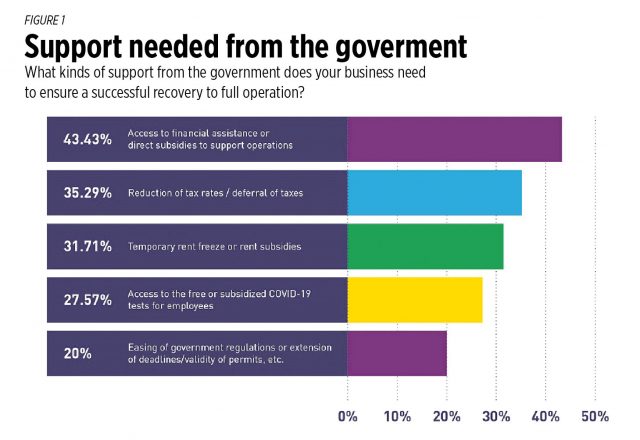
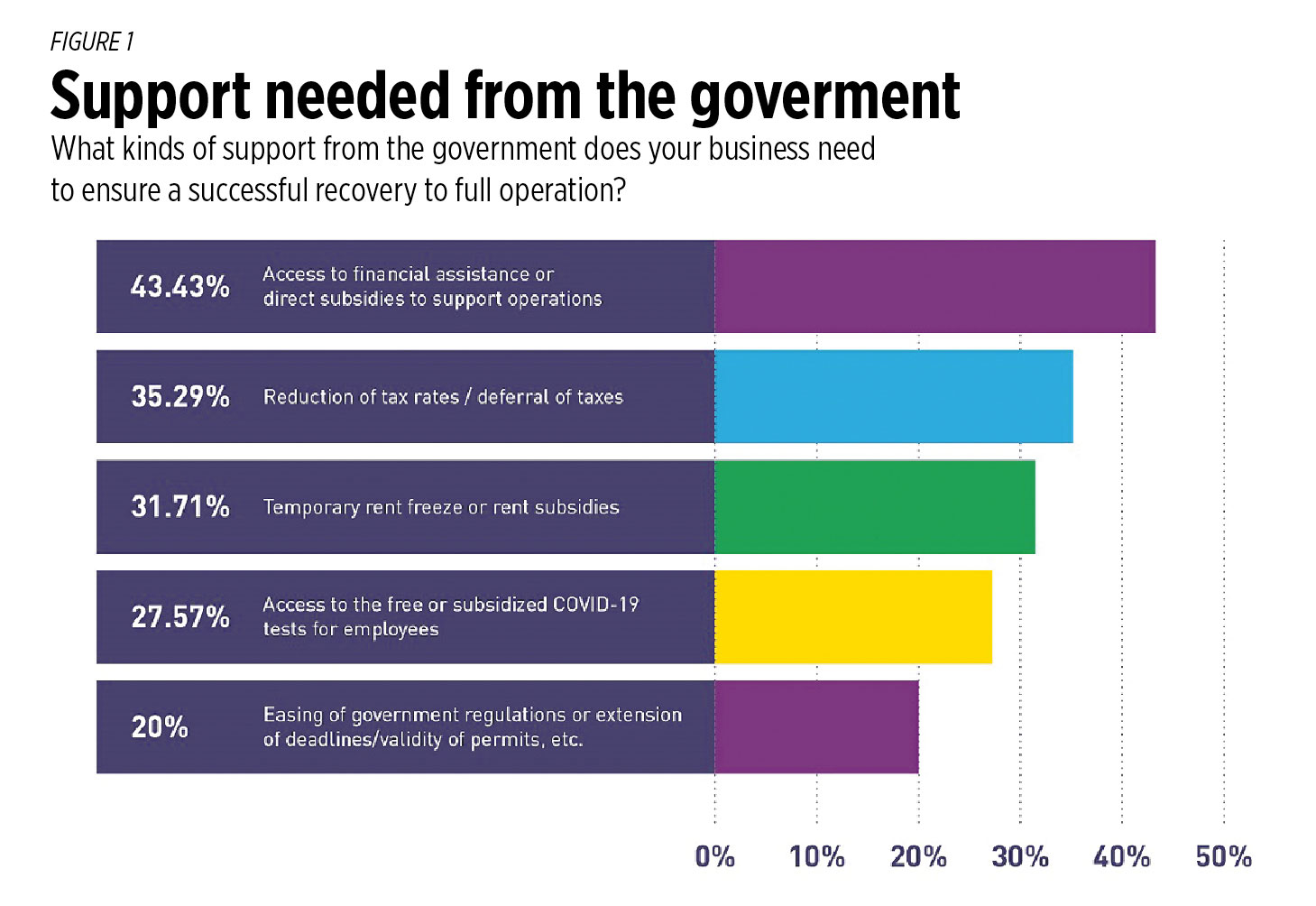
The burden of credit constraint becomes more pronounced for small businesses whenever a crisis occurs, such as the COVID-19 pandemic. The Asian Institute of Management RSN Policy Center for Competitiveness surveyed 700 MSMEs in Metro Manila and Calabarzon.4 The survey highlighted how MSMEs coped during the pandemic and their strategies for survival and building resilience. Over 43% of respondents expressed the need to receive access to financial assistance or direct subsidies to ensure a successful recovery to full operations (Figures 1 and 2), although the amount these MSMEs require is not necessarily large. Almost 69% of respondent firms said they needed less than P100,000 (roughly $2,000). This amount is relatively more substantial for micro-enterprises, who are typically more credit-constrained than their small or medium-sized counterparts.

The pandemic has transformed the way firms and customers conduct business. Since the onset of the crisis in March 2020, e-commerce platforms have seen an extensive usage increase. The shift to online shopping has been more pronounced in emerging and developing economies such as the Philippines. Even as economies navigate their way towards recovery, consumers are likely to continue embracing e-commerce, which is set to become more mainstream beyond the crisis.

In the age of quarantine restrictions and safe distancing, financial technology (fintech) companies can provide MSMEs with various financial services, from loans to digital payment solutions. Fintech democratizes finance and makes it more inclusive, which benefits small businesses and consumers alike.

Although the Philippines is a pioneer in e-commerce,5 launching its first digital payment platform Smart Money in 2001 and GCash in 2004, the use of mobile digital payment systems has been largely limited until the onset of the pandemic. The 65% increase6 in the number of customers using GCash from 20 million users in 2019 to 33 million users in 2020 indicates Filipinos’ willingness to embrace cashless transactions. As a conduit of financial inclusion, fintech platforms can encourage savings, extend much-needed credit, and promote digital financial literacy.

In response to increased demand for cashless and digital payments due to the pandemic, other countries have aggressively pursued fintech solutions as part of their business strategy.7 A study by Facebook and Small Business Roundtable found that 35% of MSMEs in the United States have adopted digital payment solutions.8 Singapore has aggressively promoted digital payment solutions to allow the safe and prompt reopening of their economy by encouraging the use of e-Invoicing and e-Payment, which enables businesses to provide e-receipts to customers and accept e-payments instead of paper receipts, cash, and checks.9

The speed and agility of fintech firms in being able to provide financial services to small businesses with limited credit history or collateral is especially needed for the quick recovery of MSMEs. Typically, fintech lenders assess the creditworthiness of MSMEs quicker than traditional banks by using analytics and other technologies.10 In Indonesia, financial inclusion is being promoted through peer-to-peer (P2P) lending using mobile apps such as Investree.11 and 12 Through participation in these P2P lending apps, SMEs were able to expand their business operations and increase their revenues.13

The widespread adoption of fintech has facilitated the recovery of small businesses in China, helping their economy bounce back.14 From being heavily reliant on cash transactions, China is now among the leading countries in digital payments, mainly through QR payment providers such as Alipay and WeChat Pay.15 By shifting directly to digital payments, China essentially leapfrogged card-based payments that Western countries such as the United States have long adopted.16 One way the two big QR payment providers enticed people to go cashless is by incorporating the traditional practice of giving angpaos or red envelopes with cash during Lunar New Year to their respective ecosystems. Instead of giving physical red envelopes to relatives and family members, they can now send digital red envelopes through these apps.17

The adoption of cashless payments is evident in urban areas in China and increasingly in rural areas. The proliferation of low-cost Chinese smartphones allows rural residents of China to access the internet for the first time. The expansion of internet access in rural areas and the Chinese state banks’ push towards opening bank accounts for rural residents lowers the barriers to entry in adopting QR payments and making financial inclusion more attainable.18 and 19 While the mobile penetration rate in the Philippines is high, several challenges remain, such as internet connectivity and financial literacy.

It is unclear how long the crisis will drag-on and what the next normal holds for small businesses in the Philippines, but fintech will play an important role in facilitating financial inclusion and ultimately helping MSMEs build resilience to future shocks. While fintech democratizes financial services for those who have access, policymakers should prioritize measures to enable the development of fintech and digital financial literacy to unlock the full potential of financial inclusion and help small businesses remain resilient to future crises.

1 https://www.poverty-action.org/sites/default/files/publications/English.pdf

2 https://www.doingbusiness.org/content/dam/doingBusiness/media/Special-Reports/improving-access-to-finance-for-SMEs.pdf

3 ibid

4 https://papers.ssrn.com/sol3/papers.cfm?abstract_id=3821248

5 https://www.gsma.com/mobilefordevelopment/programme/mobile-money/mobile-money-philippines-market-conditions-drive-innovation-smart-money-gcash-philippines-becoming-mobile-money-innovation-hub/#_ftn1

6 https://fintechnews.ph/44332/e-wallet/gcash-e-wallet-hits-php-1-trillion-in-transactions-in-2020/

7 http://www.fao.org/3/cb2109en/CB2109EN.pdf

8 https://dataforgood.fb.com/wp-content/uploads/2020/05/SMBReport.pdf

9 https://www.imda.gov.sg/programme-listing/smes-go-digital/Digital-Solutions-For-Safe-Reopening#billandpayonline

10 Kehinde, T. & Eksin, E. (May 12, 2020). How fintech can help SMEs recover from the impact of COVID-19. World Economic Forum. https://www.weforum.org/agenda/2020/05/fintech-can-help-smes-recover-covid-19/

11 Wardhani, N., & Bohmann, M. (Nov. 5, 2020). How fintech can help Indonesia’s small and medium enterprises survive the COVID-19 pandemic. The University of Queensland Research. https://research.uq.edu.au/article/2020/11/how-fintech-can-help-indonesia%E2%80%99s-small-and-medium-enterprises-survive-covid-19-pandemic

12 Eloksari, E.A. (July 3, 2020). P2P lending helps SMEs earn more, scale up business: Research. The Jakarta Post. https://www.thejakartapost.com/news/2020/07/03/p2p-lending-helps-smes-earn-more-scale-up-business-research.html

13 Ibid.

14 https://www.weforum.org/agenda/2020/05/digital-payments-cash-and-covid-19-pandemics/

15 https://www.asiapacific.ca/sites/default/files/publication-pdf/mobile_payment_report.pdf

16 https://www.brookings.edu/wp-content/uploads/2020/04/FP_20200427_china_digital_payments_klein.pdf

17 https://www.cgap.org/sites/default/files/researches/documents/Brief-Chinas-Alipay-and-WeChat-Pay-Dec-2017.pdf

18 https://www.asiapacific.ca/sites/default/files/publication-pdf/mobile_payment_report.pdf

19 https://www.cgap.org/sites/default/files/researches/documents/Brief-Chinas-Alipay-and-WeChat-Pay-Dec-2017.pdf

The views expressed in the article are the views of the authors and do not necessarily reflect the views or policies of the Asian Institute of Management (AIM).


John Paul Flaminiano is Associate Director and a Senior Economist at the AIM RSN Policy Center for Competitiveness. Christopher Ed Caboverde is a Research Associate at the AIM RSN Policy Center for Competitiveness.

policycenter@aim.edu

Biden warns of Chinese threat

REUTERS
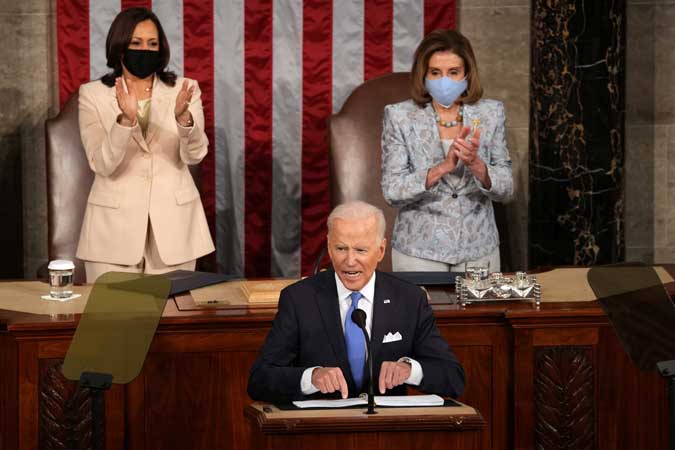
US VICE PRESIDENT Kamala Harris and Speaker of the House Nancy Pelosi applaud as US President Joseph R. Biden addresses a joint session of Congress in the House chamber of the US Capitol in Washington, April 28. — POOL VIA REUTERS

WASHINGTON — President Joseph R. Biden, Jr., proposed a sweeping new $1.8-trillion plan in a speech to a joint session to Congress on Wednesday, pleading with Republican lawmakers to work with him on divisive issues and to meet the stiff competition posed by China.

The Democratic president urged Republicans who have so far resolutely opposed him to help pass a wide array of legislation from taxes to police reform to gun control and immigration.

Republicans largely sat silently during the speech while Democrats applauded.

Mr. Biden, who took office in January, also made an impassioned plea to raise taxes on corporations and wealthy Americans to help pay for his $1.8 trillion “American Families Plan.”

“It’s time for corporate America and the wealthiest 1% of Americans to pay their fair share — just pay their fair share,” Mr. Biden said.

He made his plea in the House of Representatives at an event scaled back this year because of the pandemic, removing his mask to speak to a group of about 200 hundred Democratic and Republican lawmakers, other officials and guests.

Mr. Biden is trying to thread the needle between Republicans opposed to more spending and the tax increases needed to pay for it, and liberal Democrats who want him to push for more aggressive plans.

He said he was willing to work with lawmakers on both sides of the aisle to come to an agreement, and he is to meet top Democratic and Republican lawmakers at the White House on May 12 to try to find common ground.

But the initial Republican response to his speech was skeptical, and somewhat dismissive.

“This whole thing could have just been an e-mail,” Representative Kevin McCarthy, the top Republican in the House, said in a tweet.

Speaking less than four months after demonstrators loyal to then-President Donald J. Trump stormed the US Capitol in a bid to overturn the election results, Mr. Biden said America was “on the move again.”

“We have stared into an abyss of insurrection and autocracy — of pandemic and pain — and ‘we the people’ did not flinch,” he said. “At the very moment our adversaries were certain we would pull apart and fail, we came together — united.”

Mr. Biden argued that his proposals for families and infrastructure, which together total about $4 trillion, represent a once-in-a-generation investment vital to America’s future.

“Tonight, I come to talk about crisis — and opportunity,” he said. “About rebuilding our nation — and revitalizing our democracy. And winning the future for America.”

But Republicans say most of the spending is aimed at satisfying Mr. Biden’s liberal base, and that the president’s plans amount to socialism.

Mr. Biden said the spending plans were needed to keep up with China, which he and his administration sees as a major strategic challenger.

“China and other countries are closing in fast,” he said, adding that he has spent a lot of time talking to Chinese President Xi Jinping.

“He’s deadly earnest about becoming the most significant, consequential nation in the world. He and others, autocrats, think that democracy can’t compete in the 21st century with autocracies. It takes too long to get consensus.”

PROPOSED TAX OVERHAUL
Mr. Biden’s plan includes $1 trillion in spending on education and childcare over 10 years and $800 billion in tax credits aimed at middle- and low-income families. It also includes $200 billion for free, universal preschool and $109 billion for free community college regardless of income for two years, the White House said.

The American Families Plan and the infrastructure and jobs plan the White House introduced earlier this month could represent the most significant government transformation of the economy in decades.

To pay for the plans, Mr. Biden has proposed an overhaul of the US tax system, including raising the top marginal tax rate for the wealthiest Americans to 39.6% from its current 37%.

Mr. Biden has proposed nearly doubling the tax on investment income — known as capital gains — for Americans who earn more than $1 million. The $2 trillion-plus infrastructure plan is funded by an increase in corporate taxes.

News of the capital gains tax proposal caused stock markets to drop briefly last week.

Republican US Senator Tim Scott argued in his rebuttal to Mr. Biden’s speech that the proposals will hurt long-term economic growth.

“Our best future won’t come from Washington schemes or socialist dreams,” said Mr. Scott, the sole Black Senate Republican. “It will come from you — the American people,” Mr. Scott said.

He also argued that Mr. Biden’s presidency is benefiting from an economic recovery for which Mr. Trump, a Republican, set the stage. — Reuters

EU report accuses Russia, China of sowing mistrust in Western vaccines

BRUSSELS — Russian and Chinese media are systematically seeking to sow mistrust in Western COVID-19 vaccines in their latest disinformation campaigns aimed at dividing the West, a European report said on Wednesday.

From December to April, the two countries’ state media outlets pushed fake news online in multiple languages sensationalizing vaccine safety concerns, making unfounded links between jabs and deaths in Europe and promoting Russian and Chinese vaccines as superior, the EU study said.

The Kremlin and Beijing deny all disinformation allegations by the EU, which produces regular reports and seeks to work with Google, Facebook, Twitter and Microsoft to limit the spread of fake news.

Russian and Chinese vaccine diplomacy “follows a zero-sum game logic and is combined with disinformation and manipulation efforts to undermine trust in Western-made vaccines,” said the EU study released by the bloc’s disinformation unit, part of its EEAS foreign policy arm.

“Both Russia and China are using state-controlled media, networks of proxy media outlets and social media, including official diplomatic social media accounts, to achieve these goals,” the report said, citing 100 Russian examples this year.

The EU and NATO regularly accuse Russia of covert action, including disinformation, to try to destabilize the West by exploiting divisions in society.

“A disinformation report that has no factual basis is in itself an example of disinformation,” the Chinese mission to the EU said in a statement dated Thursday in response to the report.

Russia denies any such tactics and President Vladimir Putin has accused foreign foes of targeting Russia by spreading fake news about the coronavirus.

Vaccine supply issues with AstraZeneca, as well as very rare side effects with AstraZeneca and the Johnson & Johnson vaccines have been seized upon, the report said.

“Both Chinese official channels and pro-Kremlin media have amplified content on alleged side-effects of the Western vaccines, misrepresenting and sensationalizing international media reports and associating deaths to the Pfizer/BioNTech vaccine in Norway, Spain and elsewhere,” the report said.

Last year, China sought to block an EU report alleging that Beijing was spreading disinformation about the coronavirus outbreak, according to a Reuters investigation.

While the EU has not vaccinated its 450 million citizens as fast as Britain, which is no longer a member of the bloc, shots are now gaining speed, led by US drug maker Pfizer’s shots and its German partner BioNTech.

Russian media reported that “Brexit saved the UK from the ‘vaccine chaos’ engulfing the EU,” the EU said. “Such narratives indicate an effort to sow division within the EU,” it added.

In the report, released online at https://euvsdisinfo.eu/, the EU said Russia’s official Sputnik V Twitter account sought to undermine public trust in the European Medicines Agency.

Sputnik V responded that the disinformation campaign is against Russia and its vaccine, not the other way around.

“We will continue to fight disinformation campaign against Sputnik V in the interests of protecting lives around the world and avoiding vaccine monopoly that some vaccine producers may strive for,” it said on Twitter.

The Twitter account is managed by the Russian sovereign wealth fund, the Russian Direct Investment Fund, which is responsible for marketing and promoting the Sputnik V vaccine.

China meanwhile promoted its vaccines as a “global public good” and “presenting them as more suitable for developing countries and also the Western Balkans,” the report found. Western Balkan countries are seen as future EU members. — Reuters