Home Blog Page 7723

Metro Manila under strict lockdown to contain Delta variant
PHILIPPINE STAR/ MICHAEL VARCAS

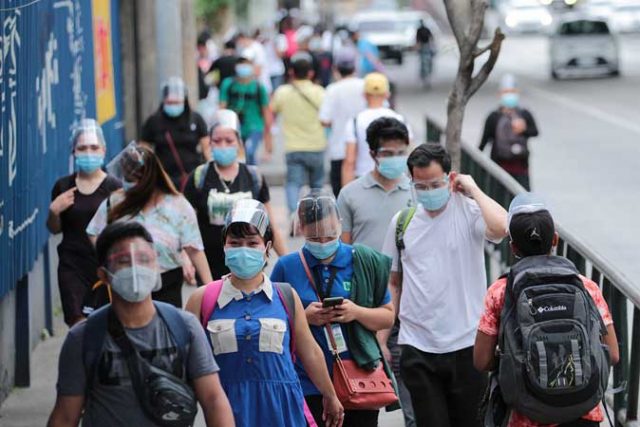
Manila and nearby cities would go back to the strictest lockdown level from Aug. 6 to 20 amid a fresh surge in coronavirus infections that may have been spurred by a more contagious Delta variant. 

The presidential palace announced the decision as the Department of Health (DoH) reported 8,562 COVID-19 infections on Friday, the highest in more than two months. This brought total cases to 1.58 million, 61,920 or 3.9% of which were still active. 

The Philippine economy could lose more than P200 billion during the two-week enhanced community quarantine, the National Economic and Development Authority said in a statement. 

It would also increase the number of poor people by as many as 177,000 and add 444,000 jobless Filipinos, Socioeconomic Planning Secretary Karl Kendrick Chua said in a Viber group message. 

The government should use the next three weeks to fast-track vaccinations in high-risk areas, Mr. Chua said. “This way, the enhanced community quarantine will be an investment to pave the way for a recovery once we control the Delta spread.”  

The government also extended the travel ban on India, where the variant was first detected, and its neighbors until mid-August, presidential spokesman Herminio L. Roque, Jr. told a televised news briefing on Friday. 

Covered by the ban aside from India are Pakistan, Nepal, Sri Lanka, Bangladesh, Oman, the United Arab Emirates, Indonesia, Malaysia and Thailand. 

More restrictions were imposed in the capital region starting July 31, including a ban on indoor and al fresco dining at restaurants. 

Physical religious gatherings were also banned, while necrological services, wakes and funerals for those who died of causes other than COVID-19 would be allowed but limited to immediate family members, the palace said. 

Public transportation will continue but only only authorized persons will be allowed to travel into and out of the National Capital Region, Cavite, Bulacan, Laguna and Rizal. 

Outdoor tourist attractions, beauty salons, parlors, barber shops and nail spas may continue to operate at 30% capacity. Indoor sports and tourist attractions won’t be allowed. 

The OCTA Research Group from the University of the Philippines earlier urged the government to impose a “circuit breaker” lockdown to contain a fresh surge in coronavirus infections that may be due to the Delta variant. 

It said about 1,000 cases were being reported daily in Metro Manila. Health authorities have debunked the claim, saying there was no evidence of a surge. 

The death toll rose to 27,722 on Friday after 145 more patients died, while recoveries increased by 2,854 to 1.49 million, the Health department said in a bulletin. 

There were 61,920 active cases, 94% of which were mild, 1.2% did now show symptoms, 2.1% were severe, 1.49% were moderate and 1.2% were critical.   

DoH has reported 216 Delta variant cases, but there could be more undetected cases because of the slow pace of the country’s genome sequencing. 

Only 7% of of 110 million Filipinos have been fully vaccinated against COVID-19. The government seeks to fully immunize as many as 70 million people by year-end. 

Albay Rep. Jose Maria Clemente S. Salceda said lockdowns should only be imposed as a last resort. 

Enhanced community quarantines only work when done early enough,” he said in a statement. “It does not work in response to a wave, because its impact is lagged. We’ll see its benefits only a month later.” — with Russell Louis C. Ku 

BSP vows to back economy with accommodative stance

The Philippine central bank will keep a supportive monetary policy amid a slower-than-anticipated economic recovery, its governor said on Friday. 

“High-frequency indicators suggest that the economy is gradually recovering from the adverse effects of the pandemic, but it would appear that the recovery is slower than anticipated,” Bangko Sentral ng Pilipinas (BSP) Governor Benjamin E. Diokno told a forum. 

“As such, the BSP will maintain its accommodative stance for as long as necessary to support and sustain the economy’s recovery,” he added. 

The central bank would watch risks to inflation and the growth outlook and would adjust policy settings when needed to maintain financial stability, he said. 

The central bank kept the key policy rate at a record low of 2% at its meeting on June 24, citing threat from the coronavirus and a recovery that had just started. 

“There are still risks to our growth outlook as the presence of the Delta coronavirus variant might give rise to renewed restrictions, similar to what is happening in select cities in Asia, Europe and Oceania,” Mr. Diokno said. 

Economic output fell by 4.2% in the first quarter after a record 9.6% contraction in 2020. 

The central bank chief said there were “promising signs of recovery, including the growth in exports and foreign direct investments (FDI). 

Exports rose by 21.4% to $29.35 billion in January to May from a year earlier, while FDI inflows jumped by 56.3% in the first four months to $3.056 billion. 

Meanwhile, Mr. Diokno said headline inflation was beyond their 2-4% target “due to transitory factors,” but should remain within estimates over the policy horizon. 

“We reiterate that increases in prices owing to supply shocks are best dealt with by supply-side interventions,” he said. 

Meanwhile, July inflation was expected to exceed the central bank’s target for the seventh straight month amid rising oil, food and electricity prices, Mr. Diokno said. 

The consumer price index is expected to rise by 3.9% to 4.7% this month, likely at 4.3%, he told reporters in a Viber message. Inflation in June was 4.1%  and 2.7% a year earlier. 

“Higher prices of domestic petroleum products and key food items along with the upward adjustment in Manila Electric Co. electricity rates and a weaker peso are the main sources of upward price pressures for the month,” Mr. Diokno said. 

Inflation was 4.4% in the first half. The central bank will hold its next policy-setting meeting on Aug. 12. 

BSP fully awards one-month bills

BW FILE PHOTO

The Philippine central bank raised P100 billion on Friday as it fully awarded its short-term securities, with yields rising due to concerns about a looming strict lockdown in the capital region. 

The 28-day securities of the Bangko Sentral ng Pilipinas (BSP) were oversubscribed as it fetched bids worth 117.75 billion. But demand failed to beat the P162.51 billion in tenders at the auction last week. 

Accepted rates were from 1.735% to 1.9279%, wider than 1.745% to 1.7705% last week. This caused the average rate to rise by 1.67 basis points to 1.7769% 

The central bank uses its bills and term deposit facilityto mop up excess liquidity in the financial system and guide market rates.   

The yields increased as investors got worried about the effect of the strict lockdown from Aug. 6 to 20 on the economy, said Michael L. Ricafort, chief economist at Rizal Commercial Banking Corp. — Luz Wendy T. Noble 

SEC creates office for fintech innovation

The Securities and Exchange Commission (SEC) on Friday launched a new office under its Corporate Governance and Finance Department (CGFD) that will focus on regulating the use of financial technology (fintech) within the country.

“The commission has supported new and emerging business concepts while taking a proactive stance against any excessive risk buildup to ensure market integrity,” SEC Chairperson Emilio B. Aquino said in a media briefing on Friday.

The PhiliFintech Innovation Office (PIO) will be creating policies for existing and new fintech innovations.

New fintech firms applying for registration will need to reach out to the PIO. Existing fintech companies that have been operating sans the proper regulation or authorization and those that will introduce new products will also be facilitated by the PIO.

The innovation office can also provide “regulatory clarifications” or “regulatory guidance” to fintech firms, wherein it can guide these firms to which regulations apply to them and even assist them in registration.

It also aims to “capacitate the commission with technical expertise” to regulate these fintech innovations, while promoting an “innovative culture” in the commission.

“The SEC established its innovation office… modeled after existing frameworks, structures, and the best practices of other jurisdictions, but we have customized it to fit the fintech landscape here in the Philippines,” SEC Commissioner Kelvin Lester K. Lee said.

The PIO will document and analyze fintech business models to allow the SEC to formulate appropriate regulatory responses to protect investors and to promote the growth of these firms.

Participants will also be allowed to pitch regulations through industry

consultations or “Present Me Anything Sessions,” either with the PIO or the commission. The commission aims to work closely with industry participants.

The PIO is working on a “Regulatory Genome Project” with the University of Cambridge.

“It is a transformation initiative to sequence the world’s vast amount of regulatory data and text, create a comprehensive repository of information to be used by agencies, regulators, and businesses around the world,” Mr. Lee said.

It is also conducting a “domestic industry mapping,” to document local fintech participants that are under the SEC’s jurisdiction.

“We will also endeavor to finalize the DAO (digital asset offerings) and DAX (digital asset exchange) rules with the commission’s own Markets and Securities Regulation Department,” Mr. Lee said, adding that the PIO will also work with the CGFD for memorandums on online lending apps.

URC sells stake in snacks joint venture to partner Intersnack

Consumer foods maker Universal Robina Corp. said on Friday that its snacks and biscuits joint venture based in Australia and New Zealand is to be fully owned by its partner Intersnack Group.

“We are pleased to be handing full stewardship of these strong businesses to our partner Intersnack, while we continue to focus on other growth segments and geographies across developing markets,” Irwin C. Lee, president and chief executive officer of URC, said in a statement.

The joint venture — Uni Snack Holding Co. Ltd. or Unisnack ANZ — was formed when Intersnack partnered with URC in December 2019 by acquiring 40% of shares in the consolidated businesses of URC Oceania Co. Ltd.

Intersnack will be acquiring the remaining 60% of the shares of Unisnack ANZ for an undisclosed amount. URC said its unit URC Oceania signed the agreement to sell on July 29.

Last year, Unisnack ANZ generated around $450 million through its subsidiaries, Snack Brands Australia and Griffin’s Foods. Both units carry a variety of brands.

Salty snack manufacturer Snacks Brands Australia has Kettle, Thins, Cheezels, CC’s, Natural Chips, Jumpy’s, and Samboy under its belt.

Meanwhile, Griffin’s Foods is a biscuit manufacturer based in New Zealand. It carries Griffin’s, Huntley & Palmers, and Gingernuts, as well as its own brands Nice & Natural, Eta, and Uppercuts.

“Unisnack ANZ, its competent management and great commercial performance, is an excellent strategic fit which will strengthen our market coverage in Oceania region and enrich our existing portfolio and innovation pipeline,” Intersnack Group Executive Chairman Maarten Leerdam said in a statement on Friday.

SECOND-QUARTER PERFORMANCE

In a separate disclosure, URC said its second-quarter net income attributable to owners amounted to P5.05 billion, 43% higher than the P3.54 billion it generated in the same period last year.

URC’s topline for the quarter inched down to P33.92 billion from P33.95 billion.

In the first semester, its attributable net income rose by nearly 46% to P8.05 billion from last year’s P5.53 billion. It said the increase was due to lower finance costs, net foreign exchange losses, and higher income from the sale of its fixed assets.

“We are holding strong in weak market conditions in this crisis; but also using this crisis to prepare and reshape our business for long term sustained value creation,” Mr. Lee said in another statement.

The company’s net sales for the January-to-June period inched up by 1.7% to P68.53 billion from P67.41 billion year on year as its international business units recovered and the company’s commodities segment posted growth.

URC’s agro-industrial and commodities unit saw sales grow by 2% to P16.8 billion compared with last year.

“The Commodity Foods Group’s 13% growth was mainly driven by the contribution of last year’s acquisitions, Central Azucarera de La Carlota and Roxol Bioenergy Corp.,” URC said.

The commodity foods group generated P11.41 billion in the six-month period from P10.11 billion previously. Meanwhile, sales of the agro-industrial group went down by 15% to P5.43 billion from P6.39 billion.

Sales of its domestic and international branded consumer foods (BCF) segment totaled P51.7 billion.

Domestic revenues declined by 7.1% to P29.16 billion “as the Philippine business cycles through a higher base last year from pantry-loading, and as consumer sentiment and trading conditions remained weak.”

International revenues grew by 13.4% to P21.55 billion from P19.01 billion. URC said Vietnam and Thailand were key drivers after recording double-digit growth in the first half.

On Friday, shares of URC at the stock exchange went down by 4.38% or P5.80 to close at P126.70 each. — Keren Concepcion G. Valmonte

Philex income up 86%; PXP losses widen

PHILEX MINING Corp. reported an 86% increase in its second-quarter net income to P599.53 million on the back of sustained levels of metal output and higher revenues.

The listed mining company also said in a stock exchange disclosure on Friday that its revenues for the April-to-June period rose 21% to P2.38 billion. Operating costs and expenses climbed 2.6% to P1.59 billion due to higher excise taxes and royalties from increased revenues.

“The slight increase was tempered by lower non-cash production costs in the second quarter of 2021 amounting to P271 million compared with non-cash production costs in the second quarter of 2020 amounting to P330 million,” Philex Mining said.

Earnings before interest, taxes, depreciation, and amortization (EBITDA) for the quarter rose 44% to P1.02 billion.

For the first six months of the year, Philex Mining recorded a 173% year-on-year increase in net income to P1.16 billion. Revenues rose 29% to P4.75 billion due to higher realized metal prices.

“The higher revenues are due mainly to the sustained higher realized metal prices for both gold and copper at $1,807 per ounce and $4.21 per pound, respectively,” Philex Mining said.

“The satisfactory execution of the mining plan and mill operations resulted in the production of 13,612 ounces of gold and 6.44 million pounds of copper for the second quarter of 2021, bringing the first half total metal output at 27,025 ounces of gold and 13.21 million pounds of copper,” it added.

Operating costs and expenses for the semester rose 4.5% to P3.24 billion, while its EBITDA for the period increased 80% to P2.03 billion.

“The increase is attributable to increasing production cost brought about by the effects of the pandemic to the supply chain, including logistics and coronavirus

disease 2019 (COVId-19) response undertaken by the company,” Philex Mining said.

SILANGAN PROJECT

Meanwhile, Philex Mining also announced that its board of directors had approved the in-phase development of its Silangan copper and gold project in Surigao del Norte and will be appointing a financial advisor to help in the fund-raising activity to be done as soon as possible.

The mining company disclosed that Silangan’s development will start by the second quarter of 2022, while commercial operations is estimated to begin in January 2025.

“With the in-phase development of Silangan, the capital expenditure requirement will be made in stages, and can be funded from a variety of potential resources including internally-generated cash and potentially through equity and debt from investors and creditors,” Philex Mining said.

Eulalio B. Austin Jr., Philex Mining president and chief executive officer, said the company will be working with its financial advisor to implement the fund-raising activity for the Silangan project’s in-phase development.

“We believe that the recent government pronouncements related to the mining industry will increase the level of interest and confidence of investors and lenders to mining companies. The launch of Silangan will be very timely,” Mr. Austin said.

Philex Mining Chairman Manuel V. Pangilinan said the company is set to benefit from the positive global outlook on metal prices, together with the execution of its plans amid the pandemic.

“In the next couple of months, we set to launch our Silangan Project under an in-phase development approach. Silangan will be an exciting project for Philex,” Mr. Pangilinan said.

PXP ENERGY INCURS MORE LOSSES

In a separate stock exchange disclosure on Friday, PXP Energy Corp. said its

second-quarter net loss attributable to parent company equity holders widened by 51.5% to P18.81 million.

PXP Energy said its petroleum and other revenues for the April-to-June period reached P19.61 million compared to none last year, while total costs and expenses amounted to P36.41 million, up 184.2%.

For the first half of the year, PXP Energy incurred a P23.15-million attributable net loss, down 47.8% from a year ago.

Petroleum revenues reached P19.61 million, up 220.4%, due to a 250% surge in Galoc crude sale price to $63.48 per barrel in the first half from $18.13 per barrel last year.

PXP Energy’s consolidated costs and expenses climbed 37.8% to P54.43 million against P39.50 million in 2020.

“This is brought about by lower petroleum production costs in Service Contract (SC) 14C-1 Galoc at P13.9 million offset by the increase in general and administrative expenses at P40.5 million,” PXP Energy said.

On Friday, shares of Philex Mining fell 0.97% or six centavos to end at P6.14 apiece while stocks of PXP Energy dropped 2.93% or 21 centavos to close at P6.95 each.

Philex Mining is one of three Philippine units of Hong Kong-based First Pacific Co. Ltd., the others being Metro Pacific Investments Corp. and PLDT Inc.

Hastings Holdings, Inc., a unit of PLDT Beneficial Trust Fund subsidiary MediaQuest Holdings, Inc., has interest in BusinessWorld through the Philippine Star Group, which it controls. — Revin Mikhael D. Ochave

IMI cuts losses despite supply challenges

Integrated Micro-Electronics, Inc. (IMI) swung to a $6.24-million net loss attributable to equity holders of the parent company in the third quarter from a $9.1-million profit $9.64-million profit during the same period in 2020, citing challenges arising from the global supply chain snarls and lockdown restrictions.

In a statement, the manufacturing arm of AC Industrial Technology Holdings, Inc. reported revenues from its contracts with customers went up two four percent to $326.41 million during the July to September period.

“We are still navigating through turbulent waters, but we see an easing of the supply chain challenges in the second half of 2021,” Jerome S. Tan, president and chief operating officer of IMI, said in a statement on Friday.

“Through rigorous collaboration with customers and suppliers, our order books remain robust with high levels of customer demand,” he added. “IMI continues to build its pipeline by winning new projects that should allow us to improve performance as soon as the supply chain finds its balance.”

The company said new program wins for its wholly owned businesses reached an annual revenue potential of $254 million in the first six months, already exceeding what it booked for the entire 2020.

Revenues for wholly owned businesses amounted to $247 million in the April-to-June period. The company noted a revenue backlog due to longer component lead times, forcing the delay of several projects.

“Margins are likewise challenged by efficiency and logistic expenses, particularly with expedited freight costs required to meet customer demand,” IMI said.

Meanwhile, non-wholly owned units generated $72 million for the quarter.

“For the past several months, VIA Optronics had been building up its capabilities and talent pool in preparation for the start of mass production of key automotive projects,” IMI said, adding that one of the projects is anticipated to ramp up in the next three months as a new manufacturing plant opens in Germany.

For the first half, IMI swung to profitability with a net income of $915,000 from last year’s loss of $21.53 million. Meanwhile, revenues grew by 36% to $646.56 million from $476.18 million.

On Friday, shares of IMI at the stock exchange closed unchanged at P8.90 apiece. — Keren Concepcion G. Valmonte

Apex Mining profit up 9.1% on higher metal prices

APEX MINING Co., Inc. recorded a 9.1% year-on-year increase in its second-quarter net income attributable to parent firm equity holders to P210.05 million due to higher metal prices.

The listed mining firm said in a stock exchange disclosure on Friday that its revenues for the quarter reached P1.54 billion, up 86.4%. Gold revenues accounted for P1.43 billion of the total while silver revenues took up the remaining P111.46 million.

Gold sales volume for the quarter rose 79.1% to 16,285 ounces while silver sales were up 0.3% to 47,908 ounces.

Further, the company said realized gold and silver prices for the quarter rose 5.3% and 55.2% to $1,800 per ounce and $26.38 per ounce, respectively.

Due to higher sales, cost of production for the period also rose 157.2% to P1.05 billion from P407.28 million.

For the first six months of the year, Apex Mining registered a 56.6% increase in its attributable net income to P488.86 million. Consolidated revenues in the first half rose 53.7% to P3.09 billion. Gold revenues contributed P2.87 billion of the total while silver revenues shared P214.47 million.

Prices of gold for the first half rose 8.7% to $1,776 per ounce while silver prices climbed 52.8% to $25.63 per ounce.

Gold sales volume reached 33,336 ounces while silver sales totalled 172,662 ounces in the first half of 2021, an improvement from the 23,008 ounces of gold and 125,635 ounces of silver sold last year, due to the availability of logistics amid the pandemic.

The company’s total cost of production for the January-June period rose 64.8% to P2.11 billion from P1.28 billion the previous year due to higher costs for materials used in mining and milling.

Shares of Apex Mining at the stock exchange fell 2.94% or five centavos to end at

P1.65 apiece on Friday. — Revin Mikhael D. Ochave

Holcim swings to profit as sales soar by 65%

BW FILE PHOTO

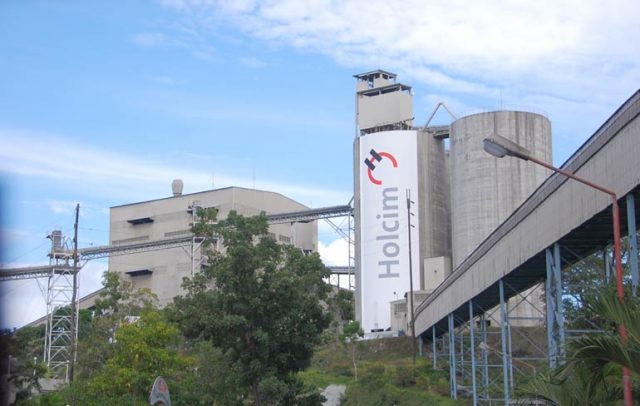
Holcim Philippines, Inc. posted a net income of P721.39 million in the April-to-June period, reversing its P87.71 million loss in the same period last year as sales surged following the resumption of construction activity.

In a disclosure to the exchange on Friday, the company said it also recorded a 65% net sales growth in the second quarter, generating P6.86 billion this year from P4.15 billion “as demand and prices recovered with the rebound in construction activity.”

“Aside from delivering outstanding results, we also helped our partners build greener, smarter, and for all,” Holcim Philippines President and Chief Executive Officer Horia Ciprian Adrian said in a statement on Friday.

The company said it consumed over 208,000 tons of wastes as its alternative fuels and raw materials in its plants.

Earlier this month, Holcim Philippines inked an agreement with Sinoma CBMIPH Construction Corp. to create drying facilities at its cement plants in Bacnotan in La Union and in Lugait, Misamis Oriental.

This will help the plants reduce fuel consumption and increase cement production, the company said.

“We are also making huge strides in innovation and digitalization with our Easybuild digital platform now used by 99% of our customers for a better experience in transacting with us particularly in placing orders and monitoring deliveries,” Mr. Adrian said.

For the first semester, the company saw its profit improve by nearly four times to P1.63 billion from P413.83 million. Meanwhile, net sales rose by 20% to P13.66 billion from P11.42 billion in the same period last year.

Shares of Holcim Philippines went down by 1.24% or eight centavos on Friday to close at P6.35 apiece. — Keren Concepcion G. Valmonte

Duterte keeps military pact with US

PHILIPPINE STAR/KRIZJOHN ROSALES

President Rodrigo Duterte has restored a military pact with the US on the  deployment of troops for war games, reversing a decision that had caused concern in Washington and Manila. 

His decision to keep the visiting forces agreement (VFA) upholds the Philippines’ “strategic core interests,” his spokesman Herminio L. Roque, Jr. said in a statement on Friday. 

He also cited the clear definition of Philippine-US alliance as one between sovereign equals and the clarity of the US position on its obligations under the MDT Mutual Defense Treaty 

The visiting forces agreement provides rules for the rotation of thousands of US troops in and out of the Philippines for war drills. It has become more important as the United States and its allies contend with an increasingly assertive China. 

Mr. Duterte last year said he was canceling the pact after the US Embassy caneled the visa of his former police chief now Senator Ronald M. de la Rosa. He had suspended the cancelation several times amid a coronavirus pandemic. 

Philippine Defense Secretary Delfin N. Lorenzana said he was unsure why Mr. Duterte had reversed himself, but made the decision after a Thursday meeting with US Defense Secretary Lloyd Austin in Manila. 

The US EMbassy in Manila said the VFA enabled a broader alliance and strengthened security for both nations, as well as the rules-based order that benefited all nations in the Indo-Pacific.  

“A strong, resilient US-Philippine alliance will remain vital to the security, stability, and prosperity of the Indo-Pacific,” Mr. Austin said in a statement released by the embassy. 

“If the VFA will have new terms, then that is a new treaty which must be concurred in by the Senate,” Senator Aquilino Pimentel III said in a Viber message. “Since there is no announcement that there is a new VFA treaty, then we assume that what has been continued is the existing VFA.” 

“We should welcome all efforts to shore up relations with other countries, especially with our allies, as only through global cooperation can we survive from this world-wide crisis,” Leyte Rep. Ferdinand Martin G. Romualdez said in a statement. 

He said keeping the VFA would help strengthen bilateral cooperation between the two countries especially during the pandemic. 

Muntinlupa Rep. Rozzano Rufino B. Biazon said Mr. Duterte’s retraction would benefit national security through “continuing cooperation with our long-standing ally” especially on matters involving the sea dispute with China. 

Members of the Makabayan bloc slammed the decision, seeing it as a move to get the US to support Mr. Duterte in the elections next year. 

“He was not really bent on abrogating the VFA,” Bayan Muna Rep. Carlos Isagani T. Zarate said in a statement. 

“If at all, the prior threat to abrogate is even one way also for President Duterte to appease the United States government and court its favor behind his political plans and for his selected successor in the 2022 elections,” he added. — Bianca Angelica D. Añago, Alyssa Nicole O. Tan and Russell Louis C. Ku 

350 more Filipinos come home

DFA

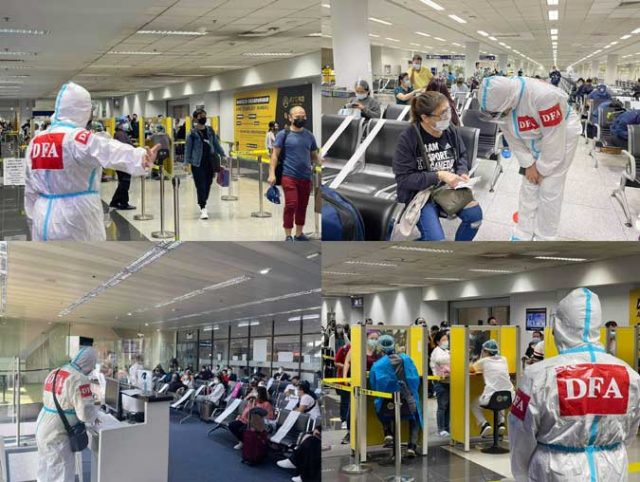
The Department of Foreign Affairs (DFA) brought home 350 more Filipinos who got stranded in Dubai amid a coronavirus pandemic, it said in a statement on Friday. 

The announcement followed Foreign Affairs Secretary Teodoro L. Locsin, Jr.’s promise that DFA would use its resources to “bring them all home.” 

All repatriates received P10 thousand in aid. They also went through medical protocols and quarantines upon arrival. 

The agency has brought home 3,350 distressed Filipinos from the UAE since the health crisis started last year. 

Meanwhile, the World Health Organization (WHO) asked local governments to double efforts to vaccinate more senior citizens given the threat of a more contagious Delta coronavirus variant. 

In a statement, WHO Philippines said only a quarter of senior citizens have been fully vaccinated, and only 35% have received their first dose. 

Also on Friday, Senator Franklin M. Drilon pushed for the creation of a law that will bar unvaccinated Filipinos from leaving their homes. 

In a statement, the lawmaker said escorting unvaccinated citizens back to their homes is a reasonable exercise of police power to protect public health. 

“In its exercise of police power, the government can impose regulations to promote the general welfare and public interest, including public health,” he said. “That said, the law must be reasonably necessary to accomplish the government’s purpose, and it must not be arbitrary or oppressive.” 

But Senator Aquilino L. Pimentel III said those unwilling to get vaccinated should not be punished because that is their right. “What did these unwilling people do wrong? Nothing at all.” 

The Commission on Human Rights earlier said unvaccinated people should not be discriminated against. — Alyssa Nicole O. Tan and Bianca Angelica D. Añago 

New SC justice applicants named

PHILSTAR

The Supreme Court (SC) has released a list of the 11 applicants vying for the associate justice position. 

Of the 11 applicants, two are from outside the Judiciary, namely Commission on Elections chief Antonio T. Kho, Jr. and Finance Undersecretary Antonette C. Tionko.  

The other applicants are Apolinario D. Bruselas Jr., Amparo M. Cabotaje-Tang, Ramon A. Cruz, Japar B. Dimaampao, Geraldine Faith A. Econg, Jose Midas P. Marquez, Ronaldo Roberto B. Martin, Maria Filomena D. Singh, and Raul B. Villanueva. 

Meanwhile, President Rodrigo R. Duterte has approved the appointment of Jose C. Faustino, Jr. as the new chief of staff of the Armed Forces of the Philippines. 

In a July 29 letter to Defense Secretary Delfin N. Lorenzana made public on Friday, the presidential palace said his appointment would take effect on Saturday. — Bianca Angelica D. Añago