Home Blog Page 7685

Golden Globes group floats changes to address diversity, ethics complaints

EN.WIKIPEDIA.ORG
EN.WIKIPEDIA.ORG

LOS ANGELES —  The board of the Hollywood Foreign Press Association (HFPA), the group that hands out the annual Golden Globe awards for television and film, proposed several changes on Monday to address criticism over its membership’s diversity and ethics.

In a letter to members, the HFPA board suggested several steps to diversify its roster, including hiring a chief diversity officer, putting emphasis on recruiting Black journalists and widening the pool of potential applicants. The board also proposed adding at least 20 new members in 2021 and boosting its ranks by 50% over the next 18 months. The changes must be approved by current members and will be discussed at the group’s next meeting, the letter said.

“We have created a roadmap for transformational change in our organization,” the board said.

The moves follow an investigation published in February by the Los Angeles Times that noted there were no Black people among the 87-member group of foreign entertainment journalists who make up the HFPA.

The Los Angeles Times also raised long-standing ethical questions over the close relationships between the HFPA and movie studios that may influence the choice of Golden Globe nominees and winners. The controversy overshadowed the Golden Globes ceremony in February, one of the major Hollywood award shows leading up to the Oscars in April.

The HFPA board said it developed the recommendations with input from outside advisers and inclusion experts as well as media partners. Comcast Corp.’s NBC network broadcasts the Golden Globes ceremony each year and welcomed the plan as “an encouraging step in the right direction.”

“It outlines the thorough reforms that are critical for our continued relationship,” NBC said.

Among other proposals, the board urged that HFPA members stop accepting promotional items from film and TV studios and that the group post a public list of members with links to their work.

“We want to be clear — these outlined changes are just the first steps in the long journey ahead,” the letter said. “We also know that in this existential moment for our association, change is difficult and sometimes scary.” — Reuters

MPIC, Meralco boost their sustainability programs

BW FILE PHOTO
BW FILE PHOTO

METRO Pacific Investments Corp. (MPIC) and its unit Manila Electric Co. (Meralco) are expanding their sustainability targets, including adhering to global standards and shifting to cleaner technology.

Expansion targets of the companies’ sustainability agenda were shared with participants of a recent virtual forum on multi-sector integration through environmental, social, and governance (ESG) principles for green economic recovery.

The online event was organized by Stratbase Albert del Rosario Institute (ADRi) in partnership with the Philippine Business for Environmental Stewardship (PBEST).

June Cheryl Cabal-Revilla, chief finance and chief sustainability officer of MPIC, said: “Our mantra is sustainability more than just compliance, and we’ve been putting this in all the things that we do. We’ve up the ante and we’ve actually committed to adhere to global sustainability standards and frameworks.”

Raymond B. Ravelo, Meralco vice-president and chief sustainability officer, said the power distribution utility had started to gain momentum towards “cleaner and greener energy.”

The forum gathered environment advocates from the government, business groups and civil society, which sought stronger collaboration between the public and private sectors in addressing climate change and urgent environmental issues.

“In the next five years, we look to ‘greenify’ our supply portfolio by securing 1,500 megawatts (MW) of clean energy contracts. As well through our company MGreen, which is our platform for investments in the renewable energy space, we will build 1,500 MW also in renewable energy projects through 2027,” Mr. Ravelo said.

Meanwhile, Ms. Cabal-Revilla said that in terms of MPIC’s carbon footprint, “we’ve stayed flat at 460 metric tons.”

“For PLDT, we’ve done marine protection, mangos preservation, and reforestation as nature is the foundation for economic growth. It is our responsibility to restore and manage the natural resources that we have,” she added.

Dr. Carlos Primo David (PhD), PBEST convenor, encouraged the private sector to expand their sustainability efforts, work with the government, and directly address the sustainability of the country and the planet.

Ludwig Federigan, executive director of the Young Environmental Forum, said, “CSOs and NGOs play a major role in key areas such as information collection, dissemination, and analysis, policy development consultation, policy implementation, and lastly, assessment and monitoring.”

Renato Redentor Constantino, executive director of the Institute for Climate and Sustainable Cities, said: “Climate issue is the biggest that we have ever faced. But it is also equally important for the people to address challenges related to poverty, health, jobs, and hunger.”

ADRi President Dindo C. Manhit said that the government, “with the help of civil society’s lenses, should set the much-needed responsive policies and frameworks that are conducive to doing business while ensuring compliance with ESG principles.”

EastWest Bank not looking to sell soured assets via FIST Law

BW FILE PHOTO
EAST WEST Banking Corp.’s chief executive said the lender is “not very keen” on selling bad assets as its financial position remains healthy. — BW FILE PHOTO

EAST WEST Banking Corp. (EastWest Bank) President and Chief Executive Officer Antonio C. Moncupa, Jr. said the bank is “not very keen” on availing of the provisions of the Financial Institutions Strategic Transfer (FIST) Law as they remain in a stable position.

“My view is that the banking industry remains resilient and that it does not have that urgency [to offload bad assets as was seen] in 1997. Personally, for EastWest, I’m not very keen on it,” Mr. Moncupa said in an interview with ANC on Tuesday.

Republic Act No. 11523 or the FIST Law was signed in February. It allows financial institutions to sell their nonperforming assets (NPAs) to FIST corporations, giving lenders a chance to clean up their balance sheets. In turn, FIST corporations will be given tax perks.

“That really depends on your position but I think we’re in a really good position, the industry as a whole. That’s very positive that there’s less need for that (selling bad assets),” Mr. Moncupa said.

Bangko Sentral ng Pilipinas Governor Benjamin E. Diokno has said the FIST will serve as a “fallback” for lenders as the banking industry’s fundamentals remain solid, noting the sector’s capital adequacy ratio remains well above the minimum regulatory requirement.

The Special Purpose Vehicle Act, which was a similar measure during the Asian Financial Crisis in 1997, was passed in 2002. Mr. Diokno said banks sold around 30% of their NPAs to asset management companies through the measure. He noted that 30% of banks’ NPAs as of Dec. 31 was equivalent to about P152 billion.

Mr. Moncupa also said banks are seeing lower demand for consumer loans.

“Households are very, very careful protecting what they have and trying to save because I’d like to think there are still remaining uncertainties with regards to this virus,” he said.

CITIGROUP
Meanwhile, Mr. Moncupa said they need more data to see if they would join other local banks in their intent to acquire the retail portfolio of Citigroup, Inc. in the Philippines. The US-headquartered banking giant has announced it would leave retail banking in 13 markets in Asia-Pacific, including the Philippines.

“I think any bank in retail banking will pause and try to see the opportunity. They’re one of the top credit card issuers, healthy wealth management for mass and emerging affluent, and good deposit base,” Mr. Moncupa said.

Officials from Bank of the Philippine Islands and BDO Unibank, Inc. last month said they are interested in acquiring Citi’s local retail base.

EastWest Bank’s net earnings increased by 4.8% to P6.5 billion in 2020 on the back of high interest income and strong trading games.

The Gotianun-led lender’s shares closed at P9.55 apiece on Tuesday, down by 28 centavos or by 2.85% from its previous finish. — L.W.T. Noble

Twitter to introduce ticketing for audio Spaces feature

FREEPIK

TWITTER, Inc. said on Monday it will introduce a new feature to let users charge admission to their live audio chat rooms in its Spaces feature, as the social media company seeks to court more content creators.

Until now, only some users who were part of Twitter’s pilot testing were able to host their own Space. Starting on Monday, any user with at least 600 followers can be a host, the company added. Twitter introduced Spaces last year to compete with viral app Clubhouse, which jump-started the audio chat trend and attracted celebrities and entrepreneurs, but remains limited as an invite-only app.

Over the coming months, Twitter said a limited group of users will be able to sell tickets to access their Spaces conversations, and will determine their own pricing and how many tickets to make available. Hosts will keep the majority of the revenue, while Twitter will earn a “small amount,” the company added.

The move is part of Twitter’s effort to be a bigger player in the “creator economy,” as influencers and independent writers are increasingly earning money from their content on platforms like YouTube or Substack.

Facebook last month announced its own plans for audio chat features, and also said it would allow listeners to tip hosts. — Reuters

Localized psychology scales reveal more anxious and depressed Filipinos

UNSPLASH

By Patricia B. Mirasol

A DEPRESSION, anxiety, and stress scale that was translated into several Philippine languages revealed that the pandemic has had a larger psychological impact on Filipinos: the translated scales show a higher incidence of severe anxiety as compared to a similar study conducted solely in English.

The importance of psychological assessment tools in local languages — considering the country’s linguistically diverse society — was discussed in an April 30 webinar organized by the National Academy of Science and Technology (NAST).

The translated scales could help increase mental health awareness, and make the allocation of mental health services more efficient, according to academician Allan Benedict I. Bernardo, a member of NAST’s Social Sciences Division. In the said webinar, he presented his team’s work translating the Depression, Anxiety, and Stress Scales (DASS-21) into Tagalog-based Filipino, Cebuano, Ilocano, Hiligaynon, and Kapampangan.

The DASS-21 Scale, developed in 1995 by Syd H. Lovibond and Peter F. Lovibond at the University of New South Wales, provides therapists with self-reported, objectively-rated information on a client’s current levels of emotional functioning.

AGITATION, ALIGAGA, ATBP.
The translated scales showed higher incidences of extremely severe depression and anxiety as compared to an online English survey on the psychological impact of the pandemic in the Philippines (published in the December 2020 Journal of Affective Disorders).

The English survey reported that 4.2% of the respondents expressed severe to extremely severe depression. Using the translated scales, the number increased to 15.7% (with 6.9% of respondents expressing severe depression and 8.8% expressing extremely severe depression).

The same increase was seen in results for severe to extremely severe anxiety. The English survey reported 11.1% of respondents falling into this category while the translated scales reported 19% (6.9% said they were experiencing severe anxiety; 12.1%, extremely severe anxiety).

Mr. Bernardo added that the sample obtained by the authors of the study using the English survey, conducted from March 28 to April 12, 2020, was a highly educated one and not representative of the Philippine population. “This was partly why our group was motivated to translate the DASS-21 into different Philippine languages,” said Mr. Bernardo.

The localized DASS-21 survey was done between May to September 2020 and across a bigger and more geographically diverse sample, albeit one that was still non-representative of the whole population.

Among the challenges encountered by Mr. Bernardo and his team were translating symptoms into the local idiom. A phrase like “excessive rapid breathing” is difficult to translate in a conversational manner — emphasis on “conversational” — as is a word like “agitation,” which translates to aligaga in Tagalog. “But imagine if that word was given to a college student,” said Mr. Bernardo. “They’d wonder what that meant.”

The NAST academician shared several examples of his team’s translations in Cebuano:

“I experienced breathing difficulty (e.g., excessively rapid breathing, breathlessness in the absence of physical exertion)” was translated as “Nakasinati ko ug kalisod sa pag-ginhawa (pananglitan, paspas akong pag-ginhawa, dili kaginhawa bisan walay pisikal nga gibuhat).”

“I found myself getting agitated” was translated as “Nakabantay ko na dali ra ko masuko o saputon.”

“I felt downhearted and blue” was translated as “Nakabati ko ug kaguol ug ma-oy.”

COVID-SPECIFIC ANXIETY
A new Coronavirus Pandemic Anxiety Scale (CPAS-11) in English that has been validated as a screening tool was also presented during the April 30 webinar. The scale, intended to pick up specific symptoms beyond the symptoms of general anxiety, revealed a percentage of severe anxiety even higher than the ones reported in the Journal of Affective Disorders and the DASS-21 local translations: 29.19%.

The CPAS-11 study noted, however, that its sample was not a nationally representative one, and should not be interpreted as a national prevalence rate.

Further validation studies are being done on the newly developed scale. The different language translations of the DASS-21, meanwhile, will be available in the HopeLab@DLSU website after the validation studies are published.

Mr. Bernardo cautioned against misinterpreting scores and taking the results of these tools as a diagnosis, as professionals rely on a more complex system of assessment for diagnosis.

“There are some levels of stress that are normal. If you’re living a life without stress, then that’s kind of strange, if you ask me,” he said. “But if these symptoms become severe or sustained over time, then we get concerned about the health of the individual.”


Aboitiz unit participates in Austal Philippines’ FSTR installation

ABOITIZ Construction, Inc. on Tuesday said it had installed and fabricated 20 tons of pillars to the 109-meter, high-speed FSTR ferry delivered by Austal Philippines Pty. Ltd.

The aluminum vessel is said to be the largest-ever to be constructed in the country. It can transport up to 1,200 passengers and some 404 vehicles.

“Our involvement in this project with Austal proves our commitment to delivering quality outputs,” Aboitiz Construction President, Chairman, and Director Anton Mari G. Perdices said in a statement on Tuesday.

The 20-ton pillars installed by the Aboitiz unit consisted of hollow tubes that support the ferry’s mezzanine.

Aboitiz Construction is also working with Austal’s for its other ferries, including the construction of additional mooring bitt and fabrication of pillars and floating docks.

The two have been collaborating since 2011 for Austal’s construction needs, which include the expansion and upgrade of its factory facilities.

“We are optimistic to demonstrate our expertise and further elevate our mission to build a better future,” Mr. Perdices said.

Aboitiz Construction is of the Aboitiz group’s subsidiaries and is a privately-held company.

Shares of the listed holding firm Aboitiz Equity Ventures, Inc. closed unchanged at the stock market on Tuesday at P35.75 each. — Keren Concepcion G. Valmonte

Marvel rallies superhero fans to assemble at movie theaters

LOS ANGELES — Walt Disney Co.’s Marvel Studios on Monday encouraged superhero fans to return to movie theaters, a show of support for pandemic-battered cinemas trying to stage a comeback amid competition from streaming services.

“See you at the movies,” said a three-minute-long trailer designed to stir excitement for 10 upcoming Marvel films including Black Widow, Eternals, and a Black Panther sequel.

The video also showed footage from inside a theater of fans reacting to the decisive battle scene in Avengers: Endgame in April 2019.

The future of movie theaters is uncertain after extended closures during the COVID-19 pandemic. Independent operators and large chains including AMC Entertainment, Cineworld Plc and Cinemark Holdings, Inc. hope that blockbusters from Marvel and others will help lure audiences back.

At the same time, Disney and other media companies are investing billions to compete with Netflix, Inc. and provide consumers with plenty of options to stream at home.

Disney is offering Black Widow for a $30 charge through the Disney+ streaming services on the same day it debuts in theaters in July.

No similar plans have been announced for any of the nine other upcoming films that Marvel previewed on Monday. The movies are scheduled for release over the next two years. —  Reuters

DiskarTech app rolls out new offerings for OFWs, teachers

RIZAL COMMERCIAL Banking Corp.’s (RCBC) DiskarTech app has launched new services to target several groups, including overseas Filipino workers (OFWs), teachers and small businesses.

The platform will offer collateral-free credit for OFWs through its loan marketplace this May, which will allow migrant workers to borrow up to P500,000, RCBC said in a statement. The OFW loans will have a one-year payment scheme.

DiskarTech also teamed up with the Gabay Guro mobile app of the PLDT-Smart Foundation to offer basic deposit account and insurance products that will be accessible to teachers. The Gabay Guro app originally allowed teachers to schedule classes and attend training to boost their online teaching skills.

“Teachers can now avail of the financial products of DiskarTech without even leaving their houses. It is a one-stop shop. It’s like you guys going to school and then going to work and then going to the bank at the same time,” Gabay Guro Chairman Chaye C. Revilla was quoted as saying.

Meanwhile, DiskarTech also unveiled a new microinsurance scheme for small businesses, which includes fire cash assistance in its coverage.

DiskarTech has also partnered with the Department of Education and the Department of Labor and Employment to offer webinars on financial inclusion, as well as financial health and management for various labor groups, including teachers.

The app was launched in July last year and offered basic deposit accounts with no initial deposit or maintaining balance requirement. It also offers bills payment and a loan marketplace where credit will be provided by lending platforms.

RCBC booked a net profit of P5 billion in 2020, down by 7% from a year earlier, as the bank beefed up its loan loss reserves amid the crisis.

The bank’s shares closed unchanged at P18.28 apiece on Tuesday.

Hastings Holdings, Inc., a unit of PLDT Beneficial Trust Fund subsidiary MediaQuest Holdings, Inc., has a stake in BusinessWorld through the Philippine Star Group, which it controls. — L.W.T. Noble

What are the blood clots being caused by some COVID-19 vaccines? Four questions answered

FREEPIK

TWO VACCINES — the Johnson & Johnson vaccine in the US and the AstraZeneca vaccine in Europe — have been linked to an increased chance of a rare type of blood clot. Researchers are investigating what causes these clots and are starting to propose some answers. Dr. Mousumi Som, a professor of medicine at Oklahoma State University, explains what these rare clots are and how they are forming after people get vaccinated.

What are the blood clots?

A small number of people in the US have developed dangerous blood clots after receiving the Johnson & Johnson vaccine. The clots have mostly been occurring in people’s brains and, paradoxically, are associated with low platelet counts.

Normally, platelets help a person stop bleeding when they get injured. If you get a cut or have an injury, the body responds by sending platelets which act as a temporary patch. The patch attracts other platelets and they stick together to stop blood loss. Since platelets normally help the clotting process, this combination of low platelets and extreme clotting makes these clots medically unusual.

These specific types of clots — called cerebral venous sinus thrombosis — although rare, affect around two to five people per million per year and are potentially life-threatening without treatment. Vaccines aren’t normally a trigger for this kind of clot.

Who is having these clots?

As of April 24, out of the 8 million people vaccinated with the Johnson & Johnson vaccine in the US, about 16 people have developed these blood clots. The clots occurred from six to 13 days after immunization, and the majority were in women between the ages of 18 and 48.

On April 26, news reports indicated that at least one man had developed a clot. The man is in his 30s and was hospitalized from a clot in his leg about two weeks after receiving the Johnson & Johnson vaccine.

Health officials in Europe have also reported that the AstraZeneca vaccine — a coronavirus disease 2019 (COVID-19) vaccine authorized and approved in Europe but not in the US — has caused about 200 cases of low-platelet clotting. Importantly, both the Johnson & Johnson vaccine and the AstraZeneca vaccine use a type of harmless virus called an adenovirus to deliver instructions to the human body on how to build an immune response to COVID-19. This is called a viral vector vaccine.

The fact that the both vaccines use a viral vector and both are associated with blood clots has led many health experts to think that the clotting issues of the two vaccines may share the same mechanism.

Why are women getting more clots than men?

At this point, doctors still don’t know what makes women more susceptible than men, nor what puts a person at risk for these clots. These clots can occur, though rarely, in people who don’t get a vaccine. Scientists know that women are three times more likely to develop this type of clot without receiving the vaccine. Many researchers think this is because of birth control or other hormonal replacements that women take.

Why might the vaccines be causing blood clots?

Researchers believe that this specific low-platelet clotting is similar to a reaction some individuals get when they receive a blood thinner called heparin, called heparin-induced thrombocytopenia.

Doctors sometimes use heparin to thin a person’s blood in the case of a heart attack or a blood clot when blood flow needs to be reestablished. But some people experience the opposite reaction, and their blood ends up clotting more instead. This happens because the body triggers an unwanted immune response after receiving heparin.

In these patients, heparin attaches to a product released from platelets called platelet factor 4. When this happens, the immune system considers the combined platelet factor 4 and heparin a problem, so it creates antibodies in response. These antibodies attach to the heparin and platelet factor 4 complex, and the body — which now thinks it needs to repair an injury — causes more clotting while using up even more platelets. This results in the low platelet count seen in these patients.

When doctors have looked at the blood of patients who developed clots after receiving the Johnson & Johnson or AstraZeneca vaccine, it looked very similar to the blood of people who have the low-platelet clotting reaction to heparin. This has led scientists and doctors to believe that the same process might be leading to these clots caused by the two vaccines.

This article is republished from The Conversation under a Creative Commons license.

Ovialand aims to build 3,000 units yearly by 2025

REAL ESTATE developer Ovialand, Inc. is ramping up expansion efforts to reach its goal of building 3,000 houses yearly by 2025 through a “dynamic growth strategy.”

“There is strong demand for our housing lifestyle product, so we are aiming to scale up our capacity to 3,000 houses per year by 2025 and eventually 5,000 houses per year by 2030,” Ovialand President Marie Leonore Fatima Olivares-Vital said in a statement on Tuesday.

The company said it plans to bring its housing products to more cities in Southern Luzon and eventually across the country.

Ovialand assigned China Bank Capital Corp. as its financial advisor for the endeavor.

Januario Jesus Gregorio B. Atencio III, private equity investor and director at Ovialand, said: “It is an honor to have been accepted as a client by one of the best capital advisory firms in the country.”

For his part, China Bank Capital President Ryan Martin L. Tapia pointed to the “huge opportunity” in the country’s housing backlog.

“We think the company’s unique premium affordable offering is well-positioned to cater to a growing market of young families looking for quality homes,” Mr. Tapia said.

Most of Ovialand’s existing projects are horizontal house and lot developments based in Southern Luzon areas.

In February, the company said it was aiming to build and complete 600 units this year as part of four projects in the provinces of Laguna and Quezon. — Keren Concepcion G. Valmonte

Herd immunity vs COVID-19

Herd immunity is the indirect protection from an infectious disease that occurs when a high percentage of the population becomes immune, either through vaccination or previous infection. Also known as population immunity or community immunity, herd immunity makes the spread of an infectious disease from person to person unlikely.

When herd immunity is achieved, even individuals not vaccinated (such as newborns and the immunocompromised) are offered some protection because the disease has little opportunity to spread within the community, according to the Association for Professionals in Infection Control and Epidemiology (APIC).

Last year, some groups floated the idea of allowing coronavirus disease 2019 (COVID-19) infection to spread through whole populations in order to achieve herd immunity quickly. Health authorities, including the World Health Organization (WHO), vehemently oppose this approach to achieving herd immunity.

According to the WHO, herd immunity against COVID-19 should be achieved by protecting people through vaccination, not by exposing them to the pathogen that causes the disease. “Letting COVID-19 spread through populations, of any age or health status will lead to unnecessary infections, suffering and death.” (“COVID-19: Herd immunity, lockdowns and COVID-19,” WHO, Dec. 31, 2020)

As the country’s COVID-19 vaccination program for priority population groups continues to build momentum, it is important to remember that vaccination is the only acceptable way to achieve herd immunity against the deadly respiratory infection. But exactly what percentage of the country’s population needs to be vaccinated before we achieve herd immunity against COVID-19?

The percentage of people who need to be immune in order to achieve herd immunity varies with each disease, the WHO explains. For example, herd immunity against measles requires about 95% of a population to be vaccinated. The remaining 5% will be protected by the fact that measles will not spread among those who are vaccinated. For polio, the threshold is about 80%.

The proportion of the population that must be vaccinated against COVID-19 to begin inducing herd immunity is not known. This is an important area of research and will likely vary according to the community, the vaccine, the populations prioritized for vaccination, and other factors, according to the WHO.

The International Federation of Pharmaceutical Manufacturers & Associations (IFPMA), the body representing the biopharmaceutical industry globally, is a founding member of the ACT-Accelerator of which the COVID-19 Vaccine Global Access Facility (COVAX) is a key pillar. On Feb. 24, COVAX and UNICEF began to roll out 2 billion doses of COVID-19 vaccines — to be delivered by the end of 2021 — to protect high risk and vulnerable people, and frontline healthcare workers in low- and middle-income countries (LMICs), including the Philippines. Since then, GAVI, the vaccine alliance, has announced various deliveries of COVAX COVID-19 vaccines, with millions of doses to reach 147 countries by the end of May.

The biopharmaceutical industry is working at unparalleled speed sparing no resources to develop safe and effective COVID-19 vaccines in record time. The decades-long investments the industry has made in new vaccine technologies enable us to respond to this crisis, while at the same time ensuring uninterrupted global supply of much needed existing vaccines to protect public health and avoid additional burden on the healthcare system.


Teodoro B. Padilla is the executive director of the Pharmaceutical and Healthcare Association of the Philippines (PHAP). PHAP represents the biopharmaceutical medicines and vaccines industry in the country. Its Members are in the forefront of research and development efforts for COVID-19 and other diseases that affect Filipinos.   

Arts & Culture (05/05/21)

Alex OReilly

Art Fair Philippines 2021 goes online

THE ART Fair Philippines goes digital for the first time from May 6 to 15 at www.artfairphilippines.com. Access to the fair is free for everyone. A highlight of the fair is a section focusing on digital art called the Metaverse.

Instituto Cervantes showcases documentaries

TO HIGHLIGHT the rich diversity of viewpoints and narratives this May, Instituto Cervantes de Manila is presenting the online film cycle Zonazine, a showcase of Spanish and Latin American documentaries. The films will be shown through the Instituto Cervantes channel on the Vimeo platform (vimeo.com/institutocervantes) and will be freely accessible for 48 hours from their start date and time. The series of four films will kick off on May 8 with the online screening of El cuarto reino (The Fourth Kingdom), available for 48 hours through the following link: https://vimeo.com/536445310. Directed by Adán Aliaga and Àlex Lora in 2019, this documentary has received several awards including the 2020 Gaudí Award for Best Documentary and the Grand Jury Award at the 2019 Atlanta Film Festival. It portrays the daily life of a can collection and recycling center in a New York neighborhood. Through René, an illegal worker from Mexico, and the relationships he establishes with his peers, the film explores the lie of the “American dream.” For further information about the cultural program of Instituto Cervantes visit the website (http://manila.cervantes.es), or the Instituto Cervantes Facebook page www.facebook.com/InstitutoCervantesManila.

Enrollment for theater workshop series starts May 7

GMG Productions is partnering with the Open House Fundraiser and the Artists’ Welfare Project, Inc. for their newly launched Workshop Series. GMG’s first Workshop Series will be taught by international touring cast members that have performed in Manila. Each week, enrollees will have the opportunity to dance to their favorite musical theater song numbers taught by international cast members. Joining the first set of moderators are Darren Greef, resident director and choreographer of international productions Joseph and the Amazing Technicolor Dreamcoat, Evita, and Chicago the Musical; Alexanda O’Reiley, cast member and Mamma Mia flipper boy; Brian O’Muiri, CATS International touring member; and Louisa Talbot, associate and resident choreographer on West Side Story, Grease, Rocky Horror Show, and Matilda. GMG’s first workshop series will launch June 7. The dance workshops will be held Mondays, Wednesdays, and Fridays at 3 p.m. Each session will be approximately one hour and will include learning choreography, cast hangout and a Q&A. Workshops slots are P3,500 per week. Enrollment will begin May 7. Very limited slots are available through the GMG Productions website https://www.gmg-productions.com/manila/workshops. A portion of the workshops’ proceeds will go to Open House as well as five workshop scholarships per week that shall be extended to qualified beneficiaries as part of additional revenue-generating measures for the Open House Fundraiser. “We are excited to partner with the Open House Fundraiser and AWPI,” said GMG Productions’ CEO Carlos Candal in a statement. “At the beginning of our discussions for the workshops, we knew right away that it was the right thing to do. With every show that comes in to Manila, we hire a team of up to 40 amazing Filipino musicians, cast and crew members, many of whom have been displaced due to the pandemic. We want to be able to help by making use of our network.” To book the Open House Fundraiser slots, e-mail artistswelfareproject@gmail.com.

Art Basel HK pushes through physically and virtually

AFTER an absence of more than two years because of the pandemic, Art Basel is officially scheduled to take place from May 21 to 23 at the Hong Kong Convention and Exhibition Center (HKCEC). More than 100 galleries from Asia, Europe, and the Americas have confirmed their participation. In addition, Art Central will run concurrently at the HKCEC for the first time, and is free to attend with registration. The annual French May will continue to offer cultural entertainment, with over 100 events running from May 1 to June 30. To ensure that all fair participants have a stress-free experience, best-practice health and safety protocols will be followed, including mask-wearing, timed entry, reduced capacity, wider aisles and regular cleaning. In addition to Art Basel, which will launch a new digital initiative, Art Basel Live: Hong Kong in parallel with the physical show to amplify its international visibility, fairs that have adopted the hybrid format include Art Central and Yim Tin Tsai Arts Festival 2021. While Hong Kong Arts Festival’s PLUS program is featuring a diverse line-up of online and in-venue experiences, the soon-to-be-opened West Kowloon Cultural District’s M+ museum is offering online movie screenings on demand. Actively contributing to Hong Kong’s art revival, the HKTB created a dedicated campaign website (www.discoverhongkong.com/Arts), which is a one-stop platform providing essential information about Arts in Hong Kong and introducing online showcases, art itineraries, an event calendar, artsy offers, interviews with art insiders, and more.

Two shows at Silverlens

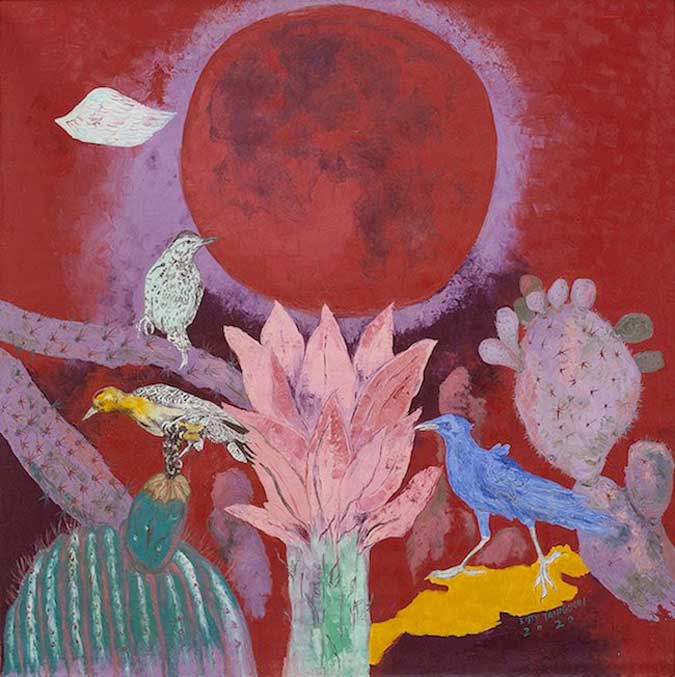
SILVERLENS presents two shows this month: “Lonely Picket in the Balcony,” featuring works by Leslie de Chavez, and “Flower Moon,” featuring works by Kitty Tanigushi, both running from May 14 to June 11. In “A Lonely Picket in the Balcony,” Leslie de Chavez demonstrates the diversity of his practice by featuring paintings, sculptures, and installations. In keeping with his socio-political oeuvre, these works investigate the struggles and inequalities faced by the marginalized — victims of systemic injustice, brought about by political indulgences. Meanwhile, Kitty Taniguchi’s “Flower Moon” continues the artist’s exploration of imagery revolving around personal mythologies set in landscape. Figures are rendered in oil, acrylic and ink including tigers, unicorns, crows, lions, fantastical plants, and cityscapes seen from afar like mountain ranges. In the midst of it all, a woman sits in repose and waiting. Ms. Taniguchi’s re-telling of myths set in new terrain allows stories to return to its geographical roots and pave other ways of expressing self-hood.  Silverlens is located at 2263 Don Chino Roces Avenue Ext., Makati. For details on scheduling visits, COVID-19 protocols and other information, call 8816-0044, 0917-587-4011, e-mail  info@silverlensgalleries.com or visit www.silverlensgalleries.com.

BenCab Museum presents 2-artist exhibit

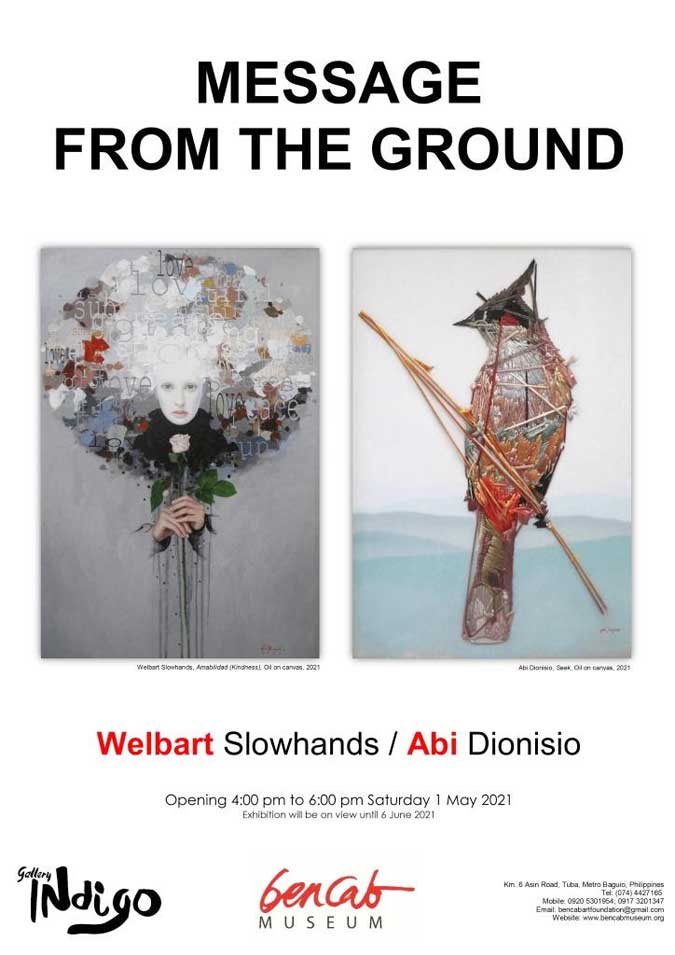
BENCAB Museum in Baguio presents “Message from the Ground,” the fourth joint exhibit of Abi Dionisio and Welbart. As a reaction to the ongoing pandemic, Ms. Dionisio labored her hands in threadwork to create embroidered moving images of hope and strength to represent the unwavering commitment and dedication of the people at the face of this threat. Because she also wanted to capture their gargantuan sacrifices that go behind each act of service, she painted the backside of each threadwork on her canvas to show how the seamy thread lines and incoherent knots make the front side we often only see most invitingly beautiful and inspiring. Meanwhile, Welbart, known for his critically acclaimed and highly celebrated nude figures set in chiaroscuro, reveal their faces painted in almost alabaster skin, indicative of years of being kept in complete solitude. For each figure, he carefully paints a crown of embroidered words he curated from years of his own self-fought battles. The exhibit is currently on view until June 6. For details, send an e-mail to the BenCab Museum at bencabartfoundation@gmail.com, or visit its website (www.bencabmuseum.org/) or its Facebook or Instagram pages (www.facebook.com/bencabmuseum/ and  www.instagram.com/bencabmuseum).

First Hebrew to Filipino book translation launched

THE EMBASSY of Israel in the Philippines launched the first Hebrew to Filipino book translation entitled Bigla, May Kumatok sa Pinto, a collection of short stories by Israeli author Etgar Keret who is a leading voice in Israeli literature and cinema. His five best-selling story collections have been translated into 46 languages. The Filipino translation was done by U. Z. Eliserio of the Departamento ng Filipino at Panitikan ng Pilipinas, Kolehiyo ng Arte at Literatura of the University of the Philippines. Anvil Publishing, Inc. is the official publisher and distributor of the book. Bigla, May Kumatok sa Pinto is available in National Bookstores and online shopping platforms for P395.