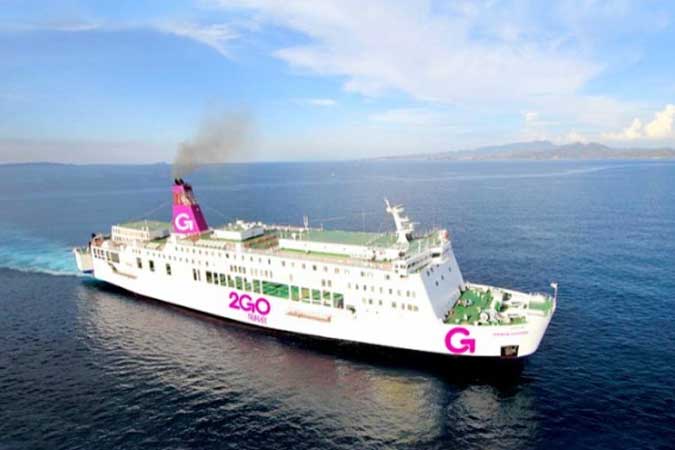
2GO reported an attributable net loss of P1.84 billion for 2020, significantly wider compared with the previous year’s loss of P890.35 million. — INSTAGRAM/2GO_TRAVEL
2GO GROUP, Inc. has no plans to raise additional capital this year to fund its modernization projects, which are expected to help the company get back on track to profitability, a company official said.
“[The] management continues to invest in modernizing 2GO. During 2020, management began implementing new software and automation systems to improve customers’ ordering and delivery experience as well as the company’s operating efficiencies. These systems go live in 2021,” William Charles Howell, 2GO chief financial officer, was quoted as saying in the minutes of the company’s 2021 annual stockholders’ meeting held on Friday last week. The document is available on 2GO’s website.
Mr. Howell also said the company continues to invest in the modernization of its shipping fleet and equipment.
“These investments will lead to improved customer service and a reduction in costs which in turn will help the company on its way to profitability. At this time, management is able to fund these investments internally thus have no current plans to raise additional capital,” he said.
The company began the implementation of its three-year modernization program in mid-2019, according to 2GO Chief Operating Officer Waldo C. Basilla.
“The process is ongoing. It includes rationalization and optimization of the company’s assets, organization and network,” Mr. Basilla was quoted as saying in the minutes of the annual meeting.
“Among many things management has accomplished to date, this process has allowed them to right-size the shipping fleet, warehouse, facility footprint and organization. These efforts have significantly improved their cost base and will allow them to compete aggressively immediately,” he added.
The company plans to deploy new ships, which are designed to consume less fuel and should support the company’s sustainability vision, in the first half of 2021, according to Mr. Basilla.
“In the first quarter of 2021, management implemented an internationally recognized transport management system that not only optimizes routings and lower cost, but more importantly improves customer experience,” the official was also quoted as saying.
“With all the technology improvements, 2GO now has the capability to do data visualization and data analytics that will ultimately help improve customers supply chain structures,” he added.
On Thursday last week, 2GO reported an attributable net loss of P1.84 billion for 2020, significantly wider compared with the previous year’s loss of P890.35 million.
Revenues fell 18.7% to P17.41 billion from P21.41 billion previously. Freight revenue decreased 9.97% to P3.03 billion, travel revenue dropped 77.57% to P839.14 million, revenue from logistics and other services fell 13.14% to P5.83 billion, while the goods segment saw a 1.55% growth to P7.72 billion.
Cost of services and goods sold declined 14.24% to P16.86 billion.
2GO said its EBITDA (earnings before interest, taxes, depreciation, and amortization) and EBITDA margin remained positive at P439 million and 3% in 2020 and P1.9 billion and 9% in 2019.
Its total liabilities to total equity ratio was 7.9 in 2020, up from 3.6 in 2019.
2GO Group President and Chief Executive Officer Frederic C. Dybuncio said, “The pandemic depressed consumer confidence and demand, which in turn weakened the business volumes overall, affecting all our businesses.”
On March 19, Davao-based businessman Dennis A. Uy’s Chelsea Logistics and Infrastructure Holdings Corp. announced that it was selling its entire stake, around 31.73%, in affiliate 2GO to SM Investments Corp. (SMIC) at P8.50 per share.
Chelsea said proceeds from the sale will be used to repay the loan that it obtained to secure the majority stake in 2GO in 2017.
The company expects to complete the disposal within 90 days from signing of the agreement.
Chelsea President and Chief Executive Officer Chryss Alfonsus V. Damuy said in a statement that the divestment will help the company recover from the pandemic crisis because it will no longer be affected by 2GO’s losses.
Chelsea has reported an attributable net loss of P3.31 billion for 2020, compared with a loss of P831.76 million a year earlier.
2GO Group shares closed 1.41% lower at P8.38 apiece on Friday. — Arjay L. Balinbin
RATES OF THE Treasury bills (T-bills) on offer on Monday will likely end mixed amid a lack of catalysts, but demand is expected to remain strong as investors continue to park their money in safe assets.
The Bureau of the Treasury (BTr) is looking to raise P25 billion via its auction of T-bills on Monday, broken down into P5 billion in 91-day debt, P8 billion in 182-day papers and P12 billion via 364-day securities.
Two traders said they expect no strong movements in the yields of short-term securities this year, but the auction will still see robust demand.
The first trader said T-bill rates will end mixed on Monday, with the rates of the shorter tenors likely to fall by up to 5 basis points (bps) while the yield on the one-year instruments could inch up.
The trader said no drastic change in rates is expected in the absence of fresh leads, unless US Treasuries see a big swing in the near term.
“Robust market liquidity along with risk aversion are perfect ingredients to make for a successful T-bill auction. Investors still prefer the short-end of the curve with the pandemic still very much at large,” a third bond trader said via Viber on Friday.
The trader said investors will watch out for the release of the BTr’s May borrowing program and the central bank’s April inflation forecast this week.
The Treasury is expected to release the schedule of auctions for May within this week. Meanwhile, the Bangko Sentral ng Pilipinas is set to come out with its April inflation forecast on Friday, with the official data expected to be reported on May 6.
Headline inflation slowed to 4.5% in March from the 4.7% seen in February, mainly because of the slower rise in food prices.
The central bank expects inflation to average 4.2% this year, beyond its 2-4% target, but stressed major upside risks were mainly due to low supply of some commodities such as meat.
The BTr last week made a full P25-billion award of the T-bills it auctioned off as bids reached P71.65 billion.
Broken down, the Treasury raised P5 billion as planned via the 91-day papers. The three-month T-bills fetched an average rate of 1.349%, higher than the 1.325% seen on April 12.
It also awarded the programmed P8 billion in 182-day T-bills. The average yield of the six-month papers inched up to 1.713% from 1.695% previously.
Lastly, the BTr made a full P12-billion award of the 364-day securities it offered last week, as the tenor was quoted at an average rate of 1.884%, down from the previous rate of 1.903%. The government also raised another P5 billion from the one-year securities at the same rate from its tap facility offer.
The Treasury wants to raise P170 billion from the local debt market this month: P100 billion via weekly offers of T-bills and P70 billion from fortnightly auctions of Treasury bonds.
The government is looking to borrow P3 trillion this year from domestic and external sources to help fund a budget deficit seen to hit 8.9% of gross domestic product. — B.M. Laforga
The Honda City Hatchback replaces the outgoing Jazz in the Philippine market. — PHOTO FROM HONDA CARS PHILIPPINES, INC.
1 of 5
The Honda City Hatchback replaces the outgoing Jazz in the Philippine market. — PHOTO FROM HONDA CARS PHILIPPINES, INC.
The Honda City Hatchback replaces the outgoing Jazz in the Philippine market. — PHOTO FROM HONDA CARS PHILIPPINES, INC.
The Honda City Hatchback replaces the outgoing Jazz in the Philippine market. — PHOTO FROM HONDA CARS PHILIPPINES, INC.
The Honda City Hatchback replaces the outgoing Jazz in the Philippine market. — PHOTO FROM HONDA CARS PHILIPPINES, INC.
The Honda City Hatchback replaces the outgoing Jazz in the Philippine market. — PHOTO FROM HONDA CARS PHILIPPINES, INC.
It’s an ‘energetic hatch’ and all that jazz
HONDA CARS Philippines, Inc. (HCPI) introduced last week its all-new City Hatchback in a virtual event streamed via HCPI’s Facebook page. With the debut of the new subcompact hatchback, Honda is expanding its popular City sedan lineup. The Philippines’s first-ever City Hatchback is also poised to take the mantle from Honda’s beloved Jazz subcompact hatchback.
Compared to the sedan’s concept of “Ambitious Sedan,” the new City Hatchback was derived from Honda’s “Energetic Hatchback” concept, which exudes a more active and energetic character. While sharing attributes in terms of comfort and premium quality with the sedan, the City Hatchback aims to provide a fun, sporty yet versatile vehicle that would complement the diverse needs of customers.
The City Hatchback further underscores its sportiness by presenting a sleek exterior design combined with a low height and generous width to present an assertive feel.
The new City Hatchback retains the same 2600mm wheelbase similar to that of the City sedan. However, given its hatchback body style, this City is 21mm taller and 204mm shorter (in length) than its sedan counterpart. This is due to the removal of its rear trunk overhang, giving it a sporty exterior look while maintaining a generous and flexible cargo capacity.
Available only in a lone RS variant, the new City Hatchback shares some flagship RS design elements together with the sedan, further strengthening its impression of its sporty characteristics. Up front, the City Hatchback comes with an RS Design front bumper and RS Design high-gloss black front grille with RS Emblem, complemented by full LED headlights and LED daytime running lights similar to that of the RS sedan.
At the side, the high-gloss black power-folding side mirrors and 16-inch two-tone Berlina black alloy wheels further contributes to the car’s strong side profile. At the rear, sporty styling cues such as the RS Design rear bumper with diffuser, glossy black tailgate spoiler and full LED taillights give the City Hatchback a sporty and upmarket feel.
The City Hatchback extends its “Energetic” concept into the vehicle’s cabin. The car features a spacious interior complemented by upscale materials similar to the sedan’s. Comprised noticeably of suede and leather seats, black interior trim with red stitching and accents, leather shift knob and steering wheel with audio controls, front and rear center armrests, sports pedals and multi-information display with red illumination, the new City Hatchback’s interiors embody a premium feel to complement its sporty RS Design exterior.
Given its hatchback styling and configuration, the new City Hatchback inherits the Jazz’s ingenious ULTR seating configuration which allows the rear seats to be folded flat or flipped up, giving the car the versatility to quickly adapt to a wide variety of passenger and cargo-hauling needs. ULTR features four adjustable modes:
• Utility Mode: With the two rear seats folded flat, the vehicle can carry two passengers and accommodate large cargo items in the rear storage area.
• Long Mode: With the front passenger seat fully reclined and rear passenger seat folded flat, the vehicle can carry two passengers and accommodate long cargo items such as surfboards.
• Tall Mode: With the rear seats folded upward, the vehicle can accommodate tall items that need to remain upright, such as a large plant or tall luggage.
• Refresh Mode: When removing the front-seat head restraints, moving the seats all the way forward and tilting the seatbacks all the way back, the Refresh Mode allows the front and rear seats to be connected, providing a comfortable place for two people to relax.
On top of its premium yet sporty and versatile interior, the all-new City Hatchback also boasts an array of various technology features such as an eight-inch advanced touchscreen display with Apple CarPlay, Android Auto, and WebLink connectivity; an eight-speaker (4+4 tweeters) system; and a new A/C system with rotary knobs, digital display and illumination.
The City Hatchback also features a One Push Start System with Smart Entry Keyless Entry System and Remote Engine Start.
Powering the City Hatchback is a 1.5-liter four-cylinder DOHC i-VTEC engine that produces 121ps at 6,600rpm and 145Nm of torque at 4,300 rpm. The engine is mated to a Continuously Variable Transmission (CVT) with paddle shifters. Honda’s Eco Assist System, which consists of the Econ mode and Eco-Coaching Ambient Light, is available to help promote fuel-efficient driving.
Honda also gives utmost priority to safety. Standard in the City Hatchback are a G-Force Control (G-Con) body structure that helps to protect the vehicle’s cabin during collisions from any direction, vehicle stability assist (VSA) with agile handling assist (AHA), emergency stop signal (ESS), anti-lock braking system (ABS), electronic brake force distribution (EBD), hill start assist (HSA) and multi-view rear camera with dynamic guidelines. The City Hatchback also comes with six air bags (dual front air bags, front driver and passenger side air bags, and side curtain air bags). The City Hatchback boasts a five-star ASEAN NCAP safety rating.
The new City Hatchback is now available with an SRP of P1.115 million (exclusive of a P13,000 Safeguard Duty cash deposit) and comes in four colors: Ignite Red Metallic, Meteoroid Gray Metallic (a new color), Platinum White Pearl (for an additional P20,000), and Brilliant Sporty Blue Metallic (available in June).
FOR EVERY jersey or cap redeemed in the promo, basketball fans and consumers will be able to donate to Gawad Kalinga’s Barangay Walang Iwanan program that supports the farmers in Sariaya, Quezon, and the fishermen in Barangay Bagumbayan, Pililla, Rizal.
GINEBRA San Miguel, Inc. (GSMI) is back with another merchandise promo but this time geared towards, as well at extending help to, those who are affected by the pandemic.
Officially launched online last Thursday, the Bagong Tapang saOne Ginebra Nation Jersey and Cap Collection Promo lets basketball fans collect Gin Kings merchandise and give back at the same time.
The promo period runs from May 1 to June 30.
The promo is in line with Ginebra San Miguel’s latest campaign, “Bagong Tapang,” which highlights the new courage and strength that Filipinos possess to overcome the challenges of the coronavirus pandemic.
In it fans get their hands on limited-edition merchandise, namely, jerseys of Barangay Ginebra stalwarts Scottie Thompson (6), Stanley Pringle (11), Japeth Aguilar (25), LA Tenorio (5), and Mark Caguioa (47). Also on offer is the One Ginebra Nation cap.
To avail of the promo, one has to pay P100 for the One Ginebra Nation jersey or P150 for the One Ginebra Nation cap for every six seals or caps of any combination of Ginebra San Miguel, GSM Blue, GSM Blue Flavors, Ginebra San Miguel Premium Gin, and Primera Light Brandy.
Customers just have to present these at participating Puregold branches and other redemption outlets.
To confirm the merchandise’s authenticity, an authentication patch can be found on the lower left part of the jersey, while an authentication sticker is attached to the cap.
For every jersey or cap redeemed, basketball fans and consumers will be able to donate to Gawad Kalinga’s Barangay Walang Iwanan program that supports the farmers in Sariaya, Quezon, and the fishermen in Barangay Bagumbayan, Pililla, Rizal.
“To underscore the need for unity during these times, we partnered with Gawad Kalinga and through the promo, we aim to support GK’s Barangay Walang Iwanan program that helps Filipinos who are severely affected by the pandemic,” said GSMI general manager Noli Macalalag during the media launch.
“We hope to encourage Gin Kings (GK) fans and our consumers to ‘put on’ a Bagong Tapang kind of courage and to wear this kind of Bagong Tapang for others to see and emulate.”
For more details and updates on the promo, log on to www.ginebra.com.ph, check out the official Facebook page of Ginebra San Miguel www.facebook.com/barangayginebra or call the GSMI customer care hotline at 8632-2564. — Michael Angelo S. Murillo
The pandemic found the government in the midst of an airport building frenzy, no doubt based on ambitious assumptions for financial returns before COVID-19 shut the world down. But now that travel demand is going to be depressed for the foreseeable future and the airlines the airports were meant to serve as gleaming new home bases hanging on precariously, many of the projects could be in for a hard rethink, because by the time they are all built or upgraded, the travel volumes they were designed around might not be there for years.
The plan, as it stood before the outbreak, was to increase the capacities of both Ninoy Aquino International Airport (NAIA) and Clark International Airport (CIA) and build Sangley Point International Airport (SPIA) in Cavite and New Manila International Airport (NMIA) in Bulacan. That would give Metro Manila four international airports servicing its travel demand, just two shy of the record holder London, which has six.
Now, people are expressing doubts whether such ambitious plans are still viable.
“With a combination of strict health protocols, travel bans and restricted household incomes, passenger volume has dropped,” Infrawatch PH convenor Terry L. Ridon said in an e-mail interview. “The viability of the aviation sector is dependent on a gradual easing of the economy through an immediate and effective vaccination program along with already-proven health and safety protocols.”
San Miguel Corp.’s (SMC) Bulacan airport caught a break at least — it was still not operational when the pandemic inflicted massive damage on the travel industry, and can make adjustments based on how its managers project the future of air travel.
“With a construction horizon of five to 10 years, the coronavirus pandemic might be over by then,” Mr. Ridon noted.
“We certainly hope that passenger volume will have reverted to pre-pandemic levels. At present, similar to the broader construction sector, we may expect some construction delays due to limited supplies or personnel due to existing restrictions,” he said.
Eldric Paul A. Peredo, the Civil Aeronautics Board’s Air Operating Rights Division chief, reported at a recent House hearing that international and domestic passengers logged in by air carriers from the first to third quarters of 2020 were only 25% of 2019 levels.
Mr. Ridon believes the government’s multi-airport approach remains viable, with the strategy to decongest NAIA showing results, particularly with the expansion of Clark.
Chairman and Chief Executive Officer Edgar B. Saavedra of Megawide Construction Corp., which had previously negotiated with the government for a contract to rehabilitate NAIA, said the Greater Manila area will be needing more airports anyway because annual passenger volume is expected to increase by more than 65 million in the next five to 10 years.
“Any new airport will always augment or add capacity to the country. Since NAIA is in the southern part of Metro Manila, it will cater not only to Metro Manila but also to Calabarzon. The Bulacan airport will also cater to the northern part of Metro Manila, so Clark will cater up to northern Luzon. All of these airports are complementary to each other,” he said.
The Manila International Airport Authority (MIAA) board recently rejected the appeal filed by Megawide and its foreign partner GMR Infrastructure Ltd. seeking to overturn the revocation of its original proponent status for the NAIA rehabilitation project. The project had proposed to expand the airport’s capacity to up to 65 million travelers annually.
MIAA can rehabilitate NAIA on its own, according to the Department of Transportation (DoTr).
Manila’s main airport has been operating beyond its 30.5 million passenger capacity for years, handling 45.3 million passengers in 2018, 42 million in 2017 and 39.5 million in 2016.
CANNIBALIZATION Avelino D.L. Zapanta, an aviation industry expert, said via e-mail that Clark might pose an obstacle to Bulacan NMIA’s bid to become the primary airport.
“At the very least, Clark has captive markets in North and West Luzon,” he said. “Passengers from Central Luzon, south of Clark, and north of Bulacan will choose either of the two depending on which would be more convenient for them.”
NMIA is a bit of a black box, offering no insight for now on its impact on the travel industry landscape, according to Mr. Ridon. “We cannot yet predict its impact on the airport sector until it becomes fully operational in five to 10 years.”
“The Finance department has put its foot down on the matter, stating that market forces should determine whether multiple airports in Mega Manila are viable,” he said.
Mr. Ridon believes cannibalization will only be relevant when NMIA becomes operational, by which time Clark will have been generating revenue for up to 10 years.
“If Clark does a great job in operating its airport in the next 10 years in addition to exponential economic growth in the surrounding regions, it will be harder for NMIA to compete for passengers, airlines and third-party vendors,” he said.
“Government should concentrate on both areas, which is why the NAIA rehabilitation project should not have been shamelessly rejected by MIAA and DoTr,” he said.
NAIA, as the main gateway, is relevant not only to passengers from Metro Manila and southern Luzon, but also to all travelers from across the country making airline connections through its terminals, Mr. Ridon said.
Mr. Zapanta believes NAIA-Sangley is more complementary since Sangley can serve Southern Luzon. “The reality though is Bulacan has a head start on Sangley,” he said.
The Cavite government is again seeking bidders for the Sangley airport project after it canceled an earlier deal with MacroAsia Corp. and China Communications Construction Company.
Meanwhile, SMC’s airport in Bulacan is expected to begin construction within the quarter, after it was granted an unprecedented legislative franchise that gives the project numerous tax perks.
Mr. Zapanta noted that Clark is at the crossroads of the South Luzon Expressway-North Luzon Expressway Connector, the Subic–Clark–Tarlac Expressway, the Tarlac–Pangasinan–La Union Expressway, and the MacArthur/Pan Philippine Highway, making it accessible from north, south, east, and west, and is thus more geographically strategic than Bulacan.
“North, West and Central Luzon air passengers will not bypass Clark to go at least 40 kilometers farther south to Bulacan,” he added.
Mr. Ridon believes that the Clark airport is going to be a viable alternative to NAIA even for travelers coming from Metro Manila and southern areas once the North-South Commuter Railway (NSCR) project is completed.
“In fact, the construction of the Clark Airport station is part of the NSCR project,” he added.
“The key for the continuing growth of Clark is not in its ability to get passengers from Metro Manila and southern Luzon, but for the general economy of central and northern Luzon to continue improving. With New Clark City and the new infrastructure further cutting Baguio and northern Luzon travel times, we are optimistic that economic growth will come to these areas in time,” he said.
Economic growth in the capital region has been mainly focused to the south of Metro Manila, away from Bulacan and closer to NAIA, he noted. “We are seeing massive economic development along southern Metro Manila’s bay area, currently anchored by Entertainment City and also driving passenger volumes through NAIA.”
Cavite and Laguna have more economic zones and metropolitan areas than the provinces north of Manila. “These are factors which will make NMIA a hard-sell proposition for passenger volume in contrast to NAIA,” Mr. Ridon said.
‘SELL NAIA’ SMC has a proposal to operate and maintain NAIA while it is building the Bulacan airport.
“Our proposal is brought on only by the need to have it running effectively and safely for the Filipino people, until our Bulacan airport project is up. And until our airport is ready, that task needs to be done,” SMC President and Chief Operating Officer Ramon S. Ang said in a statement.
According to Mr. Ridon, this move fits into SMC’s airport infrastructure agenda to retire and sell NAIA as soon as NMIA is built.
Mr. Ang said the government could better benefit from selling or redeveloping the 646-hectare NAIA complex once SMC completes its Bulacan airport project.
The NAIA property is about 2.5 times the size of Bonifacio Global City, Mr. Ang said, noting that it could “potentially earn the government as much as P2 trillion or more, which it can use for various purposes.”
“This posturing exhibits a massive conflict of interest as this seeks to limit growth in another airport to favor their own. Until the current or next government has decided on the fate of NAIA, SMC should focus its energies in constructing their airport in Bulacan,” Mr. Ridon said.
Mr. Zapanta said: “Of course, he (Mr. Ang) would go for that.That’s a swell real estate prospect, and he has a good eye for real estate.”
“My thought, though, is that NAIA is ideal for the domestic market whose true O&D (origin and destination) is Metro Manila, e.g. business, education, VFRs or the visiting friends and relatives market, and tourism as well. When the volume goes up in the immediate future, the need for NAIA to concentrate on domestic traffic will become more pronounced,” he added.
VIRES Energy Corp. has secured clearance from the Energy department to proceed with its planned gas-fired power plant, which is integrated with a liquefied natural gas (LNG) storage and regasification facility, in Batangas province.
In a press release over the weekend, the Department of Energy (DoE) said it had approved on April 22 the “notice to proceed” for the application of Vires Energy to develop the integrated natural gas-fired power plant and LNG terminal project.
DoE Secretary Alfonso G. Cusi said the project “will boost the attainment of our vision to develop the Philippines as a LNG hub in the Southeast Asian region.”
A notice to proceed (NTP) is the first step for a company that seeks to develop an LNG terminal or other downstream natural gas projects in the Philippines, the DoE said.
Firms holding an NTP are required to submit relevant permits from various government agencies, endorsements from the local government units, and proof of financial closing to the DoE within six months.
Mr. Cusi said that he hopes Vires Energy will be able to complete all the requirements before the firm’s NTP expires.
Vires Energy’s planned floating storage and regasification unit (FSRU) will have a storage capacity of around 162,400 cubic meters, which will be located 1.6 kilometers (km) from the Batangas Bay coastline. The FSRU is a converted LNG tanker with a regasification capacity of up to 3 million tons per annum.
An FSRU contains an onboard regasification plant, which can turn LNG back to gas. Natural gas is typically liquefied for ease of transport.
In its statement, the DoE said that Vires Energy’s LNG terminal and regasification project will have a turret mooring system for its FSRU, a 1.6 km subsea gas pipeline, and a 500-megawatt floating power plant, which will serve as an anchor market.
It said the project will also use a land area classified as a “heavy industrial zone” for backup fuel supply of diesel fuel during gas outage events.
Vires Energy has targeted the commercial run of its integrated LNG project by January 2023.
The approval of its NTP application comes around three months after a DoE official identified Vires Energy as one of the potential investors that wished to build a floating facility for imported gas.
In a Senate hearing in January, DoE Assistant Secretary Leonido J. Pulido, III said that the department held a pre-application conference with Vires Energy and Atlantic Gulf & Pacific Co., among others, for their plan to bring in an FSRU.
Vires Energy is owned by Cagayan de Oro-based listed company A Brown Co., Inc. — Angelica Y. Yang
A YOUTUBE channel is seeking to fill in the knowledge gap for people seeking farming know-how, borne out of the founder’s own struggle to find advice on agriculture.
Reden Mark F. Costales, who started the YouTube channel “The Agrillenial,” said he wants to provide potential young farmers access to videos that will help them set up and improve their own farming operations.
In a phone interview with BusinessWorld, Mr. Costales said the channel released its first video on July 31, 2019.
“I often go to the internet for research and I rarely find the content that I am looking for. And if ever I do find it, it always leads me to papers written by scientists, which are too much for me to understand. If I, a university graduate, am having difficulty taking in research, what more of farmers who barely finished high school?” Mr. Costales said.
Mr. Costales said the usual sources of know-how are formal seminars that impose costs on farmers.
He said since launching the channel, he has received much positive feedback from younger people, some of whom are determined to start their own farms.
“There is a connotation that farming is just for the older generation. I want to change this perspective. I want to show that farming is also for millennials and for kids,” Mr. Costales said.
“Farming really doesn’t have an age bracket If they see a millennial teaching and doing agriculture, it will somehow spark interest because “if he can do it, why can’t I?” Mr. Costales said.
Mr. Costales manages his family’s Costales Nature Farms in Majayjay, Laguna, which produces organic high-value vegetables and organic livestock.
“After I graduated from college, I immediately helped in managing the farm’s daily operations. In 2012, we started offering training and seminars here in the farm to those who want to start their own organic farms as well,” Mr. Costales said.
The YouTube channel brings in additional income of around P50,000 per month from advertisements and affiliate marketing.
“Affiliate marketing is a simple link pasted in our video descriptions and every time people buy from that link, we get a commission. Of course, the video would feature the product itself,” Mr. Costales said.
Moving forward, Mr. Costales said he wants to create more engaging content for his viewers.
The pandemic has not hindered content creation and has even helped increase viewership beginning from early in the pandemic last year.
“I don’t need to go out or to other farms to create content. It was actually beneficial for me since a lot of people are locked down. They have nothing else to do, so they just watch on YouTube,” Mr. Costales said.
To date, “The Agrillenial” channel has around 115,000 subscribers and 125 videos. — Revin Mikhael D. Ochave
The Maserati Levante Hybrid variant surprisingly weighs less than its gasoline- and diesel-engined counterparts. — PHOTO FROM MASERATI
1 of 3
The Maserati Levante Hybrid variant surprisingly weighs less than its gasoline- and diesel-engined counterparts. — PHOTO FROM MASERATI
The Maserati Levante Hybrid variant surprisingly weighs less than its gasoline- and diesel-engined counterparts. — PHOTO FROM MASERATI
The Maserati Levante Hybrid variant surprisingly weighs less than its gasoline- and diesel-engined counterparts. — PHOTO FROM MASERATI
Maserati releases a hybrid version of its SUV
THE PANDEMIC certainly did not slow down the 2021 Shanghai Auto Show — the world’s largest of its kind — now on its 19th year. Highlighted in the fair this year were several new electric vehicles, among which was the impressive Maserati Levante Hybrid — the first electric SUV ever launched in the trident brand’s history. Maserati also took this opportunity to premiere its F Tributo Special Edition, as well as to showcase its MC20 supercar.
“(The) Shanghai Auto Show is an extremely important event for our brand. The show marks a rebirth in difficult times,” explained Maserati CEO Davide Grasso. He added, “We believe strongly in this new beginning, and today we are showcasing several world premieres that project us straight into the future.”
Maserati’s journey towards electrification started with the initial launch of the Ghibli Hybrid in the latter part of 2020. And this year, its revelation of the Levante Hybrid shows that this hybrid car surprisingly weighs less than its gasoline and diesel counterparts (the latter two both running on six-cylinder engines) and even has a more balanced weight distribution (because the weight of the extra battery in the rear spreads out the weight beautifully). Therefore, the Levante Hybrid is in fact, even more agile and fun to drive than its ICE counterparts.
The Levante Hybrid, which now completes Maserati’s full Levante range, boasts of a top speed of over 240kph and can accelerate from zero to 100kph in only six seconds. This is thanks to its 330 horses and 450Nm of torque from just a low 2,250rpm. The model is only available in all-wheel drive and, despite its being electric, is engineered in such a way that it still produces that distinctive growl of a typical Maserati internal combustion engine.
Furthermore, the Levante Hybrid is visually tickled with hints of blue here and there — as it is the official color chosen to identify its hybrid vehicles. Its iconic side air ducts, the vehicle’s C-pillar logo (and optionally, its brake calipers) come in Hybrid Blue. Inside the vehicle you will find blue seams embroidered on the upholstery, to further that distinctive hybrid identity. The automobile also carries Maserati’s Connect program, which is software that also maintains the Levante Hybrid as a futuristically “connected car.”
Meanwhile, Maserati’s Shanghai Auto Show display also included an area featuring its special Maserati Fuoriserie — a special customization program that allows clients to personalize their vehicles with thousands of possible combinations. And to serve as a basic guide, three design collections have been created for customers to more easily build upon: the Corse, Unica and Futura collections. These represent the trident brand’s values of sportiness, elegance, and innovation.
And to further celebrate its participation in the 2021 Shanghai Auto Show, Maserati also extended even more Fuoriserie options for its Ghibli, Quattroporte, and Levante range — including all-new external paints, liveries, wheel and brake caliper colors, as well as special cabin combinations that feature different layouts and colors of stitching.
The MC20 has now also been officially included in Maserati’s Fuoriserie Program, allowing it greater design customization based on the Corse, Unica and Futura collections.
THE BANGKO SENTRAL ng Pilipinas (BSP) has reminded banks to comply with the maximum nine-year cumulative term limit for independent directors of BSP-supervised financial institutions, which follows previous issuances on corporate governance and reputational risk management.
In Memorandum No. M-2021-025, the central bank highlighted the provisions of both the Manual of Regulations for Banks and the Manual of Regulations for Non-Bank Financial Institutions which gives independent directors a maximum term of a cumulative period of nine years.
“After which, the independent director shall be perpetually barred from serving as independent director in the same BSP-supervised financial institution but may continue to serve as its regular director,” the circular said.
“All BSP-supervised financial institutions are hereby advised that pursuant to Monetary Board Resolution No. 371 dated March 31, 2021, the BSP shall not approve requests for exemption from the said term limit for independent directors,” it said.
BSP Deputy Governor Chuchi G. Fonacier said they have received “quite a few requests” for term extensions.
“The BSP would like to emphasize that the term of an independent director should only be for a maximum of nine years (cumulative). After having served for that period of time as an independent director, that person may no longer be considered as really independent,” Ms. Fonacier said in a Viber message on Sunday.
An independent director is a person, “who, apart from his fees and shareholdings, is independent of management and free from any business or other relationship which could, or could reasonably be perceived to, materially interfere with his exercise of independent judgment in carrying out his responsibilities as a director,” based on Memorandum Circular No. 16 Series of 2002 of the Securities and Exchange Commission.
Aside from being allowed to become a regular director after their nine-year term in a bank, an independent director can also serve the same function for other lenders, Ms. Fonacier said.
“They can serve as independent director for other banks after serving the maximum term of nine years in a certain bank provided they qualify as an ‘independent director’ for that bank,” she noted.
The central bank earlier released Circular No. 1112 which tightened policies and control measures for hiring and performance management of bankers.
Meanwhile, Circular 1114 issued last week requires banks to report “reputational risks” that could be caused by stakeholders, customers and bank employees, which could spill over and adversely impact earnings, capital, and liquidity.
“It is the thrust of the Bangko Sentral to promote good corporate governance and effective risk management systems in the financial industry,” the BSP said.
“It is in this light that the Bangko Sentral issued regulations that institutionalize control measures to highlight accountabilities, strengthen checks and balances, and ultimately protect the interest of customers and depositors,” it added. — Luz Wendy T. Noble
FOUR-TIME Olympic gymnastics champion Simone Biles has signed up with Gap, Inc.’s Athleta brand for a new apparel partnership, ending an almost six-year deal with Nike, Inc.
Ms. Biles, the most decorated gymnast in world championship history at age 24, said in an Instagram post on Friday she wanted to partner with a brand that shares her “passion to help girls rise and own their limitless potential.”
“They are committed to diversity and inclusion, which was really important for me to see in a partner,” she said.
The move is a blow to Nike, which tried for years with mixed success to expand in the lucrative market for women’s sports apparel, launching yoga, plus-size and maternity lines.
“What Nike have undersold — or at least under-monetized — in the past is womenswear,” said Michael Faherty, a portfolio manager at Adidas and Nike investor Seilern Investment Management. “You only have to look across at Lululemon to see the excellent growth they’ve been able to generate in the womenswear space.”
As it competes with Lululemon and Under Armour, Nike has spent millions cultivating relationships with Ms. Biles and other major athletes, including Serena Williams and Naomi Osaka. These deals have helped Nike’s womenswear sales growth outstrip that of its other brands for the past eight quarters.
“We will continue to champion and celebrate all athletes,” Nike said in a statement, confirming its contract with Ms. Biles has ended and wishing her “the very best.”
Athleta, founded in 1998 as a brand for female athletes, said it plans to co-create an activewear line with Ms. Biles and design other signature products.
The brand has also pledged to support Ms. Biles’ post-Tokyo Olympics gymnastics tour that she is planning to mount herself, rather than the usual tour backed by governing body USA Gymnastics, according to the Wall Street Journal.
She is not the first Nike-sponsored sports person to join Athleta. In 2019, six-time Olympic champion Allyson Felix signed up with the Gap-owned brand after penning an opinion piece in the New York Times in which she said she faced potential pay cuts from sponsors including Nike for having children.
Nike later committed to not financially penalize pregnant athletes. The company has also made a name for itself for taking a stand on social issues, fighting against racial injustice and showing solidarity with some protesting athletes. — Reuters
THE TRANSITION to imported natural gas was dictated by the impending depletion of the Philippines’ only indigenous provider of the resource, the Malampaya project. Malampaya provides fuel to natural gas-fired power plants in Batangas, which account for around 30% of the Luzon grid’s power needs. But with the field’s commercially viable reserves expected to run out by 2024, the power industry is racing to build out the infrastructure needed to bring in the gas and keep the power plants running.
As of February, at least six firms have expressed interest in setting up liquefied natural gas (LNG) terminals, either onshore facilities or floating storage regasification units (FSRU), which are needed to transform LNG into a form that power plants can use.
One of the issues that has turned up is how the LNG import sub-industry is to be regulated, including overarching concerns about the Philippine market’s general openness — or lack thereof — to foreign investment.
Batangas Clean Energy, Inc. (BCE) President Yari A. Miralao noted that anyone who wants to build an LNG terminal has to deal with the “lack of a regulatory framework to govern and incentivize this new industry; legal and regulatory constraints for foreign investors; the scarcity of good sites to build a facility, and poor infrastructure to deliver and distribute the natural gas to end-users.”
“Despite these headwinds, BCE recognizes the Philippine government’s efforts to address these issues and believes that conditions will improve going forward,” Mr. Miralao said in an e-mail.
BCE, a joint venture between Lucio C. Tan, Sr. and US-based Gen X Energy, is seeking to develop a P82.5-billion land-based project in Batangas, where natural gas plants in Luzon are clustered because the province was the landing point for gas extracted from the Malampaya field in northern Palawan.
According to its environmental impact statement, the project comprises an integrated LNG import terminal and 1,200-megawatt combined-cycle gas turbine power project.
The BCE project currently holds a notice to proceed (NTP) issued by the Department of Energy (DoE), a key milestone before construction.
PROPOSED MEASURE Much of the LNG infrastructure industry’s hopes for regulatory clarity have been pinned on a piece of legislation, the proposed Midstream Natural Gas Industry Development Act.
DoE Assistant Secretary Leonido J. Pulido III said the urgency of having proper regulation in place stems from the view of prospective investors that the Philippines is a small market for LNG, which could encourage the development of monopolies.
His wish list for the midstream natural gas industry bill includes “provisions for third-party access in the use of the LNG infrastructure (to) increase competition in the market.”
The midstream natural gas industry bill covers activities like the aggregation, supply, import, receipt, unloading, loading, processing, storage, regasification, transmission and transportation of natural gas in original or liquefied form.
“The measure institutionalizes a regulatory and legal framework for the industry, which is important for investors because it gives them a peace of mind that there are sufficient protections for them to recoup their initial investment… We’re also hoping that (the bill) would incentivize industries to shift to the use of natural gas,” Mr. Pulido said by phone.
Ideally, he said the bill should strike a balance between enforcing industry best practices and enabling free-market solutions.
“Too much regulatory oversight may also lead to issues with investors coming in. At the same time, too little regulatory oversight could lead to anti-competitive behavior so we’re hoping to find a balance between those principles,” Mr. Pulido said.
Senator Sherwin T. Gatchalian, who chairs the Senate Committee on Energy, said that the measure is configured to exert a light regulatory touch, while letting the private sector take the lead in developing the LNG industry.
“We will only regulate the competition aspect of those plants, because we want to make sure that there is robust competition, and allow third-party access,” Mr. Gatchalian said in a video call.
The proposed regulations, he said, will cover import terminals, regasification facilities and pipelines.
“The best case is to get the terminals and regasification plants up and running prior to the depletion (of Malampaya). We need to get this law up and running soon because it gives the players the framework on how to proceed with their businesses,” Mr. Gatchalian added.
The consequences of not having enough LNG importing facilities to make up for the lost Malampaya gas, Mr. Gatchalian said, include an “electricity price crisis.”
“What will happen is that these plants will (use) gas condensate or oil, but it will have a very severe impact on pricing so the prices will go up and it will be passed on to us. It’s imperative that we get imported LNG before the depletion or else we will be faced with higher electricity costs,” he said.
University of the Philippines Diliman energy engineering professor Nicanor S. Villasenor III said the development of LNG import terminals addresses the immediate need for power, but much has to be done to ensure energy security.
“With Malampaya, more or less, we have some good level of energy security because we’re sourcing gas from our territory. But when you’re importing the fuel, it becomes a problem… As far as energy security is concerned, this is imported fuel. If anything happens globally along the supply chain, we can be (vulnerable) in terms of prices,” Mr. Villasenor said.
CLEANER THAN COAL? Mr. Pulido said that the DoE advocates for natural gas since it is considered a “clean alternative to coal and a bridging fuel to (the future expanded use) of renewable energy (RE).”
He said that RE sources are intermittent by nature, but natural gas is more capable of addressing “baseload” demand — the portion of the generation mix that needs to be reliable and always on, as opposed to “peaking” — energy sources that are tapped when baseload capacity is exceeded.
“The beautiful thing about the value proposition of natural gas is its flexibility. You can easily adjust the amount of power that you need to balance the grid and that’s why it’s classified as mid-merit power. It can be baseload, and it can be used for peaking purposes,” he said.
Center for Energy, Ecology, and Development Executive Director Gerry C. Arances said however that natural gas is no alternative to coal, which the government recently declared a moratorium on with regard to new power plant construction.
“The turning of the tide against the coal industry seems to be giving the DoE an excuse to flaunt gas as the ready alternative and brand it as ‘clean energy.’ In fact, (we) refer to it as ‘fossil gas,’ if only to remind proponents that gas is but another obstacle to the reduction of greenhouse gas emissions required by the climate crisis,” Mr. Arances said in an e-mail.
He said that although natural gas emits up to 60% less carbon dioxide compared with a new coal plant, using the former “did not make it any better” than coal.
“Like coal, every stage of electricity production from fossil gas — from its extraction, transportation, to combustion — gives off pollutants that contaminate host environments and trigger health problems among communities exposed to it. It, too, is finite and thus vulnerable to fluctuations in supply and demand, unlike RE,” Mr. Arances said.
The latest draft of the National Renewable Energy Program, which is scheduled for a public hearing, currently gives natural gas a key role in accelerating the development of renewables.
National Renewable Energy Board Chairperson Monalisa C. Dimalanta has projected “an increase in RE share… supported by higher flexibility in the system coming from natural gas plants all the way to 2030, with a slight decline by 2040.”
THE Supreme Court (SC) ruled that the Metropolitan Waterworks and Sewerage System (MWSS) is exempt from real property taxes by virtue of its being a “government instrumentality vested with corporate powers” as provided by law.
The cited Executive Order 596 of then-president Maria Gloria M. Macapagal-Arroyo and Republic Act No. 10149 or the Government-Owned and Controlled Corporation Governance Act of 2011.
In the High Court’s decision dated on Jan. 13 and made public on March 19, the SC reversed the decisions of the Court of Appeals dated June 3 and Dec. 11, 2014 that MWSS was liable to pay the Pasay City government for real property taxes worth P166,629.36 for taxable year 2008.
“The real properties of the [MWSS] located in Pasay City are declared exempt from real property tax,” the court said in its 13-page decision.
The SC further voided all other tax assessments issued to MWSS. It added that its decision does not stop Pasay City from collecting the said real property taxes from the private concessionaires of MWSS.
The MWSS has a concession agreement with Maynilad Water Services, Inc. for Metro Manila’s west zone that includes Pasay City.
The SC further said that the ruling does not automatically grant MWSS refunds of its earlier real property tax payments as the agency has to file a written claim for refund with the city treasurer within two years of the SC decision according to Section 253 of the Local Government Code of 1991 to do as such. — Bianca Angelica D. Añago