Home Blog Page 7632

[B-SIDE Podcast] The Siracusa Principles and protecting the unvaccinated from discrimination

Follow us on Spotify BusinessWorld B-Side

Wealthy countries have cornered the world’s vaccine supplies. As a result, the Philippines has, as of this writing, vaccinated only 10% to 12% of its population. To punish the unvaccinated by barring them from leaving their homes — when vaccine inequity has yet to be addressed — aggravates an already inequitable public health crisis. 

In this B-Side episode, Commission on Human Rights Chairperson Jose Luis Martin “Chito” C. Gascon explains the Siracusa Principles — guidelines on the legitimacy, ethics, necessity, and proportionality of a state’s restrictions on human rights during an emergency — to BusinessWorld’s Alyssa Nicole O. Tan. “We cannot create a two-tier system where one class of people, vaccinated, are allowed every opportunity, while another set of people are denied certain rights,” he said. 

TAKEAWAYS 

Human dignity must be at the core of the state’s decisions and everyone must be treated with respect. 

When dealing with human rights issues in the context of a pandemic, it’s important that core human rights principles are guaranteed — such as the affirmation of each person’s dignity, and the avoidance of coercive or violent means. 

“The purpose is not to prevent the state from doing what it needs to do, but to confirm that the purpose for being of a state — which is to serve and protect its people — is constantly affirmed,” Mr. Gascon said. 

Under the Siracusa Principles, the question of legitimacy, ethics, necessity and proportionality stand as guideposts that lead people towards proper decision-making and implementation. More than anything, the CHR chair underscored that “these principles need to be understood in the context we find them.” 

Human rights are enjoyed in community with others. 

On the question of individual rights versus community responsibility with regard to vaccination willingness, Mr. Gascon asks everyone to consider: “The exercise of my rights must be done in such a way that it does not cause harm or violate the rights of others.” 

Each person has a responsibility to the community not only to protect themselves but others as well. This is why a spectrum of modalities must be examined to ensure that the measure undertaken will grant herd immunity, which is ultimately the supposed pledge of the state. 

“It’s important that everyone has free, informed consent, as well as protection of their personal and physical integrity,” said Mr. Gascon, adding that positive means rather than coercive means must be adopted when informing the public of the safety and efficacy of the vaccines. 

“I don’t think we are at that point where we should grab our syringes and start forcing this upon people,” he said, explaining that the focus should first remain in making vaccines readily available. 

The unvaccinated are not second-class citizens.  

Terms like “walking spreader” or “variant factories” have been used by government officials to refer to the unvaccinated, in the hopes of promoting vaccinations. While Mr. Gascon said that various health strategies to contain the virus should be pursued, “name calling or stigmatizing will not help.” 

“It’s premature to make this distinction and use language that might further isolate the unvaccinated, reduce public trust or even increase vaccine hesitancy,” Mr. Gascon said. 

The end goal is for everyone to freely and safely engage within the new normal. 

Mr. Gascon said that while vaccine passports and cards have value, “it should not be to the extent that we then deny those who do not have the vaccines — for whatever reasons — the necessary services and opportunities that will make for a productive lifestyle.” 

“We cannot create a two-tier system where one class of people, vaccinated, are allowed every opportunity, while another set of people are denied certain rights,” he said. 

While no exclusion from services and opportunities will be placed, constraints must exist to protect the safety of the public, said the CHR chair. After deciding not to be vaccinated, even if they had every opportunity to be, they must take the responsibility to ensure this does not cause harm to others.  

An unvaccinated individual may be required to take regular tests to prove that they are not infected, for example.  


Recorded remotely on Aug. 13.  Produced by Paolo L. Lopez and Sam L. Marcelo.    

Follow us on Spotify BusinessWorld B-Side

Moving forward in a digitalized now normal

By Chelsey Keith P. Ignacio, Special Features Writer

Recent developments in the insurance industry manifest in the growing interest and innovation in its services. Since the coronavirus disease 2019 (COVID-19) crisis invoked doubts and disruptions, it underlines the worth of financial security among individuals and the need for the industry to adapt and further improve.

In the Philippines, specifically, the increasing awareness within the younger generations and the digitalization of insurance services signify how the industry moved forward amid the crisis.

Atty. Julio Bucoy, CFA, Cocolife’s Corporate Finance and Strategy Division senior vice-president

Atty. Julio Bucoy, CFA, SVP – Corporate Finance and Strategy Division at Cocolife, noted that the insurance penetration rate in the Philippines is very low, yet the pandemic can bring more awareness among the people about the role and importance of insurance.

“This experience has taught us that certain risks, no matter how unlikely, can occur at any time, so we need to be protected,” he told BusinessWorld in an interview.

Similarly, Atty. Alloysius Yebra, SVP – Risk Management and Compliance Division at Cocolife, noted that the pandemic stressed the value of “having a security or emergency fund to tap into in times of tragedy or unforeseeable negative events.”

As the purpose of insurance is being highlighted, Atty. Bucoy believed that this could serve as an advantage to the insurance industry in the new normal. And notably, according to Atty. Yebra, the pandemic has marked the beginning of the increase in the number of policyholders from the younger age groups.

“We expect the younger segments to start securing more insurance protection. For many Millennials and Gen Zs, this is the first crisis [they] experienced in their adult lives. Growing up, it was mostly in a booming economic environment. As mentioned earlier, [the pandemic] has highlighted the importance of managing risk and protecting the most important things,” Atty. Bucoy explained.

“In terms of preference, given the growth of the different products and the profile of these younger generations, we expect them to have a more bespoke approach in product selection,” he perceived.

The expansion of financial literacy and the readily available and transparent information could make it easier for the customers to know which insurance product they want to avail or what seems to be the best fit for their needs, he added.
This rising interest in knowing more about personalized insurance products is among the observations that Cocolife has taken note of and will pursue, Atty. Yebra said.

Towards digitalization
Atty. Yebra also noted that the personalization of insurance products, through the aggregation of preprocessed data and advanced analytics, is a potential service that will push to fruition with the support of digitalization.

Atty. Alloysius Yebra, Cocolife’s Risk Management and Compliance Division senior vice-president

“In the new normal, digitalization is rapidly becoming the standard,” he observed, adding that the digitalization of services has already begun in most insurance companies, and more companies would soon follow on this transition.

Like most industries, insurance adapted during the pandemic by doing business remotely. “While we believe that human interaction is still critical, the new practices have provided several alternatives in conducting the same,” Atty. Bucoy shared.

“New ways of doing business have opened up, and the utilization of technology has accelerated. We were fortunate to have taken such steps even before the pandemic, so our business disruption was limited,” he added.

“The insurance industry has adjusted rapidly to meet the needs of their clients over the past year and a half,” Atty. Yebra continued. “The negative externalities brought by the pandemic to both the income streams and the health of the clients have caused the insurance industry to further innovate and pursue client-centric practices, which we are seeing today through digitalization.”

Currently, he observed, the Philippine insurance industry focuses its efforts on digitalizing its services, including the emphasis on utilizing online platforms to market and sell its products.

“The industry is also exploring the streamlining of the underwriting process and claims through the use of data analytics. These innovations would likely cause a further increase in the number of individuals who would avail of insurance and also pave the way for personalized insurance policies, which we are already seeing in the global insurance market,” he added.

With this acceleration of digitalizing services, the insurance industry can bring convenience to clients, especially with heightened safety precautions due to the pandemic.

“Our Company is currently on the path of digitalization. We are looking towards a customer-centric strategy that will further client satisfaction and encourage others to pursue their own policies through our platform,” Atty. Yebra shared.

“Through digitalization, clients will have access to most, if not all, services that their respective insurers provide from the safety of their own homes. From inquiries and premium payments to claims and policy renewals, everything can be done online,” he noted.

“Digitalization will make transactions between the insurer and the insured easier and faster, resulting in an increase in client satisfaction and increase in the number of people who will be encouraged to obtain their own insurance policies due to convenience and ease of access,” he added.

Insurtech’s part
The rise of digitalization, moreover, will also set insurtech as the new standard.

“Insurtech can be seen as an attempt to optimize the current insurance industry model,” Atty. Yebra said. “This optimization is achieved through advanced analytics and results in the creation of personalized insurance policies.”

While insurtech, along with fintech, will play a significant role in moving the insurance industry forward, Atty. Bucoy noted, several challenges will be encountered along the way, including those concerning regulation.

“Most of our current laws and regulations were written when these technologies did not exist — it is like fitting a square peg in a round hole. Our regulatory framework must be updated to take these new technologies into consideration,” he said.

Atty. Bucoy also deemed that insurtech and fintech would surely help in making the processes more efficient. But an exclusive reliance on insurtech and fintech may make the situation impersonal for clients, especially for Filipinos who, in his observation, value personal relationships more than rote efficiency.

“We still believe that human interaction cannot be replaced,” he said. “The insurance business is built on trust.”

Expanding the reach of financial services

In photo during this session of BusinessWorld Insights Fintech series are (left to right, from top) moderator Arjay Balinbin of BusinessWorld; and panelists Rogie Niño, assistant vice president and head of business project management office at InLife; Lito Villanueva, chairman of FinTech Alliance Philippines; JF Darre, chief data officer and head of financial services of GCash; Kiranjit Singh, head of the Strategy3 division at Ipsos; Zayd Tolentino, chief technology officer of Singlife Philippines; Mar Lazaro, managing director and head of enterprise business and sales at PayMaya; and Rex Gatchalian, mayor of Valenzuela City.

Fintech expected to make services more accessible while pushing financial inclusion further

By Adrian Paul B. Conoza, Special Features Assistant Editor

As the coronavirus disease 2019 (COVID-19) pandemic further accelerated digitalization in various sectors, including banking and finance, financial technology (fintech) has been significantly shaping financial services in the new normal, as seen in the increased use of electronic wallets and online banking channels.

Beyond making transactions more convenient and efficient, fintech now plays a powerful role in realizing full financial inclusion in the country, as the panel in the final leg of a BusinessWorld Insights series themed “Meeting Transformed Consumer Needs through Fintech” recognized.

Lito Villanueva, chairman of FinTech Alliance Philippines, noted that the fintech industry has been facing and dealing with the challenge of getting more Filipinos banked, especially as the 2019 Financial Inclusion Survey of the Bangko Sentral ng Pilipinas (BSP) showed that the number of unbanked Filipino adults was estimated at 51.2 million, out of a total adult population of 72 million two years ago.

“[W]e have seen this as a welcome challenge for the fintech industry to address this, especially now that going digital became the lifeline of the ordinary Filipinos to survive during the pandemic,” Mr. Villanueva said during the forum last July 28.

Moreover, he noted that the central bank’s vision of a digitally and financially inclusive Philippines, enormous as it may seem, is nonetheless within the country’s reach, “especially with current fintech innovations and solutions being implemented nationwide.”

The BSP’s Digital Transformation Map 2020-2023 envisions expanding the financially included to 70% of Filipino adults.

The progress towards financial inclusion was shown by executives from other industry players in the panel.

Noting indications of continuing growth on its end, JF Darre, chief data officer and head of financial services of GCash, pointed out that over a third of its users have tapped on its financial services such as credit, savings, investment, and insurance that can be availed right from the GCash app.

He also noted the steady adoption of digital in terms of partnerships with local government units (LGUs), with over P16 billion worth of social amelioration disbursed to over two million Filipinos through partnerships with LGUs.

“Digital can be part of the solution. It’s a complementary kind of solution in helping [amid] the crisis,” Mr. Darre said, adding that GCash has always focused on making their products accessible and affordable.

Meanwhile, Mar Lazaro, managing director and head of enterprise business and sales at PayMaya, said that BSP, stakeholders, and partners are on track to achieving the financial inclusion target.

“Financial inclusion, for us, is not a competition,” he pointed out. “[It] is a national agenda.”

Mr. Lazaro noted that on PayMaya’s end users doubled in 18 months, with about 62% of new registrations accounted outside Metro Manila and growth coming from the Baby Boomer and Gen X demographics. He also noted that the e-wallet provider makes sure that no one gets left behind by this shift to digital as it serves consumers without a smartphone through PayMaya’s network of over 45,000 Smart Padala agent touchpoints.

As the financial inclusion push moves forward, Mr. Lazaro sees digital hubs within the communities to take a key role.

“Beyond remittance, community hubs such as sari-sari stores serve as bridges to the digital world. Soon, they will be digital agents for banks, e-commerce, and so on, and we’ll see that happening in the next coming months,” he said.

Technology enabling synergy

The panel agreed on the important role fintech plays, especially in terms of kickstarting synergy among industry players and other stakeholders.

“We recognize the importance of fintech in enriching our customer experience and promoting seamless, frictionless banking for all 24/7,” Mr. Villanueva of Fintech Alliance said, adding that technology is much needed to accommodate an increased demand driven by more people migrating to digital.

“Because of this, we believe that technology can help promote synergy amongst all players in the industry,” he pointed out.

Such synergy was evidenced among insurers, whose representatives in the panel shared their recent initiatives in making their products more accessible through fintech partners and other channels.

Zayd Tolentino, chief technology officer of Singlife Philippines, shared that technology helps address the gap between the insured and the uninsured, who are “composed of mainly middle-income families in search of protection products that fit their financial needs and can be easily adjusted when their needs change.”

Yet, Mr. Tolentino added, insurance technology (insurtech) cannot exist without fintech. “You need both technologies working together to disrupt the life insurance industry and deliver protection products that are truly digital.”

Rogie Niño, assistant vice president and head of business project management office at Insular Life (InLife), considers insurtech as an extension of fintech, particularly an application that heavily touches consumer convenience and experience from the creation and distribution of insurance products to the administration of the insurance business.

Mr. Niño further highlighted that InLife partnered with platforms such as Maria Health and Lazada to make their services more available to consumers. “There are upcoming fintech partnerships that InLife is currently working on — the likes of GLife, Kwik.insure, [and] City Savings, to name a few — which depicts that we’re an active player in this digital ecosystem,” he added.

Mr. Tolentino, on the other hand, pointed out its use of blockchain technology, Application Programming Interface-driven approach, and cloud to make life insurance “totally mobile-first”. He added that their firm built a plug-and-play solution that only needs to connect to the partner’s Know Your Customer (KYC) data and payment platform.

“This plug-and-play solution, or what we call our microservices portal, houses all our protection products and can be integrated into the front end of any digital platform,” he explained. “This cohabitation setup allows a seamless user flow between two platforms without having to switch screens.”

“For any incoming partner, we simply create a partner node and embed our portal within their app so they can offer our products to their customers,” he added.

Meaningful inclusion

Aside from showing how far stakeholders have reached towards financial inclusion, the forum further delved into what remains to be done to meet such goal.

Rex Gatchalian, mayor of Valenzuela City, pointed out the importance of building an enabling environment for fintech to thrive, which government — particularly LGUs — should initiate.

“Before we become inclusive, government and LGUs must be able to provide that platform,” he said, pointing out that this “multidimensional issue” can be addressed by ramping up the national ID system or PhilSys and building up the country’s digital infrastructure. The latter, he stressed, heavily depends on internet service providers (ISPs).

“ISPs really have to shape up…It’s more of a private sector initiative in fixing infrastructure,” Mr. Gatchalian said.

Kiranjit Singh, head of the Strategy3 division at market research firm Ipsos, said that financial inclusion must be meaningful.

“We should have meaningful financial inclusion [that goes] beyond just transactions [and enables] the ability of Filipinos to utilize certain several financial tools for their personal growth [and the] growth of their business,” he said.

Mr. Singh added that digital inclusion cannot be the only solution for financial conclusion in the Philippine context. “You still need to have the basic, traditional, physical means of getting more Filipinos to become more financially inclusive,” he said.

Also, Mr. Singh noted that “financial inclusiveness is one of the greatest enablers for a rising middle class”, and this fact should direct current and future policies that will enable fintech.

“Fintech is the actually best leveler in terms of getting more people to be financially inclusive,” he emphasized.

Financial literacy

The discussion also touched on the need to cultivate financial literacy among Filipinos.

Mr. Villanueva notes the finding in BSP’s 2019 survey that the reasons cited by 88% of mobile phone users who don’t use their phones to perform financial transactions were the lack of awareness, lack of trust, and lack of mobile signal, as well preference in physical transactions.

“To help improve this scenario, a responsive grassroots program on financial education and digital literacy must be launched,” he said, noting that the Rural Financial Inclusion and Literacy Bill and the Use of Digital Payments Bill, both pending in Congress, will deepen roots of financial education and inclusion if they push through.

Moreover, he recommends the integration of lessons on digital finance and fintech in the basic education curriculum; effective strategic communications through the use of alternative and digital media; and the maximization of social media reach and platforms to cultivate financial awareness and literacy and so shape the behavior of Filipinos towards a positive attitude with fintech and financial services

Mr. Singh of Ipsos, meanwhile, noted the need to educate consumers on the dos and don’ts of managing accounts and sharing sensitive data.

“Across Southeast Asia, we’re seeing right now the rise of scams or mule accounts. The new generation of financially inclusive [people must] know what they should and should not share with strangers,” he said.

This session of BusinessWorld Insights was presented by Tata Consultancy Services, GCash, and Singlife Philippines, with the support of Globe, InLife, and PayMaya.


Cocolife mobile app to simplify access to financial solutions

Security and peace of mind are things often taken for granted. Only during uncertain times such as these do they reveal their true value, which is part of the reason why the life insurance sector has remained robust despite a nationwide recession in 2020.

In fact, based on data submitted by 31 life insurance companies, the Insurance Commission found that variable life insurance premiums last year reached P183.24 billion, 7.7% up from P170.13 billion in 2019. Single premiums and renewal premiums meanwhile rose by 19.72% and 13.58%.

To reach more people with quality life insurance and ease the burden of the pandemic, Cocolife, the biggest Filipino-owned stock life insurance company and the first ISO-certified Filipino life insurance company, is stepping up its digital efforts — starting off with a new mobile app.

Melanio De Vicente, Jr., Cocolife’s Digital Sales Department AVP

Melanio De Vicente, Jr., AVP Digital Sales Department at Cocolife, told BusinessWorld that their new app serves as the starting point for its direction towards digitalization.

“We at Cocolife, under the leadership of our President and CEO, Atty. Martin Loon, are constantly thinking of ways to positively affect the lives of our customers and fellow Filipinos. Digitalization has been part of Atty. Loon’s vision from the very beginning, and it is his firm direction that guided us to make sure that we serve our customers well,” Mr. De Vicente shared.

David Padin, Cocolife’s head of Corporate Strategy, added that the current pandemic created a fertile ground for industry incumbents and disruptors to provide solutions to gaps in how the industry has operated for the past decades.

David Padin, Cocolife’s Corporate Strategy head

“The limited mobility brought about by the pandemic further fast-tracked the need to provide solutions that will enable on-demand product and service delivery to our clients through digital means,” Mr. Padin said.

“On-demand digital service is an increasing trend even before the pandemic and since a mobile first strategy is currently the best way to provide the best possible customer journey, we decided to create our own app,” Mr. De Vicente added.

The new mobile app will include key features that will make it easy for old and new customers alike to avail of any of Cocolife’s quality life insurance products, settle and reallocate funds and investments, or manage their accounts via 24/7 access to policy details and information.

Mr. De Vicente also added that a digital claims feature will be added soon to streamline the experience of filing for benefits with access to chat facilities or live help for any of their customer service concerns.

Cocolife customers will have complete control of their own profiles and product portfolios within the app, as it was designed to provide all possible options for maximum ease of use. Profile creation within the app will be made easy with Facebook and Google credentials integration. Analytics and dashboard reporting will also be used to receive customer feedback that should be key to continuously improve this service that was created specifically for clients. For the Company’s loyalty program, members can have a convenient, digital platform to view the points and benefits tied to their account. Other customer centric digitalization projects are still being discussed and outlined.

The mobile app is set to launch early 2022, to be made available for all Android and Apple smartphone users.

“Our ambitious goal is for our app to be the end-to-end digital solution that will provide the best possible customer journey for all consumers,” Mr. De Vicente said.

As this new app kickstarts Cocolife’s digital efforts, Mr. Padin added, more innovations are in store. “We will also soon be launching the first phase of our digital solutions for our healthcare business that would support mobile requests for physician and hospital consultations and location-specific identification of nearby accredited doctors, clinics, and hospitals,” he said.

Find out more about Cocolife’s products and services by visiting www.cocolife.com.

Growth hacking towards app development

Nowadays, mobile applications are functioning as channels for various services such as payments, communications, gaming, and much more. To keep up with this wide market, app owners and developers may want to look into a growth-driven yet cost-effective strategy called Growth Hacking.

Coined by entrepreneur Sean Ellis in 2010, growth hacking is a method that focuses on consumers and involves cross-functional teams.

But how can one ‘growth hack’ their way to app development? Industry experts, who are also judges of Huawei’s app development contest AppsUp2021, discuss approaches and resources to effectively integrate growth hacking in creating apps.

The fundamental attitude that developers and owners should contain in growth hacking is being centered on the customer.

“[Growth hacking] starts with being customer-centric — having a clear vision of your intended users and you are serving their needs,” said Ryan Chan, head of Global Business Development, Global Growth Acceleration at Malaysia Digital Economy Corporation (MDEC).

To reach that audience in mind, Mr. Chan suggested using the most relevant and latest channels in designing holistic marketing and PR campaign.

App owners and developers must then generate ways for user engagement and retention.

“Listen to your user’s feedback, analyze their behavior, and engage with them actively. Having good retention and conversion number will help your apps get a spotlight on the store and ultimately have your users recommend your product to their circle,” advised Adam Ardisasmita, chief executive officer of Arsanesia.

“Once an app can acquire downloads, convert them into a high retention number, and have the users review your apps, your apps will have a solid potential to grow,” he added.

For Mr. Ardisasmita, positive reviews and ratings on the store page are important as their numbers can reflect engagement success.

Another way to keep the engagement is through consistently coming up with features that encourage increased app usage over time, recommended by Plug and Play Tech Center co-founder Jojo Flores.

“I would suggest creators of apps to try as many growth hacks as possible available in their arsenal. There is no one method in doing this, so one needs to throw as much as they can on the wall and see which one sticks,” Mr. Flores said.

“Sometimes, a high per-user engagement is better than having more users, which doesn’t really increase value,” he noted.

Along with having customer-centricity, being data-driven is also part of growth hacking. Mr. Chan of MDEC advised owners and developers to identify significant metrics for the business and the devising of growth strategies.

“Entrepreneurs need to have a plan in place to use analytics from day one to help understand user behavior, personas, and events and to use this analytics data to figure out what works best on your app,” he said.

With the data, growth hackers need to employ a mix of creative and analytical thinking to build strategies and tactics to engage users, Mr. Chan added.

Helpful resources from Huawei

In fulfilling these approaches to reach and retain app users, owners and developers also need various resources. Because growth hacking, as mentioned, does not only comprise of marketing.

“Growth hacking comes real through cross-functional cooperation within the company, by optimizing every possible step in the mobile app life cycle and achieving growth quickly and effectively,” said Shane Shan, director of Huawei Asia-Pacific (APAC) Consumer Cloud Service.

According to Mr. Shan, the technology company’s Huawei Mobile Services (HMS) helps app partners in developing a sustainable mobile ecosystem by providing start-to-end support, such as in marketing and technical matters.

HMS works with its partners in tailoring co-marketing campaigns based on an app’s unique selling points and local preferences.

The platform also provides online and offline touchpoints such as Huawei native apps and retail stores, which give apps some exposure and reach potential users.

Moreover, being a new player in the market, Huawei’s AppGallery can be advantageous for owners and developers. “Becoming an early entrant in this less saturated market means easier discovery for any app products listed on the platform, which help app owners to gain quick visibility and downloads,” said Mr. Shan.

Aside from marketing, HMS also offers technical solutions to its partners. The company is constantly upgrading its HMS Core open capabilities to bring more advanced features such as AI and AR to meet the growing need for intelligent app functions. According to

Mr. Shan, they have also set up technical teams in key APAC markets to give hands-on training and troubleshooting assistance for developers in creating and optimizing apps.

App developers based in the APAC region can also experience these advantages with more opportunities by joining Huawei’s AppsUp2021. By integrating at least one HMS Core Kit in their apps, they can submit it to the app innovation contest.

“Besides cash rewards, AppsUP 2021 is also providing a stepping stone for developers to enter the global market and bring smart life services to Huawei device users in more than 170 countries and regions,” Mr. Shan added.

The AppsUp 2021 will feature 10 award categories including Best App, Best Game, Best Social Impact Award, Honourable App Award, and Most Popular App Award. The new categories are AppGallery Rising Star Award, Best Fintech Innovation Award, Best HMS Core Innovation Award, Excellent Student Award, and Tech Women‘s Award. It will select 20 outstanding apps basing on their social value, business value, user experience, and innovativeness. APAC winners can receive a total of US$200,000 in cash prizes.

“In Huawei, we believe in building a fully inclusive digital society, where technology is for everyone. Through our accessible platforms, development tools, and technical resources, we hope to empower all levels of developers so that they can showcase their capabilities to the world,” Mr. Shan said.

Huawei‘s powerful technologies; app growth support and opportunities; and new market can thus be leveraged in employing growth hacking strategies and the app development process.

App owners and developers are invited to Huawei’s app innovation contest, AppsUP 2021. Get a chance to promote your app, receive advice, win cash, and more. To know the requirements, registration, and other information on AppsUP 2021, visit the official website (http://bit.ly/appsupapacpc).


Spotlight is BusinessWorld’s sponsored section that allows advertisers to amplify their brand and connect with BusinessWorld’s audience by enabling them to publish their stories directly on the BusinessWorld Web site. For more information, send an email to online@bworldonline.com.


Join us on Viber to get more updates from BusinessWorld: https://bit.ly/3hv6bLA

Proposed 2022 budget faces scrutiny

PHILIPPINE STAR/ MICHAEL VARCAS

By Kyle Aristophere T. Atienza, Reporter
and Russell Louis C. Ku

THE PROPOSED P5.024-trillion national budget for 2022 is expected to face tough scrutiny from lawmakers, in the aftermath of recent state audit reports showing deficiencies in the use of public funds by some government agencies, analysts said. 

President Rodrigo R. Duterte is scheduled to submit the record budget plan to Congress today (Aug. 23).

The House of Representatives is targeting to approve the proposed National Expenditure Program (NEP) on second reading by Sept. 30, just before lawmakers suspend session for the filing of certificates of candidacy for the upcoming national elections.

ACT-CIS Party-list Rep. Eric G. Yap, chair of the House Appropriations Committee, told BusinessWorld in a phone interview on Saturday that the budget hearings will start on Thursday (Aug. 26) with the Development Budget Coordination Committee (DBCC) briefing.

“If we go as planned in the Senate, we could hold a bicameral conference by early December. Then the approved [2022] General Appropriations Act would be sent to the President for his signature before the end of the year,” he said in a mix of English and Filipino.

The proposed 2022 national budget is 11.5% higher than this year’s P4.51-trillion spending plan, with the biggest chunk of the budget going to the social services sector.

“With the public attention on fiscal responsibility generated by the Commission on Audit (CoA), I believe lawmakers will make an effort to show that they are really scrutinizing every item in the proposed budget,” said Michael Henry Ll. Yusingco, a senior research fellow at the Ateneo De Manila University Policy Center.

With less than a year before the 2022 polls, lawmakers, especially those who are allied with the administration, may also avoid being accused of condoning bureaucratic inefficiencies and possible corruption, Mr. Yusingco said in a Facebook Messenger chat.

“They will purposely put on a show to the voters that they too are concerned about fiscal responsibility,” he said.

The proposed P242-billion budget of the Department of Health (DoH) “will likely be scrutinized more closely by lawmakers especially with respect to their spending performance,” said Zy-za Nadine Suzara, executive director of Institute for Leadership, Empowerment, and Democracy (I-Lead).

“That is because aside from fund mismanagement flagged by CoA, DoH has also not been able to spend a huge amount of funds which could have been used to buttress the government’s pandemic response,” she said in a Facebook Messenger chat.

In an audit report, CoA said there were deficiencies in the Health department’s pandemic response funds amounting to P67.3 billion.

The deficiencies contributed to challenges and missed opportunities by the DoH amid a national health emergency, the state auditors said. The findings “cast doubts on the regularity of related transactions,” they added.

Aside from the DoH, the Department of Education (DepEd), Department of Interior and Local Government (DILG), Department of Labor and Employment (DoLE), Department of Transportation (DoTr), Department of Agriculture (DA), Department of Budget and Management (DBM), and Department of Social Welfare and Development (DSWD) were also flagged by state auditors for irregularities and deficiencies in their handling of public funds.

Ms. Suzara said lawmakers will also keep a close eye on the proposed allocations for social services and economic recovery amid the pandemic.

“Senators will also likely look for economic aid and fiscal stimulus in the budget proposals of the DSWD, DoLE, DepEd, DoTr, DTI and, practically, all the major government departments,” she said.

The budget for cash aid, distance learning, service contracting program for public utility vehicle (PUV) drivers, support for micro, small and medium enterprises, “should ideally still be funded especially because as Moody’s pointed out, the pandemic left deep scars in our economy,” Ms. Suzara said.

“In last year’s budget deliberations, lawmakers in both houses of Congress have criticized the lack of funding for these things,” she said. “They will likely look for these allocations once again as the new variants of the coronavirus continue to develop and lockdowns will likely be imposed again and again.”

Moody’s Investors Service last month said the Philippines may face “deep scarring” or long-lasting economic losses due to the prolonged pandemic, amid uncertainty around the reopening of the economy and the continued rise in coronavirus cases.

The proposed allocations for the administration’s flagship infrastructure projects will also be scrutinized given that these have enabled patronage politics, Ms. Suzara said.

The economic services sector will get P1.474 trillion under next year’s budget. This includes the flagship infrastructure projects under the “Build, Build, Build” program.

“Duterte’s economic managers have repeatedly asserted that Infrastructure development will be the main driver for recovery, but in the 2021 budget and even previous years, the ‘Build, Build, Build’ has always included patronage-driven local infrastructure projects in the DPWH budget,” Ms. Suzara said, noting these questions are always raised every year.

Ms. Suzara said lawmakers will also question the readiness of the Commission on Elections to conduct the May 2022 national elections with COVID-19 still in the picture.

“Due to severe mobility restrictions and physical distancing requirements in the middle of the pandemic, there’s a possibility that polls might not be finished in one day. If that is the case, additional resources will have to be allocated to run the election system,” she said.

Lawmakers would also ensure that there’s “no duplication of functions and budgets between the National Government and local government units (LGUs)” in line with the implementation of the Mandanas ruling that increased the LGUs’ share from national taxes.

“While the funding levels downloaded to LGUs cannot be questioned, lawmakers will very likely ask questions about the functions and therefore budgets of National Government agencies which need to be devolved,” Ms. Suzara said.

Another major concern is the capacity of LGUs to use the bigger national tax allotment (NTA) next year, as Ms. Suzara noted that not all “LGUs have the capacity to plan, budget and program investments for their localities.”

Meanwhile, Ms. Suzara said the government’s anti-communist task force may also face a budget cut after lawmakers raised concerns that allocations for counter-insurgency programs could be used as “election giveaways.”

The task force currently implements a barangay development program, which rewards villages that have cleared their territories of Maoist rebels by funding farm-to-market roads, school buildings, reconstruction of public facilities, among others.

“Why is the Duterte administration going to subsidize local projects when the Mandanas ruling will already be implemented next year?” Ms. Suzara asked.

“Localities will already receive more funds by virtue of the Mandanas ruling and yet the National Government will pour in even more despite serious capacity problems among LGUs,” she said. “Why should these be prioritized too when project implementation will very likely be forestalled by the upcoming election ban?”

Still, the 2022 national budget’s approval appears to be safe from delays “as this will also impact the respective 2022 plans of lawmakers,” Mr. Yusingco of Ateneo Policy Center said.

“We should expect the budget deliberations to be robust, as this would definitely appeal to the public,” he said. “But given the election next year, we should also expect the budget to be passed as scheduled.”

HYBRID DELIBERATIONS
For the House of Representatives, Mr. Yap said that the ongoing modified enhanced community quarantine (MECQ) in Metro Manila will not affect budget deliberations as hearings will be held under a hybrid setup.

“Those who are in the province who cannot attend [physically] can join via Zoom and then the agencies who can come [to the hearings] will be physically present,” he said in a mix of English and Filipino.

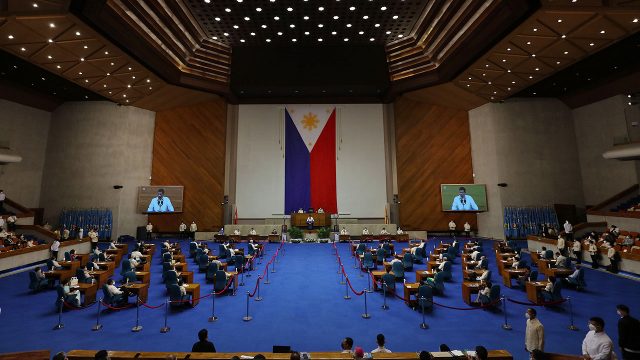
The House is also set to resume plenary sessions on Monday. Plenary sessions will be held from 2 to 5 p.m. during MECQ with only House leaders and a limited number of secretariat personnel physically present inside the session hall, while other members will attend through videoconferencing.

“We are ready to carry out our constitutional duty of carefully scrutinizing the NEP and eventually pass a national budget that is truly reflective and responsive to the needs of Filipinos as COVID-19 continues to wreak havoc on people’s lives and the economy,” House Speaker Lord Allan Jay Q. Velasco said in a statement.

Budget gap may return to pre-crisis level by 2025

THE BUDGET DEFICIT may only return to its pre-pandemic level by 2025 under the government’s fiscal consolidation plan, according to early estimates by the Finance department.

Gil S. Beltran, Department of Finance (DoF) undersecretary and chief economist, said the National Government could bring down its budget deficit to the 3.2% of gross domestic product (GDP) ceiling by 2025 if the remaining tax bills under Comprehensive Tax Reform Program will be passed.

“Our estimates show that if we can get all these measures passed, it’s now 2021, by 2025, we will be back to our usual deficit [in] 2019… We can even do better if the economy rebounds quickly,” Mr. Beltran told reporters in an interview last week.

In a Viber message, Finance Assistant Secretary Maria Teresa S. Habitan said the DoF is hoping the last two bills, the proposed Real Property Valuation and Assessment Reform Act and the Passive Income and Financial Intermediary Taxation, will be signed into law by the end of 2021.

The two bills are part of the common legislative agenda of Legislative-Executive Development Advisory Council (LEDAC) that are targeted to be passed by yearend.

Both measures have been approved by the House but are still pending at the Senate committee level.

The proposed Real Property Valuation and Assessment Reform Act aims to establish a single valuation system for local government units to improve their collections, while the Passive Income and Financial Intermediary Taxation will help simplify the tax structure for financial instruments.

While the fiscal consolidation plan is an “evolving” plan and still subject to revisions, Finance Secretary Carlos G. Dominguez III said in the same interview that the government can bring down its deficit either by lowering the budget or raising more revenues.

“One is perhaps to reduce our expenditures as Indonesia did… The other way is to increase our revenues. But I’m telling you it’s going to be very difficult; this fiscal consolidation period is going to be rather difficult. But the good thing that’s going for us is that interest rates are low,” Mr. Dominguez said.

The government incurred a budget deficit of P1.371 trillion last year. This is equivalent to 7.6% of GDP versus 3.4% of GDP seen in 2019.

The state runs on a budget deficit as it spends more than the revenue it generates. It capped the fiscal gap to internationally accepted threshold of 3.2% before the crisis hit, but the economic team adjusted this to accommodate a deficit equivalent up to 9.3% of GDP this year amid high public spending and lower tax collections.

Under the medium-term fiscal program adopted in May, the budget gap is expected to go down to 7.5% of GDP in 2022, 6.3% in 2023 and 5.3% in 2024.

On the debt levels, Mr. Beltran said they are expecting the debt stock to still hover within 60% of GDP and go back to the pre-crisis debt ratio by 2025, roughly the same timeline for the budget deficit.

“It could be earlier if the next administration will be quick, it they’re as quick as this administration, then we can even do it in 2024,” Mr. Beltran said.

“We expect the economy to surge upward, as soon as the lockdowns are taken out because the factors of production are there, it’s just that they cannot move. Once you remove the blockades, the checkpoints and the restrictions, the economy will boom significantly,” he added.

The National Government’s outstanding debt climbed to P11.2 trillion as of end-June, accounting for 60.4% of GDP, higher than the 54.6% debt-to-GDP ratio in 2020 and much bigger than the pre-pandemic level of 39.6% in 2019.

The economic team expects the debt ratio to hit 59.1% this year, peak at 60.8% in 2022 before slowly easing to 60.7% in 2023 and 59.7% in 2024, the Finance chief told reporters last month.

Mr. Dominguez said the DoF team led by Mr. Beltran and Ms. Habitan started working on the fiscal consolidation plan with the first draft submitted a week ago.

“The fiscal consolidation plan is an ongoing project which we have started about a month and a half ago. As it becomes clearer to us, maybe once a month, we will come up with more and more detail on that fiscal consolidation plan,” he said.

“We have to see how the plan evolves, as I said, depends on how long this pandemic will last. Fortunately, we are in a relatively good position, not an absolutely good position, a relatively good position,” he added.

Asian Institute of Management economist John Paolo R. Rivera said policy makers should consider the “intended and unintended consequences” of a contractionary fiscal policy on the economy, and how monetary authorities will react to this.

Raising taxes as part of the plan will be a challenge for the government, according to Mr. Rivera because of its economic, social and political implications at a time of crisis.

“Raising taxes will definitely burden everyone who has already been burdened by the ongoing pandemic and it might be difficult to make people understand this given the several news regarding alleged non-use and misuse of public funds. Also, given the political landscape of the country and that elections are also upcoming, rocking the boat might be the last thing politicians want to do,” he said.

“Rather than passing the burden to the public through taxation, government needs to generate income through other means, cost saving, and cutting waste,” he added.

He said the plan should also include legislation on the efficient use of public funds to boost the economy’s recovery. — Beatrice M. Laforga

Locals help boost investment climate in Bangsamoro region

@BANGSAMOROGOVT

By Marifi S. Jara, Mindanao Bureau Chief

INVESTMENTS in the Bangsamoro region are picking up this year — following a slump in 2020 due to the coronavirus pandemic and administrative adjustments under the transitional government — with almost P2 billion worth of new projects sealed last week and at least another P1.4 billion expected from planned ventures.

Two companies were awarded a certificate of registration on Aug. 18, signaling their formal start of operations and entitlement to fiscal and non-fiscal incentives, the Regional Board of Investments (RBoI) said on Friday.

Al-Muzafar Agriventures, Inc. (AMAVI) is pouring in P950 million for a 1,000-hectare Cavendish banana plantation in Maguindanao, while ES Maulana Global Ventures Co., Inc. (EMGVCI) is investing P998 million for an oil and gas exploration project in the Liguasan Marsh and the Sulu Sea.

“Our investments will surely generate an inclusive employment to those who are former combatants, less educated and less fortunate people in the region to help them live well,” AMAVI Board of Trustee Michael Abas Kida said during the ceremony.

EMGVCI Chief Executive Officer Datu Esmael Maulana, for his part, said their venture “could generate an employment from 2,000 up to 3,000 workers directly from the community with or without education.”

EMGVCI is also planning a poultry project worth around P100 million, according RBoI Chairman Ishak V. Mastura.

The other proposed investments are a P300-million tourism complex in Cotabato City, a cornstarch manufacturing in Lanao del Sur, a banana plantation in Lamitan, and a P1-billion oil and gas exploration project by a company under former Sulu governor Benjamin T. Loong.   

“Considering the vast potentials of BARMM (Bangsamoro Autonomous Region in Muslim Mindanao), the certainties and more stable peace and order situation now in the region, this investment of local players would influence regional investors and eventually put confidence to encourage national and even global investors to come in,” Mr. Mastura said.

SLUMP IN 2020
In an earlier interview, the RBoI head said there were “hardly” any new registered investments in 2020, with the most significant being a P14-million infusion by Community Wireless and Power Corp. in an internet service project in Lanao del Sur.

He attributed the downturn to restrictions prompted by the coronavirus pandemic, although he noted that existing companies in the BARMM fared well in terms of continued operations.

“Based on anecdotal evidence when we visited RBoI registered firms in 2020, most of them continued operations and did not go under, and in fact one Cavendish banana plantation operations in Lanao del Sur reported to us that they even increased their local hiring,” he said.

The new region, formally established in 2019, is also under transition with the Bangsamoro Administrative Code only having been finalized in December 2020.

RBoI’s workforce from the former ARMM, which was also led by Mr. Mastura, was reduced while awaiting final placement within the BARMM organization.

The investment bureau, now an attached agency of the Office of the Chief Minister, will continue to administer incentives in accordance to its devolved powers from the National Government’s Board of Investments.

“Continuity in the business environment and stable investment policies are crucial for investors so the fact that RBoI-BARMM continues to operate without any drastic disruptions or departure from its previous services is a big boon to BARMM investors,” Mr. Mastura said.

Lack of financing stalls P82.5-B LNG project of Batangas Clean Energy

By Angelica Y. Yang, Reporter

BATANGAS Clean Energy, Inc. (BCE), a joint venture which seeks to build an P82.5-billion land-based liquified natural gas (LNG) plant, has not yet been able to secure financing for the project, its top official said, citing the absence of an off-taker for the facility.

Because of this, the firm failed to meet the requirements to obtain a permit to construct expand, rehabilitate and modify (PCERM) from the Department of Energy (DoE).

“Unfortunately, BCE has not met the requirements to apply for its PCERM, primarily because we don’t have financing which is contingent on the BCE securing an off-takers agreement. On June 25, we explained this to the OIMB (Oil Industry Management Bureau),” BCE President Yari A. Miralao told BusinessWorld on Viber last week.

“[W]e remain committed to develop our LNG project but are not ready to apply for PCERM,” he said.

Mr. Miralao said an off-take agreement guarantees that banks that extend loans will get paid. Off-take agreements typically involve the advance buying or selling of a producer or importer’s goods.

His comments come after the DoE in a media release dated Aug. 20 identified six firms with permits issued by the department. BCE was not included in the list.

“It’s hard to build a facility without any customers. Banks are reluctant to lend on that kind of basis,” Mr. Miralao separately said in a phone interview on the same day.

The DoE’s OIMB said on Friday that BCE’s notice-to-proceed (NTP), a key milestone before the LNG construction phase, has expired.

“Batangas Clean Energy’s NTP has expired, and it does not have a submission for the next permit — permit to construct,” a representative of the DoE’s OIMB said through Viber.

According to an Energy department circular released in 2017, the issuance of an NTP comes before the release of the PCERM. Once the DoE releases the NTP, the proponent is given six months with a one-time extension of up to six months to submit all the requirements.

“Upon validation of the fulfillment of the NTP conditions, the DNG-REC (downstream natural gas industry-review and evaluation committee) shall recommend, for approval of the DoE Secretary, the issuance or non-issuance of the PCERM as an authority of the operator to proceed [with] the construction or expansion, rehabilitation or modifications… of the natural gas facilities,” the circular read.

Obtaining a PCERM requires submitting “proof of financial closing,” among other documents.

Mr. Miralao said the company had received an assurance from the OIMB that it can apply for a new NTP or PCERM “without prejudice.”

“With that reassurance, we intend to apply for a new NTP or PCERM when we are ready,” he said.

“Coming up with an LNG solution for the Philippines is a complicated and challenging endeavor. Delays sometimes cannot be avoided. We, however, continue to push forward and hope to report on our progress in the weeks and months to come,” he added.

Megawide readying MCIA, PITX for post-quarantine ‘revenge travel’

By Arjay L. Balinbin, Senior Reporter

MEGAWIDE Construction Corp. is eyeing more improvements to the Mactan-Cebu International Airport and the Parañaque Integrated Terminal Exchange, as well as looking to develop more landports, in anticipation of a potential surge in “revenge travel” once quarantine rules are relaxed.

“We are anticipating a rise in demand for the so-called ‘revenge travel’ post-quarantine,” Megawide Chairman and Chief Executive Officer Edgar B. Saavedra told BusinessWorld in an e-mailed reply to questions recently.

“We are looking at making the passenger experience at both the Mactan-Cebu International Airport (MCIA) and Parañaque Integrated Terminal Exchange (PITX) more comfortable,” he added.

Mr. Saavedra noted that foot traffic at PITX bounced back when transport restrictions were lifted, “showing that the terminal is an essential convergence point for land travel and that passengers feel safe with safety protocols in place.”

Megawide’s second-quarter revenue from landport operations fell 45% to over P173 million from more than P312 million in the same period a year ago.

Costs of landport operations went up 40% during the quarter to more than P77 million from over P55 million in the same period last year.

“We will continue to implement digital processes [for seat bookings] and strict safety protocols at PITX,” Mr. Saavedra said.

The company is also eyeing expansion opportunities for additional landports, as land travel has been found essential during the pandemic.

“During the pandemic, we further developed our landport concept and are now looking at opportunities to bid and develop other landports across the country together with partners,” Mr. Saavedra said.

As for the Cebu airport, he said: “To ensure seamless travel for our passengers, we will continue implementing [our] contactless passenger platform and retain the onsite [coronavirus] testing facility at the MCIA.”

The company’s second-quarter revenue from its airport operations climbed 62% to around P119 million from almost P74 million in the previous year.

Costs of airport operations for the quarter decreased 4% to over P97 million from more than P101 million in the same period a year earlier.

Lambo classic makes a Countach-tic reappearance

PHOTO FROM PGA CARS

The ultimate ’80s poster car is back!

LONG BEFORE the terms “supercar” or “hypercar” were ever coined, there was the “exotic car.” And no car represented that term better than the Lamborghini Countach. Debuting at the 1971 Geneva Motor Show, the Countach became an instant showstopper. Impossibly low, impossibly wide, and sporting an impossibly sleek wedge shape, the Countach sparked a revolution in how sports cars are designed. And that’s even before the spectacular “scissor” doors were opened.

The Lamborghini Countach was a true “disruptor,” 50 years before that term became popular.

And now, in celebration of the 50th year of the Countach’s world debut, Lamborghini is unleashing a new limited-edition Countach — a homage that embodies the still-incredible attributes of the original while boasting cutting-edge technologies that enable it to deliver the sensational performance expected of a legend.

But while the original Countach models were referred to as LP 400 and LP 500, the new one will be the LPI 800-4 — the “800” referring to the car’s rounded-off 814cv of power (and “4” for the new car’s all-wheel drive). Only 112 units will be made — the number referring to the “LP 112” internal designation of the car when it was being developed. And yes, all 112 units have been spoken for, with customer deliveries beginning next year.

“The Countach LPI 800-4 is a visionary car of the moment, just as its forerunner was,” says Automobili Lamborghini President and CEO Stephan Winkelmann. “One of the most important automotive icons, the Countach not only embodies the design and engineering tenet of Lamborghini but represents our philosophy of reinventing boundaries, achieving the unexpected and extraordinary and, most importantly, being the ‘stuff of dreams.’ The Countach LPI 800-4 pays homage to this Lamborghini legacy but it is not retrospective: it imagines how the iconic Countach of the ’70s and ’80s might have evolved into an elite super sports model of this decade. It upholds the Lamborghini tradition of looking forward, of exploring new design and technology avenues while celebrating the DNA of our brand. It is a Lamborghini that innately expresses the marque’s enduring and emotive power: Always inspirational and thrilling to see, hear and, most of all, drive.”

Despite the model not being on the market for over two decades, the new Countach is instantly recognizable as exactly that — the new Countach. And if you’ve been wondering what the name means, the “Countach” moniker is an expression of surprise and wonder in Piedmontese dialect. Unlike the Miura, Gallardo, Huracan, and several other Lamborghini model names, the Countach (pronounced “koon-tash) is not a bull breed or a name of a famous bull.

“The first Countach has been present in our Centro Stile as a model for some years now,” explains Mitja Borkert, head of Centro Stile. “Whenever I look at it, it gives me goose bumps and it serves as the perfect reminder for me and the entire design team to design every future Lamborghini in a visionary and futuristic way. This is an unnegotiable part of our DNA, the essence if you so will. The first Countach shaped the Lamborghini design DNA like no other car; the new Countach translates that unconventional and edgy character into the future.”

The car keeps its distinctive silhouette with the essential line running from front to rear, sharp angles and lines, and a distinctive wedge shape. It has an innovative modern super sports design that will also be surely reflected in future Lamborghini models. The Countach LPI 800-4 develops the characteristic lines of the nameplate’s five models over nearly 20 years.

The final outline is pure and uncluttered, with references to the first LP 400 and LP 500. Giving the LPI 800-4 a distinctive Countach face, inspiration was taken from the Quattrovalvole edition in the assertive lines of the hood with long, low rectangular grille and headlights, as well as in the wheel arches with their hexagonal theme. The sharp inclination of the greenhouse adopts the straight lines redolent of the original Countach. There is no fixed rear wing outside the pure lines (there is a subtle retractable three-position rear spoiler), and the air scoops are integrated fluidly in the strong shoulders of the car, embellished with the distinctive Countach slatted “gills.” The iconic and aerodynamically powerful NACA air intakes cut into the side and doors of the Countach LPI 800-4 while the distinctive Periscopio lines run through the roof to the rear of the car, particularly distinctive if viewed from above.

The rear of the Countach LPI 800-4 is immediately recognizable from its distinctive inverted wedge shape, with the rear bumper featuring a lower, sleeker line, and the ‘hexagonita’ design shaping the three-unit rear light clusters. The LPI 800-4 sports the four-strong exhaust tail pipes of the Countach family, connected within the carbon fiber rear diffuser. Access for driver and passenger is of course via the pioneering scissor doors, first introduced on the Countach and that have since become a Lamborghini V12 signature.

The V12 engine of the vehicle is as legendary as the design. Mounted behind the driver in a forward-cabin layout, the original Countach featured side-mounted radiators from Formula One; forward-facing gearbox and tubular spaceframe technology. More racecar wizardry for the new Countach, which has a 2,700mm wheelbase and 43:57 front-to-rear weight balance, comes from the pushrod magnetorheological active front and rear suspension with horizontal dampers and springs.

It was as revolutionary in its approach to sports car engineering as in its astonishing looks. The Countach developed the best available technologies to produce an extraordinary car. This visionary philosophy is reflected in the Countach LPI 800-4, taking the pinnacle of current Lamborghini technologies and engineering to produce the performance expected from a Countach in 2021.

“The engineering team that developed the original Countach advanced Lamborghini’s pioneering technical approach, delivering unexpected innovations and the best performance available in a production car,” says Lamborghini Chief Technology Officer Maurizio Reggiani. “That spirit inherently drives Lamborghini R&D, resulting in the pioneering hybrid technology in the LPI 800-4, and the emotive driving experience and top-line performance expected from a flagship V12 Lamborghini.”

The 6.5-liter V12 — outputting 780cv at 8,500rpm and 720Nm at 6,750rpm — is combined with a 48-volt e-motor mounted directly on the seven-speed clutch-less gearbox providing a further 34cv/35Nm for immediate response and increased performance. It’s the same innovative architecture developed for the Sián — the only mild-hybrid technology to create a direct connection between electric motor and wheels, preserving the pure V12 behavior. The e-motor is powered by a supercapacitor providing three times more power compared to a lithium-ion battery. Perhaps the biggest departure from the original rear-wheel drive Countach is the new car’s Haldex Gen-IV AWD system.

Numbers? Zero to 100kph in 2.8 seconds, zero to 200kph in 8.6 seconds, with a top speed of 355kph. It can brake from 100kph to a standstill in a stunning 30 meters.

Shunning the now-common electric power steering, Lamborghini employed hydraulic power steering, with three different characteristics coupled with Lamborghini Dynamic Steering (LDS) and Rear Wheel Steering (RWS), all managed by drive select mode.

The monocoque chassis and all the body panels are in carbon fiber, providing light weight and exceptional torsional stiffness — the Countach LPI 800-4 weighs only 1,595 kg for a dry weight-to-power ratio of 1,95 kg/cv. Carbon fiber is seen on the front splitter, around the front window and wing mirrors, engine cover air intakes and rocker panel and it is always present in specific interior details. Moveable air vents produced by the state-of-the-art 3D printing technology, and a photochromatic roof — changing from solid to transparent at the push of a button — act as a reminder that this car, despite its historic inspiration, is a future automotive screensaver for the 21st century.

The Countach LPI 800-4 is unveiled in a dedicated color Bianco Siderale, containing a hint of pearlescent blue and reminiscent of Ferruccio Lamborghini’s own Countach LP 400 S, complete with red and black leather heritage interior.

The Countach LPI 800-4 20-inch (front) and 21-inch (rear) wheels are created in the “telephone” style of the 1980s, fitted with carbon ceramic brake discs, and Pirelli P Zero Corsa tires with size 255/30R20 for the front and 355/25R21 for the rear. (The original Countach had then-widest 345/35R15 Pirelli P7 tires.)

Owners of the exclusive limited edition Countach LPI 800-4 can choose from a range of heritage exterior paint options, such as the iconic Impact White, Giallo Countach, and Verde Medio. Otherwise, the contemporary palette offers modern metallic colors, such as Viola Pasifae or Blu Uranus.

An 8.4-inch HDMI center touchscreen unique to the LPI 800-4 manages car controls including Apple CarPlay. It also includes a unique button entitled “Stile” (Design): pressed, it explains the Countach design philosophy to its privileged audience.

Lamborghini set the automotive world on fire when it unveiled the Countach in 1971. Fifty years later, it is doing exactly the same with the new Countach LP 800-4. And all the world’s a stage yet again.

Analysts weigh in as Robinsons Land’s REIT sets P6.45 price

By Keren Concepcion G. Valmonte, Reporter

THE real estate investment trust (REIT) sponsored by Robinsons Land, Corp. (RLC) has set its final offer price nearly 12% lower than the P7.31 price-ceiling it set in its preliminary prospectus.

“Please be advised that the final price for the REIT initial public offering (IPO) of RL Commercial REIT, Inc.’s (RCR) common shares is P6.45 per common share,” the company told the exchange on Friday.

Analysts said the pricing could have to do with the country’s current economic conditions amid the surge in coronavirus disease 2019 (COVID-19) cases.

“This may have to do with market or economic conditions in view of the more contagious Delta variant that led to lockdowns or tighter restrictions that could slow down business or economic activities amid record-high new COVID-19 cases,” Rizal Commercial Banking Corp. Chief Economist Michael L. Ricafort said in a text message on Saturday.

On Friday, the Health department logged 17,231 new COVID-19 infections and 317 new fatalities. The country’s tally totaled 1,824,051 on Saturday after an additional 16,694 new cases were reported.

Active cases stood at 123,935 as of Saturday with a positivity rate of 25.2%, down from the 26.1% positivity rate seen the previous day. Metro Manila, Laguna, and Bataan will be under the modified enhanced community quarantine (MECQ) until the end of the month.

However, RCR’s lower IPO price may still benefit the company by luring in more investors.

“The lower final offer price may entice more investors to subscribe to the IPO, given the more attractive yields that the issue may present,” Timson Securities, Inc. trader Darren Blaine T. Pangan said in a Viber message on Saturday.

RCR will be offering to the public 3,342,864,000 common shares for P6.45 apiece, with an overallotment option of up to 305,103,000 common shares. The company may raise up to P23.53 billion in proceeds, which it will use to reinvest in the country.

“We want to be able to contribute to nation-building by building more projects and therefore helping create jobs and helping restart the economy,” RCR President and Chief Executive Officer Jericho P. Go told BusinessWorld Live on Wednesday.

RCR’s offer period will run from Aug. 25 to Sept. 3, targeting a listing date of Sept. 14. Shares will be listed on the main board of the Philippine Stock Exchange under the trading symbol “RCR.”

The company has 14 commercial real estate assets in its initial REIT portfolio, which are located in central business districts across Makati, Bonifacio Global City, Ortigas, Quezon City, and Mandaluyong and in key cities of Naga, Tarlac, Cebu, and Davao.

RCR said it has the “most geographically diverse Philippine REIT,” with a total gross leasable area (GLA) of 425,315 square meters (sq.m.).

“We already have tenants in our buildings with very high occupancy rates, we are already guaranteed of a steady income stream, and at the same time we have built-in three percent to five percent annual rental escalation,” Mr. Go said.

RCR also has an “excellent expansion pipeline.”

“We do have additional projects that are in the pipeline that can help grow RCR by almost double the size in about four to five years’ time,” Mr. Go said.

In a previous statement, the company said its potential additions to its portfolio include RLC’s Cyberscape Gamma located in Ortigas and/or Robinsons Cybergate Center 1 in Mandaluyong. RCR said it entered into a memorandum of understanding with RLC.

“Including the Cyberscape Gamma and the Robinsons Cybergate Center 1, RLC has approximately 204,000 sq.m. GLA in existing office assets, 68,000 sq.m. GLA of business process outsourcing (BPO) spaces located within RLC’s various commercial centers as well as 150,000 sq.m. GLA of properties that are in various stages of construction,” the company said in an e-mailed statement on Aug. 11.

RCR said its potential pipeline for infusion spans an estimated 422,000 sq.m., which are still subject to its fund manager’s recommendations, market conditions, and regulatory approval.

ADVERTISEMENT
ADVERTISEMENT