Home Blog Page 7603

Shares rise on foreign buying, vaccine supply

PHILIPPINE shares continued to climb on Wednesday driven by higher foreign buying and as market sentiment got a boost from the expected arrival of more coronavirus disease 2019 (COVID-19) vaccines in the country.

The Philippine Stock Exchange index (PSEi) went up by 143.33 points or 2.15% to close at 6,822.15 on Wednesday, while the broader all shares index rose 53.63 points or 1.29% to finish at 4,198.51.

“The trading month of August is looking less of a ghost month with foreigners buying up the choppy market’s likely approach to 7,000 on the back of more vaccine supply enabling inoculation goals in Metro Manila to be within striking distance,” First Metro Investment Corp. Head of Research Cristina S. Ulang said in a Viber message.

Net foreign buying climbed to P814.59 million on Wednesday from the P291.11 million seen on Tuesday.

Around five million more doses of COVID-19 vaccines developed by Pfizer, Inc. and BioNTech SE, AstraZeneca Plc, and Sinovac Biotech Ltd., are set to arrive this week after three countries pledged to donate to the Philippines.

This is on top of over three million COVID-19 vaccine jabs expected to arrive by the end of the month, which were purchased by the government from Pfizer and BioNTech and Sinovac.

The Philippines has so far administered over 30.69 million COVID-19 jabs, with 13.2 million or 12.21% of the country’s population fully vaccinated.

Meanwhile, Regina Capital Development Corp. Head of Sales Luis A. Limlingan said the US Food and Drug Administration’s move to give its full approval for the vaccine made by Pfizer and BioNTech continued to boost market sentiment.

“Investors continued to buy Philippine shares, [feeding] off news that Pfizer and BioNTech secured a full US regulatory approval for a COVID-19 vaccine. The development is still fueling the US benchmarks, lifting the Dow by 0.09% and the S&P 500 by 0.15% last night,” Mr. Limlingan said in a separate Viber message.

“Investors are also eager to hear US Federal Reserve Chairman Jerome Powell’s speech during the Jackson Hole symposium on Thursday, where he’ll tackle what’s next for the Fed’s bond-buying program,” he added.

Back home, the majority of sectoral indices posted gains on Wednesday except for mining and oil, which declined by 11.35 points or 0.12% to 9,188.26.

Meanwhile, services gained 57.89 points or 3.50% to 1,708.57; property climbed 73.99 points or 2.40% to 3,147.38; holding firms rose 158.52 points or 2.37% to close at 6,837.41; industrials went up by 58.03 points or 0.59% to 9,865.28; and financials improved by 3.67 points or 0.25% to 1,444.26.

Value turnover increased to P6.48 billion with 1.8 billion issues switching hands on Wednesday, from the P5.53 billion with 2.68 billion shares traded on Tuesday.

Advancers narrowly outnumbered decliners, 95 versus 93, while 51 names closed unchanged. — Keren Concepcion G. Valmonte

Duterte daughter wants out of political circus

PRESIDENTIAL PHOTO/KING RODRIGUEZ

By Kyle Aristophere T. Atienza, Reporter

DAVAO City Mayor and presidential daughter Sara Duterte-Carpio on Wednesday asked her father not to drag her into his political intramurals.

“I respectfully advise them to stop talking about me and make me the reason for them running or not running,” Ms. Carpio said in a statement.

Ms. Carpio, who topped recent opinion polls on next year’s presidential elections, issued the statement after President Rodrigo R. Duterte said he would run for vice-president next year. He also said he would abandon his presidential ambition if his daughter runs for President.

She said her father had told her about his decision to run for vice president next year with long-time aide Senator Christopher Lawrence T. Go, who is supposedly running for President. “It was not a pleasant event.”

The Davao City mayor said her father had asked her in a letter to either endorse the Go-Duterte tandem in the 2022 elections, or take in Mr. Go as her vice-president.

Ms. Carpio urged his father and Mr. Go “to own up publicly their decision to run as a tandem. If they can confirm it privately, then I do not see the reason why they cannot be candid about it to the public.”

She also said she was not a “last two minutes” person, alluding to how she could become a substitute presidential candidate, which happened to her father in 2016.

“I organize, and I implement accordingly,” Ms. Carpio said. “In the meantime, I refuse to be a political punching bag for a party in complete disarray,” she added, referring to factions in the ruling PDP-Laban.

Ms. Carpio wants to distance herself from her father “because they do not have the same people behind them,” says Jean S. Encinas-Franco, a political science professor at the University of the Philippines.

She’s also trying to portray herself as an independent person “because women politicians, especially someone running for President, normally mimics the strength usually ascribed to men in power,” she said in a Facebook Messenger chat.

PDP-Laban earlier said Mr. Duterte, who is barred by law from running for reelection, had agreed to “make the sacrifice and heed the clamor of the people” by running for vice-president.

Mr. Duterte and his allies might just be “testing the waters” to know public sentiment, Ms. Franco said. The administration is also trying to create an impression that Mr. Duterte’s brand of leadership is still needed.

“This kind of zarzuela is normal in our politics because we do not have genuine democratic political parties,” said Michael Henry Ll. Yusingco, a senior research fellow at the Ateneo De Manila University Policy Center.

“I really cannot say what is wrong with the administration camp because there are too many voices talking and actors positioning themselves,” he said. “What this tells us is that they still do not have a clear and definite campaign plan for 2022.”

Mr. Yusingco said the ruling party is not too fussed because the opposition has yet to put up a united front. “They have the luxury to be this disorganized at this point because there is still no serious threat to their chances of winning in 2022.”

Institute for Political and Electoral Reform Executive Director Ramon C. Casiple said the administration camp was just doing the “art of obfuscation,” noting that a lot is still in the negotiation stage.

“That’s the President’s tactic since his Davao entry into politics,” he said in a Facebook Messenger chat. “Keep them guessing until it’s too late. Don’t take that as the final outcome yet.”

Mr. Duterte on Tuesday night said he would run for vice-president next year. “I will continue the crusade,” he said at a televised news briefing, referring to his campaign against illegal drugs, criminality and insurgency.

“I may not have the power to give the direction or guidance but I can always express my views in public for whatever it may be worth in the coming days,” he added.

In the Philippines, the President and vice-president are elected separately and may come from opposing political parties. The vice-president usually becomes powerless unless the President gives him a key post in his Cabinet.

The Go-Duterte tandem is “merely a smokescreen or distraction for their real candidate,” said Ronward Munsayac, who belongs to a faction in the party allied with Senator Emmanuel “Manny” D. Pacquiao.

“It’s impossible that the right hand of the President will go against his boss’s daughter,” he said in a Viber message. “This tandem is merely a distraction to shield their real candidate from political attacks and to weaken the PDP-Laban with this decoy candidacy.”

He said Mr. Go and Mr. Duterte could withdraw from the race at any time — from the time of the filing of certificates of candidacy up to noon time of election day.

Senator Aquilino L. Pimentel III on Tuesday said choosing the party’s vice-presidential bet before naming its presidential candidate was “an unusual circuitous convoluted process.”

Ms. Carpio said Mr. Pimentel and Mr. Munsayac should “stop blaming me for the sad state of their political party.” “It is not my fault that no one among you is a leader worthy of the respect of the majority. Do not blame me for the sitcom that your party has been reduced to.” — with Alyssa Nicole O. Tan

Virus reproduction in metro fell but still at critical level — OCTA

PHILIPPINE STAR/EDD GUMBAN

THE REPRODUCTION rate of the coronavirus in the capital region has declined but remains critical, according to researchers from the country’s premier university.

The number had fallen to 1.53 from 1.78, the OCTA Research Group said in a report on Wednesday. Metro Manila had a daily average of 4,019 coronavirus cases from Aug. 18 to 24, 13% higher than a week earlier.

The Department of Health (DoH) reported 13,573 coronavirus infections on Wednesday, bringing the total to 1.88 million.

The death toll rose to 32,492 after 228 more patients died, while recoveries increased by 15,820 to 1.73 million, it said in a bulletin.

There were 125,378 active cases, 95.9% of which were mild, 1.3% did not show symptoms, 1.2% were severe, 0.94% were moderate and 0.6% were critical.

The agency said 176 cases had been removed from the tally, 174 of which were tagged as recoveries. It added that 152 recoveries had been reclassified as deaths. Seven laboratories failed to submit data on Aug. 23.

“Several local government units in the National Capital Region had decreasing reproduction numbers and growth rates,” OCTA said.

In Navotas, the reproduction number fell to less than 1.4. The numbers in Pasay, Malabon, Manila, Quezon City, Makati, and Las Piñas were less than 1.5 and their growth rates were below 20%.

Pateros, San Juan, Taguig, Mandaluyong, and Caloocan had reproduction numbers higher than 1.7.

Still, almost all metro cities except Navotas had critical reproduction rates, OCTA said. Only Manila, Quezon City, Caloocan and Marikina were below critical.

OCTA said the intensive care unit (ICU) occupancy for coronavirus patients in Metro Manila was high at 74%, while 67% of hospital beds for coronavirus patients were occupied.

ICU occupancy was at critical levels in San Juan, Muntinlupa, Parañaque, Las Piñas and Marikina, while it was high in Makati, Taguig, Pasay, Pasig, Valenzuela and Quezon City. — Kyle Aristophere T. Atienza

Limited face-to-face classes may start in September — DepEd

MORE than a hundred public schools will participate in the Education department’s two-month pilot test for physical classes in September once approved by President Rodrigo R. Duterte.

The program which will be voluntary, will be held in areas that are not at risk of the coronavirus, Education Undersecretary Nepomuceno A. Malaluan told a Senate hearing on Wednesday.

Classes will have as many as 12 students for kindergarten, 16 for Grades 1 to 3 and 20 for senior high school. School hours will be shortened.

Some senators asked why there seemed to be no sense of urgency on the part of the Education department in slowly getting students back to the classrooms.

Senator Ana Theresia “Risa” Hontiveros-Baraquel noted that the Philippines was one of few countries that have yet to return to the classroom setup.

“That rollout is so slow and pathetic” she said at the hearing. “But we are really left behind,” she said in Filipino.

Mr. Malaluan said an inter-agency task force had approved the pilot test but Mr. Duterte had yet to approve it.

“Why does it seem like there’s no sense of urgency?” Senator Maria Lourdes Nancy S. Binay-Angeles said.

Senator Sherwin Gatchalian, citing a Pulse Asia poll, said 62% of public school students wanted to go back to school. — Alyssa Nicole O. Tan

20 private sector groups back calls to address PhilHealth efficiency  

A BROAD array of business groups have backed calls for a more efficient and faster release of funds by the state health insurer to private hospitals, which have been part of the government’s coronavirus response.  

“The delays in effecting reimbursement claims of hospitals have already adversely affected the cash flows of our hospitals, which are already burdened by higher operating costs due to the pandemic and reduced census of regular patients,” the groups said in a joint statement.   

Private hospitals have threatened to cut ties with the Philippine Health Insurance Corp. (PhilHealth), which they said have unpaid claims worth more than P25 billion.  

“These impinge on their ability to expand capacity and deliver the needed services to our people,” the 20 private sector groups said.  

The government has required private health care facilities to allocate a percentage of their bed capacity to coronavirus patients as public hospitals could not accommodate all cases.   

More than P25 billion worth of hospital claims are still being processed by PhilHealth and about P46.6 billion “were returned to hospitals for compliance with certain requirements in addition to the reported arbitrary denial of  payment for claims,” the groups said, citing the Philippine Hospital Association (PHA).  

Several organizations of hospitals and physicians in the country earlier announced that they would cut their ties with PhilHealth after it released a circular suspending payments to health care providers whose claims are under investigation.  

This circular on the possible conditional stoppage of payment for claims of private hospitals being investigated for fraudulent acts “will further delay the  processing of claims by our hospitals,” according to the groups, which include the ACI Philippines, American Chamber of Commerce of the Philippines, Management Association of the Philippines, Financial Executives Institute of the Philippines, Philippine Chamber of Commerce and Industry, Philippine Finance Association, among others. 

While recognizing that PhilHealth needs to exercise reasonable caution against false or illegal claims, the groups said the “sanctity of contracts” must be respected as mandated by the rule of law.  

“Delayed reimbursements to HCPs (health care providers) have to be addressed with urgency through, among others, simplified and more efficient claim process and consistent application of policies and rules,” they said.   

The statement’s signatories also include the Cebu Leads Foundation, Cibi Foundation, Inc. Filipina CEO Circle, Guild of Real Estate Entrepreneurs and Professionals, Inc, Judicial Reform Initiative, Philippine Bar Association, Licensing Executives Society Philippines, Makati Business Club, Philippine Council of Associations and Association Executives, Philippine Finance Association, Philippine Women’s Economic Network, Philippine Life Insurance Association, Philippine Retailers Association and Women’s Business Council Philippines.  

SENATE PROBE
Meanwhile, Senator Ana Theresia N. Hontiveros-Baraquel on Thursday filed a resolution calling on the Senate to conduct an investigation on the matter. 

“The Filipinos are the ones losing in the conflict between PhilHealth and private hospitals. On every day that the issue is not solved, there are patients that worry where they can garner payments for hospitals. The Senate must investigate because we simply cannot leave the public hanging,” Ms. Hontiveros said in mixed English and Filipino in a statement.  

Senator María Imelda Josefa “Imee” R. Marcos, in a separate statement, questioned PhilHealth’s motive on issuing the circular for payment suspension.   

“PhilHealth’s simultaneous investigation and suspension of reimbursement claims is coercion, not an anti-fraud effort. Allegations of attack-and-collect, of false fraud charges, and suspension blackmail by PhilHealth Legal have been heard many times in the past,” she said. — Kyle Aristophere T. Atienza and Alyssa Nicole O. Tan 

Labor dep’t won’t recommend increase in deployment cap for nurses  

PHILIPPINE STAR/EDD GUMBAN

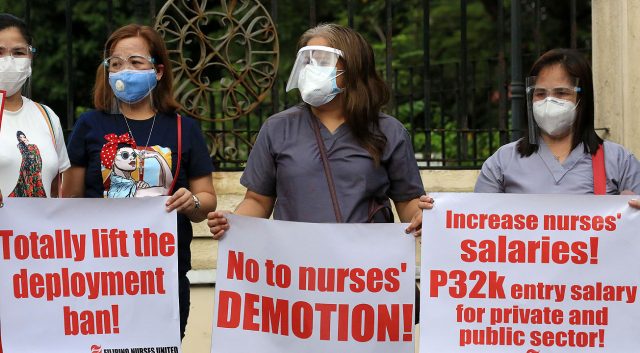
A TECHNICAL working group of the Department of Labor and Employment (DoLE) will not recommend an increase in the current 6,500 deployment cap on nurses this year, citing a supply gap of healthcare workers in the country as it battles the continued surge in coronavirus cases. 

DoLE earlier said this year’s limit has already been reached.  

Labor Assistant Secretary Dominique R. Tutay said in a news briefing on Wednesday that the decision will be submitted to Secretary Silvestre H. Bello III for approval, then to the inter-agency task force handling the coronavirus response.   

Ms. Tutay said the recommendation may still change later in the year, depending on the “replenishment of supply” of new healthcare workers, which will depend on how many graduates will pass the board exams in November.  

“There is already a perceived supply gap,” Ms. Tutay said, especially because the board examinations for healthcare workers were postponed in 2020.   

She explained that there are additional healthcare workers in the country, but some do not want to work at all, or they work in other sectors, hence the supply gap.  

The 6,500 cap does not include deployments to the United Kingdom and Germany, which have separate government-to-government agreements with the Philippines.   

Ms. Tutay also said the technical working group recommended for the department to focus instead on pushing for the passage of House Bill 7569 and Senate Bill 1837, which will increase the pay and benefits of private sector healthcare workers.   

DoLE is proposing that private sector healthcare workers get an entry level pay similar to that of public healthcare workers at Salary Grade 15 or P33,000 monthly.  

“We studied the current version of bill and did our own version based on the current situation of healthcare workers in the country,” Ms. Tutay said. — Bianca Angelica D. Añago  

Gov’t, Puregold launch cheaper frozen meat program  

THE GOVERNMENT has partnered with grocery operator Puregold Price Club, Inc. on a program that will offer cheaper frozen meat products to consumers.    

Under the program launched on Aug. 24, the Department of Agriculture (DA) said frozen pork products at Puregold supermarkets will be priced at P199 to P229 per kilogram depending on the part, while frozen chicken drumsticks will be available at P110 per kilogram.   

Trade Undersecretary Ruth B. Castelo confirmed to BusinessWorld in a mobile phone message that the program covers 107 Puregold stores in Luzon.    

Agriculture Secretary William D. Dar said the low-priced frozen meat in supermarkets is part of augmentation efforts by the government in response to limited supply caused by the African Swine Fever (ASF) outbreak.    

“We will continue to persevere and partner with DTI (Department of Trade and Industry) to talk to other supermarkets to encourage them to follow suit, making affordable meat available for the consuming public,” Mr. Dar said.    

“The DA is continuing its efforts to eradicate ASF and has intensified its repopulation program. An ongoing testing of vaccines against ASF is also being conducted,” he added.    

Aside from Puregold, the two departments also recently partnered with Robinsons Supermarket, Atkins Import and Export Resources, Inc., and the MyOwn Group of Companies for the same program.  

The partnership with Robinsons Supermarket covers all of its branches across Metro Manila, while the collaboration with Atkins and the MyOwn Group established a pop-up store at the Marikina Riverbanks Center. — Revin Mikhael D. Ochave   

Harbor Star Shipping Services gets contract to salvage Ambition Journey in Eastern Samar 

LISTED INTEGRATED maritime service provider Harbor Star Shipping Services, Inc. announced on Wednesday that it was awarded a contract together with the United States’ T&T Salvage to salvage the Panamanian-registered bulk carrier Ambition Journey in Eastern Samar. 

In a disclosure to the stock exchange, Harbor Star Shipping Services said the 189-meter vessel ran aground on Aug. 2 in Sulangan Island in Guiuan town.

“The contract to salvage Ambition Journey includes refloating the vessel, unloading its cargo of 49,550 metric tons of nickel ore, rendering oil spill control and cleanup operations, and towing the vessel for repairs to the designated shipyard,” the company said. 

The Philippine firm and T&T are coordinating with the Philippine Coast Guard and the appropriate local government units to ensure the orderly salvage of the vessel and the protection of the marine environment, it added. 

Salvage operations comprised 8% of Harbor Star Shipping Services’ revenues last year. — Arjay L. Balinbin 

Solon seeks probe into delay of more COVID-19 vaccine multi-party agreements 

@HOUSEOFREPSPH

A PARTY-LIST representative has called for a probe on pending agreements for the procurement of vaccines by local governments and the private sector, citing the need for better transparency from the national government which is a signatory to these deals.  

AAMBIS-OWA Party-list Rep. Sharon S. Garin filed House Resolution 2154 on Monday calling for an inquiry on vaccine multi-party agreements (MPAs) by the Committee on Economic Affairs, which she chairs.    

“There have been reports that these MPAs submitted by the LGUs (local government units) and the private sector are left unsigned and are languishing in the (National Task Force Against COVID-19), directly affecting the speedy vaccine rollout in the country,” according to the resolution. 

Senator Juan Miguel F. Zubiri on Aug. 17 filed Senate Resolution 858 that also seeks to probe the task force on the deals.  

Secretary Carlito G. Galvez, Jr., designated as head of the country’s vaccine program, said in a statement on Aug. 18 that the unsigned MPAs came after vaccine manufacturers said they either no longer accept orders, intend to prioritize national government-procured orders, or yet to secure authorization for the use of a specific brand.  

Ms. Garin, in her resolution, said the explanation of Mr. Galvez is not enough and that there is a need for transparency in the allocation and coverage of the country’s vaccine rollout, especially in the provinces and rural areas amid a surge in coronavirus disease 2019 (COVID-19) cases due to the Delta variant.  

LGUs and private businesses are allowed to procure COVID-19 vaccines in cooperation with the Department of Health and the National Task Force Against COVID-19, based on Republic Act 11525 or the COVID-19 Vaccination Program Act of 2021. 

Ms. Garin noted in a press conference that an estimated 10 million doses have been made available to LGUs and private businesses that were covered by earlier multi-party agreements.    

The national government is a party to the MPAs because all coronavirus vaccines are still under emergency use authorization and manufacturers require that indemnification be covered by the national government before finalizing any procurement deals. This means that the national government will shoulder the cost of potential adverse effects among those inoculated.  

The Department of Health and the task force explained earlier this year that direct purchase deals could be pursued by local governments and the private sector once vaccines are given authority for commercial sale, which means manufacturers would face liability for adverse effects. — Russell Louis C. Ku 

Iloilo City considers charges vs PhilHealth over unpaid hospital claims 

ILOILO CITY GOVT

THE MAYOR of Iloilo City has directed the local government’s legal office to look into the possibility of filing charges against the entire regional office of the Philippine Health Insurance Corp. (PhilHealth) over unpaid claims of medical facilities, which has affected the city’s coronavirus response.   

“I am giving instructions to the City Legal to study the filing of criminal and administrative cases against all personnel of PhilHealth Region 6 with the Office of the Ombudsman and the Anti-Red Tape Council for their failure to pay the claims of the hospitals and other healthcare facilities most especially during this pandemic when the island of Panay is facing a surge in cases,” Mayor Jerry P. Treñas said in a statement Wednesday.   

“The non-payment of these claims results to hospitals not adding more COVID beds and ICU (intensive care unit) beds to cater to moderate and severe positive patients),” he said.  

Mr. Treñas, in an earlier statement, said they have also requested the national government for the construction of three additional modular hospitals with a combined 66 beds for COVID-19 (coronavirus disease 2019) patients.   

Region 6 or Western Visayas had 10,987 active cases as of Aug. 24, based on Health department data. Of this, 8,383 were within Panay Island, composed of the provinces of Aklan, Antique, Capiz, and Iloilo including Iloilo City.   

The region has recorded 99,310 COVID-19 cases since the start of the pandemic, with 85,916 recoveries and 2,383 deaths.  

Iloilo City, as the regional center, is home to the biggest public hospital in Western Visayas as well as several private medical facilities, which cater to COVID-19 patients from outside the city.   

BusinessWorld sought PhilHealth Region 6’s comment but had yet to reply as of this posting. It was a non-working holiday in Iloilo on Aug. 25 in celebration of the city’s 84th founding anniversary. — MSJ 

DoLE to probe alleged illegal termination of mobile phone company workers  

THE DEPARTMENT of Labor and Employment (DoLE) on Wednesday said it will investigate the termination of 689 regular employees of a mobile phone manufacturer allegedly due to their formation of a labor union.  

“That’s a very sad story during the pandemic, but we need to get all the information about this so we can act on it accordingly,” Labor Secretary Silvestre H. Bello III said in a statement.    

In a news release on Tuesday, the retrenched employees said the company cited business losses for the workforce cut, but that the company conducted mass hiring through a manpower agency after their termination.

BusinessWorld sought the company’s comment but had yet to reply as of posting time.

One former employee questioned the company’s claim of losses, saying that “each of us were selling 50 units of cellphones equivalent to P300,000 per month.”   

“They’re earning. Our termination from work has no legal cause,” the former employee added.   

At least 200 of the company’s retrenched employees rallied at the DoLE headquarters in Manila on Monday to ask the department to intervene in the matter.   

Mr. Bello urged the concerned workers to file a formal complaint at the department. — Bianca Angelica D. Añago  

Hey, the bankers are rethinking

OUR-TEAM-FREEPIK

I had tagged several bankers in my critique on whether or not the financial sector was doing enough during these COVID times, and Wick Veloso, current President of the Bankers Association of the Philippines dropped me a one-liner, “you should hear the Bankers’ plea to help — call me for clarity,” which I of course happily obliged. We discussed our mutual experience of the 2008 crisis and he pointed out the IFRS-9 regulation (IFRS stands for International Financial Reporting Standards), created by the International Accounting Standards Board (IASB) as a response to the crisis; the purpose of which was to protect citizens from a repeat of future irresponsibility by tying the banks’ hands from taking on too much risk. In effect, what IFRS-9 does is project risk of default of clients for the next several years (generally, five) into the future, attach a fair value of that to the present and then set provisions aside today to cover those risks. Which all sounds like a reasonable regulation no one would argue with, with no question to its premise, except apparently in the whammy that is COVID.

In COVID times, we are unable to determine what will happen in three days, let alone five years. We are unable to understand whether or not the replication rate of the virus will reach a point wherein the government must necessarily shut a business down, and if so, for how long, and, in the good scenario that the shut-down is a temporary thing, then how long until the revenues recover, and if the revenues do not recover, then how long until a permanent end to the business, and consequently how high of a risk the cash flows will not be able to cover the loans taken precisely to expand a pre-languishing business. If IFRS-9 were to put every business on the spot today, no one business would be able to provide an accurate description of their near-term cashflows, holding everyone as likely to default.

I said, why then can’t anyone lobby to just change these rules for now? Well, Veloso says, these rules are so entrenched in international best practice that no one would want to stick out like a sore thumb to rally against it. And indeed, it wouldn’t look too nice, admittedly, banks wanting to circumvent regulation to yet again get rid of bad debt, something we were all too familiar with during the global financial crisis. And obviously, the central bank, as much as it would want to encourage more lending, would never actively convince banks to undervalue their provisions; it is the central banks onus to make sure the banks keep these conservative.

And if this is the case, then what would any bank in their right mind, with all their sophisticated loan default modelling, have as an option? What then is there to be done when this fiduciary duty does not result in the betterment of society?

Veloso says, let’s classify all clients as current; that is, do not put them in the usual stages of provisional default, stage one, two, three. Instead, just label them as basically “clean” or “unclean” and allow those “clean” to borrow as if they are not in risk of default. Just by mere classification, banks are able to then implement IFRS-9 and yet have the latitude to decide on creditworthiness, apart from merely restructuring loans, to treat clients as non-defaulters. To wit, he says, let’s forgive anyone that needs to be forgiven today, without needing to look at their past records to compare with today, without needing to calculate in sophisticated ways their propensity for default. Because who even has that much of a crystal ball today? Certainly not financial theory and the credit scoring models crafted based on it.

I said, but for how long? You can’t just keep making banks current; and what about going even lower than previously? Lower rates, longer tenors. Isn’t that what we need, what we are clamouring for? A step further, go beyond. Pwede rin ‘yan! Tingnan din natin iyan. (That is also a possibility! Let us look into it.) And before he had to jump into another meeting, I said: But sir, if you base it on the bottom-line, banks are still healthy and relatively okay compared to other sectors; if you look at all the metrics, the margins aren’t squeezed if you don’t lend and you can well survive on other non-interest income, why even compromise the good standing when it doesn’t make business sense, not to mention effort to lend to the quote-unquote “unlendable.” (It sounds like such a microfinance story, perusing credit-worthiness of everyone, except now everyone is up for evaluation, even the billionaire tycoons, imagine that.) And Veloso said, because Danie, we want to help! So, there you go, the rebuttal to my last paragraph in that column where I said Banks are supposed to be pillars of the economy and not places to beg for loans.

And while we wait for such help to arrive, to me it is much more than circumventing rules written during different times for Black Swan events like the one we are in today. To me, it is the idea that during times of crises, there is a scramble for new solutions which leads to a flourishing of new ideas and alternative ways of thinking. Why even stick to financial theory? How do we even integrate physical health into calculations of financial risk, which has always just been measuring the volatility of stock returns over a period of time versus the mean return. That measure of risk has been thrown out the window these past 16 months. It’s the same way we should think of creditworthiness, how to determine whether a person will pay, when the past is no longer a valid reference and no statistics and scoring will make any pragmatic sense? Essentially: you think first of the outcome you want; and then you change the model. We created those tools, now we can edit them.


Daniela “Danie” Luz Laurel is a business journalist and anchor-producer of BusinessWorld Live on One News, formerly Bloomberg TV Philippines. Prior to this, she was a permanent professor of Finance at IÉSEG School of Management in Paris and maintains teaching affiliations at IÉSEG and the Ateneo School of Government. She has also worked as an investment banker in The Netherlands. Ms. Laurel holds a Ph.D. in Management Engineering with concentrations in Finance and Accounting from the Politecnico di Milano in Italy and an MBA from the Universidad Carlos III de Madrid.