



Home Blog Page 7593

Style (05/17/21)

Shopping simplified with J&J PH Chat & Shop

JOHNSON & JOHNSON (Philippines), Inc. (J&J) has launched J&J PH Chat & Shop, the healthcare company’s official social-commerce platform to simplify purchasing of its various consumer health products. In Kantar’s 2020 COVID E-commerce report, data showed that 72% of Filipinos have switched or extended their spending to e-commerce platforms, with Facebook as the third most-frequented platform for procuring their daily essentials. Personal care products ranked second as those most-commonly purchased online, following food and groceries. In line with this trend, J&J Philippines also noticed an uptick in user traffic on its social media platforms, as well as a steady increase in orders and purchases on its active online shopping channels over the last few months. J&J PH Chat & Shop (https://www.facebook.com/jnjphchatshop), powered by ACommerce, will deliver a fully automated experience — 24/7 shopping via Chatbot, with a live agent ready to personally assist customers during business hours, and seamless, easy navigation even for new users. The online shop currently carries J&J Philippines’ bestselling products from its portfolio of consumer health brands, including Aveeno, Neutrogena, Johnson’s, Listerine, Modess, Carefree, and Band-Aid. Delivery services are available nationwide, and the platform also accepts all major credit cards and cash on delivery for all transactions.

Montblanc unveils new blue color scheme

MONTBLANC unveils its Metamorphosis and patented Exo Tourbillon in a new blue color scheme. Montblanc unveils the Montblanc Star Legacy Metamorphosis Limited Edition 8 in a sparkling blue color. This innovative timepiece literally transforms itself, revealing two faces with distinctive high complications that allow the wearer to appreciate the time in different ways. Due to the complexity of the timepiece, only a few watchmakers have the expertise and experience to create timepieces at this level. First introduced in 2010, the patented Exo Tourbillon complication is a key pillar of the Montblanc watch collection. The idea was to position the large balance wheel, beating at the traditional low frequency of 18’000 oscillations, outside of the tourbillon’s rotating cage (explaining the term “Exo”). This offered a spectacular view of the tourbillon in motion while improving the precision of the timepiece. Montblanc is available at Rustans Makati, Rustans Shangri-La, Rustan’s Cebu, Greenbelt 5, City of Dreams and Resorts World.

Bally presents new signature hardware for Spring/Summer 2021

BALLY presents the B-Chain, a new signature hardware with an edge that features across women’s bags and accessories in the Spring/Summer 2021 collection, Elemental Balance. The crafted detail features two mirrored “B” initials with a clean and angular design. Coming together in gold-tone metal, the B-Chain is incorporated into the closing system of the collection’s range of bags — a simple twist of the connecting chain opens and fastens the turn-lock closure. Bags featuring the B-Chain focus on the everyday needs of modern women, and combine sophistication with a heritage of craftsmanship to functional shapes. These include a cross-body saddle bag with a fully-organized interior, and a minibag version with the same detachable and adjustable shoulder strap with internal pockets, all in a perfectly petite form. For a more formal, business look, a top handle bag maintains a purposeful shape, with a fold-over opening and the B-Chain fastening for a sleek finish. It can be carried by the handle, or on the shoulder with a detachable shoulder strap. The B-Chain’s addition appears throughout the new collection in a seasonal color palette across applications, whether embossed on leather clutches, or as a patterned cotton jacquard, for a wide array of styles. The B-Chain collection is now available online and in Bally boutiques worldwide. In the Philippines, Bally is exclusively distributed by Stores Specialists, Inc., with stores at Greenbelt 5, Rustan’s Makati, Shangri-La Plaza, City of Dreams, Power Plant Mall, and Newport Mall. It can also be found online at Trunc.ph, and Rustans.com.


Farm support services, fertilizer seen as crucial for boosting food security

THE AGRICULTURE sector needs better farm support services in order to achieve food security, according to a paper written by former Department of Agriculture (DA) officials.

In the paper, former Secretary Leonardo Q. Montemayor and former National Dairy Authority Administrator Salvacion M. Bulatao said some immediate measures could include improving the distribution of fertilizer and updating the farmers’ registry.

“No component of support services is fool-proof.  Safeguarding against unwanted results requires a steady stream of feedback from the final recipients of the services,” they said.

The paper recommended giving farmers vouchers to buy their preferred type, brand, or variety of fertilizer. 

It added that the Registry System of Basic Sectors in Agriculture used by the DA that assists to track and identify farmer beneficiaries needs to be updated.

“The system needs to be maintained and updated, for it to continue to be useful.  It must also involve the barangay so farmers can check whether they are properly listed, and initiate inclusion or exclusion processes as needed,” they said.

They also recommended integrated and sustained location-specific interventions for farmers, noting that the current way of doing things has had little impact because the process is not sustained, compartmentalized, and disjointed.

“Thus, the benefits from one intervention get offset by losses due to the absence of other equally important interventions.  Plus, many of the interventions are not specifically designed for the problems and priorities of specific areas,” they said.  

They added that local government units should be encouraged to provide road network maps for the projects, with the DA providing geo-tagging support.  

The authors said mechanization initiatives should take place across the food value chain and improve the promotion and training of service providers for maintenance and servicing.

“It should include basic food processing of farm produce and support for food development.  The cold chain system and the installation of powdering facilities can be added to existing community fish ports and other production sites,” the paper said.

The DA has announced that it will hold a National Food Security Summit on May 18-19 to discuss concerns affecting agriculture, such as African Swine Fever.

Industry groups such as the Pork Producers Federation of the Philippines, Inc. and United Broiler Raisers Association said they will boycott the food security summit. — Revin Mikhael D. Ochave

Investors lukewarm as JFC posts profits, sets expansion plan

REUTERS

INVESTORS turned cautious on Jollibee Foods Corp. (JFC) last week after the release of its first-quarter earnings report, as they assess expansion plans abroad in the coming quarters amid slow domestic vaccine rollout.

A total of 2.63 million JFC shares were traded last week worth P448.81 million, data from the Philippine Stock Exchange (PSE) showed.

The homegrown fastfood giant closed at P168 apiece on Friday, down by 4.4% from the previous week’s closing. Year to date, the stock fell by 13.6%.

“JFC’s movement was mainly due to positive [first-quarter] earnings reports and its aggressive expansion in overseas markets. The fastfood giant posted a net profit for the second consecutive quarter, supported by international sales that have recovered to pre-pandemic levels,” Globalinks Securities and Stocks, Inc. Head of Sales Trading Toby Allan C. Arce said in a Viber message last Friday.

In a separate Viber message, Timson Securities, Inc. trader Darren Blaine T. Pangan said investor sentiments remained cautious after a series of economic reports were released last week.

JFC swung to profit in the first three months of the year after posting P152.65 million in net attributable income from P1.68-billion loss in the same period last year. However, revenue dropped by 12% year on year to P34.68 billion during the period.

System-wide sales, which include total sales from company-owned and franchised stores, dipped by 13.4% to P47.78 billion. Broken down, local market accounted for 58.9% of global system-wide sales, while international markets cornered 41.1%.

Mr. Pangan said the quarterly report had minimal impact on JFC’s share price movement last week, as investors are still assessing the international expansion efforts in the coming quarters.

“The international expansion has somehow benefited the company in a sense that countries with faster and wider coverage in their vaccination programs saw greater store sales growth,” he said.

Traders and investors are not so bullish on JFC, Mr. Arce said, as they see structural headwinds to the company’s domestic dine-in business.

“The slow vaccine rollout is likely seen to keep unemployment and consumer risk aversion elevated in the long term. Minimum health standards post inoculation are expected to be the new [normal] and could require JFC to accelerate delivery and digital channel capability improvements,” Mr. Arce said.

Aside from Jollibee, JFC operates Chowking, Greenwich, Red Ribbon, Mang Inasal, Burger King, PHO24, Panda Express, Dunkin’ Donuts, Tim Ho Wan, Smashburger, and The Coffee Bean & Tea Leaf, among others.

As of end-March, JFC has 5,827 stores worldwide — 3,218 in the Philippines and 2,609 abroad. It has presence in China, North America, Middle East, and Europe.

It recently opened its 49th Jollibee store in Maryland, US, and now operates in 12 US states. The company eyes to launch 300 stores in North America by 2024.

Mr. Arce projected a P4.3-billion attributable net income for JFC this year and P6.5 billion in 2022.

He also pegged JFC support and resistance levels next week to sit on P165 and P175, respectively.

For Mr. Pangan, he expects JFC’s next area of support at P150 and immediate resistance at P180. — Ana Olivia A. Tirona

Yields on government debt fall on GDP, inflation bets

YIELDS on government securities (GS) fell across the board last week following the worse-than-expected decline in economic output in the first quarter and the central bank’s downward revision of its inflation forecast for this year.

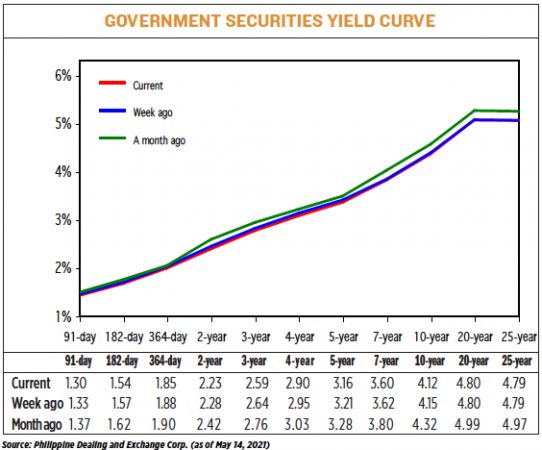
GS yields fell by an average of 2.99 bp (bps) week on week, based on the BVAL Reference Rates published on the Philippine Dealing System’s website as of May 14.

Financial markets were closed on Thursday in observance of Eid’l Fitr.

At the secondary market on Friday, yields of all tenors were lower than week-ago levels.

The 91-day Treasury bill (T-bill) went down by 2.39 bps to yield 1.304%. Likewise, the 182- and 364-day papers declined by 2.44 bps and 3.31 bps, respectively, to fetch 1.5447% and 1.8504%.

At the belly, yields on the two-, three-, and four-year bonds went down by 4.67 bps (2.234%), 5 bps (2.5934%), and 5.27 bps (2.8956%), respectively. The rates of the five- and seven-year papers also dropped 4.42 bps (3.1609%) and 2.13 bps (3.5996%).

At the long end of the yield curve, the yield on the 10-year notes fell by 2.87 bps to 4.1221%. Meanwhile, the rates of the 20- and 25-year bonds inched down by 0.23 bp (4.8006%) and 0.19 bp (4.7893%).

“The local bond market had a full plate [last] week, starting off with the Philippine GDP (gross domestic product) print showing a deeper-than-expected contraction of 4.2% in the first quarter,” Robinsons Bank Corp. peso sovereign debt trader Kevin S. Palma said in a Viber message.

“Moreover, the Monetary Board of the BSP (Bangko Sentral ng Pilipinas) kept its policy rate as widely expected by the market but lowered its 2021 inflation forecast to 3.9%, which helped improve appetite for local GS, pushing bonds yields lower week-on-week,” he added.

A bond trader noted that the first-quarter GDP data “confirmed the continued slowdown” in the economy, helping drive yields lower last week.

“However, inflation pressures from across the globe put a cap on [last] week’s rally,” the bond trader said in a Viber message.

The BSP held its key interest rate at a record low for a fourth straight meeting on Wednesday, as it continues to support the economy’s recovery from the pandemic.

The Monetary Board maintained the overnight reverse repurchase rate at a historic low of 2%, in line with expectations of 15 out of 17 analysts in a BusinessWorld poll last week. Both the lending and deposit rates were also kept at 2.5% and 1.5%, respectively.

The BSP’s decision to keep rates steady came a day after release of disappointing first-quarter GDP data. For the first three months of 2021, economic output shrank by an annual 4.2%, keeping the economy in a recession for a fifth consecutive quarter.

Meanwhile, the central bank lowered its inflation outlook this year to 3.9%, from a previous estimate of 4.2%. On the other hand, the forecast for 2022 was raised to 3%, from 2.8% previously. This will put inflation back within the BSP’s 2-4% annual target range.

Yield will likely move sideways this week and track developments here and overseas, the traders said.

“For [this week], yields may continue with its consolidation phase given the mixed developments we have onshore and abroad,” Robinsons Bank’s Mr. Palma said.

He said Monday’s T-bill auction should “guide direction” for the shorter-dated papers. Meanwhile, those in the belly and long end of the yield curve would be driven by the reissuance of seven-year bonds on Thursday and the release of the minutes of the US Federal Open Market Committee’s April 27-28 meeting on May 19.

For the bond trader: “We expect yields to trade sideways with an upward bias [this] week as market reassesses the fate of the economy amid new quarantine classification.”

Metro Manila and nearby provinces are under general community quarantine with “heightened restrictions” from May 15 to 31. – A.M.P. Yraola

French cuisine with your French ride

PHOTO FROM PEUGEOT PHILIPPINES

PEUGEOT PHILIPPINES and French specialty restaurant Metronome cook up an experience to remember for Peugeot buyers. From May through June 2021, every purchase of a Peugeot 3008 SUV or a Peugeot 5008 SUV will come with gift vouchers that can be used for up to two visits to Metronome.

Peugeot Philippines Director for Sales Dodie Gañac said, “While we’ve always seen the purchase of a Peugeot as a reward in itself, we felt that offering something that people have been missing would be an added treat. Partnering with Metronome, a French fine-dining restaurant, which has also gained its fair share of followers, was a natural course of action. We’re very excited to offer our customers a great ride and a great dining experience in one.”

Metronome is a French fine-dining restaurant owned by noted restaurateur Elbert Cuenca. It is located at the ground floor of The Grand Midori along Bolaños Street in Legaspi Village, Makati City.

“On top of these, our dealerships have come up with some fantastic ownership packages that will surely be of interest to discerning car buyers. We’d like to invite people to come to our branches and check out our products,” added Mr. Gañac. Peugeot sales outlets are located in Pasig, Alabang Town Center, Quezon Avenue, Pampanga and Iloilo.

PSE posts gains in market cap in April

PSE posts gains in market cap in April

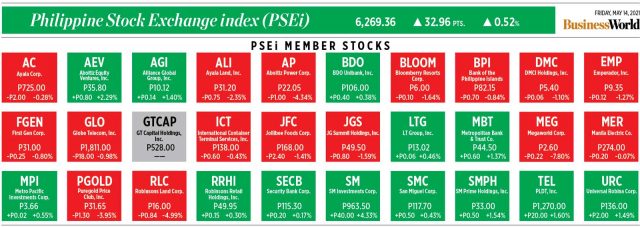
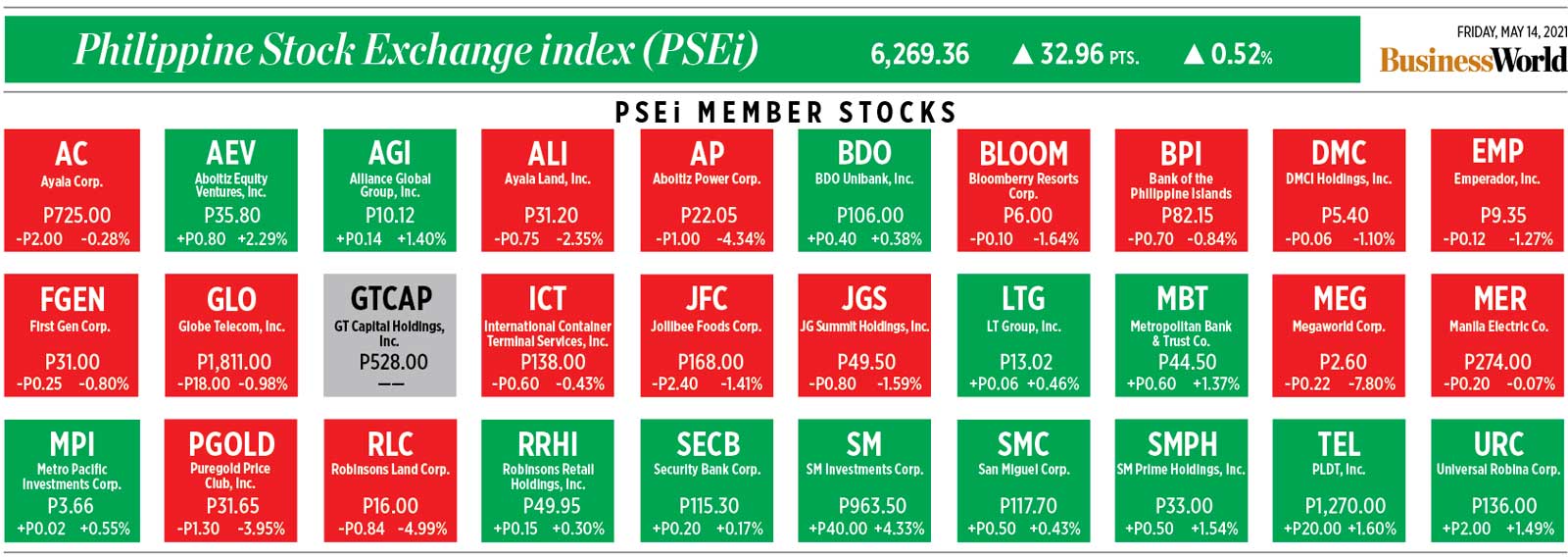
How PSEi member stocks performed — May 14, 2021

Here’s a quick glance at how PSEi stocks fared on Friday, May 14, 2021.


PHL stocks to rise further on eased restrictions

STOCKS are expected to climb this week after the government eased quarantine restrictions in Metro Manila and its nearby provinces of Bulacan, Cavite, Laguna, and Rizal on the back of lower daily coronavirus cases in the country.

The Philippine Stock Exchange index (PSEi) went up by 32.96 points or 0.52% to close at 6,269.36 on Friday. Meanwhile, the broader all shares index declined by 7.02 points or 0.18% to end at 3,850.98. Week on week, the PSEi gained 10.65 points from its 6,258.71 finish on May 7.

AAA Southeast Equities, Inc. Research Head Christopher John J. Mangun said Friday was “the most interesting trading day due to the increased volatility” in the market. He said bargain hunters held off as they were expecting the weakness of the market after restrictions were extended until the end of the month.

“Buyers waited until selling pressure had subsided and prices were significantly lower, which coincidentally was right before trading ended,” Mr. Mangun said via e-mail on Friday. “Dismal economic figures, which were released [last] week, also contributed to the deterioration of the sentiment.”

President Rodrigo R. Duterte approved the recommendation of an interagency task force to place National Capital Region and the provinces of Bulacan, Cavite, Laguna and Rizal under a general community quarantine with heightened restrictions from May 15 to 31, presidential spokesman Herminio L. Roque, Jr. said in a statement on Thursday night.

Meanwhile, the country’s gross domestic product (GDP) fell by an annual 4.2% in the quarter ending March. This marked five consecutive quarters of GDP decline, marking the longest recession since the Marcos era.

“With the further easing of restrictions, we may see the market to recover somehow but it will continue its [volatility] after the release of strong US inflation figures last week,” Diversified Securities, Inc. Equity Trader Aniceto K. Pangan said in a text message on Saturday.

“Any [sustained] inflationary pressures from the US will affect the global market including the Philippines,” Mr. Pangan added.

The US producer price index (PPI) rose 0.6% in April after surging 1.0% in March, Reuters reported. In the 12 months through April, the PPI shot up 6.2%. That was the biggest year-on-year rise since the series was revamped in 2010 and followed a 4.2% jump in March.

Meanwhile, AAA Southeast Equities Mr. Mangun said the recent downward trend of the PSEi may continue “until investors gain confidence that the economy would roar back to life.”

“[It] will only happen once the public health threat has been neutralized, mainly by developing herd immunity through mass vaccination. The PSEi’s next major support is at 6,000 which it could test in the coming trading days,” he said.

“Despite the lower prices, we encourage investors to start taking positions as the potential long-term upside of prices outweigh the potential downside risks in the short term,” Mr. Mangun added. — Keren Concepcion G. Valmonte with Reuters

Peso to strengthen vs dollar on remittances, central banks’ policies

BW FILE PHOTO

THE PESO is expected to continue strengthening versus the dollar this week on expectations of continued easy monetary policy from the US central bank and the Bangko Sentral ng Pilipinas (BSP), as well as bets of improved remittance data.

The local unit closed at P47.81 per dollar on Friday, strengthening by 0.5 centavo from its P47.815 finish on Wednesday. Trading was suspended on Thursday in view of Eid’l Fitr.

Week on week, the peso also gained 4.5 centavos from its P47.855-per-dollar close on May 7.

The peso’s Friday finish was its best in more than four years or since Sept. 15, 2016, when it closed at P47.695 a dollar.

The local unit appreciated on Friday due to the continued weakness of the dollar against other currencies, a trader said in a text message.

The dollar weakened on signals from the US Federal Reserve that there would be no imminent move to tighten monetary policy, Reuters reported.

Federal Reserve Board member Christopher Waller on Friday said rates would not increase until policy makers see above target inflation for a long time or an excessively high inflation.

Meanwhile, UnionBank of the Philippines, Inc. Chief Economist Ruben Carlo O. Asuncion attributed the peso’s strength last week to the BSP’s decision to continue supporting the economy by keeping interest rates low.

The BSP maintained the overnight reverse repurchase rate at a historic low of 2% on Wednesday. Both the lending and deposit rates were also kept at 2.5% and 1.5%, respectively.

For this week, Mr. Asuncion expects the peso to sustain its climb versus the dollar on expectations of upbeat remittance data.

The BSP is set to release March remittance data on Monday, May 17. Latest data showed cash remittances increased 5.1% to $2.477 billion in February from a year earlier, ending two consecutive months of annual contraction.

Mr. Asuncion said the market is also waiting for April balance of payments (BoP) data, which is scheduled for release on May 18, Tuesday.

The country’s BoP position in March stood at a $73-million deficit, a reversal of the $448-million surplus seen a year earlier but improving from the $2.019-billion gap in February.

This week, the trader expects the local unit to appreciate further and trade within the P47.50 to P47.75 levels versus the dollar, while Mr. Asuncion gave a forecast range of P47.65 to P47.95. — L.W.T. Noble with Reuters

Senate committee studying options to boost GUIDE funding

PHILSTAR

By Vann Marlo M. Villegas, Reporter

A SENATE committee is seeking to give Congress the option to increase the assistance to be provided to businesses affected by the pandemic, beyond the P10 billion currently being considered in current legislation.

Senator Sherwin T. Gatchalian said the senate banking committee retained the P10 billion to be provided to government financial institutions to assist businesses affected by the pandemic under the proposed Government Financial Institutions Unified Initiatives to Distressed Enterprises for Economic Recovery (GUIDE) Act.

“P10 billion pa rin siya (It’s still at P10 billion) because that’s the available cash and then Congress can add more,” Mr. Gatchalian, the vice chairman of the committee on Banks, Financial Institutions and Currencies, said in a phone interview.

Ang importante dito (The important thing is), the special holding company (proposed in GUIDE) will be incorporated and then after that, Congress, because of its power of the purse… can add more,” he added. “So if it deems necessary to add more capital, it can add more capital.”

Mr. Gatchalian said the panel is hoping to sponsor the bill to the plenary session this week.

The committee also wants to waive transaction fees and documentary stamp tax for micro, small and medium enterprises seeking to borrow from government financial institutions.

“That’s approximately 20% of the borrowing cost, so malaking bagay ‘yan na mawe-waive siya (It would be a big thing if those were waived),” he said.

The measure will also authorize the incorporation of a special holding company that will invest in “strategically important companies,” or those employing many workers with extensive supply networks.

“The government now can invest in those companies for purposes for retaining employment, retaining their employees and for purposes of stabilizing the company until the pandemic ends,” he said.

GUIDE legislation provides P10 billion to government banks as assistance to businesses, with P2.5 billion allocated to the Development Bank of the Philippines and P7.5 billion to the Land Bank of the Philippines.

The amount will be invested in a special holding company which will lead the rehabilitation of distressed firms.

Mr. Gatchalian in March said the Senate is looking into increasing the P10 billion, calling it “miniscule” relative to the economic losses suffered by businesses.

The House of Representatives approved the GUIDE bill on third and final reading in March.

Congress will resume session on Monday and will adjourn on June 5.

Refinery output in 2020 falls on plant shutdowns

REFINERY OUTPUT in 2020 fell 42% to 5,504 million liters (ML) following refinery shutdowns by Petron Corp. and Pilipinas Shell Petroleum Corp., the Department of Energy (DoE) said in a report.

Petron temporarily halted operations at its 180,000 barrels per day (bpd) Bataan refinery in May, while Shell announced in August that it will be permanently closing its 110,000-bpd refinery in Batangas.

“Based on the actual reports of the local refiners… 2020 refinery production output of 5,504 ML was significantly down by 41.8%… Average refining output for the period was 15.04 ML per day,” the DoE-Oil Industry Management Bureau (OIMB) said in its year-end report which was posted on the energy department’s website last week.

The OIMB said it received notices of shutdown from Petron and Shell who cited lower fuel demand due to the public health emergency. Both companies said “there will not be any supply disruption as supply will be restored by finished product imports.”

The OIMB said Shell’s decision to permanently shutter its oil refinery has reduced the industry’s maximum distillation capacity to 180,000 bpd.

Shell said its Tabangao refinery will close due to weak regional refining margins, which worsened as a result of “demand destruction from the global health emergency.”

Last year, crude oil exports rose by more than 150% to 402 ML in 2019. “The increase is attributed to exported excess crude oil of Pilipinas Shell due to its closure, or conversion of its refinery,” the OIMB said in its report.

Refinery capacity utilization in 2020 stood at 33.6%, against 2019’s 58.8%.

Crude oil imports declined 45.7% to 5,238 ML in 2020 due to the idling of the refineries.

In its report, the OIMB said that Petron and Shell’s refineries accounted for 40.6% or 21,301 MB (thousand barrels) of the industry’s storage capacity.

“The remaining country storage capacities of 24,006 MB or 49 import terminals are capable to receive imported finished petroleum products while the 7,090 MB or 130 depots are distribution facilities or networks and owned by various downstream oil players,” the OIMB said. — Angelica Y. Yang

Gov’t agencies improve budget usage in April

GOVERNMENT AGENCIES raised their cash utilization rates to 89% in April, up from 63% a year earlier, according to the Department of Budget and Management (DBM).

The DBM said the National Government, local governments and state-owned firms used P1.082 trillion of the P1.219 trillion worth of notices of cash allocation (NCAs) issued to them in the first four months of the year, leaving P136.57 billion unused.

NCAs are a quarterly disbursement authority from the DBM issued to agencies, allowing the later to withdraw funds from the Treasury to support their spending needs.

“This improvement in NCA usage rate is an indication of the government’s faster cash utilization to mobilize its programs and projects,” Asian Institute of Management Economist John Paolo R. Rivera said via Viber on Sunday.

“This may have something to do with government taking steps to make improvements in its social amelioration programs, efforts to curb the impact of the pandemic, and execution of other pressing initiatives to boost spending during the ECQ (enhanced community quarantine) to at least mitigate its negative impact on the economy,” Mr. Rivera added.

Line departments used 85% or P699.97 billion in NCAs released to them as of April.

The Joint Legislative-Executive Councils recorded the top utilization rate of 97%, followed by the Energy department with 96%.

After the government placed Metro Manila and nearby provinces under lockdown last month, it provided one-time cash aid to affected poor households of P1,000 per person, up to P4,000 per household. The emergency cash aid program had a total budget of P23 billion.

The DBM had released P3.613 trillion or 80.2% of this year’s P4.5-trillion spending plan as of April. — Beatrice M. Laforga