Home Blog Page 7548

Green power or coal power?

PIKISUPERSTAR-FREEPIK

The world has gone green. Tesla and even Porsche have electric cars. Yet, in a country like ours, green power is not getting enough of a push. Did you know it takes 200 permits to get a solar plant started? Now that’s real red tape.

We used to be number two in geothermal, now we slid to number three because Indonesia overtook us. This and other energy-related tidbits were shared with us by attorney Jay Layug, who used to work at the Department of Energy (DoE). I asked many questions related to shifting our little farm to solar power.

I asked a solar provider to give me a quotation to turn my coffee mill and cupping lab into a solar-powered facility. Alas, I need to spend AT COST almost P400,000, and it would take three years plus to recover the investment.

But I will still try to make a solar panel installation for my small house to at least provide for hot water and a few lights. Amadeo, Cavite is at a high elevation and we may not need air conditioning through most parts of the year. But we do need hot water and some lights. We need to run our electric water pump, etc.

The ideal scenario — given our green-related laws:

1. Use solar power if you consume at least 100 kilowatts (kW).

2. Sell your excess to government through Feed-in Tariff (FiT) which has been suspended for now. But which we hope will be reinstated in the next administration. Hello Mr. Secretary, what is the reason for suspending FiT?

3. We have the right and option to get power from green power providers. It’s supposed to be cheaper and better than coal, right?

(MAP had a general membership meeting on Aug. 10 where Mr. Layug was a guest and along with Sherwin Gatchalian and they explained to us the power situation.)

Now, what is happening to our green or renewable sector? Given that we already had a close brush with brownouts last summer, it’s time to prepare for next summer. Let’s use solar power whenever we can.

Besides being cost efficient and cheaper over the long haul, green power is something every household should consider. This is the future. Rommel, my nephew, turns on his air-conditioning which is powered by the sun. He installed solar panels and enjoys free aircon while conducting virtual meetings from his home. Rommel is also Mr. Electric Vehicle and started the EVs and electric jeeps many years ago.

So, where is this headed? Even Meralco has started its foray into green power. What about the other coal companies? When will you speed up towards going green?

The damage to the planet is being assessed as “irreversible,” but we are not losing hope. The first to go will be methane-producing cows and then, simultaneously, a conversion or transition to renewable energy.

Another investment will be solar plants or solar farms. We are looking for areas where the idle land can be converted into solar farms. Not every country has the gift of as much sun as ours —imagine the western countries who have the technology but do not have as much solar power as we have.

But again, 200 permits to put up a solar plant? Let’s think again. Where did we make a mistake? In any case, maybe this will be speeded up by the Anti-Red Tape Authority (ARTA) or, if enough netizens gave their opinion about it, maybe the DoE and other agencies will wake up to sun power, or wind power, or ocean power.

Like Congresswoman Loren Legarda says: “We have good laws. We just need to implement them well.” So, what are we waiting for? If each company or each village produced their own power through solar, it can even be a money-making activity for each town.

Let’s keep learning. Because power is something we all need. But we can shift to renewables. We can slowly get rid of coal or fossil fuels. But it has to start from the top. So, we are calling on our corporate heads to start green projects and the general investing public to choose renewable energy investments.

Why is it taking so long for corporate leaders to realize that this is the way of the future? Is it just profit even if it is not green profit? If one has to adjust to today’s pandemic, the heat upon us, the unprecedented power shortages, and the dire situation of our power plants, we must act now. Be the one who looks to the future. Be the one who looks at a sustainable tomorrow for your company while you are in charge.

It can be done if we all do it. If we see it.

However, only visionaries are seeing it. Are you one?

This article reflects the personal opinion of the author and does not reflect the official stand of the Management Association of the Philippines or MAP.


Chit U. Juan is a member of the MAP Diversity and Inclusion Committee, and Chair of the Philippine Coffee Board.

map@map.org.ph

pujuan29@gmail.com

map.org.ph

Pandemic statistics and public welfare

DCSTUDIO-FREEPIK

On Aug. 3, Deputy Speakers Bernadette Herrera and Kristine Singson-Meehan, Deputy Minority Leader Stella Quimbo, AAMBIS-OWA Representative Sharon Garin, and Quezon City 4th District Representative Bong Suntay filed House Resolution No. 2075 “Urging the House Committee on Good Government to Conduct an Inquiry, in Aid of Legislation, on the Qualifications, Research Methodologies, Partnerships, and Composition of OCTA Research Philippines.” Among the justifications given for the resolution is “the need to ensure the safety and security of the population… and that information being distributed is correct and are not irresponsibly and erroneously published.”

Many objected to the move of the legislators. Typical among the objections was that of UP sociology professor and columnist Randy David, who considers an inquiry “a misuse of congressional time” and notes that it could be taken as “a form of harassment, a muzzling of independent voices.”

I understand where the concerns are coming from, given the political temper of the times, but I think that the congressional probe is not only proper, but also necessary. I don’t necessarily doubt the COVID-19 projections of OCTA Research. Prof. Guido David and Fr. Nicanor Austriaco, the analysts of the firm who are the most often quoted by the media, seem more than qualified to conduct these kinds of projections. But people have the right to know how a private research group comes up with projections related to the pandemic, especially when these are actively disseminated by the media such that they affect public perceptions and behavior. Besides, scientists and data analysts have been increasingly called upon worldwide to practice transparency and accountability in their research and reporting activities, especially when these activities have impacts on people.

I looked for the methodology of the group in the OCTA Research website, but could not find it there. I have requested members of OCTA Research to share their methodology and look forward to studying it closely. Meanwhile, media outfits continue to report OCTA Research projections, with a recent one being the possibility of 30,000 cases across the country by the end of September.

To be fair, the congressional probe should not be limited to OCTA Research, but should include the projections of the Department of Health (DoH) as well. What is the department’s projection methodology? Why do DoH projections sometimes differ from those of OCTA Research when they are supposedly using common data? Which projections are ultimately used by the Inter-Agency Task Force for the Management of Emerging Infectious Diseases (IATF)? Why?

By knowing more about the methodologies behind COVD-19 projections, the public can be educated about the usefulness of such projections and understand the government’s basis for deciding to impose different levels of lockdowns.

The pandemic is literally a life and death matter. In addition, many among the poor think of the long lockdowns as a violation of their right to work and as a slow economic death. Hence, scientific analysis of the status and anticipated future of the pandemic is a matter of grave public interest. People should understand what terms like “reproduction number,” “surge,” “peak,” “positivity rates,” and “flattening the curve” mean for them in practical terms so that they can act responsibly to protect themselves and their communities.

While members of OCTA Research have welcomed the opportunity to explain their methodology to the legislators, Fr. Austriaco foresees the challenge of explaining the technical details of COVID-19 model-building to them. I wish them well in their presentations. I think their explanations on Pandemic Modeling 101 to the House representatives should be heard by all Filipinos in order to elevate scientific literacy in the country.

According to business history, the Japanese educated their managers and workers on statistical quality control after World War 2. Helped by the leading American statisticians of the day, such as W. Edwards Deming and Joseph Juran, Japan used the science of quality to achieve the most phenomenal post-war economic booms the world had ever seen.

Let’s face it. If there is one thing the pandemic has taught us, it is that we have to gear up as a nation to prove that we are collectively smarter than a virus. So far, we have not been doing so great. But if we can better understand the science and data analysis related to the pandemic, we will have a fighting chance.

In relation to the upcoming congressional probe, Ranjit Rye of OCTA Research said it well: “We will take the opportunity to explain our methodologies. … [Our] intent [is to] use science for public good. … This is the life of our nation. As citizens, we need to contribute.”


Dr. Benito “Ben” L. Teehankee is the Jose L. Cuisia, Sr. Professor of Business Ethics and Head of the Business for Human Development Network at De La Salle University.

benito.teehankee@dlsu.edu.ph

How gaming will change humanity as we know it

FREEPIK

THE ADVENT of gaming, especially computer gaming, marks a fundamental break in human affairs. Gaming is profoundly transforming two central aspects of the modern world: culture and regulation. There will be no turning back.

When it comes to culture, the West has been in a dialogue with itself for centuries, indeed millennia, stretching at least as far back as the Bible and the ancient Greeks. Literature, music, cinema, and the visual arts provide a common body of knowledge that intellectual elites are expected to be conversant with. Knowing one part of that canon usually helps you master the other parts; Verdi drew upon Shakespeare, who influenced Orson Welles, and so on. Culture has never been about self-contained worlds. Quite the contrary.

Games break that continuity. Typically, a game is a closed system that requires a lot of time and attention to achieve mastery, thereby encouraging specialized consumption. It is easy to become a world-class performer in a game without knowing much about the broader culture. By the same token, most of today’s cultural experts know very little about gaming, and they get on just fine. The worlds of culture and gaming are largely separate.*

This is not a criticism of gaming, which has enriched many millions of lives. It is simply to note that the mix of digitization and immersion — combined with the closed, world-building, proprietary structure of the gaming enterprise — has created something new. Games very often use interesting music and visual effects, and in this sense, they are cultural objects. But the fundamental appeal of gaming has more to do with performance and focus. Gaming is more like participating in an event than watching an event.

And make no mistake about it: As an avocation, gaming is winning out. The gaming sector produces about $179 billion in worldwide revenue, larger than that for global movies and North American sports combined. Gaming increased during the pandemic and has emerged robust.

Other cultural products, so to speak, seem to be on the wane. Are there many books today that get the attention and discussion that, say, the Harry Potter series did at the turn of the century? Even when the pandemic passes, will art exhibits have the same influence they once did?

The self-contained nature of games also means they will be breaking down government regulation. Plenty of trading already takes place in games — involving currencies, markets, prices, and contracts. Game creators and players set and enforce the rules, and it is harder for government regulators to play a central role.

The lesson is clear: If you wish to create a new economic institution, put it inside a game. Or how about an app that gamifies share trading? Do you wish to experiment with a new kind of stock exchange or security outside the purview of traditional government regulation? Try the world of gaming, perhaps combined with crypto, and eventually your “game” just might influence events in the real world.

To date the regulators have tried to be strict. It is currently difficult to build fully realized new worlds without creating something that is legally defined as an unregistered security. Those regulations don’t receive a lot of attention from the mainstream media, but they are rapidly becoming some of the most significant and restrictive rules on the books.

At the same time, regulators are already falling behind. Just as gaming has outraced the world of culture, so will gaming outrace US regulatory capabilities, for a variety of reasons: encryption, the use of cryptocurrency, the difficulties of policing virtual realities, varying rules in foreign jurisdictions and, not incidentally, a lack of expertise among US regulators. (At least the Chinese government’s attempt to restrict youth gaming to three hours a week, while foolhardy, reflects a perceptive cultural conservatism.)

Both the culture-weakening and the regulation-weakening features of games follow from their one basic characteristic: They are self-contained worlds. Until now, human institutions and structures have depended on relatively open and overlapping networks of ideas. Gaming is carving up and privatizing those spaces. This shift is the big trend that hardly anyone — outside of gaming and crypto — is noticing.

If the much-heralded “metaverse” ever arrives, gaming will swallow many more institutions, or create countervailing versions of them. Whether or not you belong to the world of gaming, it is coming for your worlds. I hope you are ready.

*It has been a common argument that the rise of the “postmodern” has meant the decline of central meta-narratives. But for decades the same people, in the same institutions, conducted the same debates about whether a particular kind of central cultural thread had vanished. Those debates themselves were a kind of central thread, well known to virtually everyone in the intellectual elite. The advent of gaming has brought about what postmodernism only promised.

BLOOMBERG OPINION

Budget 2022, borrowings, and OCTA

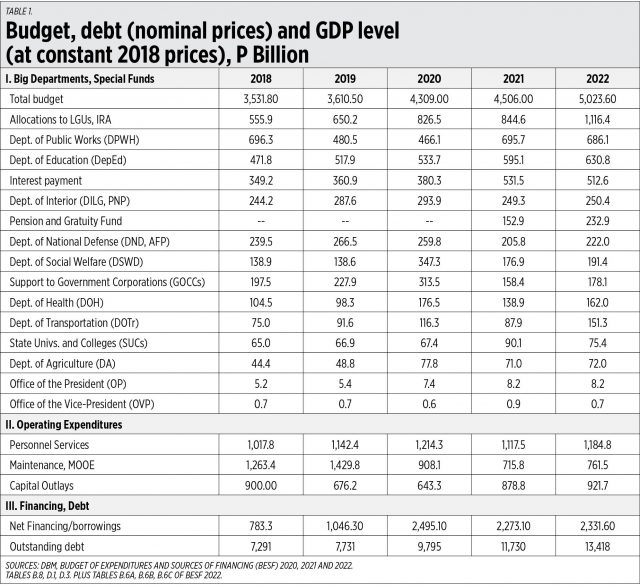
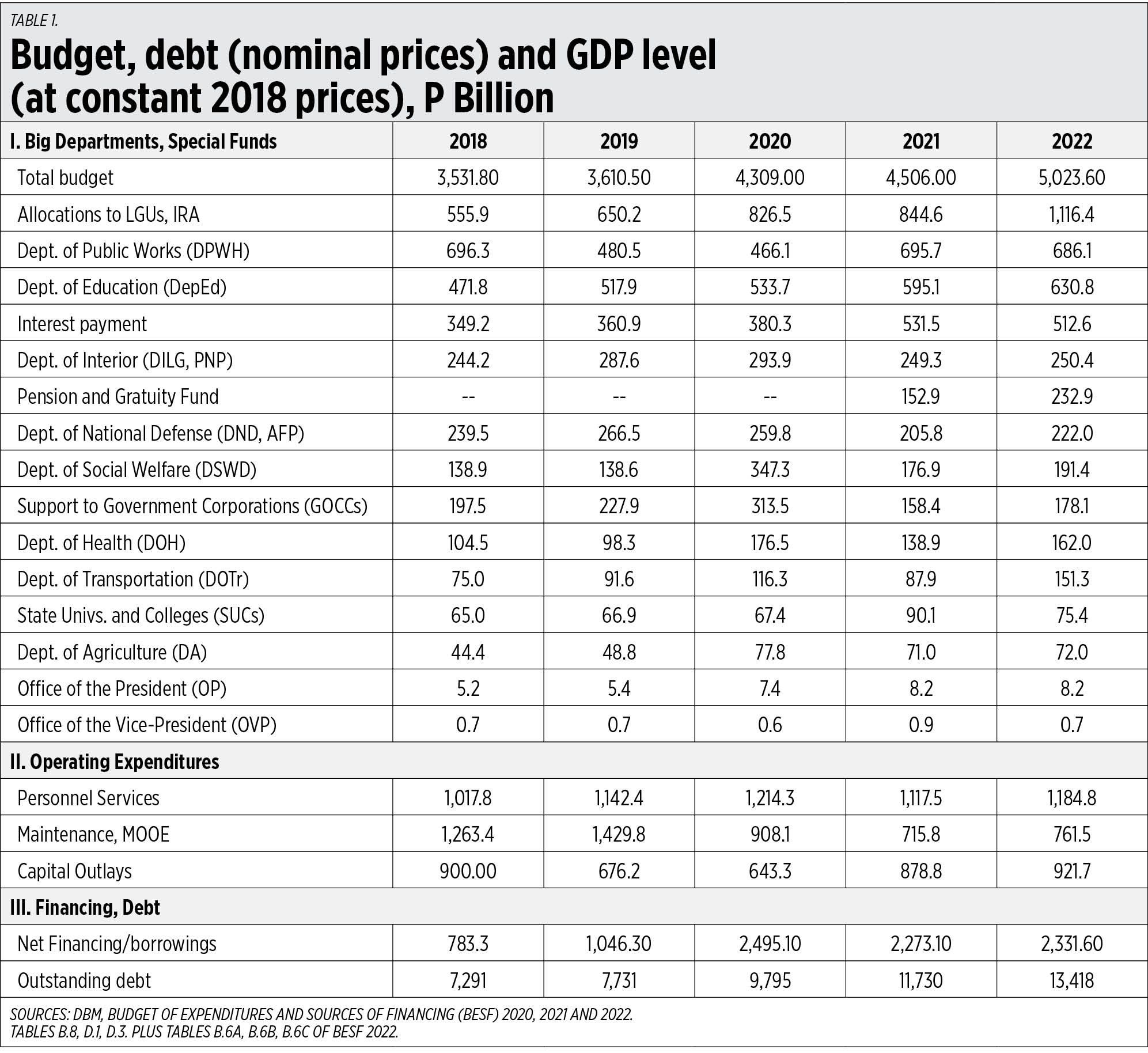
There are five important and unprecedented trends in the proposed National Government budget for 2022 that were not present in 2021 and previous years.

One, the budget will reach P5 trillion. When there is fiscal responsibility, this should also require P5 trillion of taxes, fees, and other revenues without resorting to new borrowings.

Two, allocations to local government units (LGUs) will reach P1.1 trillion. The Mandanas ruling affirmed by the Supreme Court and to be implemented in 2022 mandates that the internal revenue allotment (IRA) of LGUs should be based on total tax revenues of the National Government and not just collections by the Bureau of Internal Revenue.

Three, the budgets of some departments keep rising even if they should devolve more functions to the LGUs. These include the Departments of Education, Health, and Social Welfare and Development.

Four, outstanding public debt will reach P13.4 trillion. This is due to high borrowings of P2+ trillion a year since 2020 and big decline in revenues due to prolonged indefinite lockdown. Interest payments alone for the huge government borrowings were P532 billion in 2021 and P513 billion in 2022.

Five, government personnel services and pensions are to reach P1.4 trillion. From 2021, the Pension and Gratuity Fund were created separately from personnel services and these pensions, separation benefits have reached P232 billion in 2022. Government salaries, allowances and bonuses including non-essential bureaus continued despite many business closures (see Table 1).


One seemingly minor but noticeable trend in the budget is that while the Office of the President has P5 billion to P8 billion a year budget despite having control and jurisdiction over all Departments, the Office of the Vice-President only gets P0.6-P0.9 billion a year. This despite the fact that the Vice-President is the second highest official of the country.

On Monday, Sept. 6, the House Committee on Good Government and Public Accountability was to discuss House Resolution (HR) No. 2075, “Urging the House Committee on Good Government to Conduct an Inquiry, in Aid of Legislation, on the Qualifications, Research Methodologies, Partnerships, and Composition of OCTA Research Philippines.” The HR was authored by Representatives Bernadette Herrera Dy, Kristine Singson-Meehan, Sharon Garin, Stella Luz Quimbo, and Bong Suntay.

I received a formal invitation to be one of the speakers from the Committee Chairman, Representative Michael Edgar Aglipay. Since Dr. Benigno “Iggy” Agbayani was also invited and we are both members of the Concerned Doctors and Citizens of the Philippines (CDC PH), I informed Mr. Aglipay that I would not present and I sent my input and research to Doc Iggy and he will present our joint paper.

Among the data that Doc Iggy and I submitted to the Committee were the economic damage of indefinite, hard, “circuit breaker” lockdowns that OCTA has been advocating and are music to the ears of Inter-Agency Task Force for the Management of Emerging Infectious Diseases (IATF) officials.

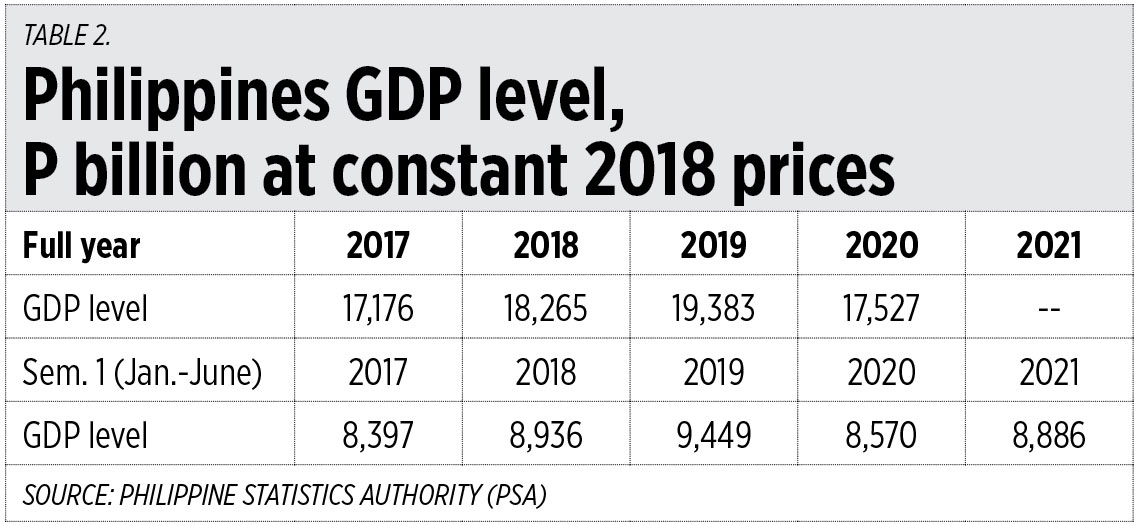
The actual GDP level, the flow of goods and services in a year or in a quarter — not just GDP percentage growth or contraction — are as follows:

The 2020 GDP level of P17.53 trillion was even lower than the 2018 level of P18.26 trillion, so three years of economic performance was erased. And this is only P351 billion higher than the 2017 level.

The first half 2021 GDP level of P8.89 trillion was even lower than the first half 2018 level of P8.94 trillion. And it was only P490 billion higher than the first half 2017 level (see Table 2).

OCTA has proposed “circuit breaker” hard lockdowns twice this year, on March 19 and July 27, both days with 7,000 cases each. Three weeks after March 19, there were 9,000 to 12,000 cases per day. Palpak sila OCTA and IATF (OCTA and IATF bungled) — their “circuit breaker 1” hard lockdown did not work and was based on false prediction.

In “circuit breaker 2” hard lockdown that OCTA announced on July 27 and implemented by the IATF in early August, the range of cases was 6,000 to 22,000 a day, an average of about 13,000 a day, twice the July 27 level of 7,000. Palpak na naman sila OCTA and IATF (OCTA and IATF bungled it again). More proof that hard lockdowns do not work and OCTA was using and announcing false predictions.

While OCTA may have good math models in computing the reproduction number R naught (R0) and related statistics, OCTA has a bad understanding about the virus. Viruses are not static and have properties of natural mutation into other variants.

OCTA and its followers in government should shut up about the false predictions and step back on hard lockdown policies. We have had lockdowns for 18 months straight already, have mass vaccination and vax discrimination policies, and still infection rates and daily cases are rising, not declining.


Bienvenido S. Oplas, Jr. is the Director for Communication and Corporate Affairs, Alas Oplas & Co. CPAs,

nonoyoplas@alasoplascpas.com

Shipping industry proposes levy to speed up zero carbon future

REUTERS

LONDON — Leading shipping associations have proposed creating a global levy on carbon emissions from ships to help speed up the industry’s efforts to go greener.

With about 90% of world trade transported by sea, global shipping accounts for nearly 3% of the world’s CO2 emissions and the sector is under growing pressure to get cleaner.

For the first time, the International Chamber of Shipping (ICS) and Intercargo jointly proposed a levy based on mandatory contributions by ships trading globally, exceeding 5,000 gross tonnages, for each ton of CO2 emitted.

The money collected would go into a climate fund that would be used to deploy bunkering infrastructure in ports around the world to supply cleaner fuels such as hydrogen and ammonia, according to the proposal.

“What shipping needs is a truly global market-based measure like this that will reduce the price gap between zero-carbon fuels and conventional fuels,” ICS Secretary-General Guy Platten said.

The proposal was submitted on Friday to the UN’s shipping agency, the International Maritime Organization (IMO).

An IMO spokesperson said all proposals were welcome and would be up for discussion later this year, adding that “proposals on market-based measures are in line with the initial IMO GHG (greenhouse gas) strategy.” 

The IMO will hold an intersessional working group meeting scheduled for late October, ahead of a late-November session of the Marine Environment Protection Committee, which will address issues including carbon-reduction efforts.

The European Commission in July proposed adding shipping to the bloc’s carbon market, targeting an industry that had for more than a decade avoided the EU’s system of pollution charges.

The ICS said “piecemeal” approaches such as the EU’s proposal would significantly complicate “the conduct of maritime trade.”  Reuters

Vietnam’s capital ramps up testing after extending COVID-19 curbs

GORDON JOHNSON – PIXABAY

HANOI — Vietnam’s capital on Monday extended coronavirus disease 2019 (COVID-19) restrictions for a further two weeks, as authorities launched a plan to test up to 1.5 million people for the coronavirus in higher-risk areas of the capital to contain a climb in infections.

The Southeast Asian country dealt successfully with the virus for much of the pandemic, but the virulent Delta variant has proved more challenging in recent months.

Hanoi, which has ordered people to stay at home and has halted all nonessential activities since July, has now divided the city into “red,” “orange” and “green” zones based on infection risk.

“Accordingly, people in red areas must shelter in place and one person of every household there will be tested three times per week,” a statement from city authorities said, adding that in other zones people would be tested every five to seven days.

Barricades on Monday separated red zones from other areas, photographs posted on social media and media outlets showed.

Hanoi authorities expect up to 1.5 million test samples to be collected in the next week. The government is eager to keep the outbreak from reaching the intensity seen in Ho Chi Minh City.

In the southern business hub, people have been encouraged to test themselves using antigen COVID-19 kits after health services were overwhelmed.

Hanoi has been reporting on average 50 cases daily and has recorded over 4,000 cases since the pandemic began, official data showed.

Although the numbers are still low, authorities are wary after the Delta variant has helped drive up infections across the country to over 524,000 cases.

One third of Hanoi’s 8 million residents have been fully vaccinated and on Sunday the health ministry called on the capital and Ho Chi Minh City to vaccinate all adult residents with at least one dose by Sept. 15.

Vietnam has one of the lowest coronavirus vaccination rates in the region, with only 3.3% of its 98 million people fully vaccinated, and 15.4% with one shot. — Reuters

Toppled Conde failed to live up to pledges in Guinea

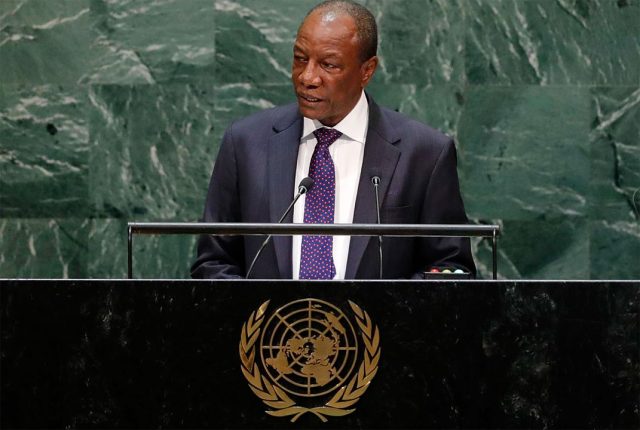
GUINEA’S President Alpha Conde addresses the 74th session of the United Nations General Assembly at the UN headquarters in New York City, Sept. 25, 2019. — REUTERS

THE APPARENT overthrow of President Alpha Conde in Guinea capped a steady slide from grace for the veteran opposition leader and human rights professor whom critics say failed to live up to pledges to deliver democratic restoration and ethnic reconciliation.

It was not entirely clear what had precipitated the army’s move on Sunday against the 83-year-old Mr. Conde. A special forces commander said in a televised address that “poverty and endemic corruption” had driven his troops to act.

The putsch came less than a year after a disputed election in which Mr. Conde won a third term after changing the constitution to allow himself to stand again.

For Mr. Conde’s critics, the third-term bid was the final nail in the coffin of his claims to be “Guinea’s Mandela” and risked chaos in the West African bauxite and iron ore producer.

Alioune Tine, an independent human rights expert for the United Nations and founder of the AfrikaJom Center think tank, said Conde’s refusal to cede power had made either a popular uprising or a coup inevitable.

“Alpha Conde is one of the politicians who worked over 40 years for democracy in Guinea. Once in power, he totally destroyed it,” Tine told Reuters.

“He put people in prison. He killed and he completely refused any political dialogue with the opposition.”

Mr. Conde has previously denied accusations of human rights abuses. Echoing other African leaders who have altered constitutions to hang onto power, he said he needed more time to realize his vision of a modern Guinea.

Dozens of people were killed in protests in late 2019 and early 2020 against a referendum to approve the new constitution, which passed easily due to an opposition boycott. Leaders of the protest movement were arrested.

The lead-up to the election last October was then marred by sporadic violence between members of Mr. Conde’s Malinke ethnic group and his main rival Cellou Dalein Diallo’s Peul. Mr. Conde was declared the winner with 59.5% of the vote.

Mr. Diallo disputed the results, although there was relatively little violence once they were certified.

‘GUINEA’S MANDELA’

The 2010 election of Mr. Conde, Guinea’s most prominent champion of multi-party democracy, was greeted with optimism by human rights activists and international organizations.

Until then, Mr. Conde had been the chief critic of a succession of autocratic leaders: Ahmed Sekou Toure, who ruled from independence in 1958 until he died in 1984; Lansana Conte, who seized power in a coup after Toure’s death; and Moussa Dadis Camara, who led a coup after Conte’s death in 2008.

His advocacy earned him a death sentence under Toure, forcing him into exile in France, where he became an assistant professor of human rights at the Sorbonne.

He lost presidential elections to Conte in 1993 and 1998. In 1998, he was arrested on the eve of the vote, accused of plotting to overthrow the government and jailed for the next two years.

After the ruling junta agreed in 2010 to a democratic transition, Mr. Conde finally got his chance to stand in an open election and scored an upset victory over Mr. Diallo.

“I will try in my small way to be Guinea’s Mandela and unite every son of Guinea,” he said in his inaugural address. “The restoration of social cohesion and national unity requires a collective look at our painful past.”

His government won early international praise for starting to reform the army, seeking to prosecute soldiers who committed rights violations, reforming the mining sector, and winning billions in debt relief.

But he encountered swift setbacks at home. Ethnic riots between Malinke and Peul broke out in 2012. Disaffected young people attacked an iron ore project run by Vale, causing millions of dollars in damage.

Faced with opposition protests and labor strikes, his security forces cracked down, drawing criticism from the United Nations and rights groups.

Then, the 2013-2016 Ebola outbreak killed more than 2,500 people in Guinea and dealt a multibillion-dollar hit to the economy.

Mr. Conde won reelection in 2015, but more turmoil followed as his opponents accused him of angling for a third term and started organizing large street demonstrations.

His promises of reconciliation failed to materialize, with his critics instead accusing him of exploiting ethnic divisions to his political advantage.

“He really tried to play on the ethnic divisions, which split the Guinean population,” said Ryan Cummings, the director of the consultancy Signal Risk.

As news of his toppling was confirmed on Sunday, some rejoiced.

“It’s a victory for the Guinean youth in general, we are really happy, we say well done to the Guinean army, to the special forces,” said Conakry resident Thierno Abdourahim Diallo.

“The youth have won, today we are free, everyone is free today.”  Reuters

New Zealand lifts virus curbs, says Delta elimination in sight

PEOPLE queue up for takeaway food as a nationwide coronavirus disease 2019 (COVID-19) lockdown eases in Wellington, New Zealand, Sept. 1. — REUTERS

WELLINGTON — New Zealand Prime Minister Jacinda Ardern on Monday said nationwide coronavirus curbs would be lifted, bar in the biggest city of Auckland, as the country gets on top of an outbreak of the Delta variant.

New Zealand had been largely virus-free, excluding a small cluster of cases in February, until an infected traveler from Australia seeded an outbreak that prompted Ms. Ardern to impose the national lockdown last week.

Ms. Ardern, who said restrictions would be eased outside of Auckland from Wednesday, is continuing to pursue an elimination strategy for the disease.

“We are within sight of elimination, but we can’t drop the ball,” Ms. Ardern said at a televised news conference. “Day by day we are making very good progress. What I don’t want to do is move too quickly and then see a resurgence.”

About 1.7 million people in greater Auckland, the epicenter of the outbreak, will remain in a full level 4 lockdown until at least Sept. 14.

The easing of the alert status to level 2 from level 3 in the rest of the country will allow the reopening of schools, offices and businesses. Regional travel will also be allowed.

Face masks will still be required inside most public venues, including shops and malls. Indoor hospitality venues will be limited to 50 patrons and outdoor venues to 100 people.

Daily new cases in the current outbreak have dropped from a peak of 85 on Aug. 29 to 20 on Monday.

The current outbreak is responsible for 821 of the country’s total of about 3,400 COVID-19 cases since the start of the pandemic. It has reported 27 deaths.

Ms. Ardern’s tough lockdowns and international border closure helped rein in COVID-19, but the government now faces questions over a delayed vaccine rollout and rising costs in a country heavily reliant on an immigrant workforce.

Just about 30% of the country’s 5.1 million people has been fully vaccinated, the slowest pace among the wealthy nations of the OECD grouping. — Reuters

Australia sees future for coal beyond 2030

MELBOURNE — Coal will be a major contributor to Australia’s economy well beyond 2030 given growth in global demand, the country’s resources minister said on Monday, a day after a United Nations (UN) envoy called on the country to phase out the fossil fuel.

Without greater efforts to cut coal, climate change will dramatically damage Australia’s economy, Selwin Hart, the UN special adviser on climate change, said in a speech in the capital Canberra on Sunday.

Australia’s heavy reliance on coal-fired power makes it one of the world’s largest carbon emitters per capita, but its conservative government has steadfastly backed fossil fuel industries, saying tougher action on emissions would cost jobs.

Australia’s latest export figures show “the reports of coal’s impending death are greatly exaggerated and its future is assured well beyond 2030,” Resources Minister Keith Pitt said in a statement.

In the three months to July, Australian coal exports grew 26% in value to A$12.5 billion ($9.3 billion), he noted. Coal prices have climbed as global economies recover from COVID-19 restrictions.

“The future of this crucial industry will be decided by the Australian government, not a foreign body that wants to shut it down costing thousands of jobs and billions of export dollars for our economy,” Pitt added.

The UN has called for phasing out coal by 2030 in Organization for Economic Cooperation and Development countries, which include Australia.

In July, energy and environment ministers from the Group of 20 big economies failed to deliver a deal to phase out coal by 2025. But some experts said there were chances of progress at UN climate talks in Glasgow in November.

Prime Minister Scott Morrison has said Australia is on a path to net zero carbon emissions but has stopped short of committing to a timeline. He has said that Australia would update its 2030 emissions projections going into the Glasgow talks. — Reuters

Israel plans to reopen for small tour groups from selected countries

REUTERS

JERUSALEM — Israel will allow small foreign tour groups from selective countries to visit from Sept. 19 under a pilot program to kick-start tourism, the government said on Sunday.

Tour groups of between 5 and 30 people from countries on Israel’s green, yellow and orange lists will be allowed to enter the country provided all group members have been fully vaccinated against COVID-19, the tourism ministry said.

Individual tourists, who have not been allowed to visit Israel since the outset of the coronavirus pandemic there in March 2020 unless they are visiting family members, will still not be allowed to enter outside of a tour group.

In May, amid a drop in COVID-19 infections, Israel had allowed in small tour groups. More than 2,000 visitors arrived, mainly from the United States and Europe, raising hopes of recovery within a tourism industry battered by the pandemic.

But the initiative was paused in August as the Delta variant spread, leading to a surge in COVID-19 infections in Israel, despite a world-leading vaccination rollout.

Under the new plan, there will be no restrictions on the number of tour groups that Israel will let in, the ministry said, but groups from countries on Israel’s red list — which currently comprises Bulgaria, Brazil, Mexico and Turkey — will not be eligible.

Foreign tourists must show proof they have received a second dose of a COVID-19 vaccine within the last six months or a booster shot in order to qualify for entry.

The tourists will also have to present a negative PCR test, taken up to 72 hours before arrival, and will undergo a serological test once they land at Tel Aviv’s Ben Gurion Airport.

In 2019, a record high 4.55 million tourists visited Israel, adding 23 billion shekels ($7.2 billion) to the local economy.

The ministry said “not one corona case was identified among the groups” that entered after the restrictions were eased in May. It said it hoped individual tourists would be allowed to visit in the near future, “depending on morbidity rates in Israel and around the world.”

Israel reported nearly 5,000 new cases of the coronavirus on Saturday, down from a pandemic-high of 11,201 reported last Thursday.

Out of Israel’s population of 9.3 million, 5.5 million have received a second shot and another 2.5 million have received a third dose of the Pfizer/BioNTech COVID-19 vaccine. — Reuters

TnT, Terrafirma making strides in PBA Pampanga tournament

THE TnT Tropang Giga and Terrafirma Dyip each went 3-0 in the restart of the PBA Philippine Cup last week in Pampanga. — PBA IMAGES

By Michael Angelo S. Murillo, Senior Reporter

THE Philippine Basketball Association (PBA) resumed its pandemic-hit All-Filipino tournament last week in Bacolor, Pampanga, with the TnT Tropang Giga and Terrafirma Dyip making major strides.

Both the Tropang Giga (6-0) and the Dyip (3-4) went 3-0 in their respective assignments in the opening week of the PBA restart at the Don Honorio Ventura State University (DHVSU) Gym to give their causes a big boost.

Already one of the top teams when action was halted on Aug. 1 over the rising cases of coronavirus disease 2019 (COVID-19) in the National Capital Region, particularly the Delta variant, TnT has picked up from where it left off in the resumption now in Bacolor.

The Tropang Giga pounded on the Blackwater Bossing, 96-76, on Sept. 1 then followed it up with another convincing victory over the Meralco Bolts, 91-76, on Sept. 3.

It played the Magnolia Hotshots Pambansang Manok on Sept. 5 in a battle of leading teams and came out victorious as well, 83-76, behind a balanced attack on both ends.

The three wins not only kept its unblemished record in the ongoing tournament intact and fortified its hold of the top spot, but also sustained its winning momentum heading into the homestretch of the elimination round.

While they are happy with where they are now in the tournament, TnT coach Chot Reyes said they are not getting ahead of themselves and underscored the need to continue to work on their collective game to achieve their goals.

“It’s very important that we stay on an even keel. We’re a work in progress. We’re not thinking of the record, not thinking of anything else except to get better,” said Mr. Reyes, who is in his first conference back with the team he coached from 2008 to 2012.

The 6-0 start incidentally is the best to date in his PBA coaching career.

PLAYING AS A TEAM
Terrafirma, meanwhile, is working on turning things around in the resumption of play.

The team opened its Philippine Cup campaign with four straight losses before its ongoing three-game win streak.

It scored huge upsets over the San Miguel Beermen, 110-104 in overtime, and Barangay Ginebra San Miguel Kings, 95-90, in that order in their first two games back then scored a 96-84 win over Blackwater on Sunday.

The streak has pushed the Dyip to solo seventh place in the standings and in the mix for a spot in the playoffs.

“I just told them to play as a team. Help one another and stay focused,” said Terrafirma coach Johnedel Cardel of the mind-set they have.

He also asked his team to treat every game like a championship, giving their best effort and being ready game in and game out.

PBA Philippine Cup action continues on Wednesday, with the schedule of games to be released on Tuesday.

Two games were postponed last week in accordance with health and safety protocols of the league.

Fil-Canadian teen Fernandez knocks out another champion to reach US Open quarterfinals

LEYLAH Fernandez of Canada hits a backhand against Angelique Kerber of Germany (not pictured) on day seven of the 2021 US Open tennis tournament at USTA Billie Jean King National Tennis Center. — REUTERS

NEW YORK — Leylah Fernandez brushed aside yet another former champion as the fearless Canadian teenager stormed into the quarterfinals of the US Open on Sunday with a (4-6, 7-6(5), 6-2) win over 16th seed Angelique Kerber.

It was a precocious and poised performance from Fernandez, who celebrates her 19th birthday on Monday and had already sent a jolt through Flushing Meadows on Friday when she stunned third seed and defending champion Naomi Osaka.

There would be no letdown for Fernandez after the biggest win of her fledgling career, the youngster soaking up the energy from a seething Louis Armstrong crowd after dropping the opening set to three-times Grand Slam winner Kerber.

“Honestly, the crowd has been amazing, so thanks to them I was able to win,” said Fernandez, who next faces fifth seeded Ukrainian Elina Svitolina. “I was just trusting my game.

“She’s an incredible fighter, incredible player.

“Just putting one more ball back in, fighting, and just having fun on the court.”

Fernandez had grabbed the early break at 4-2, but could not consolidate it as Kerber, the 2016 US Open winner, broke right back with the help of a pair of double-faults by the Canadian.

Having made the breakthrough, the experienced German quickly took command, winning four straight games to open up a 1-0 lead.

But Fernandez remained unfazed, fist-pumping and screaming with each winner throughout a tight second set that went to a tie-break that she took 7-5.

Kerber, 15 years older than her opponent, countered Fernandez’s enthusiasm with veteran calm and focus, but it was the 73rd ranked Canadian taking charge in the third, sweeping the final five games to cinch a breathtaking victory.

“I think it was a tough one,” said Kerber. “I mean I gave everything I had today.

“She played I think an unbelievable match, especially in the third set.

“I think she played also one of her best matches in her career, and she had nothing to lose.

“She went out there, she played her tennis. She really is going for her winners.” — Reuters