Home Blog Page 7453

Arts & Culture (10/06/21)


NCCA Dayaw festival goes online

THE NATIONAL Commission for Culture and the Arts (NCCA), is celebrating the National Indigenous Peoples (IP) Month in October through Dayaw 2021. This year’s theme is “Katutubong Filipino: Atin ang Tagumpay!” (Indigenous Filipinos: Ours is the Victory!). This year, over a hundred representatives from various indigenous groups will gather at their communities for cultural performances and discourses, notably on the shared cultural values embodied in their responses to the current crisis. These activities will be video documented and presented in five shows: Pagpapasinaya sa Tagumpay: The Dayaw Opening Ceremony on Oct. 9; Dayaw sa Sebangan: The Southern Cultural Communities on Oct. 17; Dayaw Sito Lubbon Na Unnot: The Northern Cultural Communities on Oct. 24; Dayaw sa Butnga: The Central Cultural Communities on Oct. 30; and, Pinagtagumpayan: The Dayaw Closing Ceremony on Oct. 31. These will be aired over social media platforms and television. The programs will include such topics as spirituality and well-being, indigenous learning systems, young indigenous entrepreneurs, safeguarding of intangible cultural heritage, and responses to the impact of climate change and disasters. Special events include the Anyo: Assistance for Filipino Artisans virtual exhibit, the virtual launch of the Schools of Living Traditions e-learning resources, and the virtual launch of the book El Folk-Lore in both Filipino and English translations.

Salcedo Auctions’ Gavel and Block auction preview

THE ONLINE preview of Salcedo Auctions’ Gavel and Block auction can be viewed until Oct. 15. The auction, which will be held on Oct. 16, is for the benefit of Hope for Lupus, a non-profit organization aimed at promoting awareness, early detection, proper treatment of the condition. For inquiries contact info@salcedoauctions.com or call or message 0917-107-5581 or 0917-825-7449. To view the catalogue, visit https://salcedoauctions.com/auction/140/benefit-hope-for-lupus.

CCP presents Dance On series

THE CULTURAL Center of the Philippines (CCP) Professional Dance Support Program presents a series of performances in the series Dance On, which will see dancers from the program performing restaged classics and original choreography. Streaming begins on Oct. 10, on the CCP Facebook page and CCP YouTube channel.

ARTablado presents ‘Sinag ng Sining’ exhibit

WORKS by Al Perez, Pancho Piano, Ral Arrogante, Gari Carreon and Rhea Jai Fernandez take center stage in ArtAblado until Oct. 15 at the 3rd level of Robinsons Galleria. The exhibit, titled “Sinag ng Sining” (Ray of Art), is a compilation of 48 paintings and sculptures which best represent the persistence and passion of the five artists who, despite being faced with the “new normal” took comfort in their art. Robinsons’ ARTablado remains true to its mission to give hope and opportunities to Filipino artists by opening its stage to talented artists who want to exhibit their works despite the pandemic. For more updates, follow ARTablado on Facebook and @artablado on Instagram.

Nilo Ilarde shows at Mo_Space

MO_SPACE presents “Old is the New New,” an exhibit of works by Nilo Ilarde. It will be open for public viewing by appointment from Oct. 9 to Nov. 7. ForOld is the New New,” Mr. Ilarde has created collages made from gathered materials extracted from both high and low culture, from art history and the commonplace, and collateral debris from the artist’s studio and the aftermath of an exhibition hanging. The gallery is open daily, from 10 a.m. to 6 p.m. For inquiries, call 8856-7915 or 0917-572-7970.

Feature on National Museum of the Philippines

THE CULTURAL Center of the Philippines (CCP) celebrates Museums and Galleries Month with a special feature on the National Museum. The National Museum of the Philippines was founded in Manila in 1901 during the American colonial period and was formerly called the Insular Museum of Ethnology, National History and Commerce. Learn more about the National Museum at the Visual Arts section of the CCP Encyclopedia: https://epa.culturalcenter.gov.ph/3/.

Musical tick, tick… BOOM! premieres on Netflix in Nov.

NETFLIX has announced that the movie of the musical tick, tick… BOOM! will premiere on Netflix on Nov. 19. Pulitzer Prize and Tony Award winner Lin-Manuel Miranda makes his feature directorial debut with tick, tick…BOOM!, an adaptation of the autobiographical musical by Jonathan Larson, who revolutionized theater as the creator of Rent. The film follows Jon (Andrew Garfield), a young theater composer who’s waiting tables in New York City in 1990 while writing what he hopes will be the next great American musical. Days before he’s due to showcase his work in a make-or-break performance, he is feeling the pressure from everywhere.  With the clock ticking, he is at a crossroads and faces the question everyone must reckon with: What are we meant to do with the time we have? The musical also stars Alexandra Shipp, Robin de Jesús, Joshua Henry, Mj Rodriguez, Bradley Whitford, Tariq Trotter, Judith Light, and Vanessa Hudgens. The film is written by Tony Award winner Steven Levenson, and produced by Brian Grazer and Ron Howard for Imagine Entertainment, Julie Oh, and Lin-Manuel Miranda. For details, visit www.netflix.com/ticktickboom .

Virgin Labfest gets new festival directors

THE CULTURAL Center of the Philippines, the Writer’s Bloc and Tanghalang Pilipino, announce that Marco Viaña and Tess Jamias will take over the reins in next year’s Virgin Labfest as the two new festival co-directors. Taking over from the two-year tenure of JK Anicoche, both artists will continue to steer the festival through the changes wrought by the pandemic. The Associate Artistic Director of Tanghalang Pilipino, Marco Viaña has received Gawad Buhay Awards for his work as an actor (Katsuri, Ang Pag-uusig) and is also a director who has worked with the Yugto Theater Ensemble and the UP College of Music. He co-directed Lam-ang, receiving the 2020 Aliw Award for Best Stage Director for a Musical. Tess Jamias is an actor, director, dramaturg, acting teacher/coach, filmmaker, voice talent, contemporary dancer, choreographer, hair cutter and machinator. She is a founding member of the pioneering independent performance companies Dulaang Talyer and the KoLabCo. She is currently the Program Adviser of the Senior High School Theatre Arts Program of the Philippine High School for the Arts. This marks two firsts for the Virgin Labfest — the first time there will be a woman as a Festival Director and the first time the post will be shared by two artists.

CCP launches folio on 2020 Gawad CCP Awardees

CELEBRATING its 52nd anniversary, the Cultural Center of the Philippines (CCP) virtually launched the Gawad CCP Para sa Sining Folio, the official publication of the highest award given by the art institution to deserving Filipino artists and cultural workers, on Sept. 30 via CCP and CCP Intertextual Division Facebook pages. Set to be released in printed and digital formats, the folio contains citations, essays, photos, and notable works of a performing group, a publication, and 12 individuals who have been named recipients of the 2020 Gawad CCP Para sa Sining for their outstanding achievements and contributions to Philippine arts and culture. The awardees are: danseur Nonoy Froilan, pianist and former CCP president Raul M. Sunico, theater veteran Felix “Nonon” Padilla, visual artist Luis “Junyee” Yee, Jr., writer Lualhati T. Bautista, filmmaker Clodualdo “Doy” del Mundo, Jr., architect Cristina V. Turalba, designer Kenneth Cobonpue, cultural worker Nestor Horfilla, Danilo L. Dolor, the late Tony Fabella, and the late Alice Guillermo, the Integrated Performing Arts Guild, and Liwayway Magazine. Follow the CCP and CCP Intertextual Facebook pages for details on how to get a copy of the Gawad CCP Para sa Sining Folio.


ATN Holdings to apply for listing of 2.33M more shares

THE board of directors of listed holding firm ATN Holdings, Inc. has given the green light for the corporation to apply for the listing of 2,325,055,429 shares at the Philippine Stock Exchange (PSE).

These shares will be issued to Unipage Management, Inc.

Broken down, Unipage Management will be subscribing to 325,055,429 common class “A” shares of ATN and two billion common class “B” shares for a price-per-share value of 20 centavos.

Meanwhile, the board also approved the subscription of Arsenio T. Ng, president, chief executive officer, and chairman of ATN, to 824,944,571 shares of the corporation for the same price. These shares will be issued once the capital stock of ATN is increased “under terms and conditions favorable to the corporation.”

“The waiver of the majority of the minority shareholders to conduct a rights/public offering with respect to the abovementioned subscription was also obtained,” ATN said in a disclosure to the exchange.

ATN shares at the stock market closed unchanged for the sixth consecutive day at 52 centavos apiece. — Keren Concepcion G. Valmonte

Thyroid cancer and gender

Thyroid cancer is a disease in which malignant (cancer) cells form in the tissues of the thyroid gland. It is the seventh leading form of cancer in the Philippines. Its incidence is three times higher in women than in men. Thyroid cancer is the most common cancer in women aged 15 to 24, according to the Department of Health (DoH). 

As defined by the American Thyroid Association, the thyroid gland is a butterfly-shaped endocrine gland that is normally located in the lower front of the neck. Its job is to make thyroid hormones to help stay warm, control metabolism, and regulate breathing, heart rate and the nervous system, among many others. 

The Johns Hopkins University School of Medicine said that thyroid concerns are more common in women, probably due to the roles of hormones, which are different in females than in males. Oftentimes women do not notice any symptoms because they are busy with family and work. 

In its early stages, thyroid cancer may be asymptomatic; it is sometimes an incidental finding during a routine physical examination by a doctor. Signs or symptoms develop as the tumor increases in size. The National Cancer Institute said that common signs and symptoms of thyroid cancer include a lump (nodule) in the neck, difficulty in breathing, trouble swallowing, pain when swallowing, and hoarseness. It is important to consult a doctor if a person has any of these signs or symptoms. 

Risk factors for thyroid cancer include age between 25 and 65 years old; female gender; exposure to radiation to the head and neck as an infant or child or to radioactive fallout; personal history of goiter (enlarged thyroid); family history of thyroid disease or thyroid cancer; and having certain genetic conditions that affect the thyroid gland.  

Thyroid cancer is usually treatable and, in many cases, can be cured completely, said the UK National Health Service (NHS). It would be important to seek physician’s advice as the treatment would depend on the type of thyroid cancer. 

According to the NHS, the main treatments are a thyroidectomy or surgery to remove part or all of the thyroid; a radioactive iodine treatment; external radiotherapy; and chemotherapy and targeted therapies. 

Cancer is one of the greatest health challenges of our time, and a leading cause of death in every corner of the world. Within the next two decades, the number of new cancer cases each year is expected to reach 22 million, the majority of them in low- and middle-income countries (LMICs).  

The International Federation of Pharmaceutical Manufacturers and Associations (IFPMA) said that without preventative measures, the disproportionate majority of mortality from cancer will also occur in LMICs, where there could be limited availability of screening, early detection, and access to treatment. 

Within the industry’s Framework of Action for the Prevention and Control of Non-Communicable Diseases (NCDs), IFPMA and its members are committed to supporting countries towards reaching the NCD targets of the World Health Organization (WHO), including the target of a 25% relative reduction in premature mortality from cancer and other NCDs by 2025.  

Today, there are more than 3,000 projects for cancer treatments. These innovative treatments come in addition to a legacy of medicines for cancer currently available in generic form. Since 1980, 83% of life expectancy gains in cancer are attributable to improved treatments.  

While treatment remains a critical factor, addressing cancer requires recognition of its complexity and management throughout the whole continuum of care, including stages such as prevention, diagnosis and palliative care. As such, industry members are engaged in a number of health partnerships with governments, academics, health workers and civil society to address barriers to cancer care in LMICs.  

The IFPMA Developing World Health Partnerships Directory contains health partnerships from the industry that work towards enhanced access to cancer care. It holds over 45 case studies from partnerships that fight cancer. Scaling up access to quality care for patients with cancer, our industry has partnered with academic groups and hospitals in LMICs to improve healthcare infrastructure, and develops access programs with ministries of health to improve availability of treatments.  

Data is another crucial element in the fight against cancer. There are also currently partnerships that look to improve the quality of completeness of cancer data and provide the local context for the roll-out of evidence-based cancer strategies.  

The fourth week of September is National Thyroid Cancer Awareness Week. In line with this, we wanted to highlight this often-overlooked major illness.  


Teodoro B. Padilla is the executive director of Pharmaceutical and Healthcare Association of the Philippines (PHAP), which represents the biopharmaceutical medicines and vaccines industry in the country. Its members are at the forefront of research and development efforts for COVID-19 and other diseases that affect Filipinos. 

Headline inflation rates in the Philippines (Sept. 2021)

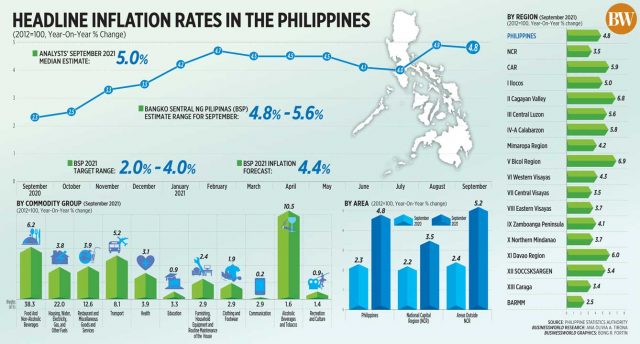
PHILIPPINE INFLATION eased in September from a near three-year high in the month prior, as the rise in the prices of food and transport slowed, the statistics agency said on Tuesday. Read the full story.

Headline inflation rates in the Philippines (Sept. 2021)

How PSEi member stocks performed — October 5, 2021

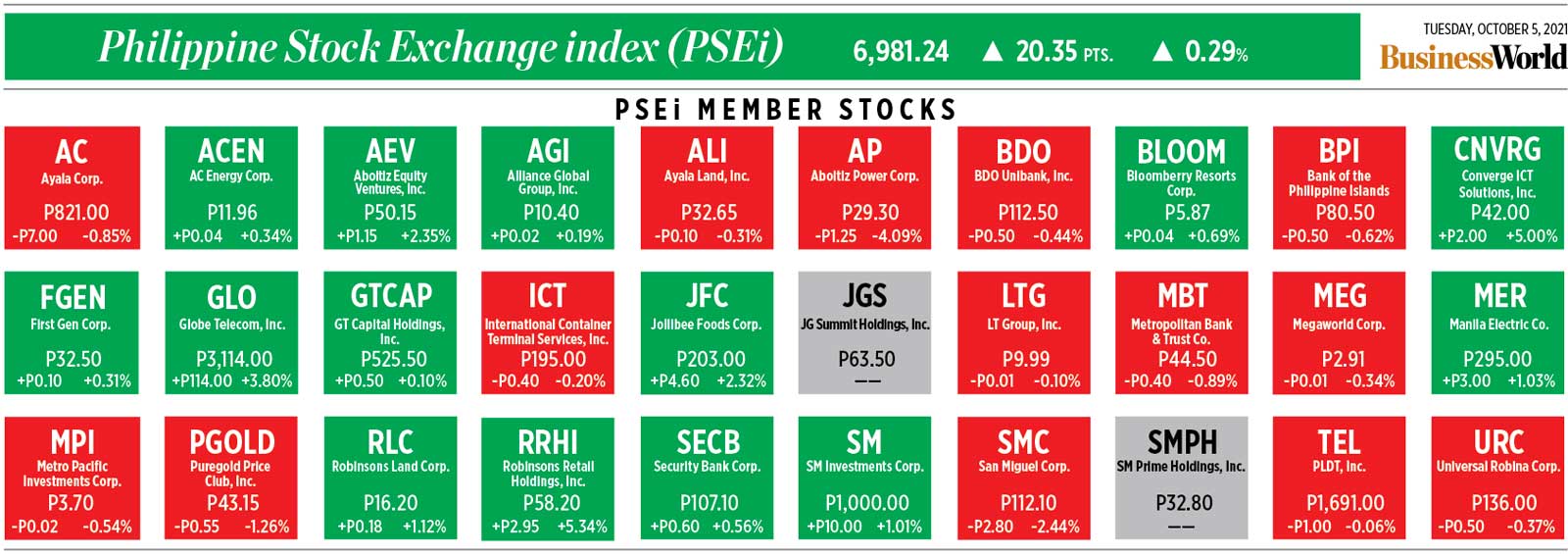
Here’s a quick glance at how PSEi stocks fared on Tuesday, October 5, 2021.


Shares climb as inflation eases slightly in Sept.

PHILIPPINE shares posted gains on Tuesday on the back of a better-than-expected September inflation print and improving coronavirus disease 2019 (COVID-19) numbers.

The 30-member Philippine Stock Exchange index (PSEi) gained 20.35 points or 0.29% to close at 6,981.24 on Tuesday, while the broader all shares index rose 9.98 points or 0.23% to finish at 4,358.17.

“Philippine shares were bought up towards closing as September inflation came in much better than most had anticipated,” Regina Capital Development Corp. Head of Sales Luis A. Limlingan said in a Viber message.

Headline inflation stood at 4.8% in September, slowing from the 4.9% logged in August but faster than the 2.3% print recorded in the same month last year, the Philippine Statistics Authority reported on Tuesday.

The latest figure is below the 5% median in a BusinessWorld poll conducted late last week and is at the low end of the 4.8%-5.6% estimate given by the Bangko Sentral ng Pilipinas (BSP) for the month.

Inflation averaged at 4.5%, still above the BSP’s 2-4% target and 4.4% forecast for this year.

“Market sustained its uptrend today as transmission rate of the pandemic virus continue its downtrend projection that will eventually ease [restrictions] going into the fourth quarter,” Aniceto K. Pangan, equity trader at Diversified Securities, Inc., said in a text message on Tuesday.

On Monday, the country logged 10,748 new COVID-19 infections. Active cases stood at 106,160.

Philstocks Financial, Inc. Senior Research and Engagement Supervisor Japhet Louis O. Tantiangco said the improvement in the country’s COVID-19 situation helped boost market sentiment.

“In the earlier part of the trading day however, the market was in the negative territory amid profit taking caused by the negative spillovers from Wall Street,” Mr. Tantiangco said in a separate Viber message.

“Trading for the day was tepid with [the] net value turnover… below the year-to-date average of P7.15 billion,” Mr. Tantiangco said.

Value turnover increased to P6.57 billion with 1.08 billion shares switching hands on Tuesday, rising from the P5.89 billion with 955.46 million issues traded the previous day.

Majority of sectoral indices climbed on Tuesday except for financials, which declined by 6.64 points or 0.46% to 1,413.24, and property, which went down by 2.87 points or 0.09% to end at 3,002.62.

Meanwhile, services increased by 19.62 points or 1% to 1,971.31; industrials climbed 61.27 points or 0.59% to 10,329.89; holding firms rose 30.10 points or 0.43% to 7,017.33; and mining and oil went up by 36.28 points or 0.37% to close at 9,627.41.

Decliners beat advancers, 106 against 84, while 58 names closed unchanged.

Net foreign selling went up to P709.34 million on Tuesday, more than double the P336.54 million logged the previous day. — Keren Concepcion G. Valmonte

Peso climbs further against the dollar on better-than-expected data

BW FILE PHOTO

THE PESO strengthened further versus the greenback on Tuesday after inflation slightly eased in September.

The local unit closed at P50.65 per dollar on Tuesday, appreciating by five centavos from its P50.70 finish on Monday, based on data from the Bankers Association of the Philippines.

The peso opened Tuesday’s session at P50.82 per dollar, which was also its weakest showing. Meanwhile, its intraday best was at P50.625 versus the greenback.

Dollars exchanged rose to $1.019 billion on Tuesday from the $857.54 million recorded on Monday.

The peso appreciated from its Monday finish on the back of positive market sentiment as inflation was slower than expected in September, a trader said.

Headline inflation stood at 4.8% in September, slowing from the 4.9% logged in August but faster than the 2.3% print recorded in the same month last year, the Philippine Statistics Authority reported on Tuesday.

The latest figure is below the 5% median in a BusinessWorld poll conducted late last week and is at the low end of the 4.8%-5.6% estimate given by the Bangko Sentral ng Pilipinas (BSP) for the month.

Headline inflation averaged at 4.5%, still above the BSP’s 2-4% target and 4.4% forecast for this year.

Meanwhile, gains at the local stock market also pushed the peso higher, Rizal Commercial Banking Corp. Chief Economist Michael L. Ricafort said.

Philippine shares posted gains on Tuesday on the back of the better-than-expected September inflation print and improving coronavirus disease 2019 (COVID-19) numbers.

The Philippine Stock Exchange index rose by 20.35 points or 0.29% to end at 6,981.24 on Tuesday, while the broader all shares index gained 9.98 points or 0.23% to finish at 4,358.17. 

On Monday, the country logged 10,748 new COVID-19 infections. Active cases stood at 106,160.

For Wednesday, the trader gave a forecast range of P50.55 to P50.80 per dollar, while Mr. Ricafort expects the local unit to move within P50.55 to P50.75. — LWTN

Oil firms urged to ensure supply amid slow OPEC output growth

PHILSTAR

THE DEPARTMENT of Energy (DoE) has called on oil companies to ensure adequate fuel supply, noting that the Organization of the Petroleum Exporting Countries (OPEC) will only be gradually increasing production despite rising demand.

“I am directing all oil companies in the country to ensure adequate supply, and come up with plans to mitigate possible price hikes of oil products in the coming months,” Energy Secretary Alfonso G. Cusi said.

Oil companies are required to maintain a minimum inventory of petroleum products, according to Executive Order 134 signed by former President Gloria Macapagal-Arroyo. The order was implemented by the DoE via a department circular issued in 2003 requiring a minimum inventory equivalent to 15 days’ supply for petroleum products, and seven days’ supply for liquefied petroleum gas.

Refiners are required to maintain a minimum crude and petroleum products inventory good for 30 days.

The DoE’s Oil Industry Management Bureau said OPEC will only be gradually adding supply to the market, adding that it expects prices to rise as a result.

“From August to December 2021, OPEC will only be enforcing a 400,000 barrel-increase per month (but this is) expected to even out the supply-demand balance by the end of 2021,” it said.

OPEC recently met with Russia and agreed to stick to a plan for a gradual increase in oil output.

Other events which may possibly raise oil prices include “aggressive demand” in the fourth quarter which is expected to hit as much as 103 million barrels per day (mbpd) of crude oil, narrowing the margin with available supply which is currently at 103.22 mbpd. Also listed as factors are continued sanctions against Venezuela, which has removed up to two million barrels of crude oil per day from the market.

This week, oil companies imposed an increase in pump prices of P1.45 per liter (/L) for gasoline, and an increase of P2.05/L for both diesel and kerosene.

“The DoE will continue to closely monitor global oil supply and price movements. As always, we are working with the downstream oil industry players to ensure that all mechanisms to protect our consumers against the impact of such developments as much as possible,” Mr. Cusi said. — Angelica Y. Yang

Asia-Pacific e-commerce seen integrating region with global supply chains

BW FILE PHOTO

THE HIGH LEVEL of development of digital commerce in the Asia Pacific is expected to help businesses more easily integrate with global supply chains and expand their pool of potential customers, according to an Asian Development Bank (ADB) official.

Bambang Susantono, vice-president for Knowledge Management and Sustainable Development at the ADB, said: “The business potential for Asia’s e-commerce, integrating regionally and globally is enormous. Businesses will be able to more easily enter the supply chains and export markets and extend that online customer base.”

He was speaking at a forum organized by the Financial Executives Institute of the Philippines Tuesday.

He said e-commerce in the region has been vibrant with $2.5 trillion spent via online platforms in 2020, accounting for 64% of the world’s retail digital commerce revenue.

E-commerce provides small businesses, which have been mostly left out in traditional markets, an effective platform to grow their businesses, he said.

The Philippines is among the economies projected to establish a solid pool of consumers and businesses adopting digital channels, along with India, Indonesia and Malaysia.

He said women-owned businesses that are going digital can also boost Southeast Asia’s e-commerce market by $250 billion, citing World Bank estimates.

Mr. Susantono said wider adoption of financial technology (fintech) in the region will play a major role in expanding financial inclusion, which will also boost the e-commerce sector.

“ADB supports expanding digital finance with a particular focus on reaching the underserved. In the Philippines, we supported cloud-based core banking system with Cantilan Bank to offer financial services in rural Mindanao. This has benefitted small businesses, farmers, women and youth.

The market is starting to accept this emerging technology, he said, with more than 200 digital banks established worldwide since 2010.

However, Mr. Susantono said the region has to adopt reforms to support the fast-growing e-commerce and fintech industries, by increasing investment in cybersecurity, bridging the digital divide, and aligning of regulatory regimes across the region.

The expected 21st century boom in Asia is “undeniable” with China becoming the world’s second biggest economy, coupled with the growing potential of India, Jose Isidro N. Camacho, the vice-chairman for Credit Suisse Asia Pacific, said at the forum.

Despite optimism on the digital future of the region, Mr. Camacho, a former Philippine cabinet member overseeing the Departments of Energy and Finance, warned that Asia might struggle in terms of regional integration due to intensifying geopolitical tensions between the US and China.

“I’m afraid and I believe that this conflict will be this generation’s cold war. It will profoundly influence regional and global developments, including the aspiration for an integrated Asia Pacific,” Mr. Camacho said.

“Asian economies like the Philippines will be under continuing pressure from both superpowers to choose sides, whether on trade issues, the choice of technology to adapt, or policymaking in international institutions. The rest of Asia will be confronted, having to make a choice and there will be consequences,” he added. — Beatrice M. Laforga

Privacy commission links SMS-based ‘phishing’ attacks to leaks of contact-tracing information

PHILSTAR

THE National Privacy Commission said it has received reports of leaked contact-tracing data resulting in “phishing attacks” via mobile phone texts, in which recipients are tricked into revealing sensitive personal data.

A commission bulletin issued Tuesday said the unsolicited texts, sent by Short Message Service (SMS), sought to trick recipients into visiting malicious websites. The practice of using SMS to carry out phishing attacks is known as “smishing.”  

The commission said the complaints it has received linked the incidents to personal information given in contact tracing and health declaration forms.

“The contents of these unsolicited messages reportedly include links that redirect to legitimate looking but fraudulent sites when clicked. These sites may steal users’ personal data, introduce mobile malware, and even commit fraud,” the commission said.

According to the commission, smishing can be used to trick recipients into opening a dummy Facebook account. The text message contains a code and a short link that, when clicked, associates the recipient’s mobile number with the dummy account.  

The commission said smishing has been connected to fake online shopping or delivery transactions, which victims fall for because they are expecting an actual delivery.

“Clicking the shortened link will redirect the recipient to a website that prompts them to fill out their personal and banking information to complete the delivery,” the commission said.

Privacy Commissioner Raymund E. Liboro recommended that recipients “scrutinize text messages, especially if they come from an unknown number and request information about you. Be skeptical and do not assume that every message you receive is genuine.”  

The commission warned against messages with shortened links, and recommended avoiding in-app links and disabling link previews in the mobile message application.

It also noted that individuals may block messages from a specific phone number, filter messages from unknown senders, and redirect spam or junk mail.

The commission also urged parties who have custody of and process personal information to adequately protect contact-tracing data. — Revin Mikhael D. Ochave 

PHL considering more nationally funded BARMM projects

PHILSTAR FILE PHOTO

THE GOVERNMENT plans to identify more nationally funded programs for the Bangsamoro Autonomous Region in Muslim Mindanao (BARMM) for inclusion in the 2023 national budget, the Department of Finance (DoF) said.

Officials representing the national and Bangsamoro governments in the Intergovernmental Relations Body (IGRB) said after a virtual meeting on Sept. 22 that they would engage with their respective Cabinet departments and ministries to identify such programs, the department said in a statement Tuesday.

Some programs for health facilities, school building, cash grants, and social pension in Bangsamoro are funded by the National Government.

“The (National Government) and BARMM have previously agreed that this list is not an exclusive one and that (National Government) agencies may still fund other national programs and projects in the Bangsamoro region as decided upon by the two sides,” the DoF said.

Finance Secretary Carlos G. Dominguez III said that the BARMM ministries and national agencies should discuss the nationally funded programs for the 2023 budget because the government makes its budget call in February each year.

“The IGRB continues to meet regularly to resolve matters and issues brought before the body as it remains determined in accomplishing its targets through unrelenting dedication, strong partnership and mutual trust between the National Government (NG) and the Bangsamoro Government,” he said.

The group also discussed speeding up addressing overlapping jurisdictions of national agencies and Bangsamoro ministries. It plans to report updates on identifying the nationally funded programs in the next meeting, scheduled for December.

House legislators last month approved the postponement of the first regular elections in the BARMM to 2025 from 2022. — Jenina P. Ibañez

British beef imports temporarily banned after mad cow disease outbreak

REUTERS

BEEF AND CATTLE imports from the UK have been banned temporarily due to an outbreak of mad cow disease, formally known as bovine spongiform encephalopathy (BSE).

Agriculture Memorandum Order No. 60, signed on Oct. 4, banned the processing, evaluation, and issuance of sanitary and phytosanitary import clearances (SPSICs) of meat and meat by products derived from cattle, including live cattle, from the UK after the detection of classical BSE. 

The Department of Agriculture (DA) said UK veterinary authorities on Sept. 17 submitted a report to the World Organisation for Animal Health (OIE) that confirmed a BSE outbreak in Somerset, a county in the southwest of England.  

Beef products from an animal suffering from BSE can lead to the development in humans of Creutzfeldt-Jakob disease.

“All shipments in transit/loaded/accepted unto port before the official communication of this order to the British authorities shall be allowed provided the slaughter and production date is on or before Aug. 31, 2021,” according to the order.

“All previously approved SPSICs which were not yet in transit/loaded/accepted unto port after the official communication of this order to the British authorities are hereby revoked.”

Philippine Association of Meat Processors, Inc. Vice-President Jerome D. Ong told BusinessWorld via mobile phone that classical BSE “poses very high risk to both animal and human health. The UK’s share of our beef imports is about 4%, mostly beef fat.”  

The Bureau of Animal Industry (BAI) estimates that beef imports from the UK as of the end of August have totaled 4,429.46 metric tons (MT), or 3.96% of all beef imports.

Mr. Ong said the DA and BAI should lift the ban on beef imports from Brazil.

The DA issued Memorandum Order No. 54 on Sept. 16 that banned the import of Brazilian beef due to an outbreak of atypical BSE.  

“They should lift the import ban because it involves only atypical BSE which, according to experts and the OIE, does not really affect animals and humans. Brazil beef accounts for up to 70% of the raw material requirements of some local processors,” Mr. Ong said.

The BAI estimates that Brazilian beef imports as of Aug. 31 amounted to 36,371.45 MT, or 32.51% of all beef imports. — Revin Mikhael D. Ochave