Home Blog Page 7447

Small exporters left behind due to ‘digital divide’

PHILIPPINE STAR/EDD GUMBAN

LIMITED ACCESS to digital resources disadvantaged smaller exporters despite government policies that allowed the sector to continue operating throughout the pandemic, a Philexport official said.

Smaller businesses accounting for the bulk of the industry have fewer resources to help on-site employees, Philexport Executive Vice-President and Chief Operating Officer Senen M. Perlada said at the BusinessWorld Insights virtual event Wednesday.

Exporters were allowed to run some on-site operations even during the strictest phase of the lockdown last year.

“Exporters were lucky in the sense that the sector was considered essential, but there is a digital divide and there is a big gap because the major, big exporters in the export processing zones — they have resources to help on-site employees so they can really continue to operate,” Mr. Perlada said.

This was not possible for smaller exporters, he added. Micro-, small-, and medium-sized enterprises (MSMEs) represent 95% of Philexport membership.

“So even if… I’d call it now maybe even lip service that exporters are there and they’re able to operate, that is not actually the reality on the ground.”

Exporters are now facing logistics delays. Vessel space and container shortages and an ensuing surge in freight rates are causing shipment delays and losses for companies, Philexport said in May. Shipment waiting times continue to be long even as market demand recovers.

Small businesses were also hit hard by the lack of financing and a demand slump while most of the population is not yet vaccinated, Philippine Disaster Resilience Foundation President Rene S. Meily said at the same event.

“MSMEs are not that familiar with the digital world that we’re seeing taking place all around us. COVID accelerated the digital shift by at least 10 years, and we’ve all had to catch up.”

Diana Crizel Montes, Eastern Communications Strategic Segment marketing manager, added that MSMEs face connectivity limitations and remote employee management issues.

“The bricks-and-mortar business set up has been a reliable model for most MSMEs ever since, but I think they can break from these limitations by exploring readily-available social media platforms to reach their audience,” she said.

To help small businesses recover, Mr. Meily said that the companies must prepare emergency cash reserves, business continuity plans, and digital strategies. — Jenina P. Ibañez

NGCP power reserve compliance inadequate, key legislator claims

SENATOR Sherwin T. Gatchalian, who heads his chamber’s energy committee, said Wednesday that regulators must strictly enforce the ancillary services (AS) requirements, a scheme for ensuring adequate reserve power, to improve supply on the grid.

He said that the Department of Energy (DoE) ordered the National Grid Corp. of the Philippines (NGCP) two years ago to enter into AS contracts to prevent rotating power outages, known in the industry as “brownouts.”

“The NGCP (is) not contracting the right amount of reserves. Clearly, they are violating that policy… (The) ERC (Energy Regulatory Commission) should now implement the policy. The foundation has been laid down by the Supreme Court that DoE produces the policy and ERC enforces the policy. In this case, since NGCP is not contracting, ERC should punish them,” he said during a virtual news forum Wednesday.

According to the DoE, the grid operator contracted regulating, contingency, and dispatchable reserves of 237 megawatts (MW), 180 MW, and 145 MW, respectively, for the Luzon grid as of the fourth quarter.

The Luzon grid’s required minimums for regulating, contingency and dispatchable reserves are 491 MW, 647 MW, and 647 MW. These reserves are also known as AS.

Aside from the lack of compliance on reserves, the Philippines has yet to address the “big problem” of red tape, according to Mr. Gatchalian.

“Red tape is a barrier to entry for new power plants… It takes two years to get the permits of these power plants approved. Imagine two years with your permit, another four years to build the plant, that’s six years from start to end to get new power,” he said.

Mr. Gatchalian said the reserve shortfall and bureaucratic paperwork are just two of the issues which the country needs to solve to improve its power supply.

The NGCP placed the Luzon grid under red alert for three consecutive days last week following forced plant outages and higher temperatures.

On Thursday, the Senate Committee on Energy is set to hold a hearing to discuss long-term solutions to the power shortage during the dry months, and ensuring the quality and reliability of electric supply.

Asked to comment, NGCP Spokesperson Cynthia P. Alabanza said the NGCP’s AS requirement was contracted “for the most part.”

“The ancillary services are there, but they’re being dispatched by the IEMOP (Independent Electricity Market Operator of the Philippines) as supply, because in times of deficiency like now, supply for consumption should be prioritized over reserve,” Ms. Alabanza told BusinessWorld.

At the end of 2020, the NGCP had a deficit of 72 MW in its contingency reserve or about 11% of the requirement for the Luzon grid.

“But the others (are) over contracted,” she said, referring to regulating and dispatchable reserves from firm and non-firm contracts. — Angelica Y. Yang

BIR preparing charges against tax stamp counterfeiters in P544-million case

BW FILE PHOTO

THE Bureau of Internal Revenue (BIR) said it will file criminal charges against tax stamp counterfeiters and review the deficiencies in tax payments by those using them in a Bacolod City case involving fakes claiming the payment P544 million worth of tax on cigarettes.

The BIR seized 15 million tax stamps on May 4 after raiding a warehouse and searching three trucks in Barangay Tangub, Bacolod City. The authorities also seized packaging materials used in cigarette production.

“The BIR (regional) office will file… the necessary criminal cases and the assessment of deficiency taxes on this,” BIR Deputy Commissioner Arnel SD. Guballa said in a statement.

Internal revenue stamps are affixed to cigarette packs at the place of manufacture to indicate that the correct excise taxes were paid. Counterfeit, recycled or altered stamps mean lost revenue for the government.

The National Internal Revenue Code prohibits the unauthorized production, import, sale and use of tax stamps, reusing previously affixed stamps and producing fake or altered stamps.

The penalties for such violations include a fine of between P10 million and P500 million and imprisonment of 5-8 years.

Fake tax stamps with a value exceeding P50 million render the violator liable to a fine of P500 million and 10-15 years’ imprisonment. — Beatrice M. Laforga

Soil health program allocated budget of P523 million 

@OFFICIALBSWM

THE GOVERNMENT will set aside P523.57 million to support a national soil health program that will enable sustainable crop production.

Agriculture Secretary William D. Dar said President Rodrigo R. Duterte recently approved the program, to be implemented by the Department of Agriculture (DA) via the Bureau of Soils and Water Management (BSWM) between 2021 and 2023.

“Soil is the foundation of agriculture; we must protect, preserve, and nurture it to sustainably produce adequate, affordable, and nutritious food… Aside from water, healthy soil is the other key ingredient,” Mr. Dar said in a statement Wednesday.

He described the program as “a science-based framework to rejuvenate our sick soils that will lead to increased crop harvests and farmers› incomes,” he added.

According to the DA, the program creates a national soil database and monitoring system to revive degraded soils.

The program will also upgrade the equipment at national and regional soil laboratories and expand the hiring of technical staff.

The program will also procure mobile soil laboratories which will tend to remote farms with no access to BSWM provincial and regional laboratories, and train local government extension workers and other stakeholders on soil science.

“With these modern soil laboratories, farmers would have their soil samples analyzed in a matter of minutes, with the corresponding specific site and crop nutrient recommendations,” Mr. Dar said.

The program hopes to improve partnerships between the BSWM and other organizations on food security and provide soil test kits to local government units for distribution to their farmer-constituents.

The DA said the national soil health program was modelled after the soil rejuvenation program implemented by the International Crops Research Institute for the Semi-Arid Tropics (ICRISAT) in Karnataka, India between 2009 and 2012.

Mr. Dar served as ICRISAT’s Director-General between 2000 and 2014.

The DA said the Indian program covered 3.3 million hectares and resulted in an increase in crop yields ranging from 23% to 66%, with the use of quality seed and soil-test based nutrient management recommendations.  — Revin Mikhael D. Ochave

Finally clarified: PEZA deductible expenses

The CREATE Act continues to live up to the hype, as taxpayers anxiously await the release of its implementing guidelines. The law is intended to attract foreign investment and boost employment through the introduction of a harmonized set of tax incentives that are available from various Investment Promotion Agencies (IPAs) such as the Philippine Economic Zone Authority (PEZA), Board of Investments, Subic Bay Metropolitan Authority, Clark Development Corp., etc. While the law has drawn flak from export-oriented enterprises due to the sunset provision on existing tax perks, it was still able to address the inconsistent tax benefits from the IPAs.

Aside from the alignment of the tax incentives, the law still allows qualified enterprises to avail of the Income Tax Holiday (ITH) and a Special Corporate Income Tax (SCIT) rate of 5% after the ITH period. The SCIT is similar to the 5% gross income tax (GIT) under the previous incentive regime, which is computed based on the registered enterprise’s gross income.  Perhaps what could be relevant to the export enterprises is how the tax regulators will treat the deductible expenses in computing the 5% SCIT under the implementing guidelines.

There has been an ongoing debate as to which expenses can be deducted under the 5% GIT regime. In the case of PEZA-registered entities, the Bureau of Internal Revenue (BIR) issued two Revenue Regulations in 2005 (RR Nos. 2-05 and 11-05).  RR No. 2-05 provided an exclusive list of deductible expenses, which can be treated as “direct costs.” However, the BIR subsequently issued RR No. 11-05, which removed the exclusivity of the expense list. Instead, the BIR stated that the enumeration provided is merely a set of examples; hence, other types of direct expenses can still be claimed as deductions under the 5% GIT regime.

Despite the update on the regulations, during tax audits, BIR examiners still disallow certain direct expenses that are not included in the enumerated list, following the exclusivity position of RR No. 2-05. The good thing is that in November 2020, the Supreme Court (SC) finally put an end to the issue when it held that the deductible costs and expenses in RR No. 11-05 are non-exclusive (G.R. No. 225266).  As such, other direct expenses not on the list can also be deducted. According to the high court, the BIR would not have changed the original regulation if the intention was to keep the list exclusive. In addition, the position of having the list of expenses as non-exclusive is consistent with the PEZA Law, which states that costs and expenses directly related to the registered activity and are not administrative, marketing, selling, and/or operating expenses or incidental losses shall be allowed as deductions.

Following the SC decision, for as long as the taxpayer can prove that the expense is a direct cost of its registered production/service activity, then it can be classified as an allowable deduction under the 5% GIT regime. In this respect, the accounting rules that provide the proper classification of the cost of goods sold/service would help in determining the “deductible” direct costs.

Further, taxpayers who took the more conservative position of claiming deductions based on the enumeration can amend their previously filed income tax returns to deduct the “other” direct costs. Such an option is available for as long as the taxpayer has not received a letter of authority from the BIR to conduct a tax audit of the tax return that will be amended. Of course, the amendment would also extend the statute of limitations for the BIR to audit the return, so this must also be considered against the potential tax savings. 

While the SC decision is an obvious victory for PEZA-registered companies, there is still a question on whether this position can also be applied to the export-oriented entities operating in other ecozones such as the Subic Freeport Zone (SFZ) and Clark Freeport Zone (CFZ).

Before I answer this question, let me briefly explain that SFZ and CFZ are governed by R.A. 7227 as amended by R.A. 9400, while PEZA is under R.A. 7916. Under the implementing rules of R.A. 9400, which were issued by the Department of Finance (DoF) in February 2008, enterprises registered with SFZ and CFZ can only claim those expenses that are enumerated in the list as deductions in computing the 5% GIT incentive. It takes the same position as BIR RR 2-05. Unfortunately, while the BIR has updated its rule on the non-exclusivity of deductible expenses for PEZA, the DoF has not changed its position for SFZ and CFZ enterprises.

Therefore, unless the DoF relaxes the rules on the allowable deductions to be non-exclusive like PEZA, I believe that the SC ruling does not hold in the case of SFZ and CFZ registered entities.

Considering that the tax regulators are still in the process of drafting the implementing guidelines of the new tax incentives law, I believe that this is the perfect time to revisit the deduction rules for the other ecozone locators and align them with the PEZA rules. Any changes can be easily incorporated since it will only require an amendment of the DoF rules at the administrative level and not the legislative law itself.

Indeed, there is reason to harmonize the rules in favor of the ecozone entities. Not only will it buttress government efforts to attract foreign investment, especially during a period of economic uncertainty, but also eliminate any double standard in our tax system, thereby realizing the purpose for which the CREATE Act was formulated in the first place.

The views or opinions expressed in this article are solely those of the author and do not necessarily represent those of Isla Lipana & Co. The content is for general information purposes only, and should not be used as a substitute for specific advice.


Joel Roy C. Navarro is a director at the Tax Services Department of Isla Lipana & Co., a Philippine member firm of the PwC network.

+63 (2) 845-2728

joel.roy.navarro@pwc.com

Peso inches down versus dollar as oil prices climb further

BW FILE PHOTO

THE PESO inched down versus the dollar on Wednesday as global oil prices continued to pick up.

The local unit ended trading at P47.731 per dollar, slipping by 1.1 centavos from its P47.72 close on Tuesday, data from the Bankers Association of the Philippines showed.

The peso opened Wednesday’s session at P47.735 versus the dollar. It moved within a narrow range as its weakest showing was at P47.77, while its intraday best was at P47.71 against the greenback.

Dollars exchanged went up to $675 million from $650.7 million on Tuesday.

The peso retreated due to risk-off sentiment because of higher oil prices, Rizal Commercial Banking Corp. Chief Economist Michael L. Ricafort said.

Reuters reported that oil marked a second straight session of uptick on Wednesday backed by signs of upbeat fuel demand in Western economies.

Brent crude futures increased 32 cents or 0.4% to $72.54 per barrel by 0640 GMT. Meanwhile, the US West Texas Intermediate crude futures rose by 31 cents or 0.4% to $70.36 a barrel.

The US Energy Information Administration on Tuesday upgraded its US fuel consumption growth forecast for this year to 1.49 million barrels per day (bpd) from 1.39 million bpd previously.

The peso dropped as the market was waiting for the release of latest US inflation data, a trader said in an e-mail.

The US Labor department will report the May consumer price index data this Thursday. In April, US inflation stood at 0.8%, which was its quickest pace since June 2009.

For Thursday, Mr. Ricafort gave a forecast range of P47.68 to P47.78 per dollar, while the trader expects the local unit to move within P47.65 to P47.85. — LWTN with Reuters

Stocks climb on vaccine rollout, decline in cases

PHILIPPINE shares closed higher on Wednesday as investors were optimistic about the country’s improving coronavirus disease 2019 (COVID-19) situation.

The Philippine Stock Exchange index (PSEi) climbed 92.82 points or 1.36% to end at 6,902.54 on Wednesday, while the broader all shares index gained 43.08 points or 1.04% to 4,160.21.

“The market ended higher [on Wednesday]… as participants feel optimistic over the COVID-19 situation in the country, and as foreigners continue to be net buyers in the local bourse,” Timson Securities, Inc. Trader Darren Blaine T. Pangan said in a Viber message.

“We think investors, at this point, continue to keep focus on improving prospects for the months ahead given the continuing pickup in vaccinations, and further relaxation of business and mobility restrictions,” China Bank Securities Corp. Research Director Rastine Mackie D. Mercado said in an e-mail.

“Foreign funds over the past several days are also buoying bullish prospects for the index as they were net buyers for eight out of the past nine trading days,” Mr. Mercado added.

Regina Capital Development Corp. Head of Sales Luis A. Limlingan said in a separate Viber message that investors returned to the Philippines, “while remaining on a wait-and-see mode ahead of the release of the US inflation data.”

Net foreign buying soared to P1.09 billion on Wednesday from the P29.01 million seen on Tuesday.

The government reported that the Philippines has already administered 6,096,208 COVID-19 vaccine doses so far. Some 4,491,948 Filipinos have received their first vaccine dose, while 1,604,260 have gotten their second.

The Philippines is also expecting to receive 11 million more doses of COVID-19 vaccines this month, which include Pfizer, Sputnik V, and Sinovac.

All sectoral indices closed in the green on Wednesday. Property improved by 86.49 points or 2.57% to end at 3,448.10; industrials went up by 122.99 points or 1.34% to 9,241.28; financials gained 19.42 points or 1.34% to 1,465.99; holding firms increased by 63.37 points or 0.92% to finish at 6,944.91; mining and oil rose by 65.28 points or 0.68% to close at 9,553.96; and services inched up by 3.74 points or 0.24% to 1,533.63.

Value turnover rose to P7.58 billion with 2.02 billion shares switching hands on Wednesday, from the P5.29 billion with 2.37 billion issues traded on Tuesday.

Advancers outperformed decliners, 138 against 61, while 52 names closed unchanged.

“We expect the market to head higher tomorrow following today’s surge,” China Bank Securities’ Mr. Mercado said. “However, we expect stronger selling pressure and volatility to emerge near the 7,000-7,100 resistance as some investors may look to take profit more aggressively.”

Meanwhile, Timson Securities’ Mr. Pangan wants to see if the 6,900 level of the index will hold in the last two trading days of the week. He placed the PSEi’s resistance at 7,080. — Keren Concepcion G. Valmonte

Daily virus tally at 5,462; 126 more people die

THE Labor department has declared COVID-19 as a compensable disease through ECC Board Resolution 21-04-14. — PHILIPPINE STAR/ MICHAEL VARCAS
PHILIPPINE STAR/ MICHAEL VARCAS

By Vann Marlo M. Villegas, Reporter

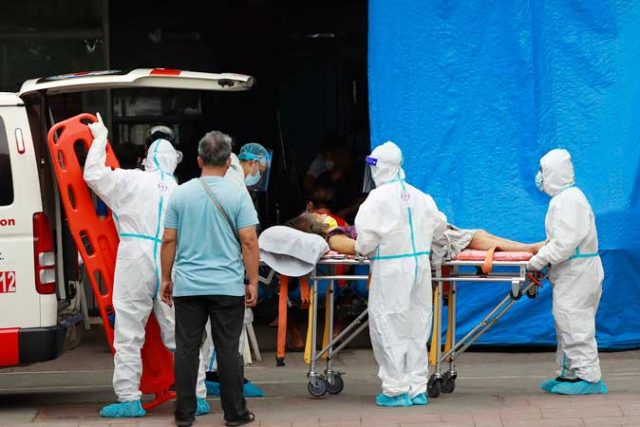
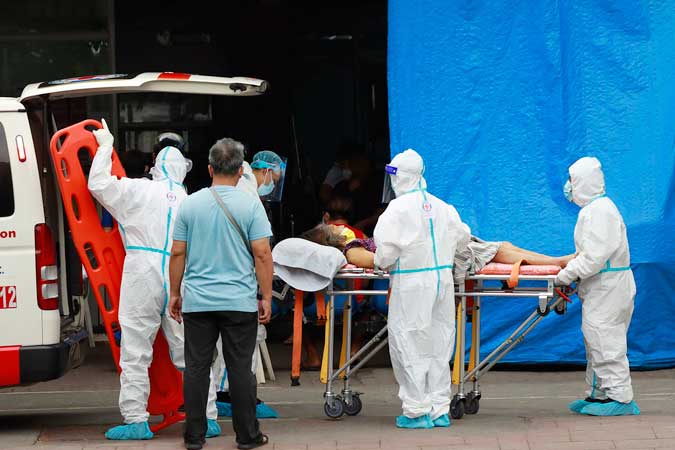
THE DEPARTMENT of Health (DoH) reported 5,462 coronavirus infections on Wednesday, bringing the total to 1.29 million.

The death toll rose by 126 to 22,190, while recoveries increased by 7,854 to 1.2 million, it said in a bulletin.

There were 54,000 active cases, 1.4% of which were critical, 92.6% were mild, 3% did not show symptoms, 1.8% were severe and 1.22% were moderate.

The agency said 18 duplicates had been removed from the tally, 14 of which were tagged as recoveries. Seventy recoveries were reclassified as deaths. Eight laboratories failed to submit data on June 7.

About 13 million Filipinos have been tested for the coronavirus as of June 7, according to DoH’s tracker website.

The coronavirus has sickened about 174.8 million and killed 3.8 million people worldwide, according to the Worldometers website, citing various sources including data from the World Health Organization.

About 158.2 million people have recovered, it said.

Meanwhile, Health Undersecretary Maria Rosario S. Vergeire said Davao City, President Rodrigo R. Duterte’s hometown, is not an epicenter of the coronavirus, adding that they discourage tagging areas with rising infections as epicenters.

She said an epicenter is usually understood to be an infection hotspot or the place where it started.

“We discourage the use of the term epicenter in describing the rise of cases in an area,” she said in a statement sent to reporters via Viber. “These areas are not the origin of the COVID-19 (coronavirus disease 2019) virus. Moreover, using the term epicenter detracts from other surrounding areas which may be equally or more affected by COVID-19.”

Ms. Vergeire said they continue to monitor the situation in Davao City where cases have been increasing.

The OCTA Research Group from the University of the Philippines on Tuesday said Davao City had surpassed Quezon City in terms of daily infections.

The city reported an average of 213 new infections from June 1 to 7, 44% higher than a week earlier. Quezon City had an average of 207 cases from June 1 to 7, down from 283.

Also on Wednesday, presidential spokesman Herminio L. Roque, Jr. said the so-called “population protection” could still be achieved in Metro Manila and eight other priority areas.

“We can achieve population protection as we intended specifically for Metro Manila Plus 8 because the numbers are achievable,” he told the ABS-CBN News Channel.

The Philippines seeks to vaccinate at least 500,000 people daily in Metro Manila, Rizal, Bulacan, Cavite, Laguna, Metro Cebu and Metro Davao to achieve herd immunity by Nov. 27.

“I wouldn’t worry about the temporary delay, should be a day or two. Then we can proceed with the vaccination again,” Mr. Roque said.

The spokesman said the one million doses of CoronaVac that recently arrived from China had been distributed to local government units. But they could not be used yet pending quality analysis.

Manila Mayor Francisco M. Domagoso on Tuesday said herd immunity or the vaccination of about 70% of the population was unlikely.

Philippine drug regulators earlier approved the emergency use of Pfizer, Inc.’s coronavirus vaccine for children at least 12 years old, as the government’s vaccination drive breached six million people.

The use of the Pfizer shot was expanded under a May 28 memo issued by the Health department and local Food and Drug Administration (FDA) but released only on Tuesday. The Pfizer drug used to be prescribed for people aged 16 years and older.

FDA Secretary General Enrique D. Domingo earlier said the American drug maker had proposed to change its authorization to include younger people after the vaccine was found to be 100% effective for the age group.

The Philippines is set to receive as many as 40 million doses of the Pfizer vaccine this year. Vaccine czar Carlito G. Galvez, Jr. has said children could get vaccinated by the fourth quarter.

Ms. Vergeire earlier said the government would prioritize the vulnerable population for vaccination and would revisit child vaccination “once our vaccine supply has stabilized.”

Of the six million coronavirus vaccine doses given out as of Monday, almost 4.5 million doses were initial doses, while about 1.6 million doses were second shots, Mr. Roque said.

The government has allotted the bulk of available vaccines in the country to Metro Manila and eight other provinces experiencing high infections. Temperature-sensitive vaccines such as those from Pfizer and Russia’s Gamaleya Institute of Epidemiology and Microbiology were also given out in industrialized areas that can store these in sub-zero temperatures.

Pacquiao says stance on China row reflects public sentiment

EMMANUEL D. PACQUIAO — HENZBERG AUSTRIA/SENATE PRIB

SENATOR and boxing champion Emmanuel “Manny” D. Pacquiao on Wednesday said his stance on the sea dispute with China reflects public sentiment, refuting President Rodrigo R. Duterte’s quip for him to educate himself on foreign policy before commenting on the issue.

“I firmly believe that my statement reflects the sentiment of majority of the Filipinos, that we should stand strong in protecting our sovereign rights while pursuing a peaceful and diplomatic solution to the dispute,” he said in a statement.

The international boxing champ, who belongs to the ruling party, noted that while he respected Mr. Duterte’s opinion, he “humbly disagrees” with his “assessment of my understanding of foreign policy.”

“I am a Filipino voicing out what needs to be said in defense of what has been adjudicated as rightfully ours,” he added.

Mr. Duterte earlier said Mr. Pacquiao had a “very shallow knowledge” of his administration’s policy on the South China Sea.

The tough-talking leader said this a month after the boxer criticized his China stance as lacking.

Meanwhile, presidential spokesman Herminio L. Roque, Jr. said he would run for an elective position next year once Davao City Mayor and presidential daughter Sara Duterte-Carpio decides to run for president.

“I would run with the administration but I think I will only run if Mayor Inday Sara will run for the position of president,” he told ABS-CBN News.

Mr. Roque also said he would support a possible bid by Senator Lawrence T. Go for the presidency, with Mr. Duterte as his running mate, if Ms. Carpio decides not to run. 

Mr. Duterte on Tuesday night claimed to have discouraged his daughter from running for the post. “Do not ever, ever commit the mistake of running for the presidency,” he said, adding that she would not get anything back.

He also said he would retire from politics when his six-year term ends next year.

Ms. Carpio is among those being considered by the President to become the ruling party’s standard bearer in the 2022 elections, Mr. Roque said last week.

Albay Rep. Jose Maria Clemente S. Salceda had said Ms. Carpio would run for President and is building an alliance with various political groups.

Mr. Salceda, a member of the ruling PDP-Laban, said at least five political parties would support Ms. Carpio’s presidential bid.

Political analysts have said calls for Ms. Carpio to run for president could be an attempt to create an artificial clamor.

Mr. Roque said it is unlikely for Ms. Carpio and Mr. Go to go against each other in the 2022 elections.

“It’s hard to believe that the Duterte family has no dynastic plan when we’re seeing their electoral machinery up and about, roaming everywhere, already prematurely campaigning,” Party-list Rep. Ferdinand Gaite said in a statement on Wednesday.

He said the administration is just employing the same “I’m-not-running’ campaign formula” as they did in 2016. — Kyle Aristophere T. Atienza

Duterte says he was wrong about promise to end drug problem

PHILIPPINE President Rodrigo R. Duterte on Tuesday night said he could not end the country’s illegal drug problem before his six-year term ends next year.

“I said I can solve the problem in six months,” he said in a televised speech on Tuesday night, referring to his campaign promise. “Little did I know that I will be fighting my own government. My critics were correct.”

Tens of thousands of drug suspects have been killed in police anti-drug operations, many of them allegedly shot and killed after resisting arrest.

Mr. Duterte said it was only after he appointed his long-time friend, now Senator Ronald M. de la Rosa, as police chief when he discovered that some cops were involved in the sale of narcotics.

Mr. Duterte earlier said his government won’t give full access to records on its deadly war on drugs and anti-insurgency drive due to national security concerns.

He said there were records that he was not privy to, adding that he is only briefed by his security officials when big personalities are involved.

Mr. Duterte said he “never, never allowed the killing of young people” under his watch, saying minors had not been at the top of the of the government’s drug list.

At least 122 children were killed in the government’s deadly drug war between July 2016 and Dec. 2019, according to the World Organization Against Torture.

Fatou Bensouda, former chief prosecutor of the International Criminal Court, had said there was reasonable basis to believe that crimes against humanity had been committed under Mr. Duterte’s drug war. Her office said those crimes, including murder and torture, happened between July 2016 and March 2019.

Several petitions had been filed before the International Criminal Court accusing Mr. Duterte and his officials of mass murder.

Mr. Duterte in 2018 admitted that extrajudicial murders happened under his administration’s drug war. The Philippine Commission on Human Rights has said the state is participating in rights violations when it does not intervene to stop abuses and protect vulnerable sectors.

Meanwhile, the Justice department has started evaluating 53 records from the Philippine National Police’s (PNP) investigations against policemen in anti-drug operations.

The agency is also working on a memo with the PNP for access to the rest of the 7,884 cases, Justice Undersecretary Adrian F. Sugay told reporters in a Viber group message.

The Justice department created a panel last year to review cases of alleged extrajudicial killings, including those involving illegal drugs, as part of its commitment to the United Nations Human Rights Council. — Kyle Aristophere T. Atienza and Bianca Angelica D. Añago

Rights body seeks surrender of rebels

THE PHILIPPINE Commission on Human Rights on Wednesday asked the armed wing of the local communist movement to surrender rebels involved in the killing of a trade leader and his cousin.

The New People’s Army (NPA) should surrender its men if it is serious and sincere about taking accountability for the killing of civilians in Masbate province, commission Chairman Jose Luis Martin C. Gascon said in a Facebook post.

The Communist Party on Tuesday said it was sorry for the “unnecessary and untimely deaths,” citing errors in its unit’s action. The Maoist group said it takes full responsibility for the tragedy.

Authorities earlier said the New People’s Army had planted a bomb that went off while the victims were cycling in the area.

A police report also cited a witness who said the explosion was followed by gunshots targeting the victims. — Kyle Aristophere T. Atienza

ASEAN Foreign ministers seek code of conduct talks

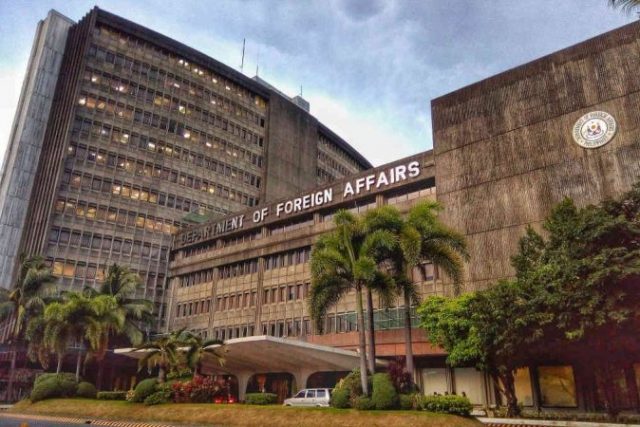
DEPARTMENT OF FOREIGN AFFAIRS — FACEBOOK/DFAPHIL

Foreign ministers in Southeast Asia want to resume talks with China on a code of conduct in the South China Sea, according to the Philippine Department of Foreign Affairs (DFA).

In a statement on Wednesday, DFA said the ministers met on Monday to discuss peace prospects in the region.

Philippine Foreign Affairs Secretary Teodoro L. Locsin, Jr. called for “full support and sincere cooperation to achieve our collective aspiration for the South China Sea to be a sea of peace, security, stability and prosperity.”

The sea should not be “a moat between the members of the family of Southeast Asian nations but a wide watery highway for trade and connection,” he said.

The foreign ministers had also reiterated their commitment for the full implementation of the 2002 Declaration on the Conduct of Parties in the South China Sea, DFA said.

They also expressed concern about the situation in Myanmar. Mr. Locsin also pushed for a dialogue and reconciliation, restoration of the status quo before the military coup and the release of Aung San Suu Kyi and other political detainees.

The meeting marked the 30th anniversary of relations between China and the Association of Southeast Asian Nations.

China pledged continued support for ASEAN state members in addressing the coronavirus pandemic by providing vaccines, DFA said.

The Philippines has filed several diplomatic protests against China due to its continued presence within the country’s exclusive economic zone in the disputed sea.

An international tribunal in 2016 favored the Philippines and rejected China’s claim to more than 80% of the disputed waterway based on a 1940s map. — Vann Marlo M. Villegas