Home Blog Page 7293

DPWH targets completion of 3 flagship projects in Zamboanga in 2022

DPWH

The Department of Public Works and Highways (DPWH) said Friday that civil works for three Asian Development Bank (ADB)-funded road projects in Zamboanga are now in the advanced stages of completion.

The “completion of the 68.78-kilometer core road projects under ADBs ‘Improving Growth Corridors in Mindanao Road Sector Project’ will be achieved by first half of 2022,” the department said in a statement.

The road projects being accelerated include the 15.35-kilometer Tampilisan-Sandayong Road with three bridges in Zamboanga Del Norte.

Road projects located in Zamboanga Sibugay Province include the 23.43-kilometer Alicia-Malangas Road with eight bridges and the 29.70-kilometer Lutiman-Guicam-Olutanga Road.

The department recently completed 1.5 kilometers of roads in Labason, Zamboanga del Norte.

“Road networks that will help improve the mobilization of agricultural products from farms to bigger market hubs are important infrastructure in rural areas that will further increase socio-economic activities,” the department said in a separate statement.

“These projects will help reduce travel time and road maintenance cost, while providing more livelihood opportunities to the locals,” it added.

The government also announced in September the completion of the upgraded Zamboanga International Airport, to accommodate flights to and from Southeast Asian destinations. – Arjay L. Balinbin

Agriculture stakeholders urge caution in ratifying RCEP

BLOOMBERG

THE world’s largest trade pact should be debated thoroughly and not rushed into ratification, with agriculture experts calling on the government to do a better job explaining its benefits and risks.

“The burden of proof is on the government,” Former Agriculture and Trade Undersecretary Ernesto M. Ordoñez said at a Friday hearing of the Senate foreign affairs committee. “We have not studied it properly, let’s not rush.”

Although some benefits may be expected from the Regional Comprehensive Economic Partnership (RCEP), the preparations should be clear and all stakeholders well-informed before into the agreement, Former Agriculture Secretary Leonardo Q. Montemayor said.

The Philippines, he added, should be willing to fall a little behind if it means properly safeguarding its industries.

The National Manager of the Federation of Free Farmers, Raul Q. Montemayor, also called on the Senate to defer its concurrence to RCEP, citing the lack of consultation. “We don’t know the final commitments the government has made,” he added. – Alyssa Nicole O. Tan

PHL in line for $200 million World Bank loan to fund nutrition program

PHILSTAR

The World Bank is set to grant a fresh $200 million loan to the Philippines for nutrition programs that will reduce the undernourished population.

According to a bank report, the loan was endorsed by Ndiame Diop, World Bank Country Director for Brunei, Malaysia, and the Philippines and Thailand, on Nov. 3.

The World Bank said $127.3 million of the loan will go to the project’s first component, which is enhancing nutrition service delivery through primary health care integration. This will be distributed to local government units that are tasked to implement nutrition interventions as well as provide essential maternal and child health services.

The second component will focus on Community-Based Nutrition Service Delivery, for which $62.1 million will be allocated.

Funds will be disbursed by the Department of Social Welfare and Development to communities for barangay health and nutrition plans.

The remaining $10.6 million will strengthen the lead implementing agencies including the DSWD and the Department of Health, as well as for monitoring, evaluation, and communication.

“Stunting (because of malnutrition) has long-term adverse developmental impacts that far surpass childhood, and has been linked to slower learning outcomes, poor academic performance, and lower productivity and wages in adulthood,” the World Bank said.

“Stunted children are unable to develop their human capital to the full potential, with negative consequences on the aggregate level in terms of labor market productivity and economic growth,” it added.

The project’s success will be gauged through indicators including prenatal care for pregnant women. Children aged six to 23 months who are part of the project will also be monitored to verify if meet the age-appropriate dietary norms. — Luz Wendy Noble

Metrobank Q3 net profit up 153% on lower provisions; loan income still weak

BW FILE PHOTO

Metropolitan Bank & Trust Co. (Metrobank) said net profit in the third quarter rose sharply after setting aside fewer loan loss provisions, and as income from the core lending business remained weak.

Net profit rose 153% year-on-year to P4.482 billion in the three months to September, it said in financial statements filed with the bourse Friday.

Nine-month net profit was P16.279 billion, up 45% from a year earlier.

Return on equity and return on assets were 6.7% and 0.88% respectively at the end of September, up from the 4.68% and 0.61% posted a year earlier.

Net interest income declined 11.9% year-on-year to P18.839 billion in the third quarter, with lower income from the loan business offsetting the higher profits from trading and securities investments.

Provisions for possible loan losses during the quarter amounted to P2.99 billion, down 76% a year earlier. Nine-month provisions totaled P10.02 billion, down 71% from a year earlier.

Non-interest income dropped 40% year-on-year to P5.527 billion in the third quarter.

Operating expenses rose 4.9% to P15.066 billion during the quarter.

Loans amounted to P1.173 trillion at the end of September, with the non-performing loan (NPL) ratio at 2.12%, against 2.25% a year earlier.

Deposit liabilities were at P1.851 trillion at the end of September.

The capital adequacy ratio (CAR) was 20.66% at the end of September, while common equity Tier 1 was 19.79%, both well above the minimum regulatory requirements.

Metrobank has over 2,000 domestic and international branches to date.

Metrobank shares closed at P49.20 Friday, down 1.3%. — Luz Wendy T. Noble

PBB Q3 net profit falls 44% after trading losses

Philippine Business Bank (PBB) said net profit fell in the third quarter after its trading account turned lossmaking in the period.

Net profit fell 44% year-on-year to P280.294 million in the three months to September, according to the bank’s financial report filed with the bourse Friday.

Nine-month net profit came to P804.329 million, down 38% from a year earlier.

The bank registered trading losses in the third quarter worth P40.713 million, reversing the P398.358 million in trading gains a year earlier

Return on equity came in at 7.61% while return on assets was 0.88% at the end of September.

Net interest income rose 1.4% year-on-year to P1.444 billion in the third quarter. The net interest margin fell to 4.78% at the end of September from 5% at the end of 2020.

Earnings from service charges, fees, and commissions also improved 26.6% year-on-year to P32.176 million in the third quarte.

Loan loss provisions dropped 37.5% year-on-year to P250 million.

Total loans were at P85.4 billion at the end of September. The non-performing loan ratio increased to 4.65% from 4.07% at the end of 2020.

Deposits amounted to P103.1 billion.

PBB’s capital adequacy ratio was 14.61% at the end of September, above the minimum regulatory requirement.

“Going forward, PBB continues to strengthen its balance sheet to meet the demands of the bank’s target market, upgrade its digital infrastructure to improve operational efficiency and customer experience, and develop new products and services for its clients,” PBB President and CEO Roland R. Avante said in a statement. – Luz Wendy T. Noble

Peso closes stronger on trade recovery

The peso closed stronger Friday after official indicators pointed to a rebound in trade.

The peso closed at P50.33 to the dollar, against its P50.595 finish on Thursday, according to the Bankers Association of the Philippines.

Week-on-week, the peso also strengthened against its Oct. 29 level of P50.415.

The peso’s Friday close was its strongest since it ended at P50.27 on Sept. 22, Rizal Commercial Banking Corp. Chief Economist Michael L. Ricafort said.

The peso opened the session at P50.62, its low, while the closing level was also the high.

Dollar volume increased to $1.2 billion from the $782.25 million traded Thursday.

The peso posted gains after external trade rebounded in September, Mr. Ricafort said.

The trade deficit widened to $4 billion in September from the deficit of $3.51 billion in August and the $2.27 billion deficit a year earlier.

Imports in September rose 24.8% year-on-year to $10.67 billion while exports increased 6.3% to $6.68 billion.

A trader said the peso also appreciated ahead of the US employment report for October.

The US unemployment rate as well as non-farm payrolls for last month are due for release Friday. — Luz Wendy T. Noble

Stocks up on inflation data, looser protocols

BW FILE PHOTO

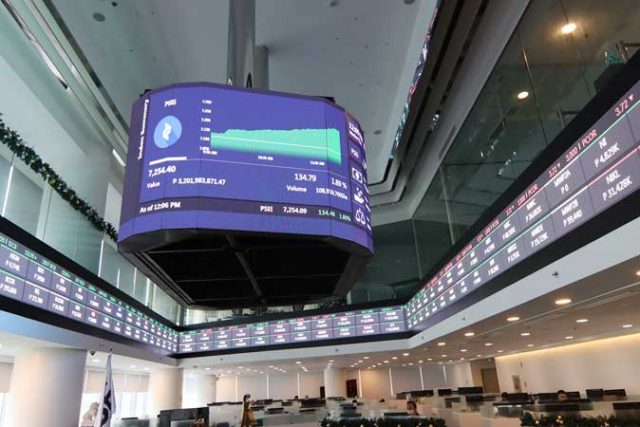
PHILIPPINE shares ended higher on Friday as investors reacted to the easing of the country’s inflation rate and the further easing of quarantine restrictions in Metro Manila.

On Friday, the benchmark Philippine Stock Exchange index (PSEi) increased 137.05 points or 1.9% to end at 7,340.77 while the broader all shares index climbed 53.84 points or 1.21% to close at 4,491.01.

Regina Capital Development Corp. Head of Sales Luis A. Limlingan said in a mobile phone message that stocks closed higher due to the country’s positive inflation figures.

“Philippine shares closed to a new year-to-date high as inflation came in better than expected and strong third-quarter earnings painted a rosier picture of the economy as the country continues to loosen restrictions caused by the pandemic,” Mr. Limlingan said.

“October consumer price index (CPI) continued to soften as key categories food and alcohol offset the acceleration in transport and fuel costs,” he added.

The Philippine Statistics Authority (PSA) announced on Friday that inflation in the country slowed to 4.6% year on year in October amid a slower increase in food prices.

The October inflation figure is lower compared with the 4.8% recorded in the previous month.

Darren Blaine T. Pangan, trader at Timson Securities, Inc., said in a mobile phone message that the market closed in green territory following the implementation of more relaxed quarantine restrictions in the National Capital Region (NCR) starting Nov. 5.

“The positive sentiment may also be brought about by investors assessing the continuous flow of corporate earnings results being released in the country,” Mr. Pangan said.

On Thursday, Presidential Spokesperson Herminio L. Roque, Jr. announced that NCR will be downgraded to Alert Level 2 from Nov. 5 to 21.

The announcement came after the Philippines recorded on Nov. 3 its lowest daily tally of coronavirus disease 2019 (COVID-19) cases, which reached 1,591.

On Friday, all of the sectoral indices at the local bourse closed higher.

Property gained 107.09 points or 3.3% to 3,349.33; services inched up 48.16 points or 2.53% to 1,951.91; financials rose 20.97 points or 1.32% to 1,600.58; holding firms went up 91.33 points or 1.29% to 7,149.91; industrials improved 51.51 points or 0.47% to 10,830.67; and mining and oil grew 41.91 points or 0.42% to 9,958.9.

Advancers bested decliners, 137 against 67, while 44 names ended unchanged.

Value turnover on Friday reached 9.42 billion with 1.4 billion shares exchanging hands, higher than the P7.68 billion with 4.69 billion shares logged the prior trading day.

Net foreign buying amounted to P695.24 million, higher than the P371.99 million worth of net purchases reported on Thursday.

“Amid the technical breakout from the 7,320-resistance area, we’ll have to see next week if this level holds. Next resistance may be placed at 7,870,” Mr. Pangan said. — Revin Mikhael D. Ochave

Jack Ma, Trump and Xi: How Chinese billionaire flew close to the sun

HONG KONG — This was supposed to be Jack Ma’s finest hour: a year ago to the day, his Ant Group was meant to go public in a $37 billion blaze of glory. Instead, Beijing reined in his empire, abruptly clipping the wings of corporate China’s biggest star.  

Now, to the cautious cheer of investors, the billionaire Alibaba e-commerce tycoon is taking his first tentative steps back on to the global stage with a low-key trip to Europe where he’s cultivating hobbies like horticulture.  

It’s a far cry from the height of Mr. Ma’s statesman-like powers in 2017 when he travelled to New York to meet President-elect Donald Trump for one-on-one talks in Trump Tower days before inauguration and promised to create a million American jobs.  

That high-profile outing had roiled the Chinese government, which first learned of the meeting and jobs pledge along with the rest of the world when Mr. Ma held an informal televised Q&A session with reporters in the lobby of the skyscraper, according to four people close to Alibaba with knowledge of the matter and one Beijing government source.  

Alibaba’s government relations team was subsequently told by Chinese officials that Beijing was unhappy about Mr. Ma meeting Mr. Trump without its prior approval, two of the people close to the company said.  

Mr. Ma’s charitable foundation, which handles his media queries, did not respond to a request for comment.  

The State Council Information Office and the Ministry of Foreign Affairs did not respond to requests for comment. All the sources declined to be named due to the sensitivity of the matter.  

The meeting on Jan. 9 came at a time of taut tensions between the two countries after Mr. Trump was critical of China during his election campaign, blaming it for the loss of American jobs.  

A spokesperson for Mr. Trump did not respond to a request for comment.  

The four people close to Alibaba said they believed the meeting was a negative turning point in the relationship between Mr. Ma and Beijing. They did not elaborate on their thinking.  

Investors are hungry for clues about Mr. Ma’s situation: the mere sighting of the businessman on the Spanish island of Mallorca last month, his first trip abroad in over a year, immediately saw Alibaba gain as much as $42 billion in value.  

The story of his fall from official favor helps illustrate how rapidly China has transformed under Xi Jinping, as he nears what could be a precedent-breaking third term as leader of the economic powerhouse and exerts greater control over some of its most innovative companies.  

‘A NATURAL FIRST TARGET’  

Authorities cracked down on Mr. Ma’s business empire after he gave a speech in Shanghai in October last year accusing financial watchdogs of stifling innovation. Regulators suspended the $37 billion listing of his fintech firm Ant Group two days before the planned debut on Nov. 5, ordered that Ant be restructured and launched antitrust investigations into Mr. Ma’s businesses, eventually leading to a record $2.75 billion fine for Alibaba in April.  

The clampdown has spread across the private sector, with officials tightening oversight of companies in technology, real estate, gaming, education, cryptocurrencies and finance.  

“Given that Jack appeared too provocative, out of step with the new approach to governance espoused by Xi, he was a natural first target to signal that a major change had begun,” said Duncan Clark, chairman of Beijing-based investment advisory firm BDA China and author of a book on Alibaba and Ma.  

“Jack was rubbing shoulders regularly with foreign presidents, prime ministers, royalty, celebrities at places like Davos or on his own visits overseas. There was a constant stream of VIP visitors to see him in Hangzhou too.”  

Mr. Ma’s global outreach did not end after the Trump meeting, though.  

Between 2018 and 2020 he held talks with a host of high-profile figures, including UN Secretary General António Guterres, Queen Rania of Jordan, Malaysia’s veteran politician Mahathir Mohamad, and then Belgian premier Charles Michel, according to Alibaba’s news portal Alizila and media reports.  

At Alibaba’s Hangzhou headquarters, it has a building housing the company’s museum where Mr. Ma and his business partner Joe Tsai would take foreign visitors and show them around, according to another person close to Mr. Ma.  

Mr. Tsai did not respond to a request for comment via Alibaba.  

Mr. Ma had viewed meetings with foreign politicians as “unofficial diplomacy” for China, which he enjoyed doing, the person added.  

Alibaba told Reuters it had a guest reception facility widely known as Pavilion 9 that offered a visual tour of its history and an overview of its businesses. It has hosted a wide variety of guests at the exhibition hall in its headquarters, it added.  

The company did not respond to other queries for this story.  

‘JUST LIKE YOU AND ME’  

In a sign of how life has changed for one of China’s most successful and influential businessmen, Mr. Ma requested an audience with at least two people in Mr. Xi’s inner circle in the weeks following the blocking of Ant’s listing, but his requests were turned down by both, said two separate sources briefed by those people.  

The billionaire subsequently wrote directly to Mr. Xi earlier this year offering to devote the rest of his life to China’s rural education, according to a government source who said the president spoke about the letter at a meeting of the country’s senior leaders in May.  

Reuters could not determine whether Mr. Xi approved of or responded to the offer, which has not been previously reported, or precisely when Mr. Ma, a former English teacher, penned the missive.  

The Alibaba-owned South China Morning Post said last month Mr. Ma was visiting Europe on an “agriculture and technology study tour related to environmental issues,” citing a person familiar with his itinerary.  

Last week the paper published pictures of Mr. Ma wearing a white protective gown and holding flowerpots. It said he would continue touring European companies and research institutions involved in agricultural infrastructure and plant breeding, citing people familiar with his plans.  

Mr. Tsai, the co-founder of Alibaba, played down his long-time associate’s influence in a rare interview about the elusive billionaire with CNBC’s Squawk Box show in June.  

“He’s lying low right now. I talk to him every day,” Mr. Tsai said. “The idea that Jack has this enormous amount of power, I think that’s not quite right,” he added.  

“He is just like you and me, he’s a normal individual.” — Julie Zhu and Kane Wu/Reuters 

Masons influence homebuilders’ choice of cement, but most are untrained

PHILSTAR FILE PHOTO

By Patricia Mirasol

Eighty two percent of low-income incremental builders (or homeowners who build their homes in increments, depending on the availability of funds) rely on the recommendations of masons for their home construction, according to a market study on the Visayas region’s wood and cement industries by Habitat for Humanity’s Terwilliger Center for Innovation in Shelter. Most masons, however, are either semi-skilled or unskilled, and have limited knowledge of the right building materials to use.

“The skills and training of masons is important for the selection of construction materials,” said Zoe M. Sibala, chief sustainability officer of cement manufacturer Holcim Philippines Inc.

The strength requirements needed for concrete — which is composed partly of cement — is different for high-rise buildings and for low-rise residences, Ms. Sibala cited as an example in a Nov. 5 event that discussed the market study.

As per the study, 76% of low-income to lower middle-income homeowners in the Visayas region do not have a cement brand preference. Another 41% do not have an idea as to what type of cement they use.

RECOMMENDATION MISMATCH

Masons make recommendations based on affordability and accessibility. Discounts also factor in their recommendations, as well as suppliers having complete stocks of items. Apo/Cemex is the most recommended brand by masons due to its strength and durability, followed by Republic Cement, due to its affordability and availability.

“When buyers go to hardware stores, the [salesperson who] engages them offer what’s available,” said Margaret Ann T. Gravador, a consultant of the Development Consulting Group, a Cebu-based research group that the Terwilliger Center commissioned for the study. Even if they don’t have a preference, hardware stores push what’s in stock, she added.

More than two-thirds (or 69%) of small and medium hardware stores in the Visayas, the study further found, do not receive any orientation on the cement products they carry.

Households select masons based on word-of-mouth within the community, Ms. Gravador told the participants at the event. “This is one area of opportunity,” she said. “Masons do not get formal training in terms of their trade, but are very influential to households.”

Among the study’s recommendations is an improvement in partnerships between government agencies and private companies in order to improve the way skills trainings are accessed by masons and other construction workers. Education, as mentioned in the webinar, will address the mismatch between the type of cement that is needed, versus the type of cement that is recommended.

The Technical Education and Skills Development Authority, the government agency tasked to manage and supervise technical education and skills development in the Philippines, offers skills training for masonry.

China, India, other big coal users missing from COP26 phase-out deal

UNSPLASH

GLASGOW — Indonesia, Poland, Vietnam and other nations pledged on Thursday to phase out use of coal-fired power and stop building plants, but their deal at the COP26 climate summit failed to win support from China, India, and other top coal consumers.  

Britain has said one of its main aims for the United Nations summit is “consigning coal power to history.” The deal saw 23 nations making new commitments, a move the president of the COP26 summit, Alok Sharma, said put the end of coal “in sight.”  

“Today I think we can say that the end of coal is in sight,” Mr. Sharma told the Glasgow meeting.  

Mr. Sharma told a news conference it had been a personal priority as COP26 president to consign coal to history and “I think you can say with confidence that coal is no longer king.”  

Still, some of the biggest coal-dependent nations were notable in their absence from the pledge to consign the most polluting fossil fuel to history.  

China was responsible for about 54.3% of global coal consumption in 2020, while India used 11.6%, according to BP’s 2021 world energy statistical review. The United States, which also did not join the pledge, consumed 6.1%, the review showed.  

Greenhouse gas emissions from burning coal are the single biggest contributor to climate change, and weaning the world off coal is considered vital to achieving global climate targets.  

Signatories of the COP26 agreement agreed to phase out coal-fueled power generation in the 2030s in richer countries, and the 2040s for poorer nations. A majority also committed to shun investment in new coal plants at home and abroad.  

The line-up and pledges of countries kept changing right up until the deal was announced. The absence of China, India, and Australia threw a shadow over the attempt to win global backing.  

A US official said President Joseph R. Biden, Jr.’s plan to decarbonize the power grid by 2035 will lessen coal dependency, as will legislation on infrastructure and social spending that Congress is haggling over.  

“I think we’re going to soon have a set of bills which will have $800 billion in clean energy and climate programs that are really going to drive transformation in the United States, and that is what we are focused on,” a senior US Department of Energy official told reporters.  

US Senator Joe Manchin, a Democrat from the coal-producing state of West Virginia and the founder and partial owner of a coal brokerage, has opposed some climate measures in the legislation.  

UNEVEN TRANSITION  

Some experts said the deal was a step forward. It came alongside an announcement by the Powering Past Coal Alliance, an international campaign, which said it secured 28 new members, including Ukraine, to pledge to quit coal.  

Antony Froggatt, deputy director for the environment and society program at London’s Chatham House think tank, said the announcements were “notable for what is absent as much as what is new.”  

“It highlights how uneven the transition to cleaner energy is across the globe,” he said.  

The commitments are not binding, and some signatories have said they will not be able to phase out coal without financial help from other countries.  

“We need to have funding to retire coal earlier and to build the new capacity of renewable energy,” Indonesian finance minister Sri Mulyani Indrawati told Reuters on Wednesday.  

The COP26 summit has so far delivered roughly $20 billion in funding to help countries phase out coal, said Britain, which hopes the summit in Glasgow will produce enough commitments to keep within reach the target of limiting the global temperature rise to 1.5 degrees Celsius (2.7 Fahrenheit) above pre-industrial levels. That would require the world to reach net-zero carbon emissions by 2050.  

Britain has largely eliminated coal from power generation, but has yet to decide on proposals for a new coal mine in Cumbria, northwest England, intended to extract coking used for steel production.  

The COP26 deal covers coal-fueled power generation, but not its use in industrial manufacturing.  

The COP26 summit has so far yielded deals on coal, deforestation and methane, but a clear picture has yet to emerge on what these voluntary initiatives would add up to in terms of moderating temperature rises.  

A Polish government spokesman said the country’s commitment would see it end coal use in the 2040s. Poland had previously agreed to stop mining coal by 2049.  

Campaigners called for an earlier end-date and firm policies to make sure Poland delivered. “Poland must set a clear and concrete plan to phase out coal by 2030 at the latest,” Joanna Flisowska of Greenpeace Poland said.  

Britain said it hoped the coal deal, with its initial signatories, would spur others such as China and India to join. — Kate Abnett and Elizabeth Piper/Reuters 

US Republicans want billions for Taiwan military aid to counter China

REUTERS

WASHINGTON — US Republican lawmakers introduced legislation on Thursday seeking to provide $2 billion per year and other assistance to bolster Taiwan’s defenses as it faces rising pressure from China.  

The legislation, reviewed by Reuters, would authorize $2 billion a year in Foreign Military Financing — US grants and loans that enable countries to purchase weapons and defense equipment produced in the United States — through 2032 for the self-ruled island.  

While the bill is sponsored only by Republicans, the minority party in the Senate, it adds to pressure from Congress on Democratic President Joseph R. Biden, Jr., for bolder action to strengthen ties with diplomatically isolated Taiwan.  

The United States is the main military supplier for the democratic island nation.  

The bill’s lead sponsor is Senator Jim Risch, the top Republican on the Senate Foreign Relations Committee. Co-sponsors include Republican Senators Mike Crapo, John Cornyn, Bill Hagerty, Mitt Romney and Marco Rubio.  

It was not immediately clear how Democrats view the bill. Support for Taiwan is a rare issue that garners bipartisan backing in the deeply divided Senate.  

The funding would come with conditions, including Taiwan committing to match US spending, and whether Taipei and Washington agree to conduct joint long-range planning for capacity development.  

The United States has urged Taiwan to pursue defense reforms to focus on capabilities to make its military forces more mobile and harder to attack, as well as to ensure it maintains a strong reserve force.  

The “Taiwan Deterrence Act” also would amend the existing Arms Export Control Act, which governs foreign military sales, to make it easier for US firms to sell arms to Taiwan. It also would require an annual assessment of Taiwan’s efforts to advance defense strategy toward China.  

The bill also would improve military exchanges with Taiwan and expand professional military education and technical training opportunities in the United States for Taiwanese military personnel.  

“The defense of Taiwan is critical to retaining the credibility of the United States as a defender of the democratic values and free-market principles embodied by the people and government of Taiwan,” the bill’s text says.  

China recently has ramped up military pressure, including repeated missions by Chinese warplanes near democratic Taiwan, which Beijing claims as its own and has not ruled out taking by force.  

Mr. Biden has confirmed a “rock-solid” commitment to Taiwan and criticized China. Beijing blames Washington’s policies of supporting Taiwan with arms sales and sending warships through the Taiwan Strait for raising tensions.  

On Wednesday, the US Department of Defense in its annual report to Congress on China’s military reiterated concern about increasing pressure on Taiwan.  

The report renewed concerns about China’s development of options to take Taiwan, although a defense official declined to speculate to reporters about whether that scenario was likely or say if the department sees a near- or even medium-term risk of armed conflict. — Reuters 

Alagang AyalaLand shares the gift of green with social enterprises

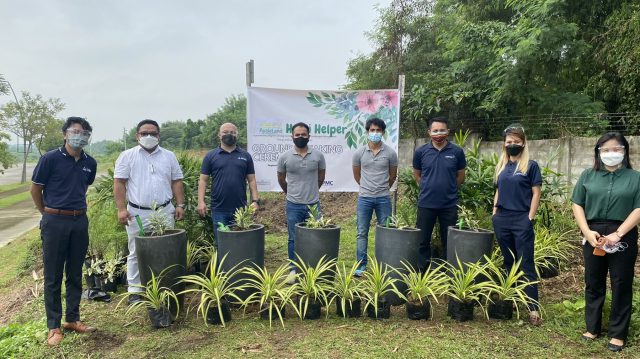
Ornamental plants will flourish in Vermosa, Cavite with social enterprise partner, Luntian Plant Boutique, handling the operations of a plant nursery in the estate. The photo shows the Vermosa Estate and Ayala Land Property Management teams with the partners.

Every year, Ayala Land, Inc. (ALI) procures at least 500 new trees and 150,000 shrubs for its estates from commercial growers outside the capital. For its emerging estates, the developer estimates more than 8,000 new trees will be needed in the next five years.

To continue creating a green environment in its estates while promoting livelihood in the community, ALI works hand in hand with social enterprises through its Alagang AyalaLand program. These groups are allotted a space in the ALI development wherein they can propagate high-quality tree and plant specimens which ALI then purchases for its requirements.

“We wanted to expand the reach and support of the Alagang AyalaLand program to social enterprises that could supply some of our regular procurement needs in the company, and trees are among the most essential to our estates. Through such partnerships, we can provide the community long-term and sustainable livelihood opportunities,” said Manny Blas, head of the Alagang AyalaLand council.

Greenery fills Ayala Land Estates

Luntian is one of the social enterprises supported by the program. Located at Vermosa in Imus Cavite. It aims to produce around 6,000 pieces of commonly used plants for the estate. It will also ensure the maintenance of plants and the implementation of landscapes in some residential and commercial projects within Vermosa. For its nursery, Luntian plans to employ workers from nearby communities as the demand for landscaping supplies increases.

Flowering trees that will soon be planted in Ayala Land developments are cultivated at the tree nursery in Altaraza estate. These trees are cultivated by the company’s social enterprise partner, Earth Recovery Action, Inc.

Meanwhile at Altaraza in San Jose del Monte, Bulacan, Earth Recovery Action, Inc. (ERA, Inc.), a social enterprise focusing on native trees and biodiversity facilitates Alagang AyalaLand’s CommuniTREE project. This involves setting up a nursery for sustainable production of quality native trees for landscaping and reforestation needs. For ERA, Inc., it is the “big picture” or the higher purpose that motivates them to work on the project and it goes beyond building the tree nursery. “We are planting trees for the future resiliency of cities,” shared Alan Silayan, ERA, Inc. partner and co-founder.

Mel Ignacio, Altaraza Estate Development head, also shared: “The CommuniTREE project in Altaraza will ensure that our estate will have easy access to the trees that we definitely need for our estate development. More importantly, the residents in the neighboring areas will benefit from this project as they will be afforded job opportunities that they may need especially during this time of the pandemic.”

Sustainable livelihood for social enterprises

The MDC Greens plant nursery in Laguna is managed by Inang Kalikasan Agriculture Cooperative which has supported many families.

Another social enterprise contributing to a greener ALI is the Inang Kalikasan Agriculture Cooperative (IKAC), a duly registered cooperative organized by farmers in 2019. IKAC found its roots in 2014 when the Ayala Foundation and ALI’s construction arm Makati Development Corporation (MDC) started MDC Greens Ornamental Plant Nursery. IKAC initially provided livelihood for eight families which has grown over the years to 30 families during the peak of operations.

Through Alagang AyalaLand, local communities and small businesses affected by the pandemic are supported  through livelihood and job creation. The community engagement program also focuses on providing disaster relief to surrounding communities and promoting a sustainable environment.


Spotlight is BusinessWorld’s sponsored section that allows advertisers to amplify their brand and connect with BusinessWorld’s audience by enabling them to publish their stories directly on the BusinessWorld Web site. For more information, send an email to online@bworldonline.com.

Join us on Viber to get more updates from BusinessWorld: https://bit.ly/3hv6bLA.