Home Blog Page 7257

Egypt’s ancient King Khufu’s Boat is moved from Giza pyramids to a new home

KING Khufu’s Solar Boat is displayed at a museum on the northern side of Khufu’s Great Pyramid, in Giza, Egypt, Aug. 31, 2016. — REUTERS/MOHAMED ABD EL GHANY

CAIRO — King Khufu’s Boat, an ancient vessel that is the oldest and largest wooden boat discovered in Egypt, has been painstakingly moved from its longstanding home next to the Giza pyramids to a nearby giant museum, officials said on Saturday.

The 4,600-year-old vessel, also known as the Solar Boat, was moved to the nearby Grand Egyptian Museum (GEM), due to be inaugurated later this year.

“The aim of the transportation project is to protect and preserve the biggest and oldest organic artifact made of wood in the history of humanity for the future generations,” the tourism and antiquities ministry said in a statement.

It took 48 hours to transport the cedarwood boat, which is 42 meters long and weighs 20 tons, to its new home. It arrived at the GEM in the early hours of Saturday, the ministry said.

The boat was transported as a single piece inside a metal cage carried on a remote-controlled vehicle imported especially for the operation, said Atef Moftah, supervisor general of the GEM project.

The vessel, discovered in 1954 at the southern corner of the Great Pyramid, has been exhibited for decades at a museum bearing its name at Giza Plateau.

Egypt says the Grand Egyptian Museum, which has been under construction intermittently for 17 years, will contain more than 100,000 artifacts when it opens. — Reuters

Aboitiz firm fully redeems P8.5-B fixed-rate bonds

ABOITIZ Equity Ventures, Inc. (AEV) said on Tuesday that it had fully paid for the early redemption of its seven-year 2015 Series B Bonds for P8.467 billion.

The company said it paid for the bonds through the Philippine Depository & Trust Corp. last week, Aug. 6.

The Series B bonds were part of the first tranche of the company’s P25-billion debt securities program, which was issued in three series.

In a statement disclosed on July 6, AEV Chief Financial Officer Manuel R. Lozano said the decision to redeem the bonds a year ahead of its maturity schedule is part of its ongoing efforts “to reduce costs” and to also “improve profitability” for its stakeholders.

Most of the proceeds were used to finance AEV’s cement venture, as well as the acquisition of Lafarge assets in the Philippines through a joint venture with CRH Plc.

The company has also since submitted documents to complete the requirements for the termination of listing of the bonds.

On Tuesday, AEV shares at the stock exchange rose by 0.50% or 20 centavos to finish at P40.20 each. — Keren Concepcion G. Valmonte

Banks’ rediscount borrowings hit P5.5 million in first seven months

BW FILE PHOTO

BANKS tapped the peso rediscount facility of the Bangko Sentral ng Pilipinas (BSP) for the second straight month in July, but availments remained low due to excess liquidity in the financial system.

“For the period Jan. 1 to July 31, 2021, total availments of banks under the peso rediscount facility amounted to P5.519 million,” the central bank said in a statement on Tuesday.

This followed the P4-million borrowing in June, which was by a single lender and was the first time the facility was tapped this year. This means availments in July totaled P1.519 million.

In 2020, banks only took out loans from the peso rediscount facility in March, April, August, and September for total availments of P26.9 billion, down by 77.7% from the 2019 level.

The BSP said nearly three-fourths or 72.48% of the peso rediscount loans granted in the first seven months of 2021 were used to fund production, particularly financing industrial processing. The remaining 27.52% went to capital asset expenditures.

Meanwhile, the central bank’s dollar and yen rediscount windows remained untouched.

Through the rediscount window, the BSP lets banks have access to additional money supply by posting their collectibles from clients as collateral.

In turn, these lenders may use the fresh cash — denominated in the peso, dollar or yen — to grant loans to their corporate or retail clients and service unexpected withdrawals.

The low availments from the rediscount window reflects the muted demand for loans due to the coronavirus disease 2019 (COVID-19) pandemic, Rizal Commercial Banking Corp. Chief Economist Michael L. Ricafort said.

“Availments remained low due to the excess liquidity in the financial system and lower demand for loans,” Mr. Ricafort said in a text message.

Liquidity freed up by the BSP’s easing measures amid the crisis have released some P2 trillion into the financial system, equivalent to about 12% of the country’s gross domestic product.

However, despite the excess cash, lending has been contracting since December, declining by 2% in June, as both banks and borrowers remain cautious due to the uncertain economic environment.

Mr. Ricafort said banks may tap the rediscount window anew for additional money supply as Metro Manila and some provinces are under strict lockdown from Aug. 6-20 to help curb a surge in COVID-19 cases due to the more transmissible Delta variant.

AUGUST RATES
Meanwhile, for this month, applicable rate for peso rediscount loans regardless of maturity remains at 2.5%

On the other hand, loans under the dollar and yen credit lines regardless of maturity will have rates of 1.897% and 2.11775%, respectively. — LWTN

Boosting vaccine production

REUTERS

There have been more than 200 million confirmed cases of coronavirus disease 2019 (COVID-19), including over 4 million deaths, globally. The rise of different variants is also threatening previous public health gains. 

The World Health Organization (WHO) has designated at least four variants of concern (VOCs), meaning that their transmissibility or virulence could have a significant impact on global public health. VOCs pose a threat to the effectiveness of social measures, diagnostics, and vaccines. 

Vaccines help prevent people from getting critically ill or dying from COVID-19. As of this time, the WHO said that close to 4 billion doses have been administered. In the race against time to save lives, increasing vaccine production is crucial in ensuring that there are enough doses for vulnerable populations. However, bottlenecks in the supply chain and a shortage of raw materials are hampering these efforts. 

A scarcity of critical input supplies including bioreactor bags, single-use assemblies, cell culture media, filters, lipids, vials and stoppers is another challenge, said Greg Perry of the International Federation of Pharmaceutical Manufacturers & Associations (IFPMA). 

These ingredients are also used in the manufacture of other vaccines for hepatitis, measles, shingles and biological medicines for cancer. 

According to Mr. Perry, a skilled workforce is important in ensuring the continued production of vaccines as it is a complex process that requires experts in manufacturing, quality, regulation, engineering, and logistics; trainers; lab technicians; maintenance crews; as well as scientists for the various stages of safety and quality controls.  

The time needed to manufacture a single batch of vaccines can take up to 120 days. Since any delay along the supply chain can push production by months, manufacturers are doubling their efforts to shorten production time. 

In a council meeting this July, AstraZeneca Chief Executive Officer Pascal Soriot (CEO) said: “We know the challenges of increasing global capacity when expertise is in limited supply, and how restrictions in international trading create ripple effects through supply chains. It is also clear that vaccine donations are essential and we are working with COVAX to unlock further supplies.” 

A similar commitment was echoed by Paul Stoffels, Chief Scientific Officer of Johnson & Johnson, at the same event. “We are also a strong supporter of the dose sharing initiatives that are now gathering momentum around the world. As industry rises to this challenge, we are focused on scaling up global production capacity. We are also advocating for the free flow of vaccines and raw materials between countries, to ensure vaccines can be produced and reach everyone who needs them,” he said in the Access to COVID-19 Tools (ACT) Accelerator Facilitation council meeting. 

Pfizer, meanwhile, is working on a shortened timeline of 60 days to contribute to equitable access of vaccines. 

“Our recently announced plans … to provide 500 million doses of the Pfizer-BioNTech vaccine to the world’s poorest nations further demonstrates our commitment to equitable access and our support for the work of the COVAX facility,” said Pfizer CEO Albert Bourla in the ACT-Accelerator meeting. 

There are close to 300 agreements aiming to increase vaccine manufacturing capacity. Novartis signed an initial agreement to support the production of the Pfizer-BioNTech COVID-19 vaccine. “Novartis plans to take bulk mRNA active ingredient from BioNTech and fill this into vials under aseptic conditions for shipment back to BioNTech for their distribution,” it said in a statement. 

Sanofi, too, will support the manufacturing and supply of the Pfizer-BioNTech COVID-19 vaccine. In a statement, it said: “Sanofi will provide BioNTech access to its established infrastructure and expertise to produce over 125 million doses of COVID-19 vaccine.” 

Merck (known as MSD in the Philippines) has also entered into agreements to support the manufacturing and supply of Johnson & Johnson’s COVID-19 vaccine. “Merck will use its facilities in the United States to produce drug substance, formulate and fill vials of Johnson & Johnson’s vaccine,” the company said. 

GlaxoSmithKline (GSK), meanwhile, has reached an agreement in principle to support manufacturing of up to 60 million doses of Novavax’s COVID-19 vaccine candidate for use in the UK. “GSK will provide ‘fill and finish’ manufacturing capacity … with a rapid technology transfer between the two companies beginning immediately,” it said. 

For its part, Takeda said that it reached an agreement to utilize capacity at IDT Biologika for three months previously reserved for its dengue vaccine candidate to manufacture the Johnson & Johnson vaccine. 

Bayer, on the other hand, will leverage its capabilities to manufacture CureVac’s mRNA-based candidate vaccine. It said that it is planning an “additional 160 million doses of CureVac’s vaccine in 2022 to further expand their supply network and overall capacity.”  


Teodoro B. Padilla is the executive director of the Pharmaceutical and Healthcare Association of the Philippines (PHAP). PHAP represents the biopharmaceutical medicines and vaccines industry in the country. Its members are at the forefront of research and development efforts for COVID-19 and other diseases that affect Filipinos. 

Arts & Culture (08/11/21)

Rak of Aegis

Rak of Aegis online extended

THE PHILIPPINE Educational Theater Association (PETA) is extending the streaming presentation of its jukebox musical Rak of Aegis to include the weekend of Aug. 14 and 15 via www.ticket2me.net. The musical’s story follows Eileen and her efforts to help her community which has been submerged in floodwaters, as told using the songs of the rock band Aegis. Written by Liza Magtoto and directed by Maribel Legarda, the streaming cast includes Aicelle Santos, Pepe Herrera, Poppert Bernadas, Isay Alvarez-Seña, Robert Seña, Joann Co, Jimi Marquez, and Gie Onida. The livestream is available for P350 (8 to 12 p.m., Philippine Standard Time). For more information, follow PETA’s social media pages: Facebook (www.facebook.com/petatheater), Instagram (@petatheater), Twitter (@petatheater), YouTube (www.youtube.com/petatheateronline) or visit www.petatheater.com/rakofaegis.

Unboxing the Galleon Trade

EXPLORE the flavors of history in “Unboxing the Galleon Trade” with chef, artist, and writer Claude Tayag on Aug. 14, 4 p.m., via Zoom. In celebration of the 500th anniversary of the circumnavigation of the world, Ayala Museum and Served Manila will host an experiential historical conversation on the Manila-Acapulco Galleon trade — complete with a curated exploration kit that allows the viewer to make and taste the food during the event itself. The session will be surveying some of the most prominent food and dishes exchanged during the Manila-Acapulco Trade to explore the impact of the 250-year relationship between Mexico and Philippines, revealing what it says about the Filipino identity. Some of the iconic dishes that Mr. Tayag will try to unbox are like the proverbial chicken and egg question: chicharon vs chicharron, champorado vs champorrado, tuba vs tuba, and lambanog vs tequila. There will also be a cocktail making segment with guest mixologist, Lennon Aguilar. By marrying food and history together through a sensory experience, this event is just one way Ayala Museum and Served Manila want to continuously find new engaging ways to bring history to the community. For P3,000, participants will get access to the session plus an exploration kit that includes two craft cocktails, a DIY champorado kit, artisanal chicharon, craft chocolates, and more. Register for “Unboxing the Galleon Trade” at http://bit.ly/galleontrade.

Winners of senior citizens painting tilt announced

ROBINSONS Land ARTablado partnered with Roman Scholarship Fund, Inc. (RSFI), a program that has been involved in giving scholarship to indigent but deserving students and artists, to mount a special art competition/exhibit showcasing the artistry of senior citizens. EntitledLight, Color and Joy in Time of Pandemic,” the competition gave senior citizens who have been homebound for over a year a chance to show their artistic side. Over 20 artworks were submitted and each piece that showcased expressions depicting the joy and fullness of life as seen by the mature population. These artworks were displayed at ARTablado, Level 3, Robinsons Galleria last July. The winners were announced and awarded on July 30. Daisy Carlos bagged the first prize for her artwork entitled Stop and Smell the Flowers, while Flowers in My Window by Joey Rodulfo and Gumamela by Al Perez placed second and third place respectively.

Cosco Capital net income climbs 18% to P5B

COSCO Capital, Inc. recorded an 18% increase in its consolidated net income for the first half of the year to P4.99 billion amid lower revenues due to the coronavirus disease 2019 (COVID-19) pandemic.

The listed retail holding firm of Lucio L. Co said in a stock exchange disclosure on Tuesday that its consolidated net income for the period is an improvement from the P4.23-billion net income it had in the same period a year ago.

“In the first half of 2021, the group’s grocery retailing businesses, Puregold Price Club, Inc. and S&R Membership Shopping Club, contributed 63% of total core net income, followed by Liquor Distribution with 23%, Commercial Real Estate segment with 13%. The group’s Specialty Retailing segment, Office Warehouse, Inc., accounted for 1% of net profit,” Cosco Capital said.

Cosco Capital said its grocery retail segment posted a 17.3% increase in its net income to P3.99 billion resulting from initiatives to improve front margins and reduce costs.

However, consolidated revenues of the company’s grocery retail segment dropped 7.1% to P76.2 billion due to lower customer traffic in Puregold supermarkets due to the pandemic.

“Despite the prevailing environment, the grocery retail group continued to implement its organic expansion strategy and opened a total of 15 new Puregold stores in the first half of 2021,” Cosco Capital said.

Net income of the company’s liquor distribution business increased by 67.6% to P709 million after being carried by the management strategic cost control of its distribution, marketing, and promotion expenses.

Revenues of the liquor unit rose 34.8% to P4.3 billion due to a 39% increase in volume of cases sold driven by the continued strong performance of its Alfonso imported brandy in the market.

The company’s commercial real estate segment recorded flat revenues at P824 million and flat net income at P395 million amid efforts in extending rental waivers, discounts and assistance to affected commercial tenants.

Meanwhile, Cosco Capital said the net income of its specialty retailing business segment, Office Warehouse, Inc., rose 104% to P30 million on the back of strategic cost controls while its revenues also improved 1.8% to P789 million.

On Tuesday, shares of Cosco Capital at the stock exchange rose 3.50% or 17 centavos to finish at P5.03 apiece. — Revin Mikhael D. Ochave

UnionBank teams up with Western Union and Pera Hub to allow remittance claims via its app

BW FILE PHOTO
UNIONBANK of the Philippines, Inc. will allow remittance recipients to claim their funds via its app. — BW FILE PHOTO

UNIONBANK of the Philippines, Inc. tied up with Western Union and Pera Hub to give remittance recipients the option to claim their cash in real time online through the bank’s online app.

The feature is available for UnionBank account holders, and Western Union remittance recipients will need to create an account online with the lender if they want to avail of the service.

“We hope this will give our OFWs (overseas Filipino workers) peace of mind so they do not have to worry more than they already do about their families back home. And to our customers, we remain committed to UnionBank’s pursuit of digital innovations to improve your banking experience and everyday lives,” UnionBank Executive Vice-President, Chief Customer Experience Officer and Chief Digital Channel Officer Ana Maria A. Delgado, said at the service’s virtual launch on Tuesday.

The partnership is seen to help diversify the remittance market in the Philippines, which broadly remained traditional and over-the-counter-based even with the Philippines being among the world’s biggest remittance recipients, UnionBank Senior Vice-President Ramon Vicente “Arvie” V. de Vera II said.

“Some people have to travel long distances to go to a remittance counter, fall in line for their turn, and when they get there, they travel back with a large amount of cash, worrying that during the commute they might get pickpocketed,” he said.

Mr. De Vera said the partnership will also allow remittance recipients to get their funds in a safer way amid restriction measures due to the pandemic.

Pera Hub Chief Executive Officer Ian T. Ocampo said while they have the advantage of having a network of physical branches, partnering with digital players and using technology and innovation is crucial for financial inclusion. He said this collaboration with Western Union and their fellow Aboitiz unit UnionBank is an opportunity to reach new client segments.

“We have seen over the years that they’ve (clients) become more comfortable with transacted online platforms. We do have our customers for our counters, but I think having this app will definitely attract more digital natives, younger people, who are used to dealing with technology,” Mr. Ocampo said.

UnionBank’s Mr. De Vera said online remittance claims per day are capped at P50,000, but they could adjust this limit moving forward.

Under the new service, only the sender will be charged for remittance fees. Recipients can have the funds credited to their account in real time by inputting details of the transaction in the UnionBank app, including the money tracking control number and the specific amount sent to them.

Jeffrey D. Navarro Head of Philippines, Malaysia, Brunei & Indochina for Western Union, said they have retained the model of only charging the sender as they operate on the premise that the receiver is the one who needs funds regardless of the channel where they claim the remittance.

“So as we move and migrate to different platforms, the way that we will still charge the service will be the same — senders will remain to pay for the fees. However, the difference would be the convenience on the receiver,” he said.

Western Union has more than 550,000 agent locations in over 200 countries and territories where OFWs can send their remittances back home.

UnionBank, through its fintech arm UBX, earlier enabled customers to make fund transfers to remittance firms such as Cebuana Lhuillier, LBC, Palawan Pawnshop and Express Padala, and Pera Hub.

The Aboitiz-led lender’s net income in the first semester increased 94% to P8.315 billion from the P4.503 billion seen a year earlier. This was attributed to higher earnings from its core businesses and lower provisions for credit losses.

UnionBank’s shares closed at P76.35 apiece on Tuesday, down by 15 centavos or 20% from its previous finish. — L.W.T. Noble

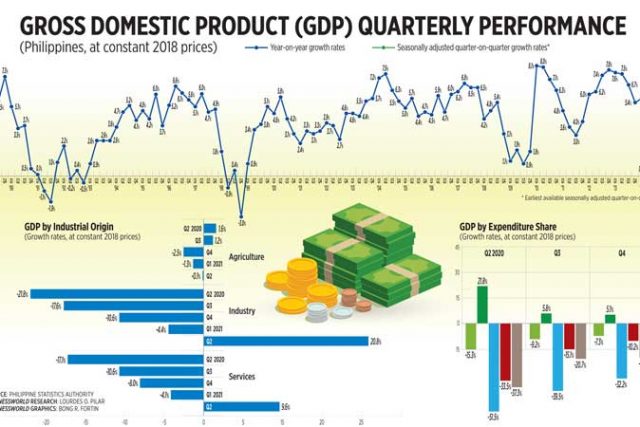
Gross Domestic Product (GDP) Quarterly Performance (Q2 2021)

THE PHILIPPINE ECONOMY exited recession in the second quarter, after growing a faster-than-expected 11.8%, according to the Philippine Statistics Authority (PSA). Read the full story.

Gross Domestic Product (GDP) Quarterly Performance (Q2 2021)

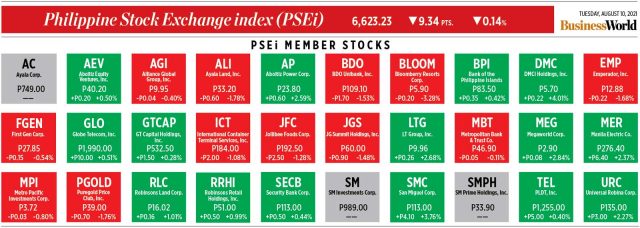
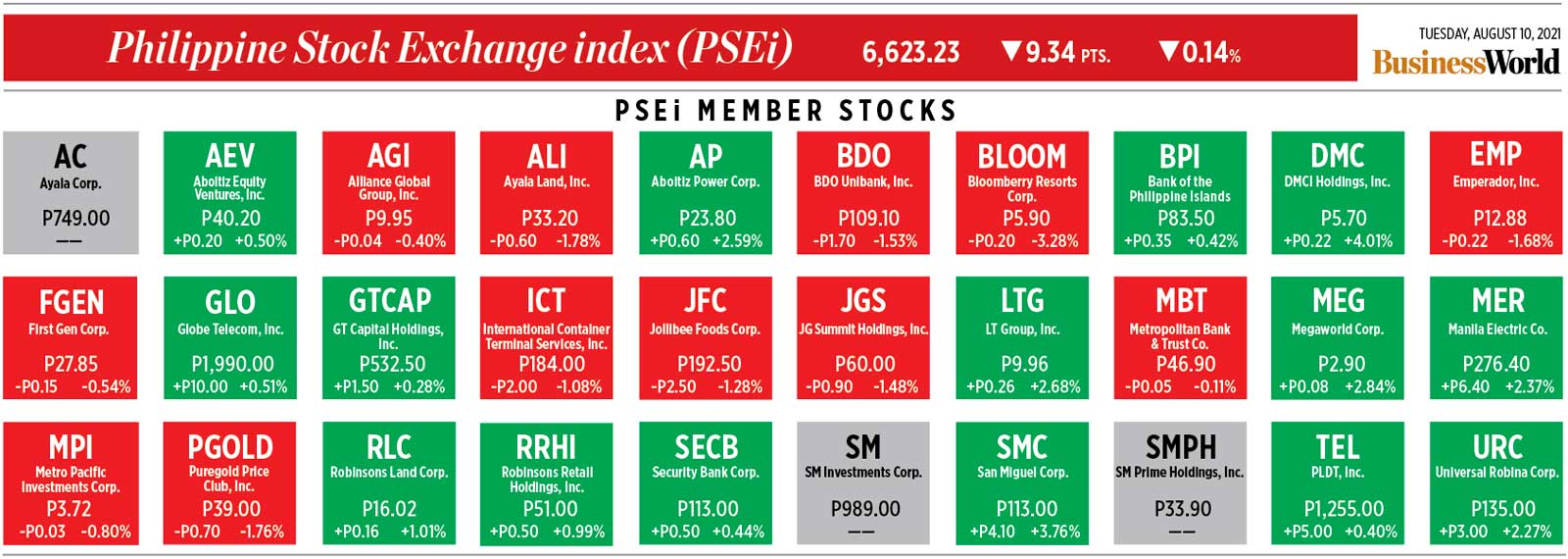
How PSEi member stocks performed — August 10, 2021

Here’s a quick glance at how PSEi stocks fared on Tuesday, August 10, 2021.


Key Senator calls for fresh Malampaya contract bids

PHILSTAR

A SENIOR legislator said Tuesday that the government must put up the Malampaya gas field for auction, if authorities decide to appoint a new operator once the project’s contract expires in 2024.

The offshore field is covered by Service Contract (SC) 38, in which the Philippine National Oil Co. Exploration Corp. holds a 10% interest.

“If ever (the) government decides to get another operator, it has to bid it out because that’s the only way for us to get the best price, (and) best operator possible and for us to get the best option. So, my view here is that, after 2024, if government do(es) decide to look for a (new) operator… or (keep the) existing operator, they have to bid it out,” Senator Sherwin T. Gatchalian said during a Management Association of Philippines webinar on Tuesday.

He was responding to a question on the possibility of extending the contract.

Mr. Gatchalian, who chairs his chamber’s energy committee, said that once the contract expires in three years’ time, the project will “revert” to the government, and the public will, in turn, be entitled to the earnings from the gas field.

“On the other side of that, government will be operating the gas field, so this is a decision that gov’t needs to make and analyze because government itself has a lot of constraints in terms of operations,” he said.

Shell Petroleum N.V. has announced that it is selling 100% of its stake in Malampaya gas field operator Shell Philippines Exploration B.V. ( SPEx) to Udenna Corp. subsidiary Malampaya Energy XP Pte Ltd. for $380 million, with additional payments of up to $80 million depending on asset performance and commodity prices between 2022 to 2024.

The Department of Energy (DoE) has described the Shell-Udenna deal as a private transaction but added that it has the power to clear the deal.

SPEx holds a 45% interest in SC 38. If the deal is completed, Udenna Corp. will hold 90% of interest in SC 38, since its other unit UC38 LLC already holds 45% in the service contract.

On Tuesday, Mr. Gatchalian also noted that there are potential oil and gas deposits in the West Philippine Sea (WPS) which can cover the country’s energy demands.

Citing DoE data, he said that some 6,048 million barrels of oil, which can be acquired in the contested area, is equivalent to Philippine demand for 36 years. Meanwhile, a total of 7,108 billion cubic feet of gas can be obtained from the WPS, good for 96 years of demand.

The called for a program to “aggressively explore” for resources, noting the lack of activity on the oil and gas front. — Angelica Y. Yang

Japan top ODA source over last 20 years, providing over $14B

PHILSTAR

JAPAN was the Philippines’ top source of official development assistance (ODA) over the last 20 years, accounting for $14.139 billion worth of loans or 72% of the foreign aid portfolio, the Department of Finance (DoF) said Tuesday.

In a statement, the DoF said Japanese ODA, both disbursed and committed, accounted for the bulk of the $19.676 billion received from development partners in the 2001-2020 period.

Under the current government, Japan provided 1 trillion yen ($9 billion) worth of loans mainly to infrastructure and economic development programs. A major portion went to support big-ticket infrastructure projects such as the Metro Manila Subway and the North-South Commuter Railway.

Hiroto Izumi, the special advisor to Japan’s Prime Minister, said at a meeting between Philippine and Japanese officials on July 28 that Japan will further expand its commitments to the Philippines.

The European Union provided the equivalent of $3.049 billion, or 16%, during the period, and China $1.185 billion.

Loans from South Korea accounted for $1.101 billion, the US $160 million and Middle Eastern partners $20 million.

ODAs are concessional loans the government obtains from its foreign development partners to help it finance its budget deficit.

Official data obtained by BusinessWorld showed the state’s utilization of ODAs — or actual spending relative to target — went up to 66.69% in 2020 from 64.28% in 2019. Total number of ongoing project loans also increased to 76 in 2020 from 67 the year before.

Last year when the pandemic hit, the government had to ramp up its borrowings both domestically and externally to plug its ballooning fiscal gap amid the crisis.

By administration, the Duterte administration obtained a total of $7.947 billion in ODAs so far meant to support its flagship “Build, Build, Build” program, the government’s response to the pandemic and other social programs.

“The extensive bilateral borrowing during the (Duterte) administration has been instrumental in allowing the (government) to spend around 5 percent of gross domestic product (GDP) for infrastructure to spur economic growth, and in safeguarding development gains during the pandemic,” DoF Undersecretary Mark Dennis Y.C. Joven was quoted as saying.

Of which, $6.122 billion or 77% of the total were from Japan.

Under late President Benigno S.C. Aquino III, the government has secured $5.641 billion in ODAs, with 85% or $4.817 billion supported by the Japanese government.

The Arroyo administration, meanwhile, had $6.067 billion of ODAs during its nine-year term, with half of which worth $3.2 billion sourced from Japan. — Beatrice M. Laforga

BoC gives CARS program participants 30 days to present tax documentation

PHILIPPINE STAR

THE BUREAU of Customs (BoC) has notified car manufacturers receiving support from the Comprehensive Automotive Resurgence Strategy (CARS) program to present tax payment certificates within 30 days in order to avail of incentives.

Commissioner Rey Leonardo B. Guerrero issued Customs Administrative Order 04-2021 on Tuesday laying down the guidelines for processing tax payment certificates with Customs for participants of the CARS program.

Under the program, incentives are given to manufacturers that produce domestically at least 200,000 units, or their parts, of three designated car models for six years.

The incentives are awarded via tax payment certificates (TPC) issued by the Trade department’s Board of Investments (BoI), against which tax and duties of the manufacturers will be offset.

“The eligible and registered participants shall ensure that the issuance (of certificates) thereof shall be valid within the statutory deadlines for payment of duties and taxes on its importation. Thus, it has to be presented immediately to the bureau for payment,” according to the order.

If the amount covered by TPC is not enough to cover all duties and taxes, the BoC said participating manufacturers will be charged the remainder.

Fees and other charges, as well as penalties and surcharges, are not covered by the tax certificate, it added.

Once the bureau has validated and processed the certificate, the company has to lodge a goods declaration and pay via a tax debit memo.

BoI Managing Head Ceferino S. Rodolfo has said that the agency is seeking an extension of three years for CARS. — Beatrice M. Laforga