Home Blog Page 7244

J&J, PCCP develop smoking cessation module 

UNSPLASH

JOHNSON & JOHNSON Philippines, Inc. (J&J), through its consumer health brand Nicorette, and the Philippine College of Chest Physicians (PCCP) developed a smoking cessation module for training healthcare practitioners in the counseling and treatment of Filipinos who want to quit smoking.   

The online module, launched September, is open by request to all public or private institutions or organizations.  

“When you talk to a smoker, it’s not just about prescribing medication. It will take roughly 30–40 minutes to do initial counseling and more time to help patients realize their motivations,” said Dr. Glynna Ong-Cabrera, PCCP’s program director, in an interview with BusinessWorld. “You have to train people. If you’re targeting a national scope, it’s important to get all the help you can get.”  

She also pointed out the three factors of smoking addiction that make it a complicated disease to treat: the biological (the body craving for more nicotine), the psychological (the need for stress relief), and the sociocultural (smoking as a social practice).  

In the Philippines, it was found that 23.8% of adults use tobacco in any form, with 18.7% overall smoking an average of 11 cigarettes per day, according to the Department of Health’s (DoH) latest Global Adult Tobacco Survey (GATS) in 2015. The next GATS will be conducted this year.  

The training comes in two modules: brief tobacco intervention, which is mandatory, and intensive counselling, which is optional but highly encouraged. The online module is powered by J&J while its contents were developed by PCCP.  

“Before the modules, if you look at Nicorette’s Facebook page, we [J&J and PCCP] have gone through informative routes first through livestreams to explain the smoking cessation landscape as well as the efficacy of nicotine replacement therapy [NRT],” said Jason Khu, senior brand manager for Nicorette in the Philippines.  

HOLISTIC TREATMENT
Nicorette, an over-the-counter NRT product that comes in the form of chewing gum, is only part of the solution, he added. Though it provides a steady, medicated stream of nicotine to those trying to quit, support from healthcare practitioners is still necessary.  

“NRT provides a sort of steady, medicated amount of nicotine, not the same as cigarettes, but a small amount just to tide over withdrawal symptoms,” said Dr. Ong-Cabrera. 

Switching to e-cigarettes or vapes, meanwhile, is not recommended as a cessation technique. 

“With vape, what happens is the addiction shifts. Vape doesn’t really stop it. You just shifted from cigarettes to vape and you’re still getting a supply of nicotine,” she said. 

Dr. Ong-Cabrera emphasized that combining behavioral and pharmacological therapy increases the chances of success.  

“Smoking is very complicated. People think it’s a habit you can quit easily if you want to. There’s this notion of just using medication and quitting, like it’s a wonder drug, and it’s not like that. It’s about the motivation and value of quitting, but because of addiction, people need counseling and help,” she said.  

The DoH’s QuitLine 1558, a toll-free hotline service for smokers seeking consultation, provides the first step toward therapy. Quitting, however, is difficult — the 2015 GATS found that only 4% of Filipino smokers who had the intention to quit were successfully able to do so.  

With J&J and PCCP’s smoking cessation module for healthcare practitioners, it will be easier to build the capacity to address smoking addiction in the country, said Dr. Ong Cabrera. — Brontë H. Lacsamana 


SIDEBAR | Majority of Filipinos think vapes, e-cigs are a ‘serious health hazard’ — survey  

NEARLY eight in 10 Filipinos (77%) believe that vaping devices and e-cigarettes pose a “serious health hazard,” according to a recent survey by Pulse Asia Research, Inc., conducted among 1,200 respondents in September.  

The survey also found that 74% of respondents support an e-cigarette or vapes-free policy in public places while 70% support restricting access to vapes and e-cigarettes to adults 21 years old and above.   

“Medical opinion and public opinion are in agreement: vapes and e-cigarettes are harmful to Filipinos’ health. Senators should heed the call of Filipinos and their doctors and reject the Vape Bill,” said Dr. Maricar B. Limpin, president of the Philippine College of Physicians, in a statement slamming the Senate Bill No. 2239.  

The Vaporized Nicotine Products Regulation Act, or Vape Bill, contains provisions easing restrictions on use of flavorings and rolling back minimum age of access to vape from the current 21 years old to 18 years old. It will also shift the regulatory mandate from the Food and Drug Administration to the Department of Trade and Industry.  

Finally, there are provisions that will allow vaping in public places. All of these have caused health advocacy groups to condemn the bill.  

“Proponents of the Vape Bill are claiming that vapes and e-cigarettes are a healthier alternative to smoking and help smokers quit. This is not true,” explained Dr. Limpin. “There are real health harms in these devices and there is not enough evidence to claim that they help smokers quit.”  

She also noted that vape products have been proven to contain cancer-causing agents, which senators must consider as they resume deliberations on the bill next week. At least 7 former health secretaries and 60 medical groups previously opposed it.  

As for provisions on flavorings, public interest law group ImagineLaw pointed out that even those who use vape products support their restriction. Pulse Asia’s survey found that 66% of vape-using respondents support a ban on the availability and accessibility of e-cigarette and vape flavors that appeal to children.  

“The Vape Bill will introduce more young people and even children to the dangers of vapes and e-cigarettes,” said Sophia San Luis, ImagineLaw executive director, in the statement. “The people have spoken against vapes and e-cigarettes. Our legislators’ duty is to listen and junk the Vape Bill.” 

PLDT Home on track to achieve over 1M customers this year

PLDT HOME on Tuesday said it is on track to meet its goal of connecting more than one million customers this year.

“We are on track to achieve our target to connect more than one million customers to the country’s fastest broadband in 2021,” PLDT Senior Vice-President and Head of PLDT Home Business Menardo “Butch” G. Jimenez said at a virtual briefing.

PLDT Home’s fiber-to-the-home business gained 324,000 customers in the latest quarter, bringing the total customer count to 2.09 million at the end of September.

“We quickly saw the increased demand for fiber, and we immediately responded by scaling our expansion and installation capabilities,” Mr. Jimenez said.

PLDT Home said in an e-mailed statement that its churn rate in the first half of the year decreased to 1.5% from 2.1% in the same period a year ago.

The company anticipates this to go even lower in the coming months as it accelerates the migration program nationwide and connects more customers to PLDT Home.

PLDT, Inc.’s total revenues for the third quarter increased 3.7% to P48.2 billion from P46.5 billion previously.

According to the company, its fiber business contributed over 19% of its total service revenue of P46 billion in the latest quarter, compared to 11% in the same quarter in 2020.

PLDT Home saw its revenue increase 25% to P35.3 billion in the first nine months. Its third-quarter revenue went up 29% to P12.6 billion.

“To support this expanded digital ecosystem, PLDT and its mobile unit Smart continued their network buildout, bringing total capital expenditures to P63.3 billion for the first nine months. PLDT and Smart are on track to meeting the 2021 full-year capex guidance of at least P88 billion,” PLDT Home said.

PLDT’s fiber network has reached more than 50% of total Filipino households at 12.7 million homes passed, it also noted.

PLDT Home also reported that its overall fiber capacity now stands at 5.29 million ports.

“This is after the completion of the 2021 rollout plan for additional 1.7 million fiber ports in September.”

The market for fixed-line telecommunications services in the Philippines is projected at $4.7 billion by 2026, equivalent to a compound annual growth rate of 5%, from a starting point of $3.6 billion this year, according to estimates by the UK’s GlobalData.

The increase will be driven by the “strong growth” in the fixed broadband segment.

PLDT is expected to lead the fixed-line voice services segment in terms of subscriptions through 2026.

“The operator will also top the fixed broadband services market, by subscriptions, supported by its strong position in DSL and FTTH (fiber to the home) service lines,” GlobalData telecoms analyst Hrushikesh Mahananda said.

For the first nine months of the year, the company’s attributable net income declined 4.6% to P18.8 billion from P19.7 billion a year ago.

Hastings Holdings, Inc., a unit of PLDT Beneficial Trust Fund subsidiary MediaQuest Holdings, Inc., has a majority stake in BusinessWorld through the Philippine Star Group, which it controls. — Arjay L. Balinbin

First Circle to provide capital to SMEs

FINTECH FIRM First Circle is eyeing to extend P2 billion in fresh capital to small businesses before this year ends, it said in a statement.

“Our customers are smart business owners who have a very healthy mindset towards taking credit. They are constantly finding opportunities for growth despite less-than-ideal conditions, so rather than standing back and letting them fend for themselves, we want to be there when they need us most,” First Circle Head of Customer Success Marcus Erlano was quoted as saying.

The firm is also reducing the interest rate for its flagship financing to 1.39% per month, it said.

By 2022, they are looking to extend financing to small- and medium-sized enterprises (SMEs) at a rate of 0.99% per month. This rate would be among the lowest for non-collateral loans that can be tapped by local SMEs.    

“We have seen first-hand the strength and resilience of business owners across the Philippines who have stared defeat in the face and come out stronger on the other side,” First Circle Chief Executive Officer Patrick Lynch was quoted as saying.

“Families and communities across the Philippines rely on these businesses for their livelihood…,” he added.

First Circle recently introduced a revolving credit line so SMEs can have access to amounts between P250,000 and P5 million, which can be used to cover their day-to-day business needs.

SMEs can apply for the loan online. Results will be released within five to seven business days.

The lending firm previously partnered with government agencies, including the Department of Trade and Industry as well as the Bangko Sentral ng Pilipinas, for SME loan offerings.

First Circle has also launched financial literacy programs across the country. — LWTN

11.11 Sales and Promos

Christmas shopping at Ortigas Malls

TICK off one entry on your to-do list and start your Christmas shopping at the 11.11 sale at the Ortigas Malls. Enjoy Christmas deals from participating establishments in Greenhills, Tiendesitas, and Estancia from Nov. 8 to Nov. 14. Exclusive freebies and discounts await Ortigas Community Card members if customers register through the Ortigas Malls app. Try ShopBox, a smart locker service at Greenhills and Estancia which will deliver presents. Shoppers can also use My Home Dashers, a personal shopper and delivery service, to shop from multiple stores and have the gifts delivered directly to the recipients. For details, call the following numbers to order: 0917-815-6640 (Greenhills), 0917-857-0379 (Tiendesitas), 0917-851-9262 (Estancia). Greenhills, Tiendesitas, and Estancia are open from Monday to Thursday from 10 a.m. to 8 p.m., and Friday to Sunday from 10 a.m. to 9 p.m. The three shopping centers have been given a Safety Seal by the San Juan and Pasig local government units (LGUs).

Sunsilk courts the ARMY

HAIR care brand Sunsilk is giving all bonafide ARMY (that is, fans of the K-Pop boy band BTS) a special treat by bringing back the limited edition Sunsilk x BT21 packs. BT21 is a spin-off concept from the boy band “born from a collaborative project between Line Friends and BTS” (according to the BT21 website) that sees the band members as animated characters. These characters are Tata (V), Mang (J-Hope), Chimmy (Jimin), RJ (Jin), Koya (RM), Cooky (Jungkook), Shooky (Suga), and Van (representing the ARMY fans). These BT21 boxes will be available on Shopee and Lazada at 50% off until supplies last. These include two 350ml Sunsilk bottles as well as a limited-edition official BT21 pouch (now P322 from P699). Fans can get the full set featuring all four designs for P1,328. “We want to make it easier for BT21 fans to expand their merch collection so we’re offering this price drop for these limited edition BT21 and Sunsilk collab packs. We want the Army to have something to be excited about, and what could be more fun than having merch items at 50% off?” said Isab Galang, Assistant Brand Manager, Total Shampoo. The limited edition BT21 x Sunsilk pack is available on Shopee and Lazada starting Nov. 11.  For the latest news on Sunsilk, visit All Things Hair at https://www.allthingshair.com/en-ph and BeautyHub.PH at https://www.beautyhub.ph.

Fighting misinformation

HEALTHY PILIPINAS WEBSITE

Scientific information on vaccines and medicines is expected to rapidly change with ongoing studies on coronavirus disease 2019 (COVID-19). People need to keep abreast of the evolving science so that they can make informed decisions that will keep them safe and protected. 

Medicine and vaccine manufacturers are uniquely positioned to provide accurate and up-to-date health information. The more people who are accurately informed, the more chances that they can stay healthy amidst the pandemic. If more people are healthy, the faster we unburden our frontliners, our public health system, and the economy. 

To fight misinformation and empower Filipinos through accurate, up-to-date health information, the Department of Health (DoH), in partnership with the Pharmaceutical and Healthcare Association of the Philippines (PHAP) and United States Agency for International Development (USAID), recently launched the Healthy Pilipinas website (healthypilipinas.ph). 

Faced with the dangers of COVID-19, people are seeking information to help them stay protected against this health threat. Thanks to technology, we have been able to receive information and be part of the discourse in real time.  

Unfortunately, as the World Health Organization (WHO) warns, the COVID-19 pandemic and the global response to it has been accompanied by a massive infodemic: an overabundance of information — accurate and otherwise — that may make it hard for people to find trustworthy sources and reliable guidance when they need it. This infodemic is a serious threat to people’s lives and to public health. 

“Through the Healthy Pilipinas website, we aim to provide Filipinos with accurate health information that is engaging and easy to understand, especially at this time when misinformation is so prevalent online,” said Dr. Beverly Lorraine C. Ho, concurrent Director IV of the DoH Health Promotion Bureau and Disease Prevention and Control Bureau. 

PHAP, together with its members Boehringer Ingelheim, Novartis, and Pfizer, supports the DoH campaign to promote the use of verified medical facts to empower people in making health decisions based on accurate information.  

In addition to providing information about COVID-19, Healthy Pilipinas also tackles illnesses such as noncommunicable diseases, wellness, and health concerns of different demographic groups such as adult males, adult females, the elderly, and children.  

“In the future, we want to build more features in the website that tackle practical health concerns of OFWs, among others,” said medical anthropologist Dr. Gideon Lasco. 

Dr. Lasco emphasized the need to ensure the health information in the website is up-to-date, accurate, and culturally contextualized. “There are many health websites, but what we need is a website that caters to the Filipino culture and our people’s specific needs.” 

He invited his colleagues in the public health community to contribute information materials to the Healthy Pilipinas website, such as databases on different disease symptoms and medicines available for their treatment. 

With all these digital health information efforts, USAID Health Development Foreign Service Officer Mr. Hoang Bui rightly said that access to quality information is truly part of improving health outcomes. 


Teodoro B. Padilla is the executive director of Pharmaceutical and Healthcare Association of the Philippines (PHAP), which represents the biopharmaceutical medicines and vaccines industry in the country. Its members are at the forefront of research and development efforts for COVID-19 and other diseases that affect Filipinos. 

PLDT inks deal with MServ, Spectrum for sustainability initiatives

BW FILE PHOTO

PLDT, Inc. inked a deal with Meralco Energy, Inc. (MServ) and Spectrum, Inc. for energy efficiency and sustainability initiatives.

“As we face daunting challenges on how to protect our environment, we believe that entering into partnerships with like-minded organizations such as Meralco (Manila Electric Co.), MServ, and Spectrum can help us contribute more significantly to the preservation of the planet and overall sustainable development,” PLDT and Smart Communications President and Chief Executive Officer (CEO) Alfredo S. Panlilio was quoted to have said during the virtual signing.

PLDT tapped Meralco subsidiary MServ to conduct an energy efficiency audit on 139 facilities of PLDT to check their compliance with the Energy Efficiency and Conservation Act and to identify savings opportunities and operational efficiencies.

MServ will also install magnetic chillers in PLDT’s facilities, which are expected to help it save up to 40% of its operational expenses.

It will likewise conduct electric facility preventive maintenance for 74 PLDT and Smart Communications, Inc. offices annually to “help avoid costly outages and improve the performance of equipment in these facilities.”

MServ will also conduct a full electrical reliability audit of ePLDT data centers and install indoor air quality solutions in PLDT offices.

“MServ is honored to be chosen as PLDT’s partner in its energy efficiency journey. This energy audit is the important first step in this journey and we hope to enable more sustainability projects in the coming years,” MServ President and CEO Ronnie L. Aperocho said during the signing.

Meanwhile, generation company Spectrum, also a Meralco subsidiary, will install solar panels with a total capacity of 483.9 kilowatt-peak in five PLDT sites in Visayas.

The solar panels will generate about 635,845 kilowatts per hour, which is equivalent to P2 million in electricity cost savings per year. The panels will also reduce PLDT’s carbon emissions by 453 metric tons, equivalent to 46,470 trees planted yearly.

Spectrum President and CEO Ferdinand O. Geluz said its partnership with PLDT “is a testament of Spectrum’s commitment to partner with the business sector and communities nationwide in providing an accessible clean energy solution that upholds our collective sustainable development agenda.”

PLDT shares closed unchanged at P1,640 apiece on Tuesday.

Hastings Holdings, Inc., a unit of PLDT Beneficial Trust Fund subsidiary MediaQuest Holdings, Inc., has a majority stake in BusinessWorld through the Philippine Star Group, which it controls. — B.A.D. Añago

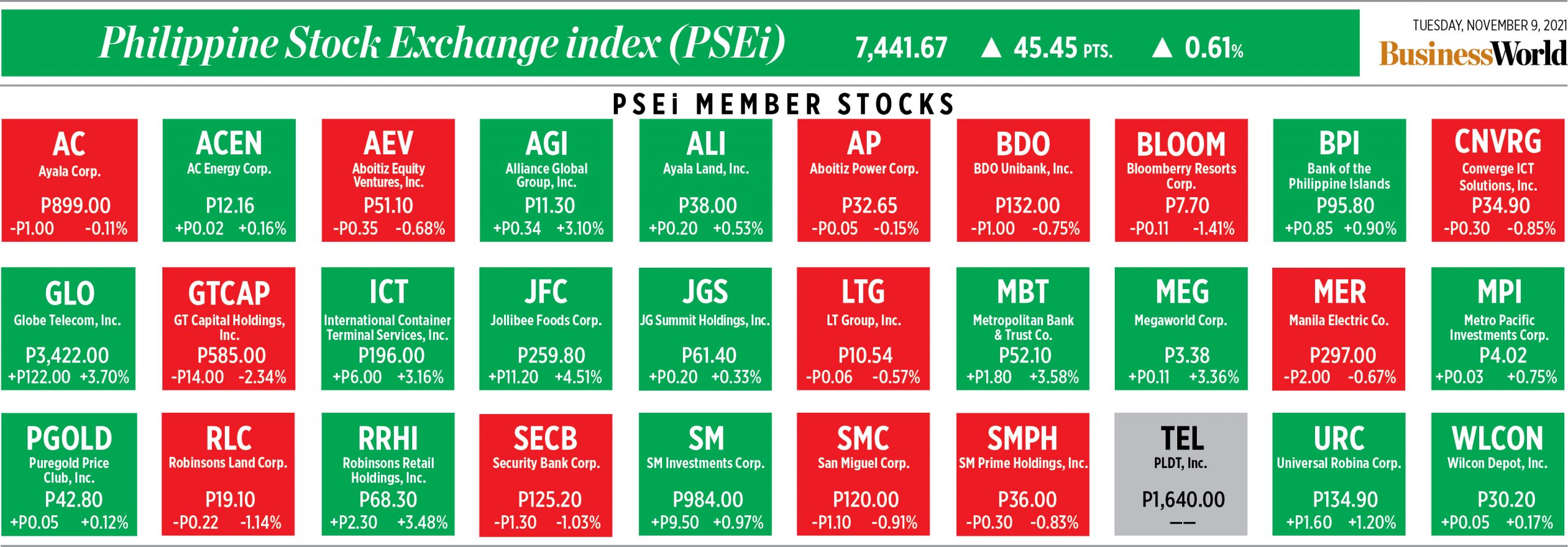
How PSEi member stocks performed — November 9, 2021

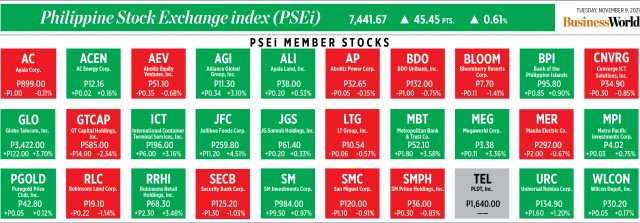
Here’s a quick glance at how PSEi stocks fared on Tuesday, November 9, 2021.


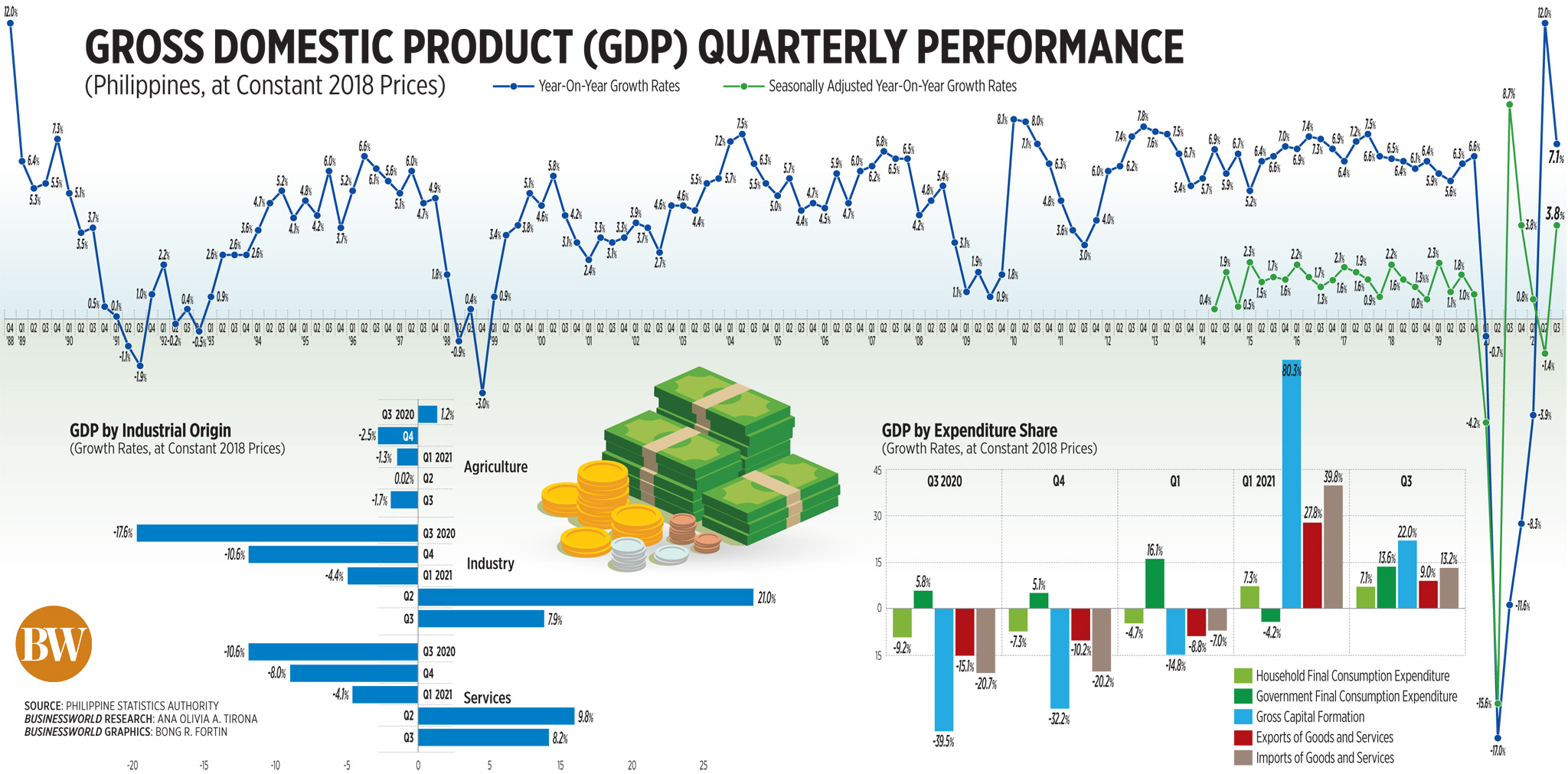
Gross domestic product (GDP) quarterly performance

THE PHILIPPINE economy grew faster than expected in the third quarter, putting it on track to meet the upper end of the government’s full-year growth target and return to pre-pandemic level as early as the first quarter of 2022. Read the full story.

Gross domestic product (GDP) quarterly performance

Peso climbs on strong Q3 GDP growth

BW FILE PHOTO
THE PESO rose on better-than-expected gross domestic product data. — BW FILE PHOTO

THE PESO strengthened versus the greenback on Tuesday amid upbeat sentiment on the Philippine economy following better-than-expected growth in the third quarter.

The local unit ended trading at P50.091 per dollar on Tuesday, gaining 6.9 centavos from its P50.16 close on Monday, based on data from the Bankers Association of the Philippines.

This is the currency’s strongest close since it ended trading at P49.95 on Sept. 17, Rizal Commercial Banking Corp. Chief Economist Michael L. Ricafort said in a Viber message.

The peso opened Tuesday’s session at P50.12 per dollar, stronger than its previous day’s close. Its weakest showing was at P50.18, while its intraday best was at P49.925 versus the greenback.

Dollars exchanged increased to $1.385 billion on Tuesday from $933.2 million.

A trader said the stronger- than-expected economic growth posted in the previous quarter supported the peso.

“The latest reading also set the year-to-date growth at 4.9%, firming expectations that full-year 2021 economic growth will likely fall within the government’s 4% to 5% forecast range,” the trader said in an e-mail.

Gross domestic product expanded by 7.1% year on year in the third quarter, slower than the 12% growth in the April to June period, the Philippine Statistics Authority reported on Tuesday. Still, it was stronger than the 4.7% median estimate in a BusinessWorld poll of 18 analysts held last week.

Meanwhile, Mr. Ricafort said local stock market gains also fueled positive market sentiment.

The Philippine Stock Exchange index gained 45.45 points or by 0.61% to end trading at 7,441.67 on Tuesday.

The wider all shares index likewise gained by 20.97 or 0.46% to close at 4,531.86.

For Wednesday, the trader gave a forecast range of P50 to P50.25, while Mr. Ricafort expects the local unit to move within P49.97 to P50.17 per dollar. — L.W.T. Noble

Shares rally on better-than-expected GDP print

REUTERS

PHILIPPINE SHARES continued to rally on Tuesday after the country logged a better-than-expected gross domestic product (GDP) growth in the third quarter.

The benchmark Philippine Stock Exchange index (PSEi) went up by 45.45 points or 0.61% to close at 7,441.67 on Tuesday, while the broader all shares index climbed 20.97 points or 0.46% to end at 4,531.86.

“Market rallied for the second day this week as GDP [data] came in better than expected. The Philippine economy rose 7.1% in the [third quarter], significantly higher than [the] consensus forecast of 4.6% and was among the fastest in the ASEAN (Association of Southeast Asian Nations),” Papa Securities Corp. Equities Strategist Manny P. Cruz said in a text message.

“GDP growth in the first three quarters averaged 4.9%, near the upper end of the target range of 4% to 5% for the year,” he added.

The Philippine Statistics Authority reported on Tuesday that the economy expanded by 7.1% in the third quarter versus the 11.6% contraction posted in the same period last year. However, this was slower than the upward-revised 12% GDP growth in the second quarter.

“Value turnover remained considerable… as net foreign buying remained robust,” Mr. Cruz said.

Value turnover increased to P9.49 billion with 1.31 billion issues traded on Tuesday, higher than the P8.30 billion with 1.34 billion shares seen the previous trading day.

Meanwhile, net foreign buying decreased to P812.74 million on Tuesday from the P908.47 million logged on Monday.

“In the international scene, market participants may be feeling positive over the global economic reopening, amid the recent promising results over a possible COVID-19 (coronavirus disease 2019) pill,” Timson Securities, Inc. Trader Darren Blaine T. Pangan said in a Viber message.

Pfizer, Inc. and BioNTech SE developed an antiviral drug to reduce the risk of severe COVID-19. The early trial of the pill was halted after it was reported to be 89% effective.

Last week, Britain became the first country to approve a COVID-19 antiviral pill developed by Merck & Co., Inc. and Ridgeback Biotherapeutics.

Majority of sectoral indices posted gains on Tuesday except for property, which lost 3.84 points or 0.11% to 3,380.12.

Meanwhile, services gained 27.41 points or 1.38% to finish at 2,006.76; industrials rose 103.17 points or 0.95% to 10,952.65; financials picked up 9.55 points or 0.58% to 1,645.89; mining and oil went up by 55.29 points or 0.55% to close at 9,938.43; and holdings firms increased by 31.80 points or 0.44% to 7,157.70.

Advancers beat decliners, 103 against 87, as 48 names closed unchanged.

“[The] 6,940 remains the immediate support area, while 7,510 seems to be the closest resistance level to watch,” Mr. Pangan said. — Keren Concepcion G. Valmonte

Duterte daughter quits Davao mayoralty race

DAVAO City Mayor and presidential daughter Sara Duterte-Carpio

By Kyle Aristophere T. Atienza, Reporter

DAVAO City Mayor and presidential daughter Sara Duterte-Carpio on Tuesday withdrew her bid for reelection, which allows her to potentially run for higher office.

She announced her quitting in a Facebook post with her photo at a local Commission on Elections office. She did not give a reason for the move.   

Ms. Carpio said her brother, Vice Mayor Sebastian Duterte, would run for the city’s top post instead. He quit his reelection bid earlier in the day also without citing a reason. The presidential son is on his first term and was running for a second term unopposed. 

Ms. Carpio, who has said she would not run for a national position next year, might run in tandem with the late dictator’s son Ferdinand “Bongbong” R. Marcos, Jr., according to political analysts.

She and former Senator Ferdinand “Bongbong” R. Marcos, Jr. met in Cebu last month, fueling speculations that the two were preparing to cement their tandem for the 2022 elections.

She confirmed her meeting with Mr. Marcos in photos she shared on her social media accounts.

President Rodrigo R. Duterte last month dropped out of the vice-presidential race and said his daughter would run for president next year, in tandem with Senator Christopher Lawrence T. Go. The president also said he was retiring from politics next year.

Ms. Carpio had declined to comment on her father’s announcement.

Mr. Duterte, who had flip-flopped on his 2016 presidential run, earlier said he would drop out of the vice-presidential race if his daughter runs for president.

“This development was actually expected given that the substitution period is still open,” said Maria Ela L. Atienza, a political science professor from the University of the Philippines.

Ms. Carpio, whose regional party has allied itself with traditional parties less than a year before the 2022 elections, has topped presidential opinion polls.

She may still run for a national post via substitution, which allows a political party to replace a member who filed a certificate of candidacy with another member. Filing ended on Oct. 8 but substitution is allowed until mid-November.

Ms. Carpio would need to become a member of the ruling PDP-Laban if she were to substitute for its presidential bet Senator Ronald M. Dela Rosa, Ms. Atienza said in a Viber message. She may also replace Mr. Go as PDP-Laban’s vice-presidential candidate.

A Duterte-Marcos rivalry for president would divide their supporters, she said.

On the other hand, a potential Marcos-Duterte tandem would be “a strong team in terms of current supporters and resources,” Ms. Atienza said. “However, neutral voters may be getting tired of all the drama surrounding Sara and Bongbong and their supporting cast.”

“For the opposition, a Sara-Bongbong or Bongbong-Sara team may be harder to beat and some adjustments in the campaign might be needed,” she added.

There’s a strong chance for Ms. Carpio to run in tandem with Mr. Marcos since she already expressed support for the latter’s presidential campaign, said Robin Michael Garcia, a political economy professor at the University of Asia and the Pacific.

“Mayor Sara knows she has a good chance of winning for any higher position next year,” he said in a Facebook Messenger chat. “Perhaps her perceived hesitance is to ensure the optimal conditions are set for a potential higher leadership position.”

Other political observers have said the administration is trying to create an impression that a Duterte brand of leadership was still needed.

Political analysts earlier said Filipinos might now be wary of substitution, which Mr. Duterte used in the 2016 presidential race. His presidential run did not become official until the last minute.

They also said the ruling camp might be doing everything to remain in power to protect Mr. Duterte from potential lawsuits.

The International Criminal Court (ICC) has ordered an investigation of Mr. Duterte’s crackdown on illegal drugs that has killed thousands, saying crimes against humanity might have been committed.

The court will also probe vigilante-style killings in Davao City when Mr. Duterte was still its vice mayor and mayor.

There have been speculations that the Dutertes would consider the son and namesake of the late dictator Ferdinand E. Marcos as either a presidential or vice-presidential candidate.

Political analysts have said Mr. Duterte could not afford to lose support from the Marcoses because their loyal backers supported his presidential bid in 2016.

A recent Pulse Asia Research poll showed that Ms. Carpio and Mr. Marcos were among the top choices for president. — with Maya M. Padillo

Daily COVID-19 tally lowest in 9 months; active cases at 30,544

PHILIPPINE STAR/ MICHAEL VARCAS

THE DEPARTMENT of Health (DoH) reported 1,409 coronavirus infections on Tuesday, the lowest in almost nine months.

Tuesday’s tally was the eighth straight day that cases were fewer than 3,000, bringing the total to 2.8 million.

The agency reported only 46 more deaths due to technical issues, bringing the total to 44,567, while recoveries increased by 2,941 to 2.7 million, according to a bulletin.

There were 30,544 active cases, 60.7% of which were mild, 8% did not show symptoms, 10% were severe, 17.05% were moderate and 4.2% were critical.

DoH said nine duplicates had been removed from the tally, eight of which were recoveries, while 46 recoveries were reclassified as deaths. Fourteen laboratories failed to submit data on Nov. 7.

It said 42% of intensive care units in the Philippines were occupied, while the rate for Metro Manila was 37%.

The Philippines was set to take delivery on Tuesday of 793,900 doses of the vaccine made by AstraZeneca Plc, presidential spokesman Herminio L. Roque, Jr. told a televised news briefing.

He said almost 64.9 million doses of coronavirus vaccines had been given out as of Nov. 8.

Almost 29.8 million people or 38.64% of adult Filipinos have been fully vaccinated against the coronavirus, he added.

In the capital region, 90% or 8.8 million of 9.8-million residents have been fully inoculated.  About 99.4% of Metro residents have received their first dose. Mr. Roque said 749,424 doses were injected on Monday.

The government is targeting to give out as many as 1.5 million vaccine doses daily starting Nov. 20.

Meanwhile, Mr. Roque said passing a law on compulsory vaccination would not violate the Philippine constitution.

Vaccine czar Carlito G. Galvez, Jr. earlier said he was in favor of making coronavirus vaccinations mandatory.

Mr. Roque said the state could exercise its police power to make COVID-19 vaccination compulsory.

Lawmakers need to pass a law to make mandatory vaccination legal, he said. “Once a law is passed, there can’t be any objections because there have been decisions by the Supreme Courts of the Philippines and the United States recognizing the validity of such laws,” he said in Filipino.

Mr. Roque also noted that while requiring beneficiaries of the government’s conditional cash transfer program to get vaccinated is reasonable, the law that created it should be amended first.

The Philippines targets to inoculate at least 50% of its adult population by yearend, as it reopens its economy amid decreasing coronavirus infections.

Mayors in the capital region have asked the government not to require face shields anymore, except in critical areas such as hospitals, village health centers and public transportation.

Metro Manila mayors made the recommendation to an inter-agency task force during a recent meeting.

Manila City Mayor Francisco “Isko” M. Domagoso on Monday signed an order allowing residents of the capital not to wear face shields anymore except in hospitals.

Mr. Roque on Monday said people should continue to use face shields pending review by the task force of the mayors’ proposal.

Mayors should follow the task force, which “exercises derivative authority from the President,” he said, adding that mayors are under the President.

Mr. Roque said the order of Mr. Domagoso, who is running for president next year under a rival political party, is void “for being in violation of an existing executive policy decreed by the President himself in the exercise of police powers.” — Kyle Aristophere T. Atienza