THE BANGKO SENTRAL ng Pilipinas (BSP) is widely expected to keep policy rates unchanged at its Thursday meeting, as the economy’s recovery is clouded by the spread of the Delta variant of the coronavirus disease 2019 (COVID-19). Read the full story.
THE PESO could appreciate versus the greenback this week on muted dollar demand due to the Metro Manila lockdown, but market sentiment could take a hit from rising coronavirus infections and slower-than-expected economic data.
The local unit closed at P50.40 per dollar on Friday, losing 16.5 centavos from its P50.235 finish on Thursday, data from the Bankers Association of the Philippines showed.
It also weakened by 43 centavos from its P49.97-per-dollar finish the previous week.
The peso depreciated following the release of trade balance data, which showed imports continued to rise, Rizal Commercial Banking Corp. Chief Economist Michael L. Ricafort said, as this could mean increased demand for the dollar.
Peso-dollar trading last week also took cues from hawkish signals from the US Federal Reserve on the timing of the tapering of its bond purchases, UnionBank of the Philippines, Inc. Chief Economist Ruben Carlo O. Asuncion said.
For this week, Mr. Asuncion said the peso may be supported by reduced demand for the dollar due to the lockdown in Metro Manila. However, sentiment may remain cautious due to the surge in coronavirus infections.
Meanwhile, Mr. Ricafort said the market is waiting release of the second-quarter gross domestic product (GDP) data on Tuesday, Aug. 10.
The Monetary Board’s policy review on Aug. 12 will also be a driver for this week’s trading, he added.
A BusinessWorld poll of 20 economists yielded a median GDP growth estimate of 10.6% in the second quarter mainly due to base effects. If realized, this would mean the country’s exit from recession and a first-half growth print of 2% — still below the 6-7% target of the government for 2021.
Meanwhile, 18 analysts in a separate BusinessWorld poll expect the central bank to retain benchmark interest rates at their current record lows at Thursday’s meeting as the Delta variant threatens economic recovery and with lending activity still weak.
For this week, both Mr. Asuncion and Mr. Ricafort expect the peso to move within P50 to P50.50 versus the dollar. — L.W.T. Noble
INVESTORS are expected to continue monitoring the country’s coronavirus disease 2019 (COVID-19) situation, with several areas under the strictest form of lockdown due to rising cases, as well as the release of second quarter gross domestic product (GDP) data on Tuesday.
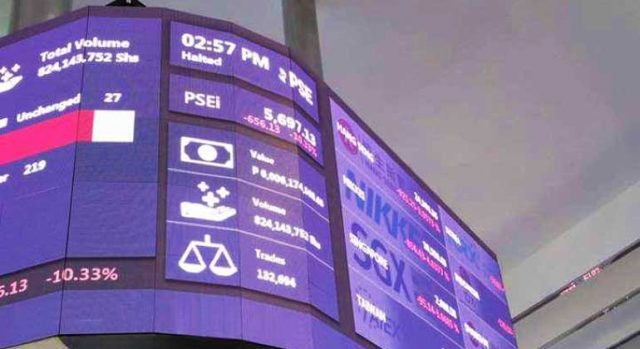
The 30-member Philippine Stock Exchange index (PSEi) inched down by 7.36 points or 0.11% to close at 6,539.91 on Friday. Meanwhile, the broader all shares index went up by 12.85 points or 0.31% to finish at 4,055.42.
Week on week, the PSEi climbed 269.68 points from its 6,270.23 finish on July 30.
“Bargain hunting lifted the local market this past trading week by 4.30%,” Philstocks Financial, Inc. Senior Research Analyst Japhet Louis O. Tantiangco said in a Viber message on Saturday.
“The rally was supported by optimism towards the second quarter corporate reports which have shown good results primarily due to low base effects,” he added. “This past trading week’s climb was also supported by foreign investors, with foreign net flows amounting to P397.61 million.”
“During the second half of the week, the market took a breather as participants chose to stay cautious while monitoring how the Delta variant’s global spread will affect our economic prospects,” Timson Securities, Inc. Trader Darren Blaine T. Pangan said in a Viber message on Saturday.
For this week, investor focus will be on the country’s COVID-19 situation and upcoming economic data.
“Investors are expected to monitor our COVID-19 situation following the recent rise in case counts, and the detection of more cases with the infectious Delta strain,” Philstocks Financial’s Mr. Tantiangco said. “A sustained surge in our COVID-19 case counts, and a detection of more Delta variant cases may cause a decline in the local bourse since it raises the risks of prolonging the strict quarantine measures in the parts of the country where it is implemented.”
The Health department reported 11,021 new cases on Saturday to bring active infections to 76,063.
“[The] market [is] still on a losing streak, but [it’s] tempering ahead of the second-quarter GDP growth release [this] week, [which is] expected to show Philippine exit from recession,” First Metro Investment Corp. Head of Research Cristina S. Ulang said in a Viber message on Friday.
“If a slow [year-on-year] growth is seen for our economy this second quarter, then it may also give rise to negative sentiment in the market,” Philstocks Financial’s Mr. Tantiangco added.
A BusinessWorld poll of 20 economists yielded a median GDP growth estimate of 10.6% in the second quarter mainly due to base effects. If realized, this would mean the country’s exit from recession and a first half growth print of 2% — still below the 6-7% target of the government for 2021.
Mr. Tantiangco placed the market’s support at 6,400 with a resistance of 6,600, while Timson Securities’ Mr. Pangan expects a trading range of 6,270 to 6,600. — K.C.G. Valmonte
THE GOVERNMENT plans to begin construction of a 12.30-kilometer segregated bus lane from Manila City Hall to Philcoa in Quezon City next year or early 2023, the Transportation department said.
“Construction is targeted to start in end 2022 or early 2023,” the Department of Transportation told BusinessWorld on Aug. 6 when asked for an update on the Metro Manila Bus Rapid Transit (BRT) Line 1 project.
“Procurement for the social management consultant and technical support consultant is ongoing. Updates on the Feasibility Study designs are about to commence,” the department added.
The segregated bus lane project, which is expected to be completed in 2023, will have designated passenger boarding and alighting stations and passenger terminals.
The Metro Manila BRT Line 1 is projected to serve up to 290,000 commuters daily once completed.
The World Bank is funding the project, which is being implemented by the Transportation department in coordination with the Manila and Quezon City governments.
The World Bank approved the financing for the project in 2017. According to its website, the project’s total cost is $109.41 million, while the committed amount is $40.70 million.
The loan for the project is set to expire on Nov. 30, 2022.
“The objective of… (the Metro Manila BRT Line 1) for Philippines is to improve the efficiency, effectiveness and safety of the public transport system along the project corridor in Metro Manila in an environmentally sustainable manner,” the World Bank said.
The World Bank is also funding the 13.2-kilometer Cebu Bus Rapid Transit (Cebu BRT) project.
The Cebu BRT hopes to serve as many as 60,000 passengers daily once fully operational in May 2022.
The World Bank said the committed amount for the project is $116.00 million, while the total project cost is $228.50 million.
“The Cebu Bus Rapid Transit Project of the Philippines has an objective to improve the over-all performance of the urban passenger transport system in the project corridor in Cebu City in terms of the quality and level of service, safety, and environmental efficiency,” it noted.
Transportation Secretary Arthur P. Tugade wants to achieve partial operability before the end of 2021.
Once completed, the Cebu BRT “will be fielding 250 buses with at least 21 stations,” the Transportation department said on its website.
THE DEPARTMENT of Labor and Employment (DoLE) said it has distributed P13 billion to its regional offices, and is seeking P2 billion more to support a cash-for-work program, which budget officials said will be forthcoming once the original funds are spent.
“The P13 billion… has been obligated and downloaded to the regional offices,” the Labor department’s Information and Publication Service Director Raul M. Francia said in a Viber message on Sunday.
The P13 billion will help fund programs like the Tulong Panghanap-Buhay Para sa Ating Disadvantaged/Displaced Workers (TUPAD), which has an overall budget of P18 billion this year.
Mr. Francia said the request for the additional P2 billion “still stands.”
The government is rushing to put together aid packages in light of the new lockdown to deal with the spread of the coronavirus Delta variant, including other forms of direct cash aid for poor people unable to work because of quarantine rules.
On Thursday, Department of Budget and Management Undersecretary Tina Rose Marie L. Canda said DoLE must first utilize the P13 billion in emergency funds before it asks for additional money.
“They still have P13 billion from various emergency employment programs, so they can utilize (that) first, then afterwards, (if it is really not enough), then we can release an amount for their use,” Ms. Canda said in an interview on CNN Philippines.
Ms. Canda specifically mentioned TUPAD, which provides temporary employment for displaced, underemployed, and seasonal workers for a minimum period of 10 days and a maximum of 30 days, depending on the nature of work to be performed.
Beneficiaries of the program will be hired for social, economic, and agro-forestry community projects such as the repair, maintenance, and/or improvement of common public facilities and infrastructure, tree planting, seedling preparation, and reforestation.
In a briefing Tuesday, Mr. Francia said DoLE has “no more savings,” and that only P4 billion remains in its budget for the TUPAD program.
On Wednesday, Mr. Francia said the department will allocate P2 billion from the TUPAD program for cash assistance to workers who will be affected by the two-week lockdown in the capital region and other areas while waiting for the Budget department’s decision on its request for another P2 billion in cash aid.
According to the request for P2 billion, the distribution will be: P776 million for workers in Metro Manila, P298.5 million in Central Luzon, P179.1 million in Calabarzon (Cavite-Laguna-Batangas-Rizal-Quezon), P159.2 million in the Western Visayas, P39.8 million in Northern Mindanao, and P537.3 million for other areas that may be placed under the strictest quarantine settings.
Mr. Francia added that the P2-billion budget, if approved, will benefit 398,000 workers with each to be given up to about P5,000.
The Labor department earlier projected that around 400,000 workers will be affected by the two-week lockdown. — Bianca Angelica D. Añago
A CONSUMER protection group called for efforts to stabilize food prices as producers seek higher prices for their goods, citing global supply chain disruptions, which have increased their import costs.
Laban Konsyumer, Inc. President Victorio A. Dimagiba said in a Viber message Saturday: “Keeping prices at bay is the better option. (The) food sector made money even last year,” he said.
The Philippine Chamber of Food Manufacturers, Inc. (PCFMI) said that the industry has been absorbing additional costs in the import of raw materials and finished products due to the supply chain disruptions, and must pass on some expenses to consumers.
Importers of raw materials, finished goods, and packaging materials are being charged higher shipping fees, the business group said.
The Department of Trade and Industry has said that the requests for higher prices for essential goods are being reviewed, although a new suggested retail price bulletin is on hold after the capital region was returned to a stricter lockdown setting to curb the spread of the coronavirus disease 2019 (COVID-19) Delta variant.
Mr. Dimagiba said that the concerns of the companies are fair due to the shipping constraints.
He said however that it is important to verify the quantities of raw materials and finished goods being imported.
“Both parties should be transparent that there should be no stock inventory that can lead to windfall profits,” he said.
“Also the peso’s exchange rate should be the average for the past three years including 2019 for the regulator to know whether the importers spent more or less for materials. Energy was cheaper last year. There should be offsetting of costs.”
The PCFMI has said that any price increases would not be significant, and called on the government to regulate what it called exorbitant shipping charges. — Jenina P. Ibañez
THE Tokyo Olympics could well be the last for top Filipino weightlifter Hidilyn Diaz, which is why she is determined to make it the best yet for her in the event she qualifies for the quadrennial sporting spectacle. — 2019 SEA GAMES WEBSITE
2019 SEA GAMES WEBSITE
A LEGISLATOR is confident that a bill seeking to make monetary donations and rewards given to international athletes will pass, in the wake of the Philippines’ successful Olympic campaign in Tokyo.
Albay Rep. Jose Ma. Clemente S. Salceda said in a statement Saturday that he is positive that the measure will be approved by the House Committee on Ways and Means, which he chairs.
“We will do it on Monday. We will probably approve it, too since no one is opposed.”
House Bill No. 9891 or the Hidilyn Diaz Act of 2021 seeks to amend Section 4 of Republic Act (RA) No. 10699, the National Athletes and Coaches Benefits and Incentives Act, to exempt rewards and bonuses granted to athletes and coaches who win international sport competitions from any tax, charges, or fees by any government agency.
This would add to existing benefits already provided by RA 10699 for athletes and coaches in the national team, such as discounts and free medical and dental consultations in government hospitals.
“It appears our laws were unable to anticipate the outpouring of material solidarity from different sectors of society for winning athletes and coaches,” Mr. Salceda said in his explanatory note.
He has sought the consolidation of pending measures filed by Quezon City Rep. Precious H. Castelo and Senior Citizens Party-list Rep. Rodolfo M. Ordanes to serve as a substitute bill.
Meanwhile, Misamis Oriental Rep. Juliette T. Uy, vice-chair of the Committee of Appropriations, said Saturday that the most recent Olympic success, the silver medal won by boxer Carlo Paalam, will be “on the back of her mind” when considering sports-related matters during deliberations for the 2022 national budget.
“The country needs more sports research and many more graduates of sports college degrees and more masters and doctoral programs, so I will write to Commission on Higher Education and [the] Department of Science and Technology on how these can be accomplished through the 2022 national budget,” she said. — Russell Louis C. Ku
THE DEPARTMENT of Trade and Industry (DTI) is backing the development of a regional circular economy plan in Southeast Asia after the recent conclusion of economic talks.
The Framework of the Circular Economy for the ASEAN Economic Community (AEC) will identify priorities in the region’s work supporting sustainable economic growth. The group of 10 Southeast Asian nations plans to adopt the framework in October, the DTI said in a statement Sunday.
“We support the finalization of the Framework on Circular Economy as this will guide AEC work on sustainable development, support cross-pillar cooperation, and serve as a building block to ASEAN Post-2025 Work,” DTI Assistant Secretary Allan B. Gepty said.
A circular economy is a system designed to make economies more sustainable by, among others, addressing climate change, by designing products for sharing and reuse and eliminating waste.
House Bill No. 7609 or “An Act to Promote Circular Economy and a Whole-of-Nation Transition Towards a Sustainable Future,” which aims to support sustainable development initiatives, is pending at the House Committee on Economic Affairs.
A meeting among ASEAN (Association of Southeast Asian Nations) senior economic officials was held virtually on Aug. 2-4 marked the completion of economic initiatives such as the launch of a one-stop shop for internationally-oriented small businesses. The group has also developed a roadmap for Smart manufacturing.
“We are confident that this momentum would also allow us to further our work, such as in finalizing the Guidelines on MSME (micro-, small-, and medium-sized enterprises) Crisis and Disaster Resilience by end of the year,” Mr. Gepty said.
Officials during the meeting also discussed investment facilitation, the region’s industrial revolution strategy, and expanding the list of goods exempt from restrictive trade measures during the public health crisis.
The 10 member states in November 2020 signed a memorandum of understanding committing to refrain from non-tariff restrictive trade measures on a list of essential goods to prevent supply disruptions during the coronavirus disease 2019 (COVID-19) pandemic. Trade Secretary Ramon M. Lopez has been pushing for the inclusion of rice in the list of essential goods. — Jenina P. Ibañez
While many organizations have embarked on implementing more agile, people-centric and digitally-enabled workplaces, these same enterprises were not sufficiently equipped to deal with the rapid proliferation of COVID-19. After more than a year of adapting to the new normal and transforming how we work, it became evident that employees, workplaces, and the future of work have changed in significant ways that we could not have previously imagined. According to the EY 2021 Work Reimagined Employeesurvey, which comprises the results of interviews with more than 16,000 employee respondents across 16 countries, employees are fully embracing the flexibility that has made remote work possible, with 48% of respondents believing that their company culture improved during the pandemic.
In the first part of this article, we discussed how companies need to understand the new normal worker, enabled by technology. In this second part, we continue by determining when and where work can be done in terms of remote and hybrid workspaces, and the necessity of making data-driven decisions fueled by workforce insights.
WHEN AND WHERE CAN WORK BE DONE Transitioning to video conference meetings and online chat presented a number of challenges. Employees reported varying levels of distress learning to manage remote work and work-life balance, such as a lack of boundaries, losing track of time over days and weeks, and feelings of isolation. These were the most common concerns raised in an EY Work Reimagined Leader’s Forum in the discussion on the challenges posed by remote work. In the survey, 78% employees and leaders responded that they felt the increased pressure to be constantly connected to their jobs.
Up to 77% of survey participants also selected the loss of human connectivity as their top concern about increased technology adoption and agile working. This indicates that human connections still matter — and are perhaps even more important now as many employees globally face limitations on mobility, travel and returning to physical work spaces.
In light of this, companies should consider incorporating “digital well-being” into their technology and tools to help employees manage remote work, such as leveraging fitness apps or digital fitness programs and emotional well-being apps to sync with enterprise technology. This technology aims to give employees insight into when they need to recharge and disconnect.
Leaders designing remote and hybrid work strategies will want to position employee well-being at the forefront. They will need to understand what well-being features available in enterprise tech can benefit their employees and, concurrently, reinforce leadership communications that emphasize how they prioritize and support the well-being of their people. Despite the widespread adoption of remote work, survey data indicates that most employees are still not ready to embrace a completely virtualized work experience. The study shows that two-thirds of respondents wish to resume some form of business travel, and that a large majority of employees would prefer to work in the office two to three days a week once it is safe to do so.
Many corporate leaders are already creating hybrid workplace strategies that bring together remote and in-office work. However, the hybrid work model risks falling flat unless the purpose of the office is made clear: as a place that helps people accomplish their best work and create meaningful connections. Employees enabled by technology have already realigned their working style to be more agile and flexible. New tools and technologies have already set the workforce on a new trajectory underpinned by flexibility. Based on the EY survey results, tomorrow’s employees will likely desire more freedom to design their workdays and meet virtually or in-person when needed to innovate and collaborate. In brief, employees want the flexibility to choose where and when to work while assisted by technology at all end points.
To capitalize on this trend, the Chief Human Resources Officer (CHRO), Chief Technology Officer (CTO) and the Head of Corporate Real Estate should deliberate and consider how future work models can offer diversity and flexibility while encouraging a diverse and inclusive workforce, finding a good balance among location, technology and human interaction to bring out the best in their people.
MAKING DATA-DRIVEN DECISIONS Leaders now have access to technology to drive their organizations forward, becoming increasingly accustomed to written communications and virtual appearances. The increased deployment of survey technology also allows leaders to align more quickly to their company purpose and employee needs.
Leadership communication has improved in terms of expressing empathy, trust, and support, according to one comment at the EY Work Reimagined Leader’s Forum. The pandemic had a humbling effect on everyone, especially leaders, leading people to be kinder and more considerate under the collective challenges that we are all experiencing today. Technology rapidly broke down barriers between leadership, management, and employees, allowing leadership to sustain a more positive culture that saw gains in 2020.
Technology leaders and the CHRO can support leadership by exploring technologies that can measure sentiment in real time during leadership video messages and livestreams. It will be important to constantly listen and collect workforce feedback to provide leadership with timely insights. Moreover, it’s no longer enough for leaders to delegate digital leadership — leaders must understand the interplay between technology and megatrends to enable their businesses to deliver long-term value and remain relevant post-pandemic.
THE WORKPLACE OF THE FUTURE The future of work, where we work and how we respond to work have all been transformed by technology, and organizations that navigate this seismic shift can successfully take advantage of its transformative opportunities. Leaders will need to continue assessing how the new ways of working can further enhance productivity among their employees to make more informed decisions about what can be kept or improved.
This article is for general information only and is not a substitute for professional advice where the facts and circumstances warrant. The views and opinions expressed above are those of the author and do not necessarily represent the views of SGV & Co.
Lisa Marie T. Escaler is the People Advisory Services –Workforce Advisory (PAS WFA) Leader of SGV & Co.
RESIDENTS of Caloocan line up for their vaccine at A. Bonifacio Elementary School on Aug. 6. — PHILIPPINE STAR/MICHAEL VARCAS
By Kyle Aristophere T. Atienza, Reporter
METRO Manila hit record daily coronavirus infections at the weekend while under a strict lockdown according to researchers from the county’s premier university.
The OCTA Research Group from the University of the Philippines on Sunday said 2,823 people got infected on Saturday, the highest since May 2, when it was also under an enhanced community quarantine amid a fresh surge in cases.
The virus reproduction ratein Manila the capital and nearby cities increased to 1.8 from 1.56 a week ago, it said in a report.
“The strong upward trend and level of new cases resemble the situation in March 9 to 15, two weeks before the National Capital Region (NCR) was placed under an enhanced community quarantine,” OCTA said.
The rapid growth rate strongly suggests that the more contagious Delta coronavirus variant was now the dominant strain in the region, it said.
The researchers said 31% of the Health department’s sampled cases had the Delta variant, higher than 16% two weeks ago.
The intensive care unit (ICU) occupancy rate in the region was still safe at 59% though it increased by an average of 11 a day in the past two weeks, OCTA said.
The hospital bed occupancy in the region was also safe at 53% though it increased by 94 a day in the past two weeks.
“With the current trends, ICU occupancy will be above 70% in two weeks,” OCTA said. “Hospital bed occupancy will be above 70% in three weeks.”
OCTA said the virus positivity rate in Metro Manila had increased to 14% from 10% a week ago.
If the decision to place Metro Manila under a strict lockdown had been delayed to Aug. 15, the region would have breached 4,500 new cases daily, “which would likely extend the lockdown and cause more negative impact on people and the economy,” OCTA said.
President Rodrigo R. Duterte placed Metro Manila under a strict lockdown for two weeks starting Aug. 6 after OCTA said the Delta variant from India might be freely roaming in communities.
Coronavirus infections in Metro Manila would continue to increase even if authorities extend the two-week lockdown in the region, Health Undersecretary Maria Rosario S. Vergeire said on Saturday.
Active coronavirus cases in Metro Manila were expected to reach tens of thousands, Ms. Vergeire said.
The Health department on Friday said Delta cases had been detected in all 17 cities and one municipality in the capital region. It said 119 more people had been infected with the Delta variant, bringing the total to 450.
The Health department reported 9,671 coronavirus infections on Sunday, bringing the total to 1.65 million.
The death toll rose to 29,122 after 287 after more patients died, while recoveries increased by 8,079 to 1.56 million, it said in a bulletin.
There were 77,516 active cases, 93.2% of which were mild, 2.8% did not show symptoms, 1.7% were severe, 1.20% were moderate and 1% were critical.
The agency said 96 duplicates had been removed from the tally, 92 of which were recoveries. Three recoveries were reclassified as active cases, while 149 recoveries were reclassified as deaths.
The presidential palace on Saturday said Bataan province would be under an enhanced lockdown from Aug. 8 to 22 to contain rising infections. The northern Philippine province was earlier placed under a modified enhanced quarantine until Aug 15.
On Thursday, Mr. Duterte put Iloilo City, Laguna and Cagayan De Oro under an enhanced community quarantine.
OCTA researchers earlier traced the fresh infection surge to the Delta variant, which was also spreading rapidly in Malaysia, Thailand and Indonesia.
The Philippines on Saturday posted more than 10,000 infections for the second straight day and more than 100 deaths for the third day in a row.
RECOVERY from a coronavirus pandemic would take center stage in the campaign for the 2022 elections, according to political analysts.
The opposition might have a chance of winning if it can present a viable pandemic recovery plan, they added.
“The government’s pandemic response and economic downturns as a result of the crisis are two issues that would take center stage in the campaign season,” Maria Ela L. Atienza, a political science professor at the University of the Philippines, said in an e-mail.
President Rodrigo R. Duterte’s political opponents might try to win voters by citing his administration’s mishandling of the health crisis, she added.
Poverty, hunger and joblessness as well as rising commodity prices are key issues that will be in the minds of voters next year, Victor Andres Manhit, president of think tank Albert del Rosario Institute for Strategic and International Studies said in a Facebook Messenger chat.
The 2022 elections would become a referendum on the Duterte administration’s handling of the coronavirus pandemic, he said.
Nine of 10 Filipinos thought government response to the pandemic has been inadequate, according to a poll by Pulse Asia Research in June. Filipinos cited the lack of financial aid, slow and inefficient vaccine rollout and failure to enforce health protocols. Jobless Filipinos rose to 3.76 million in June from 3.73 million a month earlier, according to the local statistics agency. About 6.409 million Filipinos were underemployed.
A strict lockdown in Metro Manila from Aug. 6 to 20 would increase the number of poor people by 177,000, the National Economic and Development Authority has said. It added that 444,000 Filipinos could become jobless.
Mr. Duterte risked his political capital when he failed to outline his game plan against the coronavirus pandemic in his last address to Congress last month, said Dennis C. Coronacion, who heads the University of Santo Tomas Political Science Department.
“Since President Duterte has failed to do this, I expect most of the presidential aspirants to fill the gap and craft their own economic recovery programs,” he said in a Viber message.
“The upcoming election will not just be a referendum on President Duterte’s pandemic response but also on his entire platform of government,” he added.
Mr. Duterte’s popularity might not get severely eroded given how loyal his core followers are, media research expert Jay G. Bautista said in an e-mail.
“The recent political surveys have shown how strong his equity is by ranking in the top three regardless of who among the major opinion polling agencies had conducted the research,” he said. “His followers believe he has done all he can and he is not to blame.”
The tough-talking leader’s popularity is rooted in his consistent rhetoric, which makes people believe that other people are the problem and not his administration or his policies, Jean S. Encinas-Franco, a UP political science professor said in a Viber message.
Gerardo V. Eusebio, a political science professor at De La Salle University, traced Mr. Duterte’s popularity to a weak and divided opposition.
“The real challenge for the opposition is how to break the overwhelming support for Duterte from two interlocking voting blocs — the Mindanao and class E voters scattered on the country’s three major islands,” the campaign strategist said in a Viber message.
The trend may change if the country’s economic situation worsens up to the fourth quarter or extends into the first quarter of 2022, Mr. Bautista said.
Michael Henry Ll. Yusingco, a research fellow at the Ateneo de Manila University Policy Center, said public disappointment about the government’s pandemic response could weaken Mr. Duterte’s popularity and galvanize support for opposition candidates.
“Voters’ disappointment should be enough motivation to vote for change in 2022,” he said in a Facebook Messenger chat. “But the key here is that the vote must be based on evidence and fact.”
Mr. Duterte last month threatened to keep people who refuse to get vaccinated against the coronavirus at home. He also threatened to have them arrested.
Critics have said vaccine shortage, not vaccine hesitancy, is the biggest problem in the government’s vaccination program.