
Big banks post slowest asset growth in 15 years
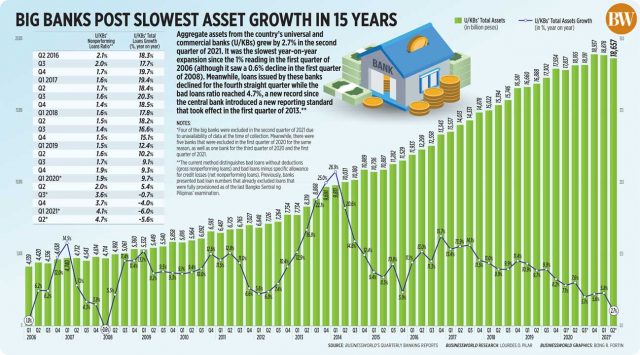
THE IMPACT of the ongoing coronavirus pandemic continued to weigh on banks in the second quarter as assets grew at a slower pace and bad loans piled up. Read the full story.

THE IMPACT of the ongoing coronavirus pandemic continued to weigh on banks in the second quarter as assets grew at a slower pace and bad loans piled up. Read the full story.

By Kyle Aristophere T. Atienza and Alyssa Nicole O. Tan
SENATOR Emmanuel “Manny” D. Pacquiao, Sr. will independently run for President next year if he loses control of the ruling Partido Demokratiko Pilipino–Lakas ng Bayan (PDP-Laban), a party official said on Monday.
The boxing champion was unlikely to join another political party, Ronwald F. Munsayac, executive director of the PDP-Laban faction loyal to Mr. Pacquiao, told an online news briefing.
Rival parties are said to be willing to take the senator in, but he would only “accept their support, not join them,” he added.
The boxing champ did not immediately reply to a text message seeking comment.
But Jake Joson, a long-time special assistant and business partner of Mr. Pacquiao, said Mr. Munsayac should not tell him what to do. He added that the senator is considered by rival parties as a “big asset.”
“The filing of certificates of candidacy is still in October,” he said. “Many changes can still happen.”
The faction led by Mr. Pacquiao on Sunday ousted President Rodrigo Duterte as chairman, replacing him with Senator Aquilino L. Pimentel III. The President had supported the faction led by Energy Secretary Alfonso G. Cusi.
Mr. Munsayac said the Pacquiao group was confident of being upheld by the Commission on Elections as the rightful party officials.
Meanwhile, Senator Christopher Lawrence T. Go declined his nomination by the Cusi faction as PDP-Laban’s presidential bet.
“As I have said many times before, I am not interested in the presidency,” he said in a letter to Mr. Cusi. The senator said he wanted to focus on measures seeking to fight the coronavirus pandemic.
Mr. Duterte, who is barred by law from running for reelection, this month accepted the party’s endorsement for him to run for vice president
Mr. Munsayac said the President’s ouster was meant to save the party. He added that Mr. Duterte had ignored members’ plea to sit down and talk with Mr. Pacquiao, insulting him instead.
The administration of Mr. Duterte is likely to be divided further as the 2022 elections draw near, political analysts said.
“It is possible that there will be a more formal split with two factions surviving or one faction will wither away if there is no sufficient support,” Maria Ela L. Atienza, a political science professor at the University of the Philippines Diliman, said in a Viber message.
The split is typical among Philippine political parties that fail to agree on their chosen candidates, she said.
“If the Pimentel-Pacquiao wing remains strong in terms of supporters and Pacquiao is serious in his presidential bid, support for the President and his anointed presidential candidate will be challenged,” Ms. Atienza said.
The Mindanao support for the Dutertes will be split if Mr. Pacquiao goes ahead with his presidential ambition, she added.
“This demonstrates the disintegration of the coalition,” Antonio M. La Viña, former dean of the Ateneo de Manila University School of Government, said by telephone.
“Pacquiao will also get a lot of votes from Mindanao since he’s one of the most favored candidates in that region,” he said.
Mr. La Viña said the rift could lead to a legal battle if the two camps refuse to accept the election body’s ruling.
“The camp of Pimentel should win the legal contest,” he said. “PDP-Laban is a party of the Pimentels. They have won several times already at the Supreme Court.”
The camp led by Mr. Cusi “has a little advantage because the President is on their side,” said Michael Henry Ll. Yusingco, a senior research fellow at the Ateneo Policy Center.
“They can manipulate the news cycle and get the free airtime they need,” he said in a Facebook Messenger chat. “They have the entire bureaucracy at their disposal.”
He said the rift is irreparable. “The legal proceedings, if commenced, will just determine which faction has the right to carry the name of the party, but it will not settle the acrimony between them.”
The party rift would not matter to voters because Philippine politics is personality-driven, said Jean Encinas-Franco, a political science professor at the University of the Philippines.
“Probably, it will not have an effect on their election prospects since Filipinos do not vote via party lines,” she said in a Facebook Messenger chat.
“In the Philippines, political parties do not really matter” Mr. La Viña said. “They have never mattered in the elections. It’s just about branding.”
The PDP-Laban rift is “an opportunity for the opposition to exploit,” Ms. Atienza said. “But they need a stronger, more united opposition behind a viable opposition candidate.”
“There is still no credible threat to the administration’s chances of winning in the 2022 polls because their opponents are still scrambling to form a united front,” Mr. Yusingco said.
“However, if the opponents of the administration are able to muster a unified challenge under the banner of a single candidate for President, then this can force some administration allies to reconsider their positions” he added.
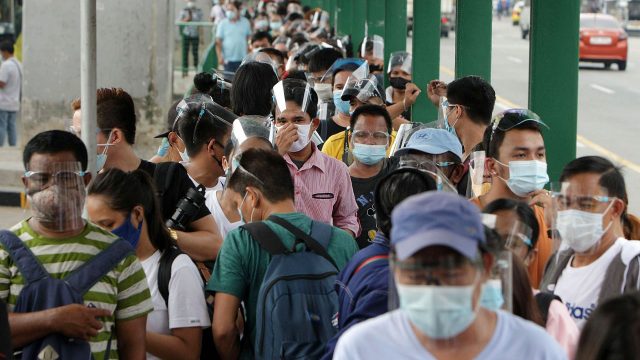
PHILIPPINE health authorities reported 22,366 coronavirus infections on Monday — a record since the pandemic started last year — bringing the total to 1.98 million.
The death toll rose to 33,330 after 222 more patients died, while recoveries increased by 16,864 to 1.8 million, the Department of Health (DoH) said in a bulletin.
There were 148,594 active cases, 95.7% of which were mild, 1.7% did not show symptoms, 1.1% were severe, 0.97% were moderate and 0.6% were critical.
The agency said 187 duplicates had been removed from the tally, 174 of which were tagged as recoveries and one as a death. It added that 105 recoveries were reclassified as deaths. Two laboratories failed to submit data on Aug. 28.
Meanwhile, Hong Kong has banned Philippine Airlines from operating flights between it and Manila after three of the seven imported coronavirus cases confirmed in Hong Kong on Sunday were found to have come from Manila via the airline’s flight PR300, according to the South China Morning Post.
The two-week ban that started on Sunday came a day before a policy shift was to reopen Hong Kong’s doors to domestic helpers vaccinated overseas.
Philippine Airlines’ flights to Hong Kong would only be carrying cargo to Hong Kong during the ban, the company said in an e-mailed statement.
It also said the three passengers — two Filipinos and a Chinese national — had presented negative coronavirus test results when they checked in.
“The top priority of Philippine Airlines has always been the safety and health of our passengers,” it said. “We consistently comply with industry and regulatory safety protocols in the Philippines and abroad.”
Also on Monday, medical frontliners in major hospitals in Metro Manila and Laguna protested the government’s failure to pay them special risk allowances, as the country commemorated National Heroes’ Day.
They demanded the release of benefits promised by the government, University of Santo Tomas Hospital Union President Donnel John Siazon said by telephone.
The protesting health workers also called for the expansion of the special risk allowance to cover hospital staff who are not in direct contact with coronavirus patients, he said.
“DoH has failed to heed our calls to expand the coverage of the special risk allowance to non-COVID workers in hospitals,” he said, noting that all hospital workers are at risk from being infected now that the country has been posting more than 10,000 infections daily.
The special risk allowance worth P227 daily is only given to health workers in areas under an enhanced community quarantine and modified enhanced community quarantine, Mr. Siazon said.
“They call us heroes but they continue to neglect us,” he said. “These protests are just preparatory to the national day of action next month.”
In a taped message on Monday, President Rodrigo R. Duterte paid tribute to health frontliners.
“As we overcome the COVID-19 (coronavirus disease 2019) pandemic, let us honor our modern-day heroes, our medical frontliners and all essential workers who sacrifice their lives, comfort and security to serve our fellow Filipinos,” he said.
“We have nothing to celebrate,” Mr. Siazon said separately in a statement. “Despite the worsening pandemic, we are now in the streets to demand benefits for all healthcare workers.”
Edwin Pacheco, president of an employee association at state-owned National Kidney and Transplant Institute, said health workers are tired of DoH and the government’s “gross incompetence, inefficiency and negligence in ensuring our safety, protection and welfare.”
“If we are heroes for you, why has it been a year now and we are still here on the street calling and shouting for the immediate release of our hard-earned COVID-19 benefits?” he said in a statement. — Kyle Aristophere T. Atienza
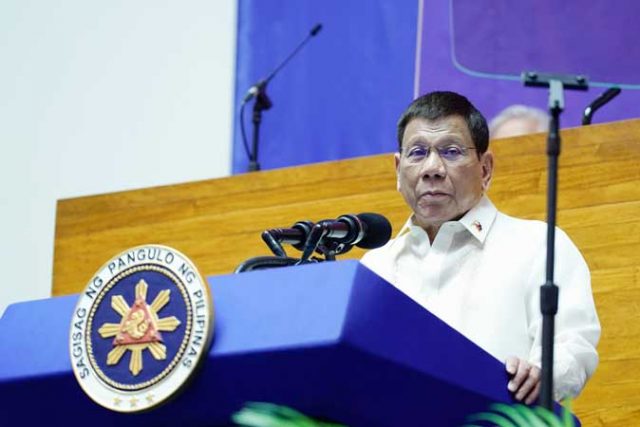
THE PRESIDENTIAL palace on Monday said it would leave to the Ombudsman the decision on whether it would release to the public President Rodrigo R. Duterte’s net worth statement.
Presidential spokesman Herminio L. Roque, Jr. issued the statement after Vice-President Maria Leonor “Leni” G. Robredo challenged the President to disclose his net worth.
“The stance of the Office of the President has been clear and consistent: We leave it to the Office of the Ombudsman,” he said.
Mr. Duterte had not disclosed his net worth despite his vow of transparency, the Philippine Center for Investigative Journalism reported last year.
Since the law requiring public officials to disclose their net worth was enacted in 1989, all five presidents before Mr. Duterte had disclosed their worth year on year without fail, it said.
Under a memo issued by the Ombudsman in September, an official’s net worth report can only be released to his authorized representative or upon a court order related to a case.
The Ombudsman order also excluded journalists from obtaining copies of the statements. — KATA
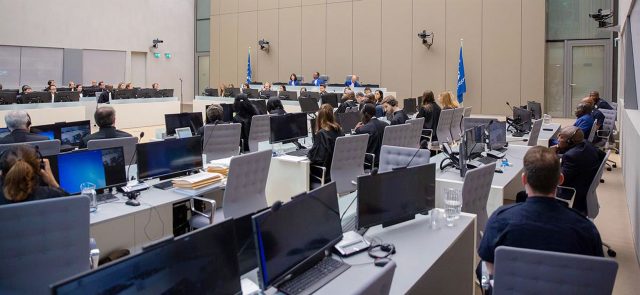
A TOTAL of 204 representations for about 1,050 families of those killed in the Duterte administration’s anti-illegal drug operations were submitted to the International Criminal Court (ICC), according to the Registry Report posted online on Monday.
The report showed that of the total representations, which cover 1,530 individual victims, 94% or 192 want the international court to investigate President Rodrigo R. Duterte’s war on drugs campaign.
Five of the representations indicated that the victims did not want an investigation, while information was unclear in seven forms.
The submissions were made from June 28 to Aug. 13 this year.
A 2020 report by the United Nations Office of the High Commissioner for Human Rights estimated that there have been more than 8,000 deaths related to the drug war since it started in July 2016.
The report on the submitted representations showed that murder was the most rampant among the alleged crimes in relation to the drug war, with 181 forms indicating that killing took place.
The other crimes reported were torture with 103 representations, 54 for imprisonment or other severe deprivation, 28 were enforced disappearance, eight for attempted murder, and three indicated sexual violence.
The report and representations were transmitted to the ICC’s Pre-Trial Chamber on Friday for ICC judges to analyze and decide on the request for investigation “in due time,” the ICC said in a separate post on its website.
The court stressed, however, that the forms submitted “are not evidence and will only be shared with the Judges.”
Former ICC prosecutor Fatou Bensouda conducted a preliminary investigation on the alleged extrajudicial killings relating to Mr. Duterte’s anti-illegal drug campaign. Before leaving the post, Ms. Bensouda on May 24 filed a request to the ICC’s pre-trial chamber for an authority to investigate the Philippines after finding “a reasonable basis to believe that the crime against humanity of murder has been committed.”
If the request is granted, the new prosecutor, Karim Khan, will handle the investigation. — Bianca Angelica D. Añago
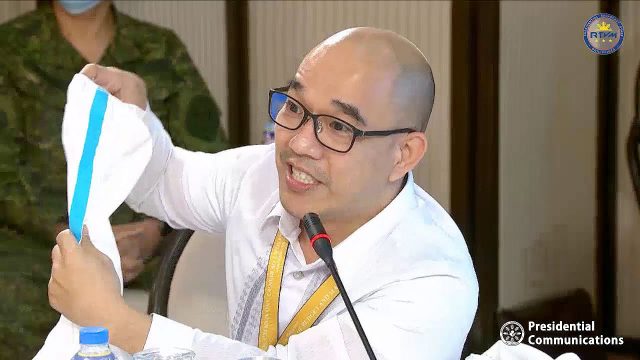
THE SENATE Blue Ribbon Committee will not stop until it untangles and identifies personalities involved in the questionable billions worth of medical equipment contracts awarded to a new company, Senator Ana Theresia N. Hontiveros-Baraquel said on Monday.
In a press conference, she said they will “trace the dots no matter how far” it may lead.
A former undersecretary, Lloyd C. Lao, was head of the Department of Budget and Management-Procurement Service (DBM-PS) when the purchases were made from Pharmally Pharmaceutical Corp.
Ms. Hontiveros said in Filipino that if Mr. Lao chooses not to be honest, “there’s a possibility that we cite him for contempt.” The senator added that if he is afraid and can be persuaded to talk, the Blue Ribbon Committee can help him get protection in exchange for his cooperation.
Senate Minority Leader Franklin Drilon, in a separate statement, said the mystery backer of Mr. Lao and Pharmally Pharmaceutical is the “missing link” that will connect the dots in the corruption scandal that involved funds for the coronavirus response.
“We see a pattern of corruption that was perpetrated by Lao and his cohorts. It cannot be done by Lao alone. He is covering for someone, and we need to find out who,” Mr. Drilon said in mixed English and Filipino. The “circumstantial evidence would show patterns of corruption,” he added.
“It seems Pharmally has friends in high places,” Ms. Hontiveros said.
Mr. Lao was appointed to the DBM in Aug. 2019 despite a pending extortion case when he was chairman of the Housing and Land Use Regulatory Board. He headed the DBM-PS starting Jan. 2020. The Department of Health transferred a P42-billion fund to DBM-PS in March 2020 for the procurement of medical supplies such as face masks.
Records show Pharmally Pharmaceutical was registered in Sept. 2019 with the Securities and Exchange of Commission (SEC) with a paid capital of only P625,000.
Based on Pharmally’s 2020 financial statement submitted to the SEC, the company’s income stood at P285 million from zero in 2019. Its assets also jumped to P285 million in 2020 from P599,000 the previous year.
Ms. Hontiveros called on DBM to stop accepting proposals from Pharmally Pharmaceutical given its close links to Pharmally International Holdings Corp., a Taiwanese firm whose chairman has been charged with financial fraud. — Alyssa Nicole O. Tan
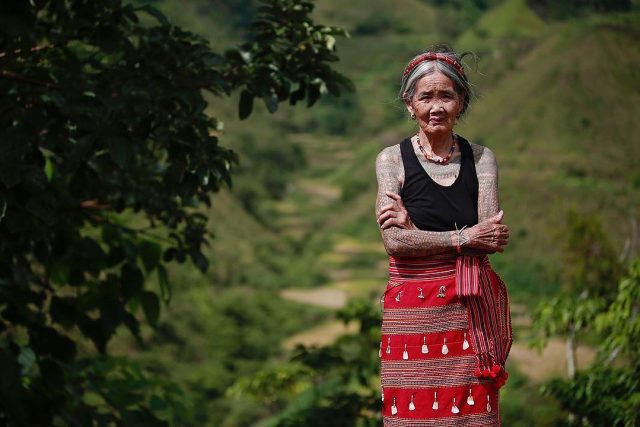
THE NATIONAL Commission on Indigenous Peoples (NCIP) said Whang-od Oggay, the oldest living traditional whatok (hand-tapped tattoo) artist, did not consent to teach the craft online through a vlogger’s site with students to be charged P750 each.
In a press release late Sunday, NCIP said the finding came after a personal interview by the agency’s Cordillera regional office with Whang-od, her family, and leaders of the Butbut tribe in Kalinga along with a review of the contract with Nas Academy owned by vlogger Nuseir Yassin.
Mr. Yassin has taken down the course on Aug. 5 but asserted that he had the tattoo master’s consent after Whang-od’s grandniece Gracia Palicas called out the move as a “scam.”
NCIP also said that the contract terms of Nas Academy were “grossly onerous” for Whang-od.
“The contract states that the Nas Academy has exclusive ownership of any content that the show would produce… including the right [to] alteration and the right to assign and transfer the same without consent. Furthermore, the law of Singapore shall govern said contract,” the agency added.
NCIP further said there was also an apparent disparity in the thumb mark allegedly affixed in the contract to a print affixed by Whang-od herself in a clean sheet of paper.
Following these findings, NCIP reminds the public that those who wish to conduct research or activities with indigenous communities should seek their consent along with notification to the agency and local government units.
NCIP also said that it will provide legal assistance for Whang-od and the Butbut tribe if needed.
“The art of tattooing is a cultural expression and it is practiced by the indigenous people of the Kalinga. Teaching of said cultural manifestation or expression in an open platform accessible to millions of people would render it generic and thus it would lose its authenticity and cultural meaning,” NCIP said.
Nas Academy in a statement on Monday said that the investigation by the NCIP was one-sided, adding that they were ready to cooperate with the agency.
They also said that a local production company was outsourced for the online course in which they were expected to conduct due diligence under Philippine law.
“We spent 2 full days filming with Whang-Od and (her niece) Estela (Palangdao). There were more than 7 people involved in this process, and Estela set-up a bank account to receive the funds from the project. It is very very hard for Whang-Od Academy to exist without the consent of Whang-Od and her family,” Nas Academy said.
Antique Rep. Lorna Regina “Loren” B. Legarda has pushed for Congress to swiftly pass House Bill 7811 or the Traditional Property Rights of the Indigenous Peoples (IP) Act to strengthen IP protection following the incident. — Russell Louis C. Ku
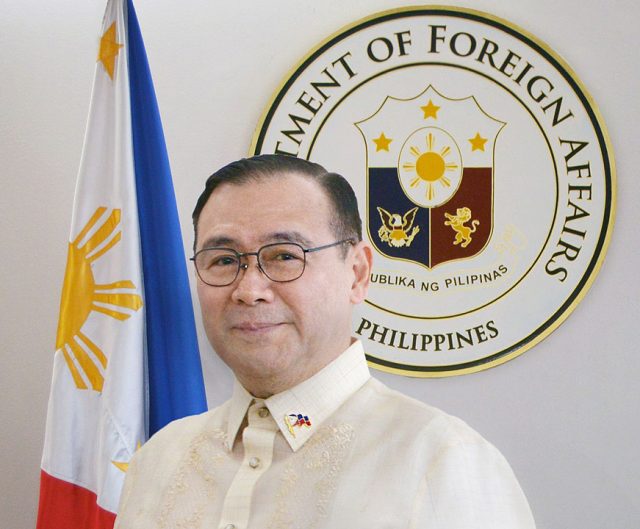
THE PHILIPPINES will be accepting Afghan refugees only under government-to-government agreements, Foreign Affairs Secretary Teodoro L. Locsin Jr. said on Monday.
“The Philippines will not accept nor listen to any proposition to accept any refugees unless it is government to government and only by their respective Foreign and Justice ministers; especially of the UK, the US, and other Western countries most active in the evacuation,” Mr. Locsin said on Twitter.
He said the country will not entertain any request for asylum coming from non-government organizations or any other non-state parties, citing potential illegal transactions under such arrangement.
“I believe that refugees will be the next lucrative order of business, having plenty of cash in hand or in foreign bank accounts. The temptation will be resistible to help them and help oneself to them. That will never happen under the administration or in my watch,” said Mr. Locsin.
He said he wanted to ensure the Philippines “aren’t dragged into a racket.”
The Palace earlier said the country would open its doors to Afghans fleeing Taliban rule. “Asylum seekers are welcome in the Philippines,” the President’s spokesperson said. The Justice chief also said mechanisms are in place for processing refugees from Afghanistan under the department’s Refugees and Stateless Persons unit.
The Philippines has already completed the evacuation of its citizens from Afghanistan. — Alyssa Nicole O. Tan

SEVERAL YOUTH groups are submitting on Tuesday a petition for an extension of the voter registration period despite an Aug. 18 decision by the Commission on Elections (Comelec) rejecting such calls, citing timeline constraints and health protocols.
More than 60 youth and student organizations signed the petition, led by Akbayan Youth, First Time Voters’ Network, and the Center for Youth Advocacy and Networking.
The groups will also ask the government’s task force managing the coronavirus response to allow voter registration activities even in areas under strict quarantine levels.
They cited that eight months’ worth of registration days were lost due to the lockdowns.
Comelec Spokesperson James B. Jimenez previously said the poll body’s en banc junked an earlier petition because an extension from the Sept. 30 deadline may delay preparations for the 2022 polls. The filing of certificates of candidacy starts Oct. 1.
In another online forum on June 28, Mr. Jimenez said the commission has reached its goal of having at least four million new registrants for the 2022 national and local elections.
He also posted on social media that the Philippines now has a total of 61.06 million registered voters as of Aug. 24, which is more than the commission’s expectation of 59 million. — Bianca Angelica D. Añago

THE NEW cases of African Swine Fever (ASF) detected in four towns in Cagayan are already under control, according to its provincial veterinarian.
“The (new) detected ASF cases are just isolated cases and are already under control. The provincial veterinary office is closely monitoring these cases,” Cagayan Acting Provincial Veterinarian Noli V. Buen said in a television interview on Monday.
The Cagayan Provincial Veterinary Office recently confirmed that new ASF cases were detected in the towns of Claveria, Ballesteros, Piat, and Aparri.
Mr. Buen said hog farmers affected by ASF in Cagayan as of Aug. 23 reached 1,411 while a total of 5,535 hogs were culled.
Mr. Buen said the new ASF cases could be attributed to the halt in “inter-municipal” checkpoints to prevent the spread of the disease after those deployed at the borders were infected by the coronavirus disease 2019 (COVID-19).
“Those stationed in the checkpoints tested positive for COVID-19. We see this as the reason why there were new ASF cases detected in Cagayan,” he said.
Recently, the Department of Agriculture announced that ASF incidence in the country is already dropping.
“To date, 484 cities and municipalities have no reported ASF cases for at least three months, of which 74 have no reported cases for three to six months, and 410 have no cases for more than six months,” Bureau of Animal Industry Executive Director Reildrin G. Morales said in a statement on Aug. 23. — Revin Mikhael D. Ochave

BAGUIO CITY, one of the most popular tourist destinations in northern Luzon, is vaccinating 4,000 of its more than 5,000 tourism sector workers from Monday to Wednesday.
“Earlier, the local tourism industry stakeholders disclosed that only 454 or 8.3% of the registered 5,458 workers in the different tourism-related establishments had been vaccinated since the roll-out of the government’s mass vaccination program last March,” the city government said in a statement.
The mountain destination currently allows entry for people on non-essential travel only if they are from areas under the general community quarantine (GCQ) or modified GCQ, the two most relaxed quarantine levels.
The city’s ongoing vaccination program includes home service for senior citizens who could not go to the designated sites.
As of Aug. 29, Baguio had 787 active coronavirus cases out of the 17,263 recorded since the start of the pandemic. There were 16,135 recoveries and 341 deaths.
Baguio City, dubbed as the country’s ‘summer capital’, will celebrate its 112th charter day anniversary on Sept. 1. — MSJ

THE DEPARTMENT of Energy (DoE) may reclassify waste-to-energy (WTE) facilities as renewable energy (RE) units capable of supplying always-on baseload power.
The plans were flagged in a draft circular posted on the DoE’s website last week, outlining the department’s intent to promote the development of the WTE industry.
“This circular is being issued to… promote WTE facilities as baseload renewable energy which can contribute to solid waste management, benefit to the local economy, and create green jobs, among others,” the Energy department said.
The DoE is proposing to categorize WTE technology as “another kind of RE source.” WTE converts various types of waste material into usable heat, electricity or fuel.
According to its proposed circular, qualified generators using such technology should be considered “must dispatch” units in order to promote investment in WTE development.
Eligible RE plants are identified by the wholesale electricity spot market as “must dispatch” units that enjoy preference in the dispatch schedule.
The DoE said it will hold a series of public consultations on the draft WTE circular on Sept. 3, 6 and 8 for Luzon, Visayas and Mindanao participants, respectively. All hearings will be held at 9 a.m.
Center for Renewable Energy and Sustainable Technology President Riedo A. Panaligan said that the DoE’s proposed rules contradict current law.
“Promoting municipal solid waste (MSW) as feedstock for incineration (or) waste-to-energy goes beyond what is prescribed under the Renewable Energy Act. Burning of MSW also contradicts the Ecological Solid Waste Management Act that espouses source separation, segregated waste collection and treatment. These legal hurdles put participating parties, especially city governments and local government units, at risk for future lawsuits,” Mr. Panaligan told BusinessWorld in an e-mail Monday.
He said WTE is the most “inefficient and expensive way” to generate power, based on the experience of developed nations.
“Incineration, if categorized as renewable, will further compete with other genuine renewable energy projects such as solar, wind and biomass for already small incentive support and market share,” Mr. Panaligan added.
A Department of Environment and Natural Resources (DENR) administrative order from 2019 details the requirements that must be met before a WTE plant can be built.
Last month, environment advocates and groups filed a petition with the Supreme Court to nullify the DENR’s guidelines on building WTE facilities, claiming that their implementation will cause “irreparable” harm to human health and the environment. — Angelica Y. Yang
