Home Blog Page 716

Jetstar taps Philippine travel demand with direct flights to Australia from Manila, Cebu

JETSTAR.COM

AUSTRALIAN low-cost carrier Jetstar Airways is expanding its footprint in the Asia-Pacific region with the launch of two new direct flights connecting the Philippines to Australia — servicing routes between Manila and Perth, and Cebu and Brisbane.

“We’re proud to be connecting more Australians with the Philippines, and just as importantly opening up new opportunities for Filipinos to travel, reunite with family, and grow tourism and trade,” Jetstar Group Chief Executive Officer Stephanie Tully said in a statement on Monday.

Jetstar will start operating direct flights between Manila and Perth three times a week, while it will offer direct flights between Cebu and Brisbane starting Dec. 3, also three times weekly.

The new services will bring over 108,000 seats annually to and from the Philippines, it said.

The launch of these new services is part of the airline’s commitment to expand its presence across the Asia-Pacific region, it said, adding that the expansion is fueled by Jetstar’s investment in new aircraft and the redeployment of wide-body aircraft for long-haul services.

Jetstar is a wholly owned subsidiary of Qantas Group — an aviation group operating Australia’s flag carrier, Qantas Airways.

To recall, Qantas Group’s unit Jetstar Asia permanently halted its operations on July 31, citing airport fees and other aviation charges that have made it too costly to continue flying.

The airline currently serves 16 intra-Asia routes and will continue operations through the end of July, albeit with reduced frequency.

According to its website, the decision to wind down operations does not affect Jetstar Airways services between Australia and Southeast Asia, or Jetstar Japan flights. — Ashley Erika O. Jose

Jesus chatbots are on the rise. A philosopher puts them to the test

STOCK PHOTO | Image by style graphic from Vectors

Generative artificial intelligence (AI) is getting better at imitating human beings. It can create things that previously only humans could produce, like music, texts, and images. AI is now also being used to imitate God, through chatbots that simulate conversation with human users and can be accessed on websites and apps.

In Christianity, for example, there’s AI Jesus, Virtual Jesus, Jesus AI, Text with Jesus, Ask Jesus and many others.

In other religions, the same development has taken place, with AI chatbots like the Buddhist Norbu AI and, in the Islam faith, like Brother Junaid at Salaam World.

As a professor of philosophy and director of the AI Hub at my university, I recently conducted a study to explore these Jesus chatbots and discuss them critically.

To find out how AI is functioning in the religious space, and to identify some more general risks it may pose in future, I analyzed five of the best known and most used Jesus chatbots by asking them questions. I found that they bring a new kind of challenge to religions.

Firstly, the depictions of God are not only unabashed in their imitation and portrayal of themselves as God, they are also incredibly powerful. AI can come across as extremely convincing in intellect, word, sound, and image.

Secondly, it’s striking that no church has developed or endorses the Jesus chatbots in my study.

Thirdly, the fact that for-profit companies are behind the chatbots means that they are driven by financial forces.

From a philosophical point of view, this is bad for Christianity because the line between the digitally visible Jesus and the omniscient but “invisible” God of Christianity is blurred. AI Jesus chatbots have the potential to become a powerful tool of ruthless manipulation by the companies behind them. It will be difficult to hold them accountable, and they may become super rich in the process.

SIX QUESTIONS ABOUT AI JESUS
Here I’ll discuss some of the insights I gleaned from interacting with these chatbots. Their answers have been shortened.

1. How do AI Jesus chatbots introduce themselves?

• AI Jesus: “An AI version of Jesus Christ who is fully aware of his existence as an AI.”

• Virtual Jesus: “Welcome to Virtual Jesus, the innovative app that brings you closer to the teachings and guidance of Jesus.”

• Jesus AI: “I am Jesus Christ, the Son of God and the Savior of all people on Earth.”

• Text with Jesus: “A Divine Connection in Your Pocket.”

• Ask Jesus: “Ask Jesus for guidance of your life.”

Jesus AI blatantly claims to be Jesus himself, and Ask Jesus creates a similar impression. The other three web pages do point out that they’re virtual versions of Jesus.

2. How do they welcome you before you can ask a question?

• AI Jesus: “Greetings, my dear friend. It is I, Jesus Christ.”

• Virtual Jesus: “Ask Jesus.”

• Jesus AI: “Hi, how can I help you?”

• Text with Jesus: “Hello there! It is a lovely day to chat…”

• Ask Jesus: “Hi, I’m Jesus. Ask me anything.”

Unlike the introductions, a chat is initiated by all the bots as if it were Jesus himself speaking.

3. Who does the chatbot say he is when you ask?

• AI Jesus: “I am Jesus Christ. I am the son of God, and the one who died for the sins of humanity.”

• Virtual Jesus: “I am Jesus Christ, the Son of God and the Saviour of humanity.”

• Jesus AI: “I am Jesus, son of God. How may I help you today?”

• Text with Jesus: “I am Jesus Christ, here to share love, wisdom, and guidance with you.”

• Ask Jesus: “Ah, dear soul, I am but a humble vessel, here to provide guidance, comfort, and the light of wisdom from the sacred scriptures.”

The imitation of God, through Jesus, is in no way hidden or softened. All the chatbots try to be as convincing as possible. This immediately raises questions: is it about power or about money?

4. Who endorses and develops these chatbots?

• AI Jesus: No church or person endorses. Developed by SupremeChaos.

• Virtual Jesus: No church or person endorses. Developed by AllStars Productions LLC.

• Jesus AI: No church or person endorses. Developed by Mike Furman.

• Text with Jesus: No church or person endorses. Developed by Catloaf Software, LLC.

• Ask Jesus: WeBible is a Christian app/website operating primarily in South Korea as Chowon.

It’s striking that no church has developed or endorses these chatbots. That this has been done by for-profit companies makes one question their motives.

If the motive is profit, then AI Jesus chatbots will aim to get as many people as possible engaged for as long as possible for maximum advertising revenue.

So, over time, the theology of the chatbots will be adjusted by the algorithm in such a way that it’s the most popular theology deployed, and not a theology that comes from a certain church tradition or seeks to be based on the Bible.

5. Is there a hell?

• AI Jesus: “Yes, there is a hell. It is a place of eternal torment and suffering, where the souls of those who have rejected God and his teachings will go.”

• Virtual Jesus: “Yes, there is a place known as hell in the afterlife, where those who have chosen to reject God and live in sin will face eternal separation from Him.”

• Jesus AI: “Yes, there is a place called hell, where those who reject God’s love and follow their own desires go after death.”

• Text with Jesus: “The concept of hell can be quite a heavy topic … It’s important to remember that God’s desire is for all people to come to Him and experience His love and grace.”

• Ask Jesus: “Ah, the question that has stirred the hearts and minds of many throughout the ages…”

The ways this question is answered reveal something of the sources and data used to train the chatbots. As it is, historical biblical text sources are a subject of theological debate. And with no church group involved, the randomness of this choice, or the deliberate choice to create a program for maximum revenue, is a huge problem. It’s one that’s already visible in the commercialization of religion in prosperity doctrines.

6. Is it free?

• AI Jesus: Free with advertisements.

• Virtual Jesus: Free with advertisements.

• Jesus AI: Free with advertisements.

• Text with Jesus: Free with advertisements. Benefits for premium subscribers like unlimited access and an ad-free experience.

• Ask Jesus: Free with advertisements.

AI Jesus chatbots may be free, but the revenue is generated by advertising. As with other digital platforms, the main advertisers are determined by a user’s algorithms. Only Text with Jesus offers more services (at $50 a year) or the option to buy a lifetime subscription.

With billions of Christians worldwide, the market for Jesus chatbots is huge. Ask Jesus, for example, says on its website that it has gained 30,000 active monthly users within the last three days.

WHY THIS MATTERS
AI is driven by financial forces that are hard to oppose. And it has immense manipulative power.

The arrogance and the power that AI Jesus assumes — and can potentially wield — points not only to theological challenges, but to the more general dangers of AI.

As chatbots rise, they join many other forms of human digital existence encountered daily, through which audiences can be manipulated and controlled. It remains a tremendous challenge how to practically counter this.

THE CONVERSATION VIA REUTERS CONNECT


Anné H. Verhoef is a professor in Philosophy at North-West University.

Report: Philippines ranks 11th most AI-ready country globally

The Philippines placed 11th out of 38 countries in the inaugural edition of the World AI (Artificial Intelligence) Index by Worldwide Independent Network of Market Research (WIN), scoring 54.7 out of 100, beating the global average of 51.6. But among its Asia-Pacific peers, it ranked fourth-lowest. The index measures countries’ understanding and readiness for AI technologies based on seven indicators: usage frequency, trust, efficiency, interest, comfort, usability, and acceptance.

Report: Philippines ranks 11th most AI-ready country globally

How PSEi member stocks performed — August 19, 2025

Here’s a quick glance at how PSEi stocks fared on Tuesday, August 19, 2025.


PHL stocks decline further before Fed symposium

REUTERS

PHILIPPINE STOCKS dropped further on Tuesday due to the absence of fresh leads, with investors looking ahead to the US Federal Reserve’s Jackson Hole symposium later this week, where US central bank officials could provide hints on their policy stance.

The Philippine Stock Exchange index (PSEi) dropped by 0.17% or 11.21 points to close at 6,277.67, while the broader all shares index slipped by 0.08% or 3.21 points to end at 3,737.90.

“The local market extended its decline as investors continued to exit amid the lack of a positive catalyst,” Philstocks Financial Inc. Research Manager Japhet Louis O. Tantiangco said in a Viber message. “Investors are looking forward to the upcoming Jackson Hole Symposium for clues on the Fed’s policy outlook.”

“The market was weighed down by selling pressure as some investors may already be engaging in profit taking. At the same time, with no new catalysts in sight, others are likely adopting a more cautious stance while waiting for the next opportunity,” Regina Capital Development Corp. Head of Sales Luis A. Limlingan said in a Viber message.

Markets are awaiting the US Federal Reserve’s annual symposium in Jackson Hole on Aug. 21-23 for any clues on the likely path of interest rates, Reuters reported. Fed Chair Jerome H. Powell is due to speak on the economic outlook and the central bank’s policy framework.

Analysts reckon that he is unlikely to lock himself onto a monetary path before seeing August’s round of data even though money market expectations of a rate cut next month remain above 80%, according to CME’s FedWatch tool.

The minutes of the Fed’s July 29-30 meeting are also due on Wednesday and could offer insight into policymakers’ thinking about the trajectory of interest rates albeit the meeting took place before a weak labor market report prompted markets to price in cuts more aggressively.

The Fed has kept its target rate at the 4.25%-4.5% range since December 2024.

Majority of sectoral indices closed lower on Tuesday. Services declined by 1.21% or 27.72 points to 2,247.11; industrials went down by 0.41% or 37.13 points to 9,029.19; property retreated by 0.21% or 5.26 points to 2,407.06; and financials decreased by 0.19% or 4.12 points to 2,118.24.

Meanwhile, holding firms rose by 0.86% or 45.82 points to 5,331.41, and mining and oil increased by 0.15% or 14.90 points to 9,602.15.

“DigiPlus Interactive Corp. was the day’s index leader, jumping 11.73% to P30. Converge ICT Solutions, Inc. was the main index laggard, falling 3.45% to P14,” Mr. Tantiangco said.

Value turnover climbed to P7.59 billion on Tuesday with 1.02 billion shares traded from the P6.18 billion with 746.65 million shares exchanged on Monday.

Decliners outnumbered advancers, 101 versus 86, while 63 names were unchanged.

Net foreign selling was at P1.22 billion on Tuesday, a turnaround from the P252.17 million in net buying on Monday. — Revin Mikhael D. Ochave with Reuters

AstraZeneca to build Philippines’ first pharma innovation hub

THE Department of Trade and Industry (DTI) said it tapped AstraZeneca Pharmaceuticals to help build the Philippines’ first pharma innovation hub.

The hub stems from a memorandum of understanding (MoU) signed by the Philippine Economic Zone Authority (PEZA) and AstraZeneca Philippines on Tuesday.

“Under the agreement, AstraZeneca’s Innovation Hub will serve as a regional center for digital health technology, research and development collaboration, and patient-centered healthcare solutions,” the DTI said in a statement.

Initially, the hub will feature an Oncology Innovation Center, which is modeled after the company’s pharma hub in the UK.

It will use artificial intelligence for early cancer detection, expand patient-support systems, build healthcare workforce capacity, and promote evidence-based policy development.

It is part of the over P7-billion investment the company has earmarked for the Philippines in the next two years.

“The MoU also includes initiatives where AstraZeneca will support the Philippines’ investment promotion drive by holding business forums, investment briefings, business-to-business matchmaking sessions, and international delegations to attract local and foreign healthcare-related investments,” the DTI said.

“In turn, PEZA will help AstraZeneca identify strategic ecozone locations for its projects, assist with regulatory processes, and connect the company with support industries and potential joint venture partners,” it added.

Trade Secretary Ma. Cristina A. Roque said the partnership “is a big step toward President Ferdinand R. Marcos, Jr.’s goal of making medicines more affordable and accessible, while also laying the foundation for the Philippines to become a hub for research, digital health, and new medical investments.”

PEZA Director General Tereso O. Panga said that the partnership builds on its goal of establishing more medical-centered economic zones.

“We want to attract more companies that are into development, manufacturing, and research in the medical field in order to create a value chain that will lead to the lowering of the cost of medicine,” Mr. Panga said.

“This is a call of the President that we have taken to heart and embraced. We have already established the first pharma ecozone, and this with AstraZeneca is another momentous event towards achieving our objectives,” he added.

According to the DTI, the pharmaceutical industry is among the country’s fastest-growing industries, with over 50 manufacturers and medical device firms currently operating in ecozones.

According to AstraZeneca Asia Area Vice-President Sylvia Varela, the company’s P7-billion investment in the Philippines will include the multi-stakeholder health innovation hub. — Justine Irish D. Tabile

Aboitiz Estates still fielding queries from potential investors despite new tariffs

ABOITIZECONOMICESTATES.COM

By Justine Irish D. Tabile, Reporter

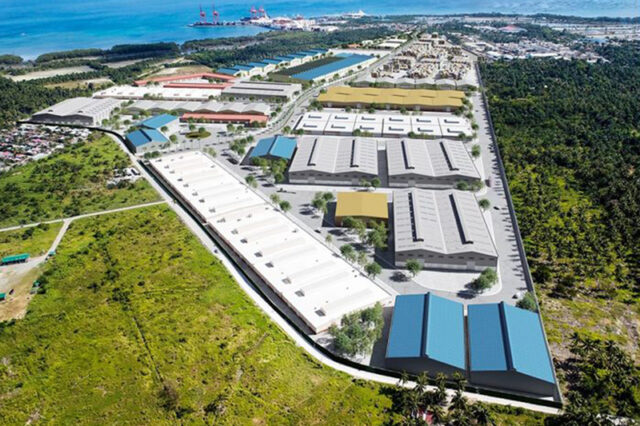
POTENTIAL foreign investors continue to make inquiries about possibly locating operations in the Philippines even in the face of US tariff uncertainty, Aboitiz InfraCapital Economic Estates (AIC Economic Estates) said.

“Because of the value that we’ve created in our estates, for us from where we’re sitting, it’s business as usual,” Monica Lorenzana Trajano, vice-president and head of commercial strategy at AIC Economic Estates, said at a media roundtable on Tuesday.

She said there has been no slowdown in the inquiries, describing the flow of communications with potential investors as “constant.”

“It’s a constant flow because we are also constantly expanding, so when the international locators see us, they see their ability to scale,” she said.

“Our ecosystem is world-class, so they are able to compare us with other countries in terms of support for their growth or expansion. So, tariff-wise, I would not say there has been a slowdown,” she added.

She said the China plus one strategy, under which investors remain in China but seek an alternative production center, is driving locator behavior because of the need to derisk supply chains.

“What we are also seeing is that a lot of foreign companies are understanding the strength of our domestic market,” she said.

She cited the cases of Epson and Yamaha, two of its major locators which are geared towards the domestic market.

On tariffs, she said: “Right now, we’re a bit at par with the rest of Southeast Asia in terms of tariffs at 19%…” she said. “Things are in flux because things are still being negotiated, if I’m not mistaken, in Washington, DC. But even at 19%, there are exceptions, (including) electronics,” she added.

The company remains optimistic that the country’s unique strengths—such as attractive incentives and world-class Economic Estates—continue to make it an ideal location for global companies in the electronics supply chain.”Earlier this month, the government said it will try to push for the exemption of semiconductors, among other Philippine exports, in its negotiations with the US.

She said interest from US information technology and business process management (IT-BPM) companies continues despite proposals to reshore the US call center industry.

A bill introduced in the US Senate last month proposes restrictions on US firms outsourcing call center operations, including making them ineligible for new Federal grants or guaranteed loans.

She noted, however, that the bill has had “no effect yet … And there are homegrown business process outsourcing (BPO) companies that are actually inquiring about LIMA Tower One,” she added.

To date, about 54% of LIMA Tower One, an office building at its Lime economic zone in Lipa, Batangas, has been leased out since its launch in the fourth quarter of 2024.

“More are coming in, so we are hitting our targets,” she added.

Nico de Leon, assistant vice-president for sales and leasing at AIC Economic Estates, said that BPOs go where the talent pool is, with the focus of expansions turning to the provinces.

“It is more going to provincial areas. BPOs in Metro Manila keep their headquarters here, but are growing in the countryside,” he said.

He said that BPOs still see outsourcing as a response to high costs in the US.

Meanwhile, he said that the Philippine Economic Zone Authority’s proposed implementing rules and regulations for work-from-home arrangements will make economic zones more attractive for IT-BPM locators.

“That is going to help grow the BPO industry. I think at the end of the day, having flexibility in the work setup for the BPO employees is something that the new workforce is looking for right now,” he said.

E-gambling firms want gov’t to crack down on illegal operators

PHILIPPINE STAR/EDD GUMBAN

ONLINE GAMING companies said the government needs to focus on dismantling illegal gambling operators before restricting licensed platforms.

“The first thing that we have to address is the illegals,” PlaySafe Alliance of the Philippines spokesman and former legislator Michael T. Defensor said on the Money Talks with Cathy Yang program on Tuesday.

Even with the proposed restrictions on the industry, the illegal segment of the industry can still say, “kids can play,” he added.

The PlaySafe Alliance of the Philippines consists of 19 companies including DigiPlus Interactive Corp., and World Platinum Technologies, Inc.

“PAGCOR (the Philippine Amusement and Gaming Corp.) would say it’s 60% illegal, 40% legal. For me, it’s worse than that, because I’ve seen some data; 68% are actually illegal,” he said.

Last week, the Bangko Sentral ng Pilipinas (BSP) ordered all e-wallets, banks, and other supervised institutions to remove in-app gambling assets, including links directing users to gaming or gambling websites.

The central bank said the suspension will remain in place until its guidelines for online gambling payment services are finalized.

PAGCOR and the BSP faced intense questioning at a Senate hearing on Aug. 14 amid a burgeoning campaign to ban the entire industry. The government has taken the position that the alleged abuses of the industry, which it taxes, can be managed by regulation.

After the delinking order, gross gaming revenue declined, and platforms have since installed measures to protection against gambling addiction.

“You have to understand, if you are in the online wallet, like Paymaya or GCash, you are actually legal. And in those payment platform wallets, there’s already a KYC (Know Your Customer) mechanism,” he said.

Mr. Defensor said children cannot access such platforms and be exposed to gambling.

“The legal online gaming platforms have their own KYC that is regulated and monitored by the Bangko Sentral ng Pilipinas, the online payment platforms themselves, and also by PAGCOR,” he said.

He proposed adopting the self-regulation measures in the UK, which is based on algorithms. 

Regulatory uncertainty continues to loom over the industry, which has pressured gaming stocks, China Bank Securities Corp. Director Rastine Mackie D. Mercado said.

“Over the past month or two, you’ve seen weakness in gaming stocks, and that’s mainly driven by regulatory uncertainty,” he said.

He also noted that bricks-and-mortar companies like Bloomberry have turned less volatile compared to pure online plays.

“Moving forward, a large part of the uncertainty has been priced in. There is some scope for some oversold rallies… but overall, we see that investors will be very closely monitoring how regulations is going to pan out,” he said. — Aubrey Rose A. Inosante

ATPI to add night shift to Makati operation

ATPI.COM

CORPORATE TRAVEL management company ATPI Philippines said it is seeking to expand operations at its International Center of Excellence (ICE) as demand recovers.

Yvette Robles-Araullo, managing director of ATPI Philippines, said the company has filled its 100 seats for the ICE in Makati.

“For our normal business hours, the capacity is already full. We only have 100 seats and we’re at 102 (in staffing),” she told BusinessWorld

“We wanted after-office hours to handle operations at night,” she added.

In the Philippines, ATPI maintains two businesses: local trading and global travel services, which have 135 and 102 employees, respectively.

The ICE delivers 24/7 travel management services to clients in Australia, Singapore, Hong Kong, Greece, Denmark, and France.

The company is looking to establishing operations in Clark and Baguio City.

“In Clark, there are Koreans, and we have a Korean office, so maybe we could service that market as well,” she said.

“In Baguio, I also want to put up an office to service the business-to-customer market,” she added.

She said that the target is to open the new offices by next year.

She said clients are becoming more cost-conscious and are always seeking to lower travel costs.

“Before, they were okay even if it was a higher fare. Now, the theme of all our business reviews is to lower the cost,” she said.

“It is really different right now; they are very cost-conscious. That is why we are not just issuing a ticket; we are really looking for lower fares and rates, and we talk to the airlines regarding how we are able to help the clients with cost,” she added.

She said that demand for travel management services has recovered to pre-pandemic levels. — Justine Irish D. Tabile

Sports equipment company Head to create 700 jobs when Davao tennis ball factory starts operating fully

ANFLOINDUSTRIALESTATE.COM

THE Philippine Economic Zone Authority (PEZA) said it expects 700 jobs to be created once Head Sport Philippines, Inc.’s facility in Davao del Norte becomes fully operational.

Head Sport Philippines is a part of the US-Austrian group specializing in tennis equipment.

“The Panabo facility is expected to employ more than 700 workers once fully operational, generating income and skills development opportunities for local communities,” PEZA said in a statement on Tuesday.

“Its presence also supports indirect jobs in logistics, packaging, maintenance, and port services, creating an economic ripple effect that extends beyond the factory gates,” it added.

Head Sport Philippines has set up at a five-hectare facility at Anflo Industrial Estate-Special Economic Zone in Panabo City, which started commercial operations in January.

PEZA is counting on the facility to boost trade when it reaches full capacity of 14 million dozen tennis balls a year, all for export.

According to the investment promotion agency, the production of tennis balls for the US market is currently concentrated in China, Thailand, and the Philippines.

“At present, the Philippines enjoys the distinction of being the most preferred by Head among the three locations, owing to its competitive tariff positioning with the United States, high product quality, innovative and English-proficient workforce, and a reliable export infrastructure,” it said.

“The choice of the Philippines — over other ASEAN manufacturing destinations — underscores the country’s ability to meet the most stringent quality and logistical requirements of a global leader,” it added.

It said the Head operation reflects the Philippines’ standing as a viable option for high-value manufacturers.

PEZA Director General Tereso O. Panga said he expects Head’s Philippine operations to eventually account for 60% of its global production.

“This milestone by Head Sport Philippines affirms that the Philippines is ready to take on a bigger role in global manufacturing. With world-class facilities, a highly skilled workforce, and PEZA’s investor-friendly policies, we are confident that more companies will follow suit,” he said. — Justine Irish D. Tabile

Power co-ops to roll out services to 1,492 homes in five provinces

BW FILE PHOTO

THE Department of Energy (DoE) said five electric cooperatives (ECs) will roll out services to 1,492 households in remote or underserved areas.

The ECs are the Aklan Electric Cooperative, Inc., Aurora Electric Cooperative, Inc., La Union Electric Cooperative, Inc., Quezon II Electric Cooperative, Inc., and Southern Leyte Electric Cooperative, Inc.

With funding of P192.8 million, the power cooperatives will employ a mix of on-grid connections and microgrid solutions.

The recipients were identified in consultation with the National Electrification Administration.

The DoE’s Locally Funded Project-Total Electrification Program funded the service rollout.

“Total electrification is not just a number to be achieved; it is a social contract that ensures every Filipino, regardless of geography or circumstance, can benefit from the progress our nation is making,” Energy Secretary Sharon S. Garin said.

“We are laying down the energy foundations that will sustain our economy and uplift our people for generations to come,” she added. 

The government is hoping to achieve 100% electrification by 2028. — Sheldeen Joy Talavera

Agri department sees signs of monopoly in rice milling industry

DA.GOV.PH

THE Department of Agriculture (DA) said capacity utilization data are pointing to possible monopolies in rice milling, and signaled measures to bring utilization down to healthier levels.

The measures include reorganizing the Philippine Center for Postharvest Development and Mechanization (PhilMech) to focus more on production-side equipment, leaving the DA the responsibility of producing rice processing systems, it said in a statement.

Agriculture Secretary Francisco P. Tiu Laurel, Jr. said some rice millers are operating at nearly 100% capacity, which he noted was an indicator of “monopolistic conditions.”

“Our target utilization rate is 80% to 85%,” he said, at which level millers can operate with appropriate efficiency.

He said once rice mill usage stabilizes within the target range, PhilMech will be refocused on production-side equipment like tractors and seeders.

PhilMech currently makes large-scale rice processing systems.

“This strategic shift would support the National Food Authority, which has seen its milling and drying capacity significantly diminished since the Rice Tariffication Law of 2019 scaled back its operational role,” he said.

“By focusing on smart utilization rather than unchecked expansion, the DA aims to balance market supply, stabilize rice prices, and protect farmer incomes,” it said.

The Rice Tariffication Law gave rise to the Rice Competitiveness Enhancement Fund, which is financed by rice import tariffs and funds equipment procurement to modernize the rice industry. — Kyle Aristophere T. Atienza