Home Blog Page 7132

Recovery through collaborative climate action

In photo during the BusinessWorld Insights, in partnership with Energy Development Corp., with the theme “Kickstarting Green Recovery," are (clockwise, from top left) panelists Hon. Loren Legarda, House of Representatives deputy speaker; Yeb Saño, Greenpeace Southest Asia executive director; Richard Tantoco, Energy Development Corp. president and chief operating officer; and moderator Santiago Arnaiz, Day3 Innovations chief operating officer.

Green recovery starts with reducing carbon footprint, advocates agree

Recovery from the widespread impacts of the coronavirus disease 2019 (COVID-19) pandemic does not only involve curbing the spread of the virus and rebounding from financial losses. As the pandemic further stressed the issue of global warming, recovering from the pandemic now also entails a shift to more sustainable practices that no longer put nature at stake.

This aspect of recovery from the pandemic was the focus of the online forum held by BusinessWorld Insights, in partnership with the Energy Development Corp. (EDC), last July 26. Themed “Kickstarting Green Recovery,” the forum gathered environmental advocates from the government, nongovernment, and private sectors to talk about mitigating the country’s carbon footprint towards green recovery through climate action from all stakeholders.

Reducing our carbon footprint

Discussing the impact of the world’s carbon footprint, Yeb Saño, executive director at Greenpeace Southeast Asia, noted that the prevailing global development framework has basically ignored nature’s limits as dependence on fossil fuels as well as the prevalence of oil-based transport have persisted.

“The kind of development we have seen and have benefitted from puts so much tremendous pressure on the environment and it’s even widening the gap between the rich and the poor,” Mr. Saño said during his presentation, which looked back on how global warming — caused by greenhouse gases (GHGs) such as carbon dioxide — has spiked and might spike further if unmitigated.

Mr. Saño also stressed that the carbon footprint, or the amount of GHGs coming from individual or group activities, is causing the acceleration of climate change. Citing findings by Our World In Data, he noted that a large share of carbon footprint (over 70%) is accounted for by energy used in industry, transport, and buildings, among other uses. This was followed by agriculture, forestry and land use, with nearly 20% share.

Mitigating this carbon footprint by reducing GHG emissions among businesses and stakeholders, thus, serves as a key to address climate change.

“Climate change affects… all sectors of society, people, and the planet. Therefore, it is our duty to really look into limiting all of that footprint,” he said. “The planet is hurtling towards a dangerous trajectory that may go beyond [global warming], and we need to avert that. In order to do that, carbon budget is a key aspect.”

For this to be achieved, Mr. Saño recommends embracing and pursuing greener electricity powered by renewables; greener transport; greener food coming from local sources and farmers; greener economy in terms of local jobs for green industries and reducing energy emissions; and greener spaces in terms of people-centric spaces and greener buildings.

Mr. Saño also pointed out that reducing carbon footprint must be initiated among companies, 100 of which are found by the Carbon Disclosure Project to be responsible for 71% of GHG emissions. “It’s really important that we have very serious conversations with these companies… because they do dictate the kind of shape the energy sector evolves into,” he said.

Following the climate pathway

Meanwhile, Hon. Loren Legarda, deputy speaker of the House of the Representatives, pointed out that attuning to the climate pathway paves the way for recovery from the pandemic. This pathway, according to the deputy speaker, is laid out by the Paris Agreement, an international treaty that aims to limit global warming to as much as 1.5 degrees Celsius.

“To achieve this, we must target a net-zero global economy by 2020, which means that GHG emissions worldwide must reduce by 45% by 2030, or by 7% every year for the next nine years,” Ms. Legarda continued.

The Philippines should join the rest of the world in limiting global warming since it is “the best form of adaptation” even if the country is found to contribute only a third of 1% of emissions in the world. The country’s commitment to these goals is shown by its nationally determined contribution to the Paris Agreement of reducing emissions to 75% by 2030 — 2.71% of which is unconditional and 72.29% is conditional.

“We submitted this target despite this country’s probably insignificant emissions because we know that climate-resilient development is the right path to improving the lives of our vulnerable population, as well as growing our economy,” she explained.

For Ms. Legarda, reducing carbon emissions entails the support and development of renewable energy and energy efficiency; sustainable transport systems; nature-based solutions; resilient buildings and infrastructure; and shifting from the use of single-use of plastics towards a circular economy.

While massive financing from international, national, and multilateral sources are needed in meeting these goals, the deputy speaker added, the private sector is nevertheless sought to help the public sector in achieving the country’s sustainability and resilience goals.

“Incentivizing and de-risking investments in low-carbon and innovative technologies while building stakeholders’ capacities for mitigation must be the new approach in government and in business,” Ms. Legarda explained.

The deputy speaker, who authored several environmental laws throughout her career, also stressed that with a lot of legislation in place to enable the country’s climate action, implementing these laws across government units and organizations, and practicing these among individuals is crucial.

“We need a paradigm shift in the way we think, work, and even breathe,” Ms. Legarda said. “We just have to work together and change the way we know how life was… We have to discard the old lifestyles — the consumptive, consumerist, throwaway culture that we continue to have until now.”

The call to be regenerative

Being regenerative, which EDC has incorporated in its mission since last year, was the focus of Richard Tantoco, the company’s president and COO, throughout the forum. He noted that the pandemic, while gravely impacting economies, gave a temporary respite from carbon emissions as this significantly fell by 6.4% or 2.3 billion tons in 2020. “We cannot afford to waste the momentum that we have from it,” he added.

At the same time, Mr. Tantoco continued, the call is ringing louder among companies to be regenerative, going beyond survival and sustainability in order to contribute to reducing carbon emissions.

“Instead of looking at our business solely as an engine for profits, we need to elevate everything we touch — starting with our environment, then our communities, customers, co-creators, and investors,” the EDC executive said.

Mr. Tantoco also mentioned that its projects have regenerative benefits for its stakeholders: cleaner energy to meet the demands of customers; prudent and tested deployment of capital for investors; and green jobs and empowerment for communities.

“That’s what we call regeneration — taking one extra step, just thinking a little bit harder about what we can do to uplift our stakeholders and enhance our environment,” he said.

In addition, Mr. Tantoco recommends unleashing the ‘arrows’ of policies, innovation, and investments, which he sees are needed to steer green recovery in the right direction. Stakeholders responsible for these three, he continued, should thus be held accountable.

As Mr. Tantoco shared how their ‘regenerative’ mission has recently been achieved by their company, he noted developments in investment as EDC listed a P15 billion worth of ASEAN green bonds last year, with its first tranche of P5 billion listed at the Philippine Dealing Exchange Corp. last June.

“I’m happy to report that it is ten times oversubscribed due to a very strong demand from investors, who want to support and participate in the financing and expansion of our 100% clean energy portfolio, which is crucial in decarbonizing while reviving our economy,” he said.

Finding strength and support from believers

Having someone who believes and encourages us can somehow boost our vigor in working on our dreams, even when dealing with challenges. For renowned sportsman and Cocolife ambassador Kiefer Ravena, he gains his inner strength to move forward in his basketball career from different people, especially his family, who believes in his endeavors and abilities.

At an early age, the passion for basketball came naturally in Mr. Ravena. As he grew up, he continued to show his determination in striving for his athletic aspirations — from achieving basketball championships in high school to overcoming the pressure of winning games in college. Things seemed to go according to his plans even until he finally became a professional.

The COVID-19 pandemic, however, made him take a step back and put his basketball pursuits on hold for more than a year now. Nevertheless, he still felt that it made him better both as a player and a person.

“Looking back, whatever I have achieved in my career, all these became possible because there were people who believed in me — my school, the fans, and most of all, my mom, my dad, and my family,” Mr. Ravena expressed.

Coming from Mr. Ravena’s experience, surrounding yourself with people who have faith in you and your goals could also greatly impact your drive towards success.

“When planning for your future, have someone who believes in your dreams,” reminded Atty. Jose Martin A. Loon, president and chief executive officer of Cocolife.

“[Mr. Ravena] has always been focused on his goals — on the court and as a young man. He tells us that he earnestly believes in the importance of investing in one’s health, education, savings, and retirement. As successful as he is now, Kiefer’s dreams are the same as yours and ours,” Atty. Loon said.

“Our goal is to make you appreciate the value of having insurance and investment plans for a future that is secure, stable, and comfortable,” he added.

Cocolife, the biggest Filipino-owned stock life insurance company, similarly assures its belief and help for the people to accomplish their goals in life through its various financial services designed to respond to their specific needs.

From individual or group insurance, healthcare, mutual funds products, and more, Cocolife serves as a believer of Filipinos in reaching their dreams and a supporter amid obstacles along the way like the current global health crisis.

As you pursue your passions and dreams, you can find a believer in Cocolife. Explore more about how its array of quality financial products can lend a hand in your life aspirations by visiting www.cocolife.com.

Enhanced Electricity Market for the entire Philippine grid

A look into the Commercial Operations of the Enhanced Wholesale Electricity Spot Market

By Richard J. Nethercott

Through the Department of Energy’s (DoE) Department Circular no. 2021-06-0015, The commercial operations of the Enhanced WESM Design and Operations (EWDO) officially commenced on June 26, 2021, in the Luzon, Visayas, and Mindanao grids. Finally, twenty years (20) after the enactment of the Electric Power Industry Reform Act (EPIRA), the Wholesale Electricity Spot Market (WESM) is now implemented in all the Philippine power grids.

The Independent Electricity Market Operator of the Philippines (IEMOP), through the guidance of the DoE, together with the National Grid Corporation of the Philippines (NGCP), Energy Regulatory Commission (ERC), Philippine Electricity Market Corp. (PEMC), and all WESM members, conceptualized and developed the EWDO to be implemented nationwide. Indeed, this is a testament of the dedication and commitment of all energy industry stakeholders and participants to create a more competitive and transparent energy industry landscape in the country.

The EWDO, which was conceived in 2013, aims to further enhance competition, transparency, and robustness of the Philippine WESM. Indeed, a competitive and transparent market will increase confidence in the spot market and will help attract investments in the different sectors of the power industry.

To provide the rules in determining prices and schedules in the electricity market under the EWDO, ERC promulgated its decision on Dec. 29, 2020 which approved the revised Price Determination Methodology (PDM).

Foremost, the transition to a five-minute dispatch and settlement interval from the previous one-hour interval will significantly improve the demand forecast and mitigate generation imbalances through enhanced mechanisms which will ensure stricter compliance of generators to their dispatch schedules.

On the other hand, customer trading participants will now have a more refined period for their bilateral contracts. The five-minute market will enable them to have greater options and flexibility in fulfilling their demand in very specific periods either through bilateral contracts or the electricity spot market.

Overall, the improved efficiency gained from this transition is expected to eventually benefit ordinary Filipino consumers through more competitive electricity prices for the distribution utilities and those who are already participating as Contestable Customers (CCs) under the Retail Competition and Open Access (RCOA). Additionally, WESM results will provide better price signals for the benefit of stakeholders, participants, investors, and the public.
The establishment of WESM in Mindanao will also benefit Mindanao energy players and their consumers. Since Mindanao currently has an excess amount of power, the operations of WESM will ensure that the most efficient and cheapest power plants are dispatched first to satisfy the grid’s demand. Moreover, when the Mindanao-Visayas Interconnection is completed, the excess power in Mindanao may be sold to Luzon and Visayas. WESM will also provide more efficient scheduling and dispatching processes as well as established settlement procedures in the Mindanao Grid, as laid down in the WESM rules and market manuals.

The implementation of the EWDO is a major technological achievement which has been accomplished by only a few electricity markets in more developed countries. In comparison to most jurisdictions, the Philippine WESM is now more responsive to real-time conditions and minute changes in the grid. Thus, with the EWDO, the Philippine WESM under the operations of IEMOP, will be established as one of the technologically advanced electricity markets in the globe.

Inflation eases to 7-month low in July

PHILIPPINE STAR/ MICHAEL VARCAS
Headline inflation stood at 4% in July, the government reported on Thursday. — PHILIPPINE STAR/ MICHAEL VARCAS

PHILIPPINE INFLATION eased to a seven-month low in July, lending support to expectations for the central bank to keep its rates accommodative.

Preliminary data released by the Philippine Statistics Authority (PSA) on Thursday showed headline inflation at 4% in July, slowing from the year-on-year rate of 4.1% in June. Still, this was above the 2.7% print recorded in July last year.

The latest headline figure matched the median of the BusinessWorld poll conducted last week. It also fell within the 3.9%-4.7% estimate given by the Bangko Sentral ng Pilipinas (BSP) for July.

Headline inflation rates in the Philippines (July 2021)

The July result marked the slowest in seven months or since the 3.5% annual rate posted in December 2020. Prior to that, the inflation in June was at a six-month low.

The inflation in July also marked the first time since December that it settled within the BSP’s 2-4% inflation target for the year.

Year-to-date inflation settled at 4.4%, still above this year’s target and above the forecast of 4% for the entire year.

Core inflation, which discounted volatile prices of food and energy items, stood at 2.9%. This was slower than the 3% in June and 3.3% in July 2020. It averaged 3.3% so far this year.

The PSA ascribed the downward trend in July mainly to the lower annual increment posted in the transport index at 7%, from 9.6% in the previous month.

Other commodities that saw slower price increases include alcoholic beverages and tobacco at 10.2% from 11.2% in June; furnishing, household equipment and routine household maintenance at 2.3% from 2.5%; and restaurant and miscellaneous goods and services at 3.6% from 3.9%.

The index for recreation and culture posted a 0.7% decline in June, faster than the 0.6% contraction the previous month.

Bucking the trend were five other indices, including the heavily weighted food and non-alcoholic beverages, which accelerated to 4.9% from 4.7% previously.

Food inflation also picked up with 5.1% in July compared with the 4.9% recorded in June.

On the other hand, the inflation rate for the bottom 30% of income households slightly rose to 4.4% in July from 4.3% the previous month. It was also faster than the 2.9% recorded in July last year. So far, bottom 30% inflation averaged 4.8% this year.

ING Bank N.V. Manila Senior Economist Nicholas Antonio T. Mapa attributed the inflation reading in July to base effects and the easing of supply bottlenecks.

“[T]ransport costs were the main offset to faster inflation from the food basket despite surging global crude oil prices as base effects from pandemic-related transport fare adjustments reversed. Lower inflation for restaurants and other services also provide downside pressure for inflation with price gains dipping to 3.6% (from 3.9%) also due to base effects,” Mr. Mapa said in a statement to reporters.

Alex Holmes, economist at Capital Economics, said the transport index will most likely support easing of inflation in the coming months. 

“Our commodities team also expect global oil prices to decline, with Brent crude set to fall to $70 per barrel by yearend and $60 per barrel by end-2022, from around $73 per barrel at present. While this will be offset somewhat by a weaker peso, it should still push transport price inflation into negative territory next year,” he said in a separate statement.

Mr. Holmes also noted a similar case for food inflation, saying: “[T]he ramp-up in imports to ease meat shortages appears to be working, with the annual pace of increase in meat prices falling to 16.0% in July, from a peak of 22.1% in May. This should continue over the coming months.”

To recall, President Rodrigo R. Duterte signed Executive Orders 133 and 134 that increased the quota of pork imports and modified the tariff rates on imported pork products, respectively.

ANZ Research Senior Economist Bansi Madhavani and Chief Economist for Southeast Asia and India Sanjay Mathur expect annual headline inflation to remain within the 2-4% range “in the near term, albeit closer to the upper bound.”

POLICY, INFLATION OUTLOOK
BSP Governor Benjamin E. Diokno said the latest result is consistent with the central bank’s assessment of inflation settling “close to the high end” of the 2-4% target before easing back to within target by the end of the year.

“Meanwhile, inflation is projected to remain firmly within the midpoint of the target range of 2-4% for 2022 to 2023. The continued implementation of direct non-monetary interventions to ease supply constraints remain crucial in tempering inflation pressures,” he said in a Viber message to reporters.

Mr. Diokno also noted the risks to the inflation outlook “remains broadly balanced over the policy horizon.”

“The uptick in international commodity prices due to supply-chain bottlenecks and the recovery in global demand could lend upside pressures on inflation. On the other hand, the emergence of new coronavirus variants and delays in easing lockdown measures are seen to pose downside risks to both demand and inflation,” he added.

The Monetary Board will review the current policy settings on Aug. 12, two days after the second-quarter gross domestic product data is released.

Analysts were in agreement on expectations of BSP keeping its accommodative monetary policy stance but differ on the view whether the central bank will cut rates or keep them steady.

“With the COVID-19 Delta variant now further threatening expected robust economic recovery in 2021, the BSP will continue its accommodative stance to further support the sputtering economic rebound. However, more interest rate cuts may be out of the table, but cuts in the reserve requirement ratio may be considered,” UnionBank of the Philippines, Inc. Chief Economist Ruben Carlo O. Asuncion said in an e-mail, referring to the more infectious variant of the coronavirus disease 2019 (COVID-19).

“We see inflation to be declining toward the end of the year. However, it may not average within the government’s inflation target,” Mr. Asuncion noted.

ING’s Mr. Mapa expects inflationary pressures to be elevated in the second half of the year despite soft domestic demand brought by impending implementation of strict lockdown measures in Metro Manila and the ongoing recession. Contributing to this outlook, he said, were the possible uptick in the cost of basic food items such as canned goods and packaged noodles as well as a possible increase in prices of fruits and vegetables due to typhoon damage.

Metro Manila and its nearby provinces will be under an enhanced community quarantine, the country’s strictest lockdown classification, starting today (Aug. 6) until Aug. 20 to help curb a possible Delta variant-driven surge in COVID-19 cases.

“Despite possible bouts of faster inflation, we fully expect BSP to keep policy rates unchanged for the rest of 2021 and well into 2022,” Mr. Mapa said.

For ANZ’s Ms. Madhavani and Mr. Mathur: “The inflation data is likely to reaffirm the monetary policy stance of staying accommodative. We believe the BSP will keep policy rate unchanged for the remainder of the year,” they said.

Capital Economics’ Mr. Holmes expects the BSP to “act soon” given the easing inflation and the Philippine economy “in desperate need of extra support.”

“We have a 25-basis-point rate cut penciled in for its [Sept. 23] meeting,” he said. — Nadine Mae A. Bo with inputs from Luz Wendy T. Noble

Public float requirement raised for firms included in PSE indices

BW FILE PHOTO

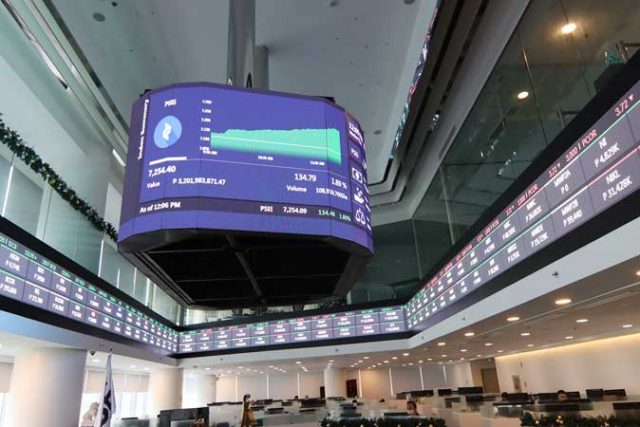
ALL COMPANIES included in the Philippine Stock Exchange (PSE) indices will be required to raise their public float level to 20% by December 2022, the bourse operator said on Thursday.

In the memorandum published on Thursday, the PSE said it is raising to 20% the free float level requirement for companies to be included in the indices, from the current level of 15%. The new rule will be implemented for the index review in December 2022 to give listed firms more time to comply, it added.

This is in line with the PSE’s policy requiring all companies conducting an initial public offering to have at least 20% minimum public ownership.

“Since newly listed companies are mandated to have a 20% free float level, this was a necessary adjustment to our index requirements. Companies that want to consistently be or aspire to become part of the index should make sure that their public float complies, if not exceeds, the minimum level required by the SEC of newly listed companies,” PSE President and CEO Ramon S. Monzon said in a statement.

The PSE also amended its index policy to accommodate the early inclusion of large issuances that “can comply with specific size and liquidity criteria” for its latest review covering June 2021.

Listed firms may also be included in the benchmark PSEi if it ranks 25th or higher in terms of market capitalization among other listed companies. Firms will be bumped off the 30-member index if it ranks 36th or lower in terms of full market capitalization.

“We reviewed the index policies of our peer exchanges and took note of provisions that will make our own policies more consistent with what is practiced globally. The policy revisions we adopted will continue to ensure the quality and integrity of the PSEi and sector indices,” Mr. Monzon said.

The PSE announced the results of its regular review of the benchmark index and sectoral indices covering trading activity for July 2020 to June 2021.

AC Energy Corp. and Converge Information and Communications Technology Solutions, Inc. will be joining the 30-member PSEi effective Aug. 16. They will replace DMCI Holdings, Inc. and Emperador, Inc. on the PSEi.

Rizal Commercial Banking Corp. will be removed from the financials index.

The industrial index will include Alsons Consolidated Resources, Inc. and EEI Corp., replacing Shakey’s Pizza Asia Ventures, Inc., and Phoenix Petroleum Philippines, Inc.

Lopez Holdings Corp. will exit the holding firms index, as AbaCore Capital Holdings, Inc. joins the index.

Arthaland Corp. and D.M. Wenceslao & Associates, Inc. will be taken out of the property index.

Converge and Premiere Horizon Alliance Corp. will be part of the services index.

Atlas Consolidated Mining & Development Corp., Marcventures Holdings, Inc., and Oriental Peninsula Resources Group, Inc. will join the mining and oil index. — Keren Concepcion G. Valmonte

PHL should focus on creating high-quality jobs

PHILIPPINE STAR/ MICHAEL VARCAS

THE PHILIPPINES should focus on diversifying its economy to produce high-quality jobs and more competitive products, according to the United Nations in the Philippines.

In a policy brief released on Thursday, the United Nations in the Philippines said the country was among Asia’s early industrializers in the early 1900s but has since failed to respond to the fast-changing environment and has struggled to compete.

“The focus on industrial catch-up is motivated by the prolonged stagnation of Philippine industry and its profound impact on the country’s labor market,” the report read.

“Unlike developed countries whose workers have largely transitioned away from agriculture to industrial and high-skilled services employment, workers in developing countries such as the Philippines have been moving out of low-productivity agriculture towards low-skilled services jobs,” it added.

Services sector accounts for 61% of gross domestic product and six out of 10 workers, but a third in low-paying jobs.

The report emphasized the urgent need for the Philippines to create productive employment given its 75 million people at their working age and 600,000 net additional job seekers entering the labor force annually.

“If you succeed in modernizing the agriculture sector, that sector would release or liberate a vast amount of labor and would have to be deployed somewhere,” Ndiame Diop, World Bank’s country director for the Philippines, said during the virtual launch of the report on Thursday.

However, Mr. Diop said the nation also has to develop other sectors that could accommodate these transitioning workers and provide them with higher productive jobs and a more decent wage.

Khalid Hassan, country director of the International Labor Organization (ILO) for the Philippines, said the country’s labor market has been struggling with a stagnant growth in real wages, gender gap, lower employment growth, and poor quality of work.

Meanwhile, the portion of its exports sector with competitive advantage and the number of exporting companies have been declining, making the Philippines a “market of consumer goods rather than a hub for manufacturing exports,” he said.

The country’s industrial base has also been less integrated which limits firms from sourcing their materials domestically.

“The Philippines has increased the sophistication in some of the global value chains, but has languished into low-value added segments and have shown competitive advantage to labor-intensive, lower-value goods and competitive disadvantage in higher-value, capital-intensive exports,” Mr. Hassan said.

Because of the huge setback in the past decades, the economy is also finding it more difficult to catch up with industrialization and in diversifying towards more complex products, added Mr. Hassan.

The report said the country can explore three paths towards economic diversification and upgrading, which includes “leap-frogging” to high-productivity and aiming for more sophisticated goods by adopting high technology over the medium to long term.

“While staging an industrial catch-up plan can be very costly and the price of targeting errors high, the consequence of policy inaction can be higher still as the resulting stagnation of the country’s technological growth is cumulatively widening the gap between its current capabilities and those required to produce complex products,” it said.

A more practical approach is to “climb up the value-added ladder” by integrating in global value chains more with products local firms can target.

The third and last route is for the country to sustain its local industrial base and support existing sectors with a strong competitive advantage, especially small- and medium-sized firms.

“After decades of filling in the most labor-intensive and relatively simple segments of production, the imperative to upgrade is increasingly becoming acute,” the report said, noting the pandemic has disrupted the labor market.

The report said policy makers have to aim for a rapid industrialization, diversification and the goal to produce goods with higher value-added, instead of clinging to a protectionist approach.

“To enable local firms to compete, the government can no longer rely on the protectionist instruments of the past and must now muster more positive, enabling measures that would allow local firms to survive increased global competition,” it added. — BML

SMC swings to P29.6-B income

SAN Miguel Corp. (SMC) returned to profitability to finish the first half with a net income of P29.57 billion, reversing last year’s P3.99-billion loss, as all of its major business units posted “robust recoveries.”

“While there is no doubt that the uncertainties brought about by the pandemic will continue to have an impact on our businesses, our strong performance in the first half reflects the effectiveness of the strategies we’ve put in place and our ability to quickly adapt to the evolving needs of our consumers,” SMC President and Chief Operating Officer Ramon S. Ang said in a statement on Thursday.

The company’s topline grew by 16% to P410.12 billion from P352.8 billion in the same period last year due to higher sales generated by Petron Corp., SMC Global Power Holdings Corp., SMC Infrastructure, and San Miguel Food and Beverage, Inc. (SMFB).

SMC’s operating income climbed by 309% to P61.02 billion “brought about by improved margins, effective company-wide cost savings initiatives, and continuous improvements in operational efficiencies.”

SMFB’s net income grew by 137% in the first semester to P17.36 billion, while its operating income went up by 103% to P23.04 billion.

Meanwhile, SMFB’s consolidated revenues went up by 20% to P146.8 billion on the back of volume improvements, especially in its spirits division, and better selling prices for its food and beer divisions.

San Miguel Brewery, Inc. generated P9.51 billion in net income for the period, 89% higher year on year from P5.02 billion.

The unit’s net sales improved by 27% to P54.33 billion from P42.79 billion. SMC said the unit saw “strong volume growth” in the second quarter, which led to a 15% increase in consolidated volumes to 97.4 million cases in the first six months.

Ginebra San Miguel, Inc.’s net income grew by 66% year on year to P2.09 billion from P1.26 billion as the unit focused on ramping up its marketing campaigns, expanding its distribution, and continuing supply chain efficiencies.

“[It] further solidified its growth momentum with domestic volumes reaching 20.1 million cases, surpassing last year’s level by 21%,” SMC said, adding that Ginebra San Miguel posted a 36% topline growth to P20.23 billion.

SMFB’s San Miguel Foods “delivered a strong first half” as its net income grew by nearly four times to P6.18 billion, while its net sales went up by 11% to P72.24 billion. The growth was due to the performance of its protein and animal health and nutrition segments during the period, as well as gains from pricing and volume.

Meanwhile, SMC Global Power’s net income improved by 35% to P12.22 billion from P9.06 billion. The unit’s income from operations, however, went down by 5.3% to P17.16 billion from P18.12 billion.

“Operating income declined… due to higher purchase volumes resulting from gas supply restrictions for the Ilijan power plant and outages in the Sual power plant,” SMC said.

The power unit recorded off-take volumes of 13,552 gigawatt hours in the six-month period. Consolidated revenues grew by 5.4% to P60.28 billion from P57.18 billion as spot volumes and customer nominations improved.

Petron swung to profitability in the first half with P3.87 billion from a P14.24-billion loss in the same period last year. Its topline rose by 14% to P174.13 billion from P152.36 billion.

“Consolidated sales volumes were still down by 7% to 38.9 million barrels from 41.9 million barrels last year, as fuel consumption in the commercial sector, particularly the aviation industry, remained restrained,” SMC said.

SMC logged a 144% growth in SMC Infrastructure’s operating income to P2.32 billion in the first half from last year’s P951 million. Revenues went up by 27% to P8.49 billion from P6.68 billion.

“Average daily traffic flow in all operating toll roads continue to improve, while volumes also continue to increase for Manila North Harbor and Bulacan Bulk Water,” SMC said.

Its Skyway Stage 3 project opened in January this year and just started collecting toll fees on July 12.

On Thursday, shares of SMC at the stock exchange went up by 0.37% or 40 centavos to close at P107.20 each. — Keren Concepcion G. Valmonte

AC Energy income eases; renewables capacity expands

AYALA-LED AC Energy Corp. reported an attributable net income of P1.42 billion in the second quarter, down by 28% from P1.97 billion year on year, despite higher revenues from its power business.

In its quarterly financial report filed with the local bourse, Ayala Corp.’s listed energy platform said electricity sales in the three months ending June hit P7.63 billion, higher by 43% than the P5.36 billion recorded in 2020. Power sales accounted for 99% of its overall revenues in the second quarter.

However, cost and expenses involved in AC Energy’s sale of electricity reached P5.95 billion in the same period, twice the amount registered in the second quarter last year at P2.91 billion.

Meanwhile, the company announced a second-quarter net income of P2.18 billion, lower by 18% than the amount registered in 2020.

In a press release on Thursday, AC Energy said that consolidated net income for the first half of 2021 climbed by 5% to P2.7 billion.

“The integration of international business into ACEN (AC Energy’s stock symbol) further strengthens the company’s balance sheet to support our diversified growth plans in the Philippine and offshore markets,” said AC Energy Chief Finance Officer Maria Corazon G. Dizon.

With the infusion of international assets, renewables now comprise 80% of the firm’s capacity.

AC Energy added that its attributable capacity in the first semester rose by 56% to 2,589 megawatts (MW) with the construction of new projects in the country, and in Vietnam, India, and Australia.

“We’re very pleased with the significant momentum in our renewables expansion both in the Philippines and around the region,” AC Energy President and Chief Executive Officer Eric T. Francia said.

In another disclosure, the company said its wholly owned unit AC Renewables International Pte. Ltd. (ACRI) secured management approval to enter into a joint venture with solar photovoltaic developer NEFIN Holding Ltd. to develop and operate rooftop solar projects across Asia.

The joint venture, which will be in the form of a holdings firm, will own 21 MW of operating assets and have “robust” project pipeline.

ACRI will initially invest $10 million of fresh funds for the development of near-term projects in the coming years. The Ayala unit also plans to finance the development of carbon neutrality pipeline.

In separate regulatory filing, AC Energy said that it is reallocating a portion of the proceeds of its stock rights offer and follow-on offer to finance renewable energy projects based in Pampanga, and Zambales, respectively.

It said P900 million from the rights offer will partially finance its investment in Greencore 3 Power Solutions, Inc. for a 75-MWdc (of direct current) plant in Arayat and Mexico, Pampanga.

Of the follow-on offering proceeds, P6.17 billion will partially finance its investment in Santa Cruz Solar Energy, Inc. for a 250-MWdc plant in San Marcelino, Zambales.

AC Energy targets to be largest listed renewables platform in Southeast Asia, as it hopes to reach 5,000 MW of renewables capacity by 2025.

The firm currently has an attributable capacity of around 1,200 MW in the country.

On Thursday, AC Energy shares improved by 3.07% or 26 centavos to finish at P8.74 apiece at the stock exchange. — Angelica Y. Yang

PLDT profit up 11% to P7B on sustained demand

JGSUMMIT.COM.PH

PLDT, Inc. saw its attributable net income for the second quarter grow 10.9% to P7.1 billion, as high demand for data and broadband continued.

“Sustained demand for data and broadband reinforced total service revenues across the company’s three customer segments — Home, Enterprise and Consumer Wireless. Home registered the highest revenue increase in the second quarter,” the fully integrated telecommunications company said in a statement e-mailed to reporters on Thursday.

PLDT’s service revenues for the quarter climbed 10.1% to P45.9 billion from P41.7 billion in the same period in 2020.

As for the first half of the year, the company’s service revenues increased 9.7% to P91.6 billion from P83.5 billion a year ago.

The company’s second-half attributable net income grew 4.8% to P12.9 billion from P12.3 billion previously.

PLDT and its wireless arm Smart Communications, Inc. invested P41.3 billion in network expansion projects in the first six months.

“In line with business demand and in support of revenue growth, the group’s continued rollout of its fiber, 5G and 4G/LTE networks is underpinned by its 2021 capex (capital expenditure) guidance of between P88 billion and P92 billion,” PLDT noted.

PLDT also said it managed to increase its fiber infrastructure by 22% to 524,000 kilometers in the first six months of the year.

“PLDT extended the reach of its fixed broadband service to cover 11.3 million homes passed, while the total number of fiber-powered ports increased to 4.8 million,” it said.

Smart also increased its base stations by 16% to more than 68,500 during the period.

The company expects its PLDT Home business to grow its subscriber base by one million this year. 

“PLDT Home’s fast-tracked fiber installation and repair capabilities aim to cover 66% of the country by yearend,” it said.

At an online briefing, Alfredo S. Panlilio, PLDT and Smart president and chief executive officer, said that in the next few years, revenues from the Home segment will be “50% of total wireless revenues.”

The company said its Home segment accelerated its momentum and recorded revenues of P11.8 billion in the second quarter or 27% higher than the amount reported in the same period last year.

Meanwhile, the Consumer Wireless segment’s revenue increased 6% to P21.7 billion compared with the second quarter of 2020.

PLDT Chairman Manuel V. Pangilinan said: “Full year, you’ll see us above P190 billion in terms of service revenues.”

He added that capex is expected to land at around P90 billion, or 25% higher than last year’s.

“We expect a high single-digit increase in consolidated service revenues, and we are on track to hit our telco core income target of P30 billion,” he noted.

PLDT said its telco core income, which excludes the impact of asset sales and Voyager Innovations, climbed 10% year on year to P15.2 billion in the first half of 2021, supported by lower tax rates.

Mr. Panlilio said PLDT expects to generate P1 billion in revenue in the second half of the year from its project with the Education department for the online study of one million public school teachers.

TOWER SALE
PLDT officials also confirmed that the company is considering selling some of its towers.

“We’ve spoken to a number of international banks, and they have enlightened us on the advantages of selling part of our towers,” Mr. Pangilinan said.

“Many of the details have got to be worked up. We’re open to it, whether the number of $800 million is the right number or not at this stage,” he added.

He said the banks managed to persuade PLDT to let go of certain towers that are “not strategic” to “what we want to achieve.”

“The job now is to identify those towers,” Mr. Pangilinan added.

PLDT has contracted with 10 independent tower companies with respect to its requirements for new sites.

“It’s good governance for us to look at strategic options… But, really, we’re at an early part of the process. It has to be not only value additive to us; but, really, in terms of the running of the towers, we have to ensure that those are done well,” Mr. Panlilio said.

PLDT shares closed 2% higher at P1,274 apiece on Thursday.

Hastings Holdings, Inc., a unit of PLDT Beneficial Trust Fund subsidiary MediaQuest Holdings, Inc., has a majority stake in BusinessWorld through the Philippine Star Group, which it controls. — Arjay L. Balinbin

Nickel Asia earns P2.7 billion on higher ore sales

NICKEL ASIA Corp. incurred a 579% increase in its attributable net income for the first six months of the year to P2.73 billion due to stronger ore sales prices and sales volume.

The listed mining firm said in a stock exchange disclosure on Thursday that its attributable net income for the January to June period is an improvement from the P401.43-million attributable net income it had in the same period a year ago.

Nickel Asia’s revenues for the period reached P11.03 billion, up 66.1% from P6.64 billion recorded in 2020.

From the total, sale of ore and limestone revenues accounted for P10.35 billion, followed by services and other revenues at P433.44 million, and revenues from sale of power at P247.87 million.

“The company sold a total of 8.3 million wet metric tons (WMT) at the weighted average realized price of $25.47 per WMT in the first half of 2021 compared to 7.3 million WMT at $16.02 per WMT in the same period last year,” it said in the disclosure.

Earnings before interest, tax, depreciation, and amortization (EBITDA) rose 157% to P5.34 billion from P2.08 billion a year ago, while operating expenses also went up 46% to P2.58 billion compared to P1.76 billion in 2020.

“The company exported 4.56 million WMT of saprolite and limonite ore at the average price of $37.50 per WMT in the first six months of 2021 compared to 3.28 million WMT at $26.03 per WMT in the same period last year,” the company said.

“Likewise, the company delivered 3.74 million WMT of limonite ore to Coral Bay and Taganito high pressure acid leach (HPAL) plants, the prices of which are linked to the London Metal Exchange (LME), and realized an average price of $7.92 per pound of payable nickel. This compares to 4.02 million WMT at $5.68 per pound of payable nickel in 2020,” it added.

Martin Antonio G. Zamora, Nickel Asia president and chief executive officer, said the demand for nickel remains high as a result of improving stainless steel production, carried by the recovery of the construction, manufacturing, and oil and gas sectors, and growing demand from the electric vehicle battery industry.

“Further, nickel supply disruptions, due in large part to the Indonesian ore export ban and coronavirus disease 2019 (COVID-19) related lockdowns, provide additional support to the price of nickel,” he said in the disclosure.

On Thursday, shares of NAC at the stock exchange rose 0.16% or one centavo to end at P6.21 apiece. — Revin Mikhael D. Ochave

Realities of Filipino life tackled in 4 films

A STILL from the film Tao Po directed by Mae Paner

Non-competition feature films get first ever screening

THE TESTIMONIES of people affected by extrajudicial killings (EJK), a couple in a turbulent relationship, a media studies student who meets his most admired broadcaster, and a story of a family man who climbs to the peak of the mountain while recovering from a traumatic experience are among the non-competition highlights in this year’s Cinemalaya Philippine Independent Film Festival.

Due to the coronavirus disease 2019 (COVID-19) pandemic, the 17th edition of Cinemalaya migrates online via KTX.ph. The pandemic has also resulted in this year’s edition focusing on short films for the competition section, to give more time to the feature films to be made under current constraints. It is planned that the feature films in competition will be shown next year.

The Cinemalaya Philippine Independent Film Festival — an all-digital film festival and competition “that aims to discover, encourage and honor cinematic works of Filipino filmmakers” — is a project of the Cultural Center of the Philippines (CCP) and the Cinemalaya Foundation, Inc.

Alongside the screening of the 13 competing short films, Cinemalaya this year presents the Premieres section, featuring four never before seen feature films by Filipino filmmakers. The feature films will be screening for the duration of the festival, Aug. 6 to Sept. 5 on ktx.ph.

The four films are the family drama Highest Peak, directed by Arnel Barbarona; the drama He Who is Without Sin, directed by Jason Paul Laxamana; neo-noir film Love and Pain In Between Refrains, directed by Joselito Altarejos; and the social monologue Tao Po, directed by Mae Paner (also known as Juana Change).

Highest Peak (screening on Aug. 7 to 14) follows a man who decides to follow through with his family’s plan to climb Mount Apo after losing his wife and son. It is a journey of redemption, closure, and healing. The film stars Dax Alejandro, Mara Lopez, Henyo Ehem, Rowena Caballes, Jea Lyka Cinco, Johnny Hager, Buggy Amplayo, Jun Alcover, Bong Artil and Ferdinand Mesias.

He Who is Without Sin takes (premiering Aug. 15 to 21) follows what transpired during a chance meeting between a broadcasting student and the TV reporter he idolizes. In the days that follow the encounter, the young student shares with his friends three separate versions of what transpired. Through the conversations with friends, he comes to terms with the idea that his idol — a dignified newsman who is supposed to be a paragon of virtue — is not who he appears to be on television. The film stars Elijah Canlas, Enzo Pineda, Pearl Lagman, Migs Campanilla, Lara Fortuna, Gio Gahol, Marnie Lapus, and Iman Ampatuan.

During an online press conference earlier this week via Zoom, the film’s director, Jason Paul Laxamana, said that the film is semi-autobiographical and based on his personal experience as a broadcast journalism student who met one of the broadcasters he admired. “During their meeting, questionable things transpired. The film is an examination of his thought process,” Mr. Laxamana said in English and Filipino.

Love and Pain In Between Refrains (premiering Aug. 22 to 28) deals with a tragedy that feeds on love and co-dependency, and the cycle of abuse and violence. It follows high school sweethearts who lost touch with each other after graduation and meet again after 10 years. Feelings rekindled; they start living together. But what was supposed to be a beautiful relationship turns into a traumatic reunion. The film stars Oliver Aquino, Elora Españo, Richard Quan, Anelle Durano, Suzette Doctolero, Natileigh Sitoy, Anjo Resureccion, and Jill Urdaneta.

“It deals with the psychology of the abused and the abuser in the cycle of violence,” said director Joselito Altarejos.

As an advocate of “Cinema of the Social Consciousness,” Mr. Altarejos —  who directed the 2014 Cinemalaya Best Film Kasal, Tale of the Lost Boys (2017), and Unfriend (2014), among others —  aims to create films that educate and inspire his audience to become more vigilant and conscious of the country’s social issues. “I would like to offer my films to help people see what is happening around us,” he said.

Tao Po (premiering Sept. 3) follows the social awakening of a photojournalist when he covers the tokhang beat. After several immersion trips and in-depth interviews conducted by artist-activist Mae Paner and playwright Maynard Manansala, four monologues were developed that give faces to the issue of extra-judicial killings.

Ang pelikulang ito ay magandang mapanood ng napakaraming Pilipino para mayroon tayong konting glimpse na makita tungkol sa nangyayari sa atin based on four personal narratives of people affected by extrajudicial killings (It would be good for many Filipinos to watch the film so that they have a glimpse of what is happening around us based on four personal narratives of people affected by extrajudicial killings),” director and producer Mae Paner said.

Tao Po will also premiere at Cultural Center of the Philippines’ Cinema under the Stars or drive-in theater at the Liwasang Ullalim located across the center’s main building on Sept. 3. A talkback session will be hosted after the drive-in film screening. Discussion for the other three films will be hosted online prior to the premiere of each film.

Tickets for the Premieres are priced at P250.

INDIE NATION SECTION
Meanwhile, four full-length feature films will be shown in Cinemalaya’s Indie Nation section.

These are: Lockdown by Joel Lamangan; Kintsugi by Lawrence Fajardo; Don Filipo by Tim Muñoz; and ECQ Diary (Bawal Lumabas) by Arlyn Dela Cruz Bernal.

Mr. Lamangan’s Lockdown is about a returning overseas Filipino worker who desperately turns to cybersex in the middle of a global pandemic and a struggling economy. The film stars Paolo Gumabao, Max Eigenmann, Allan Paule, Ruby Ruiz, Jess Evardone, Jim Pebanco, Angeline Sanoy, Paul Jake Paule, Sean de Guzman and Alexis Yasuda.

Kintsugi refers to the Japanese method of repairing broken porcelain, wherein shards are reattached with gold. The film follows a Filipino OFW factory worker who develops a close bond with his employer’s daughter. Filmed in Saga, Japan, this is Mr. Fajardo’s second Sinag Maynila full-length entry after 2015’s Imbisibol. JC Santos and a cast of Filipino and Japanese actors star in the film.

Mr. Muñoz’s Don Filipo is about a remote village that is gripped with fear as its residents go missing one by one. Now a young nurse is in town to care for an ailing Don Filipo. Will he be the next victim? The film stars Luis Padilla, Adrian Arias, Rap Robes, and Megan Sharpe.

Bernal’s ECQ Diary (Bawal Lumabas) focuses on two sisters in their sixties who are reunited in one house during the Enhanced Community Quarantine (ECQ) of 2020. Confined together because of the pandemic, the sisters confront an old issue that kept them apart for many years. Starring in the film are Elizabeth Oropesa, Daria Ramirez, Unica Yzabel, and Danni Ugali.

RETROSPECTIVE OF CINEMALAYA AWARD-WINNING FILMS
The award-winning films in previous editions of Cinemalaya will be show in the Retrospective, streaming on ktx.ph starting Aug. 6, 3 p.m. The ticket is priced at P150.

This Cinemalaya section features six short films – Tokwifi by Carla Pulido-Ocampo, Living Things by Martika Ramirez Escobar, Pabasa Kan Pasyon by Hubert Tibi, Ang Pagpakalma sa Unos by Joanna Vasquez Arong, Quing Lalam Ning Aldo by Reeden Fajardo, and Excuse Me Miss, Miss, Miss by Sonny Calvento.

Tokwifi narrates the story of a 1950s mestiza star who is trapped inside a television. A star falls from the sky and dreams up a romantic romp with a Bontok Igorot man who does not know how to kiss. The film won the 2020 Cinemalaya Best Film for its highly original take on love.

Living Things is about a woman who discovers that her lover has turned into a cardboard standee. Bagging the Best Director award, director Mr. Escobar comes out with a whimsical yet convincing tale of how two people in love confront the challenges of change.

Director Hubert Tibi won the Best Screenplay for his film Pabasa kan Pasyon, which follows a Bicolano family who turns to religion to make both ends meet. The short film has been screened in the Court Metrage section of the 2021 Cannes Film Festival.

Ang Pagpakalma sa Unos, which received the Cinemalaya Special Jury Prize, has been making the rounds in various film festivals. It tells the story of the ravages of Typhoon Yolanda as seen through the eyes of a child.

The tale of a transgender sampaguita farmer who decides to renovate their neglected kitchen as soon as she hears that her son is going home won the hearts of the viewers, bagging the People’s Audience Choice Award for Quing Lalam Ning Aldo.

Completing the list is Excuse Me Miss, Miss, Miss, which is about a department store sales lady who unearths the ultimate secret to regularization. The fantasy comedy short film was the first Filipino short film to compete in the Sundance Film Festival. 

ACCLAIMED ASIAN INDIES
AWARD-winning Asian indie films will be showcased in the Visions of Asia section of Cinemalaya. Tickets for Visions of Asia films are priced at P150.

Five films, all Network for the Promotion of Asian Cinema or NETPAC awardees, will be shown. NETPAC is a worldwide organization managed by cinephiles who promote Asian cinema. Visions of Asia this year offers the following films: A Dark, Dark Man, Bandar Band, Jazz Kissa Basie: Swifty’s Ballad, Mosul My Home, Sthalpuran (Chronicle of Space)

A Dark, Dark Man by Adilkhan Yerzhanov, one of Kazakhstan’s foremost filmmakers, is a drama about the investigation of a boy’s murder. After a phony suspect is “caught” by local police officers, things fall apart when a journalist comes to investigate and the detective on the case must conduct a real investigation for the first time in his career.

Bandar Band by Manijeh Hekmat has been shown in 20 film festivals around the world as part of the main competition or as a special screening. It won the NETPAC Prize in South Korea’s Ulju Mountain Film Festival in April 2021. In this drama, Iranian women singers are going to enter an unofficial competition in Tehran, journeying to the city from a southern province just when they have lost all they had in the flood. However, every road they take leads to a dead-end in a flood-stricken land.

Jazz Kissa Basie: Swifty’s Ballad by Tetsuya Hoshino is a candid documentary of Shōji Sugawara, whose lifelong pursuit to recreate the best audio sound imaginable has, for years, attracted audiophiles from Japan and around the world to his coffeehouse.

Mosul My Home by Adalet R. Garmiany, which won the NETPAC Jury Prize at the 43rd Moscow International Film Festival in April 2021, chronicles the journey into the peaceful, abundant and warm-hearted past of Mosul, now in ruins. This documentary journey is filled with love and compassion for its city, and is an eloquent manifestation of the power of art, memory and humanity.

Sthalpuran (Chronicle of Space) by Akshay Indikar tells the story of eight-year-old Dighu who is exploring his new internal and external environments after his mother and elder sister moved to his grandparents’ village on the Konkan coast following his father’s disappearance.

DOCUMENTARY SECTION
FIVE award-winning documentary films were selected by acclaimed film director and screenwriter Dr. Clodualdo “Doy” Del Mundo for Cinemalaya’s DOKYU section. Tickets to Cinemalaya Dokyu section are P150.

The films to be shown are: A House in Pieces by Jean Claire Dy and Manuel Domes about the destruction of Marawi; Yugto by Joanna Reyes, Cristy Linga and Ja Turla, a short documentary of the lives of Filipinos during the COVID-19 pandemic; Paraisong Bacao by Adrian N. Manaois, follows a 14-year-old Aeta who lives in a mountainous area that he considers paradise; Last Days At Sea by Venice Atienza, follows 12-year-old Reyboy who lives in an isolated fishing village in the south of the Philippines, but who has to leave for the city to study; Masterpiece by Januar Yap and Kristoffer Villarino, follows a parish priest in Bantayan Island who, inspired by the ceiling paintings of the old churches in Cebu and the Sistine Chapel, embarks on his own epic ceiling painting project.

For tickets, visit ktx.ph. Follow the official CCP and Cinemalaya social media accounts on Facebook, Twitter, and Instagram for updates on the Cinemalaya Film Festival screening schedules andother offerings. For more information, visit the CCP website (www.culturalcenter.gov.ph). — M.A.P. Soliman

Robinsons Land posts P2.6-B profit as core businesses recover

ROBINSONS Land Corp. (RLC) recorded a second-quarter net income of P2.56 billion, up nearly fourfolds from the level a year earlier, the Gokongweis’ real estate company said in a statement on Thursday.

“Despite unstable circumstances, RLC reported increasing customer activity and engagement in its malls, offices, hotels, industrials, as well as property development and residential businesses,” the listed company said.

For the first semester, net income climbed by 48% to P5.45 billion. Consolidated revenues jumped 55% to P26 billion from P16.7 billion.

RLC President and Chief Executive Officer Frederick D. Go described the company’s first-half showing as “a testament to the success of our strategic initiatives.” He said these moves position the firm for recovery and growth.

“Amidst the very challenging business environment, we continue to pursue new opportunities and agile innovations to deliver sustainable value to all our stakeholders,” he said.

RLC said its strong growth during the semester was driven the continued recovery of its core businesses with a 51% climb in net income. It also cited the earnings from its Chengdu Ban Bian Jie project in China and the sale of parcels of land within the Bridgetowne Destination Estate.

The company said its financial position “remains solid” with more than P11.98 billion in cash and cash equivalents, and net gearing ratio of only 0.39x.

During the period, its total assets stood at P214.14 billion while shareholders’ equity was at P106.90 billion.