Home Blog Page 7096

MPBL: Bicol bounces back with 80-68 win over Laguna

WWW.FACEBOOK.COM/BICOLVOLCANOESLCC

BICOL-LCC Malls vented its ire on Laguna-Krah Asia, 80-68, for a big bounce back win in the second day of the Chooks-to-Go Maharlika Pilipinas Basketball League (MPBL) Invitational at the Mall of Asia Arena in Pasay City.

Mac Tallo fired 18 points and seven rebounds in 22 minutes of play as Bicol avenged its narrow 70-65 loss to Basilan in the opener of the MPBL as the country’s latest pro league.

Kent Lao and Ralph Tansingco added 14 and 10 markers, respectively, for the Volcanoes, who improved to 1-1 in Pool B.

“We played well today compared to our first match, but we are still a work in progress,” said mentor Aldin Ayo.

Kim Aurin was the lone bright spot with 13 markers for Laguna, which slid to 0-1.

Meanwhile, Nueva Ecjia and Rizal picked up first wins over Sarangani and General Santos, respectively.

The Rice Vanguards fended off Sarangani, 99-92, behind Michael Mabulac’s 17 markers while the Golden Coolers bested GenSan with a 73-66 win on Adrian Celada’s 23 points.

Nueva Ecija joined San Juan on top of Pool C with similar 1-0 cards while Rizal (1-0) gained a piece of Pool D lead with Imus (1-0). — John Bryan Ulanday

Style (12/13/21)

Banana Republic holiday suggestions

THIS festive season, Banana Republic continues to provide men and women with rich comfort and luxurious styles that make great presents for the season. Here are some gift ideas: women’s styles include ribbed racerback dress, the Essential shift dress, petite high-rise straight Italian wool pants, petite classic-fit organic flannel shirt, ultra high-rise slim jean, and paperbag-waist short; while in men’s styles, the selection includes authentic Supima crew-neck T-shirt, organic cotton pique polo, luxury-touch performance polo, organic cotton waffle-knit sweater, slim traveler pant, and cotton linen stripe easy short. Shop Banana Republic’s latest collection for gifts worth giving. Visit Banana Republic Greenbelt 5 or shop from home through Banana Republic’s Viber Community: bit.ly/BRPHcommunity or shop deals 24/7 at bananarepublic.com.ph. Banana Republic VIP customers can enjoy exclusive offers, VIP access, plus, other benefits, including a P1,000 welcome voucher, annual milestone vouchers, and a special Birthday treat. Know more about the VIP Program here: http://bananarepublic.com.ph/pages/vip-page.

Ever Bilena unveils new logo, tagline and product refresh

AS MAKEUP and beauty is for everyone, regardless of gender orientation, age, class, and skin tone, or skin type, local cosmetics company Ever Bilena unveils a new theme that speaks to a more diverse and dynamic audience. The brand’s newest tagline is “for every beauty” that embodies the concept that beauty is for every individual. Accompanying the tagline is a new logo — clean, streamlined and straightforward. “This rebranding reflects our goal to make Ever Bilena even more accessible, inclusive and affordable to the individuals who use our extensive range of products. It is our pledge to remain as a beauty brand that supports the dreams and needs of our cosmetics users,” said Dioceldo Sy, Ever Bilena CEO. As part of this new direction is the brand’s product refresh, featuring three new major categories. These are: All Day, all day wearing products including All Day Liquid Foundation which delivers buildable coverage that helps reduce the appearance of skin imperfections while giving hydration without the greasy feel; Pro, professional-grade level products for makeup enthusiasts to professional makeup artists; Matte, the signature line of Ever Bilena which includes the Ever Bilena Matte Lipstick and the Ever Bilena Matte Two Way Cake. To shop for these products, check Ever Bilena on Lazada, Shopee or visit Ever Bilena on Facebook (@everbilenacosmetics) or Instagram (@everbilenaofficial).

Robinsons Malls launch new RMalls+ mobile app

ROBINSONS Malls has come out with its new RMalls+ mobile app which provides exclusive deals and discounts plus first dibs on mall promotions. Shoppers who download the RMalls+ app can be the first to score PLUS benefits such as Buy One Get One deals from Auntie Anne’s and Snow Plus, freebies from Cinnabon, Chili’s, Classic Savory, Kuya J, Pancake House, Smart and Super Bowl of China, and up to 50% discount deals from Charles & Keith, Mary Grace, Levi’s, World Balance, Cherry Mobile, Photoline, Executive Optical, Sarabia Optical, Lay Bare, Hey Sugar, Nailaholics, Ooh La Lash, Vivere Salon and Dental Nook. RMalls+ app users can even enjoy up to 25% off from partner hotels such as Dusit Thani Mactan Cebu, Crowne Plaza, Summit Hotels and Resorts, and Go Hotels and discounts from Foodpanda merchants inside Robinsons Malls. And starting Dec. 15, the app users can get two free parking vouchers in select Robinsons Malls when they download the app. These offers are just the start of many more in-app perks and benefits that the app will soon introduce for all users nationwide. The RMalls+ app includes information on special events and activities in the Things To Do section of the app. This includes the RC cars drift track at Robinsons Galleria and Robinsons Place Iloilo; the malls’ Christmas attractions; various games, free character balloons, and special gifts from Tom’s World, Toys R Us and other retail partners. Get movie screening information about the next blockbuster. And be the first to know about the latest and trendiest shops that opened in various Robinsons Malls. The app’s Gift tile to give Robinsons Malls eGifts which can be spent in participating Robinsons Malls stores nationwide. Find mall information like location, contact details, operational hours, and directions and even find the nearest malls. Each mall listing has a corresponding store directory. One can also contact stores directly in advance and bookmark favorite malls and shops in the RMalls+ app for quicker reference. The app has other unique features like Shop For Me which allows the user to easily contact Robbie and Rosie, Robinsons Malls’ personal shoppers, for a hassle-free shopping experience in select malls. App users can also win prizes from joining Robinsons Malls’ ongoing promos and games through the app. Soon, customers will be able to buy and even gift Robinsons Movieworld movie tickets. RMalls+ is free to download on the App Store and Google Play.

Cebuana Lhuillier holds Christmas Sale    

Cebuana Lhuillier, together with Cebuana Lhuillier Premium and Just Jewel, are holding a Christmas Jewelry Sale nationwide, from Dec. 13 to 18. The sale is offered nationwide, in more than 2,500 Cebuana Lhuillier’s branches, as well as online through Cebuana Lhuillier, Just Jewels, orCebuana Lhuillier Jewelry Premium Facebook pages. “Most people would spend their bonuses on the latest gadgets and other luxury items that depreciate over time. But they could get the best out of their money with something so small like jewelry. Like what I’ve said before, the value of gemstones are always at an upward trend, it always appreciates in value,”Cebuana Lhuillier President and CEO, Jean Henri Lhuillier said in a statement. Cebuana Lhuillier is offering 5% off on all items and up to 50% off on selected items, nationwide. Meanwhile, a 5% discount is offered for all online purchases. Visit Cebuana Lhuillier, Just Jewels, or CebuanaLhuillier Jewelry Premium branches or shop online via Cebuana FB Live Selling or cebuanalhuillierjewelry.com

The world is so desperate for manure even human waste is a hot commodity

REUTERS

THE market for manure — from pigs, horses, cattle and even humans — has never been so hot, thanks to a global shortage of chemical fertilizers.

Just ask Andrew Whitelaw, a grains analyst at Thomas Elder Markets based in Melbourne, Australia who runs a commercial pig farm in his spare time.

Mr. Whitelaw said that he’s completely sold clean of animal waste, as farmers hunt for alternatives to the more commonly used phosphate- and nitrogen-based fertilizers that are vital to boosting crop yields.

“We don’t have any left,” he said. “In a normal year, you’d probably get a couple phone calls a year, not a couple of phone calls a week.”

It may be some time before he sees the interest in pig poop taper. Prices of synthetic fertilizer, which rely on natural gas and coal as raw materials, have soared amid an energy shortage and export restrictions by Russia and China. That’s adding to challenges for agricultural supply chains at a time when global food costs are near a record high and farmers scramble for fertilizers to prevent losses to global crop yields for staples.

The Green Markets North American Fertilizer Price Index is hovering around an all-time high at $1,072.87 per short ton, while in China, spot urea has soared more than 200% this year to a record.

The demand for dung is playing out globally. In Iowa, manure is selling for between $40 to $70 per short ton, up about $10 from a year ago and the highest levels since 2012, according to Daniel Anderson, assistant professor at Iowa State University and a specialist on manure.

Manure is mostly a local market and truckloads won’t go further than 50 miles (80 kilometers), Mr. Anderson said. When crop, fertilizer and manure prices soared about a decade ago, more farmers reintroduced animals such as hogs and cattle onto their land, in part for their manure. That option could again be on farmers’ minds as fertilizer costs soar.

In Australia’s Queensland state, Brian Mclean, general manager of an organic fertilizer company, said that sales of his poultry manure compost are going through the roof. If interest keeps up at the same rate, people seeking ready-treated manure in the area would soon miss out.

 “There wouldn’t be enough in total,” he said. In just the last few months, he’s sold about 15,000 tons of the stuff, compared to around 2,000 tons the same time last year, though some of the renewed fervor has been driven by a bounce back in weather conditions after years of drought, Mr. Mclean added.

In the UK, not only are farmers scrambling for animal compost, but many are even trying to get their hands on treated sewage sludge containing human excrement, or biosolids. David Butler, who farms wheat, oats and peas in Wiltshire in the southwest of England, has traditionally relied on his own herd of cows to produce animal waste that he uses for his crops.

“The arable area still requires significant tonnage of synthetic fertilizer, but this is reduced by the use of manures,” Mr. Butler said. Since the animal waste from his farm is not enough, he has been buying biosolids from utility Thames Water.

However, Mr. Butler said that it’s increasingly difficult to source human excrement as “there is more demand than supply for biosolid materials.”

In the US, biosolids are regulated by the Environmental Protection Agency, and in Europe, biosolids have been in use since 1986 when it received regulatory approval from the European Union.

While manure is an inexpensive alternative to pricey synthetic fertilizers, it is a “poor replacement for those accustomed to traditional fertilizer products,” said Alexis Maxwell, an analyst at Bloomberg’s Green Markets. For example, the fertilizer diammonium phosphate has six times the nitrogen and 15 times the phosphate as manure on a per ton basis.

Commercial fertilizers, invented over a century ago, are among the technologies credited for raising crop yields to feeding billions of people on the planet. But even before prices for chemical fertilizers started surging, organic products had seen increased attention as proponents argue that the potent chemicals found in commercial materials can have a corrosive effect on soil health.

Green manure and composting techniques, meanwhile, can boost crop nutrients with sufficient planning ahead around some natural variability in the greener products compared to their synthetic counterparts.

The recent price spike is likely to have turned more farmers into longer-term converts, even if fertilizer prices start to cool, said Mr. Mclean, the Queensland organic fertilizer seller.

“They’ve now realized how much better off they are using the organic products,” he said. “They’ll be making it a permanent thing in their rotations.” — Bloomberg

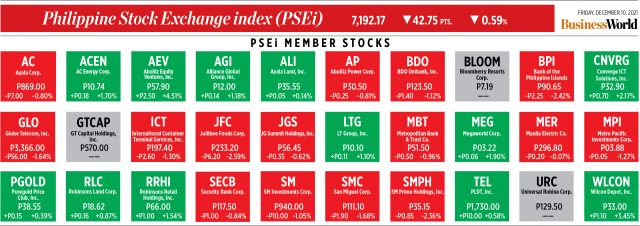
How PSEi member stocks performed — December 10, 2021

Here’s a quick glance at how PSEi stocks fared on Friday, December 10, 2021.


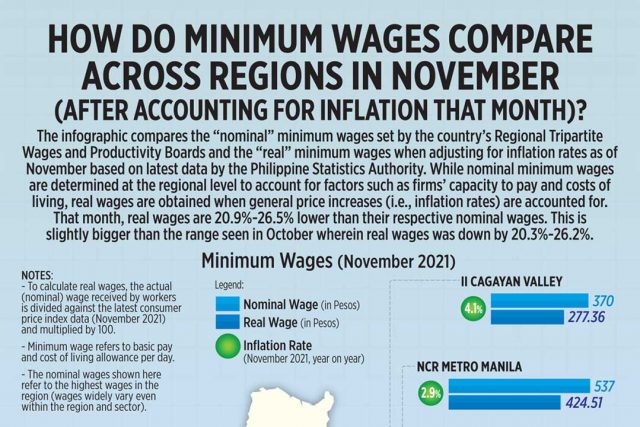
How do minimum wages compare across regions in November

How do minimum wages compare across regions in November

Renewable companies gear up for DoE’s green energy auction

Wind-Farm

RENEWABLE Energy companies are weighing their participation in the Green Energy Auction Program (GEAP) after the Department of Energy (DoE) finally launched the rules governing the program after a lengthy delay.

“We support GEAP as it aims to bolster the RE capacity share in the country’s energy portfolio. With our expansion plans, SN Aboitiz Power (SNAP) is well-positioned to meet this demand,” Joseph S. Yu, SNAP Group President and CEO, told BusinessWorld in an e-mail.

AC Energy President and CEO John Eric T. Francia said they are expecting the GEAP to boost the participants’ Renewable Portfolio Standards.

“GEAP should help industry participants comply with Renewable Portfolio Standards, but we also hope that the Renewable Energy Market is implemented soonest, to allow the market mechanism for the trading of renewable energy certificates,” he said in a Viber message.

First Gen Corp. Vice President Carlos L. Vega said the company is looking at its renewable energy (RE) projects particularly hydro and geothermal in anticipation of participation in the GEAP.

“We expect GEAP to help address uncertainties in the market that challenge the feasibility of RE projects,” Mr. Vega said in a Viber message.

The GEAP is a new market development support program which aims to promote RE as one of the country’s primary sources of energy through competitive selection of RE facilities.

The program, however, has already been delayed for five months from its initial targeted launch in June.

The DoE postponed the scheduled launch in October to complete “ongoing discussions with relevant entities.”

On Friday, the Department of Energy announced that Secretary Alfonso G. Cusi signed the revised GEAP policies on Nov. 3. They took effect on Dec. 5.

“The implementation of GEAP is seen encouraging greater private sector participation in the generation sector through RE. With GEAP, the country’s RE program will be met particularly in targeting attainment of 35% RE share in the generation mix by 2030,” Mr. Cusi said in a statement.

The policy allows qualified participants from on-grid areas that generate power from biomass, wind, solar, hydro, ocean, geothermal, and waste-to-energy.

The DoE said companies need to await the notice of auction as the auction rules are not yet set.

DoE Renewable Energy Management Bureau Director Mylene C. Capongcol told BusinessWorld in a text message that there is no certainty whether the Notice of Auction can be issued in December.

“Hopefully we can start the process before the year ends, but I can’t tell,” Ms. Capongcol said.

“There are things that have to be reviewed by the DoE. We wanted to make sure we have robust policy and guidelines, but the decision (to publish it or not this year) is beyond my authority,” she added.

The decision on the auction notice will be made by Energy Assistant Secretary Redentor E. Delola, who also heads the GEAP committee. — Marielle C. Lucenio

DAR overhauls land conversion rules for government projects 

FACEBOOK.COM/DARGOVPH

The Department of Agrarian Reform (DAR) said its land conversion rules have been overhauled to expedite government projects.

Secretary Bernie F. Cruz said in a statement Sunday that government special project undertakings (SPU) will be given priority in applications for the conversion of agricultural land.

The department considers SPUs a high-priority category for the employment opportunities they generate for local communities, and for the potential of projects such as socialized housing, power distribution, telecommunications, and water generation to benefit the public at large.

Landowners and agrarian reform beneficiaries may apply for the conversion of agricultural land for sites not exceeding five hectares.

For sites of more than five hectares, the appropriate office to file applications with is the Land Use Cases Division of the Bureau of Agrarian Legal Assistance (LUCD-BALA).

Certifications from the proponent agency or the local government unit (LGU) involved in the project are required for all applications, except for those concerning agro-industry.

“A conversion application for an energy project like power generation, transmission, or distribution must be certified by the Department of Energy (DoE), or the National Electrification Administration (NEA), or the LGU, whichever is involved in the project,” Mr. Cruz said.

Applications for a telecommunications site would need to be certified by the National Telecommunication Commission (NTC), or the Department of Information and Communications Technology (DICT).

Socialized housing projects must be certified by the Department of Human Settlements and Urban Development (DHSUD) or the National Housing Authority (NHA). Water-related projects must be endorsed by the Metropolitan Waterworks and Sewerage System (MWSS), or the Local Water Utilities Administration (LWUA).

Conversions for resettlement or relocation sites for disaster-stricken areas for displaced informal settlers are to be certified by the National Disaster Risk Reduction and Management Council (NDRRMC).

National government infrastructure projects must be certified by the proponent agency, or the Departments of Public Works and Highways (DPWH) or Transportation. — Luisa Maria Jacinta C. Jocson

External debt at end of Sept. up 4.7% quarter on quarter

BW FILE PHOTO

EXTERNAL DEBT held by the Philippines rose 4.7% from a quarter earlier at the end of September, with the government continuing to borrow to fund its pandemic mitigation measures.

According to preliminary data released by the Bangko Sentral ng Pilipinas (BSP) late Friday, external debt was $105.929 billion at the end of the third quarter, against the $101.2 billion tally at the end of June.

The end-of-September external debt total was the highest since at least 2011, according to BSP data.

The share of external debt to gross domestic product rose as a result to 27.3% from 26.5% at the end of June.

External debt consists of all types of borrowing by residents in the Philippines from non-residents.

The government raised $3 billion from a global bond issue and $1.3 billion through other external financing exercises for use in various pandemic containment projects, the BSP said.

“In view of the recent distribution by the International Monetary Fund of the $650-billion special drawing rights allocation to its members last Aug. 23, the country’s reserve assets and external debt levels increased by $2.8 billion during the quarter,” it added.

The debt service ratio, or principal and interest payments as a fraction of export receipts and primary income, rose to 8.1% at the end of September from 7.2% a year earlier.

Public-sector external debt rose 10.1% from a quarter earlier to $65.2 billion at the end of September. Some $56.9 billion consisted of national government borrowing, while $8.4 billion were loans of government corporations, financial institutions, and the BSP.

Privat-sector debt fell 1.45% from a quarter earlier to $40.7 billion at the end of September. Private borrowers made net payments of $434 million. The balance was also affected by a negative foreign exchange revaluation of $121 million.

Major creditor countries during the period were Japan ($14.8 billion), the US ($2.9 billion), the Netherlands ($2.8 billion), the UK ($2.4 billion), and China ($2.2 billion).

The government is planning for a 85:15 domestic vs. foreign financing mix this year. Before the pandemic, the applicable ratio was 75:25. — Luz Wendy T. Noble

BoI pitching PHL to Chinese tech companies

REUTERS

THE BOARD of Investments (BoI) is seeking out Chinese companies interested in investing in battery projects and other areas of technology, particularly those that will help the Philippines make progress on digitalization.  

Trade Undersecretary and BoI Managing Head Ceferino S. Rodolfo said during the recent China-Philippines Economic and Trade Conference that Chinese firms can tap Philippine mineral deposits to produce lithium-ion batteries.

Mr. Rodolfo also said Chinese firms can invest in energy storage products such as electric vehicle batteries and renewable energy battery banks.

“As the Philippines has one of the largest deposits for both nickel and cobalt, the key ingredients for making lithium-ion batteries, investment in the processing facilities for such mineral products are profitable,” Mr. Rodolfo said.

Mr. Rodolfo said Chinese investors can also look into assembling transportation equipment and consumer electronics.

“The Philippines, similar to other countries, is experiencing a surge in demand for solo mobility types of transportation equipment,” Mr. Rodolfo said.

Mr. Rodolfo said there are also opportunities in health-related products such as medicine, vaccines, and medical devices due to the presence of an established manufacturing supply chain.

He said that the Philippines has the capacity for making tooling and dies, industrial chemicals, semiconductors, plastics, and metal parts, which are all required in the production of medical devices .

“Growth in the field of medical devices in the Philippines is expected to be driven by the government’s initiative to upgrade and build more health facilities to support the projected demand from 2025 to 2040,” Mr. Rodolfo said.

Mr. Rodolfo said Chinese companies can also invest in the modernization of the agriculture sector and in agribusiness, particularly in research, processing, and logistics, as well as in fintechs.

“With financial technology and e-commerce growing ever stronger in the Philippines and Asia, we are poised to develop an advanced tech startup environment,” Mr. Rodolfo said.

“From 2016 to 2020, the total trade with China reached $145 billion with an average growth of 8.8 percent. In 2020, bilateral trade is amounting to $31 billion, making China the country’s top trading partner – the third biggest export market and the biggest import source,” he added. — Revin Mikhael D. Ochave

Farm groups press gov’t to enforce rules on first border inspection for agri imports

BW FILE PHOTO

FARMER’s groups said Sunday that the government needs to enforce the law on quarantine and other inspections at the ports for imported animal and plant products to deter smuggling.

The government has failed to set up so-called first border facilities at various ports as required by law, at which imported agricultural products are to be inspected.

Because of the lack of such facilities, imported goods, including smuggled ones, are only examined at cold storage facilities once they leave the major seaports, Samahang Industriya ng Agrikultura (SINAG) Executive Director Jayson H. Cainglet told BusinessWorld in a text message.

“What they are currently doing is merely opening and closing the container van,” he said. “Funds were already allotted since 2019 for the establishment of the first border inspection facilities; and yet, not a single inspection facility was established, contrary to the provisions of RA 10611, or the Food Safety Law of 2013.”

Mr. Cainglet also noted that Republic Act 10611 requires 100% inspection at the first port of entry.

“We are the only country that is not applying the global standard of quarantine inspection at the port of first entry of any imported food, food products, and agricultural commodity to ensure food safety and public health security; and avert wanton smuggling of agricultural products,” he said.

Raul Q. Montemayor, Federation of Free Farmers national manager, said in a Viber message to BusinessWorld that most of the time, smuggled goods are tracked only after they have left the ports. “We need an effective monitoring system that flags suspicious shipments, then a good detection system at the ports.”

In November, the Agriculture department signed a Memorandum of Agreement to establish the country’s first Cold Examination Facility in Agriculture (CEFA) at the Subic Bay Freeport Zone.
As a first border facility, the CEFA located at a 2,000-square meter site in Subic Freeport, will be equipped to inspect containerized agri-fishery commodities, while X-ray screening will be conducted by the Bureau of Customs (BoC).

“It is just a ceremonial signing of SBMA allotting them an area for the first border quarantine facility,” said Mr. Cainglet. “As of today, (there is) no construction taking place.”

“I think the number one loophole that needs to be addressed, for us, is (the lack of) a clear cut discussion on the need for a first border examination area for agriculture products especially for reefer containers,” Vincent Philip C. Maronilla, BoC assistant commissioner heading the Post Clearance Audit Group, told BusinessWorld via phone.

There is a risk when the products only undergo (X-ray inspection) after they are transferred to the cold storage warehouse for examination, he said.

At present, Mr. Maronilla said that the Agriculture department has been allowed to station personnel at BoC X-ray areas to “allow them the opportunity to flag certain containers that they feel might be being used as a way to misdeclare or bring in these smuggled agricultural products.”

Agriculture department Spokesman Noel O. Reyes did not immediately respond to a Viber message seeking comment.

The customs commissioner said advanced inspection methods still involve a risk of smuggling, so the only way to apprehend smugglers is beyond the borders.

Between 2019 and Oct. 2021, 47 cases of smuggling of agricultural goods have been filed, involving 158 individuals, importers, and customs brokers, according to data provided by the agency. Mr. Maronilla did not say how many cases led to convictions.

Smugglers are “emboldened” since none of them have been sent to jail, Mr. Cainglet said, which makes being charged “meaningless.”

Rizal Commercial Banking Corp. (RCBC) Chief Economist Michael L. Ricafort said that the continued prevalence of farm goods smuggling undercuts domestic producers.

“This could undercut the prices of locally produced vegetables, (and) could weigh on both prices and incomes of vegetable farmers,” he told BusinessWorld via Viber.

This could potentially reduce output or area planted to the smuggled crop, he said, citing a scenario under which farmers “incur losses or earn below breakeven if smuggled vegetables unduly reduce prices, especially during the harvest season.”

The government, he added, could also lose tariff revenue from smuggling.

Asian Institute of Management economist John Paolo R. Rivera said that smuggled goods compete with the agricultural sector, adding to the hardships of farmers and producers.

“It undermines our agriculture sector which is an essential sector of our economy during the pandemic,” he said in a Viber message. “It also poses a threat to sanitation because we don’t know what foreign elements these smuggled products bring that threaten national health, sanitation, and security.”

Agriculture Secretary Willian D. Dar has said that the public needs to be wary of smuggled vegetables due to the uncertainty over how they were treated with pesticides and preservatives.

The government should focus on supporting vegetable producers, think of ways to support farmers, and control or stop smuggling, Antonio A. Ligon, law and business professor at De La Salle University, said in a Viber message to BusinessWorld.

If this continues and produce growers are crowded out, it could lead to increased dependence on imports Mr. Ricafort said, which would be “inimical to the country’s food security over the long-term.”

The Senate on Tuesday will investigate the matter after vegetable dealers in the La Trinidad Valley, Benguet, wrote about their concerns to Senate President Vicente C. Sotto III. — Alyssa Nicole O. Tan


Why insurers must adapt to meet the changing Philippine landscape under COVID-19

Second of two parts

Consumer insurance behavior and preferences are evolving due to changes wrought by the pandemic on the psychological, emotional and economic levels. While the long-term impact of COVID-19 remains tough to predict, insurers must seize the opportunity to transform and reimagine their products and services to meet changing consumer behavior and preferences that will enable sustainable growth opportunities in the new normal.

The EY 2021 Global Insurance Consumer Survey reveals relevant insights about the impact of the pandemic as well as its anticipated changes to consumer insurance preferences and buying behavior. To accomplish this, consumers throughout various diverse countries in developed and emerging countries were surveyed between May and August 2021 to gather insights about the consumer insurance landscape. Moreover, the survey also highlighted how insurers can adapt in aligning solutions to cater to changing needs, helping consumers by providing a “safety net” that protects against future financial risk and uncertainty, and enabling digital channels to meet consumer demands while maintaining social distance for safety.

In the first part of this article, we discussed the details of insurance consumer behavior and preferences based on financial impact, as well as consumer concerns and product preferences. The most and least impacted segments both reveal unique needs that compel insurers to adjust their products, solutions, and distribution channels to be flexible and easy to understand.

In this second part, we discuss the increased shift to digital channels, and the increased prioritization of insurers with corporate social responsibility commitments.

THE INCREASED SHIFT TO DIGITAL CHANNELS
With the strict and constantly changing quarantine and lockdown guidelines implemented by the Government and fears of exposure to the virus when stepping outside the home, a majority of consumer activities have shifted online. There has been an increase in consumers who similarly moved online to connect with their agents — from a low 25% before the pandemic to as high as 57% ever since the pandemic started.

One key insight here is that insurance companies have the opportunity to re-examine and adjust their digital distribution and communication offerings to address these shifting consumer preferences. Taking their business to the digital space becomes a much more viable path to move forward even beyond the pandemic. This also provides a compelling opportunity for the insurance sector to devise new ways to re-engage relationships with customers through proactive communication and education regarding their products and services.

However, despite an increase in online interactions, there was still some reluctance when it came to exchanging personal data. As much as 60% of the most impacted respondents stated a willingness to share personalized communication in exchange for help in meeting their savings goals while only 50% of those in the least impacted segment were willing to share similar personalized communication.

These findings point towards an opportunity for insurers to consider investing in training agents  to interact effectively with their customers in online spaces. This situation also provides a similar opportunity to ensure the implementation of enhanced cybersecurity protocols, data privacy policies, and the like.

PRIORITIZING INSURERS WITH CSR COMMITMENTS
The survey makes it clear that both the most impacted and least impacted segments highly prefer insurance companies with CSR commitments. Of the overall respondents, 46% stated their awareness of how their insurance providers participate in CSR matters. Meanwhile, as much as 58% of the respondents use company websites to understand an insurance company’s commitment to CSR efforts.

Both segments indicated that a company’s commitment to CSR initiatives, such as labor practices, income inequality and gender income inequality are important metrics that influence their purchase decision.

Over 40% of the respondents from both the most impacted and least impacted groups let a brand’s CSR reputation influence their purchase decision, while an average of 37% from both groups have even chosen one brand over another based on its CSR footprint. The considerable impact of CSR commitments on the purchase decision of consumers must be considered in the insurer’s strategic customer-centric response.

PAVING THE PATH FORWARD FOR INSURERS
The pandemic relates to the very objective of insurance: protecting everyone against uncertainty and unforeseen circumstances. Insurers must capitalize on the heightened awareness of the necessity of insurance caused by pandemic, as this challenging environment provides a great chance for insurers to relate more effectively to customers in managing financial risks and navigating uncertainty. Though consumer needs and preferences are evolving in the context of this pandemic, they are unlikely to revert to pre-pandemic demands.

Insurers can pave the way to provide customer-centric products and solutions that would align with emerging consumer behavior and preferences. One of the ways to accomplish this is by delivering insurance products through channels that reflect the switch to digital. To remain competitive, insurers must also participate in CSR initiatives, continue to educate consumers on the value of their products and ensure that consumers can clearly comprehend their policies.

While the long-term impact of the COVID-19 pandemic remains difficult to predict, insurers who can transform and reimagine their products and services to meet changing consumer behavior and preferences are more likely to find new opportunities for post-pandemic growth.

This article is for general information only and is not a substitute for professional advice where the facts and circumstances warrant. The views reflected in this article are the views of the author and do not necessarily reflect the views of SGV, the global EY organization or its member firms.


Faith Mariel N. Reoyan is a Senior Manager from the Consulting Service line of SGV & Co.

Gov’t urged to delay easing amid Omicron

By Kyle Aristophere T. Atienza, Reporter

THE PHILIPPINES should delay relaxing coronavirus lockdowns amid the threat of the Omicron variant first detected in South Africa that scientists have said is more contagious than earlier strains, researchers from the country’s premier university said on Sunday.

Filipinos should also get vaccinated to get a better chance of fighting the virus, the OCTA Research Group from the University of the Philippines said.

“We enjoin the public to strictly follow minimum public health protocols and encourage them to get vaccinated as soon as possible,” OCTA fellow Fredegusto “Guido” P. David said in a Facebook Messenger chat.

He said the country’s daily coronavirus infections would likely stay below 1,000 this month. “It will happen as long as there is no Omicron surge.”

All parts of the country are now under Alert Level 2, the second most relaxed quarantine level. The government is set to announce new quarantine levels on Dec. 15.

Metro Manila, which accounts for a third of the country’s economic output, and other parts of the country must remain under Alert Level 2 for the rest of December “as a precaution while we are still gathering data on the Omicron variant and preparing for its possible entry into the country,” OCTA fellow Ranjit S. Rye separately said in a Messenger chat.

Rontgene M. Solante, an infectious diseases expert, said the capital region is prepared for the Omicron variant given its high vaccination rate.

“It’s better to be vaccinated rather than not be vaccinated because you still have antibodies for protection,” he told ABS-CBN’s Teleradyo, as experts around the world race to know whether the new variant resists existing coronavirus vaccines.

The Philippines had given out 92.68 million doses of coronavirus vaccines as of Dec. 11, according to data from the Department of Health (DoH). Of these, 37.27 million were second doses.

The country has injected 756, 682 booster shots, it added.

Scientists around the world are scrambling to learn how the Omicron variant behaves and how existing vaccines work against it.

The highly mutated virus has been detected in almost 60 countries, according to the World Health Organization.

Africa accounts for 46% of the almost 1,000 Omicron cases reported by 57 countries across the world, it said. Ten African countries have reported cases so far.

“Despite the widespread global presence of Omicron, more than 70 countries have imposed travel bans that are mainly targeting southern African countries — some of which have yet to report any Omicron case,” it said.

The Omicron variant has yet to be detected in the Philippines, but health experts have said it was only a matter of time before it enters the country.

John Paulo R. Rivera, an economist at the Asian Institute of Management, said the government should evaluate the situation and delay easing restrictions this month to sustain health and economic gains in recent weeks.

“The slow easing of restrictions is appropriate given the current infection, vaccination and booster rates, and delivery of vaccines,” he said in a Viber message. “It will help businesses and households to get some normalcy after almost two years.”

Mr. Rivera said the country’s tourism and hospitality industries might struggle to cope with the effects of emerging coronavirus variants. “All industries suffered the reduced demand but it’s more felt in the tourism, hospitality, transportation and aviation sectors.”

Tourism accounted for 13% of Philippine economic output in 2018, government data showed. In 2020, when the pandemic hit the country, its contribution fell 5.4%.

For the past five years, the average share of tourism to the Philippine economy was 10.5%.

South Africa, Botswana, Namibia, Zimbabwe, Lesotho, Eswatini and Mozambique, Austria, Czech Republic, Hungary, the Netherlands, Switzerland, Belgium, France, Italy and Portugal are on the Philippines’ red list for travel until mid-December.

“The Inter-Agency Task Force now has defined metrics to determine the COVID-19 situation and the capacity of the health system to ensure we can reopen, but only safely,” Makati Business Club Executive Director Francisco Alcuaz, Jr. said in a Viber message. “By sticking to that, we get predictability, build confidence and motivate all sectors to work on the metrics, especially vaccination and boosters.”

Mr. David said businesses have been helping fight the virus. “We would not be able to achieve success without help and cooperation from the private sector.”

Businesses in the country have been prioritizing fully vaccinated job seekers and patrons.

Critics have said hiring based on an applicant’s vaccination status is highly discriminatory. Requiring people to get vaccinated may also lead to political divisions and tarnish the credibility of the government’s pandemic response, they added.

The presidential palace earlier said establishments should enforce health protocols and “exclude all persons who cannot comply with the same from their respective premises.”