Home Blog Page 701

Toy makers rush into ‘blind box’ trend for holidays following Labubu craze

POPMART.COM

NEW YORK — While US consumers keep searching for an authentic Pop Mart Labubu, rivals are introducing their own cheaper, easier-to-find “blind box” products for the key holiday shopping season to capitalize on the craze sparked by the fuzzy mini monsters.

Hot gift lists from retailers like Walmart feature a new crop of blind box figurines and trading cards, and US companies including Hasbro and Mattel are selling versions of toys like Furby and Barbie in mystery packaging, incorporating the trend.

A blind box toy — like Spin Master’s popular CrystaLynx dragons — generally has packaging that hides the specific product inside so shoppers keep buying until they find the one they want or collect the whole series.

Labubus stoked excitement for the trend this summer, spiking in popularity as retailers finalized their holiday plans. The “ugly-cute” dolls with toothy grins aren’t widely available. They sell out in minutes and later turn up on resale sites like eBay for hundreds or thousands of dollars. Because of their cost and scarcity, they aren’t on top toy lists published by major retailers and trade magazines.

But now toy aisles in holiday shopping destinations like Target are crammed with goods wrapped in mystery packaging. Retailers, manufacturers, and analysts expect they will be big sellers this holiday season because they’re low-cost, inspire addictive shopping and appeal to adults and kids.

A Target spokesperson said the retailer doubled its assortment of blind box products for the holidays, adding items from brands including Baby Three, MGA Entertainment’s Miniverse, Zuru’s Minibrands and Aphmau.

“It’s bigger this year, and it’s been getting bigger,” said Juli Lennett, US toy industry advisor at market research provider Circana.

Ms. Lennett added that toy makers love it because when “people buy it, they don’t buy one, they buy 10, and 30. There’s the chase,” she said.

Toy prices have been going up month by month, Ms. Lennett said, in part because of tariffs on China, where many of the goods are made.

But many blind box toys remain affordable, adding to their appeal as stocking stuffers or gifts.

Ashley Harseim, 29, of New York, is asking for a gift card to blind box retailer Miniso for the holidays. The China-based chain, which has more than 200 US stores, offers figurines with characters from Peanuts, Care Bears, and Disney Pixar, among others, in mystery packaging.

“The surprise is cool, it’s a nice little dopamine boost and who doesn’t need that now?” she said.

To treat herself, she added, she purchases blind boxes with cats inside that cost between $6 and $10. She puts them on a shelf at home.

“I look at my phone, I look at the news and then I look at my little cat, and I’m like ‘aw,’” she said.

Collectibles overall, including trading cards like Pokémon, drove growth in toys in the first nine months of this year after the sector stagnated the past two, according to Circana. Circana’s data, which mainly covers major retailers, does not include sales of Labubus.

But despite their popularity, the blind box toys may have a limited impact on driving overall holiday spending. Manufacturers previously marketed them year round as trinkets and impulse buys, meaning holiday sales were less important to their overall annual revenue. The last three months of the year otherwise make up 40% of the toy industry’s sales, Ms. Lennett said.

Circana anticipates that a measure of sales volume for toys may fall by as much as 2.5% during the peak shopping months of November and December.

Still, this holiday is set to be significant for specialty retailers like Miniso, rival Ohku, and Canada-based Showcase, which sells authentic Labubus, and is expanding in malls and other strip centers across the country.

Ohku introduced a new blind box series for the holidays, a spokesperson said, and is planning for its products to soon be available on Amazon.com.

Showcase, which has 41 US locations, has blind boxes from Sonny Angel, a competitor to Labubu, scheduled to arrive in its stores by December, said CEO Samir Kulkarni.

“Blind boxes are going to be very big,” he said. “It’s certainly going to be the biggest category for us in toys and collectibles that we sell.

“Last year it was a small fraction of the sales. This Christmas will be a record Christmas for that reason,” Mr. Kulkarni added. Reuters

SSI Group Q3 income drops 65% to P188M as luxury, casual sales slip

TANTOCO-LED specialty retailer SSI Group, Inc. posted a 64.99% drop in third-quarter (Q3) attributable net income to P188.08 million from P537.18 million a year earlier, as weaker sales in its luxury, bridge, and casual wear segments weighed on results.

Revenue for the three months ending September fell slightly by 0.93% to P6.9 billion, while net sales declined 0.9% to P6.88 billion, the company said in a regulatory filing on Friday.

The drop in Q3 performance was mainly due to lower sales in the luxury and bridge segments, which fell 3.8%, and casual wear, which declined 2.9%, reflecting reduced discretionary spending in the high-end market during the quarter.

For the January-to-September period, SSI recorded a 0.74% increase in net sales to P20.32 billion from P20.18 billion last year, driven primarily by footwear, accessories, and luggage. Other segments — including personal care, food, and home — saw modest gains of 0.9% to 1.7%.

SSI’s e-commerce sales contributed P1.57 billion, representing 7.7% of total sales in the first nine months. The company also expanded its retail footprint by acquiring 99.4% of Rustan Marketing Corp. for P232 million in March.

By the end of September, SSI operated 613 stores nationwide across 103 brands, having opened 17 and closed 2 stores during the third quarter.

On Monday, SSI shares rose 4.25% or 10 centavos to close at P2.45 per share. — Alexandria Grace C. Magno

How amnesia is turning Asia’s tyrants into heroes

OFFICIAL PHOTO of President Suharto, 1973 — TL.WIKIPEDIA.ORG

By Karishma Vaswani

INDONESIA’s decision to honor former dictator Suharto as a hero is a stark reminder that authoritarianism’s appeal endures in Southeast Asia. Enabled in part by a younger generation that may not fully grasp the dangers of autocratic rule, this collective amnesia threatens hard-won democratic gains.

Indonesian President Prabowo Subianto — Suharto’s former son-in-law — posthumously awarded him the title of National Hero, the country’s highest civilian honor on Nov. 10. It’s a recognition typically reserved for citizens who have made extraordinary contributions to the nation. Previous presidents, including Susilo Bambang Yudhoyono and Joko Widodo, had considered the move but ultimately declined.

This willingness to whitewash history is reflective of a broader trend across the region.

The announcement provoked outrage from human rights groups, but perhaps more striking was the relatively muted public response. In a country famous for street protests, there were no mass demonstrations. This is a sharp contrast to the student-led uprising that brought down Suharto’s regime (known as Orde Baru or New Order) in 1998, and the more recent Gen Z protests over a slowing economy and perks for politicians.

The dictator presided over more than three decades of military-backed rule, an era marked by rapid economic growth but also corruption, cronyism, and human rights abuses. His government, backed by a brutal army, controlled the press and jailed or disappeared political opponents.

His rehabilitation today is remarkable. “This is part of how we honor our predecessors — especially our leaders who, despite everything, made extraordinary contributions to the nation,” said State Secretary Prasetyo Hadi.

Indonesia has form when it comes to rewriting history. I grew up in Jakarta during the years of the dictatorship, and by then the historical sanitization was fully entrenched. Suharto’s regime glossed over the 1965-66 anti-communist massacres, framing them as killings committed by ordinary civilians, rather than the army. Restive provinces like Papua and Aceh were depicted as rebellious, rather than victims of military suppression.

In that dominant narrative, Suharto was not dictator, but Bapak Pembangunan, the father of development. To be fair, he did bring about strong economic growth. But that was built on shaky foundations, corroded by nepotism and profiteering. By 1998, the Asian Financial Crisis exposed the fragility of the system, and his power collapsed, plunging the country into economic and political turmoil.

The ensuing chaos is one of the reasons many Indonesians view the Suharto era as a time of stability, despite its many problems. Citizens of all ages remember his era fondly, note the authors of a 2024 study on authoritarian nostalgia. They may also be less likely to support democratic institutions.

Prabowo has tapped into that sentiment. A former special-forces commander accused of human rights abuses (allegations he denies), he recast himself during his presidential campaign as a cute and cuddly grandfather, an image that resonated with younger voters born after the dictatorship ended. Since taking office, Prabowo has shown flashes of the New Order style: Centralizing power, sidelining critics, and expanding the military’s role in public life.

There are more worrying signs. Earlier this year, the government said it would issue new textbooks to promote national pride. But that was postponed after backlash from historians who warned the books would likely omit key events, including those tied to Prabowo’s past, and downplay mass killings.

The phenomenon of authoritarian nostalgia isn’t isolated to Indonesia. In the Philippines, the dictatorship of Ferdinand Marcos, Sr. has been whitewashed through a widespread campaign of social-media disinformation, paving the way for his son’s return to power in 2022. A population too young to remember martial law has helped sustain the myth that those years were a golden age of peace and prosperity. Thailand’s recurring coups and Cambodia’s dynastic rule are sold as stability, not stagnation.

I’ve written before about how China’s model of smart authoritarianism is offering proof that economic growth and innovation without political freedom is possible. This has emboldened leaders in the Global South and further afield who see democracy as inconvenient.

Civil society must push back before further ground is ceded. Teaching the darker chapters of history in schools and universities is essential. When young citizens don’t know what dictatorship looks like, they become more vulnerable to its return.

The risks of this nostalgia goes beyond politics. Authoritarian systems often go hand in hand with a lack of transparency. Suharto’s Indonesia should serve as a warning sign of how perceived stability can crumble overnight. Investors and policymakers alike should note that weak institutions and selective memory make for a volatile mix.

Indonesia’s decision to celebrate Suharto is being sold as an attempt to reconcile with history. It’s not. It’s a reminder that when nations forget their authoritarian pasts, they risk inviting them back.

BLOOMBERG OPINION

Holiday spending seen lifting banks’ Q4 profits

BW FILE PHOTO

PHILIPPINE BANKS may post faster earnings growth in the fourth quarter as holiday spending and remittance inflows revive credit demand after a subdued third quarter, according to analysts.

“The banking sector’s slower profit growth in the third quarter reflects tighter margins from BSP rate cuts, cautious lending due to economic headwinds, and the impact of the corruption scandal on business sentiment,” Reyes Tacandong & Co. Senior Adviser Jonathan L. Ravelas said in a Viber message.

“While top banks like BDO Unibank, Inc., Bank of the Philippine Islands (BPI) and Metropolitan Bank & Trust Co. (Metrobank) held steady, the overall tone was defensive,” he added.

The BSP cut policy rates by 25 basis points (bps) last month, the fourth straight reduction, bringing the benchmark to 4.75%. The easing cycle that began in August last year has now delivered 175 bps of cuts.

BDO’s attributable net income rose 6% in the third quarter to P22.47 billion, supported by the continued expansion of its core businesses. Nine-month earnings climbed 4% to P63.09 billion.

BPI posted a 5.2% increase in nine-month net income to P50.5 billion as revenue growth outpaced expenses.

Metrobank’s attributable net income grew 2.56% in the third quarter to P12.43 billion on the back of stronger consumer lending, bringing nine-month profit to P37.28 billion, up 4.3%. The bank cited solid loan growth, improving margin trends, healthy trading income and controlled costs.

Preliminary BSP data showed banking sector net income rose 3.6% to P300.4 billion in the first nine months. That pace lagged the 4.1% expansion in the first half and the 6.4% gain a year earlier.

Philippine Institute for Development Studies Senior Research Fellow John Paolo R. Rivera said the sector’s slower earnings reflected tighter margins, subdued loan appetite and rising operating and credit costs.

“Sluggish government spending also reduced loan activity and fee income,” he said via Viber.

Cristina S. Ulang, First Metro Investment Corp. head of research, said moderating economic growth had weighed on banks. Gross domestic product (GDP) grew 4% in the third quarter, the slowest in more than four years and well below the second quarter’s 5.5% and the year-earlier 5.2%. GDP averaged 5% in the first nine months, trailing the government’s 5.5%-6.5% target for the full year.

The widening corruption scandal over flood-control and infrastructure spending — now said to involve the President — further eroded sentiment.

Mr. Rivera said this cautious mood could persist into the fourth quarter, although the season would likely deliver a mild rebound as holiday purchases, stronger remittance flows and potential Treasury gains from easing rates add support.

“I expect a modest pickup in the fourth quarter driven by holiday spending, remittances and rate-driven loan demand,” Mr. Ravelas said. “But risks like foreign exchange volatility and lingering trust issues remain.”

Ms. Ulang also anticipates a seasonally stronger fourth quarter for lenders.

Faster BSP easing relative to the US Federal Reserve could help stimulate loan demand but could add pressure on the peso, analysts said.

Mr. Rivera noted that narrower margins might be an initial consequence but said lower rates should eventually aid lending and reduce funding costs.

Mr. Ravelas said banks need to adapt quickly, prioritizing consumer lending, digital expansion and cost discipline as they navigate slower domestic growth and position for a stronger 2026.

Mr. Rivera said lenders are likely to focus on managing deposit costs, sharpening risk assessments and leaning more on fee-based businesses to offset tighter spreads.

He said full-year 2025 net income growth would likely finish flat to slightly higher than in 2024, assuming fiscal execution improves and confidence returns.

Ms. Ulang expects faster income growth next year, saying industry loan portfolios should expand at a double-digit pace as sentiment stabilizes.

“The year 2026 will be a better year, growth and business sentiment-wise,” she said. “But climate and external trade uncertainties will be key challenges. The corruption scandal will see resolution and re-energize confidence.” Aaron Michael C. Sy

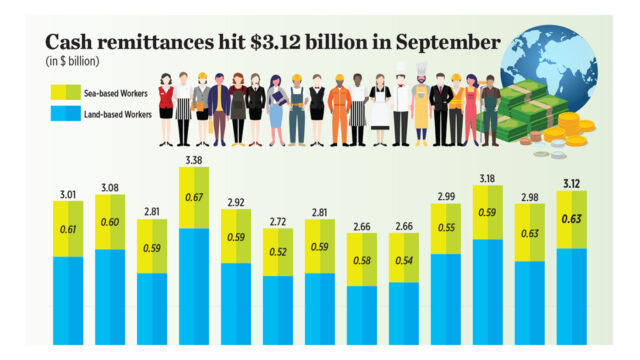
Cash remittances hit $3.12 billion in September

MONEY SENT HOME by overseas Filipino workers (OFWs) jumped by an annual 3.7% in September, the fastest pace in five months, the Bangko Sentral ng Pilipinas (BSP) said on Monday. Read the full story.

Cash remittances hit $3.12 billion in September

AllDay Marts sales drop 52%, Q3 loss at P118M

AllDay Supermarket

VILLAR-LED AllDay Marts, Inc., operator of AllDay Supermarkets, reported a net loss of P118.09 million for the third quarter (Q3), compared with a P55.44 million net income a year earlier.

Net sales fell 52.21% to P1.03 billion from P2.16 billion last year, while the cost of merchandise sold dropped 51.77% to P82.08 million, the company said in a stock exchange disclosure on Monday.

For the January-September period, the company’s net sales decreased 4.92% to P3.91 billion from P7.09 billion, mainly due to weaker performance in some stores operating in highly competitive markets.

In the same period, the cost of merchandise sold declined 44.78% to P3.1 billion, primarily caused by reduced sales in existing stores.

Support, fees, rentals, and other income also fell 13.35% to P34 million from P39 million, largely reflecting lower sales that influenced vendor incentives and support, according to the company.

For the first nine months, AllDay reported a net loss of P86.99 million, compared with P224.21 million in 2024.

On Monday, AllDay shares remained unchanged at 34 centavos apiece. — Alexandria Grace C. Magno

PHINMA CoHo urges private sector to join efforts to close housing gap in the Philippines

PHILSTAR FILE PHOTO

PHINMA COHO CORP., the community housing arm of PHINMA Corp., said the private sector can leverage policies and partnerships to make housing more accessible and help address the country’s growing housing backlog.

“The private sector can influence policies and foster partnerships that make housing more accessible, particularly for low-income workers, through collaboration with the academe, government agencies, and civil society,” PHINMA Community Housing (CoHo) President and Chief Executive Officer Luis Oquiñena said in a statement.

Property firms must adopt a “street-view” approach to create developments that align with low-income families’ lifestyles, he noted.

To boost community housing, he also cited the need for policies that simplify loan takeouts, streamline permits for housing construction, and adopt sustainable but low-cost technologies.

The government, he added, should boost investments in affordable and climate-resilient housing, amid the floods and earthquakes that damaged houses in Cebu, Davao, and Bicol.

The Philippines faces a housing deficit of 6.5 million units, which could rise to 22 million by 2040 if not addressed, according to the United Nations Human Settlements Programme.

At a forum last month, PHINMA Corp. Chairman and CEO Ramon R. del Rosario, Jr., said the company was exploring solutions to meet the “very pressing” need for affordable housing, particularly in underserved markets.

“Our society is faced with so many problems, and so many of those problems can be better addressed if the business community puts its resources together… to try and address those issues,” he said.

“We’re trying to do that in education, and we’ve made some headway there, but today we would like to explore how we can do housing for the underserved in a meaningful way, and hopefully, in a scaled-up way,” Mr. Del Rosario added.

PHINMA CoHo will conduct the groundbreaking of its first housing project in Davao this month, which is expected to house more than 500 families.

PHINMA reported a net loss of P216.45 million in the first nine months, driven by weaker results in its property, construction materials, and hospitality businesses.

At the local bourse on Monday, shares of PHINMA Corp. were down 0.12%, or two centavos, to close at P16.38 apiece. — Beatriz Marie D. Cruz

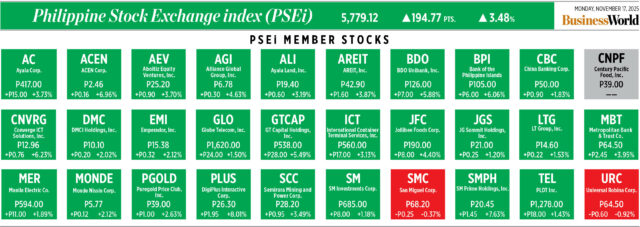
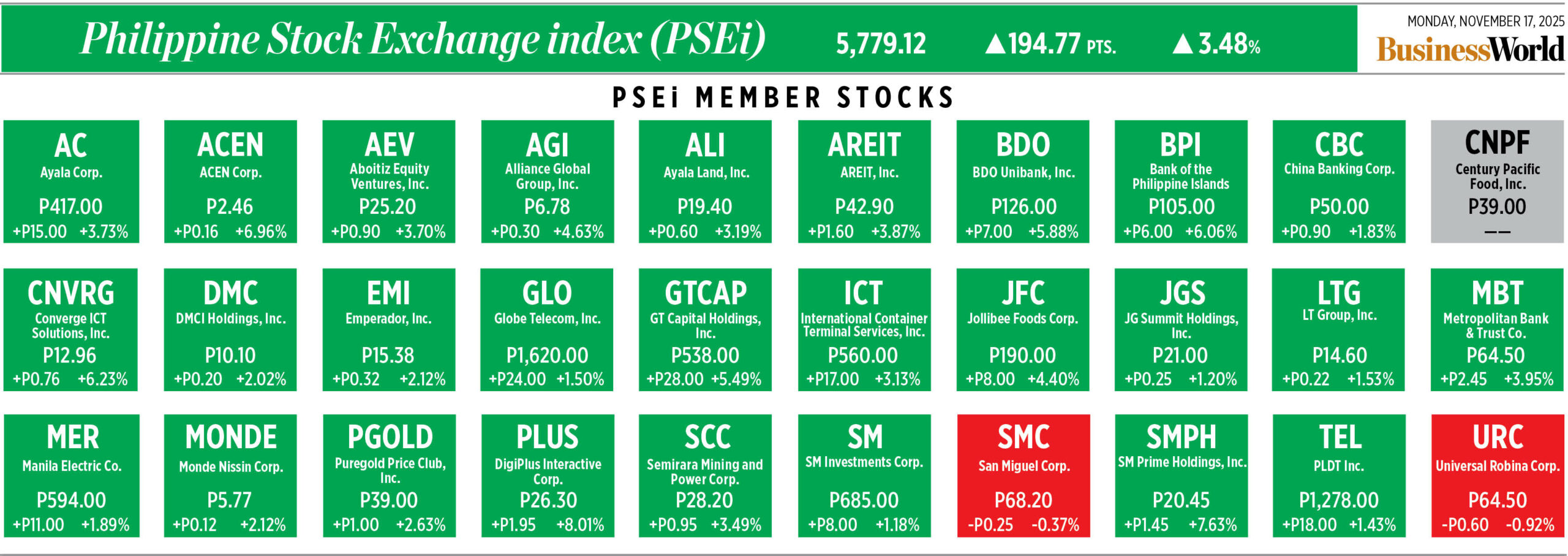
How PSEi member stocks performed — November 17, 2025

Here’s a quick glance at how PSEi stocks fared on Monday, November 17, 2025.


Cuts to bring infra budget down to 4.7% of economy next year, senators told

PHILIPPINE STAR/JOHN RYAN BALDEMOR

THE infrastructure budget will account for only 4.7% of gross domestic product (GDP) in 2026, below economic managers’ target of 5%, Sen. Sherwin T. Gatchalian told the Senate plenary on Monday.

“Because of the flood control issue and the reduction in the flood control budget, we will only hit 4.7% of GDP for 2026. So as much as possible, we diverted some of the flood control projects to other infrastructure projects,” he said.

Finance Secretary Ralph G. Recto told reporters on the sidelines of the Senate session on Monday that the infrastructure spending cuts are headlined by the P255.53-billion reduction in the budget of the Department of Public Works and Highways (DPWH).

Mr. Gatchalian said the government diverted funds originally set aside for flood control projects to classrooms, airports, and seaports.

“Admittedly because of the sheer size… it has been difficult to divert (the flood control funding to) other infrastructure projects,” he said.

Mr. Gatchalian said infrastructure spending will be restored to 5% of GDP in the following year as the Department of Economy, Planning, and Development (DEPDev) and the DPWH overhaul the spending plan.

“Once the DEPDev has organized its master planning and the DPWH reforms its processes, we will revert to the minimum 5% of GDP on infrastructure spending in the following year,” he said.

In 2027, infrastructure spending is expected to hit P1.692 trillion or 5.1% of GDP. — Aaron Michael C. Sy

PHL among highest-cost producers of pork, chicken in Asia, PIDS says

REUTERS

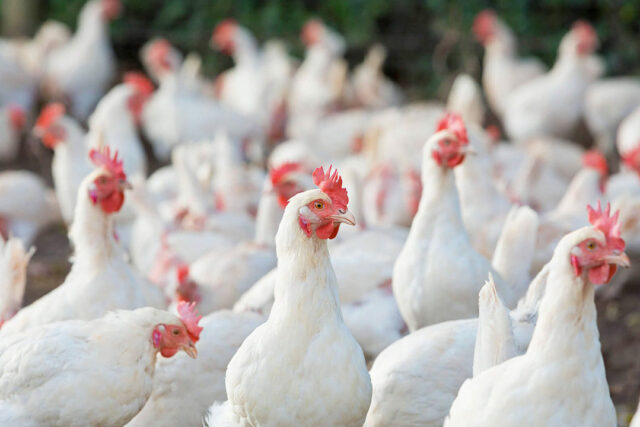
PORK and chicken production costs in the Philippines are among the highest in the region due to high feed costs, the Philippine Institute for Development Studies (PIDS) said.

In a report on the livestock, poultry and dairy (LPD) industries, the government think tank said hog farms in the Philippines consistently post higher costs than counterparts in China, Thailand and Vietnam.

Citing data from 2017 to 2020, PIDS said backyard hog farms have operating costs of P148.26 per kilo post-slaughter. Commercial farm costs are about P112.40 per kilo due to the benefits of scale.

China commercial farm costs are the equivalent of P106.97 per kilo, with Thailand at P97.53. Vietnam commercial farm costs are P120.44 per kilo.

Major pork exporters such as Spain and Denmark produce hogs at a cost equivalent to P86.50 per kilo, PIDS said.

A more recent estimate from the Department of Agriculture puts production costs for hogs at P165 to P180 per kilo.

According to PIDS, hog feed accounts for about 57% of operating expenses.

The study said that while growers in the Philippines pay less for grower stock, this advantage is offset by more expensive feed.

High feed costs similarly affect chicken production. For broiler farms, PIDS estimated production costs at around P71 per kilo (on a liveweight basis) for commercial operators and up to P78 per kilo for backyard growers, with estimates based on 2018 data.

By dressed weight, the average production cost for large-scale broiler farms in the Philippines is P92.36 per kilo. The equivalent numbers for China, Vietnam, and Thailand are P86.70, P76.55, and P66.88, respectively.

“The Philippines is not a competitive producer of broilers compared to Asian benchmark countries; the costs of feed and day-old chicks are the largest cost contributors,” the report said.

The study linked high costs to elevated corn prices, a primary ingredient in animal feed. Corn prices in the Philippines remain higher than in neighboring countries, pushing up the cost of manufactured feed used in both swine and poultry farming.

“Corn… is priced relatively low in Thailand but relatively high in the Philippines, partly due to high corn tariffs … the price of corn is a major driver of feed costs, indirectly affecting the cost of pig and chicken meat,” the study said.

According to PIDS, corn prices in the Philippines are among the highest in the region, with wholesale prices ranging from $0.42 to $0.44 per kilo, compared with $0.28 to $0.38 in China, $0.22 to $0.29 in Vietnam, and $0.19 to $0.24 in Thailand.

PIDS is urging the government to undertake a comprehensive review of trade policies affecting the value chain to “enhance the competitiveness of the LPD industries.”

“For instance, the protection policy for corn increases the cost of domestically produced feed, thereby raising the cost of livestock and poultry farming… to improve efficiency and ensure equitable treatment of stakeholders, including consumers, trade policies should be carefully recalibrated alongside production support measures,” PIDS said. — Vonn Andrei E. Villamiel

Poultry, hog production up in Q3; cattle down

DA.GOV.PH

LIVESTOCK production was mixed in the third quarter, with hog, chicken, and chicken egg output growing on a seasonally adjusted basis and cattle production declining, according to the Philippine Statistics Authority (PSA).

Seasonally adjusted volumes, which strip out the effect of factors like trader demand, disease outbreaks, and natural calamities, show the underlying trends in production, allowing for clearer comparisons across quarters.

Citing preliminary data, the PSA said the seasonally adjusted volume of hog production in the third quarter was 411,130 metric tons (MT) on a liveweight basis, up 1.2% from the previous quarter.

This is the first time the hog industry has shown quarter-on-quarter growth since the third quarter of 2023.

Seasonally adjusted chicken production rose 3.6% quarter on quarter to 582,330 MT (liveweight).

Seasonally adjusted chicken egg production was 212,060 MT, up 3.3% quarter on quarter.

Cattle was the sole decliner on a seasonally adjusted basis, falling 1.6% quarter on quarter to 58,310 MT (liveweight).  Vonn Andrei E. Villamiel

Online sellers call DTI trustmark redundant, doubt it deters scams

DTI.GOV.PH

REDUNDANT government policies are increasing the compliance burden on online sellers as overseas competition intensifies, an industry association said.

The Online Negosyo Empowerment Community (ONEC), which counts among its numbers online sellers and micro-entrepreneurs, called for the regulatory environment to be more friendly to online sellers.

“I believe that our country should be friendly to our businessmen because those are the ones that give jobs and pay taxes. Businesses should grow and not close, which is what is happening to small sellers right now,” Anna C. Magkawas, lead convenor of ONEC, told reporters on Monday.

The group pointed to the Department of Trade and Industry’s E-commerce Trustmark as a “redundant” policy.

“The current trustmark proposal is redundant, duplicating existing consumer laws, product standards, intellectual property protections, and platform verification systems,” ONEC said.

“With trustmark voluntary only until Dec. 31, the group urges that it be declared permanently voluntary, not required by platforms, aspirational, and private-sector-led, with the government focusing instead on enforcing existing laws,” it added.

ONEC said eligibility for the e-commerce trustmark duplicates requirements for other permits online sellers need to obtain before selling on major platforms.

With similar requirements, the trustmark’s purpose of deterring scammers is defeated; instead, the group urged the government to be stricter in enforcing existing regulations and not add layers of bureaucracy that not every online seller can comply with.

“The DTI has good advocacy, which is consumer protection, but again… there are more things that should be prioritized now,” said Ms. Magkawas.

In particular, she said that the government should address how fraudulent online sellers are able to sell on large platforms, which require them to hold business permits.

Meanwhile, the group is also calling for relief from additional charges being imposed by major online platforms.

“The group calls for full transparency and justification of the new P5 fee imposed by major platforms,” ONEC said.

“With rising costs and inflation, micro-sellers cannot absorb additional charges. ONEC urges platforms to review and reduce the fee, ideally to below P1,” it added.

According to the group, online platforms are charging sellers P5 for every transaction, which funds improvements to the platforms.

The platforms also charge processing fees and fees related to the sellers’ participation in the platforms’ promotions.

Ms. Magkawas said the playing field is uneven with foreign competition, who can access the Philippine market with little difficulty.

“Sellers from other countries, like China, malaya silang nakakapagbenta dito sa atin (they are free to sell here). Paano makakasabay ang local sellers natin when it comes to price? (how can we compete on price?),” she said. — Justine Irish D. Tabile