Home Blog Page 6918

Holcim Philippines continues innovation, sustainability push to drive biz growth, positive impact

Holcim Philippines accomplished a number of sustainability and innovation initiatives in 2021 to raise its business performance and contributions to development such as an agreement to have its cement plants in Luzon run on solar energy.

Leading building solutions provider Holcim Philippines, Inc. aims to build on its remarkable 2021 accomplishments anchored on innovation and sustainability to further drive business performance and support the country’s progress.

Holcim Philippines President and CEO Horia Adrian: “Despite the challenges in 2021, our Company’s commitments remain solid. We pushed on with key initiatives that will contribute to our long-term success and enable us to have a more positive impact on the country’s development. We are excited to continue our innovation and sustainability programs in line with our mission to help build progress in the Philippines.”

The Company had several notable achievements to make its operations more respectful of the environment and beneficial to society. In May, Holcim Philippines published its first Integrated Annual Report which follows the sustainability disclosure standards of the Global Reporting Initiative.

In July, Holcim Philippines signed an agreement with Sinoma CBMIPH Construction Corp. to upgrade its cement manufacturing facilities in La Union and Misamis Oriental to reduce the fuel consumption, raw materials and carbon footprint of operations.

Furthermore, Holcim Philippines appointed in August Zoe Sibala, former Vice President of Strategy to Senior Vice President of Sustainability, and expanded the role of Richard Cruz, Vice President of Health, Safety, and Security, to include the Environment portfolio.

In September, the Company completed storage and processing facilities at its Bulacan plant to increase usage of alternative fuels and raw materials in cement production through its waste management arm Geocycle. It is also participating in the rehabilitation of the Manila Bay through the Circular Explorer, a solar-powered catamaran sent by the Holcim Group that can collect up to four tons of plastic litter daily and advance marine research.

Finally, the Company signed in November a 20-year power purchase agreement with Blueleaf Energy, a leading renewable energy company, to deliver solar power to its Bulacan and La Union plants. This will make Holcim Philippines’s cement plants the first in the country to be powered by solar energy.

Aside from these, the Company is leaning on digitalization to raise its sustainability performance. The Company is participating in the Holcim Group’s Plants of Tomorrow Initiative and incorporating data analytics in logistics to make operations more efficient and further reduce its environmental footprint.

Holcim Philippines also took steps to have a more positive social impact particularly on the affordable housing front. It forged closer ties with shelter organization Habitat for Humanity, with a cement supply partnership for housing projects in Metro Manila and Negros Occidental and a number of virtual forums on addressing the country’s housing gap. The Company also continued to support the United Nations Human Settlement Programme’s housing project in Marawi and assisted the GMA Kapuso Foundation in building education facilities for indigenous communities in Cagayan.

On the commercial side, Holcim Philippines ramped up product innovations with the launch of new building solutions for specific building applications. In January, it unveiled Holcim Multifix, an easy-to-use and multipurpose mortar product that can help contractors and masons improve the quality of walls, floors, and tile installation in their building projects. The Company followed this up with in March with Holcim Aqua X, the country’s first ever water-repellent cement that protect structures against excess moisture. It capped the year off with the launch in November of Holcim ECOPlanet, its most environment-friendly product with more than 30% lower carbon footprint than other ordinary Portland cement.

ECOPlanet is a global range of green cement developed by the Holcim Group. Holcim Philippines will offer ECOPlanet as a general purpose blended cement ideal for structural applications that delivers equal to superior construction performance while lowering the carbon footprint of buildings.


Spotlight is BusinessWorld’s sponsored section that allows advertisers to amplify their brand and connect with BusinessWorld’s audience by enabling them to publish their stories directly on the BusinessWorld Web site. For more information, send an email to online@bworldonline.com.

Join us on Viber to get more updates from BusinessWorld: https://bit.ly/3hv6bLA.

SNAP hosts webinar on RE and Green Energy Option Program

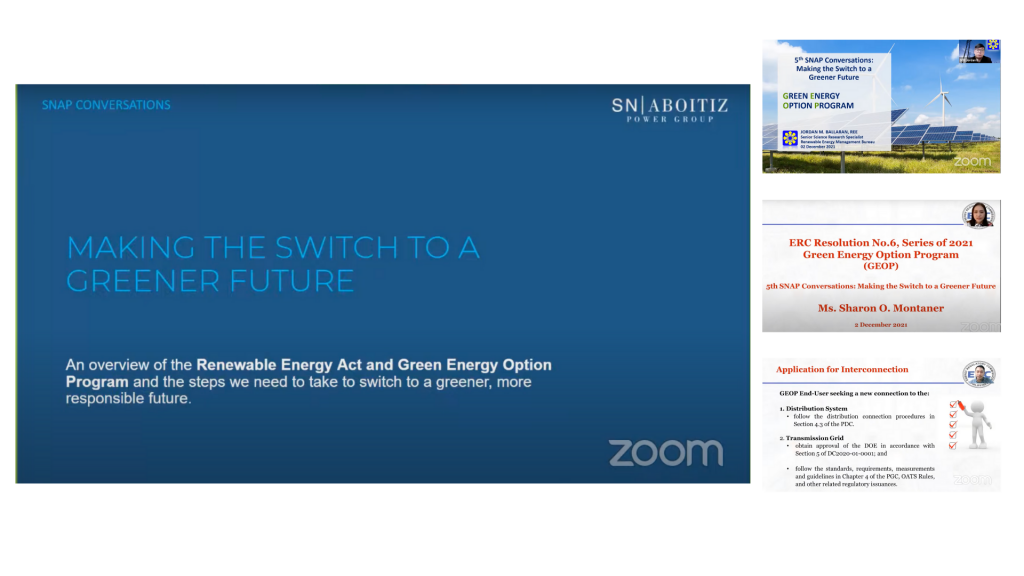
SN Aboitiz Power Group hosted “Making the Switch to a Greener Future,” a virtual talk on renewable energy and the Green Energy Option Program (GEOP) in December as part of its ‘SNAP Conversations’ webinar series.

The online event, which was supported by the Nordic Chamber of Commerce of the Philippines, featured industry experts from the Department of Energy (DOE) and the Energy Regulatory Commission (ERC) who presented the program features and policies of GEOP.

In his opening remarks, SNAP President and CEO Joseph Yu noted that climate action has become a critical issue for the energy sector. “Reducing emissions or getting to zero requires long-term planning on the part of both developers and for consumers, and we’ve seen that both the public and private sectors are increasingly and equally committed to achieving these goals. SNAP is well-positioned to support the steady rise in demand for RE. Our goals are to expand our portfolio to include other forms of renewable energy, and support our customers as they transition to responsible, renewable energy.”

Jordan Ballaran, Senior Science Research from the DOE’s Renewable Energy Management Bureau, discussed the agency’s efforts to attain the objectives of the Renewable Energy Law to accelerate the development of RE resources, achieve energy self-reliance, and mitigate the effects of climate change. “The DOE is studying a lot of policies to support RE [and] to achieve our clean energy scenario,” Ballaran said.

One such initiative is the Green Energy Option Program, a voluntary policy mechanism that provides electricity end-users consuming at least 100 kilowatts of power the option to source their supply from renewables.

The ERC’s Sharon Montañer, Director of Market Operations Service; Jayson Corpuz, Head of the Renewable Energy Division; and Liza Lagman, Head of the Contestable Market Division, presented the details of the GEOP regulatory framework. GEOP rules took effect on September 3, with a transitory period of three months, and full implementation began on December 3.

With the launch of GEOP, Ballaran said they expect commercial and industrial consumers to come in, as well as micro, small and medium enterprises (MSMEs), while Corpuz added that companies with ‘green’ or sustainable advocacies may look to switch to GEOP. Through policy mechanisms and initiatives such as GEOP, consumers can contribute to the country’s energy sustainability goals.


Spotlight is BusinessWorld’s sponsored section that allows advertisers to amplify their brand and connect with BusinessWorld’s audience by enabling them to publish their stories directly on the BusinessWorld Web site. For more information, send an email to online@bworldonline.com.

Join us on Viber to get more updates from BusinessWorld: https://bit.ly/3hv6bLA.
AIA Philippines underscores importance of effective governance to sustainability

Amid the challenges due to the pandemic, recently rebranded AIA Philippines took a bold step and shifted its approach to corporate social responsibility by adapting AIA Group’s Environmental, Social, and Effective Governance (ESG) Strategy. AIA Group is AIA Philippines’ Hong Kong-based parent company.

Effective Governance, one of pillars of the AIA Group ESG Strategy, recognizes the importance of strong corporate governance to deliver sustainable value and maintain a culture of business integrity.

AIA Philippines Chief Executive Officer Kelvin Ang further explains: “By adopting sound and effective governance practices, we are able to operate at the highest standards of responsible business practices. These, in turn, guide us as we work towards operating sustainably, effectively managing risk, while driving innovation.”

Strong Corporate Governance

With integrity and transparency at the core of its corporate governance standards, AIA Philippines cultivates a sustainable culture, guiding its Board of Directors towards achieving long-term value for all its stakeholders, while strengthening confidence in the Company.

“AIA Philippines, through our Board of Directors, maintains a governance program benchmarked against international best practices to ensure business integrity and sound decision-making,” says AIA Philippines Chief Legal Officer and Corporate Secretary Atty Carla Domingo. “To ensure balance in its decision-making, our Board is composed of executive and non-executive directors with diverse backgrounds who bring their expertise and experience to the table, and guide the company towards the achievement of its business plans.”

Managing Risk and Employing Responsible Business Practices

In a business where risk is inherent and must be managed carefully, AIA Philippines relies on a clear and effective Risk Management Framework (RMF) where the primary risk owner in all business areas is defined so risks are identified and mitigated as soon as they emerge.

“We anchor our business practices on our Operating Principle of doing the right thing, in the right way, with the right people, and this permeates across the entire business and encompasses all stakeholders,” remarks AIA Philippines Chief Risk and Compliance Officer Kitten Samaniego. “We expect integrity and reliability from all our people and partners, so we can maintain the same level of trust that our customers have given us for the past 74 years. In the same way, our partners can expect reciprocity from AIA Philippines in their dealings with us.”

Employees are indoctrinated upon employment of the various policies and the business conduct expected of them. Annually, they undergo a refresher course on the AIA Code of Conduct, which details the standards of integrity and ethics expected of an AIA employee, the Anti-Fraud Policy, and the Anti-Corruption and Anti-Bribery Policies.

To protect the Company from becoming an instrument for money laundering, AIA Philippines has an Anti-Money Laundering and Counter Terrorist Financing Program in place.

Witnesses of misconduct by anyone within or connected to AIA Philippines are encouraged to come forward under the Whistleblower Protection Program. The program ensures the whistleblower who reported suspected wrongdoing in good faith that s/he will be protected from retaliation.

When it comes to customers, clear guidelines on treating them fairly and securing their data are in place to ensure their protection. Market Conduct Guidelines and the Sales Code of Discipline, on the other hand, are the handbook to guide its agency force and agency distribution employees on the conduct of business.

Policies are also in place for engagement with vendors. A local Sourcing Policy supplemented by the Sourcing Practice Guide establishes standardized sourcing procedures. The same applies to the selection of suppliers and vendors, which are chosen on the basis of performance and merit in accordance with a fair and transparent process.

The scope of Effective Governance involves all the policies concerning the company’s business practices and stakeholders to ensure all roles, responsibilities, functions, and operations are fulfilled and aligned with the goal of achieving a sustainable future for AIA Philippines. “Our vision is always for the long term. By adhering to the highest standards of governance, we are able to assure our customers that AIA Philippines will be here decades from now, able to meet our commitments to them and their families, helping them live Healthier, Longer, Better Lives,” states Ang.

Click here for more information on AIA Philippines.


Spotlight is BusinessWorld’s sponsored section that allows advertisers to amplify their brand and connect with BusinessWorld’s audience by enabling them to publish their stories directly on the BusinessWorld Web site. For more information, send an email to online@bworldonline.com.

Join us on Viber to get more updates from BusinessWorld: https://bit.ly/3hv6bLA.

Gross borrowings hit P2.78 trillion

BW FILE PHOTO

GROSS BORROWINGS by the National Government reached P2.78 trillion as of end-November as it continued to source funding for the pandemic response, preliminary data from the Bureau of the Treasury (BTr) showed. 

In the first eleven months of 2021, gross borrowings declined by 8.9% from the P3.05 trillion raised in the same period in 2020.

In November alone, the Treasury borrowed P26.7 billion, down by 81.7% from the October figure.

Local borrowings, which accounted for the bulk of the total, stood at P16.6 billion, plunging by 87.6% compared with the P133.73 billion logged a month earlier.

There were a net redemption of Treasury bills worth P53.4 billion in November, while a total of P70 billion in Treasury bonds were sold.

The government logged P16.5 billion in net local borrowings after making P98 million in amortization payments.

Meanwhile, gross foreign borrowings reached P10.1 billion in November, slipping by 16.2% from the P12.05 billion a month earlier.

The November total consisted entirely of project loans, recording no foreign program loans.

With P6.95 billion in amortization payments, the government recorded P3.15 billion in net external borrowings.

For the 11-month period, gross domestic borrowings hit P2.25 trillion, or 8.83% lower than a year earlier.

Broken down, local borrowings consisted of P1.26 trillion in T-bonds, P463.32 billion in retail treasury bonds, and P540 billion in short-term borrowings from the central bank. The government also recorded the P97.33-billion redemption in T-bills.

Net local borrowings reached P2.19 trillion after the Treasury paid P53.58 billion in maturing obligations.

Meanwhile, gross external borrowings in the 11-month period reached a total of P528.8 billion, down by 9.39% from the same period a year earlier.

Broken down, the bureau raised P146.17 billion from global bonds, P121.97 billion from euro-denominated notes, and P24.19 billion in Japanese yen-denominated securities.

It also recorded P139.98 billion in program loans along with P96.5 billion in project loans.

The government repaid P230.88 billion of its outstanding foreign debt, resulting in P297.9 billion in net external borrowings.

The government borrows from local and foreign sources to plug a budget deficit seen to hit 9.3% of gross domestic product (GDP) in 2021.

Economic managers are planning to scale down borrowings starting this year as part of its debt consolidation plan.

Fitch Ratings earlier warned that rising levels of public debt could lead to a credit rating downgrade for the Philippines in the next few years. — J.P. Ibañez

Senate to focus on priority bills, RCEP

BW FILE PHOTO

By Alyssa Nicole O. Tan, Reporter

THE SENATE is focusing on the approval of several priority measures and international agreements including the Regional Comprehensive Economic Partnership (RCEP) within the next three weeks before Congress goes on a break on Feb. 4 for the upcoming elections.

Congress resumes session on Monday, with the Senate still yet to approve at least 12 bills that have already been passed on final reading by the House of Representatives.

“We urge the Senate to expedite the deliberations and approval of these measures so we can pass them into law before the campaign period,” House Speaker Lord Allan Jay Q. Velasco said in a statement.

Mr. Velasco said these measures include the Internet Transactions Act, and the Government Financial Institutions Unified Initiatives to Distressed Enterprises (GUIDE) Act.

Senate Majority Leader Juan Miguel F. Zubiri said there will be a caucus to determine the chamber’s priorities on Monday.

“To be practical about it, these three weeks are really risky for major contentious bills,” he said in a mix of English and Filipino via Viber.

Senate Minority Leader Franklin M. Drilon said Congress should “not allow election fever get in the way of legislation.” The national and local elections are scheduled to be held on May 9.

Senator Mary Grace Natividad S. Poe-Llamanzares, who chairs the Public Services Committee, in a Viber message to BusinessWorld, said the Senate has been able to pass “almost all of its priority bills, so now all that is left to do is to ratify the bicameral versions.”

“On my end, we are due to ratify the consolidated version of the Public Service Act (PSA) Amendments, SIM Card Registration Act, and the National Transportation Safety Board,” she said.

The amendments to the PSA would allow 100% foreign ownership in telecommunications, air carriers, domestic shipping, railways and subways, and canals and irrigation.

Despite the objections to the PSA bill, Ms. Poe expects the Bicameral Conference Committee to come up with a final version within the week.

“Debates in the Senate were very extensive. We agree on many provisions passed by the House. Knowing full well the importance of this bill, I am confident we can reach an agreement and have it ratified by both Houses before sessions adjourn in February,” she said.

Ms. Poe also expects the Senate to act swiftly on the remaining pandemic-related measures such as the vaccine passport program, the creation of a disease center, and the funding for allowances of healthcare workers.

Senator Aquilino Martin “Koko” dela L. Pimentel III, who chairs the Foreign Relations Committee, told BusinessWorld in a Viber message that the Senate has to tackle three treaties — the RCEP, Treaty to Reduce Statelessness, and Arms Trade Treaty (ATT) — before the break.

Business groups have urged the Senate to give its concurrence to the ratification of the RCEP as soon as possible, warning that delays would risk the Philippines missing out on market opportunities.

The RCEP was ratified by President Rodrigo R. Duterte on Sept. 2, 2021, and is now pending in the Senate for concurrence. It took effect on Jan. 1, 2022 for 11 countries, namely: Brunei, Cambodia, Lao PDR, Singapore, Thailand, Vietnam, Australia, China, Japan, South Korea, and New Zealand.

Meanwhile, the House of Representatives is expected to approve the proposed Rural Financial Inclusion and Literacy Act, and a measure amending the Omnibus Election Code that aims to strengthen the field offices of the Commission on Elections (Comelec).

Mr. Velasco also said they will also try to finalize the Magna Carta for Barangay Health Workers, the National Housing Development Act and the bill that assigns health workers to every barangay in the Philippines.

“We only have three weeks or nine session days to finish some priority measures before we adjourn for the election period,” he said.

Meanwhile, Senator Ronald M. dela Rosa, who chairs the Public Order and Dangerous Drugs Committee, said he wants to see the passage of the following: Marawi Compensation bill, Philippine Center for Disease Control and Prevention bill, the Department of Disaster Resilience bill, the Private Security Services bill, and the COVID-19 Benefits for Health Workers Bill.

“The Expanded Solo Parents Welfare Act is a priority, and it looks like we will be able to pass this bill as we are routing the bicam report as we speak,” said Senator Ana Theresia N. Hontiveros-Baraquel, who chairs the Women, Children, Family Relations, and Gender Equality Committee, in a Viber message to BusinessWorld.

She also expressed hope the House of Representatives will also pass the Anti-Online Sexual Abuse and Exploitation of Children Law, which has been approved by the Senate.

Diokno sees fuel prices stabilizing as OPEC increases production

REUTERS
Oil barrels are seen in front of dollar banknotes in this illustration taken on May 25, 2020. — REUTERS/DADO RUVIC/ILLUSTRATION

THE DECISION of major oil producers to stick with their plans to raise crude production in February would likely bring down fuel prices, which in turn could keep inflation within target, Bangko Sentral ng Pilipinas Governor (BSP) Benjamin E. Diokno said.

“Unlike in 2021, where the oil industry was in deficit position (demand exceeded supply), in 2022 the industry will be in surplus position (supply exceeds demand),” Mr. Diokno said in a Viber message.

A group of producers comprising the Organization of the Petroleum Exporting Countries and its allies (OPEC+) are pushing through with a planned increase of 400,000 barrels per day for February. OPEC+ is scheduled to meet again on Feb. 2.

“The increase in production by OPEC will help temper fuel prices and enable the Philippines to dampen inflationary pressures moving forward,” Department of Finance Chief Economist Gil S. Beltran said in a text message.

Mr. Diokno also noted demand for aviation fuel will likely drop as international travel takes a hit from the ongoing Omicron-driven surge in coronavirus disease 2019 (COVID-19) infections worldwide.

“Most advanced economies and many emerging economies are facing persistently elevated inflation; those with oil reserves — for example, US, UK and other countries — maybe compelled to release their oil reserves,” he added. 

Amid recent developments, the BSP chief said a hike in transport fares is “unlikely” as public transportation capacity will be raised alongside easing mobility curbs.

“By and large our inflation forecast will hold (threshold is $95 a barrel for two years), hence no change in existing outlook. This does not mean that there will be no adjustment in the current accommodative monetary policy in the next two years. There might be, but it will be based on other factors, not higher oil prices,” Mr. Diokno said.

In 2021, Philippine inflation averaged 4.5%, which is above the 2-4% target by the central bank and much faster than the 2.6% in 2020. The elevated inflation was attributed mainly to low supply of meat and higher global oil prices.

ING Bank N.V. Senior Economist Nicholas Antonio T. Mapa said the OPEC’s announcement reflects how global oil prices are not only moved by supply and demand but by politics as well, noting the production increase is helpful for net importers like the Philippines.

“As of the moment, oil prices remain quite elevated but the latest announcement may help energy costs to moderate in the near term, which in turn could bode well for energy importers such as the Philippines,” Mr. Mapa said in an e-mail.

As of Jan. 11, gasoline, diesel, and kerosene prices rose by P2.60, P3.50, and P2.75 year to date.

Mr. Mapa said inflation could return to within the 2-4% target range this year due to base effect, the rebasing of the consumer price index, and the likely moderation in oil prices.

However, he noted inflation could pick up pace in the first two months as food prices reflect the impact of Typhoon Odette.

In December, the headline inflation eased to 3.6% from 4.2% in November.

The central bank expects the consumer price index to increase by 3.4% in 2022 and by 3.2% in 2023.

The BSP’s inflation projection is based on the assumption that Dubai crude oil will average $72.66 per barrel in 2022 and $68.74 per barrel in 2023.

Reuters on Friday reported Brent crude futures settled at a 2-½-month high of $86.06 a barrel, up by 5.4% week on week.

Last week, Mr. Diokno said the central bank is unlikely to raise interest rates in the first half of 2022 to support recovery. — L.W.T. Noble

Investors search for safe havens as Omicron takes hold in Asia

REUTERS

THE THREAT of the Omicron variant is becoming real for many of Asia’s biggest countries just as it looks set to subside in some Western nations, and that’s complicating investors’ search for winning share bets in the region.

The problem is that Asian governments are carrying out widely diverging coronavirus policies, with strategies ranging from China’s pursuit of COVID Zero to Australia’s move to live with the virus, and almost everything in between. The speed of vaccinations and the strength of healthcare systems also vary greatly in the region.

It’s another example of how COVID is forcing investors to face new challenges, though many remain positive about Asia’s ability to weather the storm as its best-performing nations kept deaths from the pandemic at levels far lower than elsewhere. Asian stocks have done better than their European and US counterparts so far this year, after underperforming both of them in 2021.

“Asia will be better braced to cope with Omicron waves, which may prove to be more short-lived,” said Wai Ho Leong, a strategist at Modular Asset Management. “Markets that are better vaccinated and have timely social distancing curbs are also likely to recover faster from this wave.”

That, he says, points to Singapore, South Korea, Taiwan, China and Malaysia as potential winners, with India, Thailand and the Philippines just starting to see surges. Consumer discretionary, autos and banks are among the sectors to bet on, he said.

Western countries from Switzerland to Spain and the UK have suggested that the coronavirus pandemic may be shifting to an endemic phase. In Asia, the Omicron variant wave is starting to pounce, with cases surging in Australia, a jump in Tokyo infections prompting authorities to raise the COVID alert, and Hong Kong extending social restrictions.

‘RICH-COUNTRY NARRATIVE’
Exhausted by lockdowns, European countries have largely eschewed a return to onerous curbs. Many countries in Asia are “refusing to buy into the rich-country Western narrative that it is milder and will have a lower net impact,” wrote Jeffrey Halley, senior market analyst for Asia-Pacific at Oanda, in a Jan. 10 report.

The region’s two largest markets are among them. For some, China’s proven success in stamping out the virus when found means investors there have little to worry about from Omicron.

“While isolated lockdowns could disrupt a certain location temporarily, it is likely to have little impact on the economy as a whole,” said Jian Shi Cortesi, investment director for China and Asia growth equities at GAM Investments in Zurich. “China’s economy has adapted to zero-COVID measures, with most sectors operating normally. For most people it’s life as usual.” 

But others are wondering how long that strategy can be maintained. Morgan Stanley cut estimates for Hong Kong’s economy as the city again turns to strict curbs, likely delaying a reopening with the mainland. China’s lockdowns remain local but could become more widespread.

“The odds of a China growth shock because of Omicron and COVID Zero are steadily rising by the day,” Oanda’s Mr. Halley wrote.   

Japan was among the first countries to attempt a “living with the virus” strategy in 2020, but under the administration of Prime Minister Fumio Kishida, COVID policy has grown more cautious despite 80% of the country having had two vaccine shots.

“Japan is now the most strict country in the free world” in terms of border control, said Richard Kaye, a portfolio manager at Comgest Asset Management Japan Ltd., which oversees about $10 billion in Japanese equities. Conversely, he says the strictness makes it the ideal reopening play.

“We can invest in the reopening story with a much bigger, greater visibility than we have in other major economies,” he said. Mr. Kaye sees airlines, airport operators, railroads and retail likely to benefit when eventually the strict borders are opened.

So far this year, Japan’s blue-chip index Nikkei 225 has underperformed the Asia benchmark by about three percentage points. — Bloomberg

This is Toyota Raize-ing the stakes

PHOTO FROM TOYOTA MOTOR CORP.

TMP will try to get the last word in the crossover war

I STILL remember how, in 2018, it was considered a big deal for Toyota Motor Philippines (TMP) to have finally released a product in the then burgeoning entry-level SUV segment. The Toyota Rush launch was significant on multiple counts — but chiefly because it effectively moved the pricing goal post within easier reach. For the first time, TMP priced an SUV south of the psychic barrier of P1 million. Today, to Toyota’s credit, the most affordable Rush is still priced at a respectable P983,000 (that’s for the 1.5 E MT).

Unfortunately, four years in the auto industry might as well be a century. So many things have happened and changed during the interim. A lot more brands have entered the market since the first Rush rollout. And if you think the race to the most realistic price point ended by uncrossing that P1-million divide, think again.

To consumers’ ultimate benefit and in aid of mobility, so many options now exist in that previously “untenable” price point. Even more exciting is that features and creature comforts previously confined to rides with more expensive price tags have begun to regularly appear in more affordable models. Tech toys and accoutrements are now standard fare, so much so that discriminating buyers who are also on a budget can actually pull the trigger on value-rich offerings that appear to stretch the devalued peso.

What’s more, the novel concept that propelled the Rush into our imagination (a sub P1 million SUV) is now a standard fixture, with brands trying to undercut one another via lower prices and better specs.

TMP is now ready to do battle in that space that used to be reserved for lesser players who could price themselves more cheaply. There’s probably a lot of nervous sweating going on in the competition for this lucrative segment.

It’s called the Raize — the worst-kept secret before it became an open secret — definitely because of the excitement for the form and the attractive price point that the vehicle is bringing onto the table. We know that Toyota is set to trot it out formally by Feb. 4 (when it will be available for retail sales), but the industry is already flooded with excitement — or the aforementioned sweating.

According to a TMP memo sent to dealers that we got a hold of, reservations started exactly a week ago (Jan. 10). Four variants of the 2022 Raize are available: the 1.2 E MT (P746,000), 1.2 E CVT (P816,000), 1.2 G CVT (P906,000), and top-tier 1.0 Turbo CVT (P1.031 million). Add P5,000 to the last variant if you want the White Pearl special hue. Other exterior colors are black, turquoise, yellow, red, gray metallic, and silver metallic. Not all the colors will be available across the lineup, while black will be the standard interior hue across all trims.

The Raize measures 4,030mm x 1,710mm x 1,605mm. For comparison, the Toyota Corolla Cross (which was previously the brand’s smallest crossover here) measures 4,460mm x 1,825mm x 1,620mm.

Powering the Raize’s top model is a turbocharged three-cylinder, 1.0-liter, 12-valve, DOHC with dual VVT churning out 98ps at 6,000rpm and 140Nm from 2,400 to 4,000rpm. The rest of the lineup gets a naturally aspirated 1.2-liter, 12-valve DOHC with dual VVT — spitting out 88ps at 6,000rpm and 113Nm at 4,500rpm.

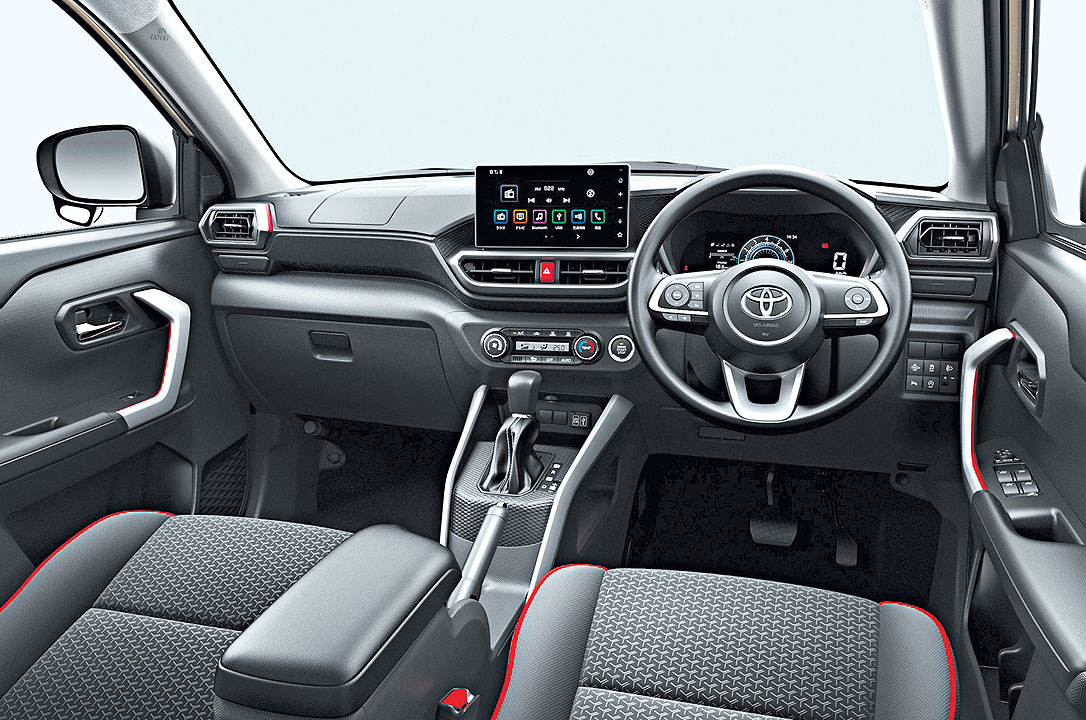
Inside the cabin is a digital meter cluster for the top two trims, and an Optitron-style display for the lower two variants. Fabric and synthetic leather wrap the Turbo’s seats, while the other trims get fabric. The driver’s seat is manually adjusted for all flavors; but the Turbo gets a six-way option compared to only four for the rest.

Other niceties for the Turbo include a two-tone exterior color, paddle shifter, additional buttons on the steering wheel, seat under tray, foot lamp, and a nine-inch display audio. Even its shoes are different — the Turbo receives 205/60 R17s, compared to 205/65 R16s for the rest.

Now onto even juicier stuff. TMP appears to be ranging the Raize against other A-segment SUVs — notably the Kia Stonic and Hyundai Venue. The company is also expecting browsers to include the mini SUV Ford EcoSport, and even the popular Suzuki S-Presso hatch and Toyota’s own Wigo in the consideration set. Owing to the relative affordability of these options, the Raize obviously targets a younger demographic — using concepts such as “sense of security,” “powerful and emotional style (that’s) attractive to the youth,” and “active useful spacious package” to drive home the idea of the Raize. The Raize owners are expected to range in age from 33 to 44 years old — but I suspect that its cuteness should be universal.

If you’re in the market for an even more affordable SUV that also boasts that reliable Toyota badge of reliability, then the Raize should be up your alley.

DoE clears 147 firms to supply clean energy to DUs

RPS program requires part of power sales to come from renewables

MORE THAN a hundred clean energy companies with a total capacity of 2,619 megawatts (MW) have been cleared by the Energy department to participate in its renewable portfolio standards (RPS), a program that requires electricity sellers to source part of their supply from renewables.

In its tally as of end-December 2021, the Department of Energy (DoE) listed 147 renewable energy (RE) companies for the program, 62 of which are solar energy companies with a total capacity of 1,312.96 MW or more than half of the total eligible capacity.

“Eligibility of RE Facilities are based on the criteria provided in Sections 10 and 11 of Department Circular No. DC2017-12-0015 and Sections 9 and 10 of Department Circular No. DC2018-08-0024,” the department in its report released over the weekend.

The first circular covers the RPS program for on-grid areas, or those within the country’s interconnected system that transmits power from where it is produced to where the demand is.

RPS is a policy mechanism under Republic Act No. 9513 or the Renewable Energy Act of 2008 mandating distribution utilities (DU) and retail electricity suppliers (RES) to source or produce at least a percent of their net electricity sales from eligible RE facilities.

The DoE later expanded the scope of the program to include those off the grid, thus increasing the use of RE while optimizing the power supply mix in these areas that are largely served by expensive diesel-fed power plants.

In summary, the DoE’s latest count covers 62 solar farms, 36 biomass and 36 hydro power facilities, seven wind farms, and six geothermal power plants.

Next to solar farms, hydro power plants came out with the biggest capacity of eligible projects at 412.802 MW. Wind farms followed with 409.9 MW, while biomass and geothermal projects under the program have a capacity of 264.845 MW and 218.5 MW, respectively.

Of the 147 renewable energy projects under the RPS program, the biggest project in terms of capacity is EDC Burgos Wind Power Corp.’s 150-MW wind farm in Burgos, Ilocos Norte. It started commercial operation on Nov. 11, 2014.

Bac-man Geothermal, Inc.’s 140-MW geothermal plant in Sorsogon province that started its commercial run on Feb. 5, 2015.

Helios Solar Energy Corp. followed with its 132.5-MW solar farm in Cadiz City, Negros Occidental, which began operating on March 14, 2016.

SN Aboitiz Power-Benguet, Inc. is the fourth biggest power plant that is eligible for the RPS program with its 104.55-MW hydro power plant in Ambuklao, Benguet whose three units all started operating in 2011.

Solar Philippines Tarlac Corp. with its 100.613-MW solar farm in Concepcion, Tarlac is the only project that opened recently — on Sept. 12, 2019.

The RPS program is among the RE initiatives introduced by the DoE after it discontinued granting guaranteed and subsidized rates under the feed-in tariff system when the target capacity was reached.

On Nov. 3, 2021, the department issued revised guidelines for the green energy auction program, or GEAP, which calls for a transparent and competitive selection of RE facilities in assisting electric utilities in complying with their RPS requirements.

The updated GEAP guidelines adopted certain mechanisms under the feed-in-tariff system, such as a “central dispatch” that gives priority to RE when selling power through the wholesale electricity spot market.

The RE initiatives are seen by the DoE to spur greater private sector participation in the power generation sector through renewables, as the government aims to attain a 35% RE share in the mix by 2030.

As of 2020, the country had an installed power generating capacity of 26,286 MW, which is dominated by coal-fired power plants with a share of 42% or 10,944 MW. Renewables, oil-based and gas-fired power facilities had a share of 29%, 16% and 13%, respectively. — VVS

Volkswagen trucks into the PHL

A total of 10 Volkswagen models will be initially available in a wide variety of forms and use cases. — PHOTO FROM VOLKSWAGEN TRUCK AND BUS

MACC marks a milestone by bringing in a German giant

By Kap Maceda Aguila

WITH MORE than three decades of experience in the truck business, MAN Automotive Concessionaires Corp. (or MACC) is stepping up its presence in the commercial vehicle segment as it becomes the official distributor and service provider of Volkswagen (VW) Truck and Bus.

Based in Brazil, VW Truck and Bus is a 40-year-old operation that features “German technology and reliability.” In a release, MACC said that “VW Truck and Bus added some extra key components to the combination: flexibility and creativity.”

VW Truck and Bus has exported more than 160,000 vehicles to some 30 countries in Latin America, Africa, the Middle East, and now Asia. It is seen as a vote of confidence not only for MACC but the Philippines itself that the company is choosing to do business here.

During a virtual presser to announce the partnership, MACC and VW Truck and Bus officials said that they see a good fit in the portfolio of products and Philippine logistical requirements vis-à-vis road conditions. The deal had been two years in the making, and now the Philippines will be seen as the VW Trucks and Buses gateway into Asia. MACC Associate Director Francis Lu said that the company has already been known for “high quality, reliable, and cost-effective” products and will now boast a “partnership with one of the most recognizable brands in the industry.”

Meanwhile, VW Truck and Bus said it “has been constantly evolving during the years, using state-of-the-art technology, and the innovative and collaborative concept of Modular Consortium. This enables us to produce a complete line of vehicles, tailor-made to the needs of the customer from light to heavy trucks and buses, capable of meeting the most varied applications and requirements of our markets.”

For MACC, securing a deal with VW Truck and Bus adds Category 3 and 4 products to its existing portfolio of Category 5 trucks. “We are bringing in various models in different weight classes ranging from nine tons to 31 tons — in 4×2, 4×4, 6×4, 8×2 and 8×4 executions. These are powered by popular Cummins and MAN engines with efficient common rail fuel management systems. They are Euro 5-compliant with Exhaust Gas Recirculation (EGR) and Selective Catalytic Reduction (SCR) emission technology. They will come in six-speed, nine-speed and 16-speed transmissions.” The vehicles will be Euro 5-compliant.

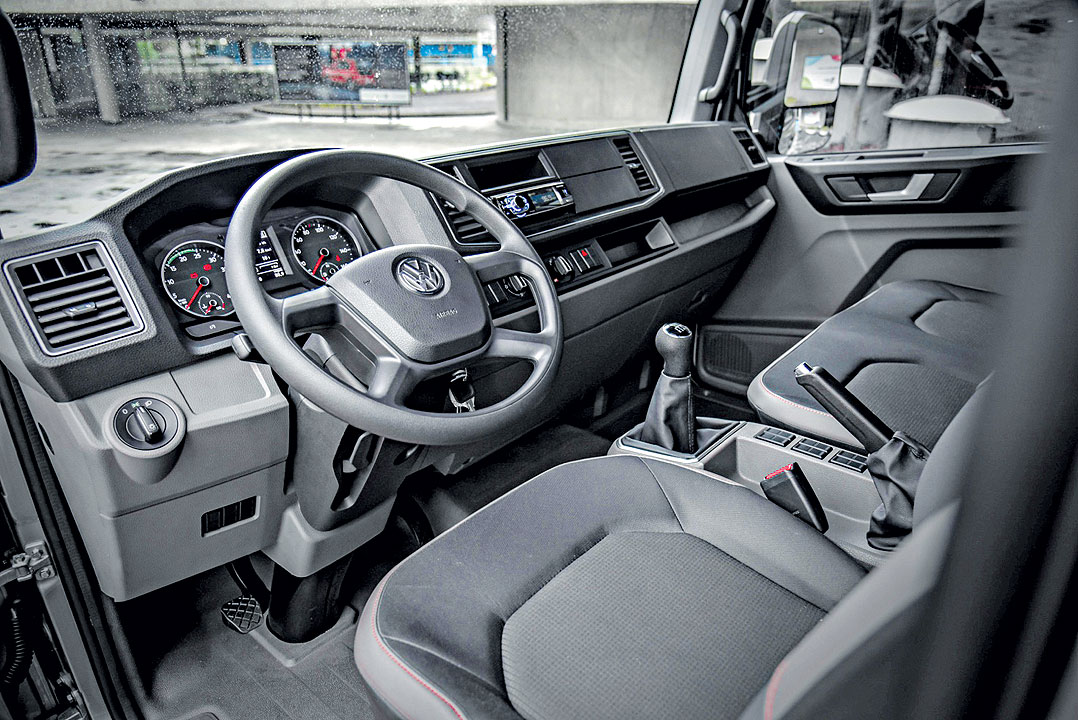
The trucks, added MACC, were conceived with comfort and safety being top-of-mind considerations. The VW vehicles will get power door locks, power windows and side mirrors, ergonomic seating, and modern-looking cab.

Expected applications and forms will be closed vans, wing-vans, refrigerated vans, drop-sides, flat beds, people transport, food and beverage transport, boom trucks, tipper trucks, cement mixers, and even special-purpose vehicles. Leandro Pereira of VW Truck and Bus said he is looking forward to establishing the brand here and once volume allows it, even perform assembly. They are also taking a keen look at how the government rolls out its public utility vehicle modernization program and possibly making a play there.

Averred MACC Managing Director Ferdie Lu: “This is a real milestone not only in the history of MACC but the Philippines. This range of products will broaden our ability to service the needs of clients. This has taken some time, and without the tireless support of the VW team in Brazil, we could have not achieved this.”

DTI, PhilDev launch programs to support startups 

THE Department of Trade and Industry (DTI) and PhilDev Foundation recently launched two programs that seek to support the growth of startups in the country.

On Jan. 12, the DTI and PhilDev introduced the Incubation, Development, and Entrepreneurial Assistance (IDEA) and Accelerating Development, Valuation, and Corporate Entrepreneurship (ADVanCE) programs to help local startups.

According to the DTI, the two programs will provide customized support such as coaching, mentoring, training, and workshops to address issues faced by local startups.

“Along with micro, small, and medium enterprises (MSMEs), startups are the bedrock of the economy. Hence, supporting startups would be crucial to create a huge pipeline of quality startups,” Trade Undersecretary Rafaelita M. Aldaba said.

The DTI said the IDEA program is for early-stage tech startups. The said program encourages collaboration among startups, mentors, investors, and the government to produce market-ready innovative science and technology products and services.

In contrast, the ADVanCE program is targeted at growth-stage tech startups. The program seeks to help the expansion of business operations and allow startups to deliver products and services that aim to solve societal needs.

“These programs are designed to nurture, develop startups, and ensure that they will become economic assets, as competitive job-generating platforms. In these programs, startups will access tailored workshops and mentorship from global talent, market readiness assessment, legal and financial support services, and many more,” PhilDev Foundation Executive Vice-Chairman Eric Tomacruz said.

The DTI said startups that are interested in the program can send their applications to PhilDev’s website until Jan. 17.

“Let us all work together towards increasing business ideas and creating committed founding teams with an aligned vision and high innovation potential. I also look forward to our strong collaboration with PhilDev and other partners towards the successful implementation of these programs and supporting our startups in their business venture journey,” Ms. Aldaba said. — Revin Mikhael D. Ochave

Rates of T-bills, bonds to drop

BW FILE PHOTO

RATES of government securities on offer could ease this week amid excess liquidity in the financial system.

The Bureau of the Treasury (BTr) will offer P15 billion in Treasury bills (T-bills) on Monday, or P5 billion each in 91-, 182- and 364-day securities.

On Tuesday, it will auction off P35 billion in fresh 10-year Treasury bonds (T-bonds).

Rizal Commercial Banking Corp. Chief Economist Michael L. Ricafort in a Viber message said T-bill yields could ease in response to excess liquidity and the effects of slower inflation.

“The National Government’s cash position increased after P300-billion borrowing from the Bangko Sentral ng Pilipinas (BSP) as well as the retail Treasury bond issuance that could reduce the need for the government to borrow/crowd out in the local market,” he said.

Meanwhile, a bond trader said T-bill yields could drop by 5 to 10 basis points (bps), while bids for the new 10-year notes could range between 4.7% to 5.1%.

“It appears demand for government debt will remain at the short end with end users still purchasing T-bills. However, demand for notes especially those at the long end of the curve may not be as robust despite inflation coming in lower than expected and the BSP Governor saying that a rate hike is unlikely in the first half of 2022,” the trader said in a Viber message.

“This may be because investors are focusing on developments abroad such as the Fed looking to hike rates three to four times this year.”

Headline inflation in December eased to 3.6%, its lowest in a year, from the 4.2% recorded in November as food and transport costs slowed.

The December print brought the 2021 average to a three-year high of 4.5%, breaching the 2-4% target of the central bank as well as its revised 4.4% forecast.

US Federal Reserve Governor Lael Brainard last week said interest rate hikes could start as soon as the US central bank ends its bond purchases, which is set for March.

The International Monetary Fund said emerging economies should prepare for a US Fed policy tightening that could rattle financial markets.

At the secondary market on Friday, the 91- 182- and 364-day T-bills were quoted at 0.9438%, 1.1246%, and 1.4809%, respectively, based on the PHL Bloomberg Valuation Reference Rates published on the Philippine Dealing System’s website.

Meanwhile, the 10-year bonds fetched a yield of 4.8243%.

The Treasury last week raised P15 billion as planned via the T-bills it offered as total tenders reached P73.58 billion, almost five times the initial offer and higher than the P71.05 billion logged a week earlier.

Broken down, the Treasury bureau raised P5 billion as planned via the 91-day securities from P23.7 billion in bids. The three-month debt paper fetched an average rate of 0.969%, down by 10.6 bps from the 1.075% seen previously.

The BTr also borrowed P5 billion as planned from the 182-day securities it offered on Monday from P24.98 billion in tenders. The average rate of the six-month T-bill fell by 14.8 bps to 1.121% from 1.269% previously.

Lastly, the government made a full P5-billion award of the 364-day debt papers as bids reached P24.9 billion. The average yield on the one-year instrument stood at 1.468%, down by 13.2 bps from the 1.6% fetched a week earlier.

The BTr plans to raise P200 billion from the domestic market this month, or P60 billion via T-bills and P140 billion from T-bonds.

The government borrows from local and external sources to help fund a budget deficit seen to hit 7.7% of gross domestic product this year. — Jenina P. Ibañez