Home Blog Page 6753

Ex-Japan PM Abe warns China a Taiwan invasion would be ‘economic suicide’

REUTERS

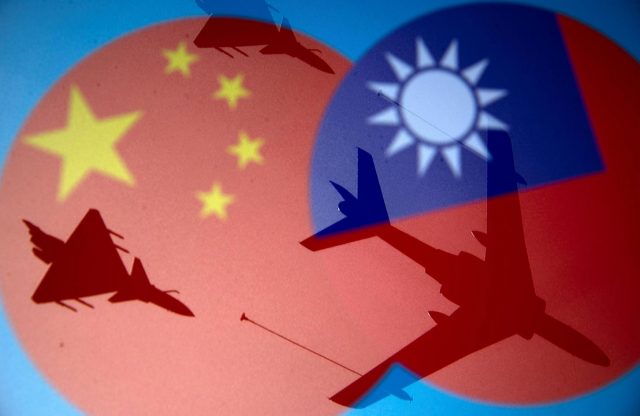
FORMER Japanese Prime Minister Shinzo Abe said China should be aware that any crisis with Taiwan would pull in Japan and its ally the US, warning of a dire situation if Beijing takes military action against Taipei.

Delivering a speech by video to an audience in Taiwan on Wednesday, Mr. Abe said actions of an increasingly powerful China toward Japan and Taiwan were likely to become more complex, blurring the line between war and peace. The comments were some of the most pointed by a prominent Tokyo politician on tensions in the Taiwan Strait.

“A military adventure would be the path to economic suicide,” Mr. Abe said. “We must keep reiterating that peaceful ties between China and Taiwan are the only option.”

The remarks by Mr. Abe, who stepped down as premier last year citing ill health, come after China sent a fresh sortie of warplanes toward Taiwan on Sunday in response to a visit by a group of US lawmakers. China’s Communist Party sees the island as part of its territory despite never having ruled it and seeks to block any official interactions with other countries.

Taiwan’s ruling Democratic Progressive Party asserts the island is a de facto sovereign nation awaiting wider international recognition and not part of Chinese territory.

“Any armed invasion of Taiwan would present a serious threat to Japan,” Mr. Abe said. “A Taiwan crisis would be a Japan crisis and therefore a crisis for the Japan-US alliance,” he added, saying that Chinese President Xi Jinping should not fail to understand the situation.

Democratic peoples should continually remind Mr. Xi and Chinese Communist Party officials not to take the wrong path, Mr. Abe said. While China is large, its links with the rest of the world mean that any aggression on its part would hurt its own economy, he said.

Spooked by Beijing’s clampdown in Hong Kong, senior Japanese lawmakers have been increasingly speaking out about the importance of Taiwan to Japan’s security, sparking irritation from Beijing.

Current Prime Minister Fumio Kishida has said the Taiwan Strait may be the next major diplomatic problem facing Tokyo, and Japan should seek to cooperate with Taiwan and countries that share its values of freedom, democracy and the rule of law.

Mr. Abe also called for Taiwan to have a greater voice on the world stage, including at the World Health Organization, and said he supported Taipei’s bid to join the Trans-Pacific Partnership regional trade agreement. China is also seeking to join the partnership, and Japan’s current leaders haven’t given a clear opinion on how the competing applications should be handled. — Bloomberg

High-tech food supply chains to foster sustainable growth in SEA 

PEXELS-ICONCOM

By Bronte H. Lacsamana 

The best bet to ensure food security and growth in Southeast Asia is to invest in technology which can provide solutions to food wastage and supply chain disruptions, according to business leaders at a virtual roundtable on building resilient and sustainable food supply chains, held by enterprise application software group SAP. 

“Turning produce into food requires efficiency and a seamless, holistic journey,” said Verena Siow, president and managing director of SAP Southeast Asia, at the event in November. “Today, digital technology not only has enormous impacts on food production, but its benefits also extend across the whole value chain.” 

Citing the Food and Agriculture Organization of the United Nations (FAO), she added that around 1.3 billion tons, or one-third of all food produced, is lost or wasted yearly — whether it’s on the part of agriculture, manufacturing, distribution, or logistics. 

Dole Asia Holdings, a leader in the production and marketing of packaged fruit and healthy snacks, is one corporation currently trying to address the issue of wastage. 

“Technology in agriculture or ag-tech is vital in shaping our progressive and proactive waste reduction agenda,” said Leonardo Rabelo, chief financial officer of Dole Asia Holdings, at the roundtable. “The in-farm internet of things (IoTs), phase tracking, and end-to end digitalization will be the new superpowers in enabling us to improve our quality and overall product value like never before and remarkably reducing waste.” 

He mentioned that clean label and clean eating are part of Dole’s core values, with natural ingredients being the basis for all of their food products, including the processed ones. They also upcycle food waste into products like banana puree or frozen banana. 

“Dole has a commitment to take out all the processed sugar by 2025. That’s basically how we are channeling our efforts and making sure that we provide our contribution,” added Mr. Rabelo. 

Meanwhile, in 2020, Vietnamese manufacturer and supplier of agricultural products and services Loc Troi Group standardized all their processes to improve its planning and tracking capacity with the help of SAP S/4HANA. 

Efficiency is important in the bid to support farmers increase their yields and have more accurate data on crop health, especially in the Mekong Delta where climate change has taken its toll, said Nguyen Duy Thuan, Loc Troi Group’s chief executive officer. 

“Half of Vietnam’s total rice exports to the world come from more than 200,000 rice farmers in the Mekong Delta,” he explained at the virtual event. “It’s very challenging when we’re talking with farmers to adapt for the environment. With rice, we also face different requirements from different countries and markets.” 

To face these difficulties, they use technology like drones and mobile apps to help farmers monitor their rice and fruits. Currently, they are working on crop planting area codes and traceability through the use of QR codes. 

SAP Southeast Asia’ Ms. Siow lauded both groups’ efforts and expressed hope for more agri-businesses and corporations in the region to follow suit. 

“In this pandemic, we all had to learn to operate virtually in many ways. We have also further expedited and accelerated the development and adoption of technology,” she said. “While tech can be deployed in many ways, what’s important is we put it all together and audit data and bring insights for decision-making — to ensure that processes are not just streamlined, but optimized.”

Edukasyon.ph revamps platform to support career development of Gen Zs  

By Patricia Mirasol  

Edukasyon.ph, an education technology (edtech) company, has redesigned its homepage to cater to its key market: students and young professionals. Inspired by user insight on self-discovery, the latest iteration features personality and aspiration quizzes, lessons presented as gamified quests, and a career guide with sections on internship, career, and job listings.  

This redesign, the company said, increased engagement and helped expand its registered user base to over 800,000 students, up from half a million over a year ago. The change likewise reflected the value parents bring as they navigate the site and play an active role in their child’s education and development.  

Also featured in its homepage are events that guide Gen Zs on possible career paths, such as its second Future Fest campaign that focused on careers under the Science, Technology Engineering, and Mathematics strand.  

“This new campaign will help achieve our commitment of allowing two million Filipino youth to have a successful and fulfilling career by 2025,” said company founder Henry Motte-Muñoz of the Nov. 26-27 event in a press release. The two-day program was designed with the help of Harrison Assessments, a firm that provides predictive analytics for developing and engaging employees, and Career Development Association of the Philippines, an organization that creates career development programs.  

Other recent partnerships include a literacy promotion initiative with Globe Telecom, upskilling courses with Cream Silk, and a school modernization program with Asus.  

The edtech platform was founded in 2015 with the aim of empowering Filipino Gen Zs to make good education decisions that lead to a fulfilling career and life.  

In a June 2020 interview with BusinessWorld, Mr. Muñoz said, “Only 20% of students are able to complete their journey from enriching education to gainful employment. The odds can be improved.” 

Human beings can choose what is good says new Ramon Magsaysay awardee

By Patricia Mirasol  

Five awardees were honored at the 63rd Ramon Magsaysay Award Foundation presentation ceremonies on Nov. 30. The awardees are Roberto “Ka Dodoy” A. Ballon, a fisherman and community environmentalist from the Philippines; Steven Muncy, a humanitarian and peace builder working all over Southeast Asia; Muhammad Amjad Saqib, a poverty alleviation visionary from Pakistan; Firdausi Qadri, an affordable vaccine champion from Bangladesh; and WatchDoc, media truth crusaders from Indonesia.  

“Human beings, while capable of the worst, are also capable of rising above themselves, choosing again what is good, and making a new start…,” said Mr. Ballon in his acceptance speech, citing Pope Francis in his 2015 encyclical Laudato Si. This, he said, exemplifies the choices he makes as a fisherman.  

The 53-year-old awardee, whose father was also a fisherman, saw how fish harvests in his hometown of Kalabasan, Zamboanga Sibugay dwindled as the mangrove forests along Sibuguey Bay were cleared to make way for aquaculture farms. Mangroves serve as breeding grounds and nurseries for fish.  

In 1986, he founded Kapunungan sa Gamay ng Mangingisda sa Concepcion (or the Association of Small Fishermen of Concepcion) with 36 other small-scale fishermen to preserve the coastal environment and restore fish breeding grounds. The association now has tenurial rights to 500 hectares of mangrove forest, yielding an improvement in the quality of life of fishermen.  

A Sept. 2 press statement from the Senate of the Philippines noted that fish catch in the area has improved from 1.5 kilograms in an eight-hour fishing trip to seven kilograms after three to five hours of fishing.  

“As a simple fisherman, I only have one desire for the community that makes me do what I have been doing,” Mr. Ballon continued in his acceptance speech. “To offer myself to provide a better environment, sustainable livelihood, and an empowered community, and to realize our vision and mission in life: to have 3, 8 [or 3 Eat, referring to three meals a day].”  

His association’s aspiration, he added, is a harmonious life — one that is propelled by a sustainable and equitable co-existence in the coastal communities of Zamboanga Sibugay. 

The Ramon Magsaysay Award is Asia’s equivalent to the Nobel Prize.  

“We have realities we need to face — sickness, lockdowns, death, and more uncertainty. But we want to do our share by focusing on stories of courage and hope,” Susan B. Afan, president of the Ramon Magsaysay Award Foundation, said in a press statement. 

Singapore tests out ‘smart bandage’ for remote recovery

SINGAPORE – Researchers in Singapore have developed a smart bandage to enable patients to have chronic wounds monitored remotely via an app on a mobile device, potentially saving them visits to the doctor.

A research team at the National University of Singapore has created a wearable sensor attached to a transparent bandage to track progress in healing, using information like temperature, bacteria type, and levels of pH and inflammation.

“Traditionally when someone has a wound or ulcer, if it’s infected, the only way to examine it is through looking at the wound itself, through visual inspection,” said Chwee Teck Lim, lead researcher at the university’s department of biomedical engineering.

“If the clinician wants to have further information then they will obtain the wound fluid and send to the lab for further testing,” he said.

“So what we’re trying to do is use our smart bandage to cut the number of hours or days to just a few minutes.”

The “VeCare” technology will enable patients to convalesce more at home and visit a doctor only if necessary.

The bandage is being tested on patients with chronic venous ulcers, or leg ulcers caused by circulation problems in veins.

Data collection by researchers on the wounds has so far been effective, according to Lim, who said the smart bandage could potentially be used for other wounds, like diabetic foot ulcers. – Reuters

Suncity shuts VIP gaming rooms in Macau after CEO’s arrest -sources

HONG KONG – Embattled gambling group Suncity Group Holdings has closed all of its VIP gaming rooms in Macau, the world’s largest gambling hub, after the company’s CEO was arrested, two sources with direct knowledge of the situation told Reuters.

The shutting of the company’s VIP rooms will result in a cut of around a third of its Macau headcount, according to one of the sources, a senior casino executive who declined to be identified as the closure has not been publicly announced.

Suncity Group, whose shares were suspended from trade on Wednesday, did not immediately respond to a request for comment.

The news comes amid a broader investigation into Suncity, which has sent Macau-listed casino stocks tumbling for a third day in a row. Shares in Wynn Macau Ltd, which analysts say is the casino operator most reliant on Suncity‘s gaming rooms, slid 7% on Wednesday, bringing this week’s losses to 18%.

Alvin Chau, the CEO of the company as well as the founder of Macau‘s biggest junket operator which brings in high rollers to play at casinos, was arrested on Sunday over alleged links to cross-border gambling.

Macau authorities have accused Chau and 10 others of using the former Portuguese colony as a base for an illegal “live web betting platform” in the Philippines that attracted mainland Chinese.

A warrant for his arrest was also issued on Friday by the mainland Chinese city of Wenzhou.

“The writing was on the wall already. But nothing was done in Macau until the Wenzhou police talked about it,” the executive said.

While Chau’s junket operations, also called Suncity, are not part of the listed Suncity Group, they have previously been singled out by mainland China’s state-run media, which said they harmed China’s social order.

A 2019 article by the Economic Information Daily, a unit of China’s state news agency Xinhua, alleged that the annual amount of online betting on websites run by Suncity was more than 1 trillion yuan ($155 billion). Suncity has also not responded to a request for comment on that estimate.

One of the casino executives told Reuters that Suncity operated VIP rooms in properties owned by all six of Macau‘s licensed casino operators – Wynn Macau, Sands China, MGM China, SJM Holdings, Melco Resorts and Galaxy Entertainment.

In 2019, Suncity operated up to 17 VIP clubs in Macau and accounted for nearly half of the gambling hub’s VIP market, the executive added.

The six licensed casino operators have not responded to Reuters requests for comment.

Suncity Group said this week that Chau, who is both CEO and chairman, intended to resign. Reuters efforts to contact Chau or his lawyer have been unsuccessful.

Suncity Group‘s stock plunged 48% on Tuesday to a record low after being suspended from trade a day earlier, valuing it at HK$880 million ($113 million). Suncity has also said its operations would not be impacted in the event that it ceased to have Chau’s support. – Reuters

Sydney braces for more Omicron cases but no lockdowns for now

EN.WIKIPEDIA.ORG

SYDNEY – Australian authorities on Wednesday flagged another probable case of the Omicron variant in Sydney as they braced for more infections after at least two international travellers visited several locations in the city while likely infectious.

Officials in New South Wales (NSW), home to Sydney, said initial testing “strongly indicates” a man in his 40s, who arrived from southern Africa on Nov. 25, had been infected with the Omicron variant and had spent time in the community.

“We believe it is likely it will be confirmed later this afternoon as a definite Omicron case,” NSW Health Minister Brad Hazzard told reporters, but he ruled out lockdowns to contain the newly identified variant.

“I feel like it’s time for a change in approach. We don’t know how many more variants of this virus are going to come,” Hazzard said.

Sydney, Australia’s largest city, came out of nearly four months of lockdown in early October to contain a Delta outbreak and has been gradually easing curbs after higher vaccinations.

Omicron has prompted Australia to delay by two weeks its plans to reopen its borders from Wednesday to skilled migrants and foreign students. Mandatory two-week quarantine has been enforced for citizens returning from southern African countries.

Vaccinated Australians reaching Sydney and Melbourne from all other countries must now quarantine for 72 hours. Other states have not opened their international borders yet.

“It’s very confusing, it was very emotional … I did lots of praying. I just thought I’m going to land here and see what happens,” Lorelle Molde, who returned to Australia from the United States, told Reuters at the Sydney airport.

When confirmed, the latest probable case would bring the total number of confirmed infections in Australia to seven, with six detected in NSW.

The other person who contracted the Omicron variant is in isolation in the quarantine facility in the remote Northern Territory. Police said three people were taken into custody after escaping from the facility early Wednesday morning.

Authorities on Tuesday confirmed the country’s first community case of the new variant but the national cabinet decided against more restrictions and to wait for more data on its severity and transmissibility.

Australia has recorded around 212,000 cases and 2,012 deaths from COVID-19. – Reuters

Air travelers to U.S. set to face tougher COVID-19 testing

STOCK PHOTO

WASHINGTON – The U.S. is moving to require that all air travelers entering the country show a negative COVID19 test performed within one day of departure in response to concerns about a new coronavirus variant, the Centers for Disease Control and Prevention (CDC) said late on Tuesday.

Currently, vaccinated international air travelers can present a negative test result obtained within three days from their point of departure. Nearly all foreign nationals must be vaccinated to enter the United States. Unvaccinated travelers currently must get a negative COVID19 test within one day of arrival.

The new one-day testing requirement would apply equally to U.S. citizens as well as foreign nationals.

Reuters reported earlier that a draft proposal was circulating among government agencies for the stricter testing requirement.

A CDC spokeswoman confirmed the agency is working to modify its global testing rules for travel “as we learn more about the Omicron variant; a revised order would shorten the timeline for required testing for all international air travelers to one day before departure to the United States.”

The administration is also considering whether to require air travelers to get another COVID19 test within three to five days after arrival in the United States, officials said.

The CDC did not confirm that, but noted it continues to recommend all “travelers should get a COVID19 viral test 3-5 days after arrival” and “post-travel quarantine for any unvaccinated travelers.”

The stricter rules could be announced Thursday, but it was not clear when they might take effect.

CDC Director Rochelle Walensky said the agency “is evaluating how to make international travel as safe as possible, including pre-departure testing closer to the time of flight and considerations around additional post-arrival testing and self-quarantines.”

On Monday, the White House barred nearly all foreign nationals who have recently been in South Africa and seven other southern African countries over concerns about the Omicron variant.

A White House official said earlier Tuesday the administration is evaluating COVID19 measures “including considering more stringent testing requirements for international travel.”

On Tuesday, the CDC advised Americans against travel to Niger, Papua New Guinea, Poland, and Trinidad and Tobago, citing COVID19 concerns.

The CDC now lists about 80 foreign destinations as having “Level Four,” its highest level of COVID19 transmission, and discourages Americans from traveling to those destinations. – Reuters

Philippines vaccine mandate sees millions facing COVID test fees

PHILIPPINE STAR/ MICHAEL VARCAS

Millions of Filipinos face having to pay for their own COVID-19 tests as a new rule mandating vaccines in workplaces comes into force, even as essential workers in some parts of the country struggle to access shots.As of Wednesday, businesses will require employees entering offices to factories to be inoculated against the virus. The rule is being enacted despite the Southeast Asian nation having one of the lowest vaccination rates among major economies, with just 41% of the population inoculated.While the government acknowledges many people haven’t been able to access vaccines due to logistical and supply delays, it’s making even those who haven’t been able to get a shot undergo regular PCR or antigen screenings at their own expense to be able to go to work.Restaurants and government agencies will also be allowed to refuse entry or deny service to individuals who remain partly or wholly unvaccinated, with the measures part of a wider push by the government to boost the overall vaccination rate.Authorities haven’t specified how often workers will need to get tested to access workplaces, but antigen tests typically cost around P2,000 ($40), while PCR tests can cost as much as P3,000 to P5,000. The gross monthly minimum wage in the Philippines was the equivalent of $10 in 2019, according to the International Labour Organization.Labor secretary Silvestre Bello told Bloomberg News the “ideal situation” would be for all workers to be vaccinated, to ensure workplace safety.“Since we can’t compel them until there’s a law that would require that, the next best thing we can do on the part of the employer is to require them to undergo testing,” Bello said in an interview. “This requirement is conditioned to the fact that we have available vaccines.”Bello said consideration would be given to workers from remote areas where access to shots was available but limited, and that the vaccine mandate and testing rule wouldn’t apply in these areas. He didn’t, however, elaborate or specify any locations.Covid vaccines are widely available in Metro Manila, which accounts for a third of the Philippines’ economic output. Outside the capital region, however, widespread logistics challenges, from storage, to transportation to distribution, hamper people’s ability to get inoculated. Of the 35.5 million essential workers across the country, only 13.2 million were fully vaccinated as of November 28, according to government data. Besides poor access, the Philippines is also seeing some vaccine hesitancy, like in many parts of the world.‘NO CHOICE’While the mandate follows similar restrictions in neighboring Singapore, which is limiting unvaccinated people’s access to workplaces starting January, the city-state’s inoculation rate is significantly higher at 89%, according to Bloomberg’s vaccine tracker. A national vaccination program run from Monday to Wednesday focused on six regions outside Manila, and had the goal of issuing another 9 million shots.The new rule “was like an ultimatum for me,” said Bernardo Wabe, 46, a security guard at a state-owned bank in Manila. “I don’t want to end up working and using my earnings just to pay for my swab tests. I headed to the nearest vaccination site to get my shot last week.”Wabe had waited even as the Philippines started rolling out vaccines starting in March. “I was afraid I’d get even more sick if I get vaccinated, but this time I really had no choice,” he said.The Philippines has eased pandemic restrictions in recent weeks as cases have declined, including loosening up internal travel rules to bolster the economic recovery. But it’s rolled back the reopening to tourists as concerns rise globally about the new omicron variant, and closed the border to countries where the strain has been detected.The vaccine mandate and push will “help sustain further re-opening and recovery of many businesses,” said Michael Ricafort, chief economist at Rizal Commercial Banking Corp. in Manila. The measures will also help cushion omicron’s potential impact, he said. — Bloomberg

SM Supermalls unites with gov’t for Bayanihan Bakunahan

Encourages Filipinos to get vaccinated for a better, safer Christmas celebration

In its bid to further ramp up the COVID-19 vaccination rollout in the Philippines, SM Supermalls joined the government’s endeavor to inoculate 9 million Filipinos nationwide, starting November 29 until December 1.

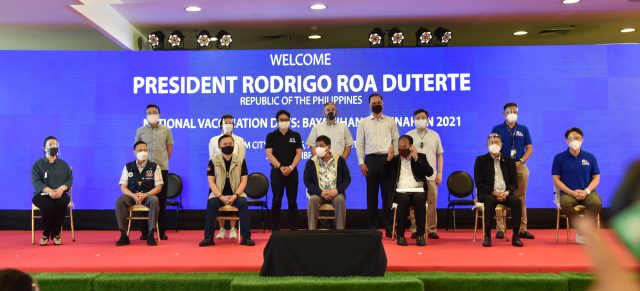
Dubbed Bayanihan Bakunahan, the three-day vaccination drive’s ceremonial launch at SM City Masinag was attended by President Rodrigo Roa Duterte; Secretary Carlito Galvez Jr., National Task Force against Coronavirus Disease-2019 (NTF COVID-19) chief implementer; Health Secretary Francisco Duque III; Senator Christopher Lawrence “Bong” Go, Chair, Senate Committee on Health and Demography; Defense Secretary Delfin Lorenzena; Rizal Governor Rebecca “Nini” Ynares; SM Supermalls President Steven T. Tan; members of the COVID-19 Inter-Agency Task Force; Cabinet Secretaries; and partners from the private and public sectors.

Bayanihan Bakunahan is a collaborative effort of the government, led by the Department of Health (DOH) and the Department of the Interior and Local Government (DILG), in cooperation with the National Task Force (NTF) Against COVID-19, together with various communities and private organizations.

“This multi-sectoral event is a resounding expression of our Bayanihan spirit, which coincides with the nation’s observance of Bonifacio Day on November 30. The heroic example of Gat Andres Bonifacio’s courage resonates in each of us as we work together to fast-track and intensify our efforts to overcome this pandemic,” said President Duterte in a speech.

Bayanihan Bakunahan was rolled out nationwide to increase the country’s coverage of the first dose to 70% as well as to increase the booster jabs across 16 regions outside Metro Manila. The second wave of the vaccination drive was slated on December 15 to 17.

“The concept of Bayanihan Bakunahan is that you and I, we’re both heroes. And we can be heroes if we vaccinate ourselves against COVID-19, not only for ourselves and our families but also for the people around us,” said Ma. Florinda Princess E. Duque, Director IV, Bureau of Communications Services.

During the event, the government mentioned that the Philippines is expecting to vaccinate 54M Filipinos by the end of the year including 80% of minors aged 12 to 17 years old. President Duterte also said that the government seeks to complete booster shots of fully-vaccinated seniors, health workers and people with comorbidities by the end of 2021. As of November, over 35 million Filipinos have been fully vaccinated.

Meanwhile, the government has also assured that there’s enough supply for the three-day vaccination drive. “It is safe to say that we have enough COVID-19 vaccine doses for the National Vaccination Days. The national government is continuously working with the local government in terms of vaccine supply. Also, preparations have been done beforehand so that we can reach our goal of inoculating 3 million individuals per day,” said Communications Director Duque.

Under the collaboration, SM Supermalls, along with over 8,000 vaccination sites, will be opened to accommodate the target population. To date, SM Supermalls has already administered 6 million doses of the COVID-19 vaccines in over 71 malls around the country, of that number 200,000 are children aged 12 to 17 years old inoculated at 45 malls.

“We at SM Supermalls have always believed that getting vaccinated is the best defense Filipinos have against the COVID-19 virus. In the past months of working together with the government, we have achieved great things. We thank the government for the opportunity to serve the country and our fellow Filipinos as we open more convenient and accessible mall vaccination sites nationwide,” said Steven Tan, President of SM Supermalls.

Apart from opening 66 mall vaccination sites, SM Supermalls also announced the participation of the National University in this endeavor. Over 500 alumni, employees, and students from the said university have registered to volunteer during the Bayanihan Bakunahan.

During the three-day Bayanihan Bakunahan event, Filipinos can walk in and register at the identified sites. For adults who want to get vaccinated, they are required to bring a government-issued ID and a medical certificate for those who have comorbidities. Pregnant and lactating mothers are also encouraged to get immunization shots.

For kids aged 12 to 17 years old, the parent/guardian should secure the following: any valid ID of the parent/guardian as well as a birth certificate, baptismal, or passport of the child. For children with health risks, parents/guardians are advised to get a medical certificate from their child’s attending pediatrician or physician showing that the child is eligible for vaccination. If both parents are not available during the vaccination day, an authorization letter signed by parents indicating the name of the assigned guardian with a valid ID will be needed.

And for those who have been vaccinated, booster shots will only be administered to those who had their 2nd dose for at least 6 months. Individuals who will avail of the booster shot should present a copy of their vaccination card. Apart from that, vaccinated individuals are also encouraged to volunteer in their respective LGUs and to rally behind the government to be vaccine advocates in their communities.

“Let us be heroes in this fight against COVID-19. Get vaccinated, volunteer, and encourage your families, friends, workplaces, and communities to get jabbed. Let us all strive to make this Christmas safer and better for the people we value most. Because it is only through our collective will to put an end to this crisis will we be able to build back better for a brighter future,” Tan closed.

For more information and up-to-date news on vaccination schedules at the SM malls in your LGU, follow @smsupermalls on all social media platforms.


Spotlight is BusinessWorld’s sponsored section that allows advertisers to amplify their brand and connect with BusinessWorld’s audience by enabling them to publish their stories directly on the BusinessWorld Web site. For more information, send an email to online@bworldonline.com.

Join us on Viber to get more updates from BusinessWorld: https://bit.ly/3hv6bLA.

Globe Business helps combat sea turtle egg poaching, supports reforestation

Globe’s enterprise group, Globe Business, supports The Mead Foundation in its environmental initiatives by contributing P500,000 to combat sea turtle egg poaching and continuing the reforestation efforts in Zambales. This is broadly aligned with the United Nations Sustainable Development Goals, which Globe is committed to.

“It is important for companies to think beyond profit as a sole metric of success and a sole purpose. Instead, let us measure our performance based on our efforts to improve the world we live in and uplift the lives of the people — from the policies we enact, the investments we make, and the technology we use,” said Peter Maquera, Senior Vice President for Globe Business, Enterprise Group.

The donation was made during Globe Business’ 12th Leadership Innovation Forum (Lead-In) attended by over 900 guests, including C-Level executives and leaders from various industries. With the theme “Bigger Picture, Greater Future: Redefining Success Beyond Business,” the event, which was held virtually, underscores the power that environmental, social, and governance (ESG) integration has on the future of enterprises.

“The Mead Foundation thanks Globe for their recognition of and support for our non-profit initiatives focused on conservation of the environment and community development. While the pandemic has presented unique challenges, we have worked diligently to continue our programs as the need remains as great as ever,” said Ben Mead, founder of The Mead Foundation.

The foundation is preparing for the pawikan (sea turtle) season, the time when these endangered species start nesting. The organization is set to embark on a conservation project to protect the sea turtles and prevent poachers from smuggling the eggs to areas where they are eaten as a delicacy.

In addition, the Mead Foundation will apply the funds towards the ongoing reforestation program in Iba, Zambales, which Globe has supported since 2018. The foundation also works closely with indigenous communities, particularly the Aetas of Zambales, to provide them with livelihood opportunities.

Engaging local communities yields positive environmental, ecological, and social benefits. It makes people aware of their significant role and participation in taking care of the area, the importance of environmental protection, and the benefits of a natural forest area.

Both Globe Business and the Mead Foundation believe that partnership and collaboration help achieve impactful outcomes by enabling corporations and individuals with three key components: Reforestation, Food Security, and Sustainable Livelihood Development.

Globe strongly supports the United Nations Sustainable Development Goals, particularly UN SDG No. 15, which promotes the protection, restoration, and sustainable use of terrestrial ecosystems. Globe is committed to upholding the UN Global Compact principles and contributing to 10 UN SDGs.

For more information about Globe Business, visit www.globe.com.ph/business/enterprise.


Spotlight is BusinessWorld’s sponsored section that allows advertisers to amplify their brand and connect with BusinessWorld’s audience by enabling them to publish their stories directly on the BusinessWorld Web site. For more information, send an email to online@bworldonline.com.

Join us on Viber to get more updates from BusinessWorld: https://bit.ly/3hv6bLA.

BWVEF 2021 | What Lies Ahead: Global Economic Growth Prospects

IMF’s Changyong Rhee gives his keynote speech on the topic “What Lies Ahead: Global Economic Growth Prospects” on the first day of BusinessWorld Virtual Economic Forum 2021.
#BWVEF2021 #RecoveryRoadmapPH