Home Blog Page 6726

Singapore property curbs may be short-term fix for market
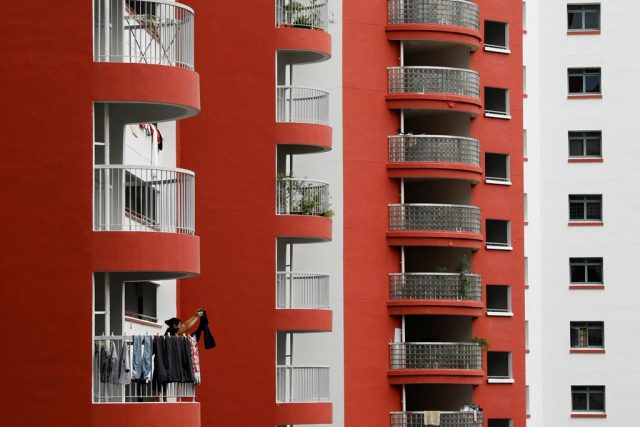
A VIEW of the public housing apartment estate in Singapore Sept. 1, 2021. — REUTERS/EDGAR SU

SINGAPORE’S MOVE to introduce property cooling measures may slow down demand and prices in the next six months. But this may just be a short-term fix in a market with an insatiable appetite for homes.

Home sales and values are likely to pick up once the market gets used to the latest curbs — just like they did after the last round in 2018, analysts said on Thursday after the government raised levies and tightened some lending limits.

Like other countries around the world, Singapore’s residential property market has remained resilient during the pandemic. Low interest rates and a rebounding economy have fueled demand for homes in the city-state, prompting policy makers to take steps to maintain affordability.

The latest curbs focus on buyers of second homes for investment and foreigners purchasing private property, rather than residents seeking to purchase a place to live. As a result, they’re unlikely to have a long-term impact given that locals make up the majority of buyers, said Alan Cheong, executive director of research at Savills Plc.

“The measures are something akin to pointing the gun to the sea when the enemy comes from the back,” Mr. Cheong said.

The steps may have a bigger impact on the mid to high-end market, which has a larger portion of investors and foreign buyers, said Christine Sun, senior vice-president of research and analytics at OrangeTee & Tie.

Private home prices climbed 5.3% in the first nine months of the year. New home sales in November jumped to a four-month high after the city-state gradually eased social restrictions. The public housing market has also been buoyant, with resale prices surging a record 9.1% through September.

Like in the aftermath of the 2018 curbs, Singapore home prices may dip 1% to 2% over the next two quarters before resuming growth that more closely keeps pace with rising incomes, Morgan Stanley analysts wrote in a note on Thursday.

Citigroup, Inc. said home sales may fall between 25% to 35% in the near term, mainly due to a reduction in demand from investors as well as a decreased desire among permanent residents and foreigners given the substantial stamp duties imposed.

But sales volume may return to normal after three to six months as buyers “acclimatize to the measures amid still-strong fundamentals of the residential market and soft interest rates,” Citigroup analyst Brandon Lee wrote in a note.

The higher additional stamp duties will remove buyers at the margin who would be most vulnerable to any interest-rate increase, said Christine Li, head of research for Asia Pacific at Knight Frank in Singapore.

“But given that most of the transactions are backed by wealth rather than income, property prices are unlikely to come back down in a sustainable manner,” she said.

 LOW SUPPLY

Developers may think twice about buying existing residential sites to be redeveloped as they assess the risks that come with the new measures, Li said. That may help to cause prices to rebound as early as the second half of next year, she said.

An increase in land taxes to 35% from 25% will place “immense additional pressure” on developers trying to recover from the pandemic, the Real Estate Developers’ Association of Singapore said.

The number of unsold units in the supply pipeline has been on a steady decline since the third quarter of 2019 as sales outpaced new additions of homes, the Monetary Authority of Singapore said in a report this month. As of September, there were about 17,100 unsold units, 35% lower than such inventory a year ago and close to the historical low of about 15,100 units in 2017.

The cooling measures also come as Singapore opens up more vaccinated travel lanes, which could lead to foreigners coming in to snap up homes. While the new property curbs may dampen demand among foreigners following the higher stamp duties — raised to 30% from 20% — it may not deter both local and foreign ultra-rich buyers who have partly driven sales in the past year.

“These are unlikely to curb the well-heeled and deep pocketed,” said Justin Tang, head of Asian research at United First Partners. “They can afford it and will factor it into their costs.” — Bloomberg


Meralco’s eSakay installs EV charging stations in McDonald stores

MANILA Electric Co.’s (Meralco) green mobility arm e-Sakay, Inc. announced on Monday its partnership with McDonalds to install electric vehicles (EV) charging stations at the fast food store.

Meralco said in a statement that eSakay will install its initial charging stations at McDonald’s Green and Good Stores along UN Avenue in Ermita, Manila and Shaw Boulevard, Wack-Wack in Mandaluyong.

Customers who are using electric scooters or electric bikes can charge their vehicles in the coin-operated charging stations for P1 per five minutes, P5 per 25 minutes, and P10 per 50 minutes.

The partnership with Golden Arches Development Corp., the master franchise holder of McDonald’s in the Philippines, is expected to extend to other branches to advance sustainability initiatives.

“We look forward to working very closely with even more companies in driving key sustainability programs such as this as part of our pledge to protect and preserve our planet, and to power good lives for Filipinos,” Meralco Chief Sustainability Officer and eSakay President and Chief Executive Officer Raymond B. Ravelo said in a statement.

Shares in Meralco at the stock exchange declined by 0.72% or P2.20 on Monday to close at P304.80 apiece. — Marielle C. Lucenio

Entertainment News (12/21/21)

Side A Live at The Grand

Side A, M.Y.M.P. at RWM’s Grand Bar and Lounge

WITH THE return of live entertainment at Resorts World Manila (RWM), the best ballads and pop hits from OPM’s popular powerband Side A and acoustic duo M.Y.M.P. can be heard this December at RWM Grand Wing’s The Grand Bar and Lounge. Side A will perform live on Dec. 21 and 28, 9 p.m., while it is M.Y.M.P.’s turn on Dec. 22 and 29, 9 p.m., at the Grand Bar and Lounge. Door charge is P800 per person, with consumable food and drinks. Guests must be at least 21 years old. For more information on RWM’s entertainment offers, visit www.rwmanila.com and follow @rwmanila on Facebook and Twitter, and @resortsworldmanila Instagram.


K-channel tvN now exclusively on Smart’s GigaPlay

BINGE WATCH K-dramas as mobile services provider Smart Communications, Inc. partners with Korea’s No. 1 network tvN to stream non-stop content on the GigaPlay app this December. Smart subscribers can enjoy K-dramas and Korean variety shows in the streaming platform that gives subscribers exclusive access to live concerts, sports events, films, lifestyle and variety shows. The GigaPlay app also carries local pay-per-view content like Love Is Color Blind, the romcom starring Donny Pangilinan and Belle Mariano. Download the app on the Apple App Store and Google Play Store or visit smrt.ph/gigaplay.


GTV shows movies on G! Flicks

GTV now offers a roster of movies on G! Flicks, weeknights at 8 p.m. and every Saturday at 7:05 p.m. Follow James Bond (played by Pierce Brosnan) as he tries to stop a mad media mogul from inciting another World War in Tomorrow Never Dies on Dec. 20. This will be followed on Dec. 21 by Batman Forever, on Dec. 22 by Men In Black 4, on Dec. 23 by Mission Impossible II, on Dec. 24 by The Perfect Storm, on Dec. 25 by Gemini Man, Dec. 27 by The Merciless, Dec. 28 by No Escape, Dec. 29 by Sharknado 2, Dec. 30 by Golden Slumber, and on Dec. 31 by Resident Evil: Extinction. Welcome the New Year with another James Bond film and join Daniel Craig in thwarting the plans of a villain who plans to launch a national surveillance network to mastermind criminal activities across the globe in Spectre on Jan. 1.


Taiwan’s Ariel Tsai on Waterwalk Records

SONY MUSIC Philippines recently announced the launch of Waterwalk Records, a music label focused on bringing fresh Christian music to the streaming generation throughout Asia. After launching several new songs from Filipino artists such as Morissette, Hazel Faith, and Nathan Huang, it is releasing a song from Taiwanese singer-songwriter, pianist, and YouTuber Ariel Tsai. Her track, “My All in All,” is a piano-driven worship song. “My All in All” is available in all digital music streaming platforms. The official lyric video is also available on Ariel Tsai’s YouTube channel.

The economies of typhoon-hit regions

211221Typhone_Odette

THE Philippine government signed a €250-million (about P14-billion) loan agreement with France’s development agency to support local governments’ disaster response, the Department of Finance (DoF) said. Read the full story.

THE ECONOMIES OF TYPHOON-HIT REGIONS

China’s banks cut borrowing costs to counter economic slowdown

PIXABAY.COM

Chinese banks lowered borrowing costs for the first time in 20 months, foreshadowing more monetary support to an economy showing strain from a property slump, weak private consumption and sporadic virus outbreaks.

The one-year loan prime rate (LPR) was set at 3.8% versus 3.85% in November, the first reduction since April 2020, according to a statement from the People’s Bank of China (PBoC) on Monday. The five-year loan prime rate, a reference for mortgages, was unchanged at 4.65%.

The cut comes as the central bank and government increase support for the economy and follows the PBoC’s decision earlier this month to cut the amount of cash banks must hold in reserve, which freed up 1.2 trillion yuan ($188 billion) of cheap long-term funding for banks. Monday’s decision means the strongest companies will be able to borrow at a slightly cheaper rate and also reinforces the shift to looser policy as the leadership aims for stability in 2022.

“The cut reinforces our view that China’s authorities are increasingly open to the possibility of an interest-rate cut amid looming headwinds to the economy,” said Xing Zhaopeng, senior China strategist at Australia & New Zealand Banking Group Ltd.

While technically not a policy interest rate, the LPR is based on 18 banks’ loan rates for their best customers and has been considered China’s de facto benchmark funding cost since 2019. The cut will lower overall interest payment burden of Chinese companies by 80 billion yuan per year starting next year, according to Xing, who said there are around 160 trillion yuan of loans pegged to the one-year LPR.

The CSI 300 Real Estate Index climbed as much as 2.6%. Gemdale Corp. and Poly Developments and Holdings Group Co. led the gains, each rising at least 3.5%. China’s 10-year note yield was little changed at 2.85%, while the offshore yuan steadied at 6.3865 to the dollar.

The move strengthens the easing bias of the PBoC, and more measures could be rolled out if the economic slowdown deepens, including further cuts to the reserve requirement ratio (RRR) as well as reduction of policy rates, according to analysts. The PBoC vowed last week to continue to unleash the potential of interest rate reforms and guide overall corporate financing costs lower.

“The signal is obvious that we are in an easing cycle,” said He Wei, an analyst at Gavekal Dragonomics, who expects the PBoC’s policy rates, or the rates for the medium-term lending facility (MLF) and seven-day reverse repurchase notes, will be lowered in the first half of next year.

In another sign of support, China will focus on supporting “quality” property developers buying the real estate projects of large companies which are experiencing difficulties, Financial News, a newspaper co-founded by the PBoC, reported Monday, citing a notice from the central bank and the banking regulator.

Bruce Pang, head of macro and strategy research at China Renaissance Securities Hong Kong Ltd., said the next window for monetary easing could be late January, when the PBoC may act to cut the RRR, policy rates or roll out more structural tools depending on the economy’s state as well previous policies’ impact.

“In the near term we may not see PBoC adding more measure,” said Qi Gao, a strategist at Bank of Nova Scotia. The PBoC could cut the MLF rate next year and lower the RRR again in the first half of 2022, he said.

Xing of ANZ echoed the view that the LPR reduction signals there may not be policy rate cut in the short term, but forecast another RRR cut early next year to cushion mounting credit risks in the property sector.

The LPR is reported by banks in the form of a spread over the interest rate on PBoC’s medium-term loans. With the PBoC having kept the MLF rate unchanged last week, most economists polled by Bloomberg had expected the LPR to remain steady as well.

Still, the chorus for a rate cut has grown louder recently, and interest rate swaps also showed traders had been betting the LPR would soon be cut. — Bloomberg

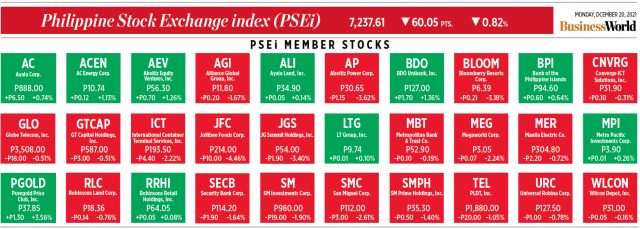
How PSEi member stocks performed — December 20, 2021

Here’s a quick glance at how PSEi stocks fared on FridayDecember 20, 2021.

Stocks drop on typhoon damage, Omicron fears

COURTESY OF PHILIPPINE STOCK EXCHANGE, INC.

STOCKS dropped on Monday as investors assess the damage caused by Typhoon Odette, which may affect economic growth, and amid the spread of the Omicron variant. 

The 30-member Philippine Stock Exchange index (PSEi) fell 60.05 points or 0.82% to close at 7,237.61 on Monday, while the broader all shares index went down by 23.21 points or 0.60% to 3,828.38. 

“Share prices opened the week on a sour note as the local market weakened amid the damage caused by Typhoon Odette in the Vis-Min area, particularly in the agriculture and manufacturing industries,” Papa Securities Corp., Equities Strategist Manny P. Cruz said in a Viber message.  

Typhoon Odette (international name: Rai) brought heavy rains and destructive winds over central and southern Philippines. It first made landfall in Siargao Island, Surigao del Norte on Thursday. Surigao del Norte may have suffered around P20 billion in damage, according to provincial officials. 

The Agriculture department on Monday said damage to crops in these areas is estimated at P333.40 million. Agriculture typically makes up around 10% of overall economic output, and a fourth of the country’s jobs.  

“The local bourse joined its regional peers in the decline as worries over the Omicron variant disrupting the global economic recovery weighed on sentiment,” Philstocks Financial, Inc. Senior Research Analyst Japhet Louis O. Tantiangco said in a Viber message. 

Asian share markets fell and oil prices slid on Monday as surging Omicron cases triggered tighter restrictions in Europe and threatened to drag on the global economy into the new year, Reuters reported. 

MSCI’s broadest index of Asia-Pacific shares outside Japan slipped 0.4% and Japan’s Nikkei 0.7%. 

The spread of Omicron saw the Netherlands go into lockdown on Sunday and put pressure on others to follow, though the United States seemed set to remain open. 

The Philippines on Monday also reported another case of the Omicron variant, bringing the total to three. 

Sectoral indices ended in the red on Monday except for financials, which went up 7.86 points or 0.48% to 1,629.78.  

On the other hand, mining and oil declined 110.98 points or 1.21% to 9.003.95; industrials decreased 119.13 points or 1.14%; holding firms tumbled 78.94 points or 1.10% to 7,051.95; services went down 21.28 points or 1.05% to 1,997.47; and property retreated 26.10 points or 0.80% to 3,203.54. 

Value turnover plunged to P6.70 billion on Monday with 1.09 billion shares traded from the P14.47 billion with 3.08 billion issues that switched hands on Friday. 

Decliners outnumbered advancers, 112 against 57, while 51 names closed unchanged. 

Foreigners turned net sellers on Monday, recording P237.48 million in net outflows versus the reversal of the P333.22 million in net purchases seen on Friday. 

Diversified Securities, Inc. Equity Trader Aniceto K. Pangan pegged the PSEi’s immediate resistance at 7,300, while immediate support is at 6,920. — M.C. Lucenio with Reuters 

Peso climbs vs dollar on remittances

BW FILE PHOTO

The peso strengthened against the dollar on Monday as remittances enter the country amid the holiday season and following the destruction caused by Typhoon Odette.

The peso closed at P49.93 per dollar on Monday, gaining nine centavos versus its P50.02 finish on Friday, data from the Bankers Association of the Philippines showed.

The local unit opened Monday’s session at P50 against the dollar. Its intraday best was at P49.90, while its lowest point for the session was at P50.02 versus the greenback.

Dollars traded declined to $887.35 million on Monday from $900.65 million on Friday.

Rizal Commercial Banking Corp. Chief Economist Michael L. Ricafort said the peso closed stronger against the dollar on Monday due to increased remittances from overseas Filipino workers (OFW) following the typhoon and amid the holiday season.

“Storm damage from Typhoon Odette especially in hard hit areas in the Visayas and Mindanao could lead to the sending of more OFW remittances to finance repairs,” he said.

Financial aid from the international community would also partially support the peso, he added.

Meanwhile, a trader in an e-mail said the peso appreciated amid concerns over the spread of the Omicron variant of the coronavirus disease 2019, which affected demand for the dollar.

For Tuesday, Mr. Ricafort said he expects the peso to trade within P49.80 to P49.98 per dollar, while the trader gave a forecast range of P49.85 to P50.05. — JPI

Typhoon not expected to have big impact on agriculture output

ANY BLOW to rice production caused by Typhoon Odette (international name: Rai) was softened by the timing of the storm, which hit the Philippines after much of the previous harvest had been brought in and as the new planting cycle was beginning, the Department of Agriculture (DA) said.

“As we reported, the main wet season is over, and dry season (from 2021-2022) has just started in affected regions,” Assistant Secretary Noel O. Reyes said via chat. “Thus, there was minimal damage on palay (unmilled rice). And we will do ‘quick turnaround’ planting, providing affected farmers free palay seed (worth) P148 million.”

“Therefore, the damage done by Typhoon Odette will not affect much the fourth quarter and over-all 2021 agriculture performance,” he added.

In August, the DA lowered its production growth target to 2% from the initial 2.5% due to the ongoing COVID-19 pandemic. The lockdown took a toll on agricultural production, particularly on the hog and poultry industry.

In the first quarter, agricultural output declined 3.3%, led by livestock and poultry, which offset increased fisheries and crop production.

Agricultural output accounts for about 10% of gross domestic product while farmers represent 25% of the workforce.

The latest estimate for storm damage in the provinces along Typhoon Odette’s track is P333.4 million, affecting 12,750 farmers and fishers across 23,198 hectares of farmland.

Lost production volume was estimated at 19,640 metric tons.

The DA damage reports took in information from Bicol, Western and Central Visayas, Calabarzon, Central Mindanao, Davao, and the Caraga region.

The affected crops included rice, corn, seafood, and other high-value commodities. — Luisa Maria Jacinta C. Jocson

Boracay rehabilitation on track to finish by early 2022 — DENR

COCO ROSALES-UNSPLASH

THE Department of Environment and Natural Resources (DENR) said it expects to complete the rehabilitation of Boracay Island by the first half of 2022, after an overhaul of the island’s environmental and land use practices that required a full closure to visitors in 2018.

“To reverse the degradation of the island, we have to work on all issues that caused its deterioration. These include recovering the beach areas and cleaning its waters, regaining the wetlands which are the island’s ‘kidneys,’ restoring ecosystems, and clearing and paving the roads that are designated for public transport,” Environment Secretary Roy A. Cimatu said in a statement.

The entire island will be declared a land reform area, he added.

The DENR will inspect the Lugutan and Tulubhan Bay areas, due to reports of illegal water discharge from households not yet connected to the island’s sewage network.

To address continuing water supply problems, the DENR’s Western Visayas office is working on a proposal to build a water tank that will supply potable water to a portion of Barangay Balabag, on the east coast of the island, and all of Barangay Yapak, which is to the north.

The Boracay Inter-Agency Task Force, which is in charge of the rehabilitation, is also evaluating a pumping station with a capacity of 800 cubic meters of raw water to be brought in from Malay, Aklan, on the Panay mainland, and supply raw water to the Angol Treatment Plant. It will also provide water to Barangay Manoc-Manoc in the south of the island, and to the rest of Balabag.

Demolition orders and notices to vacate were issued to owners in the remaining commercial and residential structures deemed too close to beach easements.

The enforcement of the “25+5-meter” easement rule is about 85% completed, and operations to clear beachfront are expected to finish by April.

Certificates of land ownership have distributed to the Ati indigenous people, the island’s original inhabitants.

By early next year, the DENR is expecting to complete its study on the carrying capacity of dive sites around the island.

“Aside from White Beach, Boracay is also known for its dive sites. This is the reason why we have to establish their carrying capacities — to regulate the number of divers at any given time,” Boracay Inter-Agency Rehabilitation Management Group General Manager Natividad Y. Bernardino said. — Luisa Maria Jacinta C. Jocson

PEZA pitches PHL to more potential Japanese locators

THE Philippine Economic Zone Authority (PEZA) said it is making a bid for more Japanese investment in the Philippines as the pandemic disrupts supply chains for manufacturers worldwide.

“The Philippines takes pride in our young Filipino workforce with high proficiency in the English language, are college graduates, dependable and hardworking,” PEZA Director General Charito B. Plaza said in a statement on Monday.

Japanese companies consider job one to be building new supply chains, with their Manila-based ambassador calling tech, communications, and startups their key focus areas.

Japanese Ambassador to the Philippines Koshikawa Kazuhiko was quoted as saying that the priority for Japanese companies is “building a strong supply chain and realizing a free and fair trade and investment environment,” which he said “Japan and the Philippines (need to work on in order to) solve the universal problem of economic recovery brought by the ongoing pandemic.”

“We want to take investment opportunities in the field of science and technology, as well as in semiconductors and communication fields, promote startup support, and develop human resources,” he added.

Ms. Plaza met virtually with the Japanese business community during a forum late last week.

She told Japanese businesses that the Philippines’ goal is to “catalyze industrial growth” by establishing more economic zones.

“To date, we have 962 Japanese locator companies among our 4,670 registered companies,” Ms. Plaza said.

“These companies are engaged in warehousing and storage, fabricated metal products, rubber and plastic products, radio, television, and communication equipment and apparatus, as well as software development,” she added.

Ms. Plaza noted that PEZA-registered Japanese businesses account for P727.679 billion in investment and employ 353,763 workers.

They also “contribute $11.065 billion in exports” to the economy, she said.

Philippine Ambassador to Japan Jose C. Laurel V said Japan is one of the Philippines’ “most significant” trade, investment, and development assistance partners.

“For the first semester of 2021, year on year, Japan was our second (largest) trade partner, the second-largest investment source, and the top official development assistance (ODA) bilateral contributor,” he said. — Arjay L. Balinbin

Vietnam cement importer calls dumping charges discriminatory

PHILSTAR FILE PHOTO

AN IMPORTER of cement from Vietnam said the industry is being treated unfairly because anti-dumping duties have been imposed on such imports even though the investigation into the actual harm done to domestic producers is only in its preliminary stages.

“(The Department of Trade and Industry [DTI] has imposed) the dumping duty even though the investigation is ongoing. It’s prejudice against foreign cement producers,” Joel R. Butuyan, counsel for Omanco Material Vietnam Ltd. Co., told BusinessWorld by telephone.

Mr. Butuyan had represented his company virtually Monday in a preliminary conference before the Tariff Commission.

The Tariff commission said at the conference that it does not have the authority to revoke the anti-dumping duty order issued by the DTI.

Omanco Material Vietnam is one of the Vietnamese cement companies subjected to four-month temporary anti-dumping duties imposed by the DTI on December 6.

The department was reacting to a petition filed by domestic cement manufacturers Republic Cement & Building Materials, Inc., CEMEX Philippines Holdings, Inc. subsidiaries Solid Cement Corp. and Apo Cement Corp., and Holcim Philippines, Inc. The domestic companies submitted the results of their preliminary investigation on Vietnamese cement.

The estimated dumping margin for Type 1 cement (also known as Portland) imports from Vietnam ranges from $1.02 per metric ton (MT) to $10.53 per MT, equivalent to 2.69%-31.87% of the export price. — Marielle C. Lucenio