Home Blog Page 6566

8,241 passed digital bar exams for 73% passing rate — SC

PHILIPPINE STAR/RUSSELL PALMA

THE SUPREME Court (SC) on Tuesday said 8,241 students passed the 2020/2021 bar exams — the first to be held outside Manila, the capital and the first to be done digitally — for a 72.8% passing rate.

“You are an extraordinary batch of bar takers whether you made it this year,” Supreme Court Justice Marvic M.V.F. Leonen told a press briefing on Tuesday. “It was an honor for my team and me to be with you every step of the way. It was an honor to be your bar chairperson.”

Students took the exams using laptops at 29 local testing sites in 22 local government units, the tribunal said in a statement.

The bar exams were postponed in 2020 amid a coronavirus pandemic. These were rescheduled again the following year amid surging infections.

The exams were supposed to be held on Jan. 23 to 25 but had to be postponed again amid a surge in cases spurred by the Omicron variant. The two-day exams finally went ahead on Feb. 4 and 6. 

Mr. Leonen said the results should not be compared with past exams because the circumstances were different. The High Court did not name the top 10 examinees.

The digital bar exams were held on two Sundays compared with four Sundays before.

The Ateneo de Manila University topped the list of law schools with more than 100 first-time examinees who passed the exams with a 99.64% passing rate.

The University of the Philippines had the most exemplary passers who scored 85-90% at 147, and the most excellent passers who scored above 90% at four.

The tribunal also disqualified several examinees for withholding information about being infected with the coronavirus, using a mobile phone inside the exam room and accessing social media during lunch break.

The bar exams covered political, labor, taxation, criminal, civil and commercial law, as well as procedural and professional ethics.

“To those who passed today, face your success with magnanimity and humility,” Mr. Leonen said. “Bar examinations only facilitate your entry to the legal profession, do not be blinded by today’s success but be awed by what lies ahead.”

Last month, Supreme Court Justice Alfredo S. Caguioa said the next bar exams would return to a four-day schedule.

Chief Justice Alexander G. Gesmundo earlier said the High Court would continue digital exams to take full advantage of new technology. — John Victor D. Ordoñez

Coronavirus cases have plateaued, says Health dep’t

PHILSTAR

CORONAVIRUS infections in the Philippines might have plateaued, health authorities said on Tuesday.

Signs of plateauing have been observed as the country posted 1,903 new coronavirus cases from April 5 to 11, 26% lower than a week earlier, Health Undersecretary Maria Rosario S. Vergeire told an online news briefing.

“The number of new coronavirus cases in the country is currently on a plateau,” she said. “Cases are now on a decline.”

She said the Philippines posted 366 infections on March 29 to April 4, 4% lower than a week earlier.

A major decline was also observed on March 22 to 28, as the country posted 383 cases, 22% lower than a week earlier.

The country’s infection rate has declined to 1.6% from last week’s 1.8%, Ms. Vergeire said. The country’s health system remained at low risk.

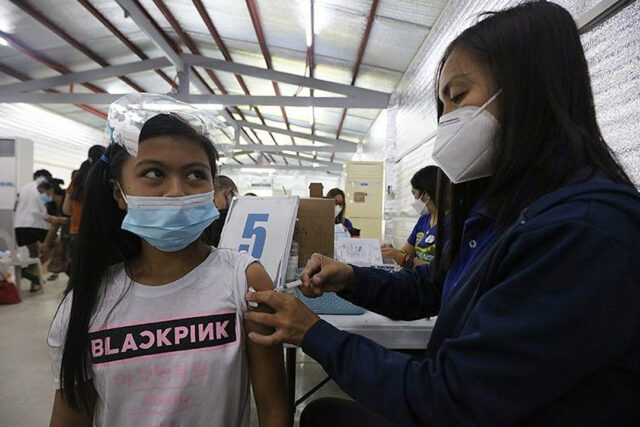
Presidential spokesman Jose Martin M. Andanar said the government had fully vaccinated 66.74 million people as of April 11, while 12.53 million people have received booster shots.

He added that 1.3 million kids aged 5 to 11 and 9.07 million children aged 12 to 17 have been fully vaccinated against the coronavirus. Almost seven million seniors have been fully vaccinated. — Kyle Aristophere T. Atienza

Returning Pinoys need not fill out arrival cards — BI 

PHILIPPINE STAR/EDD GUMBAN

FILIPINOS returning to the country would no longer be required to fill out arrival cards at airports, according to the Bureau of Immigration (BI). 

In a statement on Tuesday, the agency said this would lessen the requirements and processing time of arriving Filipinos. 

“This move is part of BI’s efforts to ease its travel requirements for arriving Filipinos and facilitate their fast and hassle-free entry into their own country,” Immigration Port Operations Division Chief Carlos B. Capulong said in the statement. 

He noted that arrival or disembarkation cards were no longer needed due to the recent decrease in coronavirus cases in the country. 

Daily passenger arrivals at the airport averaged at 13,000 to 15,000 in April, up from 6,000 to 9,000 in March. 

“We required the submission of these disembarkation cards by arriving Filipinos to help the government in its contact tracing efforts at the height of the pandemic,” Mr. Capulong said. “Now that coronavirus cases are on the decline, these cards can now be dispensed with.” — John Victor D. Ordoñez

Tropical depression Agaton leaves at least 28 dead; Duterte gov’t touts early warning improvements 

EMERGENCY responders rescue a resident of a community in Baybay City, Leyte that was affected by what authorities described as a massive landslide triggered by continuous rains from tropical depression Agaton. — BUREAU OF FIRE PROTECTION-BAYBAY CITY

AT LEAST 28 people were reported to have died in landslides and floods triggered by tropical depression Agaton, with international name Megi, which brought continuous rains over central Philippines since the weekend.    

The police regional office in Eastern Visayas said on Monday night that it recorded 21 casualties from a massive landslide in Baybay City, Leyte and one who died from drowning in Motiong, Samar.   

The national disaster management councils Tuesday update, meanwhile, reported another three deaths each in the regions of Central Visayas and Davao, subject to final validation.  

There are still reported missing individuals and are being searched, 87 are wounded and are being treated,the police Eastern Visayas office said in its 8 p.m. report on April 11.   

More than 139,000 people have been affected across nine regions, including about 19,000 who were evacuated, according to the National Disaster Risk Reduction and Management Council (NDRRMC).   

Sea travel to and from 39 seaports were suspended, leaving over 6,000 passengers stranded, based on the Philippine Coast Guards monitoring report.  

As of Tuesday early afternoon, moderate to heavy rainfall warnings were still up in several areas, based on regional advisories from state weather agency PAGASA.  

Agaton was expected to linger over the Samar-Leyte area before moving southeast towards the Philippine Sea by Tuesday night or Wednesday morning.   

PAGASA said the remnant of Agaton will then continue tracking generally eastward over the Philippine Sea as it becomes assimilated within the circulation oftyphoon Malakas, which entered the Philippine area around 10 a.m. Tuesday at 1,435 kilometers east of southern Luzon.   

Typhoon Malakas, locally named Basyang, was forecast to be out of the Philippines by Tuesday evening and would not affect the countrys weather condition.    

FORECASTING 
The Presidential Palace on Tuesday touted that early warning systems under President Rodrigo R. Dutertes administration have significantly improved, without giving credit to his predecessors government which initiated reforms to upgrade the countrys weather forecasting system.   

In a news conference, Palace spokesman Jose Martin M. Andanar said more monitoring systems used for typhoons and floods have been put up since the start of Mr. Dutertes term in 2016. 

He said the Department of Science and Technology (DoST), which heads the countrys weather bureau, now has a total of 17 doppler radar stations as of June 2021. 

But the DoST already had 10 doppler radar stations, which are used for tropical cyclone and rain monitoring, before Mr. Duterte assumed office in 2016.  

Mr. Andanar said that from zero, the government now has 29 high-frequency doppler radars, which are used to monitor sea waves, as of June 2021.  

He also said that flood forecasting and warning systems at river centers increased to 15 in 2021 from five in 2016.  

It was the late President Benigno S.C. Aquino III who pushed for the modernization of the countrys weather forecasting system.  

The DoST under his watch launched Project NOAH, a disaster prevention and mitigation research program that oversaw the establishment of monitoring stations in major river basins and flood-prone areas in the Philippines, which is hit by an average of 20 typhoons a year.   

Project NOAH was not renewed in 2017 with the Duterte administration citing lack of funds for its continuation and implementation of other components.  

Mr. Aquino said in a 2011 public address that he personally checked on the reported shortage of equipment and other financial problems besetting the countrys state weather bureau shortly after he assumed office in 2010.  

In the same year, he directed the Department of Budget and Management to release P150 million for the installation of 1,000 automatic water level sensors nationwide to aid forecasters in tracking river water levels and potential floods, according to a website post of the Philippine governments official gazette.  

Scientists worldwide have warned that rising global temperatures caused by destructive human activities are making typhoons more powerful.   

In 2013, the Philippines was hit by super typhoon Haiyan, known locally as Yolanda, one of the strongest tropical cyclones recorded globally that killed about 6,300 people. Marifi S. Jara and Kyle Aristophere T. Atienza

‘Agaton’ agri damage initially estimated at P265M; 16 roads still closed 

LEMERY MPS
LEMERY MPS

AGRICULTURAL damage and losses from the first typhoon to hit the country this year was initially estimated at P265.3 million, the Department of Agriculture reported on Tuesday.  

Storm Agaton, with international name Megi, dumped rains over central parts of the country for days, causing floods and landslides.   

Farm damage and losses were reported in the regions of Eastern Visayas and Caraga, affecting 2,132 farmers.  

Volume of production loss was estimated at 16,532 metric tons (MT) across 3,060 hectares of agricultural areas.  

Rice was the most affected crop with losses amounting to P250.1 million. 

This was followed by high-value crops, such as banana, at P13.9 million and corn at P1.4 million.  

The department said it will be providing assistance to affected farmers and fishers, including rice, corn and assorted vegetable seeds; and drugs and biologics for livestock and poultry.  

It will also allocate available funds from the Philippine Crop Insurance Corporation to indemnify affected farmers and the Quick Response Fund for the rehabilitation of affected areas.  

Meanwhile, 16 roads were still closed due to damage or obstructions while 19 others affected by flooding and landslides were partially open as of Tuesday noon, according to the Department of Public Works and Highways.   

The department said response teams were already immediately deployed for clearing operations in areas that were deemed safe.    

Agaton affected public structures across seven regions from the southern part of Luzon, the central Visayas islands, and northern-central areas in Mindanao. Luisa Maria Jacinta C. Jocson 

Comelec to probe spoiled ballot incident in Singapore 

PHILIPPINE EMBASSY IN SINGAPORE

THE COMMISSION on Elections (Comelec) will investigate the reported spoiled ballotgiven to a voter in Singapore on Monday even if the Philippine Embassy there has said it was just one isolated incident.”   

“We received later in the afternoon yesterday (Monday) a confirmation from our Singaporean post saying that indeed a ballot was given to a voter but this ballot was already considered a spoiled ballot,” Election Commission George Erwin M. Garcia told CNN Philippines on Tuesday.   

“We should really investigate this incident as this should not happen again and find out why this spoiled ballot was given to the voter.”  

The Singapore-based Filipino voter first reported the incident of receiving a pre-shaded ballot through social media.   

“This (ballot) should have been segregated and put in an envelope for spoiled ballots so we will definitely get that answer within the next few days,” he said.  

In a Facebook post on Monday, the Philippine Embassy in Singapore confirmed an “isolated incident” wherein a spoiled ballot was inadvertently given to a voter.  

Mr. Garcia defined a spoiled ballot as one that was returned due to physical defects such as water damage and tearing caused by the voter.  

“At this point, I think we should give our electoral board members the benefit of the doubt because from what I’ve seen in the past, they can get really tired,” he said.   

“We are so lucky the voter was able to complain about the isolated case,” he added.  

Vice-presidential bet Davao City Mayor Sara Duterte-Carpio, whose name was pre-shaded along with several senators in the incident, said reports of pre-shaded ballots are “grossly disconcerting.”  

In a statement on Monday, she also urged Comelec to probe allegations of electoral irregularities in Dubai and in Singapore.   

ROME
Meanwhile, the embassy in Rome has opened a pick-up site within its premises for those who earlier requested to personally claim their respective ballots instead of being sent by post.   

These voters may get their mailing packets between 9:00 a.m. to 5:00 p.m. from April 11 to 17 and return the accomplished ballot on the same day, the embassy said in an advisory.   

There are almost 1.7 million registered overseas Filipino voters. Absentee voting, which will be mainly by post in most countries and in-person in a few areas, started on April 10 and will be open until May 9. John Victor D. Ordoñez and Alyssa Nicole O. Tan 

Rep. Garcia leaves One Cebu after party endorses Marcos 

A LAWMAKER on Tuesday left provincial political party One Cebu after the group led by his sister, Cebu Gov. Gwendolyn F. Garcia, endorsed the presidential candidacy of the late dictators son and namesake Ferdinand BongbongR. Marcos.   

I have been officially informed that my party, One Cebu, has endorsed a candidate for President; a choice which, unfortunately, I cannot support,Deputy Speaker and Cebu Rep. Pablo John F. Garcia said in a statement posted on his Facebook account.  

Mr. Garcia said he will keep supporting presidential aspirant Manila Mayor Francisco IskoM. Domagoso.  

From the start, I have been clear and consistent about my support for Mayor Isko Moreno’s candidacy for President, believing that he is, among the many choices, the most capable and best prepared to lead the country out of this many-pronged crisis that it now faces, and into the future, the solon said.   

I respect One Cebu and its decision, just as I hope that the party I helped found, and have only the deepest affection for, would respect my choice and direction,he added.   

Mr. Garcia said he is stepping downfrom his party position as secretary general to avoid any conflict of interestas he continues to campaign for Mr. Domagoso.  

One Cebu, which held a general assembly on Tuesday, formally announced their endorsement of Mr. Marcos.   

In a statement signed by Ms. Garcia who is running for another term as governor, the party said the decision follows weeks of extensive consultations and discussions with provincial, municipal and barangay leaders.”  

Ms. Garcia said the consultations covered the 44 towns and six component cities of the province plus the independent city of Mandaue.   

Cebu excluding the independent cities of Cebu, Lapu-Lapu and Mandaue has the biggest voting population among the Philippines 81 provinces.   

It has more than 3.25 million registered voters for the May 9 national and local elections, based on data from the Commission on Elections. Jaspearl Emerald G. Tan 

LA Lakers dismiss head coach Frank Vogel

THE LOS ANGELES (LA) Lakers fired head coach Frank Vogel on Monday after three seasons.

The move was expected since the Lakers’ bid to reach the postseason ended last week.

“I have a tremendous amount of respect for Frank both on and off the court,” Lakers general manager Rob Pelinka said in the press release. “Frank is a great coach and a good man. We will forever be grateful to him for his work in guiding us to the 2019-20 NBA championship. This is an incredibly difficult decision to make, but one we feel is necessary at this point. All of us here wish Frank and his wonderful family all the best for the future.” — Reuters

Nets, Pelicans among favorites in NBA play-in games

THE NEW Orleans Pelicans and Brooklyn Nets are oddsmakers’ biggest favorites to win their opening games in the National Basketball Association (NBA) play-in tournament this week. Basketball bettors like them the most, too.

The Nets, the Eastern Conference’s No. 7 seed, are 8.5-point favorites (-400 moneyline) at both BetMGM and DraftKings to beat the No. 8 Cleveland Cavaliers on Tuesday night at home.

Per DraftKings, the Nets were seeing 93% of the handle and 89% of the total bets to win on the moneyline.

Despite having the No. 7 seed, the Nets are in fact one of the handful of favorites to win the championship. Buoyed by stars Kevin Durant and Kyrie Irving — who now can play home games thanks to New York lifting its coronavirus disease 2019 (COVID-19) vaccine mandate for the private sector — the Nets have the third-shortest odds at both BetMGM and DraftKings to win the whole thing.

The Nets are +600 at DraftKings and +700 at BetMGM as of Monday evening. In both cases, they trail only the Phoenix Suns and Milwaukee Bucks.

Bettors at DraftKings also like the Pelicans (-210), the No. 9 seed in the Western Conference, to beat the 10th-seeded San Antonio Spurs. New Orleans has received 62% of the handle and 64% of the total bets. But against the spread, the Spurs are five-point underdogs and attracting 77% of the handle at DraftKings.

BetRivers said 98.3% of the money on Spurs-Pelicans (moneyline) was going toward New Orleans. Similarly, the Nets were picking up 97.75% of the handle to win moneyline and the Atlanta Hawks, the No. 9 seed in the East, were responsible for 96.28% of the handle to beat the 10th-seeded Charlotte Hornets outright. Reuters

The worst is yet to come

Fittingly, the Lakers ended their disappointing regular season by hosting one of the most awkward interview sessions in recent memory. Just before Frank Vogel met with members of the media, he got wind of a tweet from ESPN’s resident National Basketball Association insider Adrian Wojnarowski announcing that he had been fired as head coach of the purple and gold. Just about everybody else did, as well, and so the queries he got in the aftermath of their first win streak in three months focused on his reaction to the news. There was just one problem, however: He had yet to be officially informed of the front office’s decision to give him the pink slip.

Vogel was understandably nonplussed. He remained composed, but made clear to the assembled throng that “I haven’t been told s–t.” And, in the context of the rare victory without the Lakers’ marquee names on tap, he was right to note that “I’m going to enjoy tonight’s game, celebrate what these young guys did in terms of scratching and clawing and getting back in this game and getting a W, and we’ll deal with tomorrow, tomorrow.” To be sure, he saw the writing on the wall as early as last month, when rumblings from reliable quarters pointed to his exit as inevitable. All the same, he remained classy and knew that, absent formal correspondence to the effect, discussing his departure was tantamount to speculating at the expense of his employers.

Make no mistake. Vogel could not but shoulder part of the blame for presiding over a veritable train wreck. By all accounts, he could have been more forceful off the court and decisive on it. Then again, it wasn’t his fault that the Lakers practically had a revolving door for players. Injury after injury, including those that sidelined top guns LeBron James and Anthony Davis for significant periods, hampered his capacity to build any semblance of momentum. In fact, so handicapped was he that he deployed 39 different starting lineups in 82 contests. And, in a highly competitive league where any given team can win at any given time, the constant patchwork was anything but an ingredient for success.

Not that the Lakers had any choice. Vogel was the first step for them to jump-start any semblance of improvement heading into their 2022-23 campaign. It also happened to be the easiest in light of the need for them to do something — anything — to get going. Subsequent moves are going to be infinitely harder, what with chemistry issues necessitating personnel movements that they have neither the resources nor the leverage to effect.

And therein lies the rub. Considering the state the Lakers are in, the worst is yet to come. James isn’t getting any younger, Davis won’t be more durable, and supposed third star Russell Westbrook remains an anvil — which is to say the real changes that need to be made can’t be made. Little wonder, then, that all and sundry are frustrated. They can’t even dream, let alone dream big.


Anthony L. Cuaycong has been writing Courtside since BusinessWorld introduced a Sports section in 1994. He is a consultant on strategic planning, operations and Human Resources management, corporate communications, and business development.

The era of rule-based security order

BW FILE PHOTO

Every year for the past eight decades, we have commemorated April 9 as Bataan Day of Valor or Araw ng Kagitingan.

But more than the bloodshed and the horrors brought about by World War II, the recognition of heroism in times of war should also enlighten us on the need to promote a rules-based international and regional security order. Only the basic principles of coexistence and political détente, after all, can assure us of security.

The West Philippine Sea (WPS) issue, for instance, showcases the overriding issue of maritime security that is persistently being challenged and upset by China’s continuous expansionist agenda.

Amid the pandemic, the littoral states in the WPS have found themselves in an even more precarious situation.

Another overarching lesson that world wars have taught us is the importance of leveraging alliances.

April 9th also speaks of a historically political and military alliance between the Philippines and the United States (US).

Attuned to the situation in the WPS, almost 9,000 participants from the Armed Forces of the Philippines (AFP) and the US military performed training exercises from the northern coast of Luzon to Palawan. Aside from humanitarian assistance and disaster relief, the Balikatan 2022 operations specifically concentrated on maritime security, amphibious operations, live-fire training, and aviation operations, which the AFP forces urgently needed. This undertaking was successfully concluded on April 8.

Yet another convergence with the April 9th commemoration was the public exchange hosted by the Stratbase Albert del Rosario Institute in partnership with the Bower Group Asia (BGA). The virtual event explored the theme “The Future of US Commitment in Southeast Asia: The Outlook Under Biden and Beyond,” and launched the book Elusive Balances: Shaping US-Southeast Asia Strategy by Dr. Prashanth Parameswaran, Deputy Head of Research of BGA, a Fellow of the Wilson Center, and Senior columnist of The Diplomat.

Ernest Bower IV, President and CEO of the BowerGroupAsia, raised in his opening remarks the challenge of translating the US Indo-Pacific Strategy and Indo-Pacific Economic Framework into concrete commitments that adhere to the needs of ASEAN countries.

This challenge continues to evolve in a more complex manner given the current global commitments of the US and Putin’s invasion of Ukraine, he said.

These remarks were made in light of the Indo-Pacific Strategy, which was recently released by the Biden administration. It is a continuation of the policy initiative from the Trump administration that brings into question the depth of commitment of the US to the region while balancing its other commitments and pressing current global political-security issues.

In preview of his book, Dr. Parameswaran elaborated on his concept of “elusive balances.” He cited the following factors to be considered in formulating a US strategy for Southeast Asia — the current power position in the world and the distribution of power, the presence of like-minded and unlike-minded states, public opinion and what it can do to check the powers of the president, threat perceptions in terms of the US-China’s symmetric and asymmetric competition and the attitude of Southeast Asian countries in consideration of coexistence and resource constraints, and the lost opportunities brought about by a sudden change in foreign policy direction.

For his part, James Carouso (Australia Chair, Center for Strategic and International Studies and Senior Advisor, BGA) said that there should be greater cooperation between the US and the Philippines on the South China Sea issue.

Interestingly, Mr. Carouso aptly alluded to the existence of a rules-based global order after World War II. It is such an order where “rules matter and everyone is supposed to abide by the rules, and small countries could feel some assurance that there wouldn’t be these actors outside the norm,” he said.

In recapping the forum, I stated that given the growing military power of China, the increasing interconnectedness of countries and societies, and expanding multilateral cooperation, it is imperative for the Philippines to craft a more responsive and strategic foreign policy that will effectively contribute to the ongoing efforts to collectively manage global and regional issues affecting the country.

The new president to be elected on May 9 should be mindful of the country’s strategic national interests vis-à-vis the growing global alliance advancing a free and open Indo-Pacific.

And with specific reference to China, I proposed that the Philippines should use its expansive network in securing the freedom of the seas and to neutralize the aggressive behavior from China’s maritime militia.

Multilateral cooperation at the global and regional level would be key in forging and strengthening alliances to prevent the escalation of conflicts and advance a rules-based international system.

Next month, Filipinos will elect a new president. What we need is a leader who will contribute to global and regional security — not someone who will jeopardize the country’s national interest and whose erratic and whimsical actions need to be undone.


Victor Andres “Dindo” C. Manhit is the president of the Stratbase ADR Institute.

Strategic plan for creative industries

MACROVECTOR-FREEPIK

(Part 3)

The Philippines has to be ready to transform its animation sector as the animation services outsourcing business continues to evolve in order to support new business segments through new platforms, genres, and means.

The Frost and Sullivan study in 2015 came out with a list of global lessons for the Philippines to take full advantage of these global trends. The first obvious lesson is the much greater reliance of the animation industry on technology. The stakeholders of the Philippine animation industry should make sure that from having been a market leader in hand-drawn artistry in the past, they should now enlarge their footprint in the digital animation area by constantly analyzing overall technology trends, especially its pool of skilled 3D animators. As digital animation is driven by constant technological innovation, budding animators should keep pace with the competition by regularly updating their competencies. This is a job for our schools of design and of computer technology which should have a wide offering of courses, some at the university level, but the majority of which should be tech-voc courses under the auspices of TESDA (Technical Education and Skills Development Authority) and focused on skills development rather than on obtaining a college degree. In fact, Miguel del Rosario, CEO of one of the leading animation enterprises in the Philippines, remarked in a webinar on the creative industries that most of the people he employs do not have college degrees.

Although technology is the key to establishing a foothold in the animation outsourcing industry, it is also important to acknowledge the impact of establishing a unique animation technique. For example, animation styles in the United States are significantly different from Japanese animation, or anime. Likewise, a production house from France will expect its outsourcing team to know the basics, the fundamental do’s and don’ts created for a French audience. The ability to comprehend the differences across various animation markets can be the key to winning or losing a project. Taking this into account, the talent pool within the subsector needs to be exposed to a greater range of animation styles and techniques to ensure that they have the required foundational skills to be more flexible and therefore marketable in this highly competitive industry. We can leverage on the fact that Filipinos are arguably the most exposed to other cultures, having been colonized by Spain, the US, and even Japan for a short period. We may also benefit from the pool of Filipino workers who have been part of the more than 10 million Overseas Filipino Workers for a period of time. Among them could be potential talents for the animation industry who would be familiar with the tastes of the consumers of animation products in such major countries as France, Japan, Spain, Germany, Italy, and other developed countries in which they worked for a while. In general, we should spend a lot of resources in upskilling, reskilling, and retooling on these OFWs upon their return to the Philippines. Among other reasons, we can expect them to have developed positive work attitudes and values in the advanced countries in which they worked.

In many parts of the world, incentives play a crucial role in the development of the local animation industry. For instance, mature markets like Canada and France still offer incentives through grants for the local animation sector. These grants are offered for the development of animation meant for the local market and have a minimum requirement on the contribution percentage expected of local animation studios. The remaining work can be outsourced, and this is where other outsourcing destinations, such as India and the Philippines, can step in and complete some of the work spill-over. Similarly, emerging destinations like Singapore and Malaysia offer various grants and incentive schemes for local companies with the aim of developing the overall national animation ecosystem.

In fact, the Creative Industries Council of the Philippines has come out with some recommendations, first to help the sector bounce back from the crisis resulting from the COVID-19 pandemic, and second for the long-term development of the industry. Especially for the animation and game development sectors (together with digital marketing and software development), it is recommended that they be classified as essential services and be allowed to operate at 75% capacity in existing locations. There should also be subsidies to the setting up of agile Digital Service Hubs around the National Capital Region to close the productivity gap. Government support for the long-term development of the creative industries in general will be discussed in another part of this series of articles.

Meanwhile, we shall discuss here the potentials for the game development sector of the creative services industry.

The game industry has become an integral part of mainstream entertainment and is no longer confined to children or adolescents playing video games. Those who play video games come from all age segments and are of both genders. When the Frost and Sullivan study was conducted in 2015, the industry generated revenues of $80.5 billion worldwide and was expected to reach more than $100 billion by 2022. It was estimated to grow at an annual compounded rate of 5% during the forecast period. The video game segments anticipated to register the highest growth rates were online, tablet, and mobile games. Video game development is a highly popular segment with nearly 60-80% of the segment being outsourced.

From a market driver perspective, new game platforms such as internet games and mobile device games are helping the overall video game industry and the game development industry to flourish. Furthermore, the industry has evolved and has increased the supply of skilled talents to develop complex games such as Triple-A. Additionally, the emergence of smaller developer companies, known as “indie” developers, and the ability to publish games directly to online platforms like Steam are driving growth. However, the rising upfront investment cost required to develop games is seen as a key obstacle, especially for the game development industry. There is also the problem of the hesitancy of video game publishers to explore new/emerging outsourcing destinations because of the lack of strong IP laws. The recent amendment of the Foreign Investment Act that allows 100% ownership of business enterprises in the Philippines could be one solution to the shortage of domestic capital. We can attract startups in game development established by entrepreneurs from North America, Europe, and Japan who want to tap the abundant human resource pool of the Philippines in this sector.

The Indo-Pacific region leads the overall market for game development, followed by North America and Europe. Demand in these regions is fairly balanced as each market contributes approximately one-third of the total share. The Latin American market is still a relatively small one, with merely 5% of the total. From a sub-segment demand perspective across all regions, the console market is the largest contributor, followed by online gaming. Most of the game development outsourcing pertains to the production and the testing stages. This includes tasks such as art, localization, audio, and music outsourcing. The most advanced global destinations for game development outsourcing are India, China, Brazil, and Poland. Vietnam, the Philippines, and Chile are among the emerging destinations for the industry. These emerging markets are constantly improving their capabilities and service offerings and are likely to pose a serious threat to mature destinations over the next few years, as is true in other industrial sectors that still depend mainly on human resources. Despite AI and robotization, the Philippines has the distinctive advantage of being one of the few emerging markets that have a young, growing, and English-speaking population.

Most game development outsourcing businesses in the Philippines involve multimedia testing and assurance, porting of games to multiple platforms, and artistic/animation design work. They also offer game operations support, quality assurance and specialized support. Game development companies in North America, Europe, and Japan continue to outsource the core labor-intensive functions of the value chain to the Philippines because of the low cost of labor and the availability of animation/graphic design platforms. Clients of traditional animation studios in North America that have traditionally outsourced 2D animation work to the Philippines have also outsourced game development-related work to the country because of similarities in talent requirements.

One trend that will intensify as the world recovers from the COVID-19 pandemic is the increasing dominance of the Indo-Pacific region in overall demand for the game development industry. Although the US and Europe are more well-known video game markets, the Indo-Pacific area is already the largest global market. While Japan, South Korea, and Australia were traditionally the larger markets, China has taken the lead and is anticipated to become the largest market (as in practically all consumer goods and services). Just before 2015, the Chinese government withdrew a 14-year ban on gaming consoles, which finally allowed console gaming giants such as Microsoft, Sony, and Nintendo to enter the market. Moreover, Singapore and Malaysia have been exposed to the video game industry for more than three decades. The growing consumer markets of the leading ASEAN countries like Indonesia, the Philippines, Thailand, and Vietnam will surely lead to their embracing more aggressively the video game culture.

There is also good news for the SME sector made up of gig entrepreneurs or freelancers.

In the past, large established video game development houses dominated the industry because of the high investment cost (upfront) required for the development of video games. Things, however, are slowly changing with the emergence of new platforms like mobile and tablet games where development tools are easily managed by a single or small group of video game developers, thus leading to the creation of mass-market indie developers. Some of these indie developers have come up with creative ways of raising funds, such as crowdfunding, to finance development costs when a large amount of capital is required. Moreover, go-to-market challenges diminish with the availability of digital distribution, which enables developers to bypass large publishers for game distribution. Indie game developers, because of their limited budgets, tend to be more creative in exploring new or unusual gameplay styles, introducing a mixture of genres into a single game, and experimenting with non-conventional lower-resolution graphics: for instance, creating retro-themed video games.

Obviously, all these bright prospects for the Philippines to benefit from the growing market demand for game development will be for naught if the necessary skills are not available.

It was suggested in the Frost and Sullivan study that the Philippines should start exposing high school students to the prospect of working in the game development industry as this will help build a technically stronger talent pool and shape the long-term prospects of the local industry. Unlike in the animation industry, in which a college degree is not a pre-requisite for developing the necessary skills, the whole process of learning to develop video games is no less challenging than becoming a software engineer. Students will need to learn multiple subjects related to mathematics, physics, designing and programming which can be quite intellectually demanding. Game development should be included among the professions that can be presented to senior high school students following the STEM (Science, Technology, Engineering and Mathematics) track. Since many of them are most probably already addicted to playing video games, it will not be difficult to convince them about the long-term career prospects in the game development industry.

(To be continued.)


Bernardo M. Villegas has a Ph.D. in Economics from Harvard, is professor emeritus at the University of Asia and the Pacific, and a visiting professor at the IESE Business School in Barcelona, Spain. He was a member of the 1986 Constitutional Commission.

bernardo.villegas@uap.asia