Home Blog Page 6523

Man City regains lead while Arsenal upsets Chelsea

MANCHESTER, England — Manchester City regained their one-point lead at the top of the Premier League with a 3-0 win over Brighton and Hove Albion while Arsenal upset London rivals Chelsea with a 4-2 victory at Stamford Bridge on Wednesday.

Liverpool had taken over at the top of the table after their 4-0 demolition of Manchester United on Tuesday, meaning City could ill afford a slip-up at home to Graham Potter’s side.

Pep Guardiola’s team struggled to break down a well-organized Brighton defense in the opening 45 minutes but broke the deadlock through Algerian forward Riyad Mahrez in the 53rd minute.

Kevin De Bruyne burst forward from inside his own half, brushing off three challengers, before finding Mahrez who converted at the second attempt.

That opener settled City’s nerves with the hosts scoring a second 12 minutes later as Phil Foden’s effort from distance was helped past Brighton goalkeeper Robert Sanchez by a deflection.

Bernardo Silva added a late third to round off the win that moved Pep Guardiola’s side onto 77 points from 32 games.

Arsenal’s victory, with two goals from Eddie Nketiah was a major boost in their bid to qualify for the Champions League via a top-four finish.

The win moves the Gunners level on 57 points with fourth-placed Tottenham Hotspur with both teams having played 32 matches and set to meet at Spurs on May 12.

Arsenal went ahead twice in a pulsating first half at Stamford Bridge, first when Nketiah pounced on a weak back pass by Andreas Christensen in the 13th minute and then when Emile Smith-Rowe finished off a flowing counter-attack in the 27th.

PEGGED BACK
But the visitors were quickly pegged back on both occasions by equalizers from Timo Werner and Cesar Azpilicueta.

Nketiah restored the visitors’ lead in the 57th minute when he seized on another mix-up in Chelsea’s defense to make it 3-2, stabbing the ball home after Thiago Silva’s interception bounced into the Arsenal striker’s path off Malang Sarr.

Chelsea searched for a third leveler but it was Arsenal’s Bukayo Saka who rounded off the win when he converted a penalty in the 92nd minute after he was adjudged to have been fouled by Azpilicueta.

Chelsea stayed in third place on 62 points having played a game less than both Spurs and Arsenal.

At the bottom end of the table, Everton needed a stoppage-time equalizer from Richarlison to scrape a point at home to Leicester City and move four points clear of the relegation zone.

Harvey Barnes put the visitors in front in the fifth minute, poking home a pass from James Maddison from close range as Everton struggled to find their feet, and the home side did not register a shot on target in the first half.

Richarlison finally forced a save from Kasper Schmeichel in the 67th minute, but he wasted several good chances before redeeming himself with a scuffed shot in the second minute of stoppage time at the end of the game to grab a point.

Everton are four points clear of 18th-placed Burnley with both teams having seven games to go. Managerless Burnley host Southampton at Turf Moor on Thursday.

Relegation worries are now a distant memory for Newcastle United who picked up their sixth straight home win with Miguel Almiron’s first goal for the club in over a year earning them a 1-0 win over Crystal Palace to move Eddie Howe’s side up to 11th. — Reuters

Real Madrid closes in on LaLiga title with win at Osasuna

REAL Madrid continued their march towards a 35th LaLiga title as goals by David Alaba, Marco Asensio and Lucas Vazquez earned them a 3-1 win at Osasuna on Wednesday with Karim Benzema missing two penalties.

The victory means Real have 78 points and hold a 17-point lead at the top over closest rivals Atletico Madrid, who were held to a goalless draw by Granada earlier on Wednesday.

Barcelona in third and fourth-placed Sevilla are a point further back and both play on Thursday.

Real needs just four more points from their last five games to be sure of the title but could clinch it without playing if Barça, who has two games in hand, does not win on Thursday at Real Sociedad and on Sunday against Rayo Vallecano.

Real coach Carlo Ancelotti decided to rest several of his usual starters like Casemiro, Luka Modric and Vinicius, Jr. as they prepare to face Manchester City in the first leg of their Champions League semifinal next Tuesday.

Alaba opened the scoring in the 12th minute, finishing with a close-range strike following a free kick but Osasuna equalized two minutes later as Ante Budimir scored after a counterattack.

Real regained the lead when Asensio was in the right place at the right time to strike home a rebound from a Dani Ceballos shot inside the six-yard box just before the break.

The visitors, however, suffered an injury scare when celebrating Asensio’s goal as Alaba asked for medical attention for what looked like a muscle injury.

The Austrian defender was immediately substituted, but only as a precaution, according to Ancelotti.

“We are optimistic, it does not seem serious. It seems to be an overload in the adductor and we decided it was better to take him out from the game,” Ancelotti told Movistar Plus.

Benzema wasted two great opportunities to extend Real’s lead, missing two penalties in less than five minutes in the second half, with both saved by goalkeeper Sergio Herrera.

LaLiga’s top scorer this season with 25 goals went the same way with both penalties and Herrera made exactly the same save at full stretch to the bottom right corner.

It was not until the last move of the game when Real sealed the deal with Vazquez finishing a counter attack led by substitute Vinicius, Jr.

“No worries, I am convinced that Benzema will score in the next game,” Ancelotti said.

“It was very good match by us, especially the second half. Now we have a week to prepare for Man City. I’m are very satisfied.” — Reuters

Djokovic slams ‘crazy’ Wimbledon ban on Russian, Belarusian players

WORLD number one Novak Djokovic said Wimbledon’s decision to ban Russian and Belarusian players over Moscow’s invasion of Ukraine is “crazy.”

Wimbledon announced on Wednesday that it had barred all Russian and Belarusian players from this year’s championships due to the invasion, which Russia calls a “special operation.”

The grasscourt Grand Slam is the first tennis tournament to ban individual competitors from the two countries, meaning men’s world number two Daniil Medvedev from Russia and women’s fourth-ranked Aryna Sabalenka of Belarus will be banned from the June 27-July 10 tournament.

Djokovic, who grew up in war-torn Serbia, said the athletes had nothing to do with the ongoing conflict.

“I will always condemn war, I will never support war being myself a child of war,” Djokovic told reporters at the Serbia Open, an ATP 250 event in Belgrade.

“I know how much emotional trauma it leaves. In Serbia we all know what happened in 1999. In the Balkans we have had many wars in recent history.

“However, I cannot support the decision of Wimbledon, I think it is crazy.

“When politics interferes with sport, the result is not good.”

The All England Lawn Tennis Club’s (AELTC) decision has been criticized by the ATP and WTA tours.

The move is the first time players have been banned on the grounds of nationality since the immediate post-World War Two era when German and Japanese players were excluded.

The AELTC said it would “consider and respond accordingly” if circumstances change between now and June. — Reuters

Warriors NBA title favorites after Devin Booker injury

THE Golden State Warriors emerged as the title favorites Wednesday on FanDuel in the aftermath of the injury to Phoenix Suns guard Devin Booker.

The Warriors are +350 to win the National Basketball Association (NBA) title outright with the Suns at +360. The Milwaukee Bucks are next at +500.

Booker suffered a hamstring injury in Tuesday’s Game 2 loss at home to the New Orleans Pelicans. The best-of-seven series shifts to New Orleans tied 1-1. Booker is expected to miss Games 3 and 4.

The Warriors have a 2-0 lead in their first-round series against the Denver Nuggets. Golden State won the games by an average of 18 points.

The Warriors and Suns are both 7/2 to win the title at the Las Vegas SuperBook. The Bucks are 4/1.

Booker, 25, averaged 26.8 points, 5.0 rebounds and 4.8 assists in the regular season. The Suns were 8-6 without him in the lineup.

The Miami Heat are +650 and the Boston Celtics +800 at FanDuel.Reuters

Jokic-less Nuggets

Considering how well the Warriors played to get their second consecutive win in the first round of the National Basketball Association Playoffs, it’s significant to note that the most lasting moment of the outing wasn’t about anything they did. Rather, it was about what the Nuggets didn’t do. As decided underdogs in light of the talent gap, the sixth seeds should have at least stayed composed. Instead, rotation regulars Will Barton and DeMarcus Cousins gave way to baser instincts and got into a heated argument during a time out midway through the third quarter. Not exactly the best way to get back from a double-digit deficit that was once a double-digit advantage.

True, passion can serve as fuel for the fire. In the case of the Nuggets, however, it was mostly misplaced. They definitely could have done without reigning Most Valuable Player awardee Nikola Jokic’s lively entreaties with the referees that got him tossed from Game Two. To begin with, it’s not as if he doesn’t know whistles get looser and physical play becomes more prominent in the postseason. And in any case, he should know by now that the blue, yellow, and red are lost without him. It’s precisely why he’s touted to retain the Maurice Podoloff Trophy even in the face of the outstanding efforts of the Sixers’ Joel Embiid and the Bucks’ Giannis Antetokounmpo. Didn’t he learn from his experience last year, when the Nuggets were swept off the court in his forced absence?

And so the Nuggets predictably lost. It wasn’t the first time they managed to snatch defeat from the throes of victory; their regular-season schedule is littered with setbacks that initially seemed to be triumphs. That said, they know well enough to compete, even in the absence of vital cogs Jamal Murray and Michael Porter, Jr. And what happened in Game Two can in no measure be construed as competing — a failing for which Jokic needs to take responsibility. He may be putting up good numbers, but if he’s not rallying the troops, he won’t be able to influence the outcome positively.

Nuggets head coach Michael Malone insists that they’ve put the incident behind them, and that they’ll do better at the Ball Arena. Perhaps he’s right given the expected support of the partisan crowd, never mind stats that show they’ve been middling at best as hosts. The bottom line is that they’re handicapped against the motivated Warriors, starring a reconstituted Death Lineup that precisely highlights their flaws. The bottom line is clear: Jokic needs to lead for them to have a chance. Else, they’ll all be unceremoniously shown the door anew.


Anthony L. Cuaycong has been writing Courtside since BusinessWorld introduced a Sports section in 1994. He is a consultant on strategic planning, operations and Human Resources management, corporate communications, and business development.

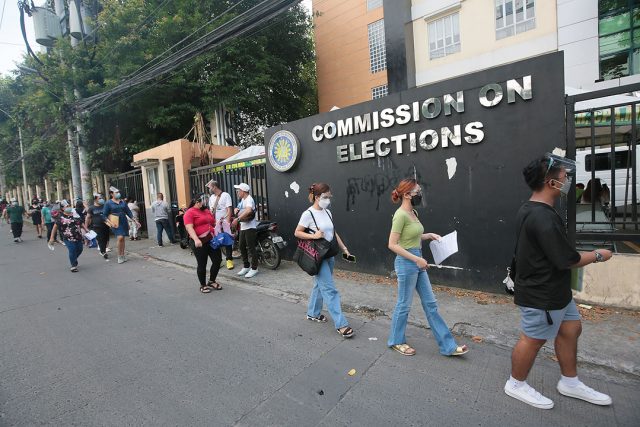
Comelec, CHED team up for voter education campaign for college  students

PHILIPPINE STAR/ MICHAEL VARCAS

THE COMMISSION on Elections (Comelec) and the Commission on Higher Education (CHED) signed an agreement on Thursday for a voter education campaign directed at students in colleges and universities nationwide.  

“We want those who have the right to vote, especially our youth and higher education students, to be empowered by giving them proper information and the benefits of voting,” CHED Executive Director Cinderella Filipina S. Benitez-Jaro said during the signing ceremony at the Comelec office in Manila.   

“Especially in this age of social media, now that we have plenty of information, we have to make sure that we have the correct information.”  

Data from Comelec show that about 52% of the 67.4 million registered voters for the May 9 national and local elections are under the youth category or those aged 18-40.  

She noted that CHED had already implemented similar voter education programs before the agreement with Comelec.  

The campaign will offer non-partisan forums and activities at universities across the country to give accurate information on candidates and a voter’s rights, according to Ms. Jaro.  

She stressed that the activities are designed not to influence students on voting for specific candidates, but providing a venue that will help them make informed choices.   

“What is important is that voters should understand the election processes so they can vote intelligently and efficiently,” Comelec Executive Director Bartolome J. Sinocruz, Jr. said at the ceremony.  

He added that the two agencies aim to increase voter turnout, especially among higher education students. John Victor D. Ordoñez 

Death toll from 1st storm now over 200; agri, infra damage hits over P4B 

BUREAU OF FIRE PROTECTION-REGION 8

THE NUMBER of reported deaths due to tropical storm Agaton, with international name Megi, has reached 224 as of April 21, up from 175 a day before, according to the national disaster management agency.  

Missing persons have also increased to 147 from 110 previously, more than a week after the first storm to hit the Philippines this year triggered landslides and flooding mostly in the Visayas, the central islands of the archipelago.    

The province of Leyte in Eastern Visayas had the most number of casualties at 201 deaths and more than 100 missing, based on the National Disaster Risk Reduction and Management Councils (NDRRMC) latest tally.   

Two massive landslides occurred in Baybay City and Abuyog town, both in Leyte.   

NDRRMC said more than two million people were affected by storm Agaton, which brought several days of moderate but incessant rains starting April 9.   

The council issued a call for volunteers on Thursday to help in preparing family food packs for distribution to those affected. Almost 176,000 people were still displaced, with more than half staying across 447 evacuation centers.   

We are in need of volunteers who will help in the repacking and other logistics activities for the ongoing Typhoon #AgatonPH operations,NDRRMC said in an announcement posted on its social media pages.   

Individuals or groups can help with the operations at the DWSD-National Resources center along Chapel Road in Pasay City.   

DAMAGE
Meanwhile, agricultural damage from storm Agaton has climbed to P2.8 billion, according to the Department of Agriculture (DA).  

Damage and losses have been reported in the regions of Bicol, Western Visayas, Eastern Visayas, Zamboanga Peninsula, Davao, Soccsksargen and Caraga, affecting 64,525 farmers and fishers. 

Volume of production loss stood at 89,093 metric tons (MT) across 31,645 hectares of agricultural areas.  

Rice was the most affected crop with estimated volume loss at 73,484 MT valued at P1.3 billion.  

This was followed by fisheries at P782.1 million, high-value crops at P296.7 million, corn at P53.6 million, and livestock and poultry at P40.9 million. 

The DA said it will be providing P715.47 million of readily-available assistance to affected farmers and fisherfolk.   

This includes P500 million worth of Quick Response Fund for the rehabilitation of affected areas and P100 million under the Survival and Recovery Assistance Program of the Agricultural Credit Policy Council for Western Visayas.  

It will also allocate P80.16 million worth of rice seeds, P24.33 million worth of corn seeds, P10.85 million in assorted vegetables; and animal stocks, drugs and biologics for livestock and poultry.  

Available funds from Philippine Crop Insurance Corporation will also be provided to indemnify affected farmers.  

In infrastructure, partial cost of damage was estimated at P1.45 billion as of Wednesday, according to the Department of Public Works and Highways (DPWH), consisting mainly of roads and bridges.   

In Eastern Visayas alone, damage to national roads and bridges was estimated at P1.30 billion.  

Most of the affected roads have been fully cleared or reopened with limited access, except for three road sections in Leyte and Southern Leyte that are still closed.  

DPWH Secretary Roger G. Mercado said the remaining impassable roads severely affected by landslides are targeted for reopening before the end of April.Marifi S. Jara and Luisa Maria Jacinta C. Jocson 

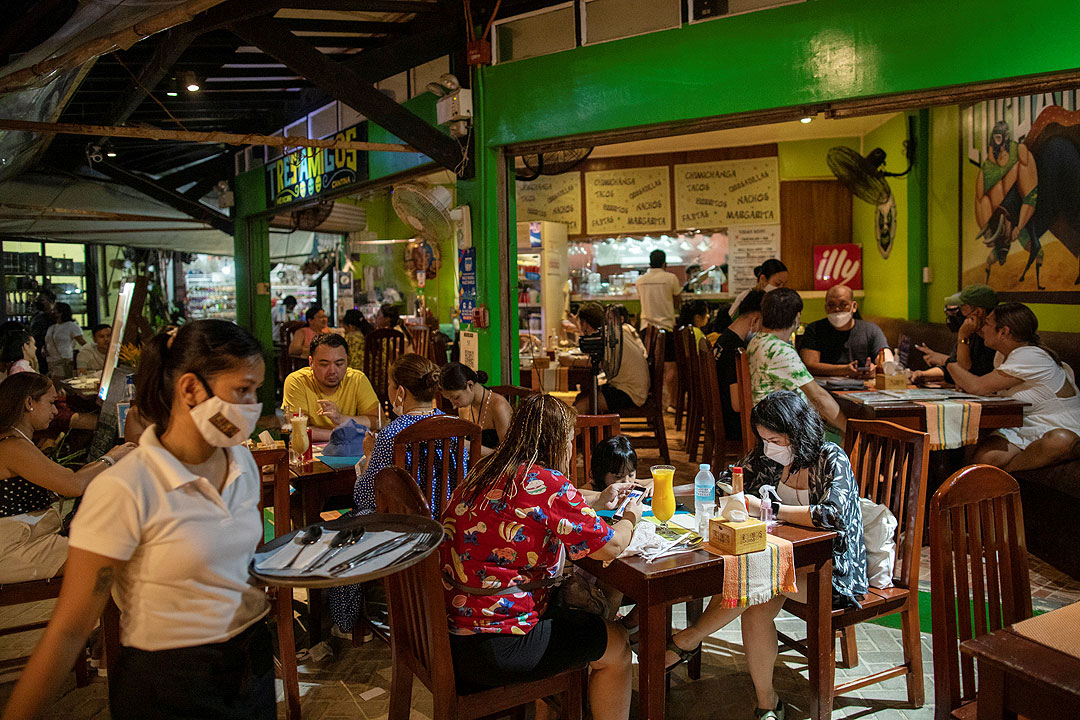
DILG warns local governments over failure to control Boracay tourist volume 

REUTERS
PEOPLE dine at a restaurant in Boracay Island in this photo taken on Nov. 30, 2021. — REUTERS

THE DEPARTMENT of the Interior and Local Government (DILG) on Thursday warned local governments with authority over Boracay to ensure the enforcement of the capacity limit set for the popular tourist destination.   

In a statement on Thursday, DILG said local officials could be issued show cause orders due to negligence following documented violations of the island’s visitor threshold during the Holy Week break.  

“We will not think twice to issue a show cause order to the officials of the local government units who disregard the policies of the island of Boracay,” Interior Secretary Eduardo M. Año said in Filipino.  

“We cannot go back to square one especially now that we are still in the middle of a pandemic,he said.   

Boracay Island is under the jurisdiction of the municipal government of Malay, which is within Aklan province.   

Based on the Malay tourism offices current guidelines, visitors to Boracay must pre-register online through the touristboracay.com site, which is controlled by the Aklan provincial government.   

The pre-registration serves as a health declaration form for contact tracing as well as for Malays tourism statistical reporting.   

A daily visitor limit of 19,215 has been set for the island.  

The Malay tourism office reported 95,646 tourist arrivals from April 1 to 16, which means a daily average of almost 6,000.   

However, tourist arrivals for April 14-15 or Maundy Thursday and Good Friday which are declared national holidays reached 21,252 and 22,519, respectively, according to Tourism Secretary Bernadette Romulo-Puyat in a letter to Mr. Año. 

The DILG chief said failing to comply with the daily threshold not only poses public health risks but also cause environmental threats that compromise the government’s progress in rehabilitating the island.   

Boracay was totally closed to tourists in 2018, following an order from President Rodrigo R. Duterte, for an overhaul of waste management systems and land use on the island. An inter-agency team was established for the rehabilitation program.    

The provincial government of Aklan as well as its governor could not be immediately reached for comment.   

“We must draw the line to ensure that our policies are being complied with on the ground,” Mr. Año said. John Victor D. Ordoñez 

Lacson promises no discrimination vs vaccine skeptics under his administration

PRESIDENTIAL aspirant Senator Panfilo “Ping” M. Lacson, Sr. on Thursday promised that vaccine skeptics will not be discriminated against under his administration.  

He maintained his position that receiving vaccination against coronavirus disease 2019 (COVID-19) will be voluntary in consideration of human rights and individual freedom.  

It cannot be forced (on people). It is our individual choice, individual right, if we will get it or not,he said.   

However, the senator also stressed the need to consider the welfare of those around so-called anti-vaxxers due to the risk of infection.  

He also said that while vaccinations will not be mandatory under his leadership, he remains in favor of incentive-based programs to encourage people to get vaccinated.  

He plans more accessible, efficient, and inclusive vaccination drives.  

Mr. Lacson further said he has plans to ensure the nations transition from a coronavirus pandemic to treating the disease as endemic while proactively preparing for future public health threats.  

“The medium and long term (plan) includes investing in research and development because we keep relying on importations,he told reporters at a press conference on Thursday.  

He said the Philippines needs to stop its over-reliance on imports and instead tap the capability of local entrepreneurs in supplying necessities, including health supplies.  

The senator also noted a bill he previously filed establishing the Virology Science and Technology Institute of the Philippines. He plans to prioritize this if he wins as the countrys chief executive. Alyssa Nicole O. Tan

Department of miseducation

BW FILE PHOTO

The bias in some Department of Education (DepEd) teaching materials against Vice-President Leni Robredo was obvious and bad enough. But even worse are their errors — the word “government” was for example misspelled in the offending texts — and their misleading and releasing these among the populace of ill-trained and uninformed future citizens incapable of wisely exercising their rights and discharging their duties, such as electing the right leaders of this rumored democracy.

Whether old (print, broadcasting, film) or new (online news sites, blogs, etc.), as purveyors of information the media can shackle the mind or free it, and deter change or accelerate it. So can the educational system provide the knowledge and understanding that can liberate men and women from ignorance — or keep them in its depths by miseducating them.

For the most part, however, both primarily function as among the means through which the State persuades and convinces the citizenry that things should remain the way they have always been. Some teachers and media practitioners are advocates of change, whether cultural, political, economic, or social. But they are the exceptions rather than the rule — deviations from the “normal” almost immediately provoke State intervention.

The Philippine experience is illustrative of how the power elite has repeatedly tried, and mostly succeeded, in controlling the narratives of the media and the educational system on what happened in the past and what is happening in the present of these troubled isles.

The political economy of the dominant media — their being commercial enterprises in the hands of economic interests whose protection and advancement depends on government goodwill — has led to institutional and practitioner self-censorship, among other consequences. Although privately owned, some media organizations are besieged by such other problems as government threats and harassment, which prevent them from fully discharging the ethical and professional responsibilities of truth-telling.

Control over the educational system is, on the other hand, at least partly assured by its being an instrumentality of the Executive Branch of government through DepEd and the Commission on Higher Education (CHED). But that control has not been absolute.

For example, although a State institution, the University of the Philippines (UP) has a number of times been in the crosshairs of State intervention for some of its constituents’ criticism of government, its officials, and its policies.

It was accused of promoting “godlessness” and “subversion” in the late 1950s. A number of its professors were brought before the House of Representatives Committee on Anti-Filipino Activities (CAFA) and interrogated for publishing a document in one of its research journals on how the tenancy system was driving the peasantry to rebellion. Martial law shut it down for weeks. Its staff, students, and faculty were already under surveillance prior to its declaration, and some were arrested and detained indefinitely once martial rule was implemented. It has more recently been tagged a “recruitment center” of the Communist Party of the Philippines (CPP) and the New People’s Army (NPA), apparently for some of its professors’ encouraging, and some of its students’ internalizing, the imperative of learning as a lifelong commitment of the truly educated man and woman.

But that is only UP — and only some of its professors and students. As for the so-called State “universities” created by congressmen out of this or that fifth-rate school in their districts, few of their so-called professors, if any, are even aware of the responsibilities of teaching and learning, and are easily bullied by such pretenders to academic authority as police and military censors into purging their libraries and silencing themselves and their students.

Their reach, however, is fairly limited compared to that of basic education, which shapes the minds of the young at their most vulnerable and impressionable age. Indeed, it is in the primary and secondary schools under DepEd’s charge where much of the misinformation and disinformation that clutter the brains of millions of Filipinos is generated, shared, and distributed.

The quality of the products of any system is what best describes it, its capacities as well as its flaws. There are basic education graduates who have not even heard of Adolf Hitler, for example, despite that monster’s slaughter of more than six million Jews and other “undesirables” (no wonder his admirer Rodrigo Duterte thought the number to be three million); his having committed the worst crime in all of human history; and his starting a war that killed an additional 50 million people in Europe alone.

Here in the lair of the Philippines’ ruling dynasties, the domestic equivalent of European fascism is hardly studied. If the Marcos kleptocracy is at all mentioned in school, it is in glowing terms by clueless teachers who use the error-filled textbooks written by well-connected “authors” that they make their students read. That the Marcos dictatorship is being described as a “golden age” — the exact opposite of what it really was — could only have originated in this country’s primary and secondary level classrooms.

It explains why the 30- to 40-year-olds who constitute the bulk of the supporters of Ferdinand Marcos, Jr. and his family either have no inkling of what transpired during that dark and brutal period, or else romanticize it as a time of peace, justice, and prosperity — and who spread their sub-literate views through Instagram and Tiktok.

Among the consequences of mass ignorance of those dark periods in history is the failure to appreciate the value of human rights and to understand how barbaric dictatorships can be. To many Filipinos, despotism is either an abstraction that has nothing to do with human lives — or, worse, a benevolent and even necessary option in times of crisis.

As bad or even worse is the failure of the same system to even provide the literacy and numeracy skills individuals need. Every independent study on the capacities of Filipino primary and secondary students has in fact found abysmally low levels of reading and mathematical competence among them.

Those findings seriously question their capacity to meet the complex challenges posed by the problems of their own country or even to survive them. Many thus end up either as domestics at home or abroad, or as part of the vast legions of the unemployed and unemployable, while being among the most confident people in the world about their social media-based, fact-challenged opinions on public issues.

The historian Renato Constantino wrote lengthily in his pioneering work, The Miseducation of the Filipino, on how little Filipinos know about what happened in Philippine history, and how misleading a guide in navigating the turbulent waters of the Philippine crisis their limited knowledge of it has been. And yet, as he pointed out, education is crucial to the cultural renewal necessary for the realization of their aspirations for a just and reasonably prosperous society.

That was in the 1960s, but here we are, six decades later and already in the 21st century, with those hopes still unrealized. Certainly, one of the reasons for it is the failure of the so-called educational system to provide the knowledge that is among the most crucial factors in any society’s advancement and even survival.

That failure is a convincing argument in favor of giving the agency in charge of education in this part of the planet a name that more accurately describes what it has been doing. But that of course will never happen — not in this country where the words of government are too often part of the State apparatus of mass deception rather than of enlightenment.


Luis V. Teodoro is on Facebook and Twitter (@luisteodoro).

www.luisteodoro.com

Mainstreaming inflation and the Fund

TARTILLA-FREEPIK

Mainstreaming some economic ideas becomes easier when enough focus is dedicated to it during the Annual Meetings of the International Monetary Fund (IMF) and the World Bank Group. After years of absence, for instance, inflation took center stage again during this April’s hybrid Spring Meetings. Fund economists behind the World Economic Outlook (WEO) have started talking about it and raising the red flags to global growth because of price pressures building up both in the US and big markets, and in small developing and emerging markets.

For instance, the IMF’s Chief Economist Pierre-Olivier Gourinchas in his press briefing on the latest WEO last Tuesday argued that the world’s economic prospects have been severely undermined as inflation may prove to be more long lasting due to Russia’s invasion of Ukraine. This is enough for the Fund to downgrade its projection of global growth from January’s 4.4% to this month’s 3.6%.

All that the Fund is saying is that Ukraine is the wild card. The continued hostilities fuel the series of supply shocks that propagate spillovers to the global economy through commodity markets, trade and financial linkages. With reduced supplies from Russia and Ukraine, oil, gas, metals, wheat, and corn prices are bound to escalate and magnify price pressures on other commodities and services.

The timing of the war in Eastern Europe could not have been worse. The pandemic has hardly disappeared from the scene while supply-demand imbalances continue to rage, prompting monetary policy normalization. With supply bottlenecks already pushing inflation higher, the latest China lockdowns could add yet another supply shock.

The Fund therefore identified monetary tightening and financial market volatility as one of the principal forces shaping near-term global outlook namely, the Russia-Ukraine war, fiscal withdrawal, slowing growth in China, and the pandemic and vaccine access.

For these reasons, the Fund has declared that “inflation has become a clear and present danger for many countries.”

Gourinchas noted that inflation has reached its highest level in over 40 years in the United States and some European countries given their tightening labor markets. This is just the inflation level, but what should also worry us is its expected long duration.

The Fund correctly identified the risk of a possible de-anchoring of inflation expectations away from central bank inflation targets. Some central banks have actually begun tightening their monetary stance; others decided to wait for more signs of second-round effects. The problem with being patient nowadays is that price movements have been unprecedentedly sharp, especially for food and fuel. This could easily build up into social unrest and destabilization.

If this rising inflation is not arrested promptly, we might be seeing spillovers into the global financial markets, tightening of financial conditions, and ultimately, from the perspective of smaller economies, capital flight. We don’t have to complete the analytical loop but we can almost foresee what comes next in terms of currency depreciation, trade disruption, and still higher inflation, and then weaker growth.

Looking back, the concern about this rising inflation originated from former US Treasury Secretary Larry Summers in a Washington Post column in Feb. 2021. He questioned the enormous size of US President Joseph R. Biden’s $1.9-trillion pandemic response which passed through the US Congress. He predicted then: “There is a chance that macroeconomic stimulus on a scale closer to World War II levels than normal recession levels will set off inflationary pressures of a kind we have not seen in a generation.” US inflation then stood below 2%. In March this year, inflation averaged 8.54 %.

Today, people are disputing whether Summers’s analysis is consistent with what is unravelling. As John Cassidy in The New Yorker of April 8 clarified, while Summers stressed the expansionary role of Biden’s American Rescue Plan and the US Fed that seems to be behind the curve in raising its policy rate early enough, others put weight on the pandemic impact on global supply chains and the labor market. Following this argument, some wonder why some European economies that eschewed big pandemic packages are also going through inflation of historic proportions.

If this analysis is to be followed, we must be seeing a global phenomenon that is gaining momentum from factors other than pandemic-driven fiscal support. US economists’ assessment that does not derive from Summers’, points to the prolonged Delta and Omicron variants and their impact on supply chains and the labor market. Most importantly, US administration economists are questioning Summers’ statistics. They argued that the estimated output gap was much larger than what was assumed by the Congressional Budget Office and the actual amount of public spending stood so much less than what was assumed by the former US treasury secretary. Therefore, with a bigger output gap and lower actual public spending, the budget allocation should not be too inflationary.

But Summers was quick to point out that the US nominal GDP is double digit and with some capacity constraints, inflation could only be excessive. He also cited a study by the Federal Reserve Bank of San Francisco showing that with a large stimulus budget including for cash transfer, that could have contributed at least three percentage points to inflation by the fourth quarter of 2021. On the smaller size of actual public spending, Summers countered: “If the argument is that the money has not yet been spent, that makes the stimulus even more problematic because it’s going to be coming at a time when there is overheating.”

His central point is that demand has been high relative to potential supply. If the two cannot be balanced and inflation starts heating up, macroeconomic management must have failed.

For Summers, it is important that the US Fed bite the bullet and sharply increase its policy rate. He is for prompt monetary action against the threat of inflation. While some Democrats have observed Summers could be providing too much ammunition to the Republicans, he has this to say: “The benefits from the American Rescue Plan depend on a strong economy, which is threatened as overheating leads to declining real wages and, quite possibly, recession.”

Two other important points are prominent in the analysis of Summers. The enormous pandemic plan has crowded out desirable long-term investments in what the US calls “Build Back Better” Plan. In the Philippines, this could be a good return to a more efficient and effective execution of Public-Private Partnerships.

His other point is that inflation at all costs should be considered a grave threat to be managed well. Otherwise, even progressive politics could be at risk. Closer at home, international financial institutions like the IMF, World Bank, ADB, and the ASEAN +3 Monitoring and Research Office are all one in saying the Philippine economy could grow by about 6% in 2022 and pre-pandemic levels could be regained in a couple of years. Yet, monetary policy appears timid even as official forecasts already indicate elevated inflation for the rest of the year in excess of the target. Next year’s inflation is expected to start tapering. A preemptive, nominal adjustment could have a big meaningful guidance to the market that inflation is a concern and monetary policy remains cautiously pro-active to re-anchor inflation expectations close to the targets.

Back to the Fund.

In the April WEO, the Fund was unequivocal that inflation drivers could be diverse, and in many cases, beyond monetary control. But it has been observed that price pressures are increasingly becoming more broad-based. The impact of the Ukraine war could also vary across countries depending on their trade and financial linkages.

Like a referee, the Fund prescribes that whether inflation is driven by strong fiscal policy support, as Summers would put it, or motivated by fuel- and war-related commodity price pressures, the Fund believes that “tighter monetary policy will be appropriate to check the cycle of higher prices driving up wages and inflation expectations, and wages and inflation expectations driving up prices.”

By all means, we must avoid this cycle in the Philippines.


Diwa C. Guinigundo is the former deputy governor for the Monetary and Economics Sector, the Bangko Sentral ng Pilipinas (BSP). He served the BSP for 41 years. In 2001-2003, he was alternate executive director at the International Monetary Fund in Washington, DC. He is the senior pastor of the Fullness of Christ International Ministries in Mandaluyong.


Second wave of Russian oil shock is starting

DEPOSITPHOTOS/ NOFRET

The lights are dimming over the Russian oil industry — literally.

The Kremlin is doing its best to conceal the full impact of formal and informal energy sanctions after its invasion of Ukraine. But Moscow can’t hide from the satellites above Siberia that measure the amount of light its oilfields emit as unwanted gas is burned, or flared: The higher the production, the more flaring and the more light — and vice versa.

The flaring data, combined with anecdotal information from traders and leaks of official Russian statistics, suggest that eight weeks into the war, Moscow is finally succumbing to the impact of government-imposed penalties and companies’ self-sanctions. On average, Russian oil output is down 10% from its pre-war level.

More production losses are likely as Western refiners and traders walk away from Russia upon the expiry of supply contracts in coming weeks. The European Union (EU) is also considering baby steps to reduce its purchases of Russian oil, trying to find ways to sidestep German opposition to the measures. “We are currently developing smart mechanisms so that oil can also be included in the next sanctions package,” EU Commission President Ursula von der Leyen told the Bild am Sonntag.

For consumers — and central banks in inflation-fighting mode — declining Russian production signals the beginning of a second, and likely longer lasting, wave of oil price increases. For Vladimir Putin, the stakes are even higher: revenue from oil and gas sales has so far helped cushion the blow of international sanctions, stabilizing the ruble and financing his military machine. A lasting decline in production that outweighs any price increase would be a longer-term headwind for Russia’s economy on top of the direct costs of the war.

The first phase of the oil-price shock from Putin’s invasion was as intense as it was brief. Russian output proved more resilient than expected; China’s COVID lockdowns reduced demand, and the US and its allies released millions of barrels from their strategic petroleum reserves. Brent, the global oil benchmark, initially surged to $139.13 a barrel on March 7 in the first days of the Russian military campaign but retreated nearly 30% to a low of $97.57 a barrel by April 11.

The second phase is likely play out in slow motion over a longer period, risking more economic havoc. Brent crude has already climbed back to near $110 a barrel, and prices will probably rise gradually as the market absorbs the supply losses. Seasonal peak demand is still two-and-a-half months away, with the summer holiday period of the northern hemisphere, and retail gasoline prices are sure to climb.

Brent has averaged $99.20 a barrel so far this year. In 2008, when prices hit an all-time high, the average price year-to-date at this time of year was $98.40 a barrel. The only potential relief is bad economic news: a recession in the US and Europe is the clearest obstacle to $100-plus oil.

Russian oil production is likely to drop further in coming months, judging by statistics from OilX, a consultancy that uses imaging data from NASA satellites to measure flaring. It estimates that output fell earlier this month to a low of 9.76 million barrels a day. On average, Russia pumped about 10.2 million barrels a day in the first two weeks of April. While the losses appear to have stabilized in recent days, April represents a big drop from the 11.1 million of February, before the impact of the invasion of Ukraine, and the 11 million of March.

The behavior of the Russian oil companies themselves highlights the declining international demand for their product. State-controlled Rosneft PJSC is trying to sell millions of barrels of crude in Europe and Asia via tenders that close on Thursday. Typically, Rosneft sells via long-term deals with commodity traders like Vitol Group, Trafigura Group, and Glencore Plc. But Western traders face a deadline of May 15 from the EU that restricts their dealings with Rosneft and several other Russian companies to “essential” activity needed to supply the EU. What “essential” means is open to interpretation, and for now, many traders are simply reducing their dealings. The production losses so far in April continue and deepen in May, as many in the industry expect, the laws of supply and demand will take over. Oil markets are like the proverbial tanker: they take time to turn. But turning they are. And that means prices are heading higher, again.

BLOOMBERG OPINION