Home Blog Page 6500

Eala falls short in final qualifying round in Spain

ALEX EALA — BW FILE PHOTO

ALEX M. Eala missed a main draw berth in her first event this year after falling short in the final qualifying round of the W25 Manacor late on Tuesday night at the Rafael Nadal Academy (RNA) in Spain.

Buoyed by two straight wins, the 16-year-old Filipina prodigy could not sustain the momentum against a more seasoned opponent in Women’s Tennis Association (WTA) No. 375 Alice Rame of France en route to a sorry 6-2, 6-4 defeat.

Ms. Eala actually enjoyed a 3-0 cushion in the second set over the 24-year-old French for a chance at forging a decider but she faltered and surrendered six of the last seven games.

She previously trounced Slovenia’s Ella Hojnik, 6-1, 6-1 before overcoming Mia Chudejová of Slovakia with a 7-6, 6-3 victory to move a win away from entering the main competition of the $25,000 event.

Ms. Eala, the WTA No. 526 and world junior No. 8, also failed to maximize her homecourt advantage in RNA where she’s a scholar under the wings of Spanish legend (Rafa) Nadal.

Last year, the left-handed wunderkind captured her breakthrough professional title by ruling the W15 Manacor in the same venue.

Ms. Eala opted to skip the ongoing Australian Open, where she won the juniors doubles crown in 2020 with Indonesian pal Priska Madelyn Nugroho, to focus more in the women’s professional circuit. — John Bryan Ulanday

US examining Alibaba’s cloud unit for national security risks

WASHINGTON — The Biden administration is reviewing e-commerce giant Alibaba’s cloud business to determine whether it poses a risk to US national security, according to three people briefed on the matter, as the government ramps up scrutiny of Chinese technology companies’ dealings with US firms.

The focus of the probe is on how the company stores US clients’ data, including personal information and intellectual property, and whether the Chinese government could gain access to it, the people said. The potential for Beijing to disrupt access by US users to their information stored on Alibaba cloud is also a concern, one of the people said.

US regulators could ultimately choose to force the company to take measures to reduce the risks posed by the cloud business or prohibit Americans at home and abroad from using the service altogether. The US-listed shares of Alibaba fell nearly 3% before the market opened on Tuesday and were last trading down just over 1%.

Former President Donald J. Trump’s Commerce Department was concerned about Alibaba’s cloud business, but the Biden administration launched the formal review after he took office in January, according to one of the three people and a former Trump administration official.

Alibaba’s US cloud business is small, with annual revenue of less than an estimated $50 million, according to research firm Gartner, Inc. But if regulators ultimately decide to block transactions between American firms and Alibaba Cloud, it would damage the bottom line one of the company’s most promising businesses and deal a blow to reputation of the company as a whole.

A Commerce Department spokesperson said the agency does not comment on the “existence or nonexistence of transaction reviews.” The Chinese Embassy in Washington did not respond to a request for comment.

Alibaba declined to comment. It did flag similar concerns about operating in the US in its most recent annual report, saying US companies that have contracts with Alibaba “may be prohibited from continuing to do business with us, including performing their obligations under agreements involving our… cloud services.”

The probe into Alibaba’s cloud business is being led by a small office within the Commerce Department known as the Office of Intelligence and Security. It was created by the Trump administration to wield broad new powers to ban or restrict transactions between US firms and internet, telecom and tech companies from “foreign adversary” nations like China, Russia, Cuba, Iran, North Korea, and Venezuela.

The office has been particularly focused on Chinese cloud providers, one of the sources said, amid growing concern over the potential for data theft and access disruption by Beijing.

The Trump administration issued a warning in August, 2020 against Chinese cloud providers including Alibaba, “to prevent US citizens’ most sensitive personal information and our businesses’ most valuable intellectual property…from being stored and processed on cloud-based systems accessible to our foreign adversaries.”

Cloud servers are also seen as ripe for hackers to launch cyberattacks because they can conceal the origin of the attack and offer access to a vast array of client networks.

While there are scant public cases of the Chinese government compelling a tech company to turn over sensitive customer data, indictments of Chinese hackers reveal their use of cloud servers to gain access to private information.

For example, hackers connected to the Chinese Ministry of State Security penetrated HPE’s cloud computing service and used it as a launch pad to attack customers, plundering reams of corporate and government secrets for years in what US prosecutors say was an effort to boost Chinese economic interests.

‘PILLAR OF GROWTH’
Alibaba, the world’s fourth largest cloud provider according to research firm Canalys, has about 4 million customers and describes its cloud business as its “second pillar of growth.” It saw a 50% rise in revenue to $9.2 billion in 2020, though the division accounts for just 8% of overall sales.

It has boasted business relationships with units of top US companies including Ford Motor Co., IBM’s Red Hat, and Hewlett Packard Enterprise, according to press releases.

While the sweeping Trump era powers don’t cover foreign subsidiaries of US companies, US regulators have previously found ways to link them to their US parent companies, which can in turn be subject to restrictions.

Before tech tensions between the United States and China started to boil, Alibaba had big ambitions for its US cloud business. In 2015, it launched a cloud computing hub in Silicon Valley, its first outside of China, with plans to compete with Amazon.com, Inc., Microsoft Corp. and Alphabet Inc.’s Google. It later added additional data centers there and in Virginia.

A person familiar with the matter says the company scaled back its US gambit during Trump’s presidency as tensions with China escalated.

In 2018, US authorities blocked a bid by Alibaba affiliate Ant Financial, now Ant Group, to acquire US money transfer company MoneyGram International, Inc. over national security concerns. But a move to put Ant Group on a trade blacklist failed and an executive order banning its mobile payment app Alipay was revoked by President Joseph R. Biden, Jr.

Mr. Biden, like Trump, has placed more and more restrictions on Chinese companies. Last month, the US government put investment and export curbs on dozens of Chinese firms, including top drone maker DJI, accusing them of complicity in the oppression of China’s Uyghur minority or helping the military. — Reuters

PAL says US flights to proceed, 5G concerns ‘resolved’

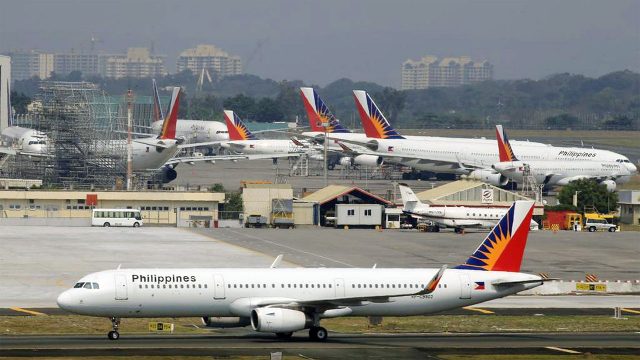
An airplane is seen on the runway at the Ninoy Aquino International Airport (NAIA) in Manila, March 14, 2016. — REUTERS/ROMEO RANOCO/FILE PHOTO

FLAG carrier Philippine Airlines, Inc. (PAL) on Wednesday said that it expects its flights to the United States to proceed as scheduled now that US authorities have “resolved” concerns about the impact of the fifth-generation (5G) service rollout on flight safety.

The airline said it was ready to cancel some flights to the US if there were still concerns about the effects of 5G on flight safety.

“The US Department of Transportation has assured the aviation community that aircraft landing in US airports will not encounter interference from 5G radio waves, now that telecommunications companies have agreed with the Biden Administration to revise the deployment of the upgraded technology around key airports throughout the US,” the flag carrier said in an e-mailed statement.

Major airlines in the US warned on Monday that a “catastrophic” aviation crisis could happen in less than 36 hours, when AT&T and Verizon were set to roll out new 5G service, Reuters reported.

PAL said that it would continue to monitor developments and make necessary adjustments “should there be changes that pose any impact on safety.”

“The safety of our passengers and crew is always our top priority,” said PAL Senior Vice-President for Operations Captain Stanley K. Ng.

“We welcome the intervention of the US Government and will continue to engage closely with the authorities, airports, aircraft makers and aviation safety professionals to ensure that every PAL flight is operated according to the highest safety standards,” he added.

PAL flies to Los Angeles, San Francisco, and New York on a regular basis.

“PAL flights to Honolulu and Guam, as well as routes to other overseas destinations in Asia, North America, Australia and the Middle East, are not affected by the 5G concerns that involved only specific airports in the US mainland,” the airline noted. — Arjay L. Balinbin

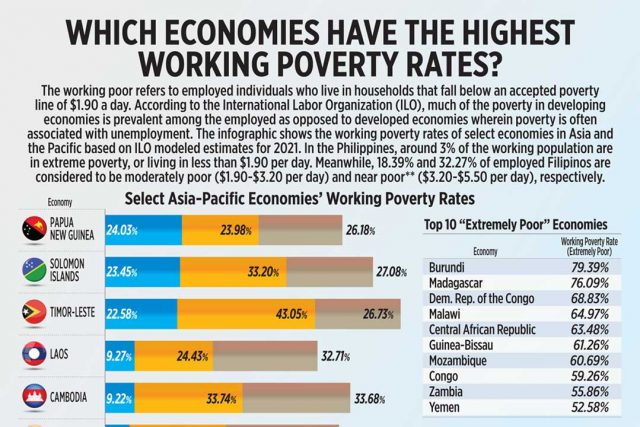
Which economies have the highest working poverty rates?

Which economies have the highest working poverty rates?

How PSEi member stocks performed — January 19, 2022

Here’s a quick glance at how PSEi stocks fared on Wednesday, January 19, 2022.


Duterte approves extra P1.185B for healthcare worker allowances

PHILSTAR

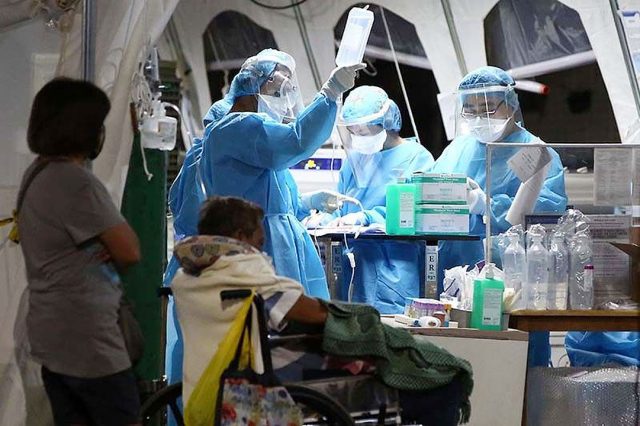
PRESIDENT Rodrigo R. Duterte has approved the release of P1.185 billion to cover the special risk allowance (SRA) of healthcare workers, his ally Senator Lawrence T. Go said on Wednesday.

The P1.185 billion was charged against the 2021 Contingent Fund and covers the SRAs of private healthcare workers and non-Department of Health plantilla personnel “who are directly catering to or in contact with COVID-19 patients,” Mr. Go said in a statement.

The Budget department recently released P8.189 billion to cover the SRAs of 497,043 health workers, Mr. Go said.

Health Assistant Secretary Maylene M. Beltran told a congressional inquiry on Tuesday that the government has released about P8 billion for the risk allowances of 496,314 medical frontliners for the period Dec. 20 to June 30.

“We have an additional request for SRA amounting to P3.3 billion and to cover the special risk allowance of around 185,000 HCWs,” she said.

Ms. Beltran, meanwhile, said at the same hearing that the government has released nearly P6.56 billion for the active hazard duty pay of health workers.

Health advocates have been urging the government to pay SRAs in light of the infections due to the highly infectious Omicron variant of the coronavirus. — Kyle Aristophere T. Atienza

Spot market trading resumes for Visayas grid except Bohol

PHILSTAR

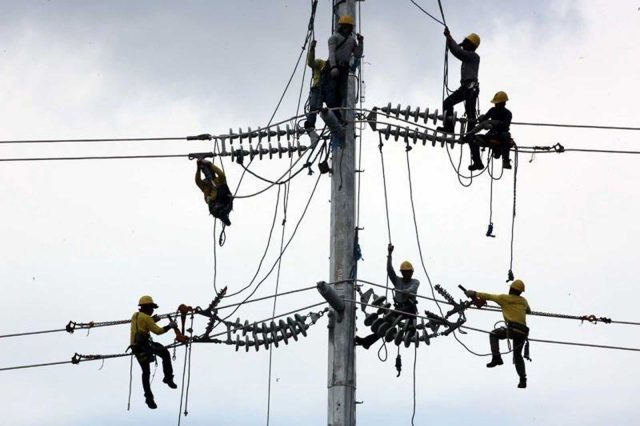
SPOT MARKET trading on the Visayas grid, with the exception of Bohol, resumed after the regulator deemed the region’s loading level sufficient to support a market. 

“The commission has ordered the Philippine Electricity Market Corporation–Market Operator (PEMC-MO) to resume the operations of the Wholesale Electricity Spot Market (WESM) in the Visayas Grid, excluding Bohol, effective Jan. 17,” the Energy Regulatory Commission (ERC) said in a statement on Wednesday.

The ERC had suspended spot market trading for the Visayas Grid on Dec. 16, due to oversupply conditions in the wake of Typhoon Odette.

The administered price of P5.27 per kilowatt hour was also in force during the suspended intervals.

“We have been closely monitoring and assessing the Visayas Grid condition and upon assessment of the information gathered from the constant coordination PEMC-MO and with the National Grid Corp. of the Philippines-Visayas System Operator, the Commission views that market operations in the Visayas Grid except Bohol are now ready to resume,” ERC Chairperson and Chief Executive Officer Agnes VST Devanadera said in a statement.

According to the grid operator, as of Jan. 16, Panay and Samar islands are drawing 100% of their power demand from the grid; Negros power loading is 95%, Leyte 89%, and Cebu 73%.

Bohol is drawing just 20% power from the grid.

“In addition to this, with the energization of the 138 KV Colon–Calung-calung Line 2 and the 138 KV Colon–Cebu Line 3, it has been assessed that market-based instructions in the area are implementable signaling the readiness to resume market operations in the Visayas excluding Bohol,” ERC said.

The commission also said Bohol might experience power generation deficits as power cannot be exported to the province from other regions. — Marielle C. Lucenio

Water treatment plants maxed out to boost supply to Marikina, Rizal

BW FILE PHOTO

MANILA WATER Company, Inc. said it is working with the Metropolitan Waterworks and Sewerage System (MWSS) and the National Water Resources Board to maximize the output of water treatment plants in Rizal and Marikina and tap deep wells to adequately service those areas.

Contingency plans include the maximized operations at the Cardona Water Treatment Plant, which draws water from Laguna de Bay, which has a capacity of 100 million liters per day (MLD), and the Marikina Portable Water Treatment Plant, which has a capacity of 20 MLD and draws water from the Marikina River.

It will also look into the operation of deep wells which can provide additional 115 MLD, Manila Water said in a statement.

“We continue to put our plans into motion to support MWSS’ call for continuous supply in our concession area given the current pandemic and as we head towards the summer season,” Manila Water President Jose Victor Emmanuel A. De Dios said.

Manila Water said these contingencies were also prepare for the low water levels being reported the past few weeks.

On Wednesday, the Angat Dam registered a level of 199.06 meters (m), which is 11.97 m lower than the year before. Ipo Dam and La Mesa Dam also registered levels of 98.67 m or 1.36 m lower and 79.15 m or 0.51 m lower, respectively.

Other initiatives include backwash recovery, treatment of wastewater byproduct, and water pressure management across the East Zone concession area.

Manila Water said that while supply augmentation measures are in place, it is still promoting the responsible use of water.

“While the government and the concessionaires work together to provide the needed water supply, the public is encouraged to use water wisely and responsibly to minimize water wastage,” the company said.

Manila Water said it will work with the MWSS for a future Calawis Antipolo Source System and East Bay Water Supply Project, which will source water from the eastern shore of Laguna de Bay.

It is also working on the construction of a new 15-kilometer (km) aqueduct and 6.4-km tunnel that will stream 1,600 MLD of water towards La Mesa Dam. — Luisa Maria Jacinta C. Jocson

House OK’s bill barring mining in Mindoro

NO TO MINING IN MINDORO FB PAGE

THE House of Representatives approved a bill on third reading on Monday which if signed into law will ban mining completely within Mindoro.

House Bill No. 10611, or the proposed Mindoro Island Mining-Free Zone Act, will be in force over Mindoro Occidental and Mindoro Oriental provinces.

According to the bill, all valid and existing mining contracts, permits, and licenses in the provinces will remain valid until expiration, with no renewals allowed.

Small-scale mining operators will be required to rehabilitate and reforest their concessions to preserve watersheds.

Quarries will be restricted to five hectares, with no more than one quarry permit allowed per person or corporation.

Violators could serve six to 12 years in prison plus a fine of up to P10 million.

On Dec. 24, the House approved the bill on second reading. The Philippine Mining Act of 1995 and the People’s Small-Scale Mining Act will not apply within Mindoro Island once the measure is enacted. — Luisa Maria Jacinta C. Jocson

Measure regulating worker rest hours filed in Senate

JCOMP-FREEPIK

A BILL was filed in the Senate regulating worker rest hours and deterring companies from compelling employees to perform additional tasks outside their formal work schedules.

“This bill defines the rest hours of employees, and prohibits employers from exacting work or contacting employees, without the latter’s consent, during rest hours,” according to the bill, proposed by Senator Francis N. Tolentino.

The bid to regulate work hours comes as work-from-home and telecommuting arrangements blur the lines between work and personal time.

Senate Bill 2475, or the proposed Workers’ Rest Law, sets normal hours of work at a maximum of eight hours a day, with those on compressed workweek arrangements capped at 12 hours a day.

The measure was meant to address the extra work being performed because “the power of control of employers now overreaches beyond working hours through the use of phone and e-mail.”

Any period beyond work hours will be considered rest hours, past which an employee may not be compelled to render overtime work without freely given written consent. Any prior waiver of the right to perform overtime work as a condition of hiring will be deemed void.

If passed, the measure provides for compensation of P1,000 for every hour of work rendered in violation of the rules.

If employees are limited, segregated, or classified in any way that would discriminate, deprive, or diminish their employment opportunities as a result of asserting their rights under the bill, the violator faces imprisonment of up to six months and a fine of at least P100,000.

The proposed law will apply to employees in all establishments, whether for profit or not, but not to field personnel, domestic helpers, personal service workers, and workers who are paid by results. — Alyssa Nicole O. Tan

Clarity on the taxation of educational institutions

Education is one of the most important pillars of any developing nation. No less than the 1987 Philippine Constitution itself mandates that the State prioritize education to foster patriotism and nationalism, accelerate social progress, and promote total human liberation and development. For almost two years now, we have been experiencing mobility restrictions with varying degrees of severity due to the COVID-19 pandemic. In responding to this situation, our educational systems have had to adapt, even as pilot testing for face-to-face classes in some localities had to be scrapped due to the sudden surge in COVID cases.

In recognition of their role in providing a public good, educational institutions are granted certain tax privileges under the Constitution and the Tax Code.

NONSTOCK NONPROFIT EDUCATIONAL INSTITUTIONS
Under Article XIV, Section 4 (3) of the Constitution, all revenue and assets of nonstock nonprofit educational institutions used actually, directly and exclusively for educational purposes are exempt from taxes and duties. As established clearly by jurisprudence (G.R. Nos. 196596, 198841, and 198941), the tax exemption of revenue and assets of nonstock nonprofit educational institutions hinges on whether these are used actually, directly and exclusively for educational purposes.

In one decision (G.R. No. 202792), the Supreme Court upheld such constitutional exemption in canceling the deficiency tax assessments of an educational institution, even if the latter belatedly paid the docket fees with the Court of Tax Appeals upon filing its judicial appeal. According to the high court, while procedural rules are important tools designed to facilitate the dispensation of justice, legal technicalities may be excused when strict adherence will impede the achievement of justice it seeks to serve.

PROPRIETARY EDUCATIONAL INSTITUTIONS
Educational institutions can also be organized as stock corporations, classified as proprietary educational institutions. In contrast with nonstock nonprofit educational institutions, proprietary educational institutions are not covered by the aforementioned broad tax exemptions on their revenue and assets as mandated by the Constitution. Nonetheless, the Constitution provides that they can be conferred tax privileges subject to limitations provided by law, including restrictions on dividends and provisions for reinvestment.

Such tax privileges are granted under Section 27(B) of the Tax Code, which provides for a special lower corporate income tax rate for proprietary educational institutions and hospitals alike. The lower rate is generally 10%, but pursuant to Republic Act No. 11534 (more commonly known as the CREATE Act), the rate is temporarily reduced to 1% effective July 1, 2020 until June 30, 2023 to provide relief for schools and hospitals that have been severely affected by the COVID pandemic.

However, in implementing the CREATE Act’s temporary tax relief, there was confusion as to what qualifies as a proprietary educational institution subject to the special tax rate under the Tax Code. In Revenue Regulations No. 5-2021, proprietary educational institutions were defined and qualified as referring to nonprofit private schools. This confusion apparently arose from the original wording in the Tax Code:

(B) Proprietary Educational Institutions and Hospitals. — Proprietary educational institutions and hospitals which are nonprofit shall pay a tax of ten percent (10%) on their taxable income . . .” (Underscore supplied.)

It seems that the nonprofit requirement for the special tax rate was interpreted to cover both proprietary educational institutions and hospitals. Such interpretation in the regulations created a seemingly absurd situation wherein the lower tax is conferred to an essentially non-existent category of schools. As previously mentioned, proprietary educational institutions include stock corporations that are, by their nature, organized as profit-oriented companies. A nonprofit proprietary educational institution could be considered an oxymoron or a contradiction of terms. Understandably, there was a clamor from the education sector to rectify the erroneous interpretation. Thus, Revenue Regulations No. 14-2021 were promulgated to suspend the implementation of the provisions on the “nonprofit” qualification of proprietary educational institutions.

TAX CODE AMENDMENT
Cognizant of the above controversy, our lawmakers recently passed Republic Act No. 11635, which sought to address the issue by clarifying the wording in the Tax Code itself. As amended by such law, Section 27(B) of the Tax Code now reads as follows:

(B) Proprietary Educational Institutions and Hospitals.Hospitals which are nonprofit and proprietary educational institutions shall pay a tax of ten percent (10%) on their taxable income . . .” (Underscore supplied.)

Thus, it is now clear that the nonprofit qualification only applies to hospitals and not to proprietary educational institutions. The latter refers to any private school maintained and administered by private individuals or groups with an issued permit to operate from the relevant government agencies (e.g., DepEd, CHED, TESDA). It is worth highlighting that, under the same Tax Code provision, to qualify for the lower rate, their gross income from unrelated trade, business, or other activity must not exceed 50% of their total gross income; otherwise, the regular corporate income tax rate (currently at 25%) applies to their entire taxable income.

More than ever, the COVID pandemic has pressed us — as individuals, as a community, and as a nation — to contemplate our priorities. While public health remains the highest priority, access to affordable education deserves equal attention. Through brilliant minds borne of education, many medical and technological breakthroughs in combating the COVID pandemic have been achieved, and countless lives are saved. This author personally hopes that the State continues to prioritize education following its constitutional mandate and enabling the education sector to contribute to nation-building through the development of future generations.

The views or opinions expressed in this article are solely those of the author and do not necessarily represent those of Isla Lipana & Co. The content is for general information purposes only, and should not be used as a substitute for specific advice.


Marion D. Castañeda is a senior manager at the Tax Services Department of Isla Lipana & Co., the Philippine member firm of the PwC network.

marion.castañeda@pwc.com

Philippines reports 492 more Omicron infections

PHILIPPINE STAR/ MICHAEL VARCAS

THE PHILIPPINES reported 492 more coronavirus infections involving the highly mutated Omicron variant, bringing the total to 535.

In a statement, the Department of Health (DoH) said 69% of 714 samples sequenced by the Philippine Genome Center on Jan. 13 to 14, tested positive for Omicron. It added that 332 of the patients were local, while 160 were returning migrant Filipinos.

The agency said 68% of the local cases were from Metro Manila, which has been struggling to contain a fresh surge in infections.

Seventy-six patients came from the Calabarzon region, 11 from Central Luzon, five from Central Visayas, two each from Cagayan Valley, Western Visayas, Davao region, Soccsksargen and the Cordillera Administrative Region, and one each from Ilocos, Mimaropa and the Bangsamoro Autonomous Region in Muslim Mindanao.

The Health department said three of the new Omicron cases were still active, two have died, and 467 patients have recovered. The agency said it was verifying 20 other cases.

Health Undersecretary Maria Rosario S. Vergeire on Tuesday said Omicron had become the predominant variant especially in the National Capital Region.

DoH on Wednesday posted 22,958 coronavirus infections, bringing the total to 3.29 million. The death toll increased by 82 to 53,044, while recoveries rose by 36,611 to 2.97 million, it said in a bulletin.

The agency said 43.5% of 62,531 samples on Jan. 17 tested positive for COVID-19, way above the 5% threshold set by the World Health Organization (WHO).

There were 270,728 active cases, 8,335 of which did not show symptoms, 257,632 were mild, 2,970 were moderate, 1,487 severe and 304 were critical.

DoH said 94% of the latest cases occurred on Jan. 6 to 19. The top regions with new cases in the past two weeks were Metro Manila with 7,861, Calabarzon with 4,647 and Central Luzon with 2,049 infections. It added that 68% of deaths occurred in January, 10% in October and 18% in September.

Eighty-seven duplicates had been removed from the tally, 64 of which were reclassified as recoveries, while 32 recoveries were relisted as deaths. Six laboratories failed to submit data on Jan. 17.

DoH also reported 115 more Delta infections, bringing the total to 8,612. Of these, 88 were local and 27 were returning migrant Filipinos. The variant first detected in India nearly exhausted the country’s health system last year.

Of the latest Delta cases, two were still active, two have died and 107 have recovered, the DoH said.

It added that the country now had 3,170 cases of the Alpha variant after a new case of the virus type first detected in the United Kingdom was also found among the samples.

DoH said 49% of intensive care unit beds in the country had been used, while the rate for Metro Manila was 53%.

Health Secretary Francisco T. Duque III on Tuesday said daily coronavirus infections were probably decreasing, but the country remained at critical risk from the virus.

Metro Manila, Ilocos, Cagayan Valley, the Cordillera Administrative Region, Central Luzon and Calabarzon were still under critical risk, he told a taped Cabinet meeting on Monday night.

The country had an average 314 cases from Dec. 21 to 27, spiked more than eight times with 2,592 cases from Dec. 28 to Jan. 3 and rose almost eight times with 20,462 cases the following week, Mr. Duque said.

The average daily cases rose by 71% from Jan. 11 to Jan. 17, he said, adding that infections have started to plateau.

Daily infections in the country have reached a record this month amid the spread of the heavily mutated Omicron variant.

Health Undersecretary Maria Rosario Vergeire on Tuesday said coronavirus infections in various regions have been increasing.

She also cited a steep increase in hospital admissions in Metro Manila in the past week, noting that 60% of hospital beds in the capital region were occupied.

Ms. Vergeire said it was too early to say that coronavirus infections in Metro Manila were decreasing. The Health department does not look at daily changes in COVID-19 data because it could be influenced by certain variables such as laboratory submissions, she told ABS-CBN TeleRadyo.

She said cases remained high. — Kyle Aristophere T. Atienza