Belonging to the advertising and communications industry that specializes in winning people’s hearts and minds, DDB Group Philippines has always seized opportunities to create positive impact on society through its work and its people.
For the upcoming May 9 elections, DDB Group came up with an “Election Day” information and advocacy campaign, which captures anew its commitment to help shape society by encouraging people to go out and vote.
This election, after all, is a rare opportunity to fully harness the power of democracy – that is, in choosing the leaders who will assume government positions – from the highest presidential post to that of a barangay councilor.
“Voting is the basic foundation of our democracy. It is a right that we Filipinos should not take for granted. It gives us the power to choose the kind of government, and yes, the kind of country we want to see in the near future,” said DDB Group Philippines Chairman and CEO Gil G. Chua.
Notably, to give the 65.7 million locally registered Filipino voters the chance to fully participate in the elections, Comelec has signed a resolution asking Malacañang to declare May 9 as a nationwide holiday.
“We encourage all registered voters within the DDB Group of companies to set aside their deadlines and job orders for the most important task on election day, that is, to cast their ballots. There is simply no reason not to go out there and vote. Every single vote matters!” said Chua.
Like their employees, DDB hopes that all Filipinos will prioritize voting on Monday as their participation in this election is the most valuable contribution they can give for the country’s future.
Spotlight is BusinessWorld’s sponsored section that allows advertisers to amplify their brand and connect with BusinessWorld’s audience by enabling them to publish their stories directly on the BusinessWorld Web site. For more information, send an email to online@bworldonline.com.
Israel shares best practices in cyber protection of the financial sector with the Bankers Association of the Philippines.
Israel shares best practices in cyber protection of the financial sector
The Embassy of Israel in Manila and the Israel Economic & Commercial Mission to the Philippines, in cooperation with the Bankers Association of the Philippines (BAP), hosted a virtual event last Feb. 16 focusing on cybersecurity entitled “Optimizing Cyber Protection of the Financial Sector: Best Practices from Israel.”
The program was divided into two parts: introducing the unique model of protecting financial institutions in Israel, and pitching of Israeli leading companies with innovative cybersecurity technologies and solutions for the financial sector.
Tomer Heyvi, economic counsellor and head of the Mission, shared that the purpose of this event is to share the Israeli expertise and technologies in the cybersecurity field in light of the growing challenges and threats that financial institutions around the world, including the Philippines, are facing these days.
In his opening remarks, Israeli Ambassador to the Philippines H.E. Ilan Fluss shared, “My vision for the future of relations between Israel and the Philippines is to see growth in cooperation in innovation and technologies especially in these critical and sensitive areas. Israel has proven itself as a reliable and solid partner of the Philippines, therefore, I believe we should see more partnerships in the cybersecurity area.”
In the first session of the program, Governor Benjamin E. Diokno of the Bangko Sentral ng Pilipinas shared his insights on Philippines Cybersecurity ecosystem and challenges in the financial sector.
In his speech, Governor Diokno mentioned some key areas for collaboration such as threat intelligence platform and setting up a national CERT, given the industry-wide initiatives in the Philippines and the maturity and sophistications of Israel in terms of cybersecurity controls and management.
“I hope this session will strengthen ties and cooperation between Israel and the Philippines so that our respective financial services sectors remain safe, innovative and resilient in the digital economy,” Mr. Diokno added.
Additionally, Jose Arnulfo A. Veloso, BAP president, highlighted in his remarks that cybersecurity remains to be a top priority of the association. He shared a number of advocacies of the BAP to promote and intensify its cybersecurity framework in the Philippine banking and financial services sector. “Together with the partnership of the guests in this forum, we can take them [cyberthreats] head on,” he noted.
Doron Liberman, director of International Cooperation Development in the Israel National Cyber Directorate (INCD), in his remarks shared the Israeli national approach and strategy to the cybersecurity ecosystem as a whole in the civilian sphere. “The INCD looks at its constituencies in different layers: critical infrastructure, sectoral and general public,” he said.
Mr. Liberman further shared that the INCD is a national agency that provides national intelligence and active defense tools and methodologies, and awareness events where their assistance is needed.
Rahav Shalom-Revivo, head of Financial-Cyber Innovation and International Engagements from the Israel Ministry of Finance, shared the multinational financial cyber simulation that the Ministry executed with countries that Israel has financial cyber relations with. In that simulation, she highlighted that international collaboration is key and that there must be synchronization between finance and cyber decision makers. She added, “The collaborative understanding that only together we can overcome such dramatic attacks that at some point in time will happen in the future.”
A study case highlighting the power of collaboration was shared by Eden Cohen, security head of Security Operation Center of Bank Hapoalim, the largest commercial bank in Israel. In her presentation, she shared that in the last three years, there has been a significant rise in organized cyber crimes towards financial organizations by new and advanced tactics to penetrate the digital world. With this, she highlighted that the best way to handle the new generation-attackers is by collaboration as a necessity to protect ourselves and our customers. She added that collaboration between people, businesses, technology, intelligence, and enforcements is a key factor to be able to face cyber-attacks in a quick and thorough way.
The discussion was followed by a pitching session of four companies offering cybersecurity technologies: Semperis: “Protecting your Active Directory, the keys to your Kingdom”; Trustpeers: “Turn Chaos into a Controlled Event with the TrustPeers Cyber Crisis Management SaaS platform”; Cybowall: “AI Powered Cybersecurity”; and CYE: “Continuous Cyber Risk Visibility — Cyber Risk Quantification — Cyber Exposure Optimization.”
Benjamin Castillo, managing director of the BAP, shared in his closing remarks that the power of collaboration is very important in cybersecurity. He mentioned continuing discussions with INCD and the Israel Ministry of Finance as the BAP continues to explore its options in building a national CERT.
Israel is one of the leaders in cybersecurity expertise around the globe, and it has about 40% of the global cybersecurity investments. Israeli’s cybersecurity industry continued to grow in 2021 with a record of USD 8.8 billion in investments in 131 funding rounds — this was tripled compared to 2020 at US$2.9 billion. Further, 33% of the Cybersecurity unicorns in the world are Israeli.
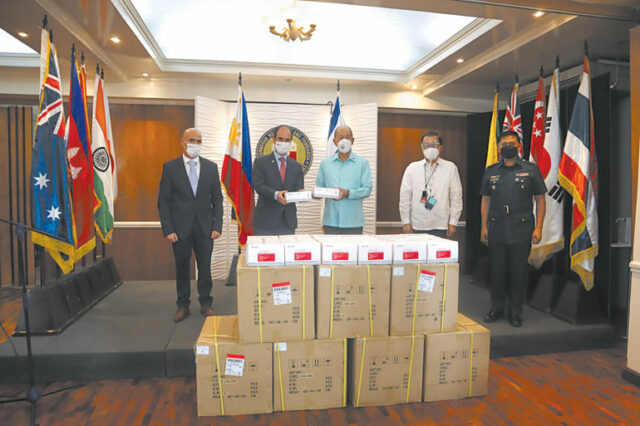
In photo (L-R): Israel’s Defense Attaché Raz Shabtay, Ambassador Ilan Fluss, Department of National Defense Secretary Delfin Lorenzana, Director Franklin Gali, and BGEN Edgar Cardiñoza
The Ministry of Defense of the State of Israel through the Israeli Embassy in Manila donated 16,000 units of antigen test kits to the Department of National Defense (DND) of the Philippines to help its fight against COVID-19.
Israeli diplomats Ambassador Ilan Fluss and Defense Attaché Raz Shabtay turned over the antigen test kits to Secretary of National Defense Delfin Lorenzana.
“Friends support each other in times of need. Israel is a friend of the Philippines and will continue to assist and share its expertise in various fields. I am proud to deliver this Israeli assistance today to support the Department of National Defense of the Philippines in keeping this country safe and secure,” Ambassador Fluss said.
“The relationship between Israel and the Philippines, particularly the relationship between both defense ministries, is never as strong as it is now,” Mr. Shabtay said. “We are delighted to be able to support once more, in the form of contributing 16,000 antigen test kits, to help the Defense Forces of the Philippines in fighting this current Global Pandemic,” he added.
Israel continues to assist the Philippines in combatting COVID-19. In 2021, the Israeli government turned over personal protective equipment to the Department of National Defense and the Philippine National Police, two Israeli delegations of medical experts assisted the country’s national vaccination campaign and shared Israel’s local clinical guidelines for COVID-19 infection control protocols and hospital management. Israel also continues to share its experience and knowledge in emergency and pandemic response with the Philippines through webinars, courses, and joint meetings.
The handover ceremony was held at the DND Headquarters in Quezon City on Feb. 9, 2022. In attendance were Asec. Jesus Rey Avilla, Usec. Ricardo Jalad, Director Franklin Gali, BGEN Edgar Cardiñoza, Usec. Raymundo de Vera Elefante, and staff members of the DND and the embassy.
Gasoline and diesel prices have continued to climb amid volatility in global oil markets. — PHILIPPINE STAR/ WALTER BOLLOZOS
By Keisha B. Ta-asan
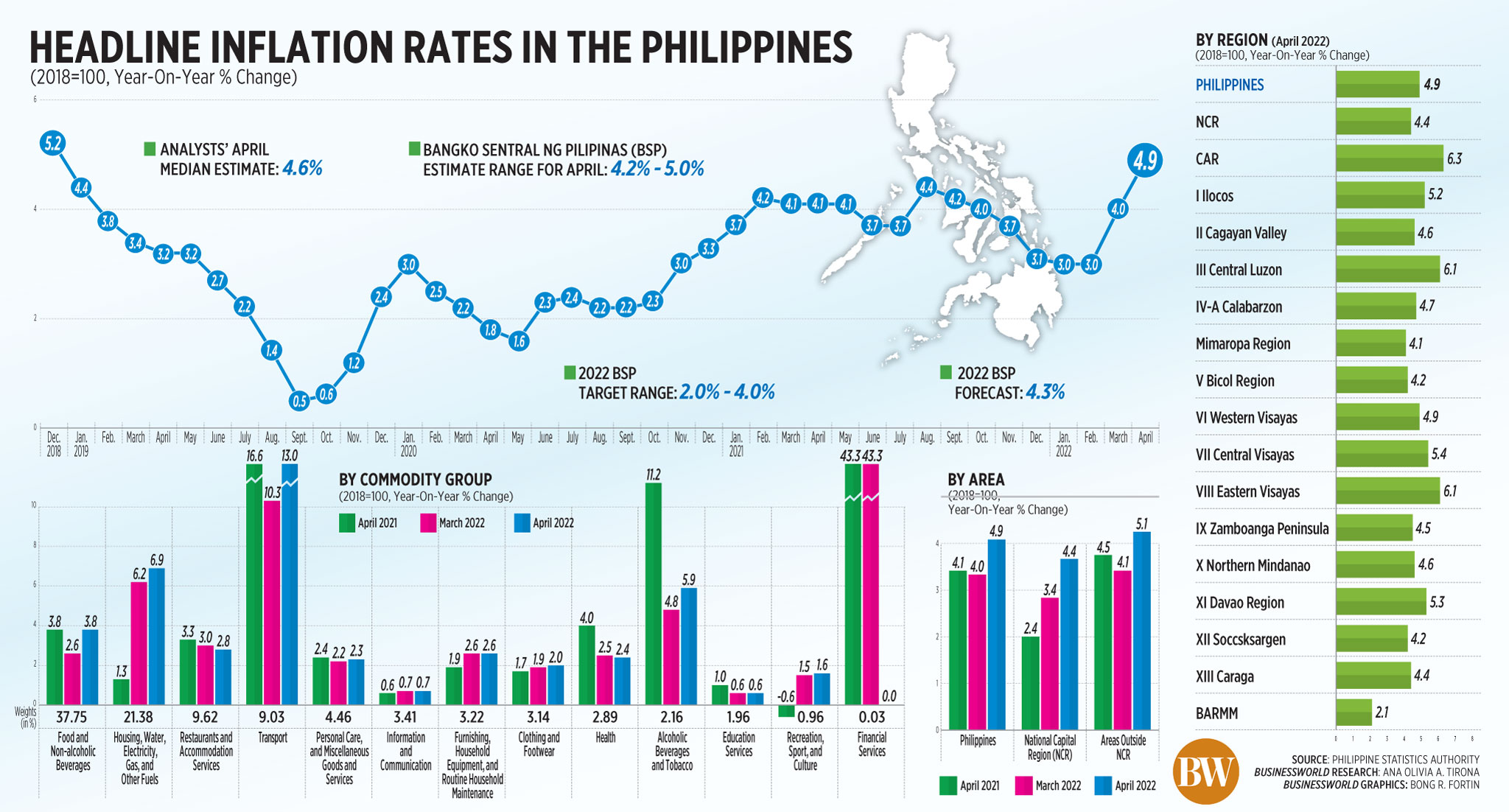
PHILIPPINE INFLATION surged to an annual 4.9% in April, the highest in more than three years as soaring food and energy prices continued to hurt consumers.
This could bolster the case for the Bangko Sentral ng Pilipinas (BSP) to tighten monetary policy earlier than expected.
Consumer prices rose to a 40-month high of 4.9% annually, from 4% in March and 4.1% in April a year ago, preliminary data from the Philippine Statistics Authority (PSA) showed.
It was the quickest pace since the 5.2% print in December 2018, and higher than the 4.6% median estimate in a BusinessWorld poll last week.
The headline figure also breached the central bank’s 2-4% target range for the year, and near the upper bound of its 4.2-5% forecast range for April.
The last time inflation went above the target was in September 2021 when it rose by 4.2%.
Month on month, inflation inched up by 0.8%. Stripping out the seasonality effects on prices, April’s inflation steadied at 1% month on month from March’s 1%.
Inflation averaged 3.7% in the four months to April, lower than 4.1% seen in the same period last year. However, it was still lower than the central bank’s 4.3% forecast for the year.
Prices of heavily weighted food and non-alcoholic beverages grew by 3.8% in April, accelerating from 2.6% in March. This matched the pace recorded in April 2021.
Housing, water, electricity, gas, and other fuels rose by 6.9% in April from 6.2% the prior month and higher than the 1.3% a year ago.
PSA data showed inflation in transport also picked up to 13% from 10.3% but eased from 16.6% last year.
The food-alone index also jumped by 4% in April from 2.8% the previous month. However, it slowed from 4.1% from a year ago.
Meanwhile, the April inflation rate for the bottom 30% of households, which still use the 2012-based prices, increased by 3.8% from 3.3% in March, but lower than the 4.9% in April 2021.
The PSA said the rebased 2018-based inflation for poor income households is scheduled to be released in December 2022.
“World commodity prices remain high as a consequence of the ongoing Russia-Ukraine war. The impact is felt domestically not just on food and basic goods but also on transport and utilities,” Socioeconomic Planning Secretary Karl Kendrick T. Chua said in a statement.
Global oil and commodity prices have become more volatile after Russia invaded Ukraine in late February.
As of April 26, prices of gasoline and diesel have increased by P18.45 and P31.45 per liter since the start of the year. This has prompted labor groups to file petitions for wage hikes, and transport groups to seek fare increases.
Meanwhile, the central bank said the domestic economic activity improved as restrictions eased but geopolitical tensions and emergence of new COVID-19 variants have clouded the outlook for global economic growth.
“Inflation will remain elevated over the near term due to the continued volatility in global oil and non-oil prices, reflecting largely the continued impact of the conflict in Ukraine on global commodities market,” BSP Governor Benjamin E. Diokno said in a Viber message to reporters.
Mr. Diokno said inflation could settle above the government’s target range this year before decelerating back to the target in 2023.
“While there are signs that inflation expectation is higher for 2022, it remains broadly anchored to the target in 2023,” he added.
University of Asia and the Pacific Senior Economist Cid L. Terosa, said the rising fuel and electricity prices exerted direct and indirect upward pressure on food prices.
“Also, the flurry of election-related activities added to the steep ascent of prices last month,” he said in an e-mail interview.
Bank of the Philippine Islands Lead Economist Emilio S. Neri, Jr. said in a press release that oil prices may continue to rise in the coming months if the European Union decides to implement an oil embargo against Russia.
Economists said the inflation target will be difficult to achieve this year coupled with a likely robust first-quarter gross domestic product (GDP) in the first quarter could prod the BSP to hike record-low key rates in the next coming months.
“We think that the government’s inflation target will be breached and that average 2022 inflation will settle at 4.7%,” UnionBank of the Philippines Chief Economist Ruben Carlo O. Asuncion said.
“My thinking is that a better-than-expected first-quarter 2022 GDP growth may merit a May hike. Nevertheless, the BSP may be willing to hold until June,” he said.
ING Bank N.V. Manila Branch Senior Economist Nicholas Antonio T. Mapa expects the central bank to raise the interest rates within the quarter as high inflation reading persists.
“However, with first-quarter GDP growth expected to be robust and confirming that growth momentum is intact, we expect BSP to finally move rates higher,” Mr. Mapa said.
“A GDP growth rate of over 6% on top of the above-target inflation rate should be enough to prod BSP to hike rates as early as the 19 May policy meeting,” he added.
Nomura maintained its average full-year inflation forecast at 4.6%, above the BSP’s 2-4% target.
“Our forecast pencils in a trajectory in which headline inflation rises further and averages above 5% over the next three months, still driven by similar factors (i.e., higher oil and food prices),” Nomura research analysts Euben Paracuelles and Rangga Cipta said in a note sent to reporters.
Asian Institute of Management economist John Paolo R. Rivera said combating high inflation can be addressed by appropriate fiscal and monetary policy.
“Together with the Monetary Board’s interpretation of Fed moves and possible actions, the Monetary Board will decide whether to raise monetary policy rates earlier than expected,” Mr. Terosa said via Viber.
The US Federal Reserve raised its key rates by 50 basis points to a range of 0.75% to 1% at the end of its May 3-4 meeting.
Last week, Mr. Diokno said the BSP was looking at raising interest rates two to three times to bring down inflation by next year, with the first hike to be considered in June.
The BSP has kept the key overnight reverse repurchase facility rate at a record low of 2% since November 2020 to help the economy weather the pandemic.
The PSA is scheduled to release the first-quarter GDP data on May 12, ahead of the Monetary Board meeting on May 19. — with inputs from Luz Wendy T. Noble and Reuters
Since 2020, the Philippines borrowed P1.3 trillion and received grants worth P2.7 billion to fund its pandemic response, including coronavirus vaccines. — PHILIPPINE STAR/ MICHAEL VARCAS
By Tobias Jared Tomas
THE NATIONAL GOVERNMENT’S (NG) outstanding debt rose to a record P12.68 trillion as of end-March, as domestic and offshore borrowings increased, the Bureau of the Treasury (BTr) said on Thursday.
Preliminary data from the BTr showed that outstanding debt jumped by 17.73% from P10.77 trillion a year ago, and by 4.8% from February.
In a statement, the BTr said the higher debt was “primarily due to the net issuance of government securities to both local and external lenders.”
Of the total, 70% of the debt portfolio were from domestic lenders, while the rest were from foreign sources.
Domestic debt stock stood at P8.87 trillion as of end-March, up by 14.5% year on year, and 5.4% month on month. The National Government raised P457.80 billion through the successful domestic retail Treasury bond (RTB) issuance and debt exchange during the month.
Of the total domestic debt stock, P8.57 trillion was from government securities, up by 18.9% year on year and by 5.6% month on month.
As of end-March, the outstanding domestic debt was 8.5% or P698.24 billion more than the end-December level.
Meanwhile, external debt grew by 25.8% year on year to P3.81 trillion as of end-March. It inched up by 3.6% from February.
The Treasury attributed the higher external debt to the net availment of external financing that reached P122.69 billion as of end-March. This included P117.33 billion ($2.25 billion) that was raised from the issuance of the triple tranche 5-year, 10.5-year and 25-year global bonds.
“Third-currency exchange rate fluctuation further lowered the peso value of external guarantees by P5.16 billion, offsetting the P2.31-billion effect of local currency depreciation against the (US dollar),” it said.
Rizal Commercial Banking Corp. Chief Economist Michael L. Ricafort said in a Viber message that the government issued RTBs and global bonds to raise funds for various projects ahead of the election ban on public works that began on March 25.
“[The] rising trend in interest rates, with long-term interest rates at new pre-pandemic highs recently could increase interest payments for new borrowings,” he said.
Mr. Ricafort noted the debt level may reach new record highs in the coming months as the government needs to borrow funds to address the widening budget deficit.
In April, the government raised $559 million from a Samurai bond issuance, and tapped a 30-billion yen ($230-million) loan from Japan.
ING Bank N.V. Manila Senior Economist Nicholas Antonio T. Mapa said in an e-mail that the country might be vulnerable to credit rating actions as the total debt hit roughly 60.6% of gross domestic product (GDP) as of end-March.
“Fitch had previously expressed some concern about the ability of the Philippines to substantially lower this ratio over time,” he added.
In 2021, the Philippines’ debt-to-GDP ratio hit a 16-year high of 60.5%. This is higher than the 60% threshold considered manageable by multilateral lenders for developing economies.
The high level of debt leaves the incoming administration with “very limited options,” Ateneo de Manila University Economics Professor Leonardo A. Lanzona said via Viber.
“Politicians who promise unrealistic programs such as lower rice prices should be avoided… The first item in the agenda of the next administration is to design an economic program that will produce enough growth to pay for our debt,” he said.
“This can mean even larger debt, but the program should be credible enough to assure the financial agencies that we can eventually pay our debts.”
For his part, Mr. Mapa said that the current administration inherited a fairly healthy fiscal position, a luxury the incoming president will not have.
The next president would have to be careful in their decisions in their first 100 days in office, as investors will be watching if fiscal consolidation is a top priority, he said.
“If spending and borrowing continue to bloat the debt levels in the near term, we believe the Philippines will receive a credit downgrade by the end of the year, forcing up our borrowing costs when the Philippines would need to source funding,” Mr. Mapa said.
Fitch Ratings earlier in February maintained the Philippines’ “BBB” credit rating, but with a “negative” outlook, meaning that Fitch could downgrade this rating within 12 to 18 months.
Meanwhile, Mr. Ricafort stressed the need for the next administration to sustain the economic and fiscal reform measures.
Last month, Finance Secretary Carlos G. Dominguez III said the economy needs to grow above 6% annually in the next five to six years to reduce debt.
“The next administration would have to design policies and stick to very strict fiscal discipline to grow out of this debt problem,” he said.
The national election will be held on May 9, with the new administration taking over in July.
Since 2020, the Philippines borrowed P1.3 trillion and received grants worth P2.7 billion to fund its pandemic response, including coronavirus vaccines.
The Department of Finance has said it would take 40 years to pay off these pandemic-related loans and grants.
US dollar banknotes are seen in this photo illustration taken Feb. 12, 2018. — REUTERS
By Luz Wendy T. Noble, Reporter
THE BANGKO Sentral ng Pilipinas (BSP) should be prepared to act as the US Federal Reserve is poised for more rate hikes this year and domestic inflation likely to remain elevated in the next few months.
The Fed’s 50-basis point hike rate that was paired with an eventual tapering of a $9-trillion asset portfolio reflects its “seriousness” in addressing the four-decade-high inflation in the United States, former BSP Deputy Governor Diwa C. Guinigundo said.
“For those investors and credit rating agencies monitoring interest rate differentials across countries, that US Fed move could encourage more capital flows to the US, away from some emerging markets with lower real interest rates,” Mr. Guinigundo said in a Viber message.
“While our local real interest rate is higher, other factors are also considered like growth prospects, currency movement and political prognosis,” he added.
Sophia Ng, an analyst at the Mitsubishi UFJ Bank Global Markets Research, also sees the possibility of capital flight, but says this could be more manageable for the Philippines.
“The saving grace for the Philippines in my view is the relatively low foreign participation in both equity and bond markets as compared to other emerging economies within Asia, which means that downward pressure on the peso from potential capital outflows is likely to be more modest than other AXJ (Asia except Japan) currencies that are more sensitive to portfolio outflows,” Ms. Ng said in an e-mail.
With central banks now also having to confront the inflation risks caused by the Russia-Ukraine war, the timing of when to start policy tightening has become more crucial, experts said.
“I don’t want to preempt future BSP moves but those decisive actions by the US Fed should make all other central banks think of the timing issue,” Mr. Guinigundo said.
“A slight, symbolic move can assure the market that monetary policy is aware of the situation and it is doing something about it,” he added.
Bank of the Philippine Islands Lead Economist Emilio S. Neri, Jr. said the latest Fed pronouncements strengthens the case for the BSP to stand ready given the Fed “appears to still be far behind the curve” in terms of policy tightening to battle inflation.
Mr. Neri said central banks, including the Fed, that initially deemed inflation risks to be “transitory” last year may now have to hike aggressively for the next six to 18 months due to rising import bill for oil, rising commodity prices.
“BSP may need to deliver a preemptive action, like an inter-meeting rate hike to avoid the consequences of getting more surprises from the US central bank,” Mr. Neri said in a Viber message.
He said an outflow of funds combined with faster inflation will affect the peso’s strength.
The local unit closed stronger by 11.5 centavos to P52.385 on Thursday from P52.50 on Wednesday, based on Bankers Association of the Philippines data. However, the pesoweakened by 2.7% from its end-2020 finish of P50.999.
The Fed’s tightening comes at a time of faster inflation in the Philippines, which should urge the central bank to prepare a monetary policy response, Security Bank Corp. Chief Economist Robert Dan J. Roces said.
Headline inflation quickened to a three-year high of 4.9% in April, as food, utility and transport costs continued to rise.
“With local inflation well-above target and poised to remain so, the buildup in price pressures will need a preemptive check from the monetary authorities,” Mr. Roces said in a Viber message.
He expects the BSP to start increasing rates by around 25 bps in the second quarter, followed by three more 25-bp increases in the third and fourth quarter of 2022.
The BSP expects inflation to surpass the 2-4% target at 4.3% for 2022.
The Monetary Board has kept its key rate at a record low of 2% since November 2020 to support theeconomy’s recovery.
BSP Governor Benjamin E. Diokno last month said they may consider a rate hike by June, when more data on economic growth and employment will be available to prove that recovery is more entrenched.
The Monetary Board will have its next policy review on May 19.
THE PHILIPPINE Economic Zone Authority (PEZA) reported a 68% decline in approved investments in the first quarter of 2022, as the Russia-Ukraine war hurt global economic prospects.
PEZA Director-General Charito B. Plaza said at a press conference on Thursday that the agency approved P8.141 billion in new investments during the first quarter, lower than the P25.382 billion during the same period in 2021.
“These (investments) came from 29 new and expansion projects with projected annual export sales of $232.454 million and expected job generation of 3,168 direct employment,” Ms. Plaza said.
She attributed the decline in approved investments to the Russia-Ukraine war, the ongoing pandemic and uncertainty ahead of the May 9 polls.
“Usually during election period, the investors would wait what is going to be the result of the election because they already anticipated that there will surely be new policies, laws, and rules that will be adopted by the new administration,” Ms. Plaza said.
The PEZA chief said more new investments are expected to come in after the May 9 polls.
“We expect that after the election, these investments will bounce back,” Ms. Plaza said.
In April, PEZA raised its investment approvals target for 2022 to 7-8% growth, from its original 6% goal.
Meanwhile, Ms. Plaza urged the next administration to immediately address the issue surrounding the work-from-home arrangement (WFH) for locators within PEZA’s economic zones, especially for registered information technology business process outsourcing (IT-BPO) firms and registered business enterprises (RBEs).
“We hope that the new administration will address this (WFH issue) immediately, so we can put a stop to the worries (and) the frustrations. Let us not make it a big issue because this is the appeal of the workers, not only the locators. In addition, the government is still earning despite the WFH arrangement,” Ms. Plaza said.
“Actually, the RBEs are frustrated with the Philippine government due to being unstable. We are not yet off the pandemic, (and) the effects of the Ukraine war. So let us be sensitive. Let us ask the new administration to address this immediately,” she added.
Currently, PEZA is allowing registered firms to conduct a 70% on-site and 30% WFH arrangement.
Ms. Plaza said that PEZA has currently issued 444 letters of authority (LOA) to registered IT-BPOs and RBEs that cannot immediately return to the office on April 1.
Under Fiscal Incentives Review Board (FIRB) Resolution 19-21, registered IT-BPM companies can implement a WFH arrangement for up to 90% of their workforce while still enjoying tax incentives as a result of the pandemic. The resolution expired on April 1, and employees were directed to return to the office.
FIRB also previously denied PEZA’s request to extend the WFH arrangement, citing the country’s improving vaccination rate.
Further, Ms. Plaza said the suggestion of the Department of Trade and Industry (DTI) that IT-BPO firms instead register with the Board of Investments (BoI) is “unfair” to PEZA.
“Asking the IT-BPOs to transfer to BoI, I think that is unfair because under Republic Act No. 11534 or the Corporate Recovery and Tax Incentives for Enterprises Act, we now have similar incentives,” she said. — R.M.D. Ochave
LOS ANGELES — Walt Disney Co.’s Marvel Studios takes a turn into horror territory in a new Doctor Strange movie that begins its global rollout in theaters on Wednesday.
Benedict Cumberbatch stars in Doctor Strange and the Multiverse of Madness, a follow-up to a 2016 film that introduced the neurosurgeon-turned-sorcerer to the big screen.
“I would definitely say it’s the darkest and scariest that this lot (Marvel) have made,” Mr. Cumberbatch said of the new film.
The movie sees Doctor Stephen Strange, played by Mr. Cumberbatch, traveling into the multiverse, a realm of infinite parallel universes that each operate in a different reality.
The multiverse allows for “possibilities and combinations of characters in new ways, alternative versions of characters that we know and it’s really opening the door for, I hope, a whole other series of Marvel films,” director Sam Raimi said.
In the film, Strange comes to the aid of America Chavez (Xochitl Gomez) who is being pursued for her ability to cross the multiverse. Elizabeth Olsen’s Wanda, with her own mystical powers, also appears.
The fact that Wanda and Doctor Strange use magic made the characters a good fit for venturing into horror, Mr. Raimi said.
“It has elements of the spooky and sometimes the fun and scary, but it never really intends to rock the audience to their core,” Mr. Raimi said. “It’s not really trying to terrify the audience.”
The movie has sparked objections in some parts of the Middle East, according to media reports.
An official in Saudi Arabia told The Guardian newspaper that Disney was asked to remove a brief clip that makes “LGBTQ references.” In the clip, Chavez refers to having two moms.
Disney declined to cut same-sex references in the film, and it will not be released in Saudi Arabia or a handful of other Middle Eastern countries, a source familiar with the matter said. A representative for Saudi Arabia’s government did not respond to a request for comment.
Mr.Cumberbatch said it was “disappointing” to hear the scene had caused a backlash.
“It’s just mind-boggling that we’re still talking about it, but here we are and I hope somehow fans of the film in Saudi Arabia of every sexuality are able to see it at some point somehow,” he said. — Reuters
A PUBLICITY photo of Dave Chappelle for the comedy show Dave Chappelle and Friends, part of the ongoing Netflix is a Joke festival. — PHOTO FROM NETFLIXISAJOKEFEST.COM
LOS ANGELES — The man accused of tackling comedian Dave Chappelle to the stage floor during a performance at the Hollywood Bowl in Los Angeles was charged on Wednesday with felony assault with a deadly weapon.
The attack on Mr. Chappelle, 48, occurred Tuesday night during a sold-out appearance by the Emmy-winning entertainer as part of an 11-day Netflix is a Jokefestival, featuring many of the leading names in stand-up comedy.
A Los Angeles Police Department spokesperson said the suspect had in his possession a replica handgun containing a knife blade when he attacked Mr. Chappelle.
A short time after the assault, Mr. Chappelle was joined onstage by fellow comic Chris Rock, who took the microphone and quipped, “Was that Will Smith?” — a reference to his own experience of being slapped by the Hollywood star during the live Oscars telecast on March 27.
Mr. Chappelle appeared to emerge unscathed from Tuesday’s attack and went on with the show, ad-libbing jokes about the incident and about what happened to the suspect, who was seen being chased down onstage by security personnel.
Mr. Chappelle said it was fortunate his assailant was “clumsy,” adding, “He’s back there getting stomped,” according to video footage of the altercation posted online by the celebrity news website TMZ.com.
Photos of the suspect seated on an ambulance gurney afterward showed his face visibly bruised and his right arm apparently dislocated or broken.
Police later identified him as 23-year-old Isaiah Lee, who was being held in jail on a $30,000 bond after being charged.
No court hearing was immediately scheduled for Mr. Lee, according to online jail records.
FOLLOWS ‘CANCEL CULTURE’ CONTROVERSY There was no word from authorities about a motive for the attack, which according to The Los Angeles Times unfolded after a routine in which Mr. Chappelle, attired in a business suit, talked about comedians worrying more about personal safety these days and introduced his own security guard on stage.
Mr. Chappelle drew a backlash last year for material presented in his Netflix comedy special The Closer that some in the LGBTQ community branded as ridicule of transgender people. Supporters of the comedian viewed the material in question as a cry against “cancel culture.”
The comedian himself alluded to the controversy from the stage shortly after he was tackled on Tuesday, quipping, “It was a trans man,” eliciting laughter from the crowd.
The assault occurred as the comedian, headlining a multi-act show billed as Dave Chappelle and Friends, was acknowledging a producer who was working at the show’s DJ booth.
Video of the incident shows the suspect charging onto the stage, apparently from the audience, and launching his upper body into Mr. Chappelle, slamming his shoulder into the comedian’s ribs and chest.
Both men fell to the floor before scrambling back to their feet, and the suspect darted away, chased briefly by Mr. Chappelle at first. He dodged a swarm of people for several seconds before they tackled him near the back of the stage.
The incident sparked immediate comparisons to the Oscar-night clash between Mr. Smith and Mr. Rock, an unprecedented incident at the globally televised event that prompted concerns that other performers might face copycat assaults.
“As unfortunate and unsettling as the incident was, Mr. Chappelle went on with the show,” his spokesperson, Carla Sims, said in a statement on Wednesday, crediting Mr. Rock and fellow comedian-actor Jamie Foxx with helping to “calm the crowd.”
Following the attack, she said Mr. Chappelle introduced the final act of the show, the hip-hop musical duo Black Star. Other comedians on the bill included Earthquake, Leslie Jones, Jeff Ross, Sebastian, Jon Stewart, and Michelle Wolf.
Mr. Chappelle was “fully cooperating with the active police investigation of this incident,” Ms. Sims said.
A representative for the Hollywood Bowl, one of the most famous entertainment venues in Los Angeles, told Reuters the incident was under investigation, declining to comment further. — Reuters
NOW that the world is opening up after two years of restrictions and lockdowns due to the coronavirus pandemic, Resorts World Manila (RWM) has brought back live entertainment. This even though there were worries about changing pandemic statuses and whether the audience was willing to come back.
“When the lockdowns first started, live entertainment was one of the first to go. It took almost two years before restrictions were first eased enough to allow shows with live audiences, so we eagerly grabbed the opportunity to stage our first concert late last year,” a Resorts World Manila representative wrote in an e-mail to BusinessWorld.
After a 20-month hiatus, in December last year Resorts World Manila’s (RWM) Full House Theater Company staged Ang Muling El Bimbo: AHEB Homecoming Concert, a concert featuring the songs of the successful original musical Ang Huling El Bimbo performed by the show’s cast.
“Looking back, it may not have made financial sense at the time, given the 50% capacity limit, but we went ahead anyway,” the RWM representative said, citing that “it was not about business then” but about the “support for Filipino performing artists and the people who make live entertainment possible.”
With the shift to the least restrictive COVID Alert Level 1 in March 2021, the Newport Performing Arts Theater (NPAT) has staged a series of live concerts: Gigi De Lana’s Domination on March 5, Shanti Dope and Gloc-9’s RAPsody on April 2, and the Basil Valdez and Jamie Rivera concert Love and Light on April 30.
Up next is Jon Santos’ comedy show LivesScreaming on May 14.
“When we first announced Gigi De Lana’s concert, the venue capacity was capped at 50%. But by the time of her actual concert, restrictions were further eased, and we were able to entertain audiences at full capacity,” the RWM representative said.
Despite the recent ease in pandemic restrictions, there was hesitation about going full swing with live events.
“We had no way of gauging an audience’s willingness to return to the theater and watch performances when they have been doing it online for the past two years,” the RWM representative said.
Aside from physical exposure of the public, the financial exposure for the company was also considered.“Breakeven points for each show vary because the basis is always total production cost,” the RWM representative said.
REFURBISHING There have been a number of changes in the NPAT now that it has reopened. For one thing, its seating capacity has been increased to 1,710 from 1,500 before the pandemic. NPAT’s air filtration system has also been upgraded.
The entire Newport Mallis also going through a metamorphosis. RWM’s Newport Grand Wing recently officially opened Hotel Okura Manila with its Grand Atrium. The Newport Garden Wing has been renovated to be better aligned with the garden theme.
“Our entertainment calendar is also filled with world-class performances from both local and international acts. Our stages are set from the Newport Grand Wing’s The Grand Bar and Lounge to the Newport Garden Wing’s Bar 360 and El Calle Food & Music Hall, and the Newport Performing Arts Theater,” the RWM representative said.— Michelle Anne P. Soliman
AFTER seven successful seasons in the Philippines, business reality TV show The Final Pitch is expanding to the rest of the region via The Final Pitch ASEAN (TFPA) which will feature high-growth startups and strategic investors from Southeast Asia. The show is now searching for business leaders to represent select Southeast Asian countries as investor-judges in the show.
They are looking for investor-judges from Singapore, the Philippines, Malaysia, Indonesia, Thailand, and Vietnam who can make investments in startups that want to scale up and expand to their home countries.
“They have to be in a position to be able to invest in high-growth companies but at the same time will serve as strategic partners for the expansion of any scale-up that wants to enter their respective countries. They have to be successful diversified family conglomerates or seasoned investors looking at investing in mostly series A and up startups,” The Final Pitch creator and host John Aguilar said in a statement.
Apart from gaining access to a pipeline of some of the best startups across the region, the investor-judges will also have the opportunity to showcase their countries and respective businesses through the show.
The show will start selecting investor-judge candidates from each country within the next two months through a regional roadshow. To be considered as a TFPA investor-judge, interested parties may e-mail admin@dragonsnest.co or contact the show at 0917-656-9215.
Mr. Aguilar stated that the ASEAN version will follow the same format as the Philippine edition.
“The world is looking at Southeast Asia as an emerging tech region. There are so many challenges here but there are also many opportunities. And there are a growing number of future unicorns that are being born as we speak. We are looking at expediting their exponential growth across Southeast Asia with TFPA,” Mr. Aguilar said.
The show is scheduled to start filming in the fourth quarter of 2022. Apart from the investor-judges and the companies presenting themselves to them, The Final Pitch ASEAN is also looking for brand and broadcast partners in the aforementioned countries.
Mr. Aguilar hopes to bring the show’s format to the region as a stepping stone in a long-term goal to license the show across these different countries. — MAPS
PLDT, Inc. revised its capital expenditure (capex) guidance for the year to P85 billion from P76-80 billion to support the company’s updated requirements for home broadband and data center businesses.
The capex will also support “upgrades of the towers and their passive infrastructure assets,” PLDT Chief Finance Officer Anabelle L. Chua said during a press briefing on Thursday.
The company saw its first-quarter attributable net income increase by 56% to P9.1 billion from P5.8 billion in the same period a year ago.
Telco core income, excluding the impact of asset sales and Voyager Innovations, increased by 9% to P8.2 billion from the same period in 2021.
Consolidated service revenues grew by 3% to P46.4 billion during the period.
The company said data and broadband, which grew by 8% to P36.6 billion, contributed 79% to its total service revenues.
Earnings before interest, taxes, depreciation, and amortization (EBITDA) improved by 10% to P25.5 billion.
“EBITDA margin was at 53% in the first quarter of 2022, from 51% in the previous year. Normalized for the impact of Typhoon Odette, EBITDA for the first quarter of 2022 would have been higher by 12% year on year to P26.1 billion,” PLDT noted.
PLDT and Smart President and Chief Executive Officer Alfredo S. Panlilio said the company is moving in lockstep with its customers’ shifting needs as the pandemic-related restrictions ease.
“Our superior, reliable integrated network continues to sustain hybrid work and learning setups, keep loved ones connected online, deliver entertainment content, as well as support businesses and e-commerce.”
Meanwhile, PLDT’s consolidated net debt reached $4.42 billion in the first quarter, while net-debt-to-EBITDA stood at 2.33x.
Gross debt was at $4.997 billion, “with maturities well spread out,” the company noted.
“Only 16% of gross debt are denominated in US dollars and 4% are unhedged,” it noted, adding that it maintained its credit ratings from Moody’s and S&P Global at investment grade.”
According to Mr. Panlilio, the growth in service revenues “will be underpinned by our continued rollout of fiber ports and LTE/5G, our data center expansion, and our commitment to delivering the best customer experience.”
PLDT Chairman Manuel V. Pangilinan said the company must “stay the course in order to generate greater free cash flow from higher revenues, cost optimization and the sale of our towers — the last of which could enhance income this year and in succeeding years.”
“Further, all of these should enable us to deleverage, reducing net debt to EBITDA back to 2.0x — enabling us to pay special dividends, and fortify PLDT’s balance sheet,” he added.
PLDT shares closed 2.28% higher at P1,932 apiece on Thursday.