Home Blog Page 6305

De Lima asks DoJ to ‘dig deeper’ in their review of her drug cases 

PHILIPPINE STAR/ GEREMY PINTOLO

DETAINED Senator Leila M. de Lima on Monday asked the Department of Justice (DoJ) to dig deeperin their review of her drug cases, after four witnesses retracted their allegations relating to her supposed crime. 

In assessing or re-assessing the rest of the evidence against me, the SoJ (Secretary of Justice) or DoJ must go beyond a superficial review of the cold statements or affidavits of the witnesses and inquire into the very circumstances by which these were extracted,the senator, one of the staunchest critics of outgoing President Rodrigo R. Duterte, said in a statement.  

Justice Secretary Menardo I. Guevarra, a Duterte appointee, at the weekend said the review would only take a few days.  

The prosecution needs to reassess the strength of its overall evidence in the light of the retractions of certain witnesses,he said. If the prosecution believes that such recantations do not affect its case, then the prosecution will maintain its course.”  

Ms. De Lima said DoJ should ensure no injustice is done to anyone.” 

The drug charges against Ms. De Lima started after she led a Senate investigation of Mr. Dutertes war on drugs that has killed thousands.  

In her previous post as head of the Commission on Human Rights, she also probed the assassination of suspected drug pushers by the so-called Davao Death Squad, allegedly upon the orders of Mr. Duterte when he was still the city mayor.  

In her five years in detention, Ms. De Lima has repeatedly asserted her innocence, saying she was being prosecuted for criticizing Mr. Dutertes drug war. Alyssa Nicole O. Tan 

Residents continue to evacuate as Mt. Bulusan remains restive 

RESIDENTS of Barangay Puting Sapa in Juban, Sorsogon are assisted by members of the Philippine Coast Guard as they move to the town’s evacuation center amid continued threat from Mt. Bulusan, which erupted on Sunday morning and spewed ash that covered several surrounding towns. — PHILIPPINE COAST GUARD

EVACUATION continued on Monday for over 8,000 residents in a town affected by ashfall from Mt. Bulusans eruption on Sunday, according to emergency response agencies.   

At least 75 families composed of 278 individuals have been moved to the evacuation center in Juban town as of Monday noon, according to the Department of Social Welfare and Development Bicol Region office.  

A total of 1,850 families or over 9,250 individuals have been affected, it said.   

No house was reported to have been damaged but local authorities warned against the health threat from ash.   

The Sorsogon provincial government said police and firefighters have completed clearing operations along the main highway and were assisting residents wash out ash from their properties.   

The mountain volcano in Sorsogon province, located about 565 kilometers southeast of the capital Manila, erupted Sunday morning and spewed ash. Sundays eruption was recorded at 10:37 a.m. and lasted for about 17 minutes.      

The Philippine Institute of Volcanology and Seismology (Phivolcs) recorded 29 volcanic eruptions in the 24-hour period from 5 a.m. Sunday, according to the agencys bulletin as of Monday morning.   

An alert level 1, which means a low-level unrest, remains in place.  

Phivolcs Director Renato U. Solidum, Jr. said another phreatic or steam-driven explosionat Mt. Bulusan is still possible in the coming days or weeks.   

In past eruptions, sometimes the interval between eruptions was days, weeks, sometimes months,he said in Filipino during Mondays Laging Handa briefing.   

The volcanos edifice was still inflated and sudden steam-driven or phreatic eruptions may occur, according to Phivolcs.  

Meanwhile, the Civil Aviation Authority of the Philippines (CAAP) said no damage was reported in the seven airports it operates in Bicol Region, including the new Bicol International Airport in Daraga, Albay.   

The six other airports are in Bulan, Sorsogon, Daet, Masbate, Naga, and Virac.  

“We remain vigilant and alert for the volcano’s next activities,CAAP Area V Manager Cynthia Tumanut said in a statement.As of now, our airports have been safe from the wrath of Mt. Bulusan’s eruption. Operations in our airports with commercial flights have remained unhampered as well,she said. MSJ 

Italy, Philippines to explore infra cooperation 

ITALY will explore potential cooperation in infrastructure with the Philippines, the camp of President-elect Ferdinand R. Marcos, Jr. said following a courtesy call on Monday by the formers top envoy.     

Italian Ambassador Marco Clemente and Mr. Marcos talked about possible cooperation in infra projectsduring their meeting, incoming press secretary Trixie Cruz-Angeles told a news briefing.   

[They] also talked about COVID-19 (coronavirus disease 2019) and cooperation on learning about COVID-19 responses and opening up the economy,she added. 

Mr. Clemente, the fourth European diplomat to pay a courtesy call on Mr. Marcos, also committed to bring the Inter Milan Football Club in the Philippines through intercampus projects to benefit children in need and to promote football locally,Ms. Angeles said.   

On the political aspect, the ambassador noted that this is the 75th year of Italian-Philippine relations,Ms. Angeles said, noting that the two officials tackled the diplomatic relations between the two countries. Kyle Aristophere T. Atienza 

Poe urges LTFRB to hasten action vs ride-hailing priority booking fees  

A SENATOR on Monday called on the Land Transportation Franchising and Regulatory Board (LTFRB) to act fast against ride-hailing companies that implement a priority booking fee scheme, an illegal practice. 

Our people deserve equal access to public transportation services without discrimination,Senator Mary Grace S. Poe-Llamanzares, who chairs the Senate Public Services Committee, said in a statement.  

She said the LTFRB must stand its ground against any illegal priority booking fee that can unduly select a passenger who can pay extra over another.”  

LTFRB Executive Director Maria Kristina E. Cassion last week said they are already evaluating the sanctions that could be imposed against JoyRide Ecommerce Technologies Corp. (JoyRide), which was reported to be imposing extra fees for priority booking through their app.    

We expect the agency to expeditiously address all challenges to ensure that no such mechanism can victimize our hapless commuters,the senator said.  

JoyRide has explained that the priority charge is an optional feethat customers can pay.  

It is an industry practice in case a customer would like to tip or incentivize a driver-partner in advance,JoyRide Senior Vice-President for Corporate Affairs Jose Emmanuel M. Eala had said, assuring that they are compliant with the fare structure set by the LTFRB guidelines.Alyssa Nicole O. Tan 

Pharmally case closed?

On Feb. 1, Senator Richard Gordon, chairman of the Senate Blue Ribbon Committee, released the 113-page draft report on the months-long investigation into the government’s use of pandemic funds and its transactions with Pharmally Pharmaceutical. The report recommended the filing of plunder, graft, and other criminal charges against Health Secretary Francisco Duque, former Budget Undersecretary Christopher Lao, Overall Deputy Ombudsman Rex Warren Liong, Chinese businessman Michael Yang, and Pharmally executives.

The report also said that at some point after his term of office, charges must be considered against Pres. Duterte because he “betrayed the public trust” when he appointed Yang as his economic adviser and allowed him to help Pharmally, a newly created undercapitalized firm, bag a P10-billion contract with the government. The report further said Duterte betrayed public trust when he sought to discredit not just the Senate but also the Commission on Audit whose state auditors first reported on the anomalies in the Pharmally deals.

The report required the signatures of at least 11 of the 20 members of the endorsing committee to be accepted as an official committee report before it could be submitted for plenary deliberation. But as of June 3, only eight senators other than Gordon had signed the report. They were Senate President Pro-Tempore Ralph Recto, Senate Minority Leader Frank Drilon, Senators Leila de Lima, Risa Hontiveros, Ping Lacson, Manny Pacquiao, Kiko Pangilinan, and Koko Pimentel.

The other members of the Senate Blue Ribbon Committee who did not affix their signature were Senate Majority Leader Migz Zubiri, Senators Sonny Angara, Pia Cayetano, Sherwin Gatchalian, Bong Go, Lito Lapid, Imee Marcos, Grace Poe, Bong Revilla, Francis Tolentino, and Cynthia Villar.

Zubiri and Gatchalian said they would have signed the report if it did not include the name of President Duterte. But the report did not accuse the President of plunder, graft, or any criminal charge. What it said was charges must be considered against him because he “betrayed the public trust.”

De Lima expressed disappointment at the failure of the Blue Ribbon Committee to get the required 11 signatures on the report. She said, “To let these people get away with plunder and corruption smacks of gross dereliction of duty on the part of the Senate. The report would now have to be archived, as if no anomaly happened.” She considers it tantamount to letting culpable parties go scot-free.

Considering that all the 18 hearings of the committee were televised, exposing to the public the apparent anomalous transactions of Pharmally and the obvious attempts of the President to disrupt the investigation and to shield certain officials from being interrogated, a senator not signing the report can be taken to mean he or she would dismiss the Blue Ribbon Committee’s report of massive graft and corruption in order not to alienate the President.

Hontiveros, who was re-elected to the Senate, said she was open to sponsoring a resolution calling for an inquiry into the Pharmally controversy. She is hopeful of getting the support of President Duterte’s allies in the Senate and those incoming senators who ran under the Marcos-Duterte ticket. I think it is wishful thinking on her part. Allies of President Duterte rarely attended the hearings on the Pharmally case.

Of those who signed the report, only Hontiveros and Pimentel will still be in the Senate. Of the seven other signatories, two ran for re-election to the Senate and four for higher office. All lost. One ran for a seat in the Lower House and another decided to retire. Four of their replacements — Robin Padilla, Loren Legarda, Mark Villar, and Jinggoy Estrada ran under the Marcos-Duterte banner.

Senate President Tito Sotto in his valedictory address had the gall to appeal to the incoming Senate to “Maintain the integrity and independence of the Senate” when he himself kowtowed to President Duterte’s directives and policies.

His subservience to the President was markedly manifested in 2019. When Chinese fishermen were seen catching fish in Philippine waters, President Duterte remarked that Chinese fishermen can fish in the West Philippine Sea. Sotto echoed the President’s deferential statement. In true Iskul Bukul fashion, Sotto said “It’s very difficult to say that there is exclusivity if it is underwater. The fish could be coming from China.”

Some people point out that charges against the Pharmally executives need not be filed by the Senate. The Secretary of Justice has the discretion to investigate through the National Bureau of Investigation (NBI), a government agency directly under him, even without a complaint. In fact, the Secretary has used that power for much lower thresholds before. The last time NBI investigated motu proprio (on its own) was to hunt down peddlers of the fake “no vaccine, no aid” rumors. But the attitude of Secretary Menardo Guevara with regard to Pharmally had been passive. He is perceived as compliant to the directives of the President.

Prior to his government stint, Guevarra was in private litigation practice. He was also a member of the faculty of the Ateneo Law School, teaching a broad range of subjects. Most of the past secretaries of Justice had a similar background — long years of private law practice and teaching Law in the most prestigious schools of Law.

The incoming Secretary of Justice is of a different mold. Jesus Crispin Remulla, better known as Boying Remulla, comes from a political dynasty. He is one of the sons of Johnny Remulla, who was governor of the Province of Cavite for 14 years. Boying himself has been governor of Cavite and representative of the 3rd and 7th districts of the province.

He was one of the most vocal congressmen opposed to the renewal of the franchise of ABS-CBN. He and 69 other congressmen accused the broadcast network of tax avoidance and of selling shares through depository receipts to foreigners, a violation of the Constitutional provision that prohibits aliens from owning Philippine mass media. But political pundits say they were just following the promptings of President Duterte who had an axe to grind against the broadcast network. It was as if they said, “Thy will be done, Mr. President.” In short, Boying Remulla is a traditional politician, a “trapo” in the language of the street.

While President-elect Ferdinand Marcos, Jr. had said his administration will run after corrupt officials, he was quick to stress that his administration will not focus on investigating corruption issues from previous administrations. “Let’s forget about the past. It was not under my watch,” he quipped. Will Justice Secretary Remulla say “As you wish, Mr. President”?

So, the final resolution of the Pharmally case depends on whether Justice Secretary Jesus Crispin Remulla acts as a traditional politician or as a man of the law.


Oscar P. Lagman, Jr. is a retired corporate executive, business consultant, and management professor. He has been a politicized citizen since his college days in the late 1950s.

Tolerating graft and corrupt practices

FREEPIK

Under Section 168 of the Revised Corporation Code (RCC), a director, trustee, or officer shall be punished with a fine ranging from P500,000 to P1 million, who knowingly:

a.) Fails to sanction, report, or file the appropriate action with the proper agencies; or,

b.) Allows or tolerates the graft and corrupt practices or fraudulent acts committed by a corporation’s directors, trustees, officers, or employees.

Section 168 properly limits its application only to directors, trustees, or officers liable for the offense defined therein. There is therefore no legal basis to hold employees and consultants of the corporation liable for participating in the offense defined therein.

In consonance with principles of corporate governance, Section 168 sends a clear message that it is not enough for directors, trustees, and officers to not directly engage in fraudulent acts or graft and corrupt practices, but they are obliged, under pain of criminal penalty, to not tolerate it or turn a blind eye when such acts are committed by their colleagues in the name of the corporation, and even go to the extent of reporting the same to the proper authorities.

THE ‘PREJUDICIAL QUESTION’ RELATING TO SECTION 167
Section 168 of the RCC, as it seeks to penalize directors, trustees, or officers criminally liable for their acts of tolerance, should be treated as the counterpart to Sections 165 to 167 that penalize directly the corporation as the medium by which fraudulent acts are committed, and graft and corrupt practices perpetrated.

Consequently, the allegedly “tolerating” directors, trustees, or officers cannot be convicted under Section 167 unless and until there has been a formal conviction of the corporation under Sections 165, 166, or 167.

RETALIATION AGAINST WHISTLEBLOWERS
Section 169 of the RCC defines a “whistleblower” as “any person who provides truthful information relating to the commission or possible commission of any offense or violation under the” RCC.

Under Section 169 of the RCC, any person who, knowingly and with intent to retaliate, commits acts detrimental to a whistleblower, such as interfering with the lawful employment or livelihood of the whistleblower, shall, at the discretion of the court, be punished with a fine ranging from P100,000 to P1 million.

The essence of the offense punished under Section 169 is to “commit acts detrimental to a whistleblower,” although illustrated by examples of “interfering with the lawful employment or livelihood of the whistleblower,” remains such a broad description that can be limited by the element that it is “with intent to retaliate.” In other words, however detrimental an act committed against a whistleblower may be, the prosecution must show that essential element of having been done “with intent to retaliate.”

LIABILITY OF DIRECTORS, TRUSTEES, OFFICERS, OR OTHER EMPLOYEES
Section 171 of the RCC provides that “If the offender is a corporation, the penalty may, at the discretion of the court, be imposed upon such corporation and/or upon its directors, trustees, stockholders, members, or officers, or employees responsible for the violation or indispensable to its commission.”

THE LIMITED APPLICATION OF SECTION 171
Strictly speaking, only Sections 165, 166, 167, and 170 (in the rare instances when it can be applied) of the RCC specifically define offenses where it is the corporation that is held criminally liable. In all other criminal offenses provided by the RCC, the corporation itself cannot be held liable as the accused. The general rule prevailing in this jurisdiction is that when a criminal act is done on behalf of the corporation, the corporation cannot be held criminally liable since being an amoral being, it cannot fulfill the requirement of “malicious or criminal intent,” and therefore the crime committed is ascribed as the direct criminal act of the directors or trustees, officers and/or agent of the corporation who actually performed the criminal act.

Therefore, when Section 171 refers to a situation when “the offender is a corporation,” it could only cover the offenses under Sections 165, 166, 167, and 170, and that Section 171 is the legal basis by which the courts may include the offending directors, trustees, shareholders, members, or officers, or employees who are directly responsible for the violation or indispensable to its commission.

WHY IS DISCRETION GRANTED TO THE COURTS UNDER SECTION 171?
Under Section 171 of the RCC, if the offender is a corporation, “the penalty may, at the discretion of the court, be imposed upon such corporation and/or upon its directors, trustees, stockholders, members, officers, or employees responsible for the violation or indispensable to its commission.”

Since a corporation is a juridical person, it can commit crimes only through acting directors or trustees, stockholders or members, officers, and/or employees, and therefore such natural persons are always responsible for the violation (having been the actors for the criminal act) and are indispensable for the corporation’s commission of the crime. Therefore, not only should the responsible directors or trustees, officers, shareholders or members, and/or employees be included as accused in the charge sheet against the corporation, but that the penalties under Sections 165, 166, 167, and 170 should be applied upon the accused natural persons separately from the imposition against the corporation.

LIABILITY OF AIDERS AND ABETTORS AND OTHER SECONDARILY LIABLE
Under Section 172 of the RCC, “anyone who shall aid, abet, counsel, command, induce, or cause any violation” of (i) the RCC, or (ii) any rule, regulation, or order of the SEC, “shall be punished with a fine not exceeding that imposed on the principal offenders, at the discretion of the court, after taking into account their participation in the offense.”

The broad language of Section 172 may be employed as the legal basis to hold legal counsel, accountants, financial advisers, and other consultants liable for advising or counseling the corporate officers into actions and projects that would be construed as “any violation of the” RCC, whether such violation would constitute a criminal offense or merely a commercial non-criminal infraction.

Be that as it may, no criminal conviction can be imposed upon an aider, abettor, or counselor unless and until the principal offender is convicted since Section 172 imposes the punishment “with a fine not exceeding that imposed on the principal offender.”

CONCLUSION
A former Chair of the Securities and Exchange Commission (SEC), who shepherded the amendments to the old Corporation Code in Congress, posited in a forum that investors, directors, trustees, officers, and corporate practitioners should not be too wary of the administrative and criminal sanctions provided in the RCC for they all cover the imposition of fines, with no imprisonment involved. We find little professional and commercial relief in such a backhanded assurance.

The fact that only fines are imposed as administrative and/or criminal sanctions under the RCC misses the point that the operations of companies, especially those vested with public interest, must be undertaken under an aura of public confidence and trust. When administrative and/or criminal sanctions are imposed on a publicly-held company, its losses are not limited only to the fines imposed, but it suffers a loss in its goodwill which is the most important resource as a going concern. In the instances when it is the company that is itself convicted as the offender, the loss in value of its business enterprise is sustained directly by the investors who actually become innocent victims.

When it comes to the directors, trustees, or officers on whom administrative or criminal fines are imposed, they are for that reason disqualified from being elected or appointed as such in all other corporations. They suffer therefore an immeasurable loss in their livelihood that goes beyond the amounts of the fines they pay. The worst is that they can be sanctioned on the basis of provisions in the RCC that are general in scope and coverage. In fact, they need not be convicted to suffer reputational loss, as the use of such broadly worded violations to establish a prima facie case, and the need to exhaust personal time and resources from such confusing provisions would destroy their reputations in the market.

The worst effect of the criminalization of corporate governance (CG) principles and best practices under the RCC is that it sets into statutory stance a hard-handed approach to corporate governance. Placing CG reforms under a criminal framework misses the very essence of CG which seeks to upend management practice to go beyond complying with the letter of the laws relating to the promotion and protection of the interests of shareholders and other stakeholders. When CG principles and best practices are subjected to both administrative and criminal sanctions then, out of a sense of self-preservation, directors, trustees, and officers who are not well-versed in criminal matters would not dare exercise their business judgment to forge ahead, but in fact, will be conservative and refer such matters to legal counsel for the determination of what criminal or administrative risk they are venturing on. CG reform therefore no longer constitutes asking the best of what business management may put forth but becomes primarily the resolution of legal issues revolving around the overly broad and sometimes confusing letter of the law that is best left to the lawyers to ponder upon and give well-considered recommendations.

Finally, it should be noted that among the major reforms undertaken in the RCC is to grant “fiscal autonomy” to the SEC. Section 175 of the RCC expressly empowers the SEC to collect, retain, and use fees, fines, and other charges it imposes pursuant to the Code and its rules and regulations, instead of the practice in the past when it had to remit such amounts to the National Treasury. “For a more effective implementation of this Code, the Commission is hereby authorized to collect, retain, and use fees, fines, and other charges pursuant to this Code and its rules and regulations. The amount collected shall be deposited and maintained in a separate account which shall form a fund for its modernization and to augment its operational expenses such as, but not limited to, capital outlay, increase in compensation and benefits comparable with prevailing rates in the private sector, reasonable employee allowance, employee healthcare services, and other insurance, employee career advancement and professionalization, legal assistance, seminars, and other professional fees.”

We really cannot judge at this point whether the fiscal autonomy granted to the SEC under Section 175 of the RCC would actually benefit the Philippine corporate sector. However, we should expect Congress to diminish the budget allocations of the SEC, which in turn may compel the SEC to raise its own working funds through the powers granted under Section 175. In all likelihood, in order to support its plantilla, and the high-salary and benefits standards granted to the SEC officers and rank-and-file, as well as to invest on the improvement of its facilities, more so its IT infrastructure, the SEC would not be gun-shy in imposing ever bigger fines and penalties on corporate stakeholders to continue to uphold and upgrade its operations in the face of limited budgetary allocations from Congress.

The worst scenario would be the day when the SEC can continue to boast that it has remained one of the top agencies in maintaining its high revenue-earning profile. That would actually be bad news for the Philippine corporate sector as that would indicate that the SEC has really abandoned its “complain or explain approach,” and has wielded its “administrative sanction powers” to boost it revenues under the mantra of pursuing, ever so forcefully, the CG agenda under the RCC.

This article reflects the personal opinion of the author and does not reflect the official stand of the Management Association of the Philippines or MAP.


Attorney Cesar L. Villanueva is co-chair for Governance of the MAP ESG Committee, the chair of the Institute of Corporate Directors, the first chair of the Governance Commission for GOCCs, a former dean of the Ateneo Law School, and a founding partner of Villanueva Gabionza & Dy Law Offices.

map@map.org.ph

cvillanueva@vgslaw.com

http://map.org.ph

Public finance and UPSE’s PDE batch 33

The Philippines’ public debt stock continues to increase big time, from P8.22 trillion (actual + guaranteed) in 2019 to P10.25 trillion in 2020, P12.15 trillion in 2021, and P13.18 trillion in April 2022. This is due to huge borrowings — from a monthly average of P73 billion in 2019 to P208 billion in 2020, P188 billion in 2021, and P291 billion in January-April 2022. (See last week’s column: https://bit.ly/Oplas053122.)

There are many elephants in the room when it comes to public spending, big issues and problems that people try to avoid discussing as they can cause discomfort to many other people. The article last week identified one — that while millions of people in the private sector lost their businesses and jobs during the lockdowns 2020-2021, the number of government personnel, from national down to barangay levels, stayed intact and their salaries, allowances, and bonuses continued to be given.

THREE ELEPHANTS IN THE ROOM
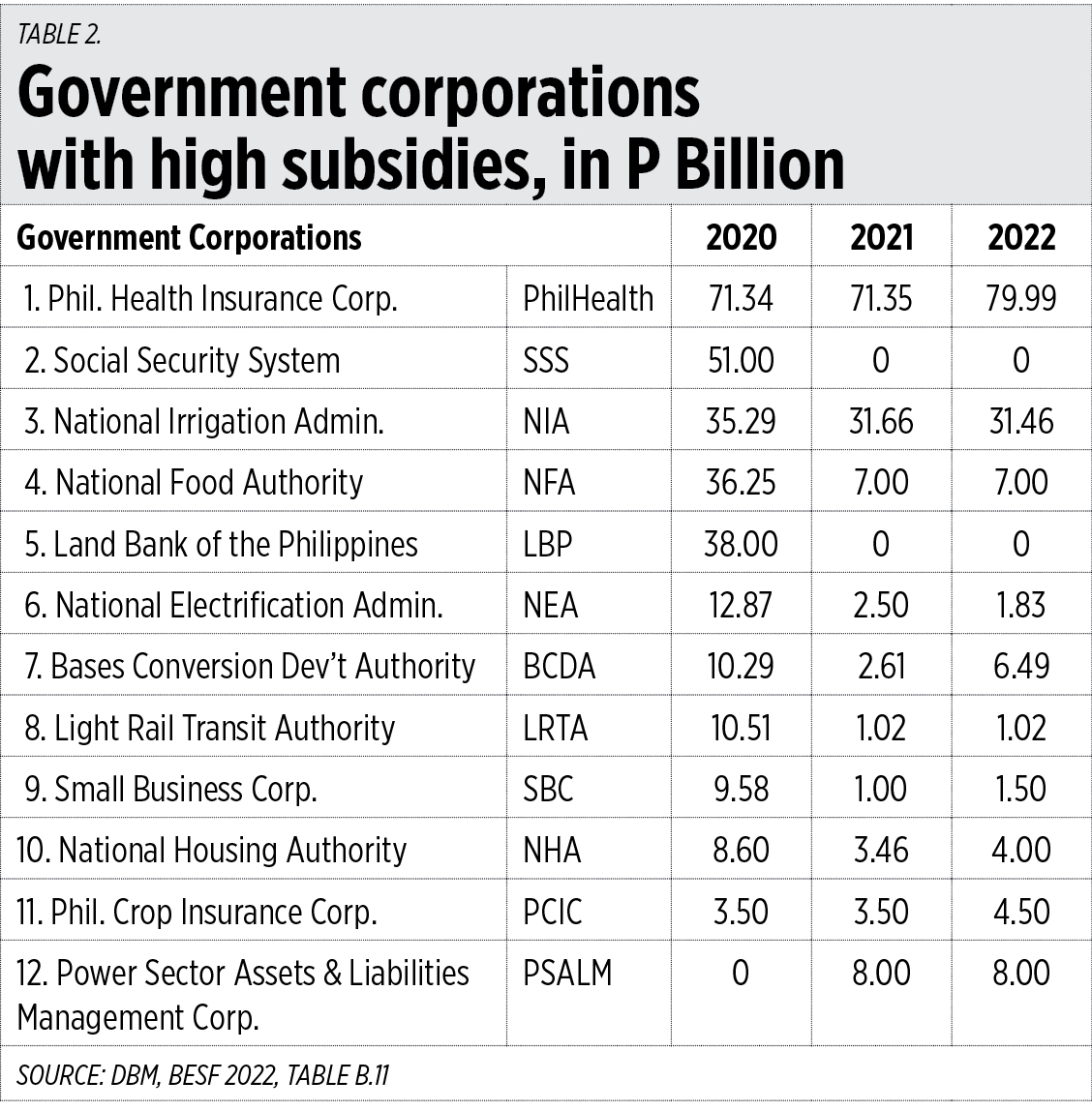
This piece will briefly discuss three other elephants in the room — the rising pensions of military and uniformed personnel (MUP), climate expenditures, and endless subsidies to government corporations.

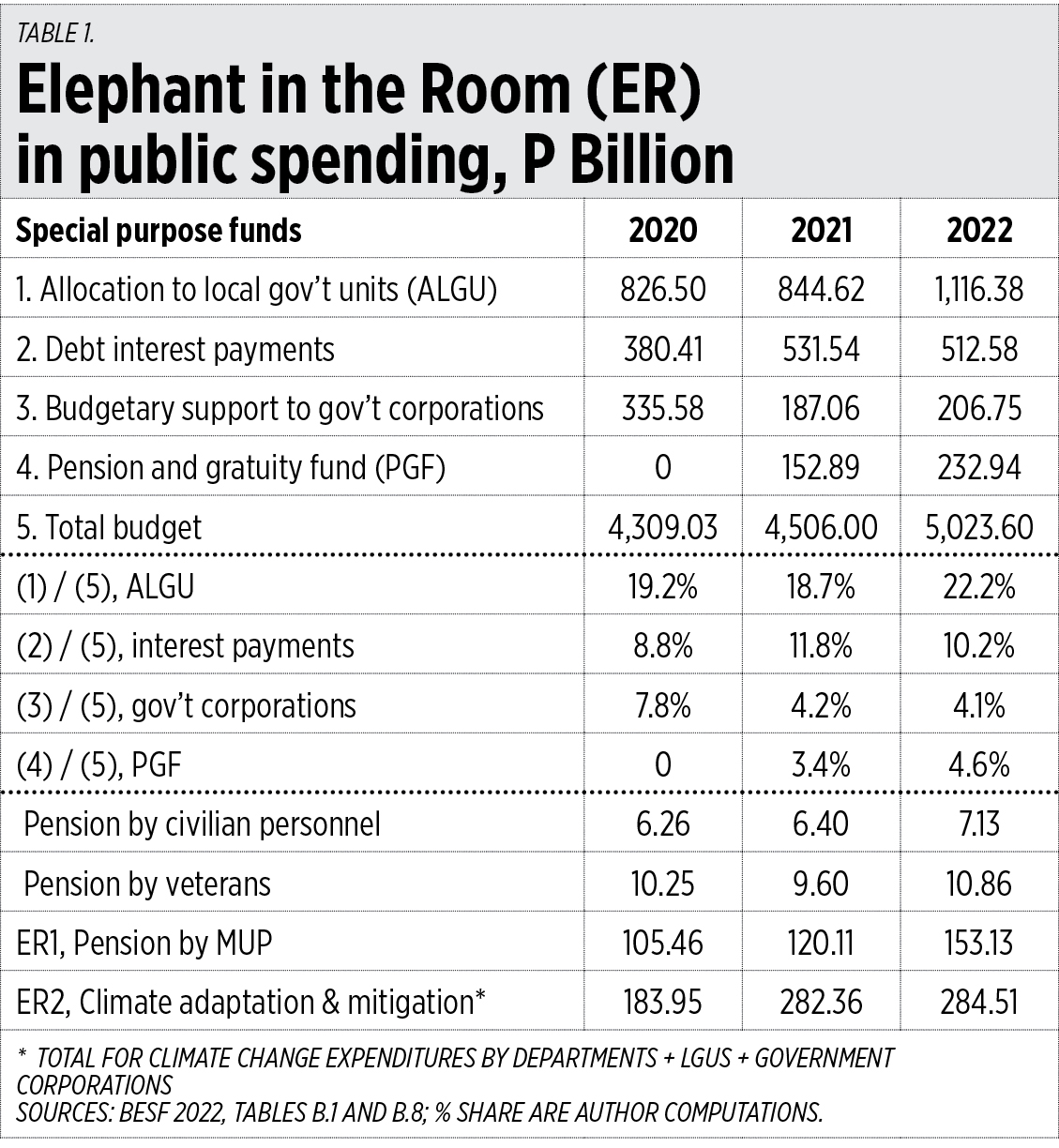
From the Department of Budget and Management (DBM), Budget of Expenditures and Sources of Financing (BESF) 2022 report, the special purpose funds have trillions, with four of these comprising 38% to 41% of the annual total budget from 2020-2022 (Table 1).

The first elephant in the room (ER) is the huge, monstrous pensions given to MUP — P153 billion this year or 21.5 times higher than the pensions of all civilian personnel combined (government teachers and doctors, engineers and agriculturists, diplomats, and so on).

The burden to taxpayers of MUP pensions is so huge that either it should be cut, or the MUP should also contribute a huge amount to the fund.

The second ER is the rising and bottomless spending on the climate because hundreds of billions of pesos yearly from taxpayers will fight less rain and more rain, fewer floods and more floods, fewer storms and more storms, etc. Climate spending by the National Government was P184 billion in 2020 and P284 billion in 2022. This is excluding climate spending by local governments from their own local funds.

The “Global Tropical Cyclone Frequency” and “Global Tropical Cycle Accumulated Cyclone Energy” (ACE) from 1970 to 2022 are not steadily rising but simply fluctuating. Good data from Dr. Ryan Maue can be found here: https://climatlas.com/tropical/.

The volume of annual Arctic and Antarctic Sea ice from 1981 to 2022 is not steadily declining but simply fluctuating. Check the official data from the Japan Aerospace Exploration Agency (JAXA), the Danish Meteorological Institute (DMI), Norway’s Nansen Environmental and Remote Sensing Center (NERSC), the US’ National Snow & Ice Data Center (NSIDC), and more (see https://wattsupwiththat.com/reference-pages/sea-ice-page/).

There is no “climate crisis” to justify huge climate spending from taxpayers and energy consumers.

The third ER is the bottomless subsidies to government corporations and financial institutions. These are supposed to be earning and not subsidies-dependent agencies. And many of them should be in the hands of the private sector, subject to competition, expansion, or bankruptcy. Like the SSS (Social Security System) that gets annual contributions from members then got P51 billion more from taxpayers in 2020 (Table 2).

One way to reduce the public debt is to privatize many government corporations and spare the taxpayers from any tax hikes, or have tax cuts in commodities that are necessary for households and industries like energy products.

PDE BATCH 33 OF UPSE
In the same column last week, I mentioned that incoming Finance Secretary Benjamin Diokno and returning National Economic and Development Authority (NEDA) Secretary Arsenio Balisacan were both my former teachers at the Program in Development Economics (PDE) of the UP School of Economics (UPSE) batch 33, school year 1997-1998. The Dean of the school at that time was former NEDA Secretary and incoming Bangko Sentral ng Pilipinas (BSP) Governor Felipe Medalla.

The PDE Director that time was Prof. Ruperto Alonzo (RIP), a very kind and warm teacher for 45 years who became UP Professor Emeritus, and was NEDA Undersecretary in 1998-2000 under the Estrada administration. He also became a godfather at my wedding.

PDE is a graduate program designed for mid-level government officers and junior technocrats, so the course content is applied economics with deep theoretical background. Many of my classmates have stayed in government and excelled in their fields. Among them are the following:

Marilou Mendoza is now Chair of the Tariff Commission (TC). Two classmates pursued PhDs — Florante Victor Balatico, PhD Agricultural Economics from UP Los Baños (UPLB) and now the Campus Executive Officer (CEO) of Cagayan State University (CSU) Lasam campus; and Joselito Basilio, PhD Economics at the University of Illinois at Chicago, now Principal Researcher at the BSP Research Academy.

Three classmates became academics. Joey Sescon and Malou Perez are teaching at the Ateneo Economics Department, and Raymund Addun is teaching at the Ateneo Environmental Science Department (he finished his MS in Ecology in Spain).

Maliz Guan-Aragon pursued law and is now the presiding judge in Magallanes, Sorsogon. Other classmates are working at the Department of Agriculture, the Bureau of Internal Revenue, and the Philippine Statistics Authority (PSA). Others have retired already — from the PSA, the Supreme Court, the Department of Education, and the Technical Education and Skills Development Authority (TESDA).

Two classmates went to the private sector. Cynthia Hernandez is now the Deal Advisory Principal Sector Head for Infrastructure, Sector Head for Energy and Natural Resources, KPMG. And Mark Agaloos is now Vice-President for Middle East, LBC.

But the most prominent among us is Amenah “Mina” Pangandaman, the incoming Secretary of the Department of Budget and Management (DBM). Back then we would occasionally make fun of her because she was the youngest in our batch at 21 years old, a fresh graduate of BS Economics from Far Eastern University. She has a good sense of humor.

Working her way in government, she became the Chief-of-Staff (COS) of former Senate President Edgardo Angara, then COS to the Chairperson of the Senate Committee on Finance, Senator Loren Legarda.

Then she moved to DBM when Sir Ben Diokno was Secretary under the Duterte administration. Sir Ben promoted her to DBM Undersecretary, supervising the Department Liaison Office and Budget Technical Bureau.

When Sir Ben became BSP Governor, he brought Mina along and she became Assistant Governor for Strategic Communication and Advocacy and Executive Offices Coordinator. And when Sir Ben was appointed as the incoming Finance Secretary of the Marcos Jr. administration, I thought that Mina would be one of the Finance Under Secretaries. But Mina has matured enough to be a Cabinet Secretary.

The Development Budget Coordination Committee (DBCC) is composed of four agencies — the DBM, the Department of Finance, NEDA, and BSP. The Council prepares the yearly budget, the revenues to fund it, and the macroeconomic assumptions that justify the spending-funding-borrowings outlook. And the heads of these four agencies are all from UPSE, all are non-politicians and plain technocrats with decades of experience in government.

I am hopeful that more market-oriented economic reforms and growth-enhancing policies that are non-burdensome to taxpayers can be fast tracked. I did not expect this under the Ferdinand Marcos, Jr. administration but it is there, a really good start. Looking towards more social and economic prosperity for the country and the Filipinos.


Bienvenido S. Oplas, Jr. is the president of Minimal Government Thinkers.

minimalgovernment@gmail.com

Read: SSS clarifies: Not a subsidy for operations, Replying to SSS: Demonopolize social security

Why do SMEs hesitate to digitalize?

TIRACHARDZ-FREEPIK

Digitalization is applying digital technologies to improve business processes, and to provide new ways of producing value for customers. It must not be confused with digitization, which is the conversion of analog data into digital form (e.g., scanning documents to transform them into electronic files). Digitalization is using digital data to make better decisions and to enable new business models.

Business owners and managers can utilize digital technologies in various aspects of the business. In the area of marketing and sales, a business can set up a company website to provide the public with information about its products and services. The website can also incorporate features that will allow customers to order and/or pay online. Without having to set up a physical store, a business effectively expands its potential market. A business can also interact with its customers by utilizing social media platforms such as Facebook, Instagram, Twitter, and YouTube.

Snug Home & Lifestyle, an entrepreneurial business that offers affordable and stylish furniture, home decor and accessories, operates primarily online. It seeks to help small-time furniture and home decor makers and independent carpenters from Rizal and Albay reach wider markets. Snug Home’s website contains its product catalogue and provides delivery and payment options for customers. The company also has Facebook and Instagram accounts, through which it promotes its products and responds to inquiries of potential buyers.

Entrepreneurial businesses can also utilize digital technologies to enhance their various internal activities including accounting, human resource management, inventory management, logistics, and product development.

Ninja Van “is a tech-enabled express logistics company providing hassle-free delivery services for business of all sizes across Southeast Asia.” Launched in 2014, Ninja Van is a fast-growing last-mile logistics company with a network covering six countries in the region — Indonesia, Malaysia, Philippines, Singapore, Thailand, and Vietnam.

Ninja Van provides a variety of delivery options — same day, next day, express, and standard — to social media sellers, small businesses, and large enterprises. It also provides different pickup options, whether customers want to have their parcels picked up, or to drop them off themselves at any of Ninja Van’s network of drop-off points. Customers can easily track the status of their parcels by entering their parcel-tracking ID in the Ninja Van website. The company also offers free redelivery attempts, one-click delivery rescheduling, and self-collection services, which are enabled by a complete logistics management system.

Despite the supposed benefits of digital technologies, many small- and medium-sized enterprises (SMEs) hesitate to adopt these technologies. This can be partly explained by what is known as the digital divide, which is the gap between the level of sophistication in information technology and e-business usage of SMEs compared with that of large companies, and of businesses in rural areas compared with those of urban areas.

According to the Organization for Economic Co-operation and Development (OECD), structural barriers to digital adoption include: internal skills gap, which prevents business managers and workers from identifying the digital solutions they need and from adapting business models and processes; financing gap, which prevents business owners from accessing finance for intangible digital investments that cannot be easily used as collateral; and infrastructure gap, or the lack of access to high-speed broadband, which is needed to maximize the benefits of digital technology.

Also coming into play is how SME owners and managers perceive risks and benefits associated with investing in digital technology. For businesses that have limited resources, the expected costs of investing in technology (including the cost of training workers in its use) must not exceed the expected benefits that they can derive from it.

While digitalization offers many opportunities for businesses, the adoption of digital technology depends on a variety of factors including the nature of the business, the ability of the entrepreneur to pinpoint the digital solutions his or her business needs, and the fit of digital technology into the overall strategy of the business.

Given their limited resources, small businesses can adopt digitalization in various phases, focusing on areas that are most relevant to their business models and that have more tangible returns. It is not a matter of digitalizing for the sake of digitalization. Neither is it about doing what others are doing, but about being judicious in one’s use of scarce resources and being clear about how digitalization contributes to business goals.


Raymund B. Habaradas is a full professor at the Department of Management and Organization of the Ramon V. Del Rosario College of Business of De La Salle University. He wrote the Philippines’ Country Report for a multi-country study entitled  Digital Entrepreneurship in Asia for Economic Resilience and Post-Pandemic Recovery,” which was supported by the Asian Development Bank.

One day focused on hiring nurses as St. Luke’s marks Nurses Week 

St. Luke’s Medical Center (SLMC) in Bonifacio Global City dedicated the first day of its 2022 Nurses Week celebration to hiring nurse applicants  

Nurses Week runs from June 6 to 9.  

Successful applicants from the provinces will get six months’ free accommodation at a condotel. All successful applicants get a P10,000 signing bonus, groceries, and a pair of shoes by Japanese sports brand ASICS.  

“These are things that will make them feel welcome,” Ma. Martina Geraldine Q. Dimalibot, SLMC’s chief nursing officer, told BusinessWorld on the sidelines of the event. “The free accommodation …we came up with because it was something that made applicants think twice [about accepting the job offer].”  

Started in 2010, Nurses Week is celebrated every year in SLMC’s Bonifacio Global City and Quezon City locations to recognize the dedication and hard work of its nurses.  

“Our nurses always play a critical role in patient care,” Dr. Arturo S. De La Peña, president and CEO of SLMC, said in a press statement. “Celebrating Nurses Week is one way for us to express our gratitude and give back to our nurses who tirelessly give their time and effort to the hospital and the patients they take care of.”  

Each of the hospital’s about 2,000-strong nursing staff will receive P5,000 shopping vouchers from ASICS, a gift of steak and wine, and a limited edition “I am a St. Luke’s Nurse” AquaFlask tumbler during the celebration.  

They will also recieve free hair treatments and body massages during the celebration. 

Apart from Nurses Week, the hospital also gives its nursing staff year-round perks — including pay for work exceeding 12 hours in addition to overtime pay, Ms. Dimalibot said. 

At the height of COVID-19, SLMC’s management likewise provided free transportation, free meals, free vitamins, and complete protective equipment for all its associates.  

“We also have the ongoing Cope lines, which is [a channel] nurses can turn to when they feel down,” Ms. Dimalibot told BusinessWorld. “They can call, and someone will help them process their feelings.”  

It’s caring for the caregivers, she added. 

“They stuck with us and never turned their backs from our patients…,” said Ms. Dimalibot, herself a fellow nurse. “Everyone understands that nurses are the backbone of the hospital.” 

SLMC is the first hospital in the Philippines to receive the Pathway to Excellence designation from the American Nurses and Credentialing Center (ANCC). The designation is awarded to hospitals that meet ANCC’s six key practice standards in shared decision-making, leadership, safety, quality, well-being, and professional development. — Patricia Mirasol

S. Korea, US launch 8 missiles in response to North Korea tests

A North Korea flag flutters next to concertina wire at the North Korean embassy in Kuala Lumpur, Malaysia March 9, 2017. — REUTERS/EDGAR SU/FILE PHOTO

SEOUL — South Korea and the United States said they fired eight surface-to-surface missiles early on Monday off South Korea’s east coast, responding to a barrage of short-range ballistic missiles launched by North Korea on Sunday.

The action is a demonstration of “the capability and readiness to carry out precision strikes” against the source of North Korea’s missile launches or the command and support centers, South Korea’s Yonhap news agency cited the South Korean military as saying.

South Korean President Yoon Suk-yeol, who took office last month, has vowed to take a tougher line against the North and agreed with US President Joseph R. Biden at a May summit in Seoul to upgrade joint military drills and their combined deterrence posture.

North Korea has conducted a flurry of missile launches this year and Mr. Yoon said its missile and nuclear weapons programs have reached a level at which they pose a threat to regional and world peace.

The South “will continue to build fundamental and practical security capabilities and deter the North’s nuclear and missile threats,” Mr. Yoon said at an event for South Korea’s Memorial Day.

The militaries of South Korea and the United States fired eight surface-to-surface missiles over about 10 minutes starting at 4:45 a.m. on Monday (1945 GMT Sunday) in response to the eight missiles fired by the North on Sunday, Yonhap reported.

An official from South Korea’s Defense Ministry confirmed eight Army Tactical Missile Systems (ATACMS) had been fired.

US Indo-Pacific Command said the exercise included one U.S. Army missile and seven from South Korea.

“The ROK-US Alliance remains committed to peace and prosperity on the Korean Peninsula and throughout the Indo-Pacific,” it said in a statement, using the initials of South Korea’s official name.

North Korea’s short-range ballistic missiles, fired toward the sea off its east coast on Sunday, were probably its largest single test and came a day after South Korea and the United States ended joint military drills.

The South Korea-US bilateral exercises involved an American aircraft carrier for the first time in more than four years.

Japan and the United States also conducted a joint military exercise on Sunday in response to the latest North Korea missile tests.

North Korea, which is several weeks into battling its first known outbreak of COVID-19, has criticized previous joint drills as an example of Washington’s continued “hostile policies” toward Pyongyang, despite its talk of diplomacy.

Yonhap, citing an unidentified source, said the North’s volley on Sunday was launched from four locations, including Sunan in the capital, Pyongyang.

Leif-Eric Easley, an international studies professor at Ewha University in Seoul said South Korea’s current missile defenses are insufficient against the expanding North Korean threat.

“This calls not only for further investments in hardware but also a more multilayered approach coordinated with Japan and diplomatic efforts with Beijing to reduce arms race dynamics with Pyongyang.”

North Korea continued with its recent trend of not reporting on missile launches in state media, which some analysts have said is meant to show the tests are part of routine military drills.

Washington and Seoul officials also recently warned North Korea appeared ready to resume nuclear weapons tests for the first time since 2017. — Reuters

As Britons thank Queen Elizabeth for 70 years, monarchy looks to future

BRITAIN’s Queen Elizabeth, Prince George and Princess Charlotte stand on the balcony during the Platinum Pageant, marking the end of the celebrations for the Platinum Jubilee of Britain’s Queen Elizabeth, in London, Britain, June 5. — JONATHAN BUCKMASTER/POOL VIA REUTERS

LONDON — While millions watched the Platinum Jubilee festivities to thank Queen Elizabeth and reflect on her 70 years on the British throne, for the monarchy itself, the four-day celebrations have also very much been about looking to the future.

From parades in London and a party outside Buckingham Palace to a Service of Thanksgiving, many in Britain have been paying affectionate tributes to a 96-year-old who has reigned longer than any of her predecessors in 1,000 years.

But the queen’s absence at many of the Jubilee events because of health issues meant the celebration of her reign provided a focus on the next monarchs, her son Prince Charles and his son William.

Royal biographer Robert Lacey, the historical consultant to Netflix’s hugely popular TV drama The Crown, said the queen was laying the ground for what comes next.

“The Jubilee had a double-edged significance,” he told Reuters. “Yes, it celebrated the queen and what will one day be the past, but it’s also provided a platform for the new formula and pattern for the future.”

The queen missed out on most of the big Jubilee events due to what the palace calls “episodic mobility problems,” which have forced her to cancel public appearances recently and have highlighted her advancing years.

In her absence, son and heir Charles,73, and his son William, the second in line, have been to the fore.

In a notable finale on Sunday, the queen appeared on the balcony of Buckingham Palace flanked by the three next monarchs — Charles, William, and his eldest child Prince George.

Journalist Tina Brown, a longtime observer of the British royalty, also said Elizabeth had been focused on succession.

“Her feelings and her sentiments right now are all about estate planning for the monarchy,” she told BBC TV. “Her only care right now is that things should be put in good order for Charles and that everything can be done to make his reign easier.”

Ms. Brown and Mr. Lacey said that was why the queen used the actual 70th anniversary of her accession to the throne in February to announce she wanted Charles’ second wife Camilla to be queen consort, removing any future controversy over her role.

FLUCTUATING FORTUNES
During Elizabeth’s long tenure, the fortunes of the monarchy have often fluctuated, such as from a low that followed the 1997 death of Princess Diana, Charles’ captivating first wife, to the highs of the wedding of grandson William and his spouse Kate, and the birth of their children.

The last three years have been particularly tough on the institution.

First, the queen’s second son Prince Andrew was forced to quit public duties over his friendship with the late, disgraced US financier Jeffrey Epstein, and he later settled a lawsuit with a woman who accused him of sexually abusing her when she was 17.

He denied the allegation and has not been accused of criminal wrongdoing, but his reputation was shattered.

Meanwhile, William’s younger brother Harry and his American wife Meghan moved to Los Angeles from where they have delivered stinging attacks on Buckingham Palace, most notably an accusation of racism in an interview with Oprah Winfrey.

“We’re very much not a racist family,” William said.

While both events stained the reputation of “The Firm,” as Britain’s royal family calls itself, opinion polls in Britain suggest the lasting damage has mainly been to Andrew and Harry themselves.

Mr. Lacey said the Jubilee had reminded many people of the positives a monarchy brought, adding: “Charles and Camilla are associated with that in a way you would not have thought possible a few years ago.”

But for all the celebrations this week and plans for the future, there remain some dark clouds on the horizon.

Polls show the queen is hugely popular and older Britons are overwhelmingly in favor of the monarchy, but they also indicate young people are far more indifferent and support has slipped over the last decade.

While Harry and Meghan have kept a low profile during the Jubilee, the prince is writing a memoir due to be released later this year that could contain more explosive details.

Barbados removed Elizabeth as its head of state last November and there is a growing feeling that republican sentiments will grow in the 14 other countries that have the British monarch as their queen.

The new center-left Labor party in Australia, which voted against ditching the monarchy in 1999, has named the country’s first “assistant minister for the republic”.

“I don’t know that it will ever be the same when she’s not here anymore, that’s how we feel about it (in New Zealand),” said Patricia Burrowes, 80, who traveled from Auckland for the Jubilee celebrations.

Some at the festivities felt the monarchy would remain integral to Britain even as the queen’s role might be drawing to an end.

“It’s easy to be critical of it and say it isn’t for these times,” said Ian Higgins, 62, a mental health nurse. “But I think having something that brings people together that isn’t political but unites people is so important for this country, and the rest of the world loves it as well.”

As to whether there would be a similar outpouring for Charles when he becomes king, the feeling was mixed.

“We’ll have to wait and see,” said Amanda Mackenzie, 51, a yoga teacher from London. “We’ll have to wait and see.” — Reuters

NFTs, a technology to bridge a gap in the art world 

By Brontë H. Lacsamana, Reporter

As a digitally native extension of traditional art, non-fungible tokens (NFTs) were an interesting platform where painter Charles Bjorn Z. Calleja could release his animation — and like many Filipino artists, this revelation led him to mint his first NFT in 2021. 

“I don’t actually consider myself a digital artist. My animations are based on paintings, and I’ve been exhibiting my work for as long as I can remember in physical galleries. I do animations to see movement… It’s an extension of my art practice,” said Mr. Calleja.  

In a video interview with BusinessWorld, he recounted that he posted animations online just for fun until his friend introduced him to the Tezos-based marketplace Hic et Nunc.  

“I didn’t really have a platform for my animations and NFTs became a good way to market and monetize them since I didn’t intend to show the work in galleries,” he said.  

Since then, Mr. Calleja has had his NFT works shown at various galleries and art shows, the most recent of which was at Art Basel Hong Kong 2022, at the Tezos-based exhibition NFTs + The Ever-Evolving World of Art held from May 27 to 29.  

As the lone Filipino contributing to the exhibit, he said: “We’re putting in something new. It represents our time as we’re living in a digital generation. I think being able to represent where we are right now is contributing to the history of art.”  

He also added that NFTs don’t necessarily go against traditional art, since they can bridge the gap between long-standing art institutions and new artists and collectors.  

“The traditional and digital art worlds can help each other with this technology.”  

TEZOS BLOCKCHAIN
Art Basel’s NFT section was hosted on Tezos, an energy efficient alternative to better-known blockchain networks Bitcoin and Ethereum. What sets it apart from those is that it has a lower minting cost and a smaller carbon footprint.  

Katherine Ng, head of marketing and operations in Asia Pacific at blockchain consultancy firm TZ APAC, said that Tezos’ momentum (up over 60% in the last month) has continued even amid downturns in the market and declines in NFT prices.  

For the Tezos community, NFTs “bridge a gap in the art world, allowing artists to connect with new collectors around the world, and institutions and sell their work to anyone at any time,” she said via e-mail interview, echoing Mr. Calleja’s hope for NFT art.  

TZ APAC helped Art Basel Hong Kong present its NFT and generative art exhibition that featured over 20 generative and NFT artists from across the globe.  

This potential hasn’t been lost on other traditional art institutions either, with Sotheby’s vice-president, contemporary art specialist, and digital art co-head Michael Bouhanna tweeting just last week: “Getting into Tezos just now! Which artists should I look at?”  

Last month, the biggest Tezos marketplace, Objkt.com, surpassed $100 million in total sales since its launch in 2021.   

Generative art, in particular, has enjoyed growing popularity. Defined as digital art with assets fed into a machine algorithm, it taps into the programmable aspect of new media which can also be interactive.  

“It’s an incredibly exciting development in the NFT art ecosystem. There are more and more platforms focused on this art form, not only within the Tezos ecosystem with FXhash, but across other blockchains,” said Ms. Ng.  

EXPANSION OF THE ART SCENE
Mr. Calleja said that avenues like Art Basel Hong Kong and Art Fair Philippines, where he also exhibited his works, will effectively spread the word about NFT art.  

“I think it helps to educate the local art audience about NFTs in general… Most of the artists I know who are minting are doing digital work and it’s only a few who are really into the galleries, into the fine art side of things, so I think it helps bridge the gap and introduce NFTs as a platform for new media art, as video art, and a lot more,” he said.  

With market-based institutions from auction houses and museums to art fairs and galleries slowly opening up to the idea, it’s only a matter of time until the art scene is expanded to include more and more NFT artists.  

For TZ APAC, this will surely occur in no time in Southeast Asia, which enjoyed rapid digitalization during the pandemic. Tezos as a platform also takes care of the issue of high minting costs.  

“When I think of the market demographics of Southeast Asia as a region characterized by a young, digitally-savvy, mobile-first population, the openness towards digital assets comes as no surprise,” said Ms. Ng.   

She added that the development of this trend has shown the asset class “no longer being limited to niche circles but also established galleries, artists, and festivals.”