
Philippines places 37th in Muslim travelers’ top destinations

THE PHILIPPINES ranked 37th out of 138 destinations in the latest report that measures a country’s preparedness in tapping the Muslim travel market. Read the full story.

THE PHILIPPINES ranked 37th out of 138 destinations in the latest report that measures a country’s preparedness in tapping the Muslim travel market. Read the full story.

ENDERUN COLLEGES partnered with American cruise line Holland America Line (HAL) to offer training in a bid to boost the competencies of Filipino employees in the food and beverage services, culinary arts, and hospitality sectors.
Endurun Colleges said its continuing education arm, Enderun Extension, signed a memorandum of agreement with HAL on June 3 that launched the training partnership. It also said that the first batch of students from HAL have been welcomed on Monday.
“With this partnership, Enderun Extension will have HAL’s potential employees be trained with courses on food and beverage services, guest services, utilities, housekeeping, including culinary, pastry, and pre-boarding orientation,” Enderun Colleges said in a statement on Monday.
“[We will be] touching so many different memories that customers will remember over and over. Allowing us to be a part of this moment where we can nurture and develop the talent with HAL is something special for us,” Enderun Colleges Lead Founder Jack Tuason said.
Oscar Herrin, HAL director for learning, culture and diversity, equity, and inclusion, said that the only way to improve a skill is for people to be informed and understand how things are done in practice.
“People’s ability and will are the keys to their success. One cannot exist without the other, and skill is crucial, and the only way to develop (a) skill is for people to get information and comprehend how things are done in practice. Enderun does an excellent job in doing that,” Mr. Herrin said.
“Majority of our people are Filipinos. Being [a] Filipino in the organization, I am very proud to have the same vision as you do in enabling people to be the best they can be,” he added.
Enderun Extension offers an open and comprehensive curriculum with courses and programs to meet the interests and needs of a diverse public. It has certificate programs in the fields of culinary, pastry arts, hospitality management, business administration, entrepreneurship, and economics.
The continuing education arm also has a variety of workshops, short courses, and conferences. It also offers courses for children who are budding chefs, hoteliers, engineers or entrepreneurs.
HAL has a fleet of 11 ships offering over 500 sailings annually across all seven continents. — Revin Mikhael D. Ochave

JERUSALEM — Israel’s government plans to sharply boost construction starts and expand a discount scheme aimed at restraining rapidly rising housing prices as demand continues to outstrip supply.
Under a joint plan by the finance, interior, and construction and housing ministries, Israel aims to start building 280,000 housing units by 2025, or 70,000 on average a year. That compares to around 55,000 a year over the past decade.
Construction and Housing Minister Zeev Elkin noted that the various incentives would mean a loss of as much as 20 billion shekels ($5.89 billion) to the country’s lands authority, which allocates Israel’s land to developers.
“The plan is not a one-step magic solution,” Mr. Elkin said at a press conference on Sunday. “(But) we believe (it)… will stabilize Israel’s housing market.”
The proposal, parts of which require parliament approval, also includes other measures, such as cutting red tape and building more housing units for rentals.
It is the latest government attempt to contain housing costs, with previous ones failing to stabilize prices.
It takes twice as long to build an apartment in Israel than it does in the United States and Britain, Finance Minister Avigdor Lieberman said at the news conference, citing data from the Israeli Central Bureau of Statistics.
Mr. Lieberman also cautioned that other factors, outside the government’s control, could slow progress.
Analysts and central bank policymakers have long said the current number of buildings starts in Israel is too low to meet demand for buyers either looking to invest or for a home.
Along with rock-bottom mortgage interest rates, housing prices have more than doubled since 2010, with a 16% rise over the past year alone.
Rent has also jumped, pricing many out of the market and contributing to rising inflation. Israeli media have reported double-digit gains in rental rates this year.
Data show that a four-room apartment in Israel averages nearly 2.5 million shekels, with prices far higher in Tel Aviv, Israel’s financial and cultural capital. — Reuters

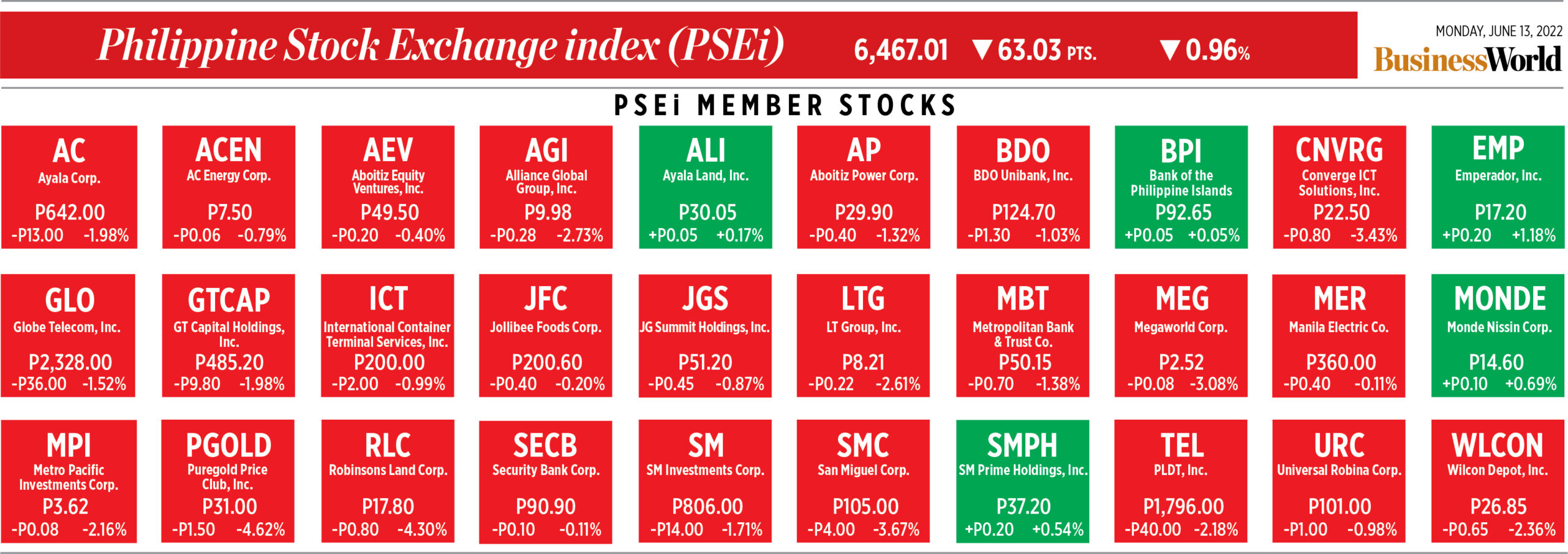
Here’s a quick glance at how PSEi stocks fared on Monday, June 13, 2022.


THE PESO fell to an over three-year low against the dollar on Monday after US inflation soared to a 40-year high in May, which could prompt aggressive tightening by the US Federal Reserve at its meeting this week.
The local unit closed at P53.30 against the dollar, shedding 30 centavos from its P53 finish on Friday, data from the Bankers Association of the Philippines showed.
This was the peso’s weakest close in over three years or since its finish of P53.59 against the greenback on Oct. 30, 2018.
The peso opened Monday’s trading session at P53.10 against the dollar, which was also its intraday best. It moved within a very narrow range as its weakest showing was its closing level of P53.30 against the greenback.
Dollars exchanged fell to $685.2 million on Monday from $949.3 million seen on Friday.
The local unit weakened as high US inflation could prompt the Fed to raise rates more aggressively, Rizal Commercial Banking Corp. Chief Economist Michael L. Ricafort said in a Viber message.
A trader likewise said in an e-mail that “the peso weakened significantly following the stronger-than-expected US consumer inflation report for May 2022.”
The trader warned that the local currency may fall further ahead of the release of US producer inflation data.
The US consumer price index increased by a faster-than-expected 8.6% last month, the largest year-on-year increase since December 1981, according to US Labor department data released on Friday, showing inflation has yet to peak.
This caused renewed bets of aggressive action from the Fed that could dampen growth prospects for the world’s largest economy. The US central bank will review its policy settings on June 14-15.
Mr. Ricafort added that the peso’s decline was also due to a drop in the local stock benchmark. The Philippine Stock Exchange index sank by 63.03 points or 0.96% to close at 6,467.01 on Monday, while the broader all shares index went down by 37 points or 1.05% to 3,474.93.
For Tuesday, Mr. Ricafort sees the peso ranging between P53.10 and P53.35 against the dollar, while the trader expects the local unit to weaken further and trade from P53.20 to P53.40. — TJT

STOCKS continued to slide on Monday due to faster US inflation in May that fueled fears of a more aggressive tightening by the Federal Reserve.
The benchmark Philippine Stock Exchange index (PSEi) sank by 63.03 points or 0.96% to close at 6,467.01 on Monday, while the broader all shares index went down by 37 points or 1.05% to 3,474.93.
“Philippine shares slid once again after a highly anticipated US CPI (consumer price index) report showed a faster-than-expected rise in prices and consumer sentiment hit a record low. For this week, traders appeared to be preparing for more aggressive Fed responses to the surge in prices. The central bank is expected to announce at least a half-point rate hike at its meeting this coming June 15,” Regina Capital Development Corp. Head of Sales Luis A. Limlingan said in a Viber message.
“Global equities plunged after Friday’s above-consensus US inflation numbers for May. The repercussion is that the US inflation has not peaked and a more aggressive monetary tightening may be in play. Meanwhile, the US Fed is also expected to announce its interest rate decision later this week which could continue to add uncertainties to the market,” Papa Securities Corp. Equities Strategist Manny P. Cruz said in a Viber message.
The US consumer price index increased by a faster-than-expected 8.6% last month, the largest year-on-year increase since December 1981, according to US Labor Department data released on Friday, showing inflation has yet to peak.
This caused renewed bets of aggressive action from the Fed that could dampen growth prospects for the world’s largest economy.
The US central bank kicked off its tightening cycle with a 25-basis-point (bp) increase in March followed by a 50-bp hike last month as inflation continued to reach multi-year highs.
Mr. Cruz added that major markets in the region also posted sharp losses in reaction to the poor performance of Wall Street last week.
MSCI’s benchmark Asia-Pacific equity index slumped 2.66% on Monday.
Back home, all sectoral indices ended on Monday’s trading session in the red.
Mining and oil dropped by 313.07 points or 2.64% to 11,543.49; services fell by 31.37 points or 1.75% to 1,753.76; holding firms declined by 99.50 points or 1.65% to 5,928.43; financials gave up by 12.08 points or 0.76% to 1,561.98; industrials dropped by 24.36 points or 0.26% to 9,053.56; and property lost 1.07 points or 0.03% to end at 3,044.91.
Decliners overwhelmed advancers, 146 versus 43, while 39 names ended unchanged.
Value turnover ended lower at P5.38 billion on Monday with 761.72 million shares changing hands from the P6.02 billion with 661.18 million issues seen the previous trading day.
Net foreign selling retreated to P624.30 million on Monday from the P1.25 billion seen on Friday. — Luisa Maria Jacinta C. Jocson

ENERGY, whether green or otherwise, was front and center in President-elect Ferdinand R. Marcos, Jr.’s discussions with members of the diplomatic corps, according to statements issued and briefings conducted by the ambassadors.
Mr. Marcos met on Monday with Ambassadors Grete Sillasen of Denmark, Marat Pavlov of Russia, Ahmed Shehabeldin of Egypt, and Ilan Fluss of Israel.
He also met with Asian Development Bank (ADB) President Masatsugu Asakawa, who pledged to support the Philippines’ climate agenda.
Ms. Sillasen said she and Mr. Marcos focused “to a high degree on the green transition that all countries have to go through these days and these years that are coming.”
“We had a focus on talking about sustainability which is partly the sustainable use of energies so we have green energies and fossil energies but also very importantly, be efficient with the energy we are using,” she said at a news conference.
“The greenest and cheapest and energy is one that we do not use and this was what he and I talked much about,” Ms. Sillasen said, noting that Mr. Marcos recognized how Denmark managed to double its economic output “without increasing our consumption of energy, water, and without increasing our carbon emissions.”
Denmark is a major producer of turbines used in wind power.
“While we looked into how the increase of wind power can go into the mix, [he didn’t lay down] actual plan yet as such,” she said. “It was more on a dedication to seeing that sustainable and renewable energy is the way we need to look at.”
In 2011, Denmark set a goal of becoming a carbon neutral country by 2050, according to the Organisation for Economic Co-operation and Development. Copenhagen’s 2011 goal of sourcing 30% of its energy from renewables by 2020 was met ahead of schedule in 2016, it added.
Countries relying on traditional sources of energy have been rocked by the Russia-Ukraine war, which took much Russian energy off the market due to sanctions, increasing demand for energy produced elsewhere.
Mr. Pavlov of Russia offered to help the Philippines deal with rising oil prices.
“During the meeting, we found out that in this turbulent period of our life, the Russian Federation could extend its hand to help the Philippines in much needed oil, gas and other sources of energy,” he said.
When asked to elaborate on the potential cooperation between Russia and the Philippines on energy security, Mr. Pavlov said: “We are ready to cooperate with the Philippines and extend our helping hand to satisfy the needs in sources of energy.”
Mr. Pavlov said he and Mr. Marcos also discussed the situation in Ukraine “very briefly…. As far as I understand, he would like to continue his independent policy.”
The ADB’s Mr. Asakawa gave assurances of support for Philippine climate projects and to facilitate “a resilient and green economic recovery.”
The ADB will also help the Philippines transition to climate-smart transportation and fund its social protection programs, Mr. Asakawa said in a statement issued after his visit with Mr. Marcos.
Mr. Asakawa said Mr. Marcos was invited to ADB’s 55th annual meeting, which will be held in the Philippines in September.
Meanwhile, Mr. Shehabeldin of Egypt said he invited Mr. Marcos to attend the 27th session of the United Nations-backed Climate Change Conference (COP 27), which will be held in Egypt in November.
“We talked about how the international community should respond to the challenges of climate change,” he said. “We both agreed that we are different in geography and climate, but we share the same concerns.”
Egypt is finalizing a national climate change strategy to support its 2030 sustainable development agenda, the World Bank said in April.
Mr. Marcos has yet to outline his plans for tackling climate change.
Climate-related hazards have caused P506.1 billion in losses and damage to the Philippines over the past decade, the Department of Finance said last year.
Mr. Fluss of Israel said his meeting with Mr. Marcos touched on agriculture, food security and employment.
Potential defense cooperation was also discussed but there were “no any specific deals,” he said at a news conference. “It is much too early and we’re not on that level yet, but certainly we discussed cooperation in many areas, including defense.” — Kyle Aristophere T. Atienza

THE Department of Finance (DoF) said in a statement on Monday that state-run banks Development Bank of the Philippines (DBP) and Land Bank of the Philippines (LANDBANK) have disbursed P8.2 billion in cash aid to rice farmers as authorized by the Rice Tariffication Law.
Between 2019 and 2021, over one million qualified rice farmers tending small plots have received P5,000 in direct and unconditional cash aid, based on data from the Department of Agriculture (DA). Funds were distributed under the Rice Farmers Financial Assistance program of the DA, as provided for under the tariffication law.
“The Rice Tariffication Law has achieved its dual goal of bringing down retail rice prices while helping farmers improve productivity through the Rice Competitiveness Enhancement Fund,” Finance Secretary Carlos G. Dominguez III said.
The law, or Republic Act 11203, opened up the rice import market, with importers paying a 35% tariff on Southeast Asian grain. These tariffs provide the RCEF with P10 billion a year. President Rodrigo R. Duterte signed the law on Feb. 14, 2019.
Rice import tariffs in excess of the P10 billion set aside for the Rice Competitiveness Enhancement Fund (RCEF) must be used solely for financial assistance until 2024, with farmers eligible if they till 2 hectares (ha) or less.
During its first year of implementation in 2019, the Bureau of Customs (BoC) confirmed an excess of rice tariffs amounting to about P2.135 billion. This excess grew to P5.5 billion and P8.9 billion in 2020 and 2021, respectively.
Between March 2019 and 2021, the BoC collected P46.6 billion in rice import duties.
The DA estimates that since the implementation of RCEF, over one million rice farmers have received over 8.7 million bags of certified inbred rice seed, which have a higher yield than traditional seed.
Over 830,000 ha worked by rice farmers have seen improved yields, while close to a million farmers gained access to 19,542 units of farm machinery.
In addition, 90,000 farmers have also participated in nearly 5,000 training sessions, 14,459 specialists, trainers, and extension intermediaries have also received training on rice farming techniques.
As a result of the RCEF’s implementation, about 220 farm schools have been established, bringing the total to 470, while close to 50,000 rice farmers have accessed loans worth P1.5 billion from LANDBANK and the DBP.
The DoF said the excess funds generated by the tariffs was a reversal from the P11-billion average annual subsidy that the government provided to the National Food Authority, which had a monopoly on rice imports.
The law “has lowered prices of rice to an average of P39 per kilogram (kg) today or a reduction of about P7 per kilo compared to its cost in 2018 when it peaked to around P47 per kilo,” the DoF added.
Socioeconomic Planning Secretary Karl Kendrick T. Chua has earlier pushed for the continuation of the law by the next administration, saying that it was “the best model we have to help both farmers and consumers.” In 2021, he added, rice tariffs generated P18.9 billion, and went towards helping farmers. — Tobias Jared Tomas

THE Bases Conversion and Development Authority (BCDA) said it remitted P7.38 billion to the Bureau of the Treasury (BTr), up 60.8%.
“The state corporation’s total remittances this year jumped 60.81% to P7.38 billion, exceeding the P4.59 billion remitted in 2021,” the BCDA said in a statement on Monday.
BCDA, a government-owned and -controlled corporation (GOCC), said that P6.38 billion of the overall amount remitted to the BTr in 2022 represented proceeds generated from sales, leases, or joint venture developments covering property in former military bases around Metro Manila.
The redevelopment of the bases is governed by Republic Act 7227 or the Bases Conversion and Development Act. “Of the disposition proceeds, almost 99% or P6.31 billion is allocated to the Armed Forces of the Philippines (AFP) for its modernization program, giving a boost to military forces who respond to crises and defend the country against all threats,” the BCDA said.
“Some P65.65 million will be given to other beneficiary agencies, while P4.05 million will be divided equally among the contiguous cities of Makati and Taguig, and the municipality of Pateros,” it added.
The BCDA said it also remitted P842.08 million in dividends to the BTr this year as required by Republic Act No. 7656 which directs GOCCs to declare and remit at least 50% of their net earnings to the government.
It added that P161.97 million in guarantee fees were also turned over to the BTr, which were booked last year in relation to the government’s loan from the Japan International Cooperation Agency, which was used for the Subic-Clark-Tarlac Expressway project.
“Our aggressive collection efforts have paid off, generating funds while resolving long-standing disputes over properties or with business partners,” BCDA Officer-in-Charge President and Chief Executive Officer Aristotle B. Batuhan said.
Since its creation in 1992, the BCDA said it remitted P80.46 billion to the BTr as of May 2022. This includes P67.18 billion in asset disposition proceeds, P7.93 billion in dividends, and P5.36 billion in guarantee fees and other obligations. — Revin Mikhael D. Ochave

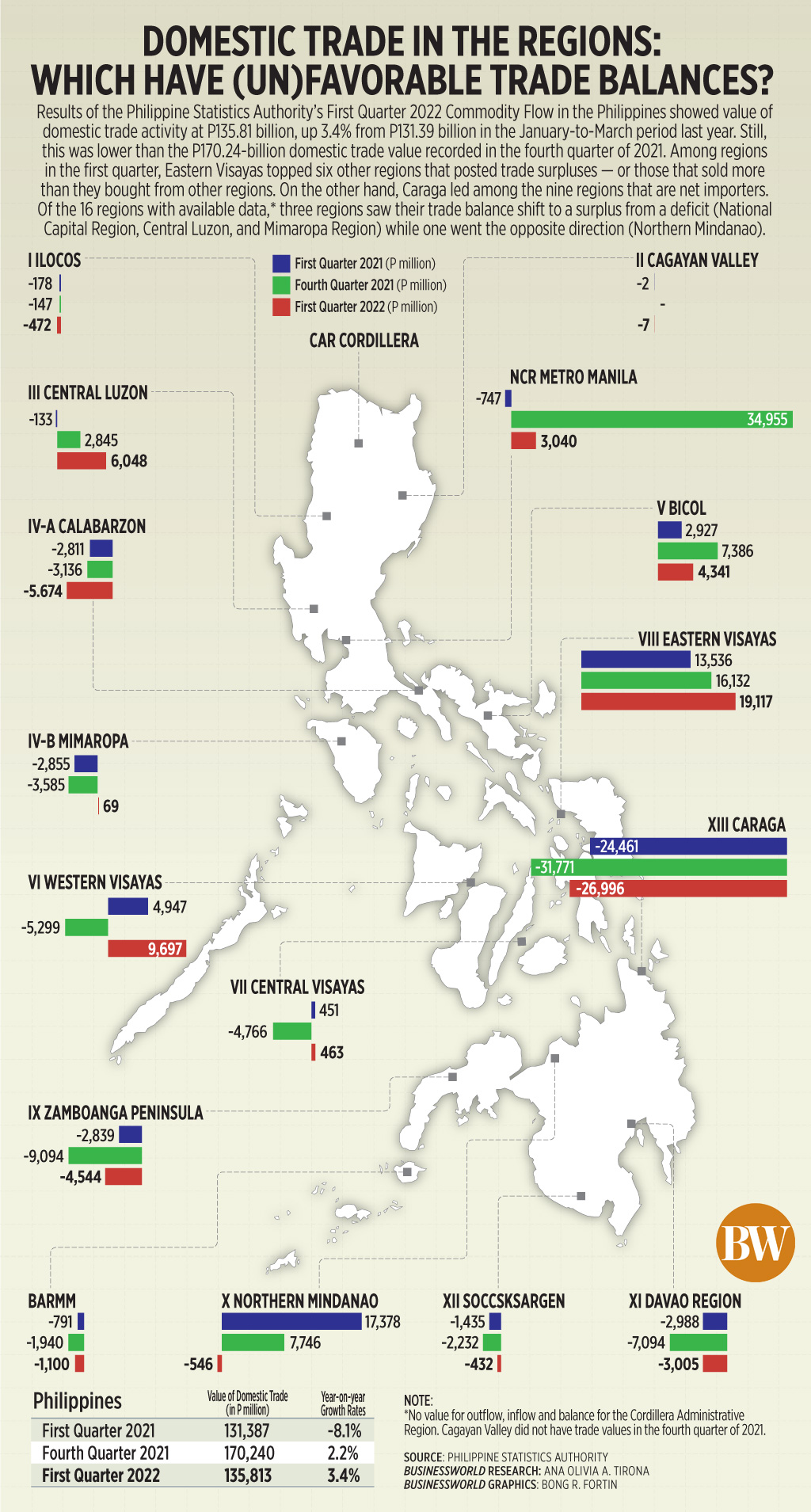
TRADE in domestic goods declined by 35.6% in the first quarter to P135.812 billion, the Philippine Statistics Authority (PSA) said on Monday, with trade hindered by mobility restrictions and the disruptions imposed by the Russia-Ukraine war.
According to the PSA’s preliminary Commodity Flow in the Philippines report, the volume of trade in the first quarter was 3.383 million tons, against 4.874 million tons in the previous quarter.
Commodity flow covers all goods transported by water, air, and rail, with shipping accounting for the bulk of the commodities.
 Rizal Commercial Banking Corp. Chief Economist Michael L. Ricafort attributed the contraction in the domestic trade data to “the surge in Omicron cases in the early part of the quarter that led to some temporary restrictions and Russia’s invasion of Ukraine since Feb. 24, that led to elevated prices of oil/energy and other major global commodities.”
Six out of 10 commodity categories monitored by the PSA reported a decline in trade by value. Among them were: beverages and tobacco, down 4.0%, animal and vegetable oils (-3.1%), chemical and related products (-5.8%), manufactured goods classified chiefly by material (-38.7%), miscellaneous manufactured articles (-1.7%), and commodities and transactions not elsewhere classified in the PSCC (-3.7%).
Food and live animals posted growth of 6.1%, while the value of crude materials, inedible, except fuels was up 12%. Mineral fuels, lubricants and related materials were up 323.4%, and machinery and transport equipment up 21.3%.
The Eastern Visayas registered the largest trade surplus in the first quarter amounting to P19.12 billion, with outflows recorded at P30.212 billion. The trade surplus for the Western Visayas was P9.70 billion, with an outflow of P28.393 billion. Central Luzon returned a trade balance of P6.048 billion, with P6.495 billion worth of outflows.
Caraga region remained the top commodity destination with inflows amounting to P31.467 billion, for a trade deficit of P26.996 billion.
Mr. Ricafort expressed optimism in the domestic trade data as the economy reopens and businesses are allowed to operate at full capacity.
“Further recovery in both domestic and foreign tourism, as well as the resumption of in-person/face-to-face schooling, all of which are the missing parts of the economic recovery story, (are) recovering in the right direction and could also support the recovery of many businesses, would also lead to some pick up in domestic trade data, going forward,” he said. — Mariedel Irish U. Catilogo

CENTRAL LUZON is being considered as a manufacturing and logistics hub, according to the Department of Trade and Industry (DTI).
DTI Region 3 Regional Director Leonila T. Baluyut said in a statement on Monday that Central Luzon has many industrial assets in place that can support such a development strategy.
“Central Luzon has the most number of provinces with plenty of growth opportunities, as Clark in Pampanga has an international airport, Bataan has the Freeport area, (Tarlac has) Luisita Park,” Ms. Baluyut said.
Ms. Baluyut added that the region can stake advantage of Republic Act No. 11534, or the Corporate Recovery and Tax Incentives for Enterprises (CREATE) Act, and the amendments made to liberalize the Foreign Investments Act, the Public Service Act, and the Retail Trade Liberalization Act.
Separately, Board of Investments Director for Domestic Investments Promotion Maria Rosario J. Dominguez said that competition has increased as the economy continues to recover from the pandemic.
“In the course of the pandemic, we learned (to use) tools to promote the Philippines despite the inability to do things physically. The world has become smaller as a result of technology and innovation. The bottom line is to have the right content/information (at the ready),” Ms. Dominguez said. — Revin Mikhael D. Ochave

Inflation in May was 5.4%, the highest level since December 2018. Last month, there was also talk of postponing the individual income tax cuts scheduled to start in 2023 under the Tax Reform for Acceleration and Inclusion (TRAIN) Act. These scenarios will certainly encourage taxpayers to think about how these events affect them. Many may already be worrying about their take-home pay as prices of goods and services rise.
As such, employers may wish to consider certain actions that could reduce the impact of taxes on their employees.
One of these actions is to revisit the non-taxable “de minimis benefits” that could be granted to employees. When considering an increase in employee benefits, companies may choose to grant de minimis benefits before increasing the basic salary rate.
De minimis benefits are non-taxable fringe benefits, a list of which is provided by current regulations. The fixed and monetary de minimis benefits include a P250 monthly medical cash allowance, a P2,000 monthly rice subsidy, a P300 monthly laundry allowance, and a P6,000 annual uniform and clothing allowance. These benefits are the equivalent of P36,600 every year, with the annual tax benefit ranging from P7,320 to P12,810 based on the current 20% minimum and 35% maximum income tax rate.
Other de minimis benefits include the annual monetized unused vacation leave credits not exceeding 10 days (for private employees), actual medical assistance not exceeding P10,000 per year, employee achievement awards in tangible personal property other than cash or gift certificates amounting to P10,000 per year, gifts made during Christmas and major anniversaries amounting to P5,000 per year, daily meal allowance not exceeding 25% of the basic minimum wage per region, and benefits received by an employee by virtue of a collective bargaining agreement and productivity incentive schemes with values not exceeding P10,000 per employee per year. The list of de minimis benefits can be found in Revenue Regulations (RR) No. 02-98, as amended by RR Nos. 05-11, 01-15, and 11-18.
Thus, if a company is considering giving salary increases, it may want to check first on the aforementioned de minimis benefits. These benefits might seem meager to some, but the consequent reduction of total compensation tax would undeniably increase the employee’s take-home pay and purchasing power.
Another action point to look into is transportation expense. In Metro Manila, some commuters may find that certain modes of transportation in use before the pandemic are still not available today. Instead of giving taxable fixed transportation allowances, companies may contemplate offering free shuttle services to employees required to resume office work.
To illustrate, suppose that an employee normally spends around P2,000 every month on transportation expenses. Thus, if a company gives a fixed transportation allowance equivalent to P2,000, the 20% withholding tax on compensation will reduce this to P1,600. The employee will have to cover the P400 deficiency.
If a company provides free shuttle services at 10 employees per shuttle and incurs a monthly shuttle rental expense of P20,000 per shuttle, the rent on the shuttle may be subjected to expanded withholding tax, which does not put the employee at risk of covering the deficiency. This makes a good case for considering transportation arrangements, with each individual employer having to weigh factors like where its employees live, or how much a service will cost.
Companies may also want to assess whether there are work-from-home (WFH) expenses solely related to the furtherance of the employer’s business that it can shoulder. Instead of giving fixed allowances to the employees to pay for such WFH expenses, which could be taxable, the company may consider directly coordinating, to the extent possible, with suppliers to pay for the WFH expenses. Thus, the corresponding documents will be issued in the name of the company. However, the problem in shouldering WFH expenses is to determine in particular the portion of the services that go to personal use as against business use, as in the case of internet usage. Perhaps the BIR can issue guidance on how to account for how much of a company-paid service may be classified as for business use, to help companies make the decision to pay for some employee WFH expenses.
Some companies might opt to just give additional taxable fixed allowances because of ease of implementation. Administrative effort expended in executing a plan is certainly something for a manager to ponder.
The rising prices of commodities are certainly a concern, and the possible postponement of income tax cuts may prove to be burdensome, unless the government can come up with some other measures. Nonetheless, with careful planning and consultation, employers can help diminish the tax burden on employees and increase their take-home pay.
Let’s Talk Tax is a weekly newspaper column of P&A Grant Thornton that aims to keep the public informed of various developments in taxation. This article is not intended to be a substitute for competent professional advice.
Ajeth A. Calabano is a senior in-charge of Tax Advisory & Compliance division of P&A Grant Thornton, the Philippine member firm of Grant Thornton International Ltd.
