Home Blog Page 6209

Duterte nuclear shift seen as admission of failure to achieve energy security

REUTERS

THE government’s decision to incorporate nuclear power into the energy mix points to the government’s failure to achieve energy security via building coal-fired plants and other power facilities running on fossil fuels, a sustainability think tank said.

President Rodrigo R. Duterte’s signing of an executive order (EO) authorizing a nuclear energy policy “makes no sense (because) the energy the government is now entertaining as (a) solution is one that will again put the lives of Filipino communities at risk. The entry of nuclear facilities and our vulnerability to calamities and disasters can easily lead to accidents,” CEED Executive Director Gerry C. Arances said in a statement.

The EO is “a clear admission that decades of coal and other fossil fuels did not bring us energy security,” he said.

On Thursday, Mr. Duterte signed EO 164, adopting a national position for nuclear energy, a go signal for the government to begin exploring nuclear energy as a power source, more than a year after an interagency body submitted its recommendation.

 Mr. Arances also said the move is untimely as Russia’s invasion of Ukraine has revealed how it can be bad for the country to rely on imported fuel, a scenario which also applies to nuclear energy.

He added that the prices of plutonium and uranium are likely to rise.

“It’s not wise to turn our energy sector more vulnerable than it already is to global shocks when we have an abundant supply of renewable energy just waiting to be developed,” he said.

Since its release, the EO has had a mixed reception, raising the prospect that the final decision to adopt nuclear energy has been kicked down the road to the next government. — Marielle C. Lucenio

Delayed impact expected from economic liberalization bills

BW FILE PHOTO

THE BENEFITS of economic reforms such as amendments to the Foreign Investment Act, Retail Trade Liberalization Act, and Public Service Act will not be immediately felt, an economist said.

University of Asia and the Pacific Senior Economist Cid L. Terosa said in an e-mail interview with BusinessWorld that other conditions need to be in place before the economic reforms gain traction.

“These conditions include the following: strong economy with growth potential; excellent transport, physical infrastructure, and business support conditions; pro-investment political leadership; and local government’s capability to facilitate investment and ensure smooth and easy implementation of investments,” Mr. Terosa said.

On March 2, President Rodrigo R. Duterte signed Republic Act No. 11647 which amended the Foreign Investments Act. He also signed Republic Act No. 11595 on Dec. 10, which amended the Retail Trade Liberalization Act.

A measure seeking to amend the Public Service Act is awaiting Mr. Duterte’s signature.

The three measures have been pushed by the government in a bid to ease restrictions and boost foreign investment to help drive the economic recovery.

According to Mr. Terosa, potential investors will be cautious in making investments due to the conflict between Ukraine and Russia.

“Investors will keep their cards close to their chest and refrain from making risky moves. Hence, the conflict between Russia and Ukraine will contribute to a slow and muted flow of investments around the world,” Mr. Terosa said.

“Developing countries like the Philippines will find it challenging to entice foreign investment with a war raging,” he added.

Foundation for Economic Freedom President Calixto V. Chikiamco said in a mobile phone message that amendments to the Public Service Act will have the biggest impact of the liberalization measures once signed by Mr. Duterte.

“The biggest impact will be felt when the Public Service Act amendment is passed into law. Big foreign telco and transport players are already indicating a desire to invest in the Philippines. The impact will be immediate. All three laws signal the government’s plan of boosting foreign investment as a driver of economic growth,” Mr. Chikiamco said.

“At the very least, existing players will brace for future competition and invest more and innovate to retain customers. Economists call this contestability, the very threat of competition will force existing players to improve their products and services,” he added.

Mr. Chikiamco added that the economic reforms will help the economy grow.

“These three laws are meant to increase investments, provide more competition, facilitate technology transfer, and make the country more competitive internationally,” Mr. Chikiamco said.

Joseph F. Purugganan, Trade Justice Pilipinas co-convenor, said in a statement that the government should prioritize improving local businesses instead of asking foreign investors to come in via liberalization.

“Failing to push for amendments to the Constitution to remove restrictions to foreign ownership and participation, President Duterte and the proponents of the law have instead adopted this piecemeal approach,” Mr. Purugganan said.

“This… is tantamount to death by a thousand cuts for micro, small and medium sized enterprises, and the workers dependent on these companies,” he added.

Under the amended Retail Trade Liberalization Act, the minimum paid-up capital requirement for foreign companies interested in investing in the Philippines was reduced to P25 million from P125 million. It also reduced the minimum investment per store to P10 million.

The amended Foreign Investment Act permits foreign investors to own up to 100% of domestic companies. It also allows foreign investors to own small and medium-sized enterprises with a minimum paid-up capital of less than P5 million as long as Filipino citizens make up a majority of the staff.

Once signed, the measure seeking to amend the Public Service Act will allow 100% foreign ownership in telecommunications, airlines, and railways. The 1987 Constitution currently caps at 40% foreign ownership in industries classified as public utilities, including many forms of public transport and the distribution of electricity. — Revin Mikhael D. Ochave 

Power rates headed upward due to more expensive coal

BW FILE PHOTO

POWER GENERATORS expect higher coal and fuel prices driving power rates upward, after the price of thermal coal hit $446 per ton on March 3, the Department of Energy (DoE) said after consultations with the industry.

In a statement on Sunday, the DoE said it met with power generators to seek ways to address the impact of higher costs.

“According to the Philippine Independent Power Producers Association (PIPPA), their initial estimates indicate that the price of fuel may (drive rates to) P9/kWh, (after) the price of coal (on March 3 hit) $446 per ton,” the DoE said.

PIPPA members include SMC Global Power Holdings Corp.; Aboitiz Power Corp.; Semirara Mining and Power Corp.; First Gen Corp.; Quezon Power Philippines Ltd. Co.; AC Energy Corp.; TeaM Energy Corp.; Filinvest Development Corp.; and Meralco PowerGen Corp.

The industry has recommended a suspension of the secondary price cap on the Wholesale Electricity Spot Market; staggered fuel price increases; suspending the value-added tax (VAT) and excise taxes on coal and oil; and relaxing the 30-day coal inventory requirement for generation companies to better manage their scheduling of coal deliveries.

The DoE told PIPPA it will bring the VAT and excise tax matter before the government’s economic managers at the National Economic and Development Authority-Economic Development Committee meeting on Monday.

Pump prices increased for a ninth consecutive time last week: 90 centavos per liter for gasoline; 80 centavos for diesel; and 75 centavos for kerosene.

Since the start of the year gasoline, diesel, and kerosene prices per liter have risen by P9.65, P11.65, and P10.30, respectively.

Fuel prices are expected to increase on Tuesday by P5.35-P5.50 for diesel and P3.60-P3.75 for gasoline. — Marielle C. Lucenio

Onion production gets additional P94.6M in gov’t support

PHILSTAR FILE PHOTO

AN ADDITIONAL P94.6 million has been allocated to support the onion industry, with investment to include planting materials, fertilizer, storage facilities, and equipment, the Department of Agriculture (DA) said.

“The amount will be mainly used to procure planting materials of red and yellow onion varieties, as well as organic and inorganic fertilizer, which will be distributed to major onion-growing provinces,” the DA said in a statement.

Domestic price producers have been subjected to price pressures due to competition from imported onions.

Following consultations with onion farmers in Nueva Ecija and Mindoro, the DA said it will also assist in marketing their produce, establish post-harvest and cold storage facilities, and regulate imports.

“We have been addressing the issue of space and storage since 2018 to allow our farmers to temporarily tuck away their surplus,” Agriculture Secretary William D. Dar said.

In 2021, onion production declined by 11,000 metric tons (MT), according to the Philippine Statistics Authority.

In the third quarter of 2021, Ilocos Region topped the regions with production of 8.04 MT, accounting for 61.2% of national output. This was followed by Soccsksargen with an 18.3% share and Cagayan Valley with 13.7%.

Some P31.97 million has been allocated for the mechanization of the industry, which will cover the acquisition of hauling trucks, tractors, hand tractors, and seeders, among others.

Another P3.7 million will go to the construction of irrigation systems in various onion-producing areas. — Luisa Maria Jacinta C. Jocson

Opportunities for tech companies to seize in 2022

(First of two parts)

With the world now able to control the ongoing pandemic better thanks to vaccines and other health and safety measures, the technology sector will more likely continue to grow as the digitalization of the economy further accelerates. In line with this, EY shares its annual report, Value Realized, ranking the top ten opportunities that technology companies should seize this year. Companies who act on these may find opportunities for growth while navigating volatility and risks in 2022.

In the first part of this article, we discuss the first five opportunities: attracting and retaining more motivated people in a hybrid workplace, strengthening your growth profile with M&A, securing business continuity by de-risking supply chains, embedding security in new activity designs, and leading in environmental, social, and governance (ESG) to strengthen stakeholder relations.

ATTRACT, RETAIN MORE MOTIVATED PEOPLE IN A HYBRID WORKPLACE
Although finding capable talent has always been a challenge and major concern in the tech sector, the pandemic only increased the urgency in addressing this issue. Companies who are investing in growth will need more salespeople to strengthen their salesforce and more engineers in their research centers.

Most tech companies are discussing a partial and staged return to the physical office while trying to balance the preferences and needs of a modern workforce and manage the costs involved. A recent EY survey also cites that nine out of 10 employees demand flexibility in when and where they work and are prepared to resign if this demand isn’t met.

However, although employees have mastered working from home, the hybrid model will pose new challenges related to motivating employees and work culture. Companies will need to be able to optimize flexibility, rewards and experience to present a package that can attract the best talent as well as retain them.

STRENGTHEN GROWTH PROFILE WITH M&A
A little over half of the technology executives surveyed in the 23rd EY Global Capital Confidence Barometer acknowledge that organic growth can be difficult in the near term, with 51% saying that they intend to pursue mergers and acquisitions (M&A) in 2022 to sustain growth. The deal market is expected to stay healthy despite increased financial uncertainty and regulatory scrutiny.

Acquisitions will be able to reignite growth through the addition of technologies, distribution channels, business solutions and end markets to a company portfolio. Moreover, divestments can help companies veer away from solutions that require different capabilities from what the company possesses, as well as from market segments with slower growth. The right M&A strategy will result in a better growth profile, while divesting of non-core businesses will help reshape portfolios out of declining businesses.

SECURE BUSINESS CONTINUITY BY DE-RISKING SUPPLY CHAINS
Supply chains came under massive pressure from geopolitical events and market volatility, with tech companies dealing with two major bottlenecks in the past months: the availability of components and logistics. Though it can be argued that these issues are temporary and have also hit the entire industry, some have managed them better than others.

Tech companies will need to carefully assess and de-risk their supply chains, all the way from the vendors of their vendors down to the customers of their customers. There is no one size solution for this; different risk profiles in the supply chain will require different policies surrounding sourcing contracts and inventories. Issues in logistics can also lead to changes in preferred manufacturing and distribution footprints, but real-time visibility can help identify bottlenecks at an early stage. Furthermore, new technologies such as digital twins, which are virtual representations that serve as real-time digital counterparts of physical objects or processes, and 3D printing could also reduce the degree of disruption.

EMBED SECURITY IN NEW ACTIVITY DESIGNS
Data security and integrity have never been more important than during the pandemic, with more flexible ways of working introducing more sources of risk. A large number of companies had to change their IT structures in rapid response to the pandemic but were not able to sufficiently consider cybersecurity in advance. This resulted in more disruptive attacks and led to increased concerns with regulation compliance.

In order to turn data integrity into a business driver and avoid major disruptions, tech companies must embed security and privacy in the design of any new activities. This includes the cyber team in the startup phase of new projects, realigning business objectives with data security, and reviewing the necessary talent profiles to do so.

LEAD IN ESG TO STRENGTHEN STAKEHOLDER RELATIONS
While tech companies have traditionally focused on sustainability, stakeholders and consumers want more, with rising expectations to drive positive environmental and social outcomes. Employees want to make a meaningful impact, and investors demand sustainable investments. Moreover, enterprise customers look to the technology sector to implement new technologies that can help drive sustainable outcomes of their own.

This is why tech companies should lead by example, drawing up long-term value propositions and communicating them with their stakeholders. This includes ESG commitments supported by transparency, top-down organizational changes, and reporting on relevant key performance indicator (KPIs).

In the second part of this article, we discuss the other five opportunities tech companies can seize in 2022: transforming the business for consumption-based sales, realigning tax organizations with digital business models, streamlining operations and increasing agility, cultivating customer trust to drive digital engagement, and preparing for the shift to 5G.

This article is for general information only and is not a substitute for professional advice where the facts and circumstances warrant. The views and opinions expressed above are those of the author and do not necessarily represent the views of SGV & Co.


Rossana A. Fajardo is the EY ASEAN business consulting leader and the consulting service line leader of SGV & Co.

Ukrainian refugees grow as ceasefire plan fails

Army soldier figurines are displayed in front of the Ukrainian and Russian flag colors background in this illustration taken, Feb. 13, 2022. — REUTERS/DADO RUVIC/ILLUSTRATION

LVIV/KYIV, Ukraine — The number of Ukrainian refugees was expected to reach 1.5 million on Sunday as Russia continued its attack 11 days after invading Ukraine and Kyiv pressed for further Western action, including more sanctions and weapons.

Moscow and Kyiv traded blame over a failed ceasefire on Saturday that would have let civilians flee Mariupol and Volnovakha, two southern cities besieged by Russian forces. Ukrainians who could escape spilled into neighboring Poland, Romania, Slovakia and elsewhere.

Ukrainian negotiators said a third round of talks with Russia on a ceasefire would go ahead on Monday, although Moscow was less definitive.

In a televised address on Saturday night, Ukraine’s President Volodymyr Zelenskiy called on people in areas occupied by Russian troops to fight.

“We must go outside and drive this evil out of our cities,” he said, vowing to rebuild his nation.

Russian President Vladimir Putin earlier reiterated that he wanted a neutral Ukraine that had been “demilitarized” and “de-nazified,” and likened Western sanctions “to a declaration of war,” adding: “Thank God it has not come to that.”

Ukraine and Western countries have decried Mr. Putin’s reasons as a baseless pretext for the invasion he launched on Feb. 24 and have imposed sweeping sanctions aimed at isolating Moscow and crippling its economy.

Ukraine’s Foreign Minister Dmytro Kuleba, after meeting with US Secretary of State Antony Blinken at the Ukraine-Poland border, said he expected new sanctions and weapons for Ukraine in coming days.

The United States has said it would give Ukraine more weapons and has repeatedly warned it could escalate sanctions, with President Joseph R. Biden seeking $10 billion in emergency funding to respond to the crisis.

Washington is working with Poland as Warsaw considers whether to provide fighter jets to Ukraine, a White House spokesperson said late on Saturday, adding that the United States could replenish Poland’s supply of jets if they did, although challenges remain given the contested airspace.

Mr. Zelensky had asked for help securing aircraft from European allies in a video call with US lawmakers earlier on Saturday. He also called again for more lethal aid, a ban on Russian oil, a no-fly zone and an end to Visa Inc and MasterCard, Inc. privileges in Russia, US media reported.

Both Visa and Mastercard later said their credit card operations would be suspended in Russia.

Mr. Biden spoke with Mr. Zelensky for about 30 minutes on Saturday evening in Washington, the White House said. They discussed security, financial support for Ukraine and the continuation of sanctions against Russia, Mr. Zelensky wrote on Twitter.

NATO, which Ukraine wants to join, has resisted Zelensky’s appeals to impose a no-fly zone over his country, saying it would escalate the conflict outside Ukraine.

Seeking to mediate, Israeli Prime Minister Naftali Bennett met with Putin at the Kremlin on Saturday and later spoke to Mr. Zelensky, Mr. Bennett’s spokesperson said.

“We continue dialogue,” Mr. Zelensky tweeted after the call.

British Prime Minister Boris Johnson issued a six-point plan to respond to Russia’s invasion ahead of meetings with leaders from Canada, the Netherlands and Central Europe in London this week.

Russia’s Defense Ministry said its forces were carrying out a wide-ranging offensive in Ukraine and had taken several towns and villages, Russian news agency Interfax said.

The general staff of Ukraine’s armed forces said the military shot down two Russian planes and five helicopters on Saturday and also carried out air strikes against 15 motorized brigades. Reuters had no way to corroborate the claim.

In Kherson, southern Ukraine, the only regional capital to have changed hands since the invasion, several thousand people demonstrated on its main square on Saturday, chanting “Kherson is Ukraine” and demanding Russian forces withdraw.

Eyewitnesses cited by Interfax said Russian troops fired automatic rifles into the air in an unsuccessful attempt to disperse the crowd and later left.

Concerns over nuclear dangers remained after Russia seized Ukraine’s Zaporizhzhia nuclear power plant, with a top US official saying on Friday that Russian troops were 20 miles (32 km) from Ukraine’s second-largest nuclear facility.

Russia was warning the EU and NATO again to stop the “pumping of state-of-the-art weapons systems” into Kyiv, foreign ministry spokesperson Maria Zakharova said, according to RIA.

Mr. Putin, in one of several decrees signed on Saturday, also gave his government two days to draw up a list of nations engaged in “unfriendly acts” towards Russia, its news agencies reported.

The International Monetary Fund warned the conflict would have a “severe impact” on the global economy, driving up energy and grain prices. It said it would weigh Kyiv’s request for $1.4 billion in emergency financing as early as next week.

Many Russians, reeling from a 30% fall in the rouble’s value, money transfer curbs and the exit of a growing number of Western companies from IKEA to Microsoft, have expressed fear for their economic future.

Software maker Adobe halted Russian sales, while Fortnite-maker Epic Games said it would stop commerce with Russia but not block access to its games, saying the world should keep all communication lines open.

Elon Musk has promised to deliver more Starlink satellite internet terminals to Ukraine next week, Zelensky said on Saturday. That could help shore up Ukraine’s internet access but also poses potential security risks, experts say.

The World Health Organization said 249 civilians had been killed so far and 553 injured as of March 3. It put the number of refugees at 1.2 million and said another 160,000 people had been internally displaced.

“The human cost is likely much higher as access and security challenges make it difficult to verify the actual number of deaths and injuries,” it said in a statement. — Reuters

Iran, IAEA agree timeline to resolve obstacles to nuclear deal

IMAGE VIA INTERNATIONAL ATOMIC ENERGY AGENCY

VIENNA — Iran and the U.N. nuclear watchdog on Saturday agreed a three-month plan that in the best case will resolve the long-stalled issue of uranium particles found at old but undeclared sites in the country, removing an obstacle to reviving the Iran nuclear deal.

Eleven months after indirect talks between Iran and the United States on salvaging the 2015 deal began in Vienna, delegates are trying to settle the final thorny issues within days as Western powers say time is running out since Iran’s nuclear advances will soon make the deal redundant.

One unresolved issue, diplomats say, has been Iran’s demand for the closure of the International Atomic Energy Agency’s investigation into uranium particles found at three apparently old but undeclared sites, which suggest that Iran had nuclear material there that it did not declare to the agency.

The agency has long said Iran has not given satisfactory answers on those issues, but on Saturday they announced a plan for a series of exchanges after which IAEA chief Rafael Grossi “will aim to report his conclusion by the June 2022 (IAEA) Board of Governors” meeting, which begins on June 6.

The joint plan clears the way for a possible agreement to revive the 2015 deal, though Mr. Grossi emphasized that his conclusion would not necessarily be positive. Where anything other than full resolution would leave implementation of any agreement, however, remains to be seen.

“It would be difficult to imagine you can have a cooperative relationship as if nothing had happened if the clarification of very important safeguards issues were to fail,” Mr. Grossi said in a news conference when asked what the effect on reviving the deal would be if the issues were not closed.

Mr. Grossi also suggested the presentation of his conclusion would happen before “Re-Implementation Day” — the day by which the bulk of US sanctions-lifting and Iranian implementation of nuclear restrictions will have happened under any future agreement — even though they are officially unrelated.

“It is obvious that for Iran it is important to try to have the processes I wouldn’t say running in absolute synchronicity, but there is a sort of a loose relationship,” he said when asked if the three-month timeframe was based on the timing of Re-Implementation Day.

‘NO LONGER OUTSTANDING’
Mr. Grossi was speaking after a trip to Tehran in which he met Iran’s nuclear chief Mohammad Eslami and Foreign Minister Hossein Amirabdollahian.

While the plan provides a roadmap for resolving the agency’s open questions about the three sites, the agency removed a fourth open issue from its list — the possible presence in the past of a uranium metal disc at another undeclared location.

A confidential IAEA report sent to member states after Mr. Grossi’s return and seen by Reuters said the agency had informed Iran that “this issue could be considered as no longer outstanding at this stage”, adding that the IAEA “could not exclude that the disc had been melted, re-cast and may now be part of the declared nuclear material inventory”.

Uranium metal and how to make it are particularly sensitive issues because they can be used to make the core of a nuclear bomb. — Reuters

The economic legacy of Marcos

LATE PRESIDENT Ferdinand E. Marcos, Sr. — COMMONS.WIKIMEDIA.ORG

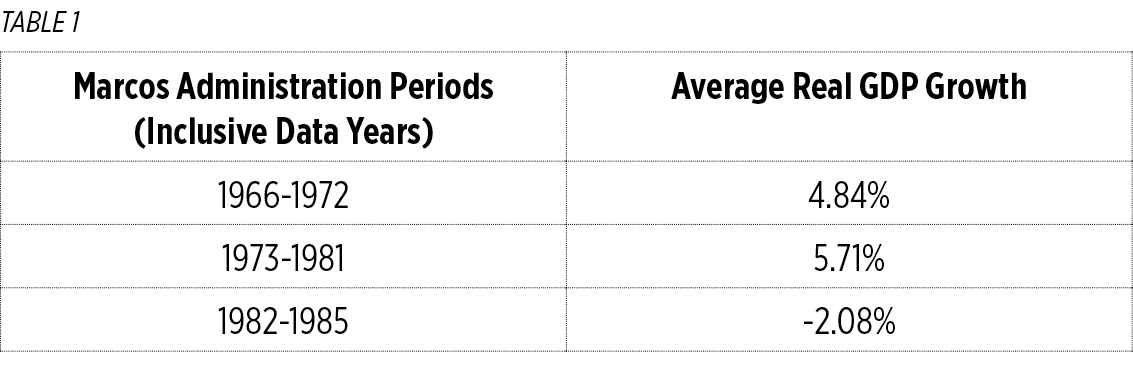
The most fervent of Marcos’ supporters will refer to his two-decade-long administration as being a “golden age” for the Philippine economy. They highlight the growth during the martial law years: From 1972 to 1981, the country grew at an average rate of 5.71%.

But from 1965 to 1985, the country’s real GDP only grew at an average annual rate of 3.85%. (See Table 1.) Economists would also argue that the authoritarian political climate, along with insecure property rights, widespread corruption, and unproductive, fraudulent debt led to an inevitable economic collapse. During the final years of the Marcos regime, the economy crashed with negative growth of 7.04% in 1984 and -6.86% in 1985.

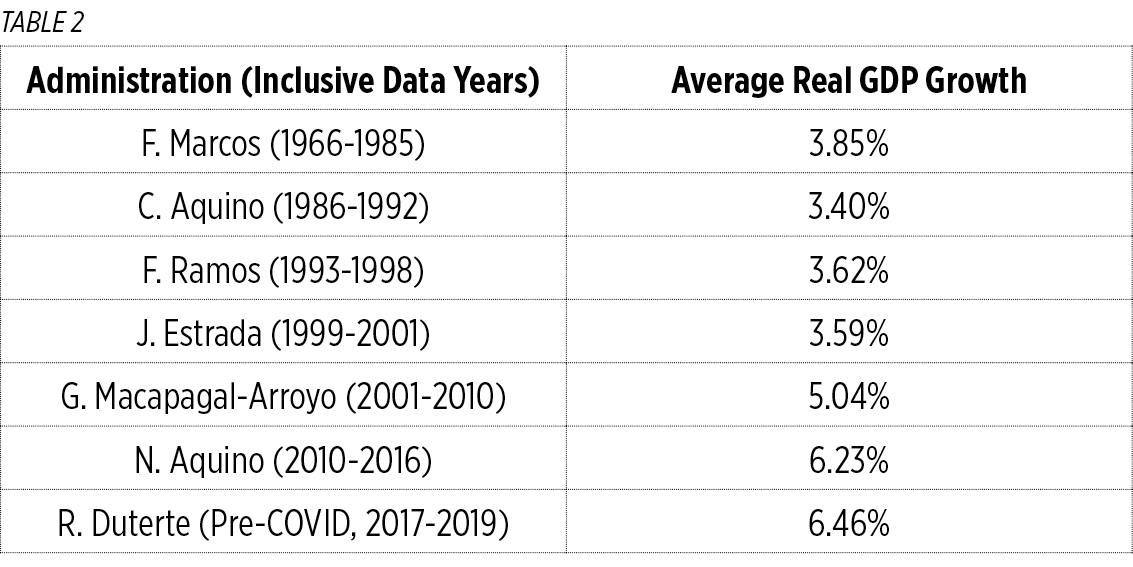
The adverse economic impact was so significant and deeply rooted that the Philippines became the “Sick Man of Asia” for two decades. Consistent high growth came only 25 years later during Noynoy Aquino’s term and continued into the Duterte administration (at least for the pre-pandemic period). (See Table 2.)

However, Marcos propagandists have been spreading disinformation since the fall of the dictatorship. The Marcos propaganda is falsifying history, including the economic narrative. Presidential candidate Bongbong Marcos’ economic platform is hollow. The crux of his campaign strategy is to conjure up the mythos of his father’s “economic golden age.”

Marcos apologists might squabble over economic data by pointing to above-average growth during martial law. They might cite alternative measures of economic prosperity such as gold reserves, past prices relative to today, or peso-dollar exchange rates. They might also point out external factors, such as global crises and shocks which contributed to the economic downfall.

But the initial growth was superficial and inevitably turned into a disaster. While the evidence unmistakably demonstrates Marcos’ economic failure, one must also evaluate the underlying policies of the late dictator’s supposed golden age. What kind of framework drove Marcos’ economic regime?

MARCOS CRONYISM
When Marcos’ cronyism is brought up, his supporters contend that successful East Asian economies employed a similar economic model of rewarding concessions to select businessmen and entrepreneurs. If this were truly the case, then why did countries like South Korea and Japan manifest economic success and resilience to external crises while the Philippines stagnated and collapsed?

The answer is that Marcos’ economy was fundamentally different from the industrialized counterparts in East Asia. One might mistake the Korean chaebol or Japanese zaibatsu as being comparable to Marcos’ crony conglomerates in the Philippines, but these are completely different animals.

During their industrialization stages, South Korea and Japan provided initial strategic investments, conditional financial support, and temporary trade protections to family-owned conglomerates. A nuance of this industrial policy is that it focused more on strategically weeding out losers rather than simply “picking winners.” The result was globally competitive manufacturing giants such as Hyundai and Samsung in South Korea and Toyota and Sony in Japan.

Contrast this to Marcos who picked cronies in the form of relatives, fraternity brothers, and other close friends and associates to become “winners” by assuming government positions, amassing land, establishing monopolies, and receiving government subsidies and protections. Most of these monopolies were simply milking cows which guaranteed profits for their owners, but were not expected to compete or develop in the long run.

East Asian tigers protected manufacturing firms through industrial policy, but they also subjected these firms to domestic competition and export-oriented discipline. The Philippine situation under Marcos was a stark contrast as crony firms were simply shielded from competition. Marcos’ biggest cronies, like Roberto Benedicto, Danding Cojuangco, and Antonio Floirendo, monopolized the sugar, coconut, and banana markets, respectively. (Note also that these were primary commodities for exports, unlike those in tiger economies which were export manufacturers.)

The result was not a golden age of competitive Filipino industry, but rather the creation of a new group of monopolists, some of whom still maintain economic influence in the country to this day.

DEBT-DRIVEN GROWTH, MISPLACED PRIORITIES, AND PROFLIGATE SPENDING
An ostensible function that such cronyism served was to appease the elites in order to maintain a political foothold. A similar motivation was behind the big-ticket construction projects such as cultural centers, luxury hotels, and other tourist attractions. These edifices may have carried the optics of progress and served as political propaganda but did very little towards the country’s long-term development. Even worse is the fact that these exorbitant projects were funded through large foreign loans.

The most egregious of the foreign debt was the $2.1-billion Bataan Nuclear Power Plant loan. The transaction was marked by fraud (overpricing and commissions) and was deemed unsafe (unmet specifications).

Aside from wasteful pet projects, resources were funneled towards personal extravagance. A vivid example of this was Marcos’ takeover of Philippine Airlines (PAL) in 1972. One American news outlet documented how Imelda Marcos is alleged to have racked up an unpaid personal bill to PAL worth over $3 million. British writer Caroline Kennedy, who personally knew the Marcoses, recounted how Imee Marcos had used PAL to deliver her breast milk to her son in Manila while she was vacationing in Europe. Marcos had turned the country’s flagship airline into a glorified personal transportation service.

The fraudulent, unproductive loans, wasteful spending, and the high interest rates, exacerbated by the assassination of Ninoy Aquino, caused the crisis and the bankruptcy of the country’s Central Bank in 1983. The Marcos’ debts remained a burden for generations of taxpayers to come. By 1986, the country’s debt obligations amounted to over 57% of GDP — nearly 40 percentage points higher than the 18.7% debt ratio recorded just 10 years earlier.

Clearly, internal factors like fiscal irresponsibility, profligate elite consumption, and uncontrolled corruption rendered our country vulnerable to external shocks. The debt-driven economy turned into a debt crisis.

THE HIDDEN SIDE: CORRUPTION, WASTE, AND FAMINE
A striking feature of the Marcos economy was how the enrichment of cronies clearly contrasted with worsening economic conditions for the rest of the population. By the end of the Marcos regime in 1985, poverty incidence was estimated to be 44.2% — nearly half of Filipinos were impoverished!

The coconut industry served as a primary source of exports along with sugar. In 1973, Marcos established the Philippine Coconut Authority (PCA) and created the Coconut Industry Investment Fund (CIIF). This coco levy fund, which was sourced from a tax on coconut farmers, was intended to “promote the rapid integrated development and growth of the coconut industry.”

Instead of benefiting farmers, however, the fund was used by Danding Cojuangco to purchase shares of the San Miguel Corp. (SMC) as well as six oil mills. Cojuangco, who had a close relationship with Marcos, channeled the funds through the United Coconut Planters Bank (UCPB). By 1982, it was estimated that a cumulative P70 billion had been paid by coconut farmers through the levy. So, while coconut farmers and the agricultural sector at-large remained mired in poverty, Cojuangco went on to become one of the wealthiest and most powerful businessmen in the country.

Consider also the Negros famine that occurred in 1984-85. In the mid-1970s the local sugar industry had already been feeling the adverse effects of global market forces and Marcosian cronyism only served to make the industry more fragile and accelerate its collapse.

In 1974, Marcos appointed Roberto Benedicto to be the chief of the National Sugar Trading Corp. (Nasutra) as well as the Philippine Sugar Commission (Philsucom). This made Benedicto preside over the sugar monopoly. However, instead of helping local sugar farmers to diversify their livelihoods and become more viable, Benedicto gambled on higher future sugar prices and hoarded large stocks of sugar looking to sell them at a profit later on.

The sugar market crashed and the resulting losses from having to sell the underpriced sugar hoards were passed on to the farmers. This led to massive unemployment and crippling debt, and widespread hunger. During that period, an estimated 40% of children under 14 in Negros or about 350,000 children suffered from malnutrition. Infant deaths shot up by 67% from 1984 to 1985.

Once the layers of outward extravagance and artificial prosperity are peeled, they reveal widespread corruption and cronyism, unsustainable debt, heightened poverty, and economic bust. All that is the rotten core of Marcos’ economic legacy.

References:

GDP Data: https://psa.gov.ph/national-accounts/base-2018/data-series

On Central Bank bankruptcy: https://www.philstar.com/business/2022/02/16/2161033/bankrupt

On Bataan Nuclear Plant: https://www.latimes.com/archives/la-xpm-1986-06-12-mn-10222-story.html

On Philippine Airlines: https://www.washingtonpost.com/archive/politics/1978/04/23/marcos-seizes-airline-that-billed-wife/b7ff03de-69cb-40fb-b53c-cb754cfa89ad/

https://lefthandedlayup.com/2021/10/22/imee-marcos-used-pal-as-an-express-service-to-deliver-her-breastmilk-daily-from-europe-to-manila/

On Negros famine: https://www.esquiremag.ph/long-reads/features/negros-famine-of-the-1980s-a00289-20210415-lfrm2

https://www.chicagotribune.com/news/ct-xpm-1985-11-24-8503210570-story.html

https://www.washingtonpost.com/archive/politics/1986/09/21/poverty-on-negros-island-breeding-filipino-rebels/2ebf1306-3422-4945-b439-18a7952fc055


AJ Montesa is a research associate of Action for Economic Reforms.

Pivot to fighting inflation from fighting COVID

FREEPIK

Pretty soon, we will be looking at the COVID pandemic in the rear-view mirror. COVID may still be around, debilitating people and even causing deaths, but it won’t be the unknown and fearsome menace it once was. Not only has mankind developed vaccines and lessened its sting, but also doctors now know how to treat it, with old and new medicines. Down the road, there will be nasal vaccines, omni-variant vaccines, more anti-inflammatories, and antibody treatments, as well as protease inhibitors.

It’s time to have a new worry, and that is inflation. Unlike COVID, which strikes only a certain percentage of people, inflation harms everybody, rich or poor, healthy or unwell, young or old.

How much should we worry? Well, like the pandemic, the menace is global. The US hit a 7.8% inflation rate, the highest in 25 years. Europe, which had been struggling against deflation for years, experienced 5.1% inflation in January. The rise in oil prices on top of supply chain issues compounds the worldwide problem of inflation.

While the Philippine headline inflation rate eased to 3.2% in January, it’s no reason not to worry.

Firstly, the inflation rate is a measure of the rate of increase, but the higher base may already be embedded in the economy. Effective February, the Department of Trade and Industry (DTI) has approved higher SRPs or suggested retail prices for several basic goods, including sardines, bread, processed meat, and bottled water.

Due to higher input costs, the DTI had no choice but to allow manufacturers to raise prices for several SKUs or self-keeping units for essentials like milk, bread, batteries, detergents, and soaps.

With higher oil prices due to limited production imposed by OPEC and a geo-political disruption caused by the war in Ukraine, there’s increasing concern about another spike in domestic inflation.

However, most of the inflation is currently coming from higher food costs, which hurt the poor the most. According to Dr. Bruce Tolentino, an agricultural economist and member of the Monetary Board, food contributes to 47% of inflation. Since the RTL or Rice Tariffication Law, rice has been a net zero contributor to inflation. On the other hand, meat and fish prices have become major drivers of inflation.

SWS surveys reveal that inflation is the number one problem identified by respondents.

However, our fight against inflation is different from that of the US and advanced countries. In the case of the US, the government adopted both hyper-expansionary monetary and fiscal policies at the same time in response to the pandemic. The result has been the US’ highest inflation in 47 years.

In our case, fiscal spending has been disciplined although monetary policy had been loose to counter the recessionary effects of the pandemic. Inflation has been mostly supply-driven. Data shows that meat and fish prices have been the main drivers of inflation in recent periods. Supply has often fallen short of demand. Therefore, in this scenario, a tight monetary stance or higher interest rates may be the wrong prescription and may prolong the damage wrought by the pandemic.

What is causing the supply constraints of meat and fish?

In the case of pork, the African Swine Fever outbreak has decimated hog populations and caused the spike in pork prices. Small hog producers are especially vulnerable to the virus as they don’t have the management and technology to adopt biosecurity protocols.

However, another factor is in play in both chicken and pork prices: the high cost of domestic yellow corn. The Philippines has the highest domestic corn prices in the ASEAN. Since corn is the major ingredient in the feedstock for poultry and hogs, accounting for about 60% of the cost, domestic chicken and pork cost more.

According to Dr. Karlo Adriano, an agricultural economist, Filipinos are paying more than double for pork compared to Thailand and 70% more compared to Vietnam. We are also paying more than double for chicken compared to Thailand and 40% more compared to Vietnam.

The high domestic prices for meat lead to tremendous welfare losses. The biggest negative effect is on children and teenagers, where protein malnutrition is most pronounced. Citing studies by nutrition scientists, Dr. Adriano says that 47% of Filipino teenagers suffer from inadequate protein intake. He says this is probably the reason why Filipino teenagers perform poorly on the PISA (Program for International Student Assessment) test compared to their global peers. Studies show a high correlation between poor performance and meat prices.

We can’t import more corn to alleviate the supply shortage and reduce prices because importation is tightly controlled by the government. Corn imports are subject to quantitative restrictions. Under the MAV (minimum access volume) system, in-quota tariff is set at 35% while out-quota tariff is set at 50%.

Farmer groups oppose more importation because they say they can’t compete with imports. However, the status quo is untenable. Food-caused inflation exacerbates protein malnutrition in children and teenagers and makes the economy uncompetitive. If our workers pay more for food, then naturally their wages will have to be higher than that of their regional peers. Industries, from fast food retailers to food manufacturers, will also suffer from higher cost structures.

The way forward is to adopt the RTL model, i.e., liberalize the importation of corn and impose tariffs where the revenue from the tariffs can be channeled to increasing productivity. Contrary to the zombie scenario peddled by the protectionists, the RTL didn’t result in many farmers going bankrupt. On the other hand, productivity increased, and domestic rice prices stabilized, leading to rice prices being a zero contributor to inflation.

Incidentally, perhaps one reason why President Rodrigo Duterte enjoys high popularity ratings compared to his predecessors, is because of the decisive action he took to dismantle the NFA (National Food Authority) rice import monopoly and thereby stabilized rice prices. Politicians, therefore, should take note: pandering to the protectionist crowd is not being politically smart.

Being politically smart is lowering the prices of food, which the country can do if it just liberalizes corn importation and reduces the tariff to 5%. (Vietnam’s corn tariff is 4%.) Dr. Adriano calculates that if the price of corn were like that of Thailand, pork prices would fall by 15% and chicken prices by 36%. I can’t think of a political winner more than that of reducing the price of food.

The country, being a net importer of oil, can’t do anything about the surging high oil prices. Instead of reducing oil taxes, which will widen our fiscal deficit and do great damage to the economy, the government can offset the sting of high oil prices by lowering the price of food. It has the power to do so by liberalizing corn importation.

What will happen to our corn farmers then? Instead of coddling them, the government must prepare them to compete as it has with the Rice Tariffication Law. But throwing money at the problem isn’t going to solve the issue because the biggest structural problem is still land fragmentation.

We must deal with this reality: the average farm size is one hectare. The average age of farmers is 54. The average educational level is Grade 5. Most of them can’t make enough from their farms and therefore must do off-farm work. In other words, they are just part-time farmers. Unless the structure of our agricultural sector is changed, food productivity and security will not be attainable. We must change the structure toward bigger, more modern commercial farms operated by professional managers or family members.

What should be the safety net for displaced farmers? The only sustainable safety net for unproductive farmers is to move them to paid farm or food processing work in bigger, more productive farms or agro-industrial estates. They can then receive fair, stable wages with social security benefits. They will be better off than if they were earning an average gross income of P24,000 a year with all the risks, from weather-related events to pest infestation, that comes from being a small farmer.

What is clear is that the status quo is unsustainable. The high food costs act as a drag to growth, impose generational welfare losses, and are probably seeding the persistent insurgency. We should start worrying more about food inflation now than we do about COVID. Inflation is the new pandemic.


Calixto V. Chikiamco is a member of the board of IDEA (Institute for Development and Econometric Analysis).

totivchiki@yahoo.com

A triumph in sustainable tourism

RON ATORY-UNSPLASH

Sustainable tourism is achieved when there is a balance between the interest of the economic stakeholders, the local community, cultural monuments, and the environment. One should never prosper at the expense of the other.

As summer approaches and with COVID-19 restrictions relaxed, we anticipate a spike in local and foreign tourism. The temptation to prioritize the economic interest of tourism-related businesses is strong given the need to recoup the losses accrued during the lockdown. But we must resist. It is incumbent upon the local government units (LGUs) to ensure that the environment and our cultural sites are not overrun by tourists. It is the LGU’s responsibility to ensure that the economic benefits of tourism trickle down to the local community.

We often hear about environmental disasters brought about by tourism. We are all too familiar with the garbage problem of Baguio, the sewage problem of Boracay, and the traffic problem of Cebu. Rarely do we hear success stories.

Last week, I was privileged to witness a triumph in sustainable tourism in the province of Camiguin. There is a wealth of lessons we can learn from the Camiguin model.

Camiguin is an island province in the northern tip of Mindanao. It is the country’s second smallest province in terms of size, following Batanes. With a population of 92,000, Camiguin is among the least populated provinces in the country, with only 390 people per square kilometer (for context, Metro Manila has a density of 21,000 per square kilometer). Urbanization has not tainted the island as its economy remains largely driven by agriculture and tourism.

As a tourism product, Camiguin is a quadruple threat. It is an island surrounded by the Bohol Sea which has endowed it with spectacular beaches of varying colors of sand. It is the ideal place for snorkeling, what with its sanctuary of giant clams and an underwater cemetery. Within the island are 11 mountains, the highest of which is the scenic Mount Mambajao. The daily deluge of fog in the mountaintops is thicker than what you will find on a chilly December day in Baguio. There are seven volcanoes in the province, and one of them, Mount Hibok Hibok, remains active. It last erupted in 1953, spreading nutritious fertilizer across the island in the form of lava and lahar. As a result, the entire island is lush with flora and fauna. It is as thick as what I have seen in Costa Rica (where the movie Jurassic Park was filmed). The island boasts of natural wonders like 70-meter waterfalls alongside historical sites like 17th century church ruins. As far as eco-tourism goes, Camiguin is a diamond product.

Sustainability starts and ends with leadership. Governor Jurdin Jesus (JJ) Romualdo may be the most jovial person on the island, but make no mistake, this public servant of 35 years is adamant about maintaining a balance between economic interests and environmental protection. Camiguin will be model eco-tourism destination for the country, he declared, and our policies are geared towards achieving that equilibrium.

Sustainability begins with infrastructure. Even before the tourism boom of 2015, Camiguin had already invested in its roads and a sewage system. A wide circumferential road links the major barangays of the island with an equally wide network of secondary roads that take you to the interior. All roads are beautifully paved, including those that lead to the mountain tops. Landslide barriers are replete along steep mountainsides.

Torrential rains hit the island during our visit but there was no flooding whatsoever. Still, the province is already upgrading its sewage system in anticipation of greater demand.

In terms of electric power, the province consumes approximately six megawatts of electricity, all of which are derived from diesel and coal sources. That will soon change as five megawatts of solar power is already under development. When completed, the province will derive 40% of its power through renewable sources and allow it to operate on a power surplus. At present, rotational brownouts are still common. Within the next five years, however, the local government plans to develop more renewable power plants so it can export excess power to mainland Mindanao.

As for water, Camiguin’s main sources are springs and groundwater tapped through shallow and deep wells. There are five major river channels that provide irrigation for the agricultural sector. Camiguin Water Company, a subsidiary of Mizu Resources, Inc., handles the water distribution of the island. Last year, it invested P400 million to fill the 21 liter per day gap in water distribution. When completed, water service will be available in practically all parts of the island, which will be sufficient for the next 25 years.

Governor Romualdo is a benevolent disciplinarian, especially when it comes to cleanliness. The local government imposes stiff fines for littering which is why the entire province is as clean as Singapore (no exaggeration!). Eating is prohibited on beaches where waste processing facilities are absent. The governor is an advocate of sustainable waste incineration and recycling as they do in Japan.

Camiguin will not go the way of other tourist destinations where retail is dominated by Manila-based chains. The governor reserves the retail trade for the locals so they can be the first to benefit. Even now, the island boasts of exceptional shops and restaurants owned by locals and/or adopted residents, the latter mostly composed of retired foreigners. Exceptionally good are Mason Peninsular Spanish restaurant, La Dolce Vida Restaurante Italiano, and Pedro’s Filipino restaurant.

Aesthetically, the island will always keep its rustic character. The governor prohibits buildings that are above five stories high and those that fail to conform with strict environmental guidelines.

Camiguin is a triumph in sustainable tourism even with its one million pre-pandemic visitor arrivals. It just shows that economic interest and environmental protection can co-exist in harmony.


Andrew J. Masigan is an economist

andrew_rs6@yahoo.com

Facebook@AndrewJ. Masigan

Twitter @aj_masigan

Filipino-owned ADAMCO raises P1B via note issuance of Development Bank of the Philippines and Security Bank

Left to right: Divino Lorenzo F. Villanueva III, Director GIV Capital Holdings Corporation; Jeffrey D. Ligsay, AVP - Trust Banking Group Development Bank of the Philippines; Ma. Felicia S. Magtibay, SAVP - Trust Banking Group Development Bank of the Philippines; Francis Nicolas M. Chua FVP - Corporate Finance Group Development Bank of the Philippines; Virgilio "Vio" Chua, President SB Capital Investment Corporation; Jorge Lindley Ong, SVP and Head of Banking Centers Group; Virginia "Babet" Del Rosario, VP and Head of Ortigas Banking Center 1; Paul D. Lazaro, SVP - Head of Development Lending Sector Development Bank of the Philippines; Emmanuel G. Herbosa, President and CEO Development Bank of the Philippines; Conrado A. Gloria Jr., President and CEO GIV Capital Holdings Corporation; Roberto P. Alingog, Chairman of the Board ADA Manufacturing Corporation; Ada Alethea A. Alingog-Nanayakkara, President and CEO; Maritess Gallardo, Chief Finance and Administrative Officer; Charles M. Rodriguez, EVP and Head of Wholesale Banking Segment.

Leading agricultural machines and equipment dealer Ada Manufacturing Corp. (ADAMCO) has successfully raised P1 billion via the issuance of notes supported by state-run Development Bank of the Philippines and Security Bank Corp.

The proceeds of the fund raising activity via the issuance of five-year corporate notes arranged by GIV Capital Holdings Corp. will be used to finance ADAMCO’s capital expenditure and working capital requirements related to the development of its branch network.

ADAMCO founder and chairman Roberto Alingog thanked GIV Capital, DBP and Security Bank for supporting the advocacies of the company.

“My firm belief is that agriculture should be taken as a promising business, and not as a dreaded occupational destination of the children of farmers. We do this by providing access to top-notch equipment with reasonable financing terms. With this fundraise, we will further solidify our presence in the industry and show the country at large a simple truth — that farmers can make money in modernized farming,” Alingog said.

ADAMCO provides a beacon of hope with their simple, powerful solution: the farmer as entrepreneur. It drives forward this solution, a paradigm shift, by presenting to the farmer-entrepreneur that he can make a profitable business from his agri-machinery acquisition by using these to provide services to his fellow farmers in land preparation, tilling, transplanting, and harvesting.

The agricultural machines and equipment distributor also makes acquisition happen quickly in 37 branches located in the top rice-producing regions nationwide.

Both DBP and Security Bank provided the funding to ADAMCO, heeding the call of the national government for banks to devote part of their lending portfolios to support agriculture.

“DBP shares the vision of ADAMCO in promoting modernity and technological advancement in the agricultural sector, and in providing our farmers access to modern agricultural machinery. Like ADAMCO, we also believe that modernization is a key element to agricultural productivity, which is why it is our honor to be a part of this funding activity that aims to benefit our Filipino farmers and agripreneurs.”, says Emmanuel G. Herbosa, President and CEO of DBP.

Security Bank believes that its funding extension to ADAMCO will go a long way in supporting our farmers who produce our food. This is also a clear way of responding to the call of government for the Banks to devote part of their portfolio to support the Agriculture industry. “This Corporate Notes Facility is an important milestone in ADAMCO’s mission to help transform the agricultural sector, and we look forward to support the company in its future endeavors. We’re proud to support these projects that align with our mission to enrich lives, empower businesses, and build communities sustainably through financial service excellence.” shares Charles M. Rodriguez, Executive Vice President and Head of Wholesale Banking Segment of Security Bank.

GIV Capital Holdings president and CEO Mr. Conrado Gloria Jr. said much work still needs to be done when it comes to helping the agriculture sector in the Philippines.

“This transaction is only the beginning for ADAMCO. Its mission of spurring development at the grassroots level of agriculture is of utmost importance to the country, and ADAMCO’s unique approach, the farmer as entrepreneur, is a transformative one,” Mr.Gloria said.

New initiatives from both the private and public sector are needed to fully address the food security issues the country.

At least one player is raring to take on the challenge. “For as long as people will eat, there will be agriculture and for as long as agriculture is needed to provide the food, there will be ADAMCO,” Mr. Alingog vowed.

ADAMCO had its humble roots in the 1970’s after its founder witnessed the lack of the simplest motorized equipment in his home province of Isabela.

Alingog said mechanization is key in rice farming and the Rice Combine Harvester (RCH) is a hit among farmers. On top of reducing harvesting losses at an average rate of 10 percent through a superior process, the RCH also further reduces harvesting losses because of the attendant timeliness and speed.

Prior to the introduction of RCH, 25 farm laborers are needed to harvest one hectare in one day. Despite promises made by labor contractors to bring 25 farm laborers, they end up bringing only five people thereby delaying harvesting.

“Like any fruit, palay grain when matured, falls to the ground. This is called splintering. Palay has a splintering rate of two percent per day. Hence, the delay caused by the lack of enough manpower results into substantial losses to the farmer,” Mr. Alingog said.

According to Alingog, the labor shortage situation is partly explained by the planting schedules that are aligned with the availability of water from the irrigation.

“When irrigation dams have enough water and is released for field irrigation, all the irrigation beneficiaries start to till. Hence, they also all harvest within a narrow period of time. It is to a farmer’s advantage if he goes along with the schedule otherwise if he is late in planting and late in harvesting, all the pest in the surrounding harvested fields will converge on this remaining unharvested field causing high losses for the farmer,” Mr.Alingog said.

Federico De Guzman, product development director at ADAMCO, also debunked claims that agri-machinery displaces farm labor, resulting to massive unemployment in the countryside.

De Guzman said that there has been no report that there was indeed a large displacement of farm labor resulting into massive unemployment since the start of mechanized agri-machinery adoption in the 1970s.

Instead, what was observed ever since was that farm labor had always been in short supply.

“One reason was that farming families did not want (and still do not want) their children to become traditional farmers who with manual labor till the farms,” De Guzman explained.

Instead, farmers want to send their children to become employees in other industries or even to become overseas Filipino workers (OFWs).

“Hence, the farmers who grow old and retire are not replenished in the same rate resulting to fewer and older farmers at a high average age of 57 years old. Hence, the perennial shortage of farm labor,” Mr. De Guzman said.

For her part, ADAMCO president Ms. Ada Alethea Alingog-Nanayakkara said that the company wants to elevate the country’s agriculture sector to the next level via mechanization.

“It is always very heart-warming to see the excitement in the eyes of the farmers when we deliver the agri-machinery to them and teach them how to operate the machines. Their feeling of going to the next higher level of economic life is intense and palpable,” Ms.Alingog-Nanayakkara shared.

Well-established Yanmar brand of Japan, manufacturer of a wide range of agricultural machinery like rice combine harvesters, tractors, and transplanters has tapped ADAMCO as its sole dealer in the Philippines.

“We’re very pleased to see the strong growth that ADAMCO has shown since we established our partnership with them. The Philippine agriculture sector has so much untapped potential and we believe Yanmar and ADAMCO have found the right approach to mechanize the industry and help bring the country to the status it deserves,” Mr. Masatoshi Suyama, President of Yanmar Philippines Corporation (YPC) said.

For more information, visit their website at adamco.ph or at their Facebook page at www.facebook.com/adamcoph.


Spotlight is BusinessWorld’s sponsored section that allows advertisers to amplify their brand and connect with BusinessWorld’s audience by enabling them to publish their stories directly on the BusinessWorld Web site. For more information, send an email to online@bworldonline.com.

Join us on Viber to get more updates from BusinessWorld: https://bit.ly/3hv6bLA.

Malayan Colleges Laguna offers ‘hybrid flexible’ courses

The HyFlex course format is an instructional approach that combines face-to-face and online learning. Each class session and learning activity is offered in-person, synchronously online and asynchronously online. Students can decide for each class or learning module how to participate.

CABUYAO CITY — This month, Malayan Colleges Laguna, A Mapúa School launches the hybrid flexible, or “HyFlex,” courses that allow students to choose whether to attend classes face-to-face or online synchronously or asynchronously.

The HyFlex course format is an instructional approach that combines face-to-face and online learning. Each class session and learning activity is offered in-person, synchronously online and asynchronously online. Students can decide for each class or learning module how to participate.

On-site classes can be threatened by climate change, natural disasters (including tropical depression, floods, and earthquakes), health crises such as the COVID-19 pandemic, and other disruptions.

When campus reopens, students still face a range of uncertainties surrounding health and safety, financial concerns, and travel issues, among others.

The Malayan Colleges HyFlex model will maintain educational and research activities as the circumstances of a given disruption or personal concerns unfold. It also allows students to choose different learning modalities that work better depending on proximity to campus, work and family commitments, and other factors.

In HyFlex courses, students can choose from one of three participation paths:

  1. Participate in face-to-face class sessions in-person (in a classroom).
  2. Participate in face-to-face class sessions via video conference (Zoom and MS Teams).
  3. Participate fully asynchronously via MCL Learning Management System (LMS) powered by Blackboard Learn (BBL).

The system will make available to students all class meetings and materials online or in-person, during or after class sessions. Regardless of the path taken, all students will achieve the same learning objectives.

Malayan Colleges Laguna has outfitted its classrooms with video cameras and distributed microphones to create hybrid learning environments, or the HyFlex Classrooms.

Video conference software such as Zoom and MS Teams connect in-person and remote students to the synchronous learning sessions. All video conference sessions are recorded and uploaded to the MCL’s LMS powered by BBL.

“Our goal in offering HyFlex classes is to reduce learning barriers by providing equitable access and meaningful learning opportunities for all our students,” Dr. Dodjie Maestrecampo, president of Malayan Colleges Laguna, said.

“Our HyFlex classes reconceptualize the learning experience and rethink how students engage with their teachers, learning content, and peers,” he added.

Selected HyFlex courses will start in the third term of A.Y. 2022-2023 (March 2022) during the implementation of limited face-to-face classes. All relevant courses will utilize the HyFlex approach starting A.Y. 2022-2023 (August 2022).

Visit mcl.edu.ph/mcl-hyflex for more details about unparallel flexibility in learning. Learn more about Malayan Colleges Laguna at www.mcl.edu.ph/confirm-ask-us/.


Spotlight is BusinessWorld’s sponsored section that allows advertisers to amplify their brand and connect with BusinessWorld’s audience by enabling them to publish their stories directly on the BusinessWorld Web site. For more information, send an email to online@bworldonline.com.

Join us on Viber to get more updates from BusinessWorld: https://bit.ly/3hv6bLA.