Home Blog Page 6186

Suzuki Auto Mactan reopens as a 2S facility

PHOTO FROM SUZUKI PHILIPPINES, INC.

SUZUKI PHILIPPINES, INC. (SPH) has announced that the construction work on Suzuki Auto Mactan in Cebu is now complete. The facility now boasts its own after-sales service department ready to provide assistance to its patrons.

Suzuki Auto Mactan is located in Mactan Breeze, Soong, Lapu-Lapu City — standing on a 100-sq.m. lot and boasting a 48-sq.m. showroom that can accommodate two vehicles for display. Operated by Cebu Autocentrale and Suzuki Philippines, the facility’s launch was livestreamed via Suzuki Auto Cebu’s Page through Facebook Live. Said SPH General Manager for Automobile Norihide Takei, “The demand for our products and services in Cebu makes it evident that the dedication of our partner, Cebu Autocentrale Corp., continues to be recognized by our patrons. This partnership is testament that the market’s support toward our brand reaches across islands and braves distances. We will continue to be the reliable mobility partner especially in areas that are vital for the development of the Philippines as a country.”

For inquiries, call at (032) 263-7878. For further information, visit any of the 74 authorized Suzuki Auto dealerships nationwide or http://suzuki.com.ph/auto/. For daily updates on Suzuki, like Suzuki Auto Philippines’ Facebook page at https://www.facebook.com/SuzukiAutoPh, follow on Twitter at https://twitter.com/SuzukiAutoPh and Instagram at
@suzukiautoph.

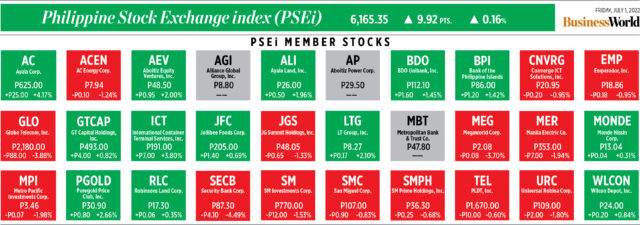
How PSEi member stocks performed — July 1, 2022

Here’s a quick glance at how PSEi stocks fared on Friday, July 1, 2022.


Business chambers endorse Trade dep’t position on joining RCEP, MSME support

REUTERS

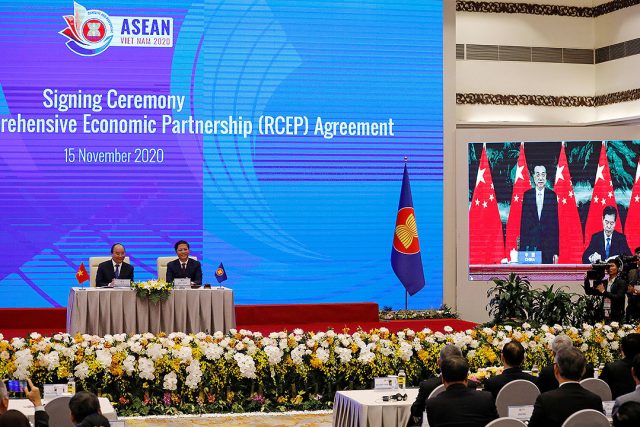
TRADE Secretary Alfredo E. Pascual’s intention to join more free trade agreements received backing from major business chambers, who declared support for participating in the Regional Comprehensive Economic Partnership (RCEP).

Makati Business Club (MBC) Executive Director Francisco Alcuaz, Jr. said in a mobile phone message that the MBC supports Mr. Pascual’s plan to push for immediate RCEP ratification.

“We believe RCEP’s ratification is an important part of the open-for-business story we recently advanced with (the amended) Public Service Act (PSA), Retail Trade Liberalization Act, and Foreign Investments Act (FIA),” Mr. Alcuaz said.

British Chamber of Commerce Philippines Executive Director Chris Nelson said by mobile phone that while the priorities of the new Trade chief are generally on the right track, the Department of Trade and Industry (DTI) needs to push for further economic liberalization.

“We’ve seen (liberalization in) three key legislation that were passed, (amendments to the) Retail Trade Liberalization Act, the FIA, and PSA. We’d like to see that momentum continue,” Mr. Nelson said.

“I had a one-on-one discussion (with Mr. Pascual) and we agree on these priorities,” Philippine Chamber of Commerce and Industry President George T. Barcelon said.

Mr. Pascual announced his priorities during the DTI’s turnover ceremony on July 1.

“We will continue to push for the immediate ratification of the RCEP agreement and other trade agreements… These agreements will diversify the country’s exports… and enhance the country’s attractiveness to foreign investment,” Mr. Pascual said.  

RCEP failed to obtain Senate approval in the 18th Congress after some senators objected to the lack of protections for parts of the farm industry. It is now up to the 19th Congress to decide on RCEP ratification. The session is set to open on July 25.

RCEP, which started taking effect on Jan. 1 in jurisdictions that approved it early, involves Australia, China, Japan, South Korea, New Zealand and the 10 members of the Association of Southeast Asian Nations.

Mr. Pascual also expressed his intent to sustain the development of micro, small, and medium enterprises (MSMEs) and improve the food value chain.  

Calling MSMEs “the backbone of our economy,” he said he wants to “enable small businesses to grow and graduate from micro to small, from small to medium, and from medium to large.”

“To help address food security challenges, we will collaborate with the Department of Agriculture to improve the food value chains through upgraded transport and logistics facilities, including cold storage and cold chain facilities (and) increased community value adding,” he added.

“Increasing production and untangling bottlenecks are the effective way to fight inflation. Price controls and delayed suggested retail price adjustments will only squeeze production and result in actual, serious shortages,” the MBC’s Mr. Alcuaz said. — Revin Mikhael D. Ochave

GOCC subsidies decline 82.31% as NIA gets P6.2B

NATIONAL IRRIGATION ADMINISTRATION PHOTO RELEASE

SUBSIDIES provided to government-owned and -controlled corporations (GOCCs) declined by 82.31% year on year to P7.905 billion in May, the Bureau of the Treasury (BTr) reported.

Budgetary support to GOCCs also fell 54.49% compared to the April total. They amounted to P32.296 billion in the year to date, according to preliminary data from the BTr.

Subsidies are granted to GOCCs to cover operational expenses not supported by their revenue.

The National Irrigation Administration (NIA) was the top beneficiary, receiving P6.262 billion or 79.22% of total subsidies in May. The NIA received P1.303 billion in April providing a low base for the 380% month-on-month rise.

The National Housing Authority (NHA), the National Food Authority (NFA), and the National Privacy Commission were among the major non-financial GOCCs that did not receive subsidies.

The NFA was the top beneficiary in April, when it was given P2.055 billion. The NHA was the top beneficiary in March, when it received P2.979 billion.

The Light Rail Transit Authority received P6 million, down 97.6% month on month.

Other top recipients in May were the Civil Aviation Authority of the Philippines (P400 million), the Small Business Corp. (P200 million), the Philippine National Railways (P161 million), and the Philippine Heart Center (P147 million).

Other GOCCs that were given more than P50 million were the Philippine Children’s Medical Center (P115 million), the National Kidney and Transplant Institute (P107 million), the Philippine Coconut Authority (P74 million), the Local Water Utilities Administration (P61 million), and the Lung Center of the Philippines (P58 million).

Other GOCCs that received no subsidies during the month were the Bases Conversion and Development Authority, the Philippine Crop Insurance Corp., the Philippine Fisheries Development Authority, the Subic Bay Metropolitan Authority, the Social Housing Finance Corp., and the Sugar Regulatory Administration.

The year-to-date subsidy total was down 59.6% from a year earlier. The top recipient year to date was the NIA, which was given P15.263 billion, the most of any GOCC, accounting for 47.26% of all subsidies.

This was followed by the NFA and the NHA, which got P3.243 billion and P3.194 billion respectively.

Government subsidies to GOCCs totaled P184.77 billion in 2021, a 19.3% decline from the previous year. In 2021, the Philippine Health Insurance Corp. received P80.98 billion, nearly 44% of the total. — Diego Gabriel C. Robles

Agri policy needs more bottom-up planning to meet farmers’ needs, study concludes

PHILIPPINE STAR/ MICHAEL VARCAS

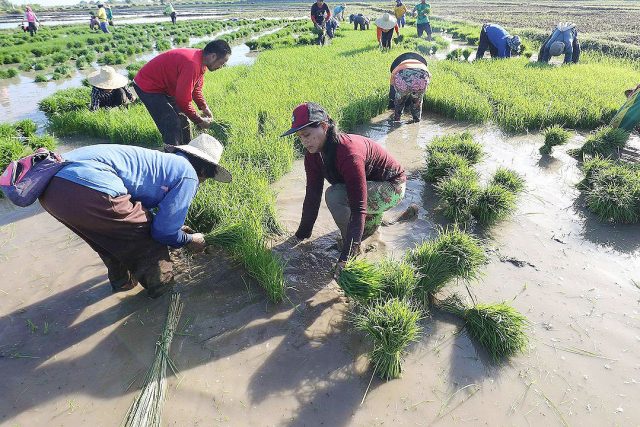
AGRICULTURE and fisheries planning needs to be more “bottom-up” to better meet the needs of farmers and fisherfolk, steering away from “top-down” programs imposed from above, especially those concerning rice, according to a study by the Philippine Institute for Development Studies (PIDS).

According to the report, in order to pursue modernization, the government must abandon elements of traditional industrial policy.

Another recommendation is to terminate expenditure programs based on distortionary subsidies to give way to funding a modern industrial policy for the agri-food system.

“There is also a need to apply area-based, bottom-up planning in determining strategic interventions to meet the needs of farmers and rural enterprises along the value chain,” the report’s author and PIDS Senior Research Fellow Roehlano M. Briones said.

“We must shift from a top-down and banner program-centric type of planning especially focused on rice as customary in many (Department of Agriculture) strategies and move to bottom-up planning and area-based approach as originally envisioned in the Agriculture and Fisheries Modernization Act (AFMA),” he said.

“In terms of the share of the agri-fisheries sector in the country’s gross domestic product, it declined to 9% in 2019 from 19% in 1990 then rose slightly to 10% in 2020 when the COVID-19 pandemic happened. The agriculture employment share shed 22 percentage points from 1991 to 2019,” the study found.

The study sought to track the effects or impacts of the AFMA since its passage in 1997.

The AFMA provides guidelines for the sustainable and equitable development of the agriculture and fisheries sector.

According to the study, growth in crops, the biggest subsector, started strong in the 2000s but slowed down over the past two decades, hindering the overall growth of agriculture.

The fisheries and livestock subsectors also suffered in the last decade. The poultry subsector, on the other hand, has been a consistent growth performer since the late 1990s.

Mr. Briones said that the interventions to further the modernization of agriculture since AFMA’s passage have fallen short.

“One is introducing an area-based approach to agricultural development planning based on delineated zones. However, the failure to properly delineate the strategic agriculture and fisheries development zones hindered the pursuit of this approach,” he said.

“The AFMA reinforced an ongoing market-oriented reform in the agricultural credit system. Although this resulted in a gradual shift in the source of small farmer loans from informal to formal lenders, smallholder agriculture financing remains inadequate,” he added.

Mr. Briones said many smallholder farmers are also unlikely to borrow from the formal sector because of documentary requirements as well as the lenders’ unwillingness to absorb risk and their perception of the high risk of agriculture. — Luisa Maria Jacinta C. Jocson

From war to wild weather, global crop problems point to years of high food prices

REUTERS

ERIC BROTEN had planned to sow about 5,000 acres of corn this year on his farm in North Dakota, but persistent springtime rains limited him to just 3,500 in a state where a quarter or more of the planned corn could remain unsown this year.

The difficulty planting corn, the single largest grain crop in the world, in the northern United States adds to a string of troubled crop harvests worldwide that point to multiple years of tight supply and high food costs.

Russia’s invasion of Ukraine, a major agricultural exporter, sent prices of wheat, soy and corn to near records earlier this year. Poor weather has also reduced grain harvests in China, India, South America and parts of Europe.

Fertilizer shortages meanwhile are cutting yields of many crops around the globe. The world has perhaps never seen this level of simultaneous agricultural disruption, according to agriculture executives, industry analysts, farmers and economists interviewed by Reuters, meaning it may take years to return to global food security.

“Typically, when we’re in a tight supply-demand environment you can rebuild it in a single growing season. Where we are today, and the constraints around boosting production and (war in) Ukraine … it’s two to three years before you get out of the current environment,” said Jason Newton, chief economist for fertilizer producer Nutrien Ltd.

United Nations Secretary-General Antonio Guterres said last week that the world faces an unprecedented hunger crisis, with a risk of multiple famines this year and a worse situation in 2023.

Ahead of a crucial North American harvest, grain seeding delays from Manitoba to Indiana have sparked worries about lower production. A smaller corn crop in the top-producing United States will ripple through the supply chain and leave consumers paying even more for meat than they already are, as corn is a key source of livestock feed.

Global corn supplies have been tight since the pandemic started in 2020, due to transportation problems and strong demand, and are expected to fall further. The US Department of Agriculture (USDA) expects end-of-season US corn stocks to be down 33% from pre-pandemic levels in September before this year’s harvest, and down 37% in September 2023.

In North Dakota, corn would normally be at least knee-high by mid-June, but only about two-thirds of the state’s crop had even emerged from the ground. It was late May before Mr. Broten was able to plant any corn, and he traded in his seed for shorter-season and lower-yielding varieties twice before finally deciding it was too late to plant more.

Ideally, he would have finished corn planting by the first week of the month. He could not wait any longer for fields to dry out. “We were pushing the envelope, working ground that was way too wet, just trying to get a crop in,” Mr. Broten said, noting that wheel tracks are still visible in his corn fields where his farm machinery compacted the saturated dirt.

“Our production goals for the farm are going to be way down,” he said. The slow spring planting pace already forced USDA to lower its national corn yield outlook last month by 4 bushels per acre. That cut alone slashed the US harvest potential by more than 9 million tons, or equal to almost half of China’s record US imports last year.

The Biden administration moved to encourage planting as a means to temper food price inflation, already the highest in decades. The government lifted restrictions on planting on environmentally sensitive land, increased funding for domestic fertilizer production and made more counties eligible for insurance for planting a second crop this year.

But the benefits have been minimal as conserved acreage is limited and the soil can be less productive, while farmers are hesitant to risk double-cropping when seeds and crop chemicals are priced so high. US farmers may also leave unplanted some 3.2 million acres earmarked for corn and instead file prevented planting insurance claims that can compensate them when weather prohibits planting, according to University of Illinois economists.

An abnormally large share of prevented planting corn acres will likely be in North Dakota, while crops that were planted have an “elevated risk of damage from an early-to-normal frost,” the economists said in a report.

The problems extend north across the border in Canada, where heavy snowfall through April was followed by a May rain storm that washed out Gary Momotiuk’s fields and forced him to relocate panicked cattle in the middle of the night.

“It was just wild how high the water was,” said Mr. Momotiuk, 49, who farms near Dauphin, Manitoba. “It was probably the first time we could catch fish right in the farmyard.”

In mid-June, Mr. Momotiuk still had 1,200 acres unplanted. He abandoned plans to sow profitable canola and wheat crops because they would not have time to mature, and hoped to seed barley to feed his cattle.

Manitoba, the third-biggest provincial grower of spring wheat and canola in Canada, left 880,000 acres unplanted, the most in eight years and representing 9% of the province’s insured farmland, according to its Agriculture department.

Cassandra Lepp, who farms near Rivers, Manitoba, said her family’s custom application business planted crops by airplane for other farmers for the first time in a decade after the spring rain deluge.

Seeding by air enables farmers to produce a crop in challenging times, but the practice is costly and can lack the precision of traditional planting on dry fields, resulting in seeds that fail to germinate and lower harvest yields. “It definitely seems like the weather is getting more extreme,” Ms. Lepp said. “We just have to pivot really fast.”

Farmers may struggle to rebound from this season’s challenges as costs for inputs, from fertilizers to fuel that runs farm machinery, remain elevated. Grain output may suffer if margin-squeezed farmers cut back.

Scott Kay, vice-president of US crops for BASF SE, warned a shortage of herbicide that protects crops from weeds would likely persist. Ukraine’s grain output could take years to rebuild after fighting wrecked crop handling, storage and shipping infrastructure in a country that accounted for as much as 17% of global corn exports and 11% of wheat exports before the war.

Even once the war ends, global grain supplies are likely to remain structurally tight, said Nutrien economist Mr. Newton. Efforts to slow climate change are driving up demand for crops to produce biofuels instead of food and China is importing dramatically more grain as it runs out of new land for agriculture, he said.

Juan Luciano, CEO of grain trader Archer-Daniels-Midland Co., expects global crop staples to remain in low supply for at least two years. The war will create a global wheat shortage for at least three seasons, according to Ukraine’s agriculture minister.

But North Dakota’s Mr. Broten is more concerned about next year. “We had opportunities to buy inputs at a decent price so those costs are not going to reflect this year’s production nearly as much as next year’s,” he said. “I’m looking to see substantial increases in my cost of production for an acre of corn.” — Reuters


Tradition and transformation in single family offices

(First of two parts)

Family-run businesses require structures that are necessary to ensure a smooth transition. In the Philippines, the wealth of ultra-high net worth families is often managed by holding companies or a trust, and not by a family office.

So, what is a family office and why is it important for ultra-high net worth families? A family office provides services specifically to meet the needs of high net-worth families. It is basically private wealth management for family assets and so much more. Apart from being a financial advisor, single family offices (SFOs) are usually involved in activities in furtherance of the family’s philanthropical objectives, succession planning, family governance, tax reporting and other compliance matters. It is often used as a structure to manage family wealth in developed countries such as Singapore.

In today’s high-pressure and fast-changing environment, the strategic role of the SFO continues to evolve, amplify and expand. EY teams recently engaged with more than 250 SFOs around the world with the goal of gathering and sharing deeper insights into their priorities in times of accelerating economic, social, and geopolitical disruption.

The EY SFO study was commissioned to determine how SFOs perceive their capabilities, how they can learn from best practices, and where they can see growth opportunities or market challenges.

The EY study aims to help SFOs innovate around purpose, priorities and legacy, creating and protecting long-term value while also optimizing family office strategy and operations. The key findings from the SFO study are based on focus areas shared by the respondents regardless of their location and function. They reflect the insights shared by the respondents to the survey as well as the actions that leading SFOs are taking to respond to the rapidly changing business environment to deliver long-term value and support to family office stakeholders.

The key findings of the survey are set out across four focus areas: (a) wealth and regulation; (b) digital transformation; (c) risk and reputation; and (d) strategy and governance. In the first part of this article, we cover wealth and regulation, and digital transformation.

WEALTH AND REGULATION
Policy changes have always had far-reaching implications to the strategy, structure and operations of SFOs. Changes in the wealth and regulatory landscape are impacting every aspect of family office planning, strategy, and execution with the pace of developments requiring the need for agility. Recently, external forces brought about by the pandemic, geopolitical uncertainties, economic trends and social considerations have further intensified a keen focus on family wealth profiles.

As an example, an increasing number of global jurisdictions are using tax policy and transparency initiatives as a platform to address broader economic and social policy issues. Moreover, many jurisdictions are reviewing how their tax policies and enforcement will evolve to secure higher revenue while remaining fair and competitive.

SFOs also shared concerns about how new virtual ways of working will raise new tax considerations for family members, family office employees and their broader business ecosystem. Family office principals and beneficiaries often lead an international lifestyle, so when that is combined with the new normal of virtual work, it comes as no surprise that as much as 72% of the respondents in the SFO survey cited the tax consequences of remote working as a concern.

One survey respondent shared how companies now need to be more transparent about their taxes to both tax authorities and shareholders, and how family offices and family businesses worry about long-term sustainability. If SFOs want to be sustainable for the next 50 to 100 years, they should consider avoiding any entanglement with cross-border tax issues.

In addition, SFOs have to manage a delicate interplay between increasing demands for transparency and obligations for additional reporting and the ongoing desire to maintain family and personal privacy. This is reflected in the study, where 67% of the survey respondents shared significant concern about three or more regulatory issues.

Their worries are not very different from corporate entities, especially in the Philippines. As much as 64% also shared that they were not very confident that their tax operations are high performing, which indicates that more work must be done to remain compliant.

With the many external forces at play as well as the likely inevitable regulatory policy changes for prominent families, most SFOs will benefit from a careful review of how best to adapt to the shifting landscape. Fresh perspectives are needed now more than ever to satisfy critical obligations while sustaining strategic focus in support of family, business and regulatory stakeholders.

SFOs that can engage and proactively adapt are better positioned to meet these obligations.

However, getting hold of the required technology and skills in-house can prove difficult given the rapid pace and sophistication of changes in technology. This is why many SFOs are instead considering co-sourcing family office operations that involve the fastest changing technology and operating model or the most unique skillsets.

Emerging areas of focus also include tax, accounting, risk management and technology. SFOs need to adapt easily with the changing times, and they need tools in order to do so.

Disruptive technology is here to stay, and the technological landscape provides significant opportunities as well as challenges for SFOs as they prioritize technology and digital transformation trends more and more. Responses to the survey share a clear urgency for digital transformation across a broad spectrum, with 81% of respondents indicating plans to make significant investments in three or more digital tools and technologies in the next two years.

Whether it is regarding cybersecurity or using intelligent automation to improve efficiency and manage risk, SFOs are showing a clear drive towards employing a “digital first” mindset in the entire ecosystem — including connected businesses and the families involved.

As much as 74% of the respondents indicated experience in some form of data or cybersecurity breach. This is not surprising, as SFOs share concerns about a wide range of associated risks such as theft, loss of privacy, stolen identities, reputational threats, and even physical risks to family security.

However, the survey also shows that a diligent approach to cybersecurity does not seem to be the norm despite acute concerns. Most SFOs do not have robust practices in place to respond to cyber issues, with as many as 72% of respondents lacking a cyber incident response plan and less than a third with actual cyber training for their employees or family members.

With the increased use of remote working and collaboration amidst evolving technology requirements, there is a greater risk from a data security perspective. Leading families cannot simply acknowledge these inevitable changes — they must seize the opportunities arising from harnessing new technologies while becoming more sophisticated in managing related risks. Data-driven decision-making makes sense now more than ever given the insights that we can draw from it.

SFOs need reliable and ‘fresh’ data in order for such information to be useful in coming up with critical decisions. Before creating or choosing technology solutions, however, SFOs must first define evolving family stakeholder needs, strategic priorities, multi and generational expectations, and the core business functions of the SFO. These will determine the nature of the technology required, whether it would be a product off the shelf or an ecosystem of integrated solutions.

SFOs are also considering how to leverage external service providers in new ways by having them operate or support specific functions given the need for specialized resources. Some SFOs take a proactive route and formally engage the next generation of family leaders in designing and defining the necessary technology solutions for the future. By taking the lead, next generations can use their level of comfort with digital trends to spur innovation and align with objectives and expectations for tomorrow.

This article is for general information only and is not a substitute for professional advice where the facts and circumstances warrant. The views and opinions expressed above are those of the authors and do not necessarily represent the views of SGV & Co.


Kristopher S. Catalan is the Philippines EY private leader and Jules E. Riego is the Philippines and ASEAN Business Tax Services (BTS) leader of SGV & Co.

Good governance key to Marcos’ unity call, economic program

THOUSANDS of supporters of President Ferdinand “Bongbong” R. Marcos, Jr. are unfazed by the rain during a free concert held in Manila on the evening of June 30 after his inauguration in the morning. — PHILIPPINE STAR/ MIGUEL DE GUZMAN

By Kyle Aristophere T. Atienza, Reporter

PRESIDENT Ferdinand R. Marcos, Jr. will have to pursue reforms for good governance to substantiate his campaign slogan of unity and pull off support towards economic recovery, according to political analysts and economists.

It would allow Mr. Marcos to tackle long-term challenges with the help of a broad array of sectors, they said.

“The pursuit of good governance reforms in his first 100 days would be a good way for President Marcos to give flesh to his campaign platform of unity,” said Francisco A. Magno, who teaches political science and development studies at the De La Salle University.

“This would entail measures that would improve citizen participation, public accountability, control of corruption, government effectiveness, regulatory quality, and rule of law,” he said in a Messenger chat.

Mr. Magno said promoting transparency and accountability in government and participatory leadership will boost business confidence. “These will pave the path to economic recovery from the COVID-19 crisis.”

John Paolo R. Rivera, an economist at the Asian Institute of Management, said a good governance agenda that values human rights is “good for the economy because everyone is given the opportunity to contribute to national productivity.”

“A good governance agenda that promotes participatory governance is important because this is what unity is about,” he said in a Viber message. “While government can do it by asking much from people, the participation of the citizenry is vital in ensuring success, sustainability of policies, and checks and balances.”

Good governance and human rights are mutually reinforcing, according to the United Nations’ Commission on Human Rights.

“Human rights standards and principles provide a set of values to guide the work of governments and other political and social actors,” it said in a website post. “Human rights principles inform the content of good governance efforts: they may inform the development of legislative frameworks, policies, programmes, budgetary allocations and other measures.”

It said that the rule of law and public service delivery are among the links between good governance and human rights.

Leonardo A. Lanzona, who teaches economics at the Ateneo De Manila University, said Mr. Marcos should ensure that he follows through the commitments he made during the campaign “in a way that does not violate the rule of law.”

“I think the priorities right now are short term in nature, getting through this hump and how to do it in a way that will be not damaging in the long term should be prioritized,” he said in a Messenger chat.

“In other words, he has to show he is qualified for the position and not just some member of a dynasty who may have won the elections illegitimately.”

Mr. Lanzona, meanwhile, said Mr. Marcos should immediately bare his pandemic recovery plan and inform the public about his economic priorities in his first 100 days in office.

Mr. Marcos has been hounded by a number of controversies during the campaign, including his family’s ill-gotten wealth and his failure to file income tax returns in the 1980s.

He and his family are also being urged to settle their unpaid estate tax that lawyers say has ballooned to more than P200 billion due to interests.

Maria Ela L. Atienza, a political science professor at the University of the Philippines, said it is important for both supporters and critics to continue pressing him “to address urgent issues” through specific programs, not motherhood statements.

“He tends to speak in general terms,” she said in a Viber message.

TRANSPARENCY
On Sunday, the presidential communications office said it will only be releasing statements on issues “where public interest is involved.”

This, after Malacañang reporters pressed the new administration to release a statement on the birthday celebration of Mr. Marcos’ mother at the presidential palace on July 2.

Former first lady Imelda R. Marcos, 93, was convicted for seven counts of graft in 2018. She appealed the ruling before the Philippine Supreme Court and was released on bail.

In a statement, a group of Martial Law detainees renewed its call for the matriarch and her children to be held accountable for the wealth they illegally acquired during the two-decade rule of their patriarch, the late dictator Ferdinand E. Marcos.

Samahan ng Ex-Detainees Laban sa Detensyon at Aresto (Selda) said Filipinos should not forget the “sins” committed by the former first family.

“They exploited the blood and sweat of Filipinos for their lavish lifestyle for many decades — from 1965 up until today,” it said in Filipino.

China not seen to budge from maritime activities after NATO branding

PRESIDENT Ferdinand “Bongbong” R. Marcos, Jr. receives Chinese Ambassador to the Philippines Huang Xilian at his campaign headquarters in Mandaluyong City on May 12, a day after his camp declared victory in the May 9 election. — BONGBONGMARCOS TWITTER PAGE

BEIJING is unlikely to restrain actions in the disputed South China Sea after a military alliance of 30 western states labeled China a “systemic challenge,” Philippine-based political experts said at the weekend.

Herman Joseph S. Kraft, who heads the University of the Philippines (UP) Department of Political Science, said China does not allow itself “to be swayed by public scrutiny.”

“It has its own way of dealing with the situation in the SCS,” he told BusinessWorld in a Viber message.

During a summit recently convened in Madrid, the North Atlantic Treaty Organization (NATO) said China’s “attempts to undercut the rules-based international order run counter to our values and interests.”

Top leaders of Japan, South Korea, Australia, and New Zealand also attended the NATO summit for the first time.

The South China Sea, a key global shipping route, is subject to overlapping territorial claims involving China, Brunei, Malaysia, the Philippines, Taiwan and Vietnam. Each year, trillions of dollars of trade flow through the sea, which is also rich in fish and gas.

“China’s policies and practices in the South China Sea have been under increased public scrutiny particularly after the 2012 Scarborough incident and the landmark decision by the Permanent Court of Arbitration. Even with the pandemic, China has not moderated its audacity in the South China Sea,” Jaime B. Naval, a UP political science professor, told BusinessWorld in a Facebook message.

Nonetheless, “continuing public scrutiny, international pressure and sagacious backchanneling efforts are vital in pressing on China to temper its ways,” Mr. Naval said.

China has refused to recognize the 2016 arbitral ruling that voided its claims to more than 80% of the disputed seas.

The Philippines has since filed several diplomatic protests against China due to its continued presence within the country’s exclusive economic zone (EEZ).

Former President Rodrigo R. Duterte, who pursued friendly relations with China, terminated oil and gas explorations between the two countries before his six-year term ended on June 30.

Mr. Kraft said this means negotiations under the new administration of President Ferdinand “Bongbong” R. Marcos, Jr. will have to start from scratch, “But from what the President has been saying, it seems there is an interest in building relations with China.”

He said he expects Mr. Marcos to enact policies similar to that of his predecessor.

“He should try 60-40 since this is what our Constitution mandates,” Mr. Kraft said, referring to the sharing agreement in joint exploration deals. “If the area being negotiated is in our EEZ, he should do no less.”

Mr. Naval said the new leader might also go for a strategy that makes a “distinction between partners as in the economic sense, and allies as in the traditional security sense.”

“It is very likely that economic ties with China would be sustained, and be given a boost,” he said. “However, on the alliance side, if the new president is indeed sending a nuanced signal, trying to distinguish between partners and allies, then our concerned MDT (mutual defense treaty) ally would be advised to heed the message and act accordingly,” he added.

Under the treaty, the United States, one of the 12 founding members of NATO, and the Philippines must help each other in case of any external aggression.

NATO has called out China’s “stated ambitions and coercive policies” and warned of the deepening strategic partnership between China and Russia, citing the latter as a threat with its continued aggression against Ukraine.

They criticized Beijing’s defense-building and economic policies, among other aspects, but at the same time remain open to “constructive engagement” with China.

Chinese Foreign Ministry spokesman Zhao Lijian last week asserted that the NATO 2022 Strategic Concept has “misrepresented facts and distorted the truth,” saying that the document sought to “stoke confrontation and antagonism and smacks heavily of Cold War mentality and ideological bias.”

“China is gravely concerned over this and firmly opposes it,” according to a transcript of his press conference posted on their website Thursday,

Mr. Zhao stressed that China is committed to a path of peaceful development, aiming to build a shared future for all mankind. — Alyssa Nicole O. Tan

Health department strained to get by without new head, directives

PRESIDENT Ferdinand R. Marcos, Jr. has yet to name his health chief despite the continuing increase in coronavirus infections and the waning immunity among the vaccinated population.
The Department of Health (DoH) said in the absence of a secretary, “our current pandemic response protocols continue to be implemented.”

“Everything is status quo until new directives from our new president come in,” it said in a Viber message to reporters over the weekend.

The Philippines is still confronting threats from emerging coronavirus variants and struggling to enhance the immunity of its citizens with the low take up of booster shots.

In his first memorandum circular, Mr. Marcos said government agencies where he has yet to designate a head shall be led by an officer-in-charge, who should be “the next in rank and most senior office.”

The DoH has yet to name its temporary head.

Health Undersecretary Maria Rosario S. Vergeire, a career executive officer and had stood as spokesperson for the agency, is now heading the National Vaccination Operations Center.

The administration of former President Rodrigo R. Duterte placed Metro Manila, which has recently logged a significant increase in coronavirus cases, under the first level of a five-scale alert system until July 15. — Kyle Aristophere T. Atienza

Iloilo City suspends transport scheme limiting jeepney services 

BW FILE PHOTO

ILOILO City Mayor Jerry P. Treñas has suspended the new transport scheme that restricts provincial jeepneys from the city, providing a 45-day period for further consultations and policy review. 

In an executive order dated July 1, his first under his fresh three-year mandate, the mayor said the 45-day suspension will start after a week that will be used for preparation activities on the expected traffic congestion with the return of jeepneys coming from the towns of Oton, Pavia, and Leganes.   

Mr. Treñas said the order is in consideration of the still existing COVID-19 pandemic which requires observance of health and safety protocoals, the increasing prices of commodities, the inflation experienced by both national and local economies, public clamor of the community, and the impending increase of commuters due to the upcoming opening of classes.”  

The nationwide base fare for traditional jeepneys increased to P11 from P9 effective July 1 amid fuel price hikes.  

The Iloilo provincial board, which has administrative authority over the three towns, had earlier appealed to the independent Iloilo City government to reassess its new transport scheme, citing the spiraling increase in the prices of crude oil, gasoline and other petroleum products.   

(T)he transport groups and the passengers coming from the municipalities will be burdened by taking multiple rides and exorbitant transportation fares,the Iloilo provincial board said in a resolution.   

During the 45-day suspension of the transport scheme, which was first implemented on June 12, Mr. Treñas said all stakeholders in the public transport system including operators, cooperatives, drivers, riding public, and the Land Transportation Franchising and Regulatory Board can address their respective concernsto Iloilo City council.  

Iloilo City, located on the western side of central Philippines, is one of the fastest growing urban areas in the country.   

Mr. Treñas, who has been pursuing green urbanization policies and programs, won his reelection bid in May by a landslide. MSJ

Davao City maps out plan for 2 industrial parks 

BW FILE PHOTO

THE DAVAO City government is pursuing plans to develop industrial parks with two potential sites, one each in the northern and southern parts, already identified, a local official said.   

Christian D. Cambaya, a unit head of the Davao City Investment Promotion Center, said the property being considered in the north is privately owned while the southern spot is under the state-owned National Development Company (NDC).   

Establishing industrial parks in Davao City has long been on the drawing board but hampered by budgetary constraints. There are two accredited agro-industrial parks, one light manufacturing, and more than a dozen information technology special economic zones.    

We have identified in the north largely industrial areas in Tibungco, Bunawan and these areas are feasible because it is very close to the Sasa Port,Mr. Cambaya said during the Habi at Kape media forum at Abreeza Mall last week.  

He noted that proximity to a seaport is one of the requirements for developing a special economic zone.  

The 80-hectare private property is currently planted with coconuts. 

For the 25-hectare NDC property in the south, Mr. Cambaya said negotiations are underway.  

A pre-feasibility study will be conducted starting this month to determine the specific type of ecozone that would be ideal for the city.  

Pre-FS first then a full-blown FS will be undertaken, which is more expensive. But during the pre-FS, at least we can identify already the bird’s eye view of what type of park is good for Davao City,he said.  

By 2023 we can already have the full-blown FS,he added. Maya M. Padillo