Home Blog Page 6170

910 more cases of Omicron subvariants detected
PHILIPPINE STAR/ MICHAEL VARCAS

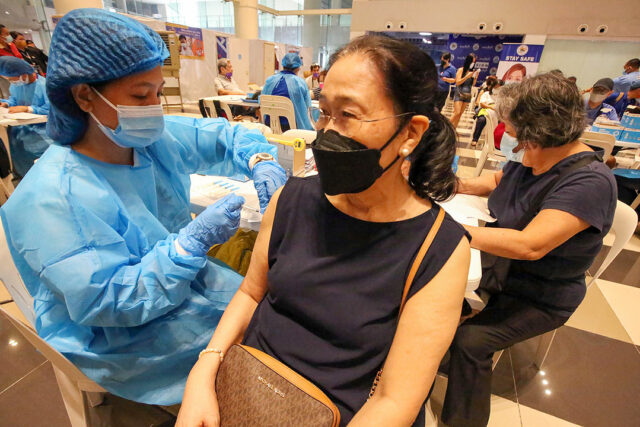
THE PHILIPPINES has logged 910 more infections involving more contagious subvariants of the Omicron coronavirus, the Department of Health (DoH) said on Wednesday.

Of the total, 816 were BA.5, 42 were BA.4, and 52 were BA.2.12.1 cases, Health Officer-in-Charge and Undersecretary Maria Rosario S. Vergeire told a televised news briefing.

Majority of the patients have recovered, she said, adding that the Philippines remained at low risk from the virus despite rising infections.

Most COVID-19 admissions were asymptomatic and mild, she said. “The number of severe and critical admissions remains fewer than 1,000 at the national level.”

Ms. Vergeire said they would start a campaign on July 26 that would encourage more Filipinos to get booster shots against the coronavirus. Under the campaign, the government aims to fully vaccinate 90% of senior citizens and give booster shots to 50% of the target population in the first 100 days of President Ferdinand R. Marcos, Jr. in office, Ms. Vergeire said.

More than 71.4 million people had been fully vaccinated against the coronavirus as of July 19. More than 1.1 million people have received their second booster shot. 

Meanwhile, Mr. Marcos has ordered the Department of Education (DepEd) to allow blended learning in some areas if the country, rejecting the agency’s plan to mandate full face-to-face classes starting November.

“We continue with blended learning but in very specific places only,” he said during a Tuesday meeting with Vice President Sara Duterte-Carpio in mixed English and Filipino, according to a statement from the presidential palace. “As much as possible, it should be face-to-face.”

Mr. Marcos asked DepEd to prepare the learning devices and other supplies needed for blended learning. The President did not identify the areas covered by his order.

Ms. Carpio’s first order as Education chief mandates all public and private schools to implement five days of physical classes starting Nov. 2.

She earlier said classes would start on Aug. 22 amid a coronavirus pandemic, despite calls to move the new school year to September. 

The Teachers’ Dignity Coalition earlier asked DepEd to move the school year to mid-September or the first week of October to give teachers more time to rest and prepare, saying they had been working even during the break.

Under the order, all public and private schools must transition to five days of face-to-face classes.

“Starting Nov. 2, all public and private schools shall have transitioned to five days of in-person classes,” according to the order. Pure distance or blended learning except for schools that are implementing an alternative mode won’t be allowed.

DepEd said it would give schools “ample time to slowly transition” by implementing any of the following options: five days of face-to-face classes, blended learning, three days of in-person classes and two days of distance learning, four days of in-person classes and a day of distance learning or full distance learning. Schools may enforce these until Oct. 21. 

But Ms. Carpio said private schools that fail to start physical classes on Nov. 2 won’t be penalized. 

Some private schools have said they would not implement five days of in-person classes, citing their dialogues with parents.

In a statement, Ms. Duterte-Carpio said the president had agreed during the meeting that a plan for blended learning scheme “should be made with a caveat that face-to-face classes shall be the priority and blended modality shall be considered only in specific schools and areas with special circumstances.”

“DepEd will prepare a plan to be reviewed by the president,” Ms. Carpio said. “No details are forthcoming anytime soon.”

“The requirement of the five-day in-person classes by November 2, 2022 is still in effect,” she added. 

The Philippines was among the last countries to reopen schools physically after a global coronavirus pandemic was declared in 2020. 

A year of school closures cost about P10.8 trillion in productivity and wage losses over the next 40 years, according to the National Economic and Development Authority.

The President ordered DepEd and other agencies to address issues related to the reopening of physical classes, including internet connectivity, the palace said.

Mr. Marcos, 64, also expressed concerns about the increasing number of new coronavirus infections driven by highly contagious Omicron subvariants, it added.

“He was concerned that those issues might affect the implementation of in-person learning, but he was nevertheless determined to proceed with the plan.” — Kyle Aristophere T. Atienza
Watchdog rejects proposal to defer village elections

BW FILE PHOTO

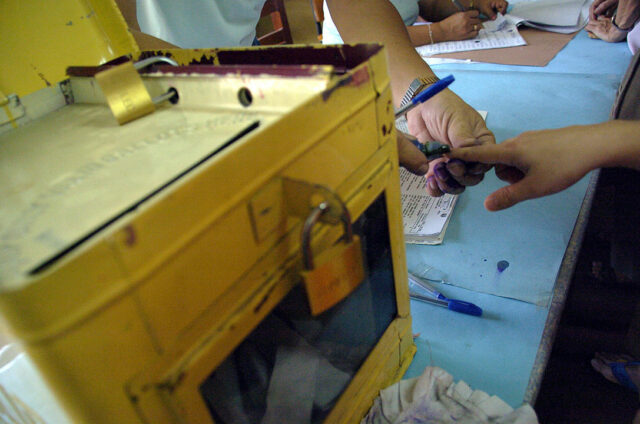
THE NATIONAL Citizen’s Movement for Free Elections (Namfrel) on Wednesday rejected a proposal to defer by a year village elections scheduled for December.

“The will of the people, as expressed through the ballot, is the very essence of democracy,” the watchdog said in a statement. “This should not be set aside again.”

Namfrel said voters should be allowed to choose their local leaders regularly and “without interruption.”

Senator Jose “Jinggoy” E. Estrada earlier filed a bill seeking to postpone village ang youth elections to December 2023, citing the coronavirus pandemic as a concern.

He said the budget for the elections could be used to fund other economic programs that would help industries recover from the pandemic.

Commission on Elections (Comelec) spokesman John Rex C. Laudiangco told reporters in a Viber message the budget for the December elections is P8.44 million.

Namfrel argued that local projects would be strengthened under new officials and lead to more pandemic response initiatives at the community level.

Barangays or villages are the smallest political unit in the Philippines and are the primary planning and implementing unit of the government in communities, the watchdog said.

More than 1.71 million Filipinos have registered for the elections. The registration started on July 4 and will run until July 23.

The Kabataan Party-list also opposed the postponement.

“Election postponement would actually hinder rather than help achieve efficient governance and services for pandemic recovery,” Party-list Rep. Raoul A. Manuel said in a statement. — John Victor D. Ordoñez

115 Filipinos in crisis-hit Sri Lanka want to come home

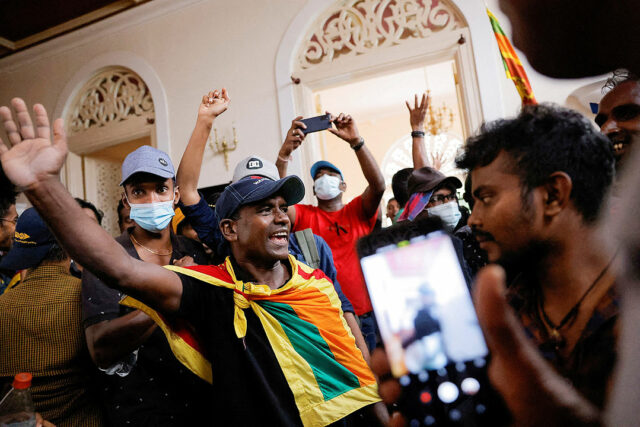
DEMONSTRATORS celebrate after entering the president’s house during a protest in Colombo, Sri Lanka, July 9. — REUTERS

AT LEAST 115 Filipinos in Sri Lanka, where the people are rioting amid a crippling political and economic crisis, are seeking to come home, the Department of Foreign Affairs (DFA) said on Wednesday.

There are about 700 Filipinos in the South Asian country that is home to more than 20 million people, DFA Undersecretary Eduardo De Vega told a televised news briefing.

Sri Lanka has been experiencing power blackouts, spiraling prices, fuel shortages and collapsing hard currency reserves in signs of how vulnerable its economy is.

The country is in talks with the International Monetary Fund (IMF) for a bailout, and has borrowed from India and other Asian nations to make ends meet this year.

Mr. De Vega said Manila has been struggling to arrange repatriation flights due to Sri Lanka’s administrative requirements, including landing rights approval.

“But there are commercial flights. That’s one way. We are thinking of funding plane tickets for those who want to go home,” he said. “The 100 Filipinos, hopefully within next week, the next two weeks, will already start to go home. That’s our goal.”

Mr. De Vega said returning Filipinos from Sri Lanka would get financial aid.

He said the government might also help the more than 500 Filipinos who want to stay in Sri Lanka. But bringing money to Sri Lanka could be a challenge due to regulations it has imposed to tame inflation.

Sri Lanka’s former leader Gotabaya Rajapaksa resigned last week after being under fire in recent months for mishandling the South Asian country’s economy, which is now unable to pay for imports of essential goods due to its ballooning external debt. — Norman P. Aquino and Kyle Aristophere T. Atienza

MIAA, CAAP heads named

PRESIDENT Ferdinand R. Marcos, Jr. has appointed Cesar Chiong as acting general manager of the Manila International Airport Authority, according to Malacañang

He also named Edgardo Diaz as deputy director-general for operations of the Civil Aviation Authority of the Philippines (CAAP) and Manuel Antonio Tamayo as deputy director-general for administration and finance, Press Secretary Trixie Cruz-Angeles said in a statement.

“The Civil Aeronautics Board (CAB) shall remain under the leadership of Executive Director Carmelo Arcilla,” she added.

Meanwhile, the Office for Transportation Security will be headed by Ma. O Ranada Aplasca.

Mr. Marcos also picked Hernani Nieves Fabia as administrator of the Maritime Industry Authority, she said. — Kyle Aristophere T. Atienza

Former labor usec to lead tech-voc agency; bowling icon Coo joins PSC 

PRESIDENT Ferdinand R. Marcos, Jr. has appointed Danilo P. Cruz as director of the Technical Education And Skills Development Authority (TESDA), according to the Presidential Palace.  

Mr. Marcos has also picked Olivia “Bong” Coo as commissioner of the Philippine Sports Commission (PSC), Press Secretary Trixie Cruz-Angeles said in a statement.   

Mr. Cruz served as Labor undersecretary under the administration of ex-President Gloria Macapagal-Arroyo.   

As head of TESDA, he will be in charge of steering the technical-vocational education sector towards improving the quality of training programs as well as the employment rate for graduates.  

The country needs to upgrade its technical and vocational education training (TVET) system to better adapt to industry developments after the economic impact of the coronavirus pandemic, according to an Asian Development Bank (ADB) report released in 2021.   

Skill mismatches limit TVET graduatesemployability and reflect an inability to keep the training curriculum, course offerings, and training equipment relevant for the job market,ADB said.  

Ms. Coo, meanwhile, previously headed the Philippine Bowling Federation. The bowling icon earned eight gold medals in the Southeast Asian Games. Kyle Aristophere T. Atienza 

More than 50% of target fund for typhoon Odette recovery still needed 

DAMAGED houses in the province of Dinagat Islands, where tropical cyclone Odette (international name: Rai) made its second landfall on Dec. 16, 2021. — DINAGAT ISLANDS PIO

MORE than 50% of the target fund for recovery programs in areas hit by typhoon Rai, locally known as Odette, in December is still needed, according to a United Nations official who is leading humanitarian assistance efforts.   

We were challenged, and the number one (reason is) the COVID-19 (coronavirus disease 2019),UN Resident Coordinator and Humanitarian Coordinator Gustavo Gonzalez said during Wednesday’s ribbon cutting ceremony for an exhibit on the Odette rehabilitation and resilience-building projects.  

He cited the need to follow various protocols and develop the concept of crises within a crisisto respond effectively to the situation.  

Typhoon Odette, the strongest tropical cyclone to hit the Philippines last year, swept through 11 of the countrys 17 regions, affecting close to 12 million people and leaving 2.4 million people in need of assistance.   

In February, the Humanitarian Country Team in the Philippines launched a revised Humanitarian Needs and Priorities (HNP) plan to coordinate the response.   

The HNP called for a budget of $169 million (about P9.5 billion), which is currently 46% funded, according to a release previously sent by the Spanish Embassy.  

Mr. Gonzalez said coordination was crucial in formulating a priority plan as various public and private agencies were involved in the immediate response and rehabilitation initiatives.   

He said a major lesson learned from Odette was that “the success of any humanitarian operation relies on readiness readiness for the nation, and I think that we are building a new model to coordinate amongst ourselves and with the government.”  

In a country like the Philippines, the humanitarian community needs to be very subtle and strategic,he added, noting that their role is to fill critical gaps. 

The Philippines, situated within the typhoon belt, is struck by an average of 20 typhoons per year.  

The country has a National Disaster Risk Reduction and Management Council that oversees local plans and teams set up at regional and local government levels.    

Mr. Gonzalez thanked the international community, the private sector and other resource persons for the massive response and their valuable contributions during Philippine disaster and resilience cooperation.  

I think I can properly say that there are not many humanitarian coordination efforts in the world as intense and effective as those developed in the Philippines,Ambassador of Spain to the Philippines Jorge Moragas Sanchez said during the event, citing the efficient leadership, willingness and commitment of all the national, international and national humanitarian institutions.   

The support of donors allowed the UN and over 200 humanitarian partners to address the urgent humanitarian needs of typhoon-stricken areas and assist them with early recovery programs through more than 14,600 multi-sectoral activities across 18 clusters.   

Funding is still needed specially to support mid- to long-term recovery activities,the Spanish Embassy said, noting that several humanitarian agencies are implementing projects which will carry on into the second half of the year.  

Although most of the displaced population have returned, development should be integrated into response and recovery efforts to provide sustainable and long-term solutions for affected communities, including education, economic, and livelihoods support,it said. 

Long-term and sustained recovery must consider measures to bolster preparedness and build resilience against future shocks,it added. Alyssa Nicole O. Tan 

Community bakeries urged to use coconut flour amid rising costs  

DTI.GOV.PH

A BAKING industry group called on community bakeries to use coconut flour in the production of the common Filipino bread roll pandesal to mitigate the high prices of raw materials.    

Lucito Chavez, Asosasyon ng Panaderong Pilipino president, said a major bread company has already adopted the use of the locally-made ingredient for making coco pandesal, and small neighborhood bakeshops should follow suit to keep their businesses afloat.   

One of the things we are pushing that big bakeries have already started is the use of coconut flour for coco pandesal,Mr. Chavez said in Filipino in a Teleradyo radio interview on Wednesday. 

And it has been successful so far. We hope that community bakeries will mix coconut flour. 10% of coconut flour for coco pandesal.”  

According to Mr. Chavez, consumers are slowly embracing the coco pandesal, which is priced at P23.50 for 10 pieces.     

The Department of Science and Technology, Department of Agriculture, Department of Trade and Industry, the Philippine Baking Industry Group, and the Virgin Coconut Organization of the Philippines launched the coco pandesal in June as an alternative amid the rising costs of flour and wheat.   

Coconut processors have been producing and exporting coconut flour, which is especially popular for those on a gluten-free diet.    

Previously, the Philippine Association of Flour Millers, Inc. said that flour prices are increasing, currently at over $500 per metric ton, due to the spike in   wheat cost caused by Russias invasion of Ukraine.   

The Agricultural Sector Alliance of the Philippines, Inc. also said recently that egg prices might reach P10 to P15 per piece due to high production costs.    

Meanwhile, Mr. Chavez said that pandesal prices could not be increased at this point as consumers already burdened by inflation may be discouraged. 

He said community bakeries have adjusted the size of pandesal instead to keep up with the high prices of inputs.   

The pandesal is already small. We cannot increase the prices because the community will not be able to handle it. The pandesal will not be bought. Most of the community bakeries made the pandesal smaller. The rates of the pandesal range from P2.50 to P4 in community bakeries,Mr. Chavez said. Revin Mikhael D. Ochave 

Gatchalian to prioritize simplification of tax system for MSMEs 

MTEFI FB PAGE

SENATOR Sherwin T. Gatchalian on Tuesday said he will prioritize measures that will simplify tax procedures for micro, small and medium enterprises (MSMEs) alongside establishing a mechanism for reporting abusive government officials involved in the collection system.   

I want to put taxpayers first as a priority in the committee, making sure that taxing is as simple as buying goods in Shopee,the senator, who will be chairing the Ways and Means Committee in the 19th Congress, said during a speech at a Senate hearing. 

We make sure that corruption and erring government officials are held into account, he added.   

He said he wants tofocus on the small and thriving MSMEs sector,which is considered asthe backbone of our economy.”  

MSMEs comprise 99.5% of business establishments in the country, 63% of the workforce, and about 40% of gross domestic product in recent years, based on data from the Department of Trade and Industry.  

Mr. Gatchalian said prioritizing MSMEs and other taxpayers while looking at accountability and efficiency require attention through oversight and not just the creation of new laws.  

OTHER TAX SOURCES
Revenues can also be generated from non-essential goods and casinos, he added. 

When asked if he was open to imposing higher taxes on the countrys most affluent segment, the senator pointed to the Passive Income and Financial Intermediary Act (PIFITA), one of the bills he plans to prioritize. 

The PIFITA will not only harmonize the different tax regimes in the different income classes, but alsoincrease the passive income tax levels, so to a sense it will be addressed through that bill,he said.  

Mr. Gatchalian will also put the proposed Real Property Valuation and Assessment Reform Act in the priority list, which was part of the previous administrations planned tax reform packages.   

The proposed measure is seen to bring in more revenues for local government units, which is in charge of collecting annual property taxes, and accelerate the rollout of infrastructure projects.  

The senator also noted that the imposition of new or higher taxes requires consideration of other factors.   

Timing is very important in raising taxes,he said. Its also very important to listen to the calls of the people.” 

He also said that he was uncomfortable suspending the discounts promised to constituents, especially at a time of heightened inflation.   

We can all contribute to nation-building by contributing a portion of our earnings through taxes because revenues build roads, tools and other things,said the senator. But we also have to make sure that our customers, our taxpayers are not being abused, victimized and being treated as second class citizens.”  

He is looking to conduct oversight committee hearings within the first three months after Congress opens on July 25. Alyssa Nicole O. Tan 

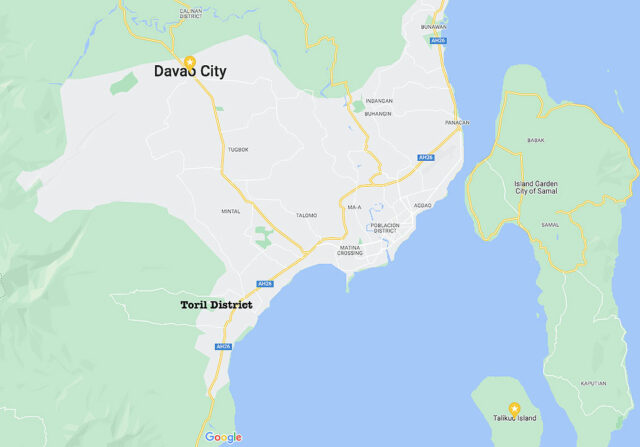
Food stalls temporarily closed in Davao City district as diarrhea cases reach 147, one child dead 

A 10-YEAR OLD who died from severe dehydration was among the 147 cases of diarrhea recorded as of June 19 in a district in Davao City, prompting the local government to order the temporary closure of food stalls and suspension of street food vendors in the area.  

Pending results of laboratory tests, the City Government has suspended the operations of food stalls in Toril District until further notice,the local government said in a statement on Tuesday.  

Food and drink samples from the sellers were collected for testing and analysis to rule out any possible source of infection that might have caused the outbreak,it said.  

At the same time, the city is conducting an independent analysis of the water supply in the area.    

Distributor Davao City Water District (DCWD) said on July 18 that results from its water sampling and testing in the affected area yielded negative results for the presence of Escherichia coli and total coliform with chlorine residuals of 0.3-1.5 ppm.   

The results mean that the water DCWD distributes to its customers is not contaminated with bacteria causing waterborne diseases such as diarrhea. It also indicates that there is enough chlorine to protect and disinfect the water through the distribution network,the utility said.    

DCWD also said it found no major leaks in its distribution line along the affected areas, which could have been a point of contamination from flood water.  

The diarrhea outbreak was first reported last weekend with an initial 40 people seeking medical treatment.  

The City Health Office has set up an incident command center at one of the Rural Health Units in Toril for immediate medical response and referral to medical facilities for severe cases.   

Pending the laboratory results on the food and drinks samples as well as the water supply from the distribution system, the city government has advised all residents to properly boil water for consumption or use bottled water, and observe hygiene practices such as washing of hands. MSJ 

Good buy or goodbye?

PHILIPPINE STAR/KRIZ JOHN ROSALES

Obviously, we are learning to live with COVID-19. But at the same time, we seem to get bogged down in our efforts to leap forward. New variants come and go, and some linger longer than others. Meanwhile, vaccine effectiveness also wanes over time. And while quite a number of people have received vaccine boosters, I believe the majority have not.

In this line, perhaps those willing among the adult population in general should already be allowed to get first and second boosters, rather than “reserving” the present stock of vaccines for the effort to fully vaccinate (three doses) against COVID-19 the entire population in the next three months. The issue is time-bound: a big portion of the local stock expires this month.

I therefore support calls for the Department of Health (DoH) to temporarily go beyond prioritizing A1, A2, and A3 for second boosters. I believe A4 and the Rest of the Adult Population should be allowed to jump the cue, just this time. Second boosters, temporarily, should no longer be limited to just healthcare workers, senior citizens, and immunocompromised individuals.

It is in this light that I find interesting the April 2021 Working Paper by University of Chicago economist Casey Mulligan titled, “The Backward Art of Slowing the Spread? Congregation Efficiencies during COVID-19.” Mulligan analyzed data to test the presumption used to justify lockdowns and stay-at-home orders — that the workplace was less safe than the home.

He found that in many instances in the United States, workplaces actually became safer than homes because businesses had the incentive or the motivation as well as the capital to invest in so-called “mitigation protocols,” to ensure workers’ safety, and to allow for continued business operations. On the other hand, households were less likely to adopt similar levels of precaution and actually go beyond the minimum.

“The available data from schools, hospitals, nursing homes, food processing plants, hair stylists, and airlines show employers adopting mitigation protocols in the spring of 2020. Coincident with the adoption, infection rates in workplaces typically dropped from well above household rates to well below,” he noted.

“When this occurs, the sign of the disease externality from participating in large organizations changes from negative to positive, even while individuals continue to have an incentive to avoid large organizations due to the prevention costs they impose on members. Rational cooperative prevention sometimes results in infectious-disease patterns that are opposite of predictions from classical epidemiology,” Mulligan wrote.

He added, “Micro evidence contradicts the public-health ideal in which households would be places of solitary confinement and zero transmission. Instead, the evidence suggests that ‘households show the highest transmission rates’ and that ‘households are high-risk settings for the transmission of [COVID-19]’.”

Moreover, “schools, businesses, and other organizations implemented a range of prevention protocols — from adjusting airflow to installing physical barriers to monitoring compliance to administering their own testing services — that households did not, and perhaps could not. Something in these organizations greatly reduced the spread.”

For expiring vaccines, perhaps we can waive the priority list. Over 1.5 million vaccine doses bought by the private sector are set to expire by the end of July, said Go Negosyo founder Joey Concepcion, who wants the DoH to allow second boosters particularly for workers. “If you look at these expiring vaccines, that’s a lot of money. Yes, we have to focus on the first boosters, but the private sector bought these vaccines. This is my frustration.”

Of the total expiring vaccines in warehouses, over 628,000 doses are AstraZeneca ($5 each dose), while 887,000 doses are Moderna ($27 each dose). These were bought under a tripartite agreement among the private sector, vaccine makers, and the government — and where half of the vaccines acquired go to the government for distribution to the public for free.

“The vaccines should be used rather than left to expire. Many productive members of the workforce fall outside of the age limit set by the HTAC. Yet they also have risk factors and are exposed to the virus every day when they come to work,” Concepcion told a press forum, as reported by the Philippine Star.

He added, “The private sector has already proven that it is willing to get vaccinated. There is no need for mandates when it comes to the private sector. They don’t want to get sick and use up their sick leaves…[But] the sense of urgency is not there. Government is trying to do its best, but there is this body that is moving quite slow.”

DoH data indicate over 65 million Filipinos have been fully vaccinated, but only about 15 million for them have gotten their first booster as of July 17. Some estimates put at 71 million the number of vaccinated people. But the booster uptake has been slow, for some reason. In Makati City, for instance, vaccination sites have been operating at below 30% capacity.

In fact, the SM Makati vaccination site is already scheduled to be closed by end-July. The same goes for the Nayong Pilipino Mega Vaccination Site. I believe a number of other vaccination sites in Metro Manila are all winding down operations and are just depleting present stocks — many of which are probably about to expire this July or early August.

“We asked the private sector to buy the vaccines but now they are given difficulties in using the vaccines that they bought. Do we want the people to get vaccinated illegally? … Clamor to allow a second booster has been there for months. But it seems nobody is listening,” noted Iloilo Rep. and former Health Secretary Janette Garin, who is also pushing for second boosters for the general population.

Garin presents a more dire scenario: she claims that only 152 million out of 245 million vaccine doses procured by the government have been administered. And, not only 1.5 million but actually four million doses bought by the private sector were about to expire. While another 23 million doses donated and procured by the government were also set to expire.

Whose numbers are more precise is anybody’s guess. But, no matter how the issue is viewed, Concepcion and Garin present compelling arguments against wasting resources and opportunities. And with only 10 days left in the month, for sure millions of expensive COVID vaccine doses will soon end up in the bin. Public and private money all down the drain.


Marvin Tort is a former managing editor of BusinessWorld, and a former chairman of the Philippine Press Council

matort@yahoo.com

Friendship is the best way to counter China in the Pacific

REGIONAL POWERS have been watching China’s growing influence in the Pacific with rising alarm, and casting around for ways to counter it. After Beijing signed a security pact with the Solomon Islands earlier this year and offered a similar deal to other Pacific Island nations, efforts stepped up a gear.

At the annual Pacific Islands Forum last week, Vice-President Kamala Harris last week promised to build new embassies in Tonga and Kiribati and offered a near-tripling of aid for marine resilience and security. “In recent years, the Pacific Islands may not have received the diplomatic attention and support that you deserve,” she said. “So today I am here to tell you directly: We are going to change that.”

In all this effort, one policy that’s been central to neighbors’ relations with the Pacific for decades has been ignored: migration.

The challenges for small island countries like those of the Pacific are unique. Their numbers include relatively affluent territories like Palau, the Cook Islands, and French Polynesia, which occupy a status in between full independence and support by their former colonists. On the other hand, the region also includes nations like Vanuatu, Papua New Guinea, and Kiribati, which receive far less aid and whose development levels are often comparable to those in sub-Saharan Africa.

Alongside the longstanding challenges of physical isolation and slow economic development, the region is also most at risk from climate change. Tuvalu and the Marshall Islands are among the world’s lowest-lying nations. Long before the islands themselves are claimed by the sea, the fragile layers of rainwater that keep thin soils irrigated risk being disrupted by saltwater. The high dependence on imported food throughout the Pacific is one reason that the region has some of the highest incidence of diabetes worldwide.

Migration has long been central to the Pacific’s relations with the wider world. The Marshallese and Palauan diasporas in the US number about half as many people as live in those respective countries, thanks to the fact that they, along with citizens of the Federated States of Micronesia, have full work and residency rights there. There’s about four times as many Samoan Americans as there are residents of American Samoa. People born in New Caledonia, French Polynesia, Guam, and the Northern Mariana Islands are full citizens of France and the US. New Zealand has a green card-style program for citizens of Samoa and four other Pacific nations that grants permanent residency to 1,750 people a year.

The gap in this picture is Australia. In contrast to New Zealand, whose Pacific Islander population accounts for about 8% of the total (Maori comprise an additional 16.5%), it has long turned its back on the region.

In the 19th century, tens of thousands from the islands of Melanesia were kidnapped or tricked into working in the Queensland sugar industry in conditions little different to slavery. One of the first laws passed after independence in 1901 was an act to deport the roughly 10,000 who remained, a plank of the racist “White Australia” policy that was only finally dismantled in the 1970s.

The country’s Pacific-born population numbers just 190,170 now, compared to 381,642 in New Zealand and 1.4 million in the US — proportionately not much higher than it was in 1901. In the popular mind, “migration” and “Pacific islands” are associated mainly with the grim detention centers on the islands of Manus, in Papua New Guinea and Nauru, where Australia has sent refugees for many years instead of processing their claims onshore.

To its credit, the new Labor government has promised to provide a permanent migration program similar to New Zealand’s, that would provide 3,000 visas a year to islanders. It’s also boosting existing temporary labor migration streams to allow family members to travel as well, and strengthening protections against worker exploitation.

That’s welcome, but it could afford to be far more generous. If 10,000 visas a year were available to the most isolated Pacific populations — those from Kiribati, Tuvalu, the Solomon Islands, and Vanuatu — then within a decade Australia could boast diasporas equivalent to 10% of the populations of their home countries. Those migrants would be able to support island economies through sending remittance money home, while building a web of links that Beijing would struggle to disrupt.

More visas should be provided for Papua New Guinea, Australia’s closest neighbor and a nation that it’s neglected since the end of colonial rule in 1975 — though its population of nearly 9 million is unlikely to become as intertwined with an overseas diaspora as smaller island nations.

Nations seeking to counter China’s influence in the Pacific shouldn’t be surprised if island governments are enthusiastic about the arrival of a new power in the region. If they want to counteract this shift, friendship and migration will do far more than hectoring and promises of aid.

BLOOMBERG OPINION

A widow as role model

FORMER Prime Minister Shinzo Abe (R) of Japan, accompanied by his wife Akie Abe, meets the Indian President at Rashtrapati Bhawan in New Delhi on Jan. 25, 2014. — MEAPHOTOGALLERY-FLICKER

The assassination of Japanese former Prime Minister Abe, continues to deserve air time on international media. The legacy that Abe left behind remains a subject of discussion. The man was Prime Minister twice, from 2006 to 2007, and again, when he made a comeback in 2012, to remain in office up to 2020. He resigned in September 2020 for health reasons.

Abe will be remembered for his nationalist position. This particular stance turned off most Japanese liberals who felt his desire to rejuvenate the Japanese armed forces would be a return to Japan’s long history of aggression and war with neighbors. The resuscitation of the Japanese self-defense forces would have required the amendment of Article 9 of the Japanese constitution which the United States forced on Japan at the end of World War II when Japan surrendered.

Abe had set a deadline of 2020 to revise the Constitution and legitimize the Japan Self Defense Forces. Article 9 outlawed war as a means of settling international disputes. Abe did not stay long enough to help rebuild the military which naturally alarmed China, East Asia’s military power.

Aside from the regeneration of Japan’s military forces into a key component of restoring Japan’s reputation and stature, Abe had Tokyo bid for the 2020 Olympics which he had hoped would help jumpstart an economy which had entered a period of deflation. The deflation discouraged the production of goods by manufacturers who did not see the wisdom in producing goods that were sold at low prices or were not being bought at all. Abe did not live long enough to see the effects of his policies on the Japanese economy and politics. Fumio Kishida, present prime minister, and regarded as Abe’s protégé and member of the Liberal Democratic Party (LDP), is expected to pursue Abe’s initiatives and policies.

The assassination of Abe triggered the customary investigation on the circumstances behind the killing in broad daylight in a country not known for political violence and with strict gun controls. Abe’s death raised serious questions about the personal security of Japanese politicians and former public officials.

Mari Yamaguchi of the Associated Press (AP) reports that a top police official “has acknowledged possible security lapses that allowed an assassin to fire his gun into Japanese former Prime Minister while he was addressing a campaign rally” for a Liberal Democratic Party candidate in Nara City. Police arrested the attacker, ex-Navy man Tetsuya Yamagami, 41.

Police said, the assassin killed Abe because “he believed rumors that Abe was connected to an organization that he resents.” According to Yamaguchi, Japanese media reported that Yamagami developed a hatred toward a religious group that his mother was obsessed about and that caused his family financial problems.

The AP story stated that Nara prefectural chief Tomoaki Onizuka said Abe’s assassination was his “greatest regret” in a 27-year career. Onizuka said, “I cannot deny there were problems with our security. Whether it was a setup, emergency response, or ability of individuals, we still have to find out. Over-all, there was a problem and we will review it from every perspective.”

Observers who watched videos of the attack that went viral noted a lack of attention to the open space behind Abe. This obvious gap did not go unnoticed, calling the lapse so “un-Japanese” who are noted for paying meticulous attention to detail, especially in matters involving security and protection of so-called very important persons. AP reported that a former Kyoto prefectural police investigator, Fumikazu Higuchi said the footage suggested security was sparse at the event and insufficient for a former prime minister.

Other experts wondered why Abe was speaking from a street level island and not from a platform which would have made it more difficult for an assassin to execute his plan. In addition, there was “too much focus frontward” without giving attention to what was behind Abe.

The death of Japan’s longest serving prime minister left behind a nation and the many who admired Abe, in grief and mourning. Shinzo Abe also left behind a 60-year-old widow, Akie Abe. CNN’s Nectar Gan and Emiko Juka wrote that Akie “set a new mold for Japanese first ladies.”

And here’s why.

Gan and Juka report that when Akie Matsuzaki married Shinzo Abe, then a rising political aide in 1987, she followed a path well-trodden by Japanese wives and gave up her job at the country’s largest advertising agency, Dentsu.

Over the years, including the nine that she was First Lady, Akie proved to be an unconventional Japanese wife and certainly an unconventional political wife.

According to CNN, “Akie is best known in Japan for her outspoken and progressive views.

“Unlike her predecessors, she refused to stay in the shadow of her husband. Instead, the socialite carved out a public role for herself in a style akin to American first ladies.”

When word reached her on Friday, July 8, of the fatal attack on her husband, she took an hour-long journey by train to be beside her husband at the Nara hospital. Abe failed to survive the attack suffering from massive blood loss from wounds in his left arm, collar bone and other parts of his body.

The next day, Akie was bringing her husband’s body back to Tokyo by car. Two days later she mourned alongside relatives and guests at a private wake.

In life, Akie “refused to stay in the shadow of her husband.” She spoke her mind and took different positions on issues often enough to be referred to by Japanese media as Abe’s “domestic opposition” But this time, all throughout the funeral services and wake for her husband, she remained, per CNN, outwardly composed and quiet when appearing in public. She was thrust into public view two years after she faded from the same public view when her husband resigned in 2020. Japan now looks at her again, this time, as it mourns its fallen former leader.

Gan and Jozuka report that Tobias Harris, a senior fellow for Asia at the Center for American Progress, states that Akie’s support for progressive causes, freewheeling ways, and cheerful confidence endeared her to the Japanese public.

She took positions at variance with her husband’s policies, from Abe’s push for nuclear power, to the Trans Pacific Partnership trade deal, to meeting with protesters against the expansion of a US Marine Corps base in Okinawa, which Shinzo Abe supported.

In explaining to Bloomberg in 2016 her outspoken stance on issues, Akie was quoted to have said, “I want to pick up and pass on the views that don’t get through to my husband or his circle.”

CNN reports that she has been a vocal advocate for LGBTQ rights, joining a gay pride parade in Tokyo in 2014. She also supports the use of medical marijuana, having posed for photos in a sprawling cannabis field in 2016.

Despite their opposing views on a number of issues, the couple had a loving relationship as reported by Gan and Jozuka: Akie and Abe did not shy from letting the public know about their genuine affection for each other. The couple did not hesitate to hold hands when disembarking from a plane during official trips — a public display of attention rarely seen in Japanese political circles. On their 30th wedding anniversary, Akie posted a wedding picture of them dressed in kimonos. On their 32nd anniversary — the last they would have together — they celebrated with cherry cream cake and wine.

Perhaps a lot of Akie’s pleasing personality and cheerful confidence can be traced simply to good and unpretentious breeding. A daughter of a confectionery magnate, Akie grew up in a wealthy and privileged family in Tokyo. She was educated at a private Catholic school and a women-only vocational school and speaks fluent English.

Abe and Akie had no children. The couple sought fertility treatment but to no avail. The man is gone leaving behind a widow who is a role model — and probably a successor.


Philip Ella Juico’s areas of interest include the protection and promotion of democracy, free markets, sustainable development, social responsibility and sports as a tool for social development. He obtained his doctorate in business at De La Salle University. Dr. Juico served as secretary of Agrarian Reform during the Corazon C. Aquino administration.

ADVERTISEMENT
ADVERTISEMENT