
Philippines’ factory picks up in May
MANUFACTURING ACTIVITY in the Philippines grew for a 14th straight month, buoyed by the further reopening of the economy as the number of coronavirus cases declined. Read the full story.
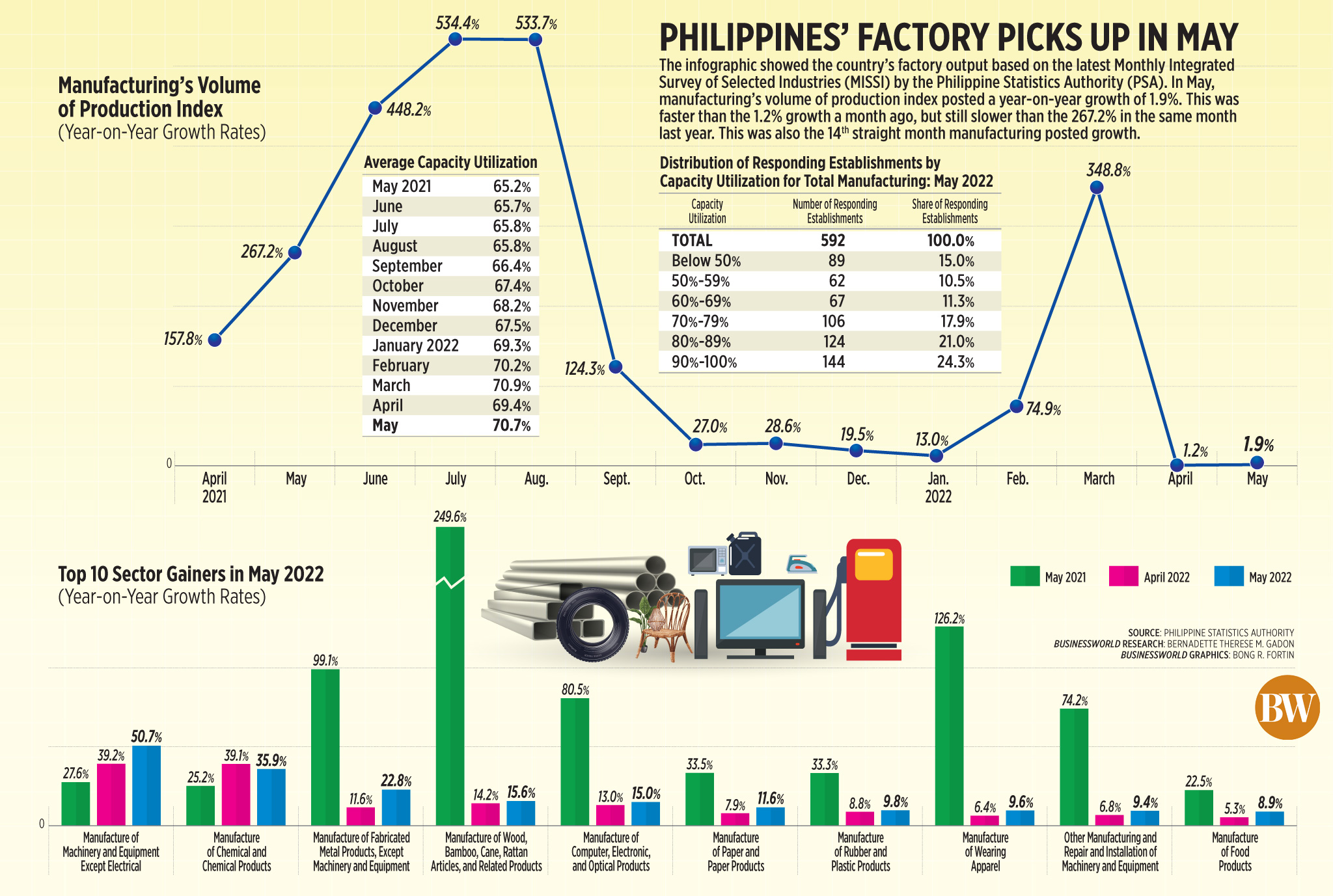
MANUFACTURING ACTIVITY in the Philippines grew for a 14th straight month, buoyed by the further reopening of the economy as the number of coronavirus cases declined. Read the full story.
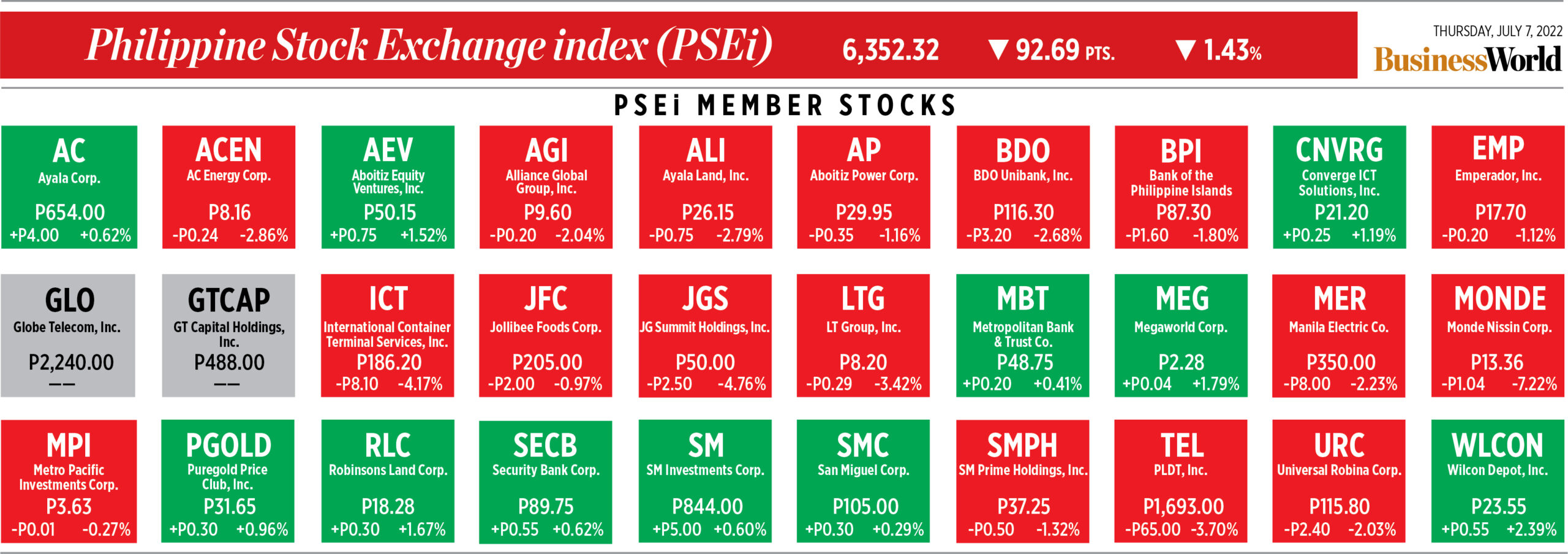
Here’s a quick glance at how PSEi stocks fared on Thursday, July 7, 2022.


PHILIPPINE STOCKS fell on Thursday on profit taking and data showing more Filipinos were unemployed in May, with the quality of jobs worsening.
The benchmark Philippine Stock Exchange index (PSEi) slid by 92.69 points or 1.43% to close at 6,352.32 on Thursday, while the broader all shares index went down by 37.51 points or 1.08% to 3,405.39.
“The PSEi retreated today and retraced much of yesterday’s rally as investors likely took profit following gains in the first half of the week… Nevertheless, the market’s move remains in line with a healthy pullback,” China Bank Securities Corp. Research Head Rastine Mackie D. Mercado said in a Viber message.
“Shares on the Philippine Stock Exchange retreated, snapping a four-day winning streak, as more Filipinos found themselves unemployed or out of business in May while the quality of available jobs worsened, in what could be a sign that the economy, while growing again, is struggling to heal the pandemic-battered labor market,” Globalinks Securities and Stocks, Inc. Head of Sales Trading Toby Arlan C. Arce said in a Viber message.
“Sentiment may have also been soured after the government tempered its growth target for this year. The Marcos administration is now looking at a 6.5% to 7.5% economic growth in its first year in office, lower than the target set by the previous government,” Mr. Arce said.
Preliminary data from the Philippine Statistics Authority released on Thursday showed this was higher than the jobless rate of 5.7% in April, but remained lower than 7.7% in May last year.
May’s unemployment rate was equivalent to 2.927 million jobless Filipinos in May, up 165,000 from 2.762 million in April.
Job quality also deteriorated as the underemployment rate — the proportion of those already working but still looking for more work or longer working hours to the total employed population — rose to 14.5% in May from 14% in April.
In absolute terms, this translated to 6.668 million underemployed Filipinos in May, 269,000 more than the 6.399 million the previous month.
All sectoral indices posted losses. Industrials fell by 217.61 points or 2.30% to 9,216.24; services lost 33.46 points or 1.97% to end at 1,665.01; mining and oil went down by 200.45 points or 1.79% to 10,942.96; financials dropped by 24.45 points or 1.61% to 1,486.51; property decreased by 44.15 points or 1.49% to 2,903.76; and holding firms declined by 15.68 points or 0.25% to 6,056.71.
Value turnover went down to P4.69 billion on Thursday with 708.51 million shares from the P5.32 billion with 915.72 million issues seen the previous day.
Decliners outnumbered advancers, 103 versus 68, while 51 names closed unchanged.
Foreigners turned sellers anew with net sales worth P662.86 million on Thursday from the P93.22 million in net purchases seen the previous trading day.
China Bank Securities’ Mr. Mercado placed the PSEi’s support at 6,200 and resistance at 6,500, while Globalinks Securities and Stocks’ Mr. Arce placed support between 6,200 and 6,150 and resistance from 6,450 to 6,500. — J.I.DP. Tabile

PRESIDENT Ferdinand R. Marcos, Jr., who is also his own Agriculture Secretary, has called on the Department of Public Works and Highways (DPWH) to focus on infrastructure projects that benefit food security, Public Works Secretary Manuel M. Bonoan said.
“The President has instructed the prioritization of infrastructure that would aid in the food security program of the government amid rising inflation, as well as the interconnectivity of regions and convergence programs with other agencies,” the DPWH said in a statement on Thursday, citing Mr. Bonoan.
Being his own agriculture secretary allows “things (to) move quickly” in response to global developments, Mr. Marcos said in a statement, noting that the agriculture industry has been facing “severe” problems.
The “infrastructure projects under DPWH that would help farmers are farm-to-market roads in convergence with the Department of Agriculture (DA),” the DPWH said.
In June, the DPWH reported that it completed farm-to-market road projects in Cabanatuan City and Gabaldon and General Tinio, all in Nueva Ecija.
“The concreting of the local roads required a combined amount of P12.6 million funded through the General Appropriations Act (GAA) of 2022,” the department said in a statement.
The paving project “was made possible through the convergence program of the DPWH and the Department of Agriculture with funding sourced from the 2021 (General Appropriations Act),” it added.
Mr. Bonoan said he will continue to pursue the big-ticket projects under the Build, Build, Build Program of the former administration “as instructed” by Mr. Marcos.
The DPWH hopes to “continue to tap the private sector for the country’s road network improvement through Public-Private Partnership program.”
In April, DPWH officials from the previous administration said they had completed 12 out 119 flagship projects.
The department had projected the completion of seven more big projects by June 30 and 12 more by December, including the P45.29-billion Southeast Metro Manila Expressway Project and the P75-billion MRT-7 of San Miguel Corp. (SMC).
Mr. Bonoan was SMC Tollways’ president and chief executive officer when he was tapped by Mr. Marcos to head the DPWH. — Arjay L. Balinbin

THE Department of Public Works and Highways (DPWH) said on Thursday that it is seeking an additional P500 million for the remaining civil works of the Albay-Sorsogon Connector Road project, which is expected to benefit up to 5,000 motorists daily once completed.
“The project has so far received an allocation of P2.21 billion,” the department said in a statement.
The remaining works are “civil works covering the installation of active and passive slope protection systems, metal beam guardrails and continuation of the concreting of the unpaved areas,” the department said.
The 15.87-kilometer connector road is a priority project for the Bicol Region, according to DPWH Region 5 Director Virgilio C. Eduarte.
“Locals and visitors will be able to utilize this all-weather road very soon. We are targeting completion of ongoing sections before the end of this year,” Mr. Eduarte said.
Once completed, the road is expected to reduce travel time by one hour.
The project will “eventually (improve) the economic condition of areas along its route,” Mr. Eduarte said. — Arjay L. Balinbin

THE World Bank (WB) said the Philippines’ cash transfer program, designed to aid the poorest 40% of the population, has seen beneficiaries from outside that category creep in gradually, to the point where only 60% of recipients in 2020 would have qualified under the original eligibility criteria.
“In 2009, almost 92% of (the Pantawid Pamilyang Pilipino Program) beneficiaries belonged to the bottom 40% of income distribution. However, this share has declined over time and, by 2020, during the pandemic, only slightly over 60% of… household (beneficiaries) are from the bottom 40%,” World Bank Senior Economist for Social Protection and Jobs Global Practice Yoonyoung Cho said in a presentation with the Philippine Institute for Development Studies (PIDS) on Thursday.
She was referring to the government’s cash transfer program, which is also known as the 4Ps.
Ms. Cho called for a cleanup of the Philippines’ beneficiary list to ensure that payments intended for the most vulnerable members of the population do not leak to unauthorized recipients.
“There should be a clean beneficiary and citizens database which facilitates better targeting (or) identification of beneficiaries in the time of crisis,” she said, calling the distribution of aid in the Philippines “quite inefficient.”
She added that “prioritizing those in the greatest need enhances fiscal efficiency, meaning greater impact for peso spent.”
When beneficiaries are effectively targeted, she backed the use of multiple financial service providers for disbursements to “further enhance greater access and convenience for beneficiaries.”
“(These) delivery systems can be enhanced using digital tools,” Ms. Cho said.
“This does not mean that poor beneficiaries have to become internet experts. Rather, wherever feasible, the implementers (should) use these tools and platforms for swifter response so they have sufficient time and energy to care for beneficiaries.”
Ms. Cho also recommended the streamlining of contingency financing mechanisms ahead of calamities and “simpler bureaucratic processes for activating and using the calamity funds.”
“Utilizing the rapidly developing and growing finance ecosystem for government transfers will greatly help,” Ms. Cho said.
She called for the Philippine Identification System (PhilSys) ID and the PhilSys Number rollout to be expedited.
“The PhilSys holds a key to many of these recommendations and it has made a huge progress during the pandemic,” Ms. Cho said. — Diego Gabriel C. Robles
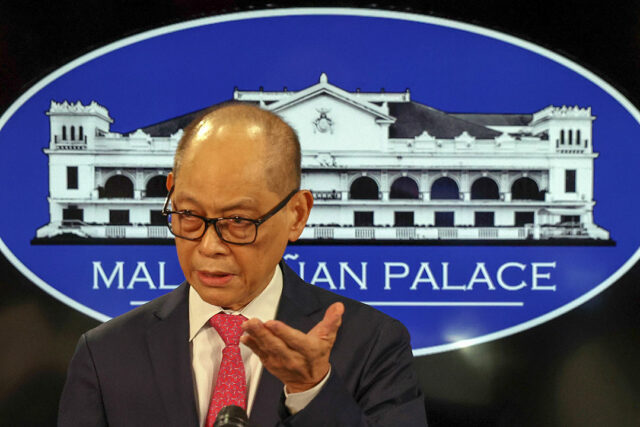
FINANCE Secretary Benjamin E. Diokno said his department is considering a carbon tax, and is currently working out whether such a measure is practicable.
“Carbon tax too, if feasible,” Mr. Diokno told reporters in a Viber message after being queried on fund-raising initiatives under consideration by the new government.
Asked to elaborate on the carbon tax, Mr. Diokno did not respond.
A tax on carbon emissions was contemplated in the third package of former Finance Secretary Carlos G. Dominguez III’s fiscal consolidation plan.
If approved, the third package is set to be implemented in 2025. The impact on government revenue has yet to be determined.
A carbon tax is levied on businesses that emit carbon dioxide, with the proceeds helping support greenhouse gas mitigation projects while forcing companies to address their own emissions to minimize their tax exposure.
Mr. Diokno also signaled the possibility of imposing a tax on single-use plastics in an interview with the ABS-CBN News Channel on Wednesday.
“The Philippines is probably one of the most vulnerable with respect to climate change, and so it is in our own interest that the movement towards climate change should be supported,” he said. “I think we on our part, on the tax side, should think of some measures that we can do to reduce pollution. For example, a tax on single-use plastic is worth considering.”
A P20 excise tax per kilogram of single-use plastics was also part of the previous government’s fiscal consolidation plan, although it had been targeted for rollout in 2023.
The previous government estimated that the tax can raise P249 billion or more every year, with the revenue going towards paying down the P3.2 trillion in additional debt incurred during the pandemic.
At the end of May, National Government debt stood at P12.5 trillion.
Mr. Diokno formerly served as co-chair of the previous administration’s so-called “Green Force,” an Inter-Agency Task Force for Sustainable Finance.
The task force supported the Sustainable Finance Roadmap that hopes to unlock financing for green initiatives.
In April 2021, President Rodrigo R. Duterte approved the Philippines’ first Nationally Determined Contribution, which set a target of reducing greenhouse gas emissions by 75% by 2030. — Diego Gabriel C. Robles

TRANSPORTATION Secretary Jaime J. Bautista urged the Philippine Ports Authority (PPA) to work towards reducing the cost of shipping and travel, ahead of the appointment of the agency’s new leader.
“As we wait for the appointment of your General Manager, which will happen in the next couple of days, please make sure to further reduce shipping and travel costs nationwide and maintain the high quality of service in all ports,” Mr. Bautista said during a surprise visit to the PPA on Thursday.
Mr. Bautista promised to support the PPA in achieving government-to-government interconnectivity, information and communication technology, staffing, and compliance with global best practices for port administrators.
He added that the PPA will play its part in achieving the government’s goal of providing accessible, affordable, comfortable, and safe transportation.
The PPA said it is due to complete another seven seaport projects in the next 100 days, geared towards improving inter-island connectivity.
“Prior to the appointment of Secretary Bautista to the Department of Transportation, the PPA completed about 248 seaport development projects which form part of the 586 completed seaport projects under the previous Transportation Secretary. The projects were designed to increase productivity, and capacity and modernize the facilities of the ports to offer comfort and convenience to travelers and shippers,” the PPA said.
The statement comes as business executives take note of rising shipping costs.
Industrial designer Kenneth Cobonpue said during The Chiefs on One News program on Wednesday that cargo shipping rates have risen significantly.
“In terms of exports, shipping, logistics (are) a big problem. Before, a 40-foot (container) shipping from Cebu to Los Angeles used to cost $3,000. Now the price is anywhere from $15,000 to $18,000. That price really wipes out all the margins. That’s the problem with exports,” Mr. Cobonpue said.
“It’s very hard to book a container and that’s a problem. I really think (the shortage is) artificial. All the shipping companies have consolidated… There are only three big shipping companies left… the shipping industry (also) announced record profits over the past two years. It started with the pandemic but now there should be no problem with trade, but the shipping prices are still high and now they blame it on fuel,” he added. — Revin Mikhael D. Ochave

THE GOVERNMENT needs to establish a fertilizer database to improve transparency on the cost components that go into prices charged by dealers, according to the findings of a study conducted by the Fertilizer and Pesticide Authority (FPA).
“This will result in more accurate data and help improve price studies in the future. Moreover, reporting of price values in averages only might not be an accurate representation of the dealer’s prices given the differences in prices per region,” the FPA reported.
“To further improve the inventory monitoring (of) fertilizer… batch numbers of importers and local producers should cover sources of origin, manufacturing dates, dates of arrival, and landed costs for imports,” it added.
Regional dealer prices should be based on sources of origin plus logistics costs, in accordance with a prescribed price matrix, according to the report.
“Importing companies are urged to coordinate and order bulk imports from certain countries, if possible, to avail of lower prices and discounts and save freight costs,” the study concluded.
The FPA reported that fertilizer prices rose sharply worldwide, even before the war in Ukraine. The international price of urea rose to $393.25 per metric ton (MT) in June 2021 from $216 per MT in June 2020.
“Global fertilizer prices increased during 2021 with limited supply brought about by the disruption of production and transportation due to the COVID-19 pandemic, higher input costs, the hike in fuel prices, trade disputes and geopolitics, and the recent Russian invasion of Ukraine,” it added.
Fertilizer prices in the Philippines started to increase in mid-2021 and surged towards the end of the year, according to the study.
“The Philippines, as a net importer of fertilizer, is vulnerable to rising fertilizer prices (as the) COVID-19 pandemic caused fertilizer shortages around the globe,” it added.
The report recommended that the government conclude bilateral agreements with countries producing fertilizer to bring down costs.
It also recommended “market assistance in regions where fertilizer is expensive to ensure supply and lower fertilizer prices by reducing additional transportation costs,” it said.
The FPA also proposed the adoption of alternatives like organic, microbial, and biorational fertilizer to reduce dependence on chemical fertilizer. — Luisa Maria Jacinta C. Jocson

ENVIRONMENTAL organizations have written to the Department of Trade and Industry (DTI) calling for the use of thermal paper in receipts to be minimized, claiming that such material contains toxins that interfere with the workings of human hormones.
In a statement on Thursday, EcoWaste Coalition and Interfacing Development Interventions for Sustainability said they sent a joint letter on July 5 to the DTI, highlighting to Trade Secretary Alfredo E. Pascual and Trade Undersecretary Ruth B. Castelo the “hidden hazards” posed by thermal paper.
“According to the results of a pioneering study by the groups, endocrine disrupting chemicals (EDCs) such as Bisphenol A (BPA) and its chemical cousin Bisphenol S (BPS) have been detected in thermal paper receipts collected from business and government establishments in the country. EDCs are non-natural chemicals or mixtures of chemicals that interfere with the way the body’s hormones work, causing adverse health effects,” they said.
“Laboratory tests… show that 32 of the 53 analyzed samples from the Philippines (60%) had BPA and 13 (25%) had BPS. The concentration range of BPA for the samples collected from Davao, Makati, Manila, Quezon City and Taguig was 0.92 to 1.86%, way above the European Union’s limit of 0.02%. The concentration range for BPS was 0.61 to 1.12%,” they added.
The two groups said that the study was done as part of the recently-completed eight-country EDC-Free Asia Project led by the Wonjin Institute for Occupational and Environmental Health with support from the Korea Financial Industry Public Interest Foundation.
They said that cashiers, mostly women, who handle thermal paper receipts may have high exposure, which may lead to adverse effects.
“We express our concern about the plight of cashiers who touch and handle thermal paper receipts on a daily basis as this may result in high BPA/BPS exposure and cause negative health outcomes, especially for pregnant or nursing women, and women of childbearing age,” they said.
They called for thermal paper to be phased out and to draft national regulations to that effect.
Asked to comment, Mr. Pascual told BusinessWorld via mobile phone that he has yet to evaluate the two groups’ proposals.
However, Mr. Pascual said that he is pushing for the use of digital receipts in the broader context of digitizing business transactions. — Revin Mikhael D. Ochave

TRADE Secretary Alfredo E. Pascual said retailers must continue their digital transformation to ride the wave of e-commerce that gained momentum during the pandemic.
Mr. Pascual said during the Philippine Retailers Association second quarter general membership meeting in Makati City on Thursday that retailers need to seize the opportunity in digital as online transactions rise.
“I encourage you to continue engaging in digital transformation. The government has been working to ease and widen retailers’ adoption of the digital economy. Government efforts on policy are guided by e-commerce as ‘easy commerce’ — safe, reliable, easy, and efficient everywhere. We don’t want digital platforms to be difficult for all involved, including merchants and consumers,” he added.
Mr. Pascual described digital merchant payments as a critical tool for facilitating transactions, especially for small businesses.
“I think if we are able to digitalize the operations of sari-sari stores or other similar small retailers, we will be able to build up a database that could eventually be the basis for banks (to evaluate) the creditworthiness of small retailers,” Mr. Pascual said.
Mr. Pascual said the DTI projects that P56 billion worth of additional foreign investment and over hundreds of thousands of jobs will be generated five years from the enactment of the amended Retail Trade Liberalization Act.
On Dec. 10 last year, former President Rodrigo R. Duterte signed Republic Act No. 11595 that amended Republic Act No. 8762, or the Retail Trade Liberalization Act.
Under the amended law, the minimum paid-up capital of foreign retailers was reduced to P25 million from $2.5 million, while the minimum investment requirement per store was lowered to P10 million in order to attract more foreign investors.
“By simplifying the requirements of foreign entry, the law allows our country to be more competitive, facilitate more foreign equity into the retail trade industry, and generate greater economic and employment benefits. Liberalizing retail trade does not only encourage more investors to the country, but it also helps create a more competitive environment,” Mr. Pascual said.
Mr. Pascual said that the DTI remains positive about growth in the retail industry, and asked retailers to help safeguard consumer interests.
He promised to ensure the availability of basic and prime commodities “at affordable prices” and to “closely monitor prices… so that there is no manipulation, there is no profiteering, there is no hoarding, and there is no cartelization, and when needed, negotiating with manufacturers and producers.” — Revin Mikhael D. Ochave
