Home Blog Page 6161

When is the best time to resign?

I’m a department manager at a Japanese company where I spent almost 25 years. My Japanese boss keeps on pushing me to the limit by requiring me to complete many projects at the same time while I’m doing my regular job resulting in an average of ten work hours a day even at home. What’s the cure for all this? Is this the best time to look for another job? – Moon River.

A 10-year old girl from the city was visiting a farm for the first time. She had never seen many animals before. The first time she encountered an animal, she blurted out: “What a strange-looking cow. But why hasn’t she got any horns?”

Her uncle, the farmer, explained: “Well, you see, some cows are born without horns and never have any. Others shed theirs, and some were dehorned. And some breeds aren’t supposed to have horns at all. But the reason this cow hasn’t got any horns is because she’s not a cow. She’s a horse.”

Good advice requires an understanding of context. In your case, that means evaluating your current situation, understanding how it relates to your career goal, and harmonizing them all with your family and health concerns in mind. It’s not easy.

Even if you’ve already decided to resign and find new work, you can expect a lot more emotional distress on your way out. That’s why I’m advising you to take it easy. Think twice to come up with the best possible decision.

No matter how overwhelmed you are by the burdens of your job, resigning is not the best option, unless you’ve exhausted all available remedies. Even if you’ve done something to correct the situation and found the resolution wanting, looking for another job is another challenge that you weigh carefully.

AVAILABLE REMEDIES
If you want to be happy at work, you must take a broader view of your situation, by understanding what you can and cannot change. This means discovering the source of your dissatisfaction at work — which as you’ve said is the heavy volume of work you’re doing. Sometimes, however, it’s easy to jump to conclusions.

Instead of seeing what’s bad about your situation, list down what you can do to help alleviate the situation. Then start exploring the following remedies:

One, revisit the company culture. Most Japanese companies and managers are known for working long hours. You’ve been in that company for 25 years, so you should be first to understand what’s going on. Try to discover if you’re the only one feeling that way.

Two, talk to your boss about your problems. Most Japanese managers believe in horenso which requires you and other managers to regularly report, coordinate, and consult with them. While this mainly focuses on tasks, no one should prevent you from using it to discuss your personal concerns about the job.

Three, offer temporary measures. Discover ways to lighten your work load without necessarily burdening the company with hiring additional workers or buying new equipment. The Japanese are known for their kaizen mindset. Which means they are open to employee ideas, especially if it has something to do with making the job easier, better, faster and of course cheaper in the long term.

Four, challenge the old ways of doing things. The Japanese know the continuous improvement concept so well you may not encounter difficulty in making a proposal in that spirit, as long as your ideas are commonsensical and practical to implement. Remember, Japanese people are reasonable people, but you may need to explain your side of things.

Last, agree on a priority list. You need to be on the same page with your boss on what matters the most at any given time. Emphasize the fact you can’t possibly do all things at once without adversely affecting the quality of work. It’s a matter of doing an extensive horenso to prove your point.

IMPROVE THE SITUATION
There’s a saying “what doesn’t kill you makes you stronger.” In your current situation, knowing what you can change with the approval of your boss is an important step towards a successful career and in solving your concerns. There’s no need to sulk in a corner or think that resigning is the only solution.

Try the abovementioned suggestions to see what works. Your Japanese boss may have to take it easy with you lest your case be interpreted as harassment involving a manager with 25 years of service. Seniority matters to the Japanese. Your issue may be transitory and need not ruin your work life.

Even if you can always leave for another organization, there’s no guarantee that things will be better. You may not like the struggle, but try these options to see if you can make things at least tolerable. And manage what you can control.


Have a chat with Rey Elbo via Facebook, LinkedIn or Twitter or send your workplace questions to elbonomics@gmail.com or via https://reyelbo.consulting


Johnny Depp says ex-wife Heard beat him, cost him ‘everything’

Johnny Depp and Amber Heard in a scene from the 2011 film The Rum Diary. — IMDB.COM

ACTOR Johnny Depp, testifying in a defamation case against his former wife Amber Heard, said on Wednesday that she was the one who became violent in their relationship and that her false accusations cost him “nothing less than everything.”

In a second day on the witness stand in a Virginia courtroom, Mr. Depp said the couple had frequent arguments that included “demeaning name calling” and “bullying” by Ms. Heard.

“It seemed like pure hatred for me,” Mr. Depp said. “If I stayed to argue, eventually, I was sure it was going to escalate into violence, and oftentimes it did.”

The Pirates of the Caribbean star, 58, is suing Ms. Heard, 35, for $50 million after she accused him of abuse.

Mr. Depp said it was Ms. Heard who would “strike out” with a slap or shove. During one argument, Ms. Heard threw a vodka bottle at Mr. Depp’s hand, cutting off the top of his right middle finger and exposing bone, he said.

The actor said he felt like he was suffering some kind of breakdown and began writing on the wall with blood from the injury. He said he wrote reminders of “lies” Ms. Heard had told him.

“She has a need for violence. It erupts out of nowhere,” said Mr. Depp.

In a similar legal case in Britain, Ms. Heard denied throwing a bottle and severing Mr. Depp’s finger. She said she threw things only to escape when he was beating her, and once punched him because she feared he would push her sister down a flight of stairs.

On Wednesday, Mr. Depp described an incident in which he said Ms. Heard repeatedly punched him. The actor said he put his arms around her to calm her, and their foreheads touched.

According to Mr. Depp, Ms. Heard accused him of “head butting” her and breaking her nose, returning minutes later with a tissue she said was stained with blood. Mr. Depp said he later retrieved the tissue and found the red stain came from nail polish.

The actor said he would remove himself from heated arguments, sometimes locking himself in a bedroom or bathroom, and never struck Ms. Heard. “My main goal was to retreat,” he said.

Mr. Depp has accused Ms. Heard, also an actor, of defaming him when she penned a Dec. 2018 opinion piece in the Washington Post about being a survivor of domestic abuse.

The article never mentioned Mr. Depp by name, but Mr. Depp lawyer Benjamin Chew told jurors it was clear Ms. Heard was referencing the Hollywood leading man.

Mr. Depp said Ms. Heard’s allegations cost him “nothing less than everything.” A new Pirates movie was put on hold, and Mr. Depp was dropped from the Fantastic Beasts film franchise, a Harry Potter spinoff.

“When the allegations were made, were rapidly circling the globe, telling people I was a drunken, cocaine-fueled menace who beat women —  suddenly in my 50s – it’s over,” he said.

“I lost then,” he added. “No matter the outcome of this trial, I will carry this for the rest of my days.”

Attorneys for Ms. Heard, who just started their cross-examination of Mr. Depp late on Wednesday, have argued that she told the truth and that her opinion was protected free speech under the US Constitution’s First Amendment. In opening arguments, Ms. Heard’s attorneys said Mr. Depp physically and sexually assaulted her while abusing drugs and alcohol.

A state court judge in Fairfax County, Virginia, is overseeing the trial, which is in its second week and is expected to last six weeks.

Less than two years ago, Mr. Depp lost a libel case against The Sun, a British tabloid that labeled him a “wife beater.” A London High Court judge ruled he had repeatedly assaulted Ms. Heard.

Mr. Depp’s lawyers have said they filed the US case in Fairfax County, outside the nation’s capital, because the Washington Post is printed at a facility there. The Washington Post is not a defendant in the case.

Mr. Depp and Ms. Heard, known for her roles in Aquaman and Justice League, were married for roughly two years. Their divorce was finalized in 2017.

Ms. Heard has brought her own libel claim against Mr. Depp, saying he smeared her by calling her a liar. Ms. Heard’s counterclaim, seeking $100 million, will be decided as part of the trial. — Reuters

Ateneo dominates Santo Tomas, 101-51

UNSCATHED defending champion Ateneo shredded Santo Tomas into pieces with a 101-51 annihilation to make it 36 wins in a row in the University Athletic Association of the Philippines (UAAP) Season 84 on Thursday at the Mall of Asia Arena in Pasay City.

Already seeded in the Final Four as early as Tuesday, the high-flying Blue Eagles conquered greater heights this time in a gargantuan 50-point win that further solidified their place on top with a 10-0 card.

Raffy Verano fired 18 markers to lead six players in double figures for the three-time reigning titlist, which scored the largest winning margin in the UAAP since it started the computerization of stats in 2003. It surpassed La Salle’s 43-point drubbing of Santo Tomas, 99-56, in 2016.

It’s also the third highest output for Ateneo under the watch of mentor Tab Baldwin after tallying identical 102 points twice against the same team in 2017 and 2018.

Backstopping Verano were SJ Belangel (16), Geo Chiu (14), Josh Lazaro (12), Dave Ildefonso (11) and Ange Kouame (10) as the four-peat seeking Ateneo bolstered its bid for an automatic finals ticket with only four games to go.

“The difference in the score line has a reflection that our coaching staff really asked for a 40-minute performance. We haven’t given that 40-minute performance yet and today, we came in pretty close to that,” said Mr. Baldwin, whose wards raced to a 22-8 start until leading by as many as 53 points.

Later, Xyrus Torres hit the game-winning trey as Far Eastern University (FEU) completed a comeback and snatched a big win against National U, 59-57, to gain a piece of fourth spot.

Mr. Torres finished with 16 points, Emman Ojuola had an 11-11 double to go with two steals and two blocks for the Tamaraws, who tied the Bulldogs at No. 4 with similar 4-6 cards.

“We’re chasing NU (National University) so we really needed this win. We did not give up especially in the second half,” said coach Olsen Racela as FEU erased a huge 11-point deficit in the fourth quarter to avenge its 73-68 loss in the first round.

John Lloyd Clemente banged in 13 markers in the costly collapse of the Bulldogs as they fell short in solidifying hold of No. 4 seed entering the homestretch of the crucial second round.

Nic Cabañero, meanwhile, was the lone bright spot with 18 points for the Growling Tigers, who missed out on keeping a three-way tie at fourth place with now a 3-7 card.

The Scores:

First Game

Ateneo 101 – Verano 18, Belangel 16, Chiu 14, Lazaro 12, Ildefonso 11, Kouame 10, Koon 9, Andrade 6, Padrigao 5, Mamuyac 0, Tio 0, Gomez 0, Daves 0.

UST 51 – Cabanero 18, Manaytay 9, Fontanilla 8, Manalang 7, Concepcion 5, Yongco 2, Santos 2, Ando 0, Herrera 0, Gomez de Liano 0, Garing 0, Mantua 0, Pangilinan 0.

Quarterscores: 22-8, 46-21, 80-36, 101-51.

Second Game

FEU 59 – Torres 16, Ojuola 11, Sandagon 10, Gonzales 7, Tempra 4, Sleat 3, Abarrientos 3, Bienes 2, Alforque 2, Li 1, Celzo 0, Sajonia 0.

NU 57 – Clemente 13, Ildefonso 9, Joson 8, Minerva 6, Malonzo 5, Felicilda 5, Torres 3, Figueroa 2, Gaye 2, Mahinay 2, Manansala 2, Yu 0, Enriquez 0.

Quarterscores: 14-15, 22-33, 40-49, 59-57.

Toyota to launch all-new Veloz SUV

REUTERS

TOYOTA MOTOR Philippines Corp. (TMP) is set to launch the all-new Veloz on April 29 as part of efforts to expand its sport utility vehicle (SUV) lineup in the country.

TMP said in a statement on Thursday that the Toyota Veloz is a sub-compact SUV that will be marketed to customers searching for a bold and spacious vehicle that “combines confident stylish looks with features and performance that are perfect for adventures.”

The price of the all-new Veloz starts at P1.185 million, while authorized Toyota dealers nationwide will begin accepting reservations on April 23.

Sherwin Chualim, TMP first vice-president for vehicle sales operations, said the introduction of the all-new Veloz “marks another milestone” for the car manufacturer.

“Previously known as the top-grade variant of the Avanza compact multipurpose vehicle range, the Veloz has evolved to become a new standalone brand ready to claim its position as a sub-compact SUV of choice for customers seeking new adventures,” Mr. Chualim said. 

The all-new Veloz will be launched on 11 a.m., April 29 via Toyota’s Facebook and YouTube accounts. — Revin Mikhael D. Ochave

Remittances rise as host economies reopen

OVERSEAS Filipino workers (OFWs) sent home a total of $5.75 billion in the first two months of 2022, based on the latest data from the Bangko Sentral ng Pilipinas (BSP). This reflected a 1.9% growth over the corresponding level last year.

Land-based workers with contracts lasting more than one year comprised the bulk of senders, remitting $2.18 billion in January and February this year. Trailing behind were short-term land-based workers and seafarers, whose combined remittances reached $547 million during the same period in 2021.

OFWs in the United States accounted for the largest share in overall remittances at 41.6%. Year to date, the rest of the top 10 originating countries were Singapore, Saudi Arabia, Japan, United Kingdom, United Arab Emirates, Canada, Taiwan, Qatar, and Malaysia.

These statistics have been validated by the experience of WorldRemit Ltd., a cross-border digital payments service headquartered in London. WorldRemit country director Earl Melivo said: “It’s just a continuation of last year, with the redeployment of OFWs caused by more and more host countries reopening their economies – particularly in the US, where it’s almost normal now.”

The Middle East, where about 60% of OFWs are deployed, was the most adversely affected region when the pandemic hit in 2020. The limited economic activities in other countries had a negative impact on the livelihood of nearly 10 million Filipinos working overseas.

But many of the Gulf states have started accepting OFWs again. There is also a continuing indication globally that major sending countries are opening up their economies and therefore requiring more foreign workers, including Filipinos.

Mr. Melivo estimates an increase of 5-6% in remittances this year on top of the 5.1% growth in 2021. He noted that even in 2020, despite the challenges posed by the severe lockdowns, Asia-Pacific countries such as Singapore, Taiwan, and South Korea increased their market in terms of total volume to the Philippines.

Compared with other recipient countries within the Southeast Asian region, the Philippines tops the list, followed by Indonesia. According to Mr. Melivo, our country is very much resilient because OFWs are sending money home regardless of their situation.

Digital money transfer companies have ensured that there is a continuous improvement in their services during the current pandemic. Traditional players that used to be offline have begun offering online remittance services as well.

For its part, WorldRemit offers one of the lowest costs to its customers – translating to lower fees and more money being sent back home. In the Philippines, it maintains thousands of cash pick-up locations serving far-flung areas and those without stable internet connectivity. It has directly partnered with more than 100 local banks, including the big unibanks, to ensure that its remittance services are reliable.

Aside from the banking system, WorldRemit also send money to mobile wallets that it launched in the first and second quarters or 2020 amidst the strictest lockdowns here. Its e-wallet business is currently the fastest-growing service by volume.

It seems that one of the few advantages arising from the pandemic is the acceleration of digital transformation in many industries. Mr. Melivo believes that the continuous shift toward digital send and receive remittance services will continue, along with other financial services.

With the BSP’s National Retail Payment System (NRPS) in place, financial institutions are reaping the benefits of almost instant transfers to other banks via the Instapay network. In fact, WorldRemit immediately took advantage of the NRPS facility by launching mobile wallet services that are ranked among the top three in the country. “Basically, it’s 24/7 sending to the Philippines because of the technology we have now,” Mr. Melivo shared, noting that fintech players have made a significant contribution to the level of OFW remittances over the past two years.


J. Albert Gamboa is the chief finance officer of Asian Center for Legal Excellence and chairman of the FINEX Media Affairs Committee. The opinion expressed herein does not necessarily reflect the views of these institutions and BusinessWorld. #FinexPhils www.finex.org.ph

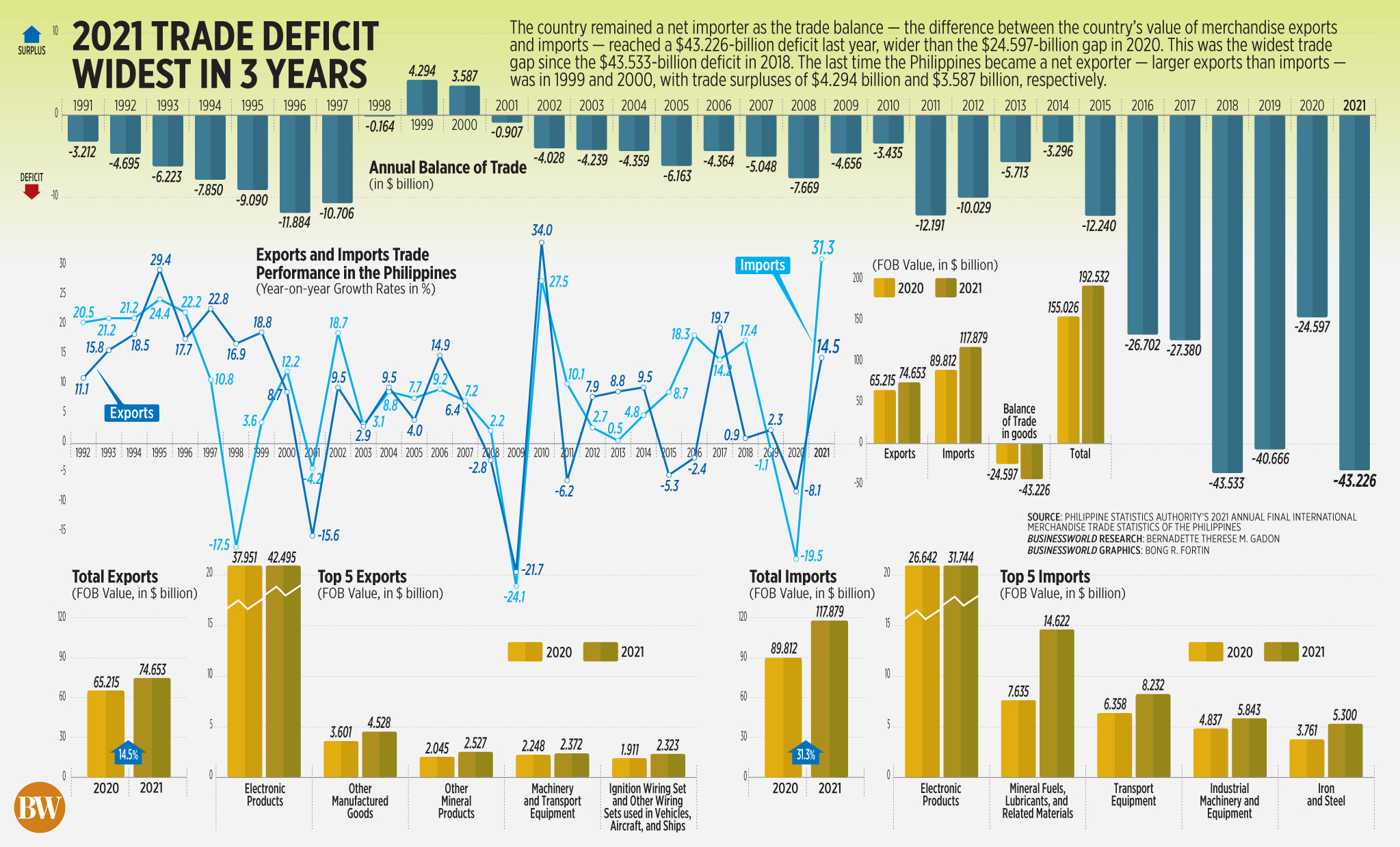
2021 trade deficit widest in 3 years

THE Philippines’ trade deficit further widened to a three-year high in 2021 as imports continued to outpace exports amid a coronavirus pandemic, latest data from the Philippine Statistics Authority (PSA) showed. Read the full story.

2021 Trade deficit widest in 3 years

How PSEi member stocks performed — April 21, 2022

Here’s a quick glance at how PSEi stocks fared on Thursday, April 21, 2022.


Local shares drop on profit taking, rate hike fears

COURTESY OF PHILIPPINE STOCK EXCHANGE, INC.

PHILIPPINE SHARES dropped on Thursday along with other Asian markets due to profit taking amid fears of an aggressive rate hike from the US Federal Reserve and other central banks.

The benchmark Philippine Stock Exchange index (PSEi) went down by 80.93 points or 1.13% to close at 7,061.49 on Thursday, while the broader all shares fell by 24.59 points or 0.65% to 3,752.54. 

“[Most] US stock markets corrected slightly lower overnight after softer US existing home sales data… and the recent hawkish signals from some Fed and ECB (European Central Bank) officials that suggest more aggressive rate hikes/monetary tightening that could lead to higher interest rates/borrowing costs and could slow down the economic recovery in an effort to curb/rein in on elevated inflation,” Rizal Commercial Banking Corp. Chief Economist Michael L. Ricafort said in a Viber message.

New York Fed President John Williams said on Thursday that the Fed should reasonably consider raising interest rates by a half percentage point at its next meeting in May, which was seen as a further sign that even more cautious policy makers are on board with bigger rate hikes, Reuters reported. This was after the ECB said it plans to cut bond purchases — known as quantitative easing — this quarter, then end them at some point in the third quarter.

“Philippine shares succumbed to profit taking following other Asian markets, while the US traded rather mixed as investors digested a fresh batch of 1Q22 earnings results,” Regina Capital Development Corp. Head of Research Luis A. Limlingan said.

Fears of a sharp economic slowdown in China and higher oil prices weighed on most Asian stocks on Thursday, but a dip in US treasury yields offered some relief for broader markets worried by the prospect of aggressive rate hikes.

Chinese and Hong Kong shares hit month lows and the yuan fell to its lowest in six months as Shanghai authorities said tough coronavirus disease 2019 (COVID-19) restrictions would remain in place.

The declines pulled MSCI’s broadest index of Asia-Pacific shares outside Japan 0.66% lower.

Back home, only two sectoral indices closed in the green on Thursday. Mining and oil went up by 251.37 points or 2.01% to 12,741.04 and financials climbed by 16.62 points or 0.99% to 1,696.10.

Meanwhile, property dropped by 72.02 points or 2.16% to 3,261.29; services went down by 29.76 points or 1.49% to 1,960.75; industrials fell by 110.07 points or 1.13% to 9,608.09; and holding firms lost 70.51 points or 1.06% to end at 6,581.27.

The MidCap index retreated by 7.83 points or 0.66% to 1,185.85, while the Dividend Yield index improved by 6.88 points or 0.419% to close at 1,688.03.

Value turnover increased to P6.04 billion with 895.46 million shares changing hands from the P4.82 billion or 799.64 million issues seen the previous day.

Decliners outnumbered advancers, 91 versus 83, while 61 names closed unchanged.

Foreigners turned sellers anew with net sales of P206.05 million versus the P585.78 million in net purchases seen the previous trading day. — R.C.S. Agustin with Reuters

Peso up on profit taking amid hawkish Fed, softer US home sales data

BW FILE PHOTO

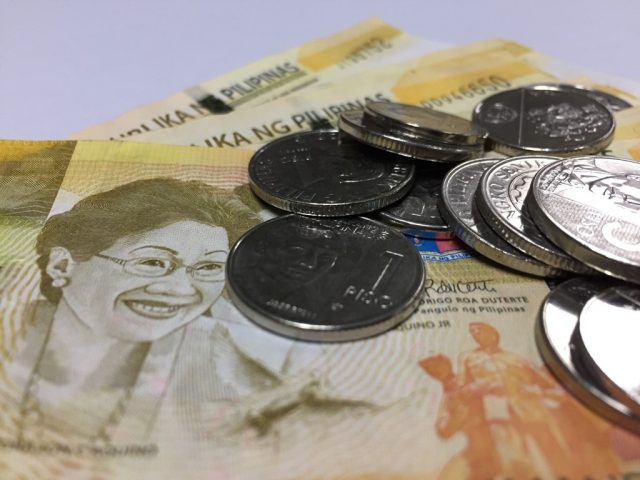
THE PESO strengthened versus the greenback on Thursday amid profit-taking following hawkish signals from Federal Reserve officials and softer US economic data.

The local unit closed at P52.365 per dollar on Thursday, appreciating by 12.5 centavos from its P52.49 finish on Wednesday, based on Bankers Association of the Philippines data.

The peso opened Thursday’s session at P52.40 versus the dollar. Its weakest showing was at P52.45, while its intraday best was at P52.35 against the greenback.

A trader in a Viber message said the peso closed stronger due to profit-taking following hawkish signals from Fed officials.

San Francisco Federal Reserve President Mary Daly on Wednesday said she supports a broad consensus to raise the interest rates to about 2.5% by the end of 2022, Reuters reported.

“Once accommodation is removed, we need to evaluate the effects — observe how financial conditions adjust, how much inflation recedes, and what more remains to be done to ensure a sustained expansion,” Ms. Daly said.

The Fed in March hiked rates by 25 basis points to begin its tightening cycle.

The peso also appreciated after the release of softer US home sales data, which partially led to a healthy downward correction of the dollar, Rizal Commercial Banking Corp. Chief Economist Michael L. Ricafort said in a Viber message.

Data reported by the National Association of Realtors on Wednesday showed US existing home sales dropped 2.7% to a seasonally adjusted annual rate of 5.77 million units in March. This is the lowest level since June 2020.

Home resales, which make up the bulk of the sales, were down 4.5% annually in March.

For Friday, both Mr. Ricafort and the trader gave a forecast range of P52.25 to P52.45 per dollar. — LWTN with Reuters

Presidential frontrunners visit vote-rich Visayas

ONENEWS.PH

By Kyle Aristophere T. Atienza, Reporter

THE PHILIPPINES’ top three presidential frontrunners visited the Visayas island this week, as they tried to woo more voters less than three weeks before the elections.

Vice-President Maria Leonor “Leni” G. Robredo on Thursday held campaign rallies in three big cities in vote-rich Cebu province, whose governor had pledged a landslide victory for the son and namesake of the late dictator Ferdinand E. Marcos.

“I won’t lose focus on my real goals,” she told reporters in Filipino in Cebu’s Bogo City when asked to comment on rival presidential bet Manila Mayor Francisco “Isko” M. Domagoso’s call for her to quit the race, according to a transcript sent by her office.

Mr. Domagoso, a former matinee idol, on Wednesday night campaigned in Tagbilaran City, where he drew about 40,000 supporters, according to his office.

The provinces of Cebu, Negros Occidental and Iloilo in the Visayas have a total of 6.8 million voters, according to Commission on Elections data.

“Moreno urged the people anew, especially the youth, not to be blindsided by the fight for power among the two warring elitist political factions who have lorded over the country for several decades only to leave the ordinary mortals on the losing end,” it said in a statement that used Mr. Domagoso’s screen name.

The mayor has presented himself as an alternative candidate to political clans that have dominated Philippine politics. Ms. Robredo is a member of the Liberal Party, the party of the late President Benigno S.C. Aquino III, whose mother Corazon replaced Ferdinand Marcos after he was toppled by a popular street uprising in 1986.

The dictator’s son, Ferdinand “Bongbong” R. Marcos, Jr., visited Cebu City, whose governor Gwendolyn F. Garcia estimated more than a million votes more for him compared with his closest rival in the May 9 election.

Mr. Domagoso and other presidential poll laggards on Sunday urged Ms. Robredo to withdraw from the race after some sectors asked them to back her instead in a presidential race that is shaping up to become a two-way contest.

Marcos, Jr. is leading in presidential opinion polls, where Ms. Robredo is a distant second though her ratings have risen.

Presidential candidates are expected to intensify their campaigns on various fronts, whether through large rallies or from house to house, said Maria Ela L. Atienza, a political science professor from the University of the Philippines (UP).

“Last-minute endorsements can pull their candidacies, but I think this will only affect undecided or soft voters,” she said in a Viber message. “Hard voters are already decided, and it would take something drastic for them to change their choice.”

She said Ms. Robredo is expected to keep her composure amid personal attacks. “As always, her message is to focus on the campaign.” 

Ms. Atienza said Mr. Domagoso might use the remaining days to get media attention and increase his exposure. “Whether this works or not is something that will unfold later.”

“All campaigns will try to gain momentum until the end of the campaign period,” said Jan Robert Go, an assistant political science professor from UP.

He said candidates who run negative campaigns like Mr. Domagoso “may intensify their attacks against other candidates but it could backfire like what is happening now.”

“Others may intensify the strategies that are working, like advertisements, rallies, house-to-house campaigns,” he said in a Messenger chat. “There could be more shifts in alliances and endorsements for certain candidates.”

Mr. Go said Ms. Robredo’s campaign would likely gain more momentum after being attacked by her rivals. “She remains unbothered despite attacks from Domagoso.”

The last government-organized presidential debate on Sunday could still affect their campaigns.

“The Marcos-Duterte camp can’t afford to have a lull in their campaigns and their continued silence on issues against them and their absence from debates may cost them some more votes,” he said.

Ms. Atienza said Mr. Domagoso might reiterate his tirades against the opposition. “It would be interesting to see how other candidates who denied asking the vice-president to withdraw will react to these possible dynamics.”

Former BSP official says Robredo gov’t to attract investors

PHILSTAR

VICE-PRESIDENT Maria Leonor “Leni” G. Robredo “will make every peso count” in her administration’s pandemic recovery program if she becomes president, according to a former Philippine central bank official.

Her anti-corruption drive and proven leadership during the global health crisis could also boost business confidence and attract investors, ex-Bangko Sentral ng Pilipinas (BSP) Deputy Governor Diwa C. Guinigundo said in a statement on Thursday.

Ms. Robredo’s office outperformed other agencies with higher budgets, making her a good model for the country’s market-driven economy, he added.

“She was able to maximize the Office of the Vice President’s allocation to fund an operation truly national in scope,” Mr. Guinigundo said.

“The next president must be able to judiciously utilize scarce resources. Robredo is the only one with executive experience to make every peso count.”

The Commission on Audit has given the Office of the Vice President the highest audit rating for three straight years.

Mr. Guinigundo said the country is entering an era “when a coronavirus-hit economy will not be able to contribute revenues that can substantially finance a national budget that addresses the needs of the people.”

“She will attract investors who will be lured that an economist is at the helm,” he said. “They will see her as both fair to labor, capital and consumers.”

Mr.  Guinigundo said Ms. Robredo is a “stark contrast” to her main rival, Ferdinand ‘Bongbong’ R. Marcos, Jr., who failed to file his income tax returns in the 1980s.

Critics have asked him and his family to settle the unpaid tax of their father’s estate that has ballooned to more than P200 billion due to interests and other penalties.

Nomura Global Research earlier said a government led by Ms. Robredo would be more “market-friendly.”

“Marcos Jr., in our view, will likely be regarded as less market-friendly than [Ms. Robredo], particularly when it comes to experience at the national level and in articulating a strategy for the country to recover from the pandemic,” it said in a report last year.

Ms. Robredo, who lawyered for the poor before becoming a congresswoman, has vowed to promote transparency and accountability in government and pursue pandemic recovery through health-based measures that respect human rights.

Her main rival, Mr. Marcos, who is leading in presidential opinion polls, has promised to continue a number of President Rodrigo R. Duterte’s policies, including his infrastructure plan.

“A Marcos victory will likely be viewed negatively owing to perceptions against him, in part because his candidacy is facing some petitions for disqualification on grounds of making false statements and a previous conviction of failing to file income tax returns,” Nomura said.

A recent poll conducted by Bloomberg showed that Filipino investors were lukewarm to the prospects of a Marcos presidency, with Ms. Robredo emerging as their top pick to oversee an economic rebound.

The late President Benigno S.C. Aquino III, who started economic policies that led to investment-grade credit ratings for the Philippines and economic growth exceeding 6% from 2012 to 2014, endorsed Ms. Robredo’s vice presidential run in 2016.

The country’s economic output grew from an annual average of 4.5% before Mr. Aquino’s term to 6.2% during his six-year reign, according to economists. — Kyle Aristophere T. Atienza

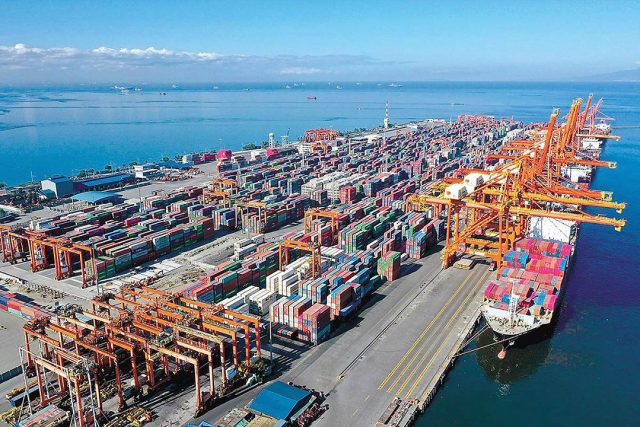
FedEx Clark capacity seen expanding five times

REUTERS

TRADE SECRETARY Ramon M. Lopez said FedEx Corp.’s Clark capacity is expected to expand around five times amid plans to use Clark as a transshipment base.

In a statement issued out of Washington, DC, the Department of Trade and Industry (DTI) said transshipment status will mean FedEx will conduct hub-and-spoke operations at Clark. Hub and spoke means packages arriving in Clark will be reloaded to other aircraft that will proceed to their specific regional destinations.

FedEx discussed its plans with DTI officials, Presidential Adviser on Flagship Programs and Projects Vivencio B. Dizon. Representing the company at the April 18 meeting was Vice-President Ralph Carter.

Mr. Dizon was in attendance to address FedEx concerns about the processing of documentation that will enable speedy transfers at the hub.

Mr. Carter said FedEx is looking to initiate Phase 2 of its project in Clark as soon as possible. FedEx’s Phase 1 facility is 7,000 square meters.

He also cited the need for clear and flexible rules to ensure that transit goods that come into the Philippines are not stopped and inspected.

In February 2022, FedEx executives met virtually with Board of Investments (BoI) Managing Head and Trade Undersecretary Ceferino S. Rodolfo to discuss FedEx’s expansion plans and to seek assistance in getting the Bureau of Customs to agree to rules governing transshipments.