Home Blog Page 6153

‘Climate change affects everyone’: Europe battles wildfires in intense heat

Global warming - STOCK IMAGE

JERTE, Spain — Authorities across southern Europe battled on Sunday to control huge wildfires in countries including Spain, Greece, and France, with hundreds of deaths blamed on soaring temperatures that scientists say are consistent with climate change.

In Spain, helicopters dropped water on the flames as heat above 40 Celsius and often mountainous terrain made the job harder for firefighters.

Shocked residents watching thick plumes of smoke rising above the central western Jerte valley said the heat was making their previously green and cool home more like Spain’s semi-arid south.

“Climate change affects everyone,” said resident Miguel Angel Tamayo.

A study published in June in the journal Environmental Research: Climate concluded it was highly probable that climate change was making heatwaves worse.

More than 1,000 deaths have been attributed to the nearly week-long heatwave in Portugal and Spain so far. Temperatures in Spain have reached as high as 45.7°C.

Spain’s weather agency issued temperature warnings for Sunday, with highs of 42°C forecast in Aragon, Navarra and La Rioja, in the north. It said the heatwave would end on Monday, but warned temperatures would remain “abnormally high.”

Fires were raging in several other regions including Castille and Leon in central Spain and Galicia in the north on Sunday afternoon. Firefighters stabilized a blaze in Mijas, in Malaga province, and said evacuated people could return home.

British pensioners William and Ellen McCurdy had fled for safety with other evacuees in a local sport center from their home on Saturday as the fire approached.

“It was very fast …. I didn’t take it too seriously. I thought they had it under control and I was quite surprised when it seemed to be moving in our direction,” William, 68, told Reuters.

In France, wildfires have now spread over 11,000 hectares in the southwestern region of Gironde, and more than 14,000 people have been evacuated, regional authorities said on Sunday afternoon.

More than 1,200 firefighters were trying to control the blazes, the authorities said in a statement.

France issued red alerts, the highest possible, for several regions, with residents urged “to be extremely vigilant.”

In Italy, where smaller fires have blazed in recent days, forecasters expect temperatures above 40°C in several regions in coming days.

Similar temperatures were recorded in Portugal on Sunday and are forecast in Britain on Monday and Tuesday, in what would top its previous official record of 38.7°C set in Cambridge in 2019.

Britain’s national weather forecaster issued its first red “extreme heat” warning for parts of England. Rail passengers were advised to only travel if absolutely necessary and to expect widespread delays and cancellations.

DROUGHT IN PORTUGAL

Around 1,000 firefighters tried to control 13 forest and rural fires in the center and north of Portugal, the largest being near the northern city of Chaves.

Portugal’s Health Ministry said late on Saturday that in the last seven days 659 people died due to the heatwave, most of them elderly. It said the weekly peak of 440 deaths was on Thursday, when temperatures exceeded 40°C in several regions and 47°C at a meteorological station in the district of Vizeu in the center of the country.

By Saturday, there were 360 heat-related deaths in Spain, according to figures from the Carlos III Health Institute.

Portugal was grappling with extreme drought even before the recent heatwave, according to data from the national meteorological institute. Some 96% of the mainland was already suffering severe or extreme drought at the end of June.

Emergency and Civil Protection Authority Commander Andre Fernandes urged people to take care not to ignite new fires in such bone-dry conditions.

In Greece the fire brigade said on Saturday 71 blazes had broken out within a 24-hour period. — Guillermo Martinez/Reuters
Boeing says ‘lessons learned’ from costly Air Force One deal

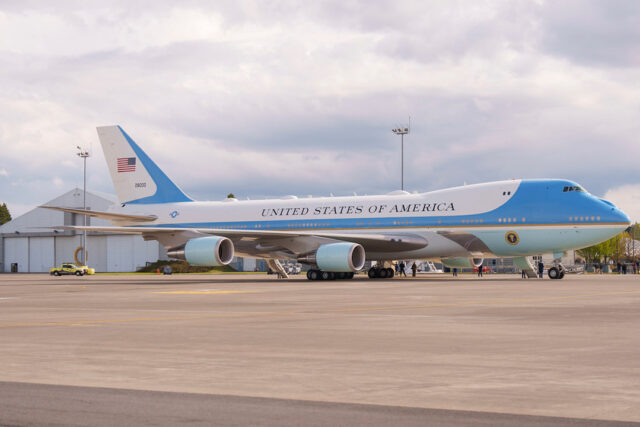
Air Force One sits on the tarmac at Portland International Airport in Portland, Oregon, on April 21.
— Official White House Photo by Adam Schultz

LONDON — Boeing’s defense chief said on Sunday it had learned lessons from a contract to supply the US presidency with new Air Force One aircraft, which has cost the planemaker almost $1 billion in charges and is up to three years behind schedule.

Ted Colbert did not give details of learnings, but said they had contributed to a new schedule for the two planes that has seen deliveries pushed back to 2026 and 2027.

“The lessons learned are important to us and we’re applying them going forward,” Mr. Colbert told reporters at a briefing ahead of the Farnborough air show. “We’ve made changes to the program. We’ve made changes to the way we work on the program.”

“These are challenging programs and you learn as you go along and you adapt as you have to,” he added.

In April, Boeing recorded a $660 million charge after taking a $318-million one in April 2021 on the program “largely due to COVID-19 impacts and performance issues at a key supplier.”

Asked if Boeing could recoup those cost overruns, Mr. Colbert said: “If we can find a way to, we will.”

Boeing received a $3.9 billion contract in 2018 for two 747-8 aircraft to be delivered starting in 2024.

In December 2016, then US President-elect Donald J. Trump secured a promise from then Boeing Chief Executive Officer Dennis Muilenburg that the cost of replacing Air Force One would not exceed $4 billion. Mr. Trump had earlier urged the government to cancel buying Boeing’s new Air Force One, saying it was “ridiculous” and too expensive.

Boeing CEO Dave Calhoun said in April the deal was problematic.

“Air Force One — I’m just going to call a very unique moment, a very unique negotiation, a very unique set of risks that Boeing probably shouldn’t have taken,” Mr. Calhoun said. “But we are where we are, and we’re going to deliver great airplanes. And we’re going to recognize the costs associated with it.”

The Boeing 747-8s are designed to be an airborne White House able to fly in worst-case security scenarios, such as nuclear war, and are modified with military avionics, advanced communications and a self-defense system. — David Shepardson/Reuters

Top US energy envoy expects further steps from OPEC producers on supplies

PIXABAY

WASHINGTON — Major crude oil producers have spare capacity and are likely to boost supplies following President Joseph R. Biden, Jr.’s visit to the Middle East, a senior US energy envoy said on Sunday.

Speaking on CBS’ Face the Nation, Amos Hochstein, senior US State Department adviser for energy security, said: “Based on what we heard on the trip, I’m pretty confident that we’ll see a few more steps in the coming weeks.”

Mr. Hochstein did not say which country or countries would boost production or by how much.

“It’s not just about Saudi … We met with the GCC, and with Saudi Arabia. I’m not going to go into how much spare capacity there is in Saudi Arabia and in UAE (the United Arab Emirates) and Kuwait etc. But there is additional spare capacity. There is room for increased production,” he said.

GCC stands for Gulf Cooperation Council and includes Bahrain, Kuwait, Oman, Qatar, Saudi Arabia and the United Arab Emirates.

Mr. Biden visited Saudi Arabia on Friday as part of his first trip to the Middle East as US president, hoping to strike a deal on oil production to help drive down gasoline prices. A rise in US gasoline prices to more than 40-year highs is fueling inflation and pummeling his ratings in opinion polls.

But he has not secured a clear assurance on an oil production increase.

Saudi Arabia’s foreign minister said a US-Arab summit on Saturday did not discuss oil. He said that OPEC+ would continue to assess market conditions and do what is necessary. OPEC+, which also includes Russia, meets next on Aug. 3.

Oil prices rocketed to their highest levels since 2008, climbing above $139 a barrel in March, after the United States and Europe imposed sanctions on Russia over its invasion of Ukraine, which Moscow calls a “special military operation.” Prices have slipped since then.

Mr. Hochstein also said he expected to see U.S. gasoline prices to fall further towards $4 a gallon, after exceeding $5 a gallon earlier this year for the first time in history. — Humeyra Pamuk/Reuters

[B-SIDE Podcast] Keeping the peace in the PHL

Follow us on Spotify BusinessWorld B-Side

Peace in the Philippines improved in the last four years, moving up the country’s position to 128th out of 168 territories in the global peace index, according to the Institute for Economics and Peace (IEP).

The improvements were driven by four factors, including the reduction of violent demonstrations, political instability, terrorism and deaths from internal conflict.

In this B-Side episode, IEP founder and executive chairman Steve Killelea talks to BusinessWorld reporter Alyssa Nicole O. Tan about the ways in which the Marcos administration can “manage future instabilities culminating from unexpected global events such as pandemics or civil unrest.”

“Obviously, a government policy around positive peace is important,” he said.

TAKEAWAYS

Despite improved peacefulness in the Philippines, peace in the region slightly deteriorated.

“If we’re looking at Asia overall, 10 countries deteriorated and nine improved, it’s slightly less peaceful than it was in the last year, so all in all, the Philippines has still outscored the other countries in the region,” Mr. Killelea said.

Despite improvement, the country remains the third least peaceful country in the region for the second consecutive year. 

“Although it has seen improvements in the homicide rate, the Philippines is still quite high. It also has the number of different militants, some Islamic in nature, that are fighting with the state and those situations have improved somewhat, but according to global standards and particularly in the region, it’s still fairly high,” he said.

“Violent crime, it’s still reasonably high for the region as well, so you’ve got a number of internal conflicts running in parts of the country,” he added.

Peaceful countries enjoy stronger economic environments.

Positive peace, drawn from a well-functioning government, strong business environment, acceptance of people’s rights, equitable distribution of resources, among other positive factors, leads to several benefits.

The Philippines, for example, has 2% per annum higher gross domestic product growth rates than countries that are deteriorating in positive peace, Mr. Killelea said. 

“We simply find that the inflation rates are lower, the interest rates are lower. In fact, the inflation rates are four times less volatile in countries improving in positive peace compared to those which are deteriorating.”

“Foreign direct investments higher — twice as high. Debt ratings tend to improve overtime, whereas in countries deteriorating in positive peace, they deteriorate as well,” he added.

“When we look at positive peace, we also find the countries in which are better in positive peace have better mentions in well-being and happiness, better performance on ecological performance, and much better in a whole range of developments as well so therefore in many ways we use positive peace to describe an environment in which human potential can flourish,” the IEP executive chairman said.

The new administration should focus on enhancing the everyday life of ordinary Filipinos.

According to Mr. Killelea, President Ferdinand “Bongbong” R. Marcos, Jr., has to address corruption, violent crime, and homicide.

Based on the results of IEP’s research, prosperous countries are more peaceful: people are less inclined to fight or resort to violence to try and make ends meet.

The Philippines must balance its relationships with the two superpowers. 

“It’s unlikely in the next couple of years that we see a full stage conflict between the US and China, I don’t think either country sees it in its interest, but whether China keeps being aggressive towards the claims in the territory in the South China Sea will have a lot to do on how the relationships between the Philippines and China will develop over the next decade,” Mr. Killelea said.

“Certainly, the US is going to place more emphasis on the Asia-Pacific over the next decade, we can see that over the last few years, that will come in the form of economic support and the form of a stronger military presence also,” he added.

“The last thing you want to see is conflict or violence, breakout in the Indo-Pacific region,” the IEP founder said.

A data-driven plan is necessary to prepare the country for incoming global challenges.

“I think what the government needs to do is to create a special task force that will look at emerging threats to both the Philippine economy and the security situation,” Mr. Killelea said.

He noted the need for a “whole-of-government policy” to look at where emerging threats come from and create plans to counter them and their after-effects as they arise.

“We don’t know whether they’re going to occur or not, but having a strategic insight and doing the planning around them is not necessarily expensive. If the eventualities do turn out, they manifest and start to become real, then at least the plans are in place,” he said.

For the next two years, economic management will be key, he added. There will be a need for aggressive management of inflation, while food security will remain critical.

“There’s a need to address the needs of the most vulnerable, particularly the very poor. The government will have to address food for the most vulnerable within Philippine society,” Mr. Killelea said. “It will go a long way to improving the peace, and it will also improve the appearance of the government in the eyes of the average Filipino.”

Recorded remotely July 2022. Produced by Earl R. Lagundino and Sam L. Marcelo.

Follow us on Spotify BusinessWorld B-Side

Transformational leadership: Fostering growth through people

Business transformation is far from easy. The merits of digital transformation have been evident long before the outbreak of the COVID-19 pandemic, and yet many companies essentially still had to be forced by the ensuing crisis to start the process.

“A substantive and irreversible shift in an organization’s identity, value system, and capabilities requires three difficult acts: Developing a deeper sense of purpose that guides strategic decisions and shapes the workplace culture, repositioning the core business, and creating new sources of growth,” Harvard Business Review (HBR) wrote in an article.

Furthermore, HBR pointed to the requirement of upgrading infrastructure, workflows, and tools to allow for digital changes such as online commerce and remote work. “The growth and diversification of digital platforms like Amazon, Alibaba, and Stripe raises important strategic questions about where and how to compete. Difficult economic conditions (low consumer demand in particular) challenge the viability of some business models,” the Harvard publication added.

Successfully guiding a company through such fundamental changes demands more from its leaders than simply fulfilling a company’s immediate interests. Transformational leadership, a concept that gained popularity in the 1970s and 1980s, is more about creating a vision to guide the change through influence, inspiration, and executing that vision alongside a team in shared purpose.

Michigan State University (MSU) cited James MacGregor Burns, a political science and leadership researcher, who in the 1970s defined the actions of transformational leadership as “when one or more persons engage with others in such a way that leaders and followers raise one another to higher levels of motivation and morality”.

“Equal parts visionary, mentor and source of inspiration, these leaders create a culture of innovation and positive change that leads to successful business outcomes. Transformational leaders do this by creating a distinctive culture within the organizations and teams that they lead,” MSU wrote in an article.

While the term can bring to mind conventional image of a strong, energetic, charismatic and passionate leaders, MSU clarified that transformational leadership goes beyond personality to drive a cultural and visionary change within an organization.

“While these may be the types of leaders who automatically come to mind, the characteristics of a transformational leader go much deeper and shouldn’t be thought of as innate personality traits or types. Becoming a transformational leader is about developing behaviors, strategies and actions, all grounded in leadership theory,” MSU wrote.

What defines a transformational leader?

The list of demands facing businesses today from all stakeholders grows longer each year. As current events unfold and consumers, employees, and investors alike begin to grow more conscientious of social, economic, and environmental issues, they are starting to expect more organizations to do their part to address those concerns.

Leaders whose organizations are undergoing transformation today, HBR noted, need to be in tune with such demands in order to give them a more complex context in which to execute major structural change (such as acquisitions, disposals, partnerships, and organizational redesign), widespread deployment of new technologies, considerable effort, and cultural change.

“Employees, customers, and investors also expect organizations to play a more prominent role in tackling other systemic issues, such as climate change and social inequality — while also making a profit. Employees, many of whom will have experienced trauma, loneliness, and burnout, expect to use smarter, more flexible working practices and to work for leaders who are effective, authentic, and compassionate,” HBR wrote.

“Transformations are often, but not always, initiated and led by the ‘center’: the board and the CEO and their direct reports and supporting functions. At first, they reach out to customers, partners, and employees on the front line to understand their needs, frustrations, and problems in order to work out what needs to be addressed,” HBR pointed out.

Once they complete their diagnosis, these leaders often retreat to the center, staying there until they are called to action once more. This should not be the case under a transformational leader, as they should keep their fingers on the pulse of their organization at all times.

The transformational leader thinks beyond the status quo and challenges conventional approaches to the issues most relevant to the organization, and inspires others to do the same. MSU stated that one of the key transformational leadership traits is the ability to transmit a sense of the larger culture to the individual, giving employees a feeling of ownership in company goals and independence in the workplace.

“Transformational leaders do not dictate ideas from a bubble and then leave it to employees to carry them out. They are concerned with the professional development of employees and foster positive relationships with them. This involves keeping lines of communication open, attending to the individual needs of employees, mentoring them and recognizing each person’s unique contributions,” MSU wrote.

“You can often identify a transformational leader by the trust, respect and admiration others feel for them. Transformational leaders do not micromanage. They lead by communicating a clear vision and creating a workplace where seasoned employees are trusted to make decisions in their assigned areas. All employees are encouraged to think creatively to find new solutions to longstanding challenges.”

Transformational leaders in this sense should serve as the organization’s role models as a kind of ‘idealized influence’ that inspires ethical and socially desirable behavior, maintaining a dedication to work goals and exhibiting enthusiasm about company strategy. Most importantly, the followers of a transformational leader do this not merely because it is good for the company, but because they trust that it is good for their team and for them as individuals.

This is also the main difference between transformational leadership and visionary leadership. Many would conflate the two as both kinds of leaders look for new possibilities for the future of an organization, team or product and help others to conceptualize and inspire others to find their own solutions. However, MSU noted that the difference between these leadership styles “lies in a true transformational leader’s ability to inspire the development of new ideas”.

“Even if the vision is not their own, transformational leaders can nurture it toward reality,” MSU added. — Bjorn Biel M. Beltran

The rise of sustainable buildings

Buildings provide spaces to live in, work, and shop, among other activities. But while we recognize them as an important part of our day-to-day lives and the economy, we should also realize the significant environmental impact of buildings.

In 2015, building operations and construction generated 13.1 gigatons or 38% of the global energy-related carbon dioxide emissions, according to the United Nations Environment Programme’s 2021 Global Status Report for Buildings and Construction. This dropped 10% to 11.7 gigatons in 2020, mainly due to the lesser energy demand during the COVID-19 pandemic, along with the decarbonization efforts for the power sector. Though the share of buildings and construction in the global energy-related CO2 emissions that year was at 37%.

Constructing green buildings, therefore, has the potential to reduce their impact on the environment. In the Philippines, green buildings have been garnering an increasing interest among developers.

Developers use green building certification rating systems to substantiate that their project met green building standards. Among the commonly held certifications in the country are LEED (Leadership in Energy and Environmental Design), WELL, EDGE (Excellence in Design for Greater Efficiencies), and BERDE (Building for Ecologically Responsive Design Excellence). And in the past years, the number of green-certified buildings has risen.

Real estate services firm Jones Lang LaSalle (JLL) Philippines’ data showed that, starting from 2016, the growth of green-certified buildings has a compound annual growth rate of 4.6% as of the third quarter of 2021. Of this figure, office buildings accounted for around 67.1%, while 11% were retail and 9.8% were residential.

EDGE, for its part, has seen this increase in green-certified buildings in the country, particularly during the pandemic.

Angelo Tan, country lead for the Philippines at the Climate Business Department of the International Finance Corp. (IFC), said that over 50 projects, spanning roughly 86,000 sq.m., have received EDGE certifications in the country so far. “What is interesting is that more than half of those projects were certified in 2022 alone. You’re seeing a lot of interest in recent years. In addition to that, we have 3.7 million sq.m. in the pipeline that are pursuing EDGE,” he shared at the BusinessWorld Virtual Economic Forum last May.

EDGE is a green building certification system by IFC, seeking to help developers and builders swiftly determine the most cost-effective strategies to construct resource-efficient buildings.

Mr. Tan said the Philippines has “a little over 200 plus” green buildings, noting also that most are office towers in Metro Manila.

But despite the rising interest in green buildings, he said that the development of green buildings in the country is still slow compared to its Southeast Asian neighbors.

“It’s been very slow. It’s largely focused on a very elite segment of the property sector. And I think that’s something that we need to change,” Mr. Tan said. “We need to make green and resilient infrastructure much more accessible to a greater proportion of the population.

Colliers also observed that office developments located in established central business districts are at the forefront of the green building sector. Yet, the real estate services and investment management firm noted that the rise of green buildings has extended not only within established CBDs in recent years, having also seen the growth in emerging provincial markets, especially in the residential, industrial, and institutional sectors.

According to an April 2020 article published by Colliers on its website, of those certified green buildings in the provincial market, 38% are industrial and 43% are office. Green strategies were also being planned and employed in residential development, particularly for the economic and upscale segments.

“There is an untapped green market in the provincial area, especially in the municipalities of Southern and Central Luzon, where demand for residential housing is stable,” the firm said. “Project owners and planners must work collaboratively to find ways of adopting green building strategies into residential developments and create an offering to the applicable market segment.”

Meanwhile, there is also a greater demand among occupiers for green buildings, according to JLL Philippines, which has urged developers to build more green buildings.

The firm said that this aligned with the broader real estate sustainability developments across the Asia Pacific, in which its survey recorded that 40% of corporate occupiers have already adopted net zero carbon emission targets, and another 40% are planning to adopt targets by 2025.

“While the Philippines has a long way to go in terms of our sustainability journey, there is greater consciousness and more conversations about it now,” Joey Radovan, JLL Philippines’ country head, said in a webinar last year. “The pandemic helped to increase the demand for green buildings, and this awareness must be augmented by government support through policies and incentives, as well as real estate firms adapting and promoting sustainability efforts among their clients.”

The green building sector offers an estimated $24.7 trillion investment opportunity in emerging market cities by 2030, according to IFC’s report in 2019. In the East Asia Pacific, there is an estimated $16 trillion investment potential in green buildings. — Chelsey Keith P. Ignacio

SACHI-Group and Cassava Bags: Eco-packaging solutions to address plastic pollution

SACHI-Group (Sustainable And Compostable Horizons Industries Group, Inc.) is a pioneer manufacturer of biodegradable and compostable cassava bags in the Philippines.

By Chelsey Keith P. Ignacio, Special Features Writer

The problem with plastic has become more evident for many consumers and businesses. Most plastics are made from fossil fuels and could take hundreds of years to decompose. But each year, according to Our World in Data, the world currently produces over 380 million tonnes of plastics. Mismanagement, overuse, and the few recycling of plastics then cause waste and pollution, which are harmful to the environment.

This plastic pollution problem is therefore multifaceted, as realized by the founders of SACHI-Group, Inc. Because more than the issue with the material itself, the plastic pollution problem is also about solid waste and climate change.

“To tackle those issues, the material, the systems, and the people’s behavior need to be addressed,” SACHI-Group CEO and Co-founder Prince Ang told BusinessWorld. “With cassava bags, we can take steps towards addressing the problem.”

SACHI-Group (Sustainable And Compostable Horizons Industries Group, Inc.) is a pioneer manufacturer of biodegradable and compostable cassava bags in the country. For the startup, cassava bags could complement the current solid waste infrastructure and enable users to practice proper disposal, hence could help address the plastic pollution problem.

Cassava bags may look like traditional plastics. But unlike the plastics commonly used today, cassava bags are not petroleum-based and do not leave toxic residues.

“The material is home compostable and water-soluble, giving those without experience in composting the ability to properly dispose of the bags,” Mr. Ang explained. “By manufacturing it locally, we can build the whole company with circularity at its core.”

SACHI-Group occupies an a 1100 sq. ft. area for its first production line of compostable cassava bags. With its advanced bioplastic extruding, cutting, sealing, and printing machines, the startup can supply over 70,000 tonnes every year. It utilizes plant-based and renewable resources like cassava starch for its main films, while the outer packaging and design are made from recycled, upcycled, or non-toxic materials.

The products of SACHI-Group include t-shirt shopping bags, e-commerce mailer pouches, grip hole bags, and cassava rolls for various uses. By manufacturing these locally, the startup is able to cut the production and delivery lead time from 90 days to as short as 20 days.

By far, one of SACHI-Group’s major partners, marketing and distribution company EcoNest Philippines, has distributed over 2,000 kgs of converted cassava resins, and over fifty small and medium enterprises and corporations across the country are using these cassava bags.

“We are looking forward to encouraging and tapping thousands of MSMEs and local/ international corporations in the coming years, especially those who are committed to supporting the Paris Agreement to achieve net zero by 2050,” Mr. Ang said.

SACHI-Group also plans to work with different stakeholders who seek to take actionable steps to develop a circular model in their organizations through the startup’s products and services, according to SACHI-Group Director and Co-founder Nikki Luy Sevilla, who also co-founded EcoNest Philippines.

For Ms. Sevilla, making the switch to cassava bags or employing circular approach to packaging “speaks volumes about the real principles and values” of those who run the companies.

“We, at SACHI-Group, Inc. envision a livable and greener future. Deciding to work towards circularity entails a different level of commitment and we are always thrilled to support those who are conscious in their business’ actions and impact on the community,” she said.

“As more and more brands increase the use of cassava bags, we can definitely see further developments in the performance and proper disposal of truly plant-based materials here in the Philippines. Any support to raise awareness and encouragement for other businesses to join our movement simply by using cassava bags will go a long way,” she added.

How beneficial is a green structure to workers?

Built by more sustainable materials and powered by renewables, green buildings are seen to be a healthy component of cities and communities as they reduce greenhouse gas emissions and maximize the use of resources. But how do these capabilities — or at least the practices of making buildings green — translate into benefits for occupants?

Sazan Rahman, a PhD candidate and teaching assistant at McGill University whose research is mostly about green walls, green roofs, and green buildings with other green technologies, noted that research has proven that green buildings greatly benefit workers in their productivity and well-being.

“Some planners might worry about the added design and construction costs of a green building. But detailed analyses show that the small increase in building costs has noticeable benefits on the health and wellness of those working or living inside the building — or nearby,” Mr. Rahman wrote in an article in The Conversation last February.

“Green workplaces meet all the criteria of the ‘triple bottom line,’ summarized as ‘people, planet and profit.’ These improve the health and well-being of people, improve energy efficiency and boost productivity,” he further stressed.

The engineering academic wrote that interior spaces with green walls, vertical gardens, or potted plants can reduce noise levels, which helps occupants concentrate on their work.

On the other hand, outdoor permeable surfaces like soil, rock wool, and vermiculite, and plants on buildings’ roofs and courtyards reduce echos.

With green roofing, green buildings are also seen to reduce the “urban heat island” effect, which occurs when a city replaces natural land cover with dense concentrations of pavement, buildings, and other surfaces that absorb and retain heat, resulting in a city experiencing much warmer temperatures than nearby rural areas.

Covering the roof of an uninsulated building with plants, Mr. Rahman explained, reduces cooling energy by as much as 33%, particularly in the summer season; and such roofing also reduces daytime indoor temperature fluctuations in the absence of air conditioning.

“Studies show people working or living in areas with high proportions of green roofs have better mental health, heal more quickly after an illness and are more productive at work,” he added.

Green buildings, or at least putting more greens in one, also pave way for occupants to breathe cleaner air. Mr. Rahman cited a study way back in the 1990’s which showed that there were fewer mold spores and microbes in a room where houseplants covered one-third of the floor space compared to a room with no house plants.

“Plants also increase indoor humidity levels in dry climates, reducing the likelihood of dry eyes, itchy or scratchy throat or chapped lips,” he added.

More recently, the engineering academic added, latest research has also shown that plants can help hospitalized patients heal faster.

“A report by the Green Building Council of Australia found that hospitals with green infrastructure, such as an ornamental green wall, plants on every balcony and large trees around the building, reduced average hospital stays by 8.5%, sped up recovery time by 15%, reduced the rate of secondary infections by 11% and lowered the need of pain medication by 22%,” Mr. Rahman shared.

“Not only do buildings with plants help patients heal faster, but they also energize the doctors, nurses and other staff who work there, and provide esthetic, acoustic and air quality benefits.” — Adrian Paul B. Conoza

The makings of healthy buildings

Cities generate more than 80% of all economic growth globally. As cities make up an integral part of society, how they are built has a significant effect on the natural environment.

Estimates of the United Nations suggest that cities are responsible for 75% of global CO2 emissions, with transport and buildings in the city being among the largest contributors.

It is no secret that climate change is one of the many implications of the constant development of urban areas. Hence, today, numerous people, both in large-scale companies and individual consumers, are making conscious lifestyle choices and are co-creating a future built on sustainability.

In designing a sustainable community within a city, a number of factors contribute to the eco-friendliness of the infrastructure — enough for it to earn the title of a ‘green building’.

From planning, construction and operation, green buildings can also adapt to the environment as it changes and are developed using strategies that preserve precious natural resources, reduce negative impacts to the environment, and improve the overall quality of life of the inhabitants.

While many think that the job is done once a building is constructed, developers point out that buildings may stand for years but, at some point, buildings will be updated or replaced, and it is their job too to know what materials can be reused or recycled in the process.

In creating green buildings, some of the best practices of premier green-infra developers are their utilization of environmentally preferable construction materials, crafting of products that are or can be made with recovered materials, and selecting brownfield sites that have the potential for redevelopment.

Aside from the vigorous attempt to repurpose construction materials, green buildings also display top-of-the-line technology to curb energy consumption. Some of these are through installation of cool roofs (also known as energy-saving roofs with proper insulation), maximizing the use of natural lighting, and establishing energy-efficient rules and regulations for tenants to follow.

In a recent UN report, more than half of the world already lives in urban areas today, and by 2050, more than two-thirds of the global population of around nine billion is expected to live in cities, particularly in developing countries like the Philippines.

As water is at the core of sustainable development and is critical for socio-economic development, healthy ecosystems and for human survival itself, built environment must be capacitated with an efficient use and maintenance of water resources.

Developers of green building projects consider how much water they will use during and after construction, utilize techniques that detoxify wastewater for re-consumption, and create a masterplan that can minimize the risk of flooding. Some green infrastructures also restore the natural waterflow by reconnecting their drainage systems to rivers and coasts.

As COVID-19 emphasized the importance of health now more than ever, the public looks for safer spaces within dense cities. While green buildings are good for the environment, developers also characterize them as healthy buildings that can positively impact the well-being and overall lifestyle of the occupants.

According to a Harvard study, healthy buildings must strive to meet the foundational criteria which cover everything from ventilation and air quality to lighting, views and physical security.

At present, with the use of integrated technologies, green buildings display some of the specified foundations — starting from minimizing the risk of harmful ground gases such as radon that may enter through building cracks, considering fire safe materials with flame retardants, establishing and maintaining good Indoor Air Quality (IAQ), following biophilic and active designs, up to providing vegetated roofs.

However, it is worth noting that not all green buildings are or need to be the same as different countries and regions have distinctive climatic conditions, unique cultures and traditions, diverse building types and ages, and wide-ranging environmental, economic and social priorities.

The World Green Building Council, a non-profit organization made up of businesses working in the building and construction industry that aims to transform the built environment to make it healthier and more sustainable, underscored that any building can be a green building, whether it’s a home, an office, a school, a hospital, a community center, or any other type of structure, provided it includes the necessary features.

While green buildings may incur additional expenses to design and construct, as per experts, the energy savings alone will bring a return on the investment in about six years.

Architects, engineers and project managers know that sustainability is vital in any commercial or residential projects. They are aware that to deliver environmentally- and people-friendly designs is a task leaning towards a shared responsibility, yet, having buildings certified is also about gaining a competitive advantage in the current widening market.

According to the World Economic Forum, by 2025, there will be at least 40 megacities. And in 2030, the second-largest city in the world behind Tokyo is expected not to be in China, but in the Philippines’ capital — Manila.

With the country’s young population, demand for these green buildings is on the rise. More sustainable urban developments and structures are expected to be seen in the next few years that will vastly improve the living environment and restore the overall atmosphere of the city. — Allyana A. Almonte

MSMEs should create ‘product dependency,’ start small — PTTC

Knowing the right product to sell to the right market will help ensure the success of one’s business and products, according to a lecture presented at a July 13 training event organized by the Department of Trade and Industry’s Philippine Trade Training Center-Global MSME Academy (PTTC-GMEA).

Talking to a group of microentrepreneurs, Gary B. Sta. Cruz, a PTTC-GMEA research and training design specialist, noted how food fads such as Heinz’s green ketchup failed to endure a few years after being introduced to the market, despite making an initial splash.

It demonstrates that you need to know the right product to sell, he said, referring to the marketing mix of product, promotion, place, and price.

“We want our customers to be loyal to our products — although for me, there’s one level higher than product loyalty, and that’s product dependency,” he added in the vernacular. “That’s our goal.”

Online commerce has turned the old business model of creating a product then bringing it to market on its head. Today’s entrepreneurs should make products that satisfy the needs of the market.

“If they want soap, what type are they looking for? Do they want something for sensitive skin? Do they want something with bleaching properties? Create a product based on their need,” he said.

While segmenting consumers into subgroups based on shared factors — age, geographic location, opinions — is an efficient way of marketing, a brand should take care to remain consistent in its messaging.

“When you stay true to your positioning, customers… have a clear picture of who you are versus your competitors,” said Jem Perez-Chua, Century Pacific Foods, Inc. marketing manager.    

Aside from positioning, businesses have to consider pricing and location (both in the physical and digital sense).

Even if proximity remains an advantage, hybrid setups allow, say, an electronics shop in Divisoria, Manila, to serve customers through its Facebook page. “You don’t even need a huge storefront for this type of setup anymore,” said Mr. Sta. Cruz. “Bodega lang siya [Their place is just a storeroom].”

He added that microbusinesses writing a marketing plan need to consider the following: (1) one’s business situation; (2) one’s target audience; (3) one’s objectives, budget, and timeline; (4) the implementation of the best suited marketing strategy; and (5) evaluation and adjustment of the same. 

If you’re offering a discount but realize your bottom line can’t cover this promo, recalibrate, Mr. Sta. Cruz said. If you’re offering free delivery but realize your customers have cars and prefer to pick up their orders, recalibrate.

If you have a canteen and plan to scale it up into a restaurant in five years, be cognizant of the initiatives you need to take — investing in modern equipment, sampling new recipes, joining online platforms — to drive that growth, he added. 

Mr. Sta. Cruz shared the Indonesian proverb: “Sedikit-sedikit lama lama menjadi bukit,” which means small acts add up to big results. (Its rough literal translation is “little by little, with time, it becomes a hill.”)

“Don’t be embarrassed to start small. All the training seminars you attend, all the orders you [negotiate with] your suppliers: these are all small steps that can yield big results,” he said. — Patricia B. Mirasol

Hold my cuppa! It’s Coffee Fest at SM Supermalls!

Having a sip of coffee is a personal experience. To some, it can be a reward for getting out of bed in the morning. For others, it’s a perfect time to ruminate about life and everything in between. But whatever the reason that coffee drinkers have, one thing is for sure: A cup of joe shared with other people is joy tasted and time well-spent.

This July, enjoy a cuppa or two with loved ones and friends at the SM mall near you! 

SM Supermalls is bringing Reconnect Over Coffee– a celebration where our favorite caffeine source is taken to a whole new level! From July 15 to 31, visit your favorite SM mall for new coffee experiences, meet-ups, hangouts, and activities that all coffee enthusiasts would enjoy. 

SM North Edsa

Take your time and savor your coffee at the Coffee Pop-Up Street

On the hunt for a cozy coffee shop to hang out? SM is your place to go. Event areas and alfresco dining spaces will be transformed into coffee-themed multi-functional outdoor spaces for shoppers to hang out. Complete with larger-than-life centerpieces and lighted installations for Instagram-worthy snaps, you’ll surely love every bit of your time sipping a cup of coffee while catching up with friends at the Coffee Pop-Up Street!

Get your coffee fix from your fave coffee brands at a discounted price

What’s a fest without discounts? At the Coffee Fest, SM is making every day an exciting cuppa with amazing promos and exclusive deals on coffee drinks and blends. Indulge in your favorite cappuccino at a discount or share your Buy 1 Take 1 grande mocha frappe with a friend when you buy from the partner stores. And yes you can get these deals online when you shop digitally through the SM Malls Online app and have it delivered to your home or office. 

Listen to your fave local bands and artists while sipping on your coffee

Acoustic music and coffee are a match made in heaven! This is why SM is putting the spotlight on local artists in the pop-up spaces from July 22 to 24. Sit back and relax as you listen to a perfect blend of coffee house original and cover songs from your favorite local acoustic bands and artists. 

SM Pampanga

Tune in to a specially curated coffee playlist

Or if you prefer a chill and cozy afternoons at the pop-up spaces while working, don’t worry because we got you! SM will be curating a special coffee playlist to get you through the day. Listen to inviting, soothing, and laidback rhythms like jazz or bossa nova to get you into the mood.

SM Davao

Find your fave brews all in one place!

Since it’s Coffee Fest, SM will also be tapping brands, especially local gourmet coffee businesses, to put up stalls and booths at Coffee Pop-Up Street. Here, you can find and enjoy your favorite brews especially made by our local coffee artisans! And while you get your caffeine fix, you’ll be able to help local coffee MSMEs find their footing amid the crisis.

Maybe it’s the caffeine talking but we’re so excited for all things coffee at SM Supermalls’ Reconnect Over Coffee! It’s time to add a dash of fun to your coffee days with family and friends when you drop by at any SM malls nationwide from July 15 to 31. 

Coffee reigns supreme at SM! For more news and the latest updates, you can follow SM Supermalls on Facebook, Instagram, and Twitter.


Spotlight is BusinessWorld’s sponsored section that allows advertisers to amplify their brand and connect with BusinessWorld’s audience by enabling them to publish their stories directly on the BusinessWorld Web site. For more information, send an email to online@bworldonline.com.

Join us on Viber to get more updates from BusinessWorld: https://bit.ly/3hv6bLA.

BSP seen to deliver more rate hikes

BW FILE PHOTO

By Keisha B. Ta-asan

THE PHILIPPINE central bank could deliver more aggressive rate hikes in order to support the peso and tame inflation without derailing economic growth, analysts said.

The Bangko Sentral ng Pilipinas (BSP) unexpectedly tightened its monetary policy by 75 basis points (bps) on July 14, bringing the benchmark rate to 3.25%.

Interest rates on the overnight deposit and lending facilities were also hiked by 75 bps to 2.75% and 3.75%, respectively.

Deutsche Bank Chief Executive Officer for Asia Pacific Alexander von zur Muehlen said the BSP would likely raise interest rates by another 50 bps in August to support the peso, which recently touched the all-time low.

“We think the central bank needs to stabilize the currency and it will take more than (the July 14) move to do that. We still expect a 50-bp rate hike in August and for now will keep the September rate hike at 50 bps too,” Mr. Muehlen said in an exclusive interview with BusinessWorld.

Despite policy tightening, the peso remains under pressure. It closed at P56.36 against the US dollar on Friday, weakening by 21 centavos from its Thursday finish.

Year to date, the peso depreciated by 10.5% or by P5.36 from its close of P51 versus the dollar on Dec. 31, 2021

“What we’re experiencing right now, is that obviously, a lot of currencies here in our region are looking weaker against the dollar. This is less to do with any individual currency’s weakness, and more to do with a number of macroeconomic drivers pushing up the dollar’s strength,” Mr. Muehlen said. 

Investors are flocking to the dollar, which is seen as a safe-haven asset, as the US Federal Reserve considers larger rate hikes amid red-hot inflation.

BSP Governor Felipe M. Medalla said he would not rule out another interest rate increase in its next policy meeting on Aug. 18.

“We still have room to raise depending on the inflation picture,” Mr. Medalla said in an interview with Bloomberg TV on Friday, also citing spillover effects from other countries for last Thursday’s off-cycle decision.

Inflation rose by 6.1% year on year in June, the fastest in nearly four years and exceeded the central bank’s 2-4% target band for a third straight month. The inflation rate averaged 4.4% in the first six months, still below the BSP’s full-year forecast of 5%.

The Philippine Statistics Authority (PSA) is scheduled to release July inflation data on Aug. 5, and second-quarter gross domestic product  (GDP) data on Aug. 9. 

GROWTH OUTLOOK
Sanjay Mathur, chief economist for Southeast Asia and India of ANZ research, said the BSP has room to hike rates without hurting economic recovery amid global uncertainties.

“The 75-bp rate hike, though unexpected and unexpectedly large, is unlikely to impact growth. Nonetheless, further tightening is also on the cards to reduce inflation,” Mr. Mathur said in an e-mail. 

“Now the critical point to bear in mind is that the way a monetary tightening cycle works is that it reduces aggregate demand and that in turn, stabilizes or reduces inflation. The same transmission will evolve in the Philippines — aggregate demand ease and that is a prerequisite for lower inflation.”

The economy expanded by a faster-than-expected 8.3% in the first quarter. The Development Budget Coordination Committee (DBCC) is targeting 6.5-7.5% GDP growth this year.

“On the external developments, we should bear in mind that the Philippines is not a major exporting economy. Nonetheless, even a marginal impact on exports when domestic demand is easing (as discussed above), the overall impact on growth would be apparent,” Mr. Mathur said.

The global economic outlook for this year and 2023 is expected to be further downgraded when the International Monetary Fund (IMF) releases its World Economic Outlook Update later this month.

“The war in Ukraine has intensified, exerting added pressures on commodity and food prices. Global financial conditions are tightening more than previously anticipated. And continuing pandemic-related disruptions and renewed bottlenecks in global supply chains are weighing on economic activity,” IMF Managing Director Kristalina Georgieva said in a statement. 

“Moreover, downside risks will remain and could deepen — especially if inflation is more persistent — requiring even stronger policy interventions which could potentially impact growth and exacerbate spillovers particularly to emerging and developing countries,” she added. 

Meanwhile, Mr. Muehlen expects that countries in the Southeast Asian region would continue their recovery in contrast with the global outlook.

“This part of the world is set for growth, we anticipate that ASEAN (Association of Southeast Asian Nations) and large parts of Asia will see its GDP grow by two times versus the rest of the world, in the foreseeable future, and for quite a number of years,” Mr. Muehlen said. 

“The growth opportunities here are over proportional. And as a consequence, we continue to look very constructively at the future here for us,” he added.

ADVERTISEMENT
ADVERTISEMENT