Home Blog Page 6112

Lyceum remains unbeaten; UE scores first win in three years

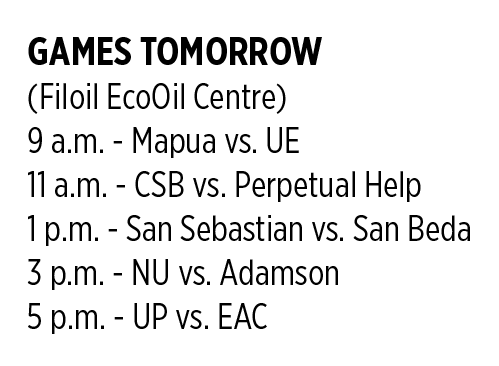
UNIVERSITY of the East (UE) ended its three-year drought while Lyceum of the Philippines University extended its unbeaten run in the Filoil EcoOil Preseason Cup on Wednesday at the Filoil EcoOil Centre in San Juan.

The Red Warriors bested Arellano University in the battle of listless squads, 58-50, to barge into Group A’s winning circle while the Pirates sank Santo Tomas, 83-73, and improved to 3-0 for a solo lead in Group B.

More than its Filoil breakthrough, UE posted its maiden victory in three years since taming National University, 79-76, in the UAAP Season 82 in 2019 prior to the pandemic.

Nikko Paranada made sure to rescue UE from that long futility with 17 points, four rebounds, three assists and four steals. Harvey Pagsanjan and Calvin Payawal chipped in nine each.

UE’s agony included a 0-14 campaign in the University Athletic Association of the Philippines (UAAP) return from a long hiatus last summer.

Vincent Cunanan (17) and Renzo Navarro (12), meanwhile, bannered the Pirates in their takeover of Group B leadership from idle La Salle (2-0).

In the other game,  Far Eastern University (FEU) rolled past San Beda in Group B, 82-73, as Yuri Escueta fell short in his hunt for a debut win as the Red Lions’ new head coach.

Bryan Sajonia (16) and Royce Alforque (15) starred for the Tamaraws, who have slowly but surely found their groove at 2-2 after a winless start.

Arellano (0-4) and San Beda (0-2) stayed winless in their respective pools while Santo Tomas slid to 1-1. — John Bryan Ulanday

Djokovic likely to miss US Open over COVID-19 vaccine status

THERE is a petition circulating to allow Novak Djokovic to play at the US Open but the Serbian appears likely to miss the entire North American hardcourt swing barring a sudden change in coronavirus disease 2019 (COVID-19) protocols in the United States and Canada.

Djokovic has refused to take the COVID-19 vaccine, yet the 21-time Grand Slam winner remains on the entry lists for the ATP 1000 events in Montreal and Cincinnati that serve as tune-ups for the Aug. 29-Sept. 11 US Open in New York.

In the case of the US Open, which does not have a vaccine mandate, organizers previously said that per the Grand Slam Rule Book, all eligible players are entered into the main draw based on their ranking 42 days prior to the first Monday of the event.

US Open organizers also said that while they do not have a vaccination mandate in place for players, they will respect the US government’s position regarding travel into the country for unvaccinated non-US citizens.

Former world number one Djokovic, whose website shows no upcoming events, said last week he was preparing for the US Open as if he will be allowed to compete in the year’s final Grand Slam despite not being vaccinated.

Djokovic’s camp and organizers of the three North American hardcourt events did not immediately respond when asked by Reuters on Tuesday for comment.

The hashtag #LetNovakPlay was circulating on social media as a slew of Djokovic supporters voiced their support for a player who moved to within one of Spaniard Rafa Nadal’s record of 22 Grand Slam titles after his Wimbledon triumph last month.

An online petition that launched a month ago calling for the United States Tennis Association to work with the US government to allow Djokovic to compete in the US Open was edging closer to its target of 50,000 signatures on Tuesday. — Reuters

6 of 52 drug war cases dismissed for lack of witnesses — DoJ 

BW FILE PHOTO

By John Victor D. Ordonez, Reporter 

GOVERNMENT prosecutors have dismissed for lack of witnesses six out of 52 cases against police officers accused of involvement in the previous administrations war on drugs, the Justice department said on Wednesday.  

In a live-streamed press briefing, Justice Undersecretary Jesse Hermogenes T. Andres said other factors for the dismissal were no sign of foul play and families choosing not to pursue the cases.  

He added that case buildup is ongoing for seven more cases. 

“We are confident with the evidence in these seven cases. It’s the certainty of punishment that deters crimes,” Mr. Andres said.  

Justice Secretary Jesus Crispin C. Remulla told the same briefing that the Department of Justice (DoJ) intends to pursue the cases filed by the government and appealed to witnesses to cooperate.   

“Please come forward. We will welcome these people who wish to put forward their testimonies,” he said.  

Mr. Remulla said the DoJ intends to share all its information on the drug war with the Commission on Human Rights.  

The Justice department had only brought five of the 52 cases involving 150 police officers to court since it started its own probe last year.  

An inter-agency committee formed 15 teams last year that probed alleged extralegal killings and human rights violations involving the governments anti-illegal drug operations.  

President Ferdinand R. Marcos, Jr. on Monday said the Philippines would not rejoin the International Criminal Court (ICC) as it may resume its probe into his predecessor’s deadly anti-illegal drug campaign.  

Mr. Duterte had canceled Philippine membership in the international tribunal in 2018.  

Mr. Remulla said the Philippines’ non-membership to the ICC does not deprive Filipinos of an avenue for justice as the country has a functioning justice system. 

In a 53-page request to the international courts pre-trial chamber in June, ICC Prosecutor Karim Ahmad A. Khan said the Philippines had failed to show it investigated crimes related to the campaign. 

He said the chamber should issue an order on an expedited basis.It should receive any further observations it considers appropriate from victims and the government of the Philippines,he added.  

The ICC, which tries people charged with crimes against humanity, genocide, war crimes and aggression, suspended its probe of Mr. Dutertes deadly war on drugs last year upon the Philippine governments request.  

Data from the Philippine government released in June 2021 showed that at least 6,117 suspected drug dealers had been killed in police operations as of April 2021. Human rights groups estimate that as many as 30,000 suspects died. 

Marcos appoints FDA head, others in various agencies 

PRESIDENT Ferdinand R. Marcos, Jr. has appointed his personal physician, Samuel A. Zacate, as chief of the Food and Drug Administration (FDA), according to Malacañang.  

Mr. Zacate is eminently qualifiedto head the agency that regulates food and drugs before they enter the market, Press Secretary Trixie Cruz-Angeles told a televised news briefing.  

He is a known public health advocate with years of expertise in medicine and medical consultancy in other government units and offices, including the Public Attorneys Office and Presidential Security Group Hospital,Ms. Cruz-Angeles added.   

Mr. Zacate was a diplomate for the Philippine Society of Venereology and a fellow at the International College of Surgeons, the Palace official said.   

Meanwhile, Mr. Marcos picked Carlo Dimayuga as acting chief of the Metropolitan Manila Development Authority.  

The President also chose Roman A. Felix, a retired police general, as secretary of the Office of the Presidential Adviser on Military Affairs.   

Ms. Cruz-Angles said Ariel R. Caculitan, a retired military general who served in different units of the Philippine Marine Corps and Philippine Navy, was appointed undersecretary of the Office of the Presidential Adviser on Military Affairs (OPAMA).  

Isagani R. Nerez, a lawyer and retired police officer, will serve at OPAMA as undersecretary for police affairs.   

For the Justice department, the President has named five new undersecretaries and two assistant secretaries.  

Jesse Hermogenes T. Andres, Geronimo L. Sy, and Jose Ragus Cadiz, Jr., Deo L. Marco, and Nicholas Felix L. Ty were appointed as undersecretaries, according to the appointment letter dated July 29.  

Also appointed were Jose Arturo R. Malvar and Majken Anika S. Gran-Ong as assistant secretaries. Kyle Aristophere T. Atienza and John Victor D. Ordoñez 

US looking to assist the Philippines in clean energy transition 

PHILSTAR FILE PHOTO

THE AMERICAN government is looking to provide assistance to the Philippines clean energy transition through the United States Trade and Development Agency (USTDA), the US Embassy said in a statement on Wednesday.   

USTDA Director Enoh T. Ebong is coming to the Philippines later this week to explore collaborations on sustainable infrastructure with public and private entities, the embassy said.   

USTDA works in close partnership with the public and private sectors in the Philippines and South Africa to advance the development of sustainable infrastructure projects that each country has established as its priorities,Ms. Ebong said in a statement on Tuesday.  

Our model of assistance focuses on access and inclusivity and is based on the core principles of mutual benefit and trust,she added.   

She will be joining US Secretary of State Antony J. Blinken during his visit to the Philippines and South Africa.  

The Department of Foreign Affairs earlier announced that Mr. Blinken is scheduled to visit the Philippines from August 5 to 6. It will be his first visit to the country since assuming office in January last year.  

While in Manila, he will meet Philippine Foreign Affairs Secretary Enrique A. Manalo to discuss the coronavirus pandemic, climate crisis, and other regional and global challenges. Alyssa Nicole O. Tan

DoT to hold trainings as Bohol LGU works on regulation after overpriced food incident 

SUNSET in Panglao, Bohol. — PANGLAO MUNICIPAL TOURISM OFFICE

THE TOURISM department will hold trainings anew in Bohol as the provincial government drafts local laws that will tighten regulation of goods and services after a visitor posted an incident of an absurdly overpriced meal that went viral on social media.    

The alleged overpricing of seafood by vendors in Virgin Island, Panglao, Bohol is a matter that the Department of Tourism (DoT) takes seriously especially as it concerns the welfare of tourists whose continued support for our destinations is critical to the recovery of the tourism industry,Secretary Christina G. Frasco said in a statement released late Tuesday evening.   

Ms. Frasco said their regional office is working with the local government units (LGUs) of Bohol and Panglao to provide guidance on standards for the provision of tourist goods and services, and we will extend trainings to the frontline tourism workers and stakeholders involved to safeguard the overall tourist experience in the Island.”  

The DoT is also coordinating with the Department of Trade and Industry on policies relating to reasonable pricing standardsto protect consumers.   

Bohol Governor Erico Aristotle C. Aumentado has ordered a temporary halt on boat trips to Virgin Island while a probe is ongoing.   

Ms. Aumentado has also directed the provincial council to begin working on resolutions or ordinances that will provide protection to tourists.   

The governor, who is on his first term in office, acknowledged that there had long been reports of exploitative practices in the tourism sector.   

We will fix this!he said in a statement on Tuesday.  

Ms. Frasco underscored that tourism, which provides livelihoods and could become a major contributor to the economy, is a shared responsibility.” 

Bohol, located in central Philippines, is known for its beaches and dive spots, the Chocolate Hills, tarsier, and historical and heritage sites. MSJ

Senate bill seeks deferment of student loans in public, private schools during emergencies

PHILSTAR

A BILL filed at the Senate seeks to defer the payment of student loans in both public and private schools during disasters and similar emergencies, including the coronavirus pandemic.   

Senate Bill 975 proposes to provide a moratorium on the collection of all fees, charges, and costs relating to student loan programs in colleges, universities, and technical-vocational education institutions. 

“Many of our compatriots have lost their jobs and sources of income due to calamities such as earthquakes, typhoons, and most recently, due to the pandemic. That is why I am promoting this bill to reduce the burden of parents who send their children to school in times when they are hit by a disaster or pandemic,” Senator Manuel LitoM. Lapid said in a statement on Wednesday.   

“Let’s aim to temporarily ease the burden of families affected by the disaster in any student loan liability, so that they can focus on more basic and important daily expenses,” he added.  

The moratorium would cover the period from the declaration of a national and local state of calamity or emergency, to 30 days after its termination. If this period exceeds 60 days, the payment of the student loan and related fees will be further deferred until the next semester or term.  

The bill also protects the enrollment or graduation eligibility of students availing of the moratorium.  

Under the bill, no government subsidy will be provided to private schools to cover potential cash flow problems, according to the head of Mr. Lapids legislative office, Abelardo P. Maglanque.  

For short term situations, the schools will be expected to absorb the financial hit to be caused by the deferment,Mr. Maglangue told BusinessWorld in a Viber message.  

But for longer terms, we are open to looking into government financial institutions to come in and take over, he added.   

Mr. Lapid said they aim to have the bill approved as soon as possible.If passed into law, it will be applied retroactively for those affected by the coronavirus health emergency. Alyssa Nicole O. Tan

Garcia eyes own building for Comelec

FIREFIGHTERS respond on July 31 to a fire at the 7th floor of the Palacio del Gobernador building in Manila, which is occupied by the Commission on Elections’ IT department. — PHILIPPINE STAR/ RUSSELL PALMA

THE NEWLY-appointed chairman of the Commission on Elections (Comelec) on Wednesday said initial discussions have been undertaken for the construction of the agencys own building, and the more immediate need to transfer its information technology (IT) department after a fire broke out at its office on Sunday evening.  

“I think it is high time that Comelec gets its own building,” Chairman George Erwin M. Garcia told a virtual press briefing.  

“I also recommended to the en banc that we should study how to transfer the IT department to a more safe, secure, and protected office.”  

Comelec earlier gave assurance that election servers and data were not affected by the fire.  

He noted that Comelec also rents several warehouses nationwide for storage.  

Mr. Garcia added that he recently had a phone call with Budget Secretary Amenah F. Pangandaman on the preparatory work required for the proposed building.   

“Yesterday, I received a call from her (Ms. Pangandaman) inquiring about the extent of the preparations for a new building and it looks like our request is being granted,” he said in mixed Filipino and English.  

The election agency’s office is currently located at the Palacio del Gobernador in Intramuros, Manila.  

Mr. Garcia said the Comelec will have to include an allocation for a new office in its annual budget proposal.   

“I know that our budget is tight because of the pandemic, but a gradual increase in budget for the new building would be enough,” he said. John Victor D. Ordoñez

Sta. Cruz town reopening Mt. Apo trail to climbers in Sept.

Members of the diplomatic corps in the Philippines scale Mount Apo through the Sta. Cruz Circuit Trail on February 21-23. — STA. CRUZ TOURISM FACEBOOK PAGE

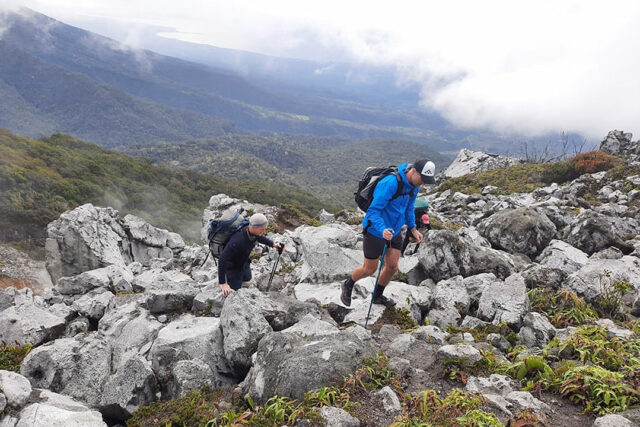
THE STA. CRUZ trail of Mt. Apo, the Philippines highest peak, will be reopening in September and bookings up to December are already being accepted, according to the towns tourism office.   

Under the new guidelines released on Tuesday, the maximum number of daily slots that will be available Monday to Thursday would be 35, and 50 on Friday-Sunday.  

The guide or any representative from the climbing group should physically visit the Tourism Office to book for dates and pay. Bookings through phone calls, messenger messages and text messages will no longer be entertained,the office said, citing wasted slots in the past due to no-show trekkers.   

Priority will also be given to guides who have undertaken the Retooling Training conducted in June and those who have regularly attended meetings for certified guides.    

Each guide is allowed to book only two weekends per month to give equal opportunities to others to climb on weekends,the tourism office said.    

Total permit fees are P2,000 per person.   

Officers of the Mt. Apo Sta. Cruz Guides Association headed by Jake Caspi recently met with the local Investment Promotions and Tourism Office to align planned activities ahead of the resumption of Mt. Apo trekking on Sept. 1.   

The group will have a preparatory climb on Aug. 24-26 to check the trails and existing facilities as well as meet with the Sibulan Porters Association based at a community within the mountain leading up to the summit.   

An off-season is observed at Mt. Apo, a declared protected area, from June to August to allow for biodiversity preservation, natural rehabilitation, and improvement of public services and facilities. MSJ 

News site Bulatlat exec tells court of continued limited access  

ONLINE news site Bulatlat.com, which reports on human rights issues in the Philippines, continues to suffer from limited access by readers after a government order blocking 26 websites supposedly linked to communist and terrorist organizations, one of its officials told the court on Tuesday.   

A Quezon City trial court earlier ruled that the website was still accessible to the public and that there was no suppression of free speech in effect. 

Bulatlat Managing Editor Ronalyn V. Olea testified before the same court on Tuesday, saying that many of their readers are still having difficulty accessing the website, she told BusinessWorld in an email. 

She noted that editors have to use virtual private networks to publish news articles and other content.  

“Although we put up a mirror site courtesy of Qurium, search engines still point to our original Uniform Resource Locator (URL) Bulatlat.com, which makes it inconvenient for many to access our stories, especially archives on human rights issues,” Mr. Olea said.   

“Partial access to our website does not diminish the fact that we are still censored in our own country.”  

In June, the National Telecommunications Commission (NTC) issued an order to block 26 websites supposedly affiliated to and are supportingthe Communist Party of the Philippines, New Peoples Army and the National Democratic Front.   

The directive was issued upon the request of former National Security Adviser Hermogenes C. Esperon, Jr.  

Bulatlat sued the NTC on July 8 and sought an injunction against the agency to stop the implementation of the order. John Victor D. Ordoñez 

Fidel V. Ramos: A man dedicated to peace and his people

BW FILE PHOTO

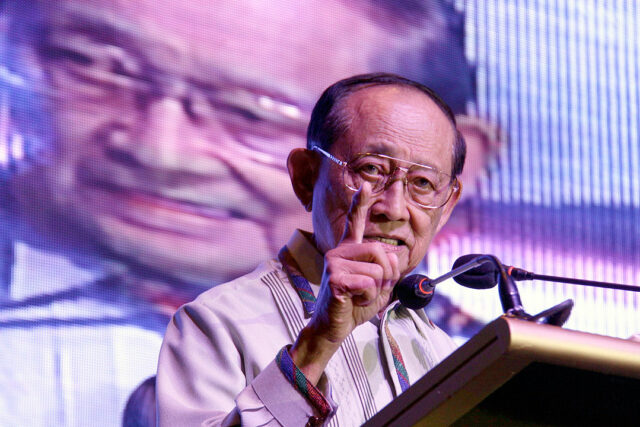
I received a text message on the death of President Fidel V. Ramos on Sunday afternoon as I was getting ready to join a Zoom meeting. The sketchy report said the former President succumbed to COVID complications at the Makati Medical Center. I tried to get confirmation from his daughter, Cristy. I later learned she was in Indonesia as Competition Commissioner in an international football tournament. Cristy, a former member of the women’s national football team, had always said that football is her sport. It was sad that she wasn’t around when her dad passed away at the age of 94 after serving the country in various capacities with honor, dignity, and competence.

I first met Armed Forces of the Philippines (AFP) vice-chief of staff Fidel V. Ramos (FVR) at EDSA, on the second day of EDSA I. We were in front of the then Philippine Constabulary (PC) headquarters, Camp Crame, across Camp Aguinaldo, headquarters of the Armed Forces of the Philippines (AFP). He had his unlit cigar and was casually talking to the groups huddled in the night, sharing meals and encouraging one another as the uprising went into its second night. The General was reassuring everyone, “Everything is ok. Just hold your ground.”

We would see him again later in the night, inside a war room that the General and the people of Defense Secretary Juan Ponce Enrile had established. The place was full of heavily armed military and police personnel who were warning civilians like us that an attack early that morning, Monday, Feb. 24, 1986, was imminent. The attack never materialized. Around seven the next morning, General Ramos and Enrile appeared on a platform beside the PC flagpole and announced that Marcos had fled. The General did what would later become his signature “jump,” to the delight of the crowd that had gathered inside the camp. The crowd freely entered the camp which sheltered the same forces which were instrumental in the enforcement of martial law.

The next day, Tuesday, Feb. 26, I shook hands at Club Filipino with both the General and Enrile, who were appointed by President Corazon Aquino as AFP Chief of Staff and Minister of Defense, respectively, by the country’s 11th President. I noticed the presence of several politicians who, just a few days before President Aquino’s oathtaking, were loudly proclaiming their opposition to the new Administration.

In late 1987, General Ramos joined President Aquino’s cabinet as Defense Secretary, vice Rafael Ileto. I had by then been Secretary of Agrarian Reform since July 1987 and I welcomed the opportunity to work with a man who would provide perspective in my attempts to deal with farmers and landowners of various stripes — including military and police retirees and military and police officials-landowners in active service who opposed the government’s Comprehensive Agrarian Reform Program (CARP). In one public forum in Cebu City sometime in early 1988, a man who introduced himself as a “Colonel Gonzalez” in the AFP, declared that “you will get my land over my dead body.”

Ramos was very supportive of our efforts as the Cabinet Officer for Regional Development (CORD) for the Cordilleras. As CORD of the Cordilleras, we were tasked with helping implement the provisions of the peace negotiations between the then-New Armed Forces of the Philippines and the Cordillera People’s Liberation Army (CPLA), headed by priest-turned-dissident, Conrado Balweg, sometimes referred to as Fr. Balweg or Ka Ambo. With the help of Chief of Staff Renato de Villa, we were able to get the AFP to provide Ka Ambo’s troops with weapons, to join the AFP in the battle against the insurgents. Secretary Ramos would regularly monitor the progress of our activities in support of the Mt. Data peace talks. It was at that point that I noted that FVR was a man of peace, ready to discuss ways to achieve common ground.

Sometime in June 1994, almost two years into his presidency, FVR asked me to join him in a round of golf at the Veteran’s Memorial Golf Club in Quezon City. It was the usual early Sunday morning golf game for which the early-rising and late-retiring, hardworking President was known. Joining us were then Deputy Executive Secretary Leonardo Quisumbing and Gen. Jose Magno of the Government Service Insurance System. Quisumbing would later be appointed Associate Justice of the Supreme Court.

President Ramos and the rest of the foursome played the first hole and then proceeded to the tee mound of the second hole at the corner of North and Mindanao Avenues. President Ramos pointed towards the terminal-garage of the Metro Manila Transit Corp. (MMTC) of the “Love Bus” fame. FVR remarked, “Look at that garage of the MMTC. The employees are perpetually on strike — either the drivers, the conductors, the mechanics, or the office personnel. This is your district (he had asked me to run for Congress in 1992 under Lakas-NUCD) and you have something at stake in its development. We have plans for this North area — develop it into a North City and bring in large developers like Ayala, SM, etc. I want you to work with (Department of Transportation Secretary) Sonny Garcia and come up with a creative and non-bureaucratic approach to privatize MMTC so we can free this entire area for these developers.”

As we approached the third hole, FVR called Quisumbing and said, “Prepare Popoy’s appointment as Presidential Consultant for Community Development or PCCD. PCCD, puwede na ba ’yun? (Is that OK?),” he asked me. Then he added, “Pero walang opisina ito ha (But this has no office).” I merely smiled. I knew what he meant. This was a job for the Boy Scouts. Volunteer work. No pay. For the country.

Over the years, the government had tried to liquidate MMTC. All attempts were unsuccessful and resulted in bloodshed, deaths and injuries to both peacekeepers and MMTC people. We took a look at the situation and personalities involved. Garcia was only too happy to pass on the problem to me. With his support, I asked the President to sign (around the middle of June 1994) a Memorandum Circular ordering all government agencies to cooperate with the PCCD in privatizing the MMTC. It was going to be the first ever attempt at “blue collar privatization.”

We had countless meetings, peaceful and contentious, with all MMTC groups. After many months of consultation with the groups, the Senate and House Committees on Public Services and Transportation, the Development Bank of the Philippines (a creditor of MMTC), the private sector, and the Quezon City government, we were able to successfully privatize the MMTC. The company was sold to the organization’s blue-collar workers and privatized in ceremonies held in Malacañang in early March 1995. FVR was visibly happy — but at the same time agitated as the Flor Contemplacion issue exploded.

Contemplacion was a domestic worker in Singapore who was convicted of strangling to death fellow domestic worker, Delia Maga, nanny of a three-year-old Singaporean who drowned to death. Overseas workers were outraged and frustrated by their overall situation and blamed the government for its inability to work for the exoneration of Contemplacion. FVR was to see a group of overseas workers’ representatives right after the MMTC privatization ceremonies. He had told me. “Sige. Good work pero dalian mo. Medyo problema itong kay Contemplacion (Good work but do it fast. This Contemplacion situation is problematic).”

The North City has since become a reality and a booming business district.

The nine-month MMTC engagement allowed me to see the FVR who believed in the developmental and entrepreneurial roles of both the private sector and government. It also afforded me an opportunity to see him up close during a difficult, politically-charged moment.

A few days after the MMTC privatization, on March 25, 1995, FVR called me up as I was conducting a class at the Asian Institute of Management. He asked me to assume the Chairmanship of the Philippine Sports Commission. I then got used to his CSW (Completed Staff Work) requirements, his calls at five in the morning to ask specific pointed questions and for details, and his evening golf games capped with brandy at the Presidential Security Group Golf course in Malacañang and at the Municipal Links in Intramuros.

At the end of his term, I wrote a book to pay tribute to his commitment to good governance and love for sports entitled, Sports and Governance.

Farewell Mr. President. Your heart for peace and democracy will be missed.


Philip Ella Juico’s areas of interest include the protection and promotion of democracy, free markets, sustainable development, social responsibility and sports as a tool for social development. He obtained his doctorate in business at De La Salle University. Dr. Juico served as secretary of Agrarian Reform during the Corazon C. Aquino administration.


Making net zero a reality in the Philippines sooner rather than later

USER6702303-FREEPIK

A NUMBER of countries in the Asia-Pacific region, including China and Indonesia, have set aggressive targets to reduce greenhouse-gas emissions, despite significant coal exposure. The Philippines has not yet followed suit. Instead, it has pledged to reduce emissions by 75% from the “business as usual” trajectory by 2030; this promise is also almost entirely conditional on international financial support that has so far not been forthcoming. The Philippine Energy Plan forecasts emissions increasing until at least 2040.

That said, there has been some action. The Department of Energy has set an objective of 50% renewable energy in power generation by 2040, and in 2020 imposed a moratorium on construction of new coal-fired power stations. In transport, there are mandates for biodiesel and bioethanol and targets for electric vehicle (EV) penetration. There are also goals for energy efficiency in buildings and for planting new forests. But it is not enough.

A more aggressive approach that would cut emissions 44% by 2030 and reach net zero by 2060 — as China and Indonesia have pledged — is not only possible, but could bring substantial benefits, in the form of cleaner air, healthier land, and new sources of economic value and growth.

There is great potential in four areas.

Expanding renewable power generation capacity to 80% of supply, including decommissioning and conversion of existing thermal plants and modernization of the electricity grid. Solar power would contribute the biggest share, accounting for about 40% of total capacity by 2060, with wind contributing more than 20%. For this to happen, the Philippines would need to build long-duration energy storage to give the system the necessary flexibility to operate with a higher renewable share. All this would enable a full phase-out of coal-fired generation by 2050, with some installed coal capacity retro-fitted with carbon capture and storage (CCS) equipment. The shift to renewables and phase-out of coal would bring about a 98% reduction in emissions from the power sector by 2060, even as demand is expected to rise more than 150% over that period.

Introducing mechanical farming techniques, especially in rice cultivation. This will require educating farmers and coordinating with many small landowners; there may also be a role for subsidies to finance the transition. More efficient cultivation could cut emissions 70% by 2060, and also improve water management. In addition, restoration of forest areas and other land-use improvements could abate 20 million metric tons of carbon dioxide equivalent (Mt CO2e), the basic unit of greenhouse-gas accounting.

Creating new green-value chains in emissions-intensive industries, including installation of CCS devices on industrial plants and adoption of new electric technologies for manufacturing steel. For example, 100% of cement production could be decarbonized through CCS and electrification.

Converting to low-emission technologies in transport and buildings. Converting the road fleet from internal combustion engines (ICE) to EVs will take time, as well as regulatory support and further technology improvements. But improving efficiency 60% by 2040, and an additional 1% a year thereafter, would get the Philippines to net zero in transport.

In the building sector, the opportunity is for electrification, for example shifting from gas to electric cooking in residences would improve indoor air quality and improve health. Regulatory support for this shift in the form of subsidies could incentivize this change. For instance, in the UK a government scheme makes grants available to homeowners to replace oil and gas boilers with electric heat pumps, opening up the likelihood of clean energy usage, kickstarting the British heat pump industry, and buffering consumers against unexpected hikes in oil and gas prices.

Given appropriate investment, all these activities could serve to create new sources of value and growth.

Private companies and startups in the Philippines are already at work on green-growth initiatives. A number of companies are producing power from biomass waste. For instance, by end 2022, SMC Global will complete 1,000 MW of BESS facilities. Prime Infrastructure Holdings has also invested P3.5 billion in Solar Philippines Project Power Holdings for >340 MW of solar, and has partnered with US-based WasteFuel Global for a 30-million-gallon synthetic crude oil biorefinery pilot targeted to be operational by 2025. Victorias Milling Company has one of the largest biomass power plants (63 MW) in the Visayas. In the area of transport, EV startup QEV Philippines plans to roll out 50,000 electric jeepneys over the next five years by replacing their ICEs with lithium-ion batteries.

That is the potential; getting there, however, means putting sustainability at the heart of strategy. For government, that starts with reporting emissions and setting ambitious and quantifiable sector-level decarbonization goals. This would provide a framework within which individual agencies could work with the private sector to devise action plans. The government can also put emissions reduction at the heart of its investment strategy, for example by working with business to build charging infrastructure for EVs and establishing a market for carbon credits, which could support investment in these areas.

The private sector must be involved — and it can be in their interest to do so. International experience shows that businesses that act to reduce their carbon footprint can improve returns and cut costs, including the cost of capital. A recent example in the Philippines includes RCBC bank, the first bank in the Philippines to issue green bonds. In 2019, RCBC listed P15 billion worth of green bonds, which ended up directly correlating with the bank achieving a low borrowing cost of 7%, the lowest of any bank. Another example is telecoms provider Globe which set itself a goal of being net zero by 2050. To this end, it has been pro-actively undertaking sustainable practices even before regulatory compliances require them to do so, including installing hybrid generators at off-grid sites, which have resulted in a 60% reduction in fuel and maintenance costs. A number of other companies in the Philippines have made similar pledges to become net zero and are establishing targets and prioritizing budgets to cut emissions, such as Ayala Corp., Nestlé, and Shell.

Finally, the Philippines’ current modest strategy envisions support from international investors and donors; a more ambitious one will likely do the same. One priority is to mobilize green finance to support investment in decarbonization, for example through public-private partnerships in the power sector. The Asian Development Bank is already playing a crucial role in supporting the development of green financing instruments. NGOs and donors also have an opportunity to scale up investment in low-carbon programs such as microgrids and sustainable agriculture, by providing technical assistance and innovative financing.

The conventional wisdom is that action on climate change is inimical to economic growth. On the contrary: the right strategy could bring new green growth opportunities, particularly in power and carbon management. Capturing these opportunities depends not on innovations yet to be seen or unrealistic business models, but on proven, economically competitive technological solutions.

Indeed, not going in this direction poses long-term risks. Climate change is becoming a factor in international policies on trade and investment; countries that fall short risk being subject to punitive trade measures. In addition, international investors are increasingly focused on sustainability.

Finally, let’s not forget that the Philippines archipelago is already exposed to significant risks from climate change, including sea levels rising at three times the global average. The UN Food and Agriculture Organization projects that falling crop yields will cause a 6% annual loss of GDP by 2100 if climate change continues unabated.

The imperative is clear, and so are the opportunities. A start has been made; now it’s time to advance.


Jon Canto is a senior vice-president in McKinsey Manila office.

ADVERTISEMENT
ADVERTISEMENT