Home Blog Page 6108

Peso sinks further after Fed decision

BW FILE PHOTO

THE PESO weakened further versus the dollar on Thursday after the US Federal Reserve hiked rates by 75 basis points (bps) for a second straight meeting, as expected.

The local unit closed at P55.82 against the dollar on Thursday, down by 14 centavos from P55.68 on Wednesday, data from the Bankers Association of the Philippines’ website showed.

The peso opened the session at P55.58 against the dollar. Its weakest showing was at P55.97, while its intraday best was at P55.55 versus the greenback.

Dollars exchanged went up to $1.27 billion on Thursday from $1.01 billion on Wednesday.

Rizal Commercial Banking Corp. Chief Economist Michael L. Ricafort said the peso dropped after the Fed’s widely expected 75-bp hike and “as Fed Chair Jerome H. Powell signaled that the US economy is not in recession, the pace of Fed rate hikes would slow at some point.”

Mr. Ricafort said the peso’s decline versus the dollar was a healthy correction after its recent surge.

“Market sentiment also supported by the latest gains in the local stock market, as well as lower global crude oil price lingering among three-month lows recently,” he added.

“The FOMC (Federal Open Market Committee) doubled down on aggressive policy tightening by raising the benchmark Fed funds rate by 75 bps yet again last night as largely expected,” Mitsubishi UFJ Group Global Markets Research analyst Sophia Ng said.

The Fed on Wednesday raised its policy rate by 75 bps for a second straight meeting, bringing total interest hikes since March to 225 bps.

After the meeting, Mr. Powell said while the labor market remains strong, other economic indicators have softened. He also hinted at an eventual slowdown in hikes.

Philippine shares rose following the Fed’s latest move. The Philippine Stock Exchange index went up by 142.50 points or 2.28% to close at 6,379.26 on Thursday, while the broader all shares index increased by 54.38 points or 1.61% to 3,424.96.

For Friday, Mr. Ricafort sees the peso moving within P55.60 to P55.90 against the dollar, while Ms. Ng expects it to remain below P56. — DGCR

Cancer control program waiting on 2023 funding prospects

PIXABAY

A 2019 law outlining a system for managing cancer treatment is awaiting how much funding it will get in 2023 to ensure its proper implementation, according to the law’s principal author.

Senator Joseph Victor G. Ejercito said at the Pandesal Forum on Thursday that funding for the National Integrated Cancer Control Act (NICCA) will depend on the priority assigned to it by Department of Health (DoH) and Department of Budget and Management (DBM), as well as on how much funding was left unspent in 2022.

“The NICCA was only given a sufficient budget in 2022. Imagine, that’s two years since its passage,” Mr. Ejercito said. “We’re just looking forward to (funding). We’ll have to make sure, with the help of the DBM and DoH, that it’s funded so that we can help a lot of Filipinos who have or are suffering from cancer,” he added.

Mr. Ejercito said that the 2022 General Appropriations Act allocated P789.956 million and P529 million for the NICCA’s Cancer Control Program and Cancer Assistance Fund (CAF), respectively.

The Cancer Control Program governs all cancer control activities of the government, while the CAF is a pot that cancer patients can draw from.

The Cancer Control Program received P500 million in 2021, while P120 million went to the CAF.

“We’ll see how the funds were utilized in 2022. If there is enough (left over), then probably we can have the same or probably add a little more. We’ll see how it goes, and we will ask for a report from the DoH and the DBM on utilization in 2022. If it’s not enough, then we’ll have to augment (in the) 2023 budget,” Mr. Ejercito said.

Budget Undersecretary Tina Rose Marie L. Canda said that as yet, the DBM has not received a response from the DoH in regard to the release of the CAF money.

“We referred the joint memorandum circular to the DoH, and informed them that we are deferring to their expertise in so far as the coverage of treatment and funding of CAF is concerned. We returned it sometime in June 15, 2022 but we haven’t received any response from them after that,” she said at the same forum.

Ms. Canda also said that the government is thinking of placing the CAF under the DoH’s Medical Assistance for Indigent Patients program, which readily available but at a reduced amount compared to its funding as a line item.

“Probably, we can discuss which will make it easier,” Mr. Ejercito responded, saying that he will consult with the Cancer Control Council.

President Rodrigo R. Duterte signed Republic Act 11215 or the NICCA in February 2019, which aside from the Cancer Control Program and the CAF, also established the Philippine Cancer Center, a research facility, and the National Integrated Cancer Control Council, which makes policy.

Mr. Ejercito hopes to solidify the NICCA’s role as the government implements the Universal Health Care (UHC) Act early on in the latter’s rollout.

“The establishment of the specialty centers is already part of the UHC. For several years, patients went here (to Metro Manila) — to the Lung Center of the Philippines, the National Kidney and Transplant Institute, the Philippine Heart Center — so from all parts of the country, they are sent here… the plan with the DoH is to establish specialty centers in strategic areas,” he said.

President Ferdinand R. Marcos, Jr. said in his first State of the Nation Address that coronavirus disease 2019 (COVID-19) highlighted the need for a stronger healthcare system.

“We must bring medical services to the people and not wait for them to come to our hospitals and healthcare centers,” Mr. Marcos said. “We will put clinics, RHUs (rural health units) that will have doctors, nurses, midwives, medtechs once or twice a week.” — Diego Gabriel C. Robles

Data scientist calls coal power unreliable, backs ‘flexible’ renewables 

PEXELS-PIXABAY

RENEWABLE ENERGY (RE) plants can be counted on to reliably service power demand more than coal-fired facilities, even though RE is saddled with a reputation for being intermittent because of the variability of solar and wind sources, a data scientist representing the Institute for Climate and Sustainable Cities (ICSC) said on Thursday.

In a virtual forum hosted by the Department of Economics at the University of the Philippines Los Baños, Jephraim Manansala, chief data scientist of the ICSC, called coal “unreliable” and that it is time for the Philippines to shift to renewables and wean itself from depending on coal, which is “unreliable” and not sufficiently flexible.

“When we have too many baseload power plants (powered by coal), we will have too much power when we do not need it and not enough when we do. What we need is flexible generation to have enough power whenever we need it,” Mr. Manansala said.

He noted that the Philippines is rich in wind and solar resources, and needs to focus on distributed energy generation to achieve the desired flexibility.

The Department of Energy estimates that the Philippine power mix is 47% coal-fired. Natural gas accounts for 22% and renewables 24%, including hydro, geothermal, wind, and solar. Oil-based sources account for 6.2%. — Ashley Erika O. Jose

Marcos plans action on ICC drug investigation

PCOO.GOV.PH

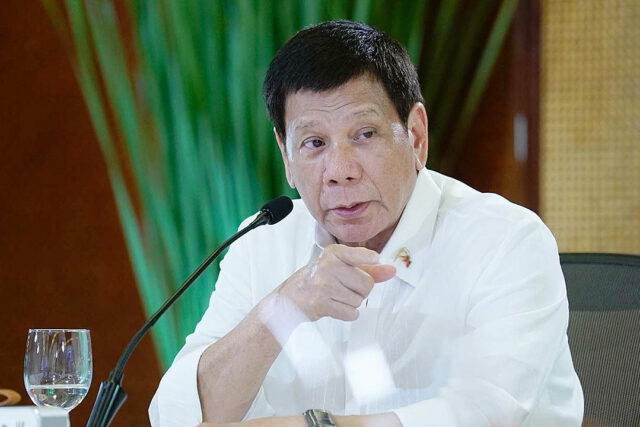
PHILIPPINE President Ferdinand R. Marcos, Jr. on Wednesday met with his top legal officials to discuss the government’s next course of action on the International Criminal Court’s (ICC) investigation of his predecessor’s deadly war on drugs.

“The government’s position on the ICC investigation was the only official matter discussed,” Solicitor General Menardo I. Guevarra told reporters in a Viber message on Thursday.

The Marcos government’s chief government lawyer was the Justice secretary of ex-President Rodrigo R. Duterte, who has been accused of crimes against humanity in connection with the government’s anti-illegal drug campaign.

Among those present at the meeting were Presidential Legal Counsel Juan Ponce-Enrile, Executive Secretary Victor D. Rodriguez and Justice Secretary Jesus Crispin C. Remulla.

ICC Prosecutor Karim Ahmed Khan last month asked the international tribunal’s pre-trial chamber to reopen the probe months after it was halted upon the Philippine government’s request.

Mr. Guevarra said he would leave it to Mr. Marcos to disclosure the state’s plans on the drug war probe.

The Hague-based international court on July 14 gave the Philippines until Sept. 8 to comment on the ICC Office of the Prosecutor’s request to resume the investigation into alleged crimes against humanity by Mr. Duterte and his officials. It also allowed victims to make written submissions through their lawyers.

Mr. Khan and fellow ICC prosecutor Colin Black were given until Sept. 22 to reply to the government’s response.

The Department of Foreign Affairs (DFA) would consult other agencies on the drug war probe, spokesperson Maria Theresita C. Daza told a livestreamed press briefing.

“For that, we’ll have to wait, but as of now, the Philippines is no longer a party to the Rome Statute,” she said. “We are in a period of transition.”

Last week, Mr. Duterte’s police chief Ronald M. Dela Rosa said he would not cooperate with the ICC probe and preferred to get tried by a local court. Now a senator, he called the International Court’s probe an insult to the Philippine judicial system.

Mr. Guevarra earlier said his office was weighing its options on how to deal with the probe and would consult with Mr. Marcos, DFA, Department of Justice (DoJ)  and international law experts.

The ICC, which tries people charged with genocide, crimes against humanity, war crimes and aggression, was also set to probe vigilante-style killings in Davao City when Mr. Duterte was still its vice mayor and mayor.

Mr. Duterte canceled the Philippines’ membership in the international tribunal in 2018.

In a 53-page request to the ICC pre-trial chamber last month, Mr. Khan said the Philippines had failed to show it investigated crimes related to the campaign.

He said the chamber should issue an order on an “expedited basis.” It should “receive any further observations it considers appropriate from victims and the government of the Philippines,” he added.

Senator Maria Lourdes Nancy S. Binay earlier said the investigation should be allowed for transparency’s sake.

Senate Minority Leader Aquilino Martin “Koko” L. Pimentel III said the Hague-based tribunal should be allowed to decide autonomously as an independent international organization.

The ICC suspended its investigation of the drug war in November as the Justice department and other agencies started looking at 52 cases involving policemen.

DoJ had only brought five of the 52 cases involving about 150 police officers to court since it started its own investigation in 2021.

Data from the Philippine government released in June 2021 showed that at least 6,117 suspected drug dealers had been killed in police operations as of April 2021. Human rights groups estimate that as many as 30,000 suspects died.

Meanwhile, the Philippine Supreme Court has released clarificatory guidelines on plea bargains in drug cases. It last issued the guidelines in 2017.

“Holding the plea bargaining in the prosecution of drugs cases goes into the very matters of fundamental constitutional rights, the court resolved to clarify the guidelines it earlier issued,” it said in a statement.

The Supreme Court during its en banc deliberations on Tuesday “reaffirmed the primacy and exclusivity of its rule-making power under the Constitution, and guaranteed its precedence in governing over the plea-bargaining process in drug cases.”

Plea bargains are agreements between the accused and prosecutors in which the defendant pleads guilty to a lesser charge in exchange for a more lenient sentence.

In 2017, the High Court ruled that a case won’t have to run its entire course if courts approve a plea bargain.

The Justice department issued a circular in 2018 that prohibited plea bargains for drug trafficking cases.

In the updated guidelines, the High Court said judges may overrule the prosecution’s objection to a plea bargain if it does not follow the DoJ’s rules.

The court had yet to upload a copy of the resolution on its website. — John Victor D. Ordoñez

923 more Omicron subvariant cases reported by DoH

PHILIPPINE STAR/ MICHAEL VARCAS

THE PHILIPPINES on Thursday reported 923 more cases involving more contagious Omicron subvariants.

The Department of Health (DoH) said there were 890 more infections involving the BA.5 Omicron subvariant, bringing the total to 1,997.

Of the new BA.5 patients, 823 have recovered, 31 were still in isolation and the status of 36 was still being verified, Health Undersecretary Beverly Ho told a virtual news briefing on Thursday. Nine returning overseas Filipinos tested positive for the subvariant.

The new BA.5 cases were detected in all regions except Soccsksargen and the Bangsamoro, she added.

Meanwhile, 18 more people got infected by the BA.4 Omicron subvariant, bringing the total to 71. Seven were from the National Capital Region (NCR), six from Bicol, two from the Cordillera Administrative Region (CAR) and one each from Ilocos , Cagayan Valley and Calabarzon.

Seventeen of the BA.4 patients have recovered, while the remaining one was still in isolation, Ms. Ho said.

She said the Philippines also posted 15 more BA.2.12.1 Omicron cases, bringing the total to 154. Five patients came from Metro Manila, four from CAR, three from Calabarzon and one each from Ilocos and Mimaropa. One returning overseas Filipino tested positive for the subvariant, she added.

Fourteen of them have recovered, while four others were in isolation.

Ms. Ho said the exposure and travel histories of the newly detected cases were still being verified.

Like other countries, the Philippines is also preparing for a potential outbreak of monkeypox, which is now considered a global threat.

Ms. Ho said the Health department was eyeing to protect Filipinos against the virus by using smallpox vaccines through a compassionate use permit.

“We can’t use the emergency use authorization as a tool for other vaccines,” she said, noting that the permit was only allowed by existing regulations for coronavirus vaccines.

“If we wait for a certificate of product registration, it will take a long time,” she said.

Ms. Ho said DoH guidelines allow supportive therapy as the main treatment for monkeypox. “We basically relieve their symptoms and make sure they don’t go into a much worse condition.”

Local health authorities were in “constant communication with its counterparts” for monkeypox treatment and vaccines, she added.

Last week, the World Health Organization declared monkeypox infection as a public health emergency of international concern.

The virus, which was first discovered in 1958, causes flu-like symptoms and pus-filled skin lesions. It spreads via contact.

Meanwhile, a former presidential adviser hit health authorities for their late decision on the business community’s proposal to expand the eligibility for the second booster shot, after more than 4 million COVID-19 vaccines expired.

Jose Ma. Concepcion, now a member of the Marcos administration’s Private Sector Council, said belated action by DoH’s Health Technology Assessment Council prevented the private sector from using P5.1 billion worth of vaccines that expired on Wednesday.

“This is a huge loss, P5 billion worth of expired vaccines is not small for the private sector,” he told the ABS-CBN News Channel. “For the government, even more.”

“Unfortunately, the council didn’t act on it right away,” he said. “This wouldn’t have come to this point.” — KATA

Infra damage from Luzon earthquake hits P33.8 million

OFFICE OF REP. CHING BERNOS

INFRASTRUCTURE damage from Wednesday’s magnitude 7 earthquake that rocked the northwestern part of the Philippines’ main island of Luzon has hit P33.8 million, according to the local disaster agency.

“The estimated cost of damage to infrastructure of P33.8 million was incurred in Region 1 (Ilocos), Region 3 (Central Luzon) and National Capital Region,” the National Disaster Risk Reduction and Management Council (NDRRMC) said in a 6 a.m. bulletin on Thursday.

Power in 36 of 37 towns that experienced brownouts had been restored, according to the report.

The Department of Public Works and Highways (DPWH) said it was working double time to reopen the remaining four closed roads in quake-hit Northern Luzon.

Seventeen of 21 road sections affected by the earthquake had been reopened to traffic, Public Works Secretary Manuel M. Bonoan said in a separate statement.

Meanwhile, the Department of Agriculture said road closures in Benguet and Mountain Province was unlikely to cause significant delays in the delivery of agri-fishery goods to Metro Manila.

“To date, there are no reported damage and losses yet in the agriculture and fisheries commodities and infrastructure that could hamper the food supply system,” it said in a bulletin.

Wednesday’s quake damaged several bell towers, churches and heritage houses as well as cars and other properties in northern Philippines.

The quake’s tremors were also felt in the capital Manila and nearby areas, forcing workers to evacuate buildings and halting train operations.

The Philippines’ seismological agency said it had recorded more than 800 aftershocks almost 24 hours after the temblor rocked Abra province, where the epicenter was located.

More than 20,000 people from 4,000 families in the Ilocos Region and Cordillera Administrative Region (CAR) were affected by the quake, Defense department officer-in-charge Jose Faustino, Jr. told a briefing led by President Ferdinand R. Marcos, Jr. in Abra.

He said more than 2,000 families remained in evacuation centers as of Thursday morning. “Inside 31 evacuation centers, there were 2,312 families from Regions I and CAR,” he said.

“We have a total of 4,969 families or 20,000 persons more or less that were affected in 110 barangays in Region I and CAR, Social Welfare Secretary Erwin T. Tulfo said at the same briefing. More than 300 houses were damaged.

He said 1,657 people from 413 families were staying in temporary shelters outside evacuation centers.

At least 35 schools were damaged, the Department of Education said, citing initial reports. Eleven of these were in Central Luzon, nine in Cagayan Valley, eight in CAR and seven in Ilocos. It estimated the cost of the damage at almost P230 million.

The agency said 8,027 schools were also affected by the quake.

At the briefing, Mr. Marcos ordered authorities to prioritize the restoration of electricity and communication lines in affected areas.

He said electricity and communication are needed for the government’s relief efforts. He also cited the need for sufficient water supply. — KATA and ALB

Bill on creation of department for disaster management ready for refiling in House

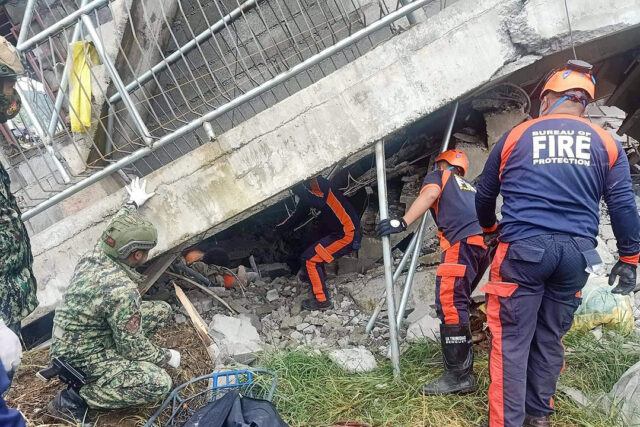
EMERGENCY responders — including firefighters, police, military, and local government teams — at a site of a collapsed building in La Trinidad, Benguet following the magnitude 7 earthquake that struck northwestern Luzon on July 27. — BUREAU OF FIRE PROTECTION

A BILL that will create a new department focusing on disaster management is ready for refiling in the House of Representatives while another related measure has already been submitted, according to lawmakers.  

Ang Probinsyano Party-list Rep. Alfred C. Delos Santos said in a news release on Thursday that the July 27 earthquake that hit the northwestern part of the main island of Luzon should be the last reminder to Congress on the urgent need of creating a Department of Disaster Resilience.   

I was a co-author of the Department of Disaster Resilience (DDR) bill during the 18th Congress. It was approved on third and final reading; so, I add my voice in agreement to the fast-track approach to bills that the House previously approved on third and final reading, he said.  

A DDR bill was approved by the House in the previous Congress but its counterpart measure did not hurdle the Senate as several legislators questioned its practicality and the funding required to set up another department.    

Emergency preparedness and response programs are currently under the multi-agency National Disaster Risk Reduction and Management Council (NDRRMC), which is led by the Department of National Defense.  

President Ferdinand R. Marcos, Jr. on Wednesday said he will push Congress to prioritize the establishment of a DDR.  

Mr. Delos Santos said he has filed House Bill 1923, otherwise known as Laging Handa bill, which seeks to integrate basic medical training and disaster awareness or response in all institutions of learning. 

BHW Party-list Rep. Angelica Natasha Co said other bills relating to disaster resilience are ready to be filed.  

In times of disasters and more so before disasters strike, we need the proposed Medical Reserve Corps, Philippine Center for Disease Prevention and Control, and fully-functioning State Universities and Colleges Mental Health Services,said Ms. Co. 

AID
Meanwhile, House Speaker Ferdinand Martin R. Romualdez said in a separate statement that the lower chamber will support the allocation of funds in the national budget for the rehabilitation and restoration of public infrastructure in affected provinces.   

The newly-formed Department of Migrant Workers (DMW) also announced on Thursday that it has allocated P20 million to assist families of overseas Filipino workers (OFWs) affected by the earthquake.

“This is just an initial allotment to help OFW families affected by the earthquake. I have directed the Overseas Workers Welfare Administration to immediately provide help and find out what other forms of assistance the DMW can provide,” DMW Secretary Susan V. Ople said in a statement. 

Ms. Ople added that the department will wait for the damage assessment report of the NDRRMC to determine the areas most affected by the tremor.

She has also asked the state-run Home Development Mutual Fund or Pag-IBIG to open an emergency loan window for affected OFW families. Matthew Carl L. Montecillo and John Victor D. Ordoñez 

Land, guns are pressure points in Bangsamoro transition, sustainable peace — IA report

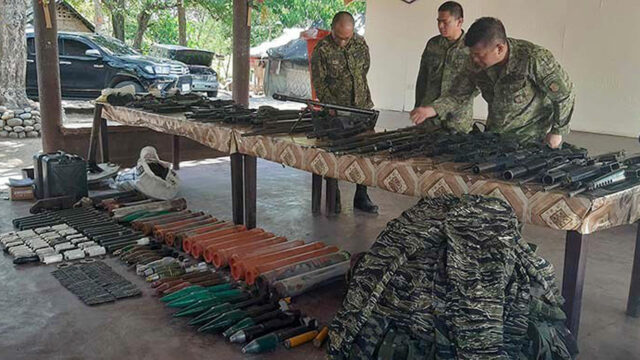
UNREGISTERED weapons seized by the military in Maguindanao in 2019. — WESTMINCOM

CONFLICTS over land ownership and continued proliferation of illegal guns are two of the main threats to the Bangsamoros ongoing political transition and sustaining peace in a restive region, according to a global peacebuilding organization.   

International Alert (IA), in its book Conflicts Long Game: A Decade of Violence in the Bangsamoro launched on Thursday, said measures that will settle land disputes and curb loose firearms must be prioritized by the regional and national governments to mitigate continued cycles of violence.   

What is lingering, what is continuing is always those issues pertaining to land. And what should be raised is the increasing tendency even among violent extremist groups to involve themselves in land issues,International Alert Senior Peace and Conflict Adviser Francisco Lara, Jr. said during the launch.   

Violent incidents in the Bangsamoro Autonomous Region in Muslim Mindanao was on a downtrend from 2016 to 2020, based on the data-driven book. However, the 2020 total was still more than double the under 1,000 recorded in 2011.   

The problem on illegal guns is partly tied to the slow implementation of the decommissioning program wherein armed combatants of the former rebel group Moro Islamic Liberation Front (MILF), which signed a peace deal with the government, are to give up their weapons.   

The longer that is delayed will create a lot of problems,Mr. Lara said.   

An immediate solution, he said, is to require all non-decommissioned MILF members to register their guns based on the countrys firearms regulation law under Republic Act 10591.  

Loose firearms are also linked to the return of the illegal drug trade,a major facet of the underground economy in the region, especially in urban areas such as the cities of Marawi and Cotabato.   

International Alert Philippines Country Director Nikki C. de la Rosa said getting the Bangsamoro out of the conflict trap and cycles of violencerequires an understanding of the dynamics of identitiesin a multi-cultural region with a Muslim majority.  

What cuts across the ebb and flow of violence in the last 10 years is identities,Ms. De la Rosa said.    

Identities can be instrumentalized for political gains during election period, for specific things whether that relates to the use of your affiliation with a certain armed group, and land issues, and non-Moro indigenous peoples land, and so on.MSJ

Palace extends authority of officers-in-charge until yearend

MALACANANG.GOV.PH

THE PRESIDENTIAL Palace on Thursday released a memorandum circular extending the authority of officers-in-charge of agencies under the Executive department until the end of the year. 

This extends the authority of Officers in Charge until December 2022, unless a replacement has been designated or appointed, whichever comes first,Press Secretary Trixie Cruz-Angeles said in a statement. 

In Memorandum Circular (MC) 3, Executive Secretary Victor D. Rodriguez said the extension of the term of OICs until end-December will “ensure the continuous and effective delivery of government services.” 

Among those covered by the memo is Health Undersecretary Maria Rosario S. Vergeire who is currently OIC head of the department. 

The Department of National Defense and the Department of Science and Technology are also among the agencies with OICs. 

The latest memo supplements and amends MC 1, which facilitates the designation of OICs in government agencies where Mr. Marcos has yet to appoint a secretary or head. Kyle Aristophere T. Atienza

Teachers’ party-list denounces DepEd plan on added benefits instead of pay hike

A GRADE 1 teacher at an elementary school in Montalban, Rizal holds tutorial classes on Nov. 15, 2021. — PHILIPPINE STAR/ MICHAEL VARCAS

DEPUTY Minority Leader and ACT Teachers Party-list Rep. France L. Castro on Thursday said their group is disappointed by the Department of Educations (DepEd) proposal to grant additional benefits to teachers instead of a pay increase.  

“Teachers in the public sector have been left behind by other professions with similar qualifications,Ms. Castro said in a statement.   

It is only just that the government gives our teachers increases in their salaries,” she said, noting governments lack of support in terms of overtime pay and provision of allowances for additional costs required under the blended learning system during the coronavirus pandemic.   

She cited Section 15 of Republic Act 4670, or the Magna Carta for Public School teachers, which states that ‘Teachers’ salaries shall compare favorably with those paid in other occupations requiring equivalent or similar qualifications, training and abilities and that they shall be such as to insure teachers a reasonable standard of life for themselves and their families.”   

Ms. Castro also said that the government needs to raise public school teachers’ salaries to set the standard for those teaching in private schools.   

For the longest time, the government has been denying public school teachers salary increases by pitting their salaries against teachers in the private sector, which is wrong because most private school teachers are paid at very low rates, even near-starvation salaries,” she said.  

The ACT Teachers Party-list filed House Bill 203 which seeks to upgrade the salary grade of public school educators.   

“These are part of our priority measures that reflect the demands of our teachers in both the public and private sector. We urge the House leadership to pass these bills into law,” Ms. Castro said. Matthew Carl L. Montecillo 

Almost 2,600 kilos of trash collected in Muntinlupa under Maynilad’s clean-up drive for Laguna Lake

MAYNILAD PHOTO HANDOUT

HUNDREDS of sacks of solid waste weighing a total of 2,584 kilograms were collected during a recent clean-up drive in Muntinlupa Citys two rivers as part of Maynilad Water Services, Inc.s (Maynilad) program to protect the water quality in Laguna Lake.  

The Magdaong and Alabang-Bayanan rivers in the city are among the tributaries that flow into Laguna Lake, which serves as a raw water source for about two million consumers within Maynilads concession area, the company said in a statement on Thursday.    

These river clean-up drives are among the interventions we are taking to help reduce pollution load into Laguna Lake, which is being used as a source for drinking water and should therefore be protected,” says Maynilad President and Chief Executive Officer Ramoncito S. Fernandez.  

We call on other stakeholders to also partner with us in this environmental conservation initiative, he said.   

Maynilad said the clean-up activity also helped unclog waterways that cause flooding.  

The water company also said it is donating solar paddle wheels and a water quality analyzer equipment to Muntinlupa City to help mitigate algal bloom episodes in Laguna Lake.   

Maynilad provides water and wastewater services in the west zone of the greater Metro Manila area, covering 17 cities and municipalities.   

Metro Pacific Investments Corp., which has a majority stake in Maynilad, is one of three Philippine units of Hong Kong-based First Pacific Co. Ltd., the others being Philex Mining Corp. and PLDT, Inc. 

Hastings Holdings, Inc., a unit of PLDT Beneficial Trust Fund subsidiary MediaQuest Holdings, Inc., has an interest in BusinessWorld through the Philippine Star Group, which it controls. 

North Korea’s Kim says nuclear deterrent is ready, slams South Korea’s Yoon

KCNA VIA REUTERS

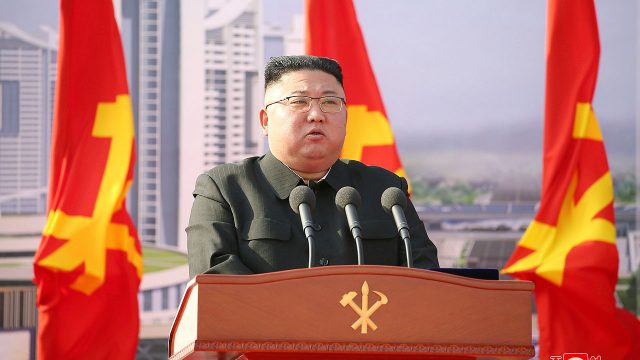
SEOUL — North Korean leader Kim Jong Un said his country is ready to mobilize its nuclear war deterrent and counter any US military clash, and criticized South Korea’s new president for the first time, warning Seoul was pushing towards the brink of war. 

Mr. Kim made the remarks during a speech at an event to mark the 69th anniversary of the July 27 Korean War armistice, which left the two Koreas technically still at war, according to the official KCNA news agency on Thursday. 

The confrontation with the United States posed nuclear threats since the 1950–53 war required the North to achieve an “urgent historical task” of beefing up its self-defense, Mr. Kim said. 

“Our armed forces are thoroughly prepared to respond to any crisis, and our nation’s nuclear war deterrence is also fully ready to mobilize its absolute strength faithfully, accurately and promptly to its mission,” he said. 

The speech came after Seoul and Washington officials said Pyongyang has completed preparations to conduct its first nuclear test since 2017. 

South Korea’s unification minister handling inter-Korean affairs said on Tuesday there was a “possibility” of the test around the anniversary of the armistice, though a military official said there were no immediate signs for it. 

North Korea is likely to face stronger sanctions including measures targeting its cyberattack capabilities if it goes ahead with the test, South Korea’s foreign minister said on Wednesday. 

In the speech, Mr. Kim said Washington continues “dangerous, illegal hostile acts” with South Korea against the North, and seeks to justify its behavior by “demonizing” the country. 

The North has long accused the United States of double standards over military activities and pursuing a hostile policy towards Pyongyang, saying it hampers a restart of talks aimed at dismantling the country’s nuclear and missile programs in return for sanctions relief. 

“The duplex act of the United States, which is misleading all the routine actions of our armed forces as ‘provocation’ and ‘threat’ while holding large-scale joint military exercises that seriously threaten our security, is literally a robbery,” Mr. Kim said. 

“That is driving bilateral relations to the point where it is difficult to turn back, into a state of conflict.” 

‘ABSOLUTE WEAPON’
Mr. Kim also denounced South Korea’s new conservative President Yoon Suk-yeol by name for the first time, accusing him of threatening the North’s security and right to self-defense. 

“Warmongers” and “disgusting thugs” in Mr. Yoon’s administration are bent on confrontational military activities, Mr. Kim said, singling out Seoul’s weapons developments and drive to bring back US nuclear strategic assets as well as allied military drills. 

Their “heinous confrontational policy” toward the North and “toadyish, treacherous acts” are pushing the situation to the brink of war, he said. 

North Korea in recent months has tested hypersonic missiles and missiles that it says could carry tactical nuclear weapons, narrowing the time that Seoul would have to respond to a pending attack. 

Mr. Yoon has vowed to complete the so-called “Kill Chain” system that calls for preemptive strikes against the North’s missiles and possibly its leadership if an imminent attack is detected. 

But that system would never be able to cover the North’s “absolute weapon,” Mr. Kim said. 

“If you think you can counter us militarily and preemptively neutralize or destroy part of our military power,” he said. “Such a dangerous attempt will immediately be punished by a powerful force, and Yoon Suk-yeol’s government and his army will be annihilated.” 

Seoul’s defense ministry spokesman said it would continue reinforcing its own capabilities and the US extended deterrence including its nuclear umbrella to better respond to Pyongyang’s threats. 

Yang Moo-jin, a professor at the University of North Korean Studies in Seoul, said Mr. Kim’s remarks seem to be intended to highlight the legitimacy for weapons developments and his “eye for eye” approach toward Washington and Seoul. — Hyonhee Shin and Soo-hyang Choi/Reuters