Home Blog Page 6075

How Philippines compare with its regional peers in returning to ‘normal’ life

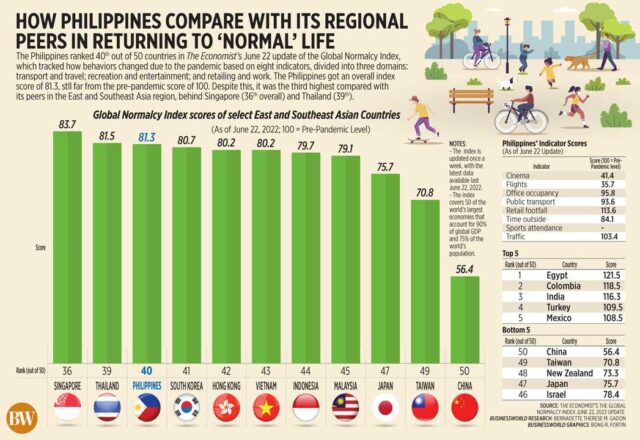
The Philippines ranked 40th out of 50 countries in The Economist’s June 22 update of the Global Normalcy Index, which tracked how behaviors changed due to the pandemic based on eight indicators, divided into three domains: transport and travel; recreation and entertainment; and retailing and work. The Philippines got an overall index score of 81.3, still far from the pre-pandemic score of 100. Despite this, it was the third highest compared with its peers in the East and Southeast Asia region, behind Singapore (36th overall) and Thailand (39th).

How Philippines compare with its regional peers in returning to ‘normal’ life

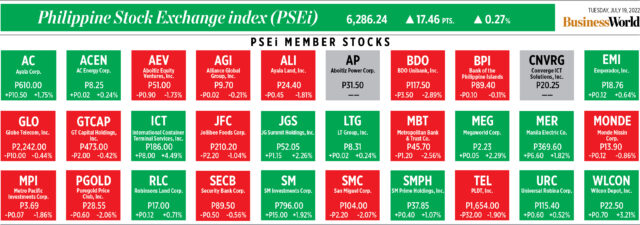
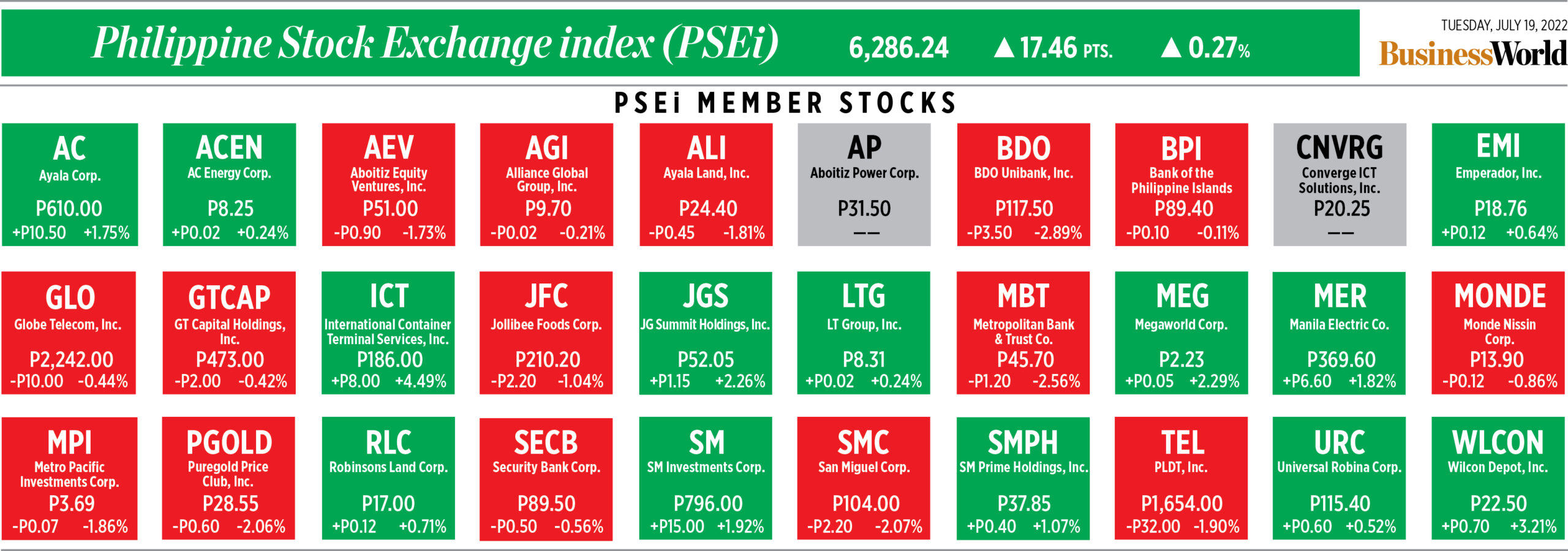
How PSEi member stocks performed — July 19, 2022

Here’s a quick glance at how PSEi stocks fared on Tuesday, July 19, 2022.


Metrobank allows fund transfers via Pera Hub

METROPOLITAN BANK & Trust Co. (Metrobank) has expanded its partnership with remittance company Pera Hub to provide fund transfer services to its clients.

The new service allows individuals who want to send cash to Metrobank clients to do so through Pera Hub branches, the lender said in a statement on Tuesday. Senders will need to present one valid ID and to fill out a remittance form.

Bank transfers can range from P100 to P25,000 and will be charged a fee of P100 per transaction.

Recipients can withdraw the money from any Metrobank automated teller machine or over the counter in its branches for those with passbook accounts.

“This added service with our partner, Pera Hub, shows that Metrobank remains committed to our customers in improving our services and providing them with more accessible and convenient channels to conduct their financial transactions with us,” Metrobank Executive Vice-President and Retail Banking Sector Head Richard Benedict S. So said.

Metrobank said its partnership with Pera Hub, which began in 2020, has helped give Filipinos accessible remittance channels.

Pera Hub is the retail network brand of PETNET, Inc., a transaction network with over 3,000 locations nationwide. Pera Hub offers products and services such as money changing, payment transactions and micro-insurance, among others. 

Aboitiz Equity Ventures, Inc. (AEV) bought a 51% stake in PETNET in 2015. In 2018, AEV sold its majority stake in PETNET to subsidiaries City Savings Bank, Inc. and Union Properties, Inc. to consolidate its banking and financial services interests under affiliate UnionBank of the Philippines, Inc.

BEST BANK
Meanwhile, Metrobank was recognized as the “Best Bank in the Philippines” at the Euromoney Awards for Excellence 2022, solidifying its position as the country’s second-largest private universal bank.

“A changing of the guard this year as Metrobank pushes aside other local banks to post the best numbers in a mercurial year. Metrobank’s story was about more than prudence. The bank is out there supporting a reviving economy, recording a growth in its commercial lending business,” Euromoney was quoted as saying by the bank in a statement.

“It also took advantage of COVID-19 (coronavirus disease 2019) to push digital channels and launch a host of new services to address its customers’ needs. Pretty much the entire street rates Metrobank a buy right now in recognition of a growing bank with strong capital and asset quality,” Euromoney said.

For the Best Bank category, Euromoney Excellence Awards looks at these key metrics: market capitalization, total revenues, pre-tax profit, net income, return on tangible common equity, return on assets, net interest margin, cost-to-income ratio, Basel III Tier 1 capital, market share of deposits, market share of loans, and loan-to-deposit, nonperforming loan (NPL) and NPL coverage ratios.

“It is a great honor to be named as the Best Bank in the Philippines by Euromoney, which is a highly regarded institution in the financial industry. This is very timely as we mark our 60th anniversary of serving Filipinos this September,” Metrobank President Fabian S. Dee said in a statement on Monday.

“This award is a testament to the hard work of Metrobankers to maintain the bank’s status as a strong, reliable, and stable partner for all our stakeholders. At Metrobank, we remain committed to serving our customers as their trusted financial partner,” he added.

Metrobank’s net profit hit P8 billion in the first quarter, or 2.7% higher year on year, amid a stable net interest income supported by a recovery in loans, a rise in non-interest earnings, and marginal costs growth.

The Ty-led bank’s shares finished at P45.70 each on Tuesday, down by P1.20 or 2.56% from the previous close. — Keisha B. Ta-asan


Peso climbs vs dollar on Fed rate bets

BW FILE PHOTO

THE PESO appreciated on Tuesday as the dollar weakened amid expectations that the US Federal Reserve won’t raise interest rates by a full percentage point at its July 26-27 meeting despite rising inflation.

The local unit closed at P56.255 per dollar on Tuesday, up by 9.5 centavos from its P56.35 finish on Monday, based on data from the Bankers Association of the Philippines.

The peso opened Tuesday’s session at P56.35 versus the dollar. Its weakest showing was at P56.37, while its intraday best was at P56.25 against the greenback.

Dollars exchanged rose to $663.05 million on Tuesday from $561.75 million on Monday.

“The peso appreciated as the dollar’s appeal waned following reports that the US central bank might push for a softer 75-bp (basis point) policy rate hike instead of an aggressive 100-bp adjustment,” a trader said in an e-mail.

Fed officials said on Friday they would support another 75-bp interest rate increase at their July meeting, though high inflation could still prompt larger increases than anticipated later in the year, Reuters reported.

“It probably doesn’t make too much difference to do 100 basis points here and less in the other three meetings (in 2022) or to do 75 basis points here and slightly more in the remaining three meetings of the year,” St. Louis Fed President James Bullard said.

Atlanta Fed President Raphael Bostic cautioned against the central bank moving “too dramatically” because it could undermine the strong hiring and other positive trends still seen in the economy.

Both Mr. Bostic and Mr. Bullard reiterated the Fed’s firm commitment to raising interest rates as high as needed to control inflation.

Meanwhile, Rizal Commercial Banking Corp. Chief Economist Michael L. Ricafort said in a Viber message that the peso rose amid gains in the local stock market. The Philippine Stock Exchange index went up by 17.46 points or 0.27% to close at 6,286.24 on Tuesday, while the broader all shares index increased by 11.30 points or 0.33% to 3,381.36.

“The peso also stronger after the government kept the COVID alert level system and plans to have new alert classification by mid-August 2022,” Mr. Ricafort added.

For Wednesday, the trader said the peso may weaken anew against the dollar on potentially hawkish remarks from other Fed officials overnight.

The trader expects the peso to move between P56.15 and P56.35 against the dollar, while Mr. Ricafort gave a forecast range of P56.10 to P56.35. — Keisha B. Ta-asan with Reuters

Stocks inch higher on continued bargain hunting

BW FILE PHOTO

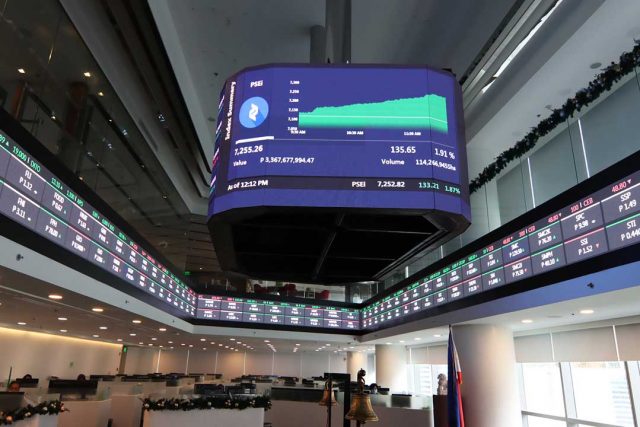
SHARES inched higher on Tuesday on bargain hunting amid a lack of fresh leads and ahead of the release of companies’ second-quarter results.

The benchmark Philippine Stock Exchange index (PSEi) went up by 17.46 points or 0.27% to close at 6,286.24 on Tuesday, while the broader all shares index increased by 11.30 points or 0.33% to 3,381.36.

“The local bourse closed in the green, up by 17.46 points (+0.27%) to 6,286.24 as investors continue to bargain hunt from last week’s decline. However, during the intraday, the market moves sideways amid a lack of fresh leads,” Philstocks Financial, Inc. Research Analyst Claire T. Alviar said in a Viber message.

Ms. Alviar said investors remained on the sidelines, as seen in the value turnover recorded on Tuesday.

Value turnover declined to P3.793 billion on Tuesday with 1.07 billion shares changing hands from the P4.24 billion with 521.89 million issues seen the previous trading day.

“The Philippine main index finished marginally higher, but volume remained low as investors remain cautious ahead of the earnings season,” Timson Securities, Inc. Head of Online Trading Marc Kebinson L. Lood said in a Viber message.

Mr. Lood said the market is also awaiting the US Federal Reserve’s July 26-27 meeting, where it is expected to hike rates further as consumer inflation in the world’s largest economy hit another 40-year high last month.

Some market players are even pricing in a 100-basis-point (bp) rate increase from the Fed next week, bigger than the 75-bp hike made in June.

“The local market may still move sideways for the rest of the week as there is no market moving news as of yet, but investors will be watching closely the first SONA (State of the Nation Address) of President [Ferdinand “Bongbong” R. Marcos, Jr.], which may set a new trend direction for our index,” he added.

Mr. Marcos is set to deliver his first SONA on July 25, Monday.

The majority of sectoral indices ended in the green on Tuesday except for financials, which went down by 23.44 points or 1.55% to 1,480.89.

Meanwhile, mining and oil went up by 272.18 points or 2.55% to 10,932.83; services went up by 22.38 points or 1.38% to 1,640.04; holding firms climbed by 60.44 points or 1.03% to 5,893.02; industrials increased by 35.95 points or 0.38% to 9,411.27; and property inched up by 7.34 points or 0.25% to end Tuesday’s session at 2,859.82.

Advancers outnumbered decliners, 99 versus 77, while 51 names closed unchanged.

Net foreign selling dropped to P227.51 million on Tuesday from the P333.39 million seen the previous trading day.

Mr. Lood placed the PSEi’s support at 5,900 and resistance at 6,700, while Philstocks Financial’s Ms. Alviar put support at the 6,000-6,150 range and resistance at 6,400. — Justine Irish DP. Tabile

Marcos urged to attend to higher input costs ahead of farm roads

ATLASFERTILIZER.COM

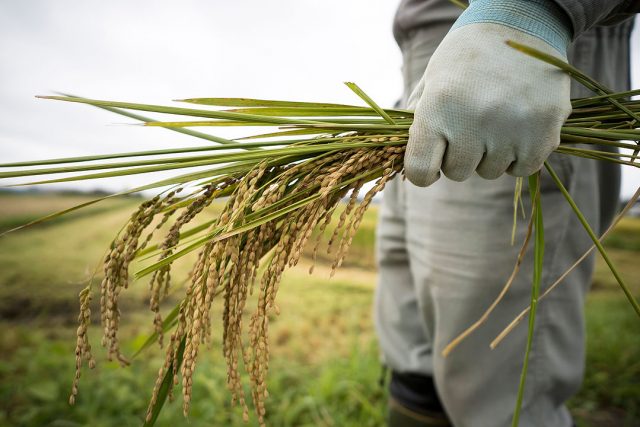
THE government’s farm-to-market road (FMR) masterplan is less of a priority at the moment than ensuring that farmers gain access to affordable inputs and are insulated from excessive competition from imports, agriculture industry representatives said.

“Right now, the high cost of inputs, and to a lesser extent, fuel, are the most pressing problems.  Then we have to find a way to manage imports and assure farmers of reasonable prices for their products and incentives for them to continue producing,” Federation of Free Farmers National Manager Raul Q. Montemayor said in a Viber message.

Nevertheless, he said, “There is a huge backlog in the farm-to-market and rural infrastructure programs, especially since priority funding has often gone to urban roads and infrastructure. Poor rural infrastructure results in high transport and marketing costs that translate into lower prices for farmers’ products and high prices for their farm inputs and needs, and at the other end, high prices for consumers.”

President Ferdinand R. Marcos, Jr., who is also the Agriculture Secretary, said in a briefing on Monday that he is tasking Department of Agriculture officials to come up with an FMR masterplan to address food security concerns. 

An association of fisherfolk, Pambansang Lakas ng Kilusang Mamamalakaya ng Pilipinas (PAMALAKAYA) said the FMR masterplan is not as large a concern as securing domestic production.

“What is the purpose of farm-to-market roads if there are no products to deliver since production is down? Costs are high. Roads and infrastructure are not the solution to ensure food security. We need to support actual producers of food,” the group said in a statement.

PAMALAKAYA spokesman Ronnel S. Arambulo said that a significant number of the rural population employed in the fishery and agriculture have left their farms and fishing grounds due to the high cost of production, chief among them fuel.

“In the fishing sector, for instance, fuel takes up almost 80% of the production cost in a small-scale fishing operation. Mr. Marcos should first address low productivity among our rural sectors before anything else,” he said.

“If Mr. Marcos wants a comprehensive plan on food security, he should certify this production subsidy bill as urgent to ensure that aside from mobility, there would be enough agriculture and fisheries products to (send to market),” he added. — Luisa Maria Jacinta C. Jocson

Business chamber eager to hear food security, inflation plans in SONA

PLANS dealing with food security and inflation will be among the most eagerly expected portions of the State of the Nation Address (SONA) to be delivered by President Ferdinand R. Marcos, Jr. on July 25, the Philippine Chamber of Commerce and Industry (PCCI) said on Tuesday.

PCCI President George T. Barcelon told the BusinessWorld Live program on One News channel: “We know that the President is in charge of the agricultural portfolio. So, we’d like to see what’s the roadmap for this in view of our issues with food supply. We know very well that food prices have been going up primarily because of external factors, and also because of supply chain (issues). So that is top of mind on the agriculture side,” Mr. Barcelon said.

Mr. Barcelon said the SONA, which will open the next session of Congress, should also include plans for addressing inflation.

The Philippine Statistics Authority reported that headline inflation surged to 6.1% in June on the back of higher food and transport prices.

“The other thing that is of concern is the inflation that we’re facing. Again, this is (due to) international cost-push impact. I think this has to be addressed (because) the salary of the working people may not cover it,” Mr. Barcelon said.

Mr. Barcelon expressed the hope that Mr. Marcos will address helping the tourism industry recover and discuss energy security.

“We’re seeing that our tourism business has picked up… I hope (travel and leisure) is considered low-hanging fruit… The government should (pay attention) to this. This not only creates jobs, but it’s a foreign currency earner,” Mr. Barcelon said. 

Mr. Barcelon added that he is hoping for an expansion of the power grid’s connectivity “so that areas with an oversupply can redirect (electricity) to areas that need power.”

Separately, Tourism Congress of the Philippines President Jose C. Clemente III told the Agenda program on One News channel that the tourism industry is worried about the rising prices of goods. 

“I’m fearful of the tourists’ threshold (for continuing to travel) since the prices of goods are increasing,” Mr. Clemente said.

While travelers remain willing to absorb high fuel costs and airfares, “maybe we are already nearing the threshold past which they’ll just say never mind, I’ll just do it next time when prices are lower,” he added. — Revin Mikhael D. Ochave

Philippines among most exposed to price shocks in food, Moody’s says

NEDA

THE PHILIPPINES is among the most vulnerable to food price shocks, and must enter into regional agreements to ensure supply and increase efficiency in domestic production, Moody’s Investors Service.

The Philippine consumer price index basket of goods is heavily weighted towards food and energy, making the indicator sensitive to price volatility in those commodities, Moody’s said.

“Food security has become a major concern for governments in Asia-Pacific as the Russia-Ukraine military conflict continues to disrupt the supply and raise the cost of agricultural products, especially cereals and vegetable oils, as well as fertilizers and other agricultural inputs,” Moody’s said.

Net food import dependence in key cereals consumed in Asia, such as rice and wheat, was found to be high in the Philippines based on trade data.

“Rising commodity prices may prompt governments in Asia-Pacific to invest in agricultural supply chains and crop yields to enhance domestic production, particularly in more vulnerable economies,” the report said.

“More targeted support to smaller farmers through agricultural reforms, such as access to rural financing and value-chain infrastructure, would be positive for agricultural employment, especially in economies with a large agrarian sector, and in enhancing overall food security,” it added.

According to the Food and Agriculture Organization, there were 768 million undernourished people globally in 2020, of which 54% were in Asia.

A number of economies in the region with the highest social risks, according to a Moody’s estimate of environmental, social and governance risks, are also low-income.

“Compensating for domestic food price increases will entail fiscal costs for governments or state-owned commodity companies. The pace of fiscal consolidation in some of these economies is likely to slow as spending pressures persist,” according to Moody’s.

“The economic slowdown, and job and income losses over the past two years, have also disproportionately affected vulnerable countries and communities, rendering them more susceptible to higher commodity prices,” it added. — Luisa Maria Jacinta C. Jocson

BoI approves P924-M desiccated coconut project

CENTURYPACIFIC.COM.PH

THE Board of Investments (BoI) has approved an application to register for incentives Consolidated Coconut Corp.’s desiccated coconut project in Misamis Oriental worth P924 million, which is expected to generate export income.  

In a statement on Tuesday, the BoI said that the company’s project will be located in Plaridel, Misamis Oriental, and will begin commercial operations in September. The facility has an annual capacity of 93,750 metric tons (MT) of desiccated coconut.

“The firm will engage in the production and export of high-quality food-grade desiccated coconut. Further, the target markets for the product to be exported are North and South America, Europe, China, Asia, Australia, and the Middle East,” the BoI said.

“We are making headway in sustaining Philippine exports, particularly desiccated coconut, with the approval of the project by Consolidated Coconut Corp. We are truly seizing the opportunity, as the Philippines is the top producer of such products globally,” BoI Managing Head Ceferino S. Rodolfo said.

The BoI said that the first five years of the project’s commercial operations and construction will generate 475 jobs. The project will utilize raw materials, specifically dehusked coconuts from Misamis Oriental and nearby provinces.

The company will be importing paring machines, dryers, and laboratory equipment worth P430 million from Sri Lanka, India, and Singapore, respectively.

“The project exploits the country’s competitive advantage in manufacturing and exporting desiccated coconut. Based on the Philippine Coconut Farmers and Industry Roadmap (2021-2040), the Philippines is the world’s largest exporter of desiccated coconut and has the greatest ability to compete in the global market,” the BoI said.

According to the BoI, the Philippines has the largest land area planted to coconut and the second-largest coconut output in the world, accounting for 23.4% of global production.

It added that the project will support one of the goals of the Coconut Farmers and Industry Development Plan, which is to promote integrated processing systems to optimize use of the produce.  

“In 2020, the total volume of desiccated coconut exported in the world (was) 438,052 MT. The Philippines sits at the top with 147,000 MT of desiccated coconut exported, representing 33.56% of the world exports, and the country’s top export destinations of desiccated coconut are the US, Netherlands, Australia, the UK, and Russia,” the BoI said.  

“Coconut is the second largest crop in the country in terms of area planted at 3.6 million hectares in 2020, or approximately 26% of the country’s total agricultural land. The Philippines represents 26.8% of global coconut exports which are valued at $229.79 million annually,” it added. — Revin Mikhael D. Ochave

Miners call on gov’t to provide stable environment, spell out ESG best practices

MINERS have asked the government to provide a stable environment and to specify how the industry can best comply with environmental, social, and governance (ESG) standards.   

“We hope for nothing less than a stable business environment to allow mineral resource development to flourish, the harmonization of national and local laws to avoid conflicts, and the promotion as well as reporting of environmental, social, and governance (ESG) best practices for resource development,” Philex Mining Corp. said in a Viber message.

The listed miner said that “through responsible and sustainable means, mining has the potential to contribute to economic growth and national development.” 

Finance Secretary Benjamin E. Diokno has said that the government is hoping to accelerate the revival of the mining industry, the operations of which were disrupted by the Duterte administration, which found large parts of the industry non-compliant with environmental rules. The government before that had declared a moratorium on new mining permits.

Last year, then President Rodrigo R. Duterte lifted the nine-year-old permit moratorium and lifted the ban on open-pit mining.

In 2021, the mining and quarrying industry posted output growth of 5.0%, accelerating from 2.6% in 2020, according to the Philippine Statistics Authority.

“It has always been our strong belief that responsible mineral development, when allowed to flourish, could substantially contribute to economic recovery, particularly in increasing government revenue, job generation, and poverty alleviation that are most needed in this time of pandemic and beyond,” Chamber of Mines of the Philippines Chairman Michael T. Toledo said in a statement.

On the opposite of the issue, Alyansa Tigil Mina (ATM), an advocacy group, said the environmental consequences of mining outweigh its economic benefits.

“A revitalization of the mining industry could only lead to food and water insecurity, land-use changes, loss of biodiversity, soil erosion, air and water pollution and the displacement of communities,” ATM National Coordinator Jaybee Garganera said in a statement.

Mr. Garganera said that environmental concerns should be one of the government’s priorities in its economic recovery program.

“Ignoring the harmful environmental consequences of mining in the drive to revitalize the mining industry could only do more damage to the economy,” he said.

“It is imperative that alternatives to mining be pursued if the government truly wants to revive the economy. These include: agroforestry, eco-tourism and watershed development, agriculture and fisheries, and community-based enterprises,” he added.

ATM called for the full disclosure of all the mine audit reports and the immediate review of these mine audits.

“The new administration must immediately convene an environmental summit that will involve affected communities and environmental groups in order to assess and craft this administration’s environmental and climate program,” it added. — Luisa Maria Jacinta C. Jocson

Pharma group backs DTI plan to develop PHL as an industry hub

MIZIANITKA FROM PIXABAY

THE Pharmaceutical and Healthcare Association of the Philippines (PHAP) said it is confident that the Philippines can be developed as a hub for the industry, expressing support for a Department of Trade and Industry (DTI) plan to build up domestic production.

In a statement on Tuesday, the PHAP said that the Philippines can “position itself as regional hub for biopharmaceutical innovation.”

Trade Secretary Alfredo E. Pascual has said he is pushing for more domestic manufacturing in health and life sciences, targeting biopharmaceuticals, pharmaceuticals, medical devices, and healthcare services.

“With a health crisis at the root of the current global economic distress, the health and life science cluster plays a strategic security role, opening income-generating opportunities in all countries, including the Philippines,” Mr. Pascual said.

According to PHAP Executive Director Teodoro B. Padilla, the group’s aim is to develop a “vibrant biopharmaceutical industry.”

“We are eager to share our expertise to accelerate the attainment of this goal for us to better prepare for and respond to current and future emergencies while at the same time sparking economic activity,” Mr. Padilla said.  

Diana M. Edralin, PHAP president, said the Philippines has much to offer in biopharmaceutical research and development, which can become a catalyst for future investment.

“The Philippines can be part of the actual research and development process… The country is currently an active participant in the conduct of clinical trials, and we are eager to partner to see more of these research and development activities in the Philippines,” Ms. Edralin said.

“When we participate in global clinical trials, we are creating early access to innovation, bringing in major investment, and building the scientific capacity… to pursue pharmaceutical research and development,” she added.

According to the PHAP, the DTI is the lead agency in the Industry Strengthening Working Group developing the integrated roadmap for the pharmaceutical industry.

“We will work with the DTI and related agencies for us to build capacity and foster an environment conducive to innovation to make available life-saving biopharmaceuticals for Filipinos and even to people in neighboring countries in the long term,” PHAP Chairman Emeritus Beaver R. Tamesis said.

“(The) PHAP is keen to continue working with the DTI to pursue pandemic recovery and foster pharmaceutical security for an uninterrupted supply of life-saving medicines, vaccines and diagnostics amidst global demand or political instability in other regions,” the group added. — Revin Mikhael D. Ochave

Gov’t budget utilization hits 99% at end of June

BW FILE PHOTO

GOVERNMENT agencies raised their cash utilization rate to 99% at the end of June, up from the 97% rate posted a year earlier, the Department of Budget and Management (DBM) said.

The DBM said the National Government, local governments and state-owned firms used P2.01 trillion of the P2.033 trillion in notices of cash allocation (NCAs) issued to them in the first half of the year, leaving P24.22 billion unused.

NCAs are a quarterly disbursement authority from the DBM issued to agencies, allowing the latter to withdraw funds from the Treasury to support their spending needs.

“This may have to do with the election year to optimize budget utilization as needed to accomplish (and) complete more government projects and programs,” Rizal Commercial Banking Corp. Chief Economist Michael L. Ricafort said.

“Furthermore, some government spending especially on infrastructure could have been rushed before the election ban on some public works,” he added in a Viber message.

Line departments used 98% or P1.39 trillion in NCAs released to them as of June.

Those recording a utilization rate of 100% were the Office of the Vice-President, and the Departments of Education, Foreign Affairs, Health, Interior and Local Government, National Defense, Public Works and Highways, and Transportation.

The Joint Legislative-Executive Councils, the Judiciary, the Civil Service Commission, the Commission on Audit, the Commission on Elections, the Office of the Ombudsman, and the Commission on Human Rights also posted a 100% utilization ratio.

In June, the Department of Social Welfare and Development announced the distribution of the first batch of cash aid intended for an initial 1.2 million Filipino households amid the rising costs of fuel and other commodities. The subsidy under the Targeted Cash Transfer program amounts to P500 per month for six months.

The DBM released P4.68 trillion or 93.2% of this year’s P5.02 trillion spending plan as of June.

In the same period last year, the DBM had released P3.83 trillion or 85.1% of that year’s P4.51-trillion budget. — Diego Gabriel C. Robles