Home Blog Page 6

Fernandez spearheads new inductees to the Philippine Sports Hall of Fame

CALL THEM “The Magnificent Seven.”

Basketball legend Ramon Fernandez and Olympic boxing silver medalist Mansueto “Onyok” Velasco head the new batch of inductees to the Philippine Sports Hall of Fame that was officially named on Monday by Philippine Sports Commission (PSC) Chair Patrick C. Gregorio.

Also inducted were Eduardo Pacheco of basketball and football, Bea Lucero-Lhuillier of gymnastics and taekwondo, Isidro del Prado of athletics, Adeline Dumapong-Ancheta of para powerlifting , and Cecil Mamiit of tennis.

“The Philippine Sports Hall of Fame is more than an honor roll of medals — it is a living ledger of greatness to honor those who have defined what it means to be Filipino in sport,” said Mr. Gregorio, who headed the selection committee along with Philippine Olympic Committee chief Abraham Tolentino.

“These are not just names. They are the pride and memory of a nation. The search for new enshrinees has been difficult because there are many stories of greatness in sports,” he added.

Mr. Fernandez, a former PSC commissioner and PBA legend, was the ninth from the sport to be named into the elite group while Mr. Velasco joined elder brother Roel as the ninth boxer in that league of extraordinary gentlemen and ladies.

All of the inductees will receive P500,000 each plus a beautifully sculpted wooden trophy.

Mr. Pacheco was part of the 1962 Asian Games basketball team that struck gold and the squad that competed in the 1960 Olympics and suited up for national booters that competed in the 1954 Asian Games and Olympic qualification in that same era.

Ms. Lucero-Lhuillier, for her part, was a 1987 Southeast Asian (SEA) Games gold winner in gymnastics, an Asian Championship taekwondo bronze winner and a 1992 Olympian while Ms. Dumapong-Ancheta blazed the trail for the country’s para team after becoming the first to win a medal in the Paralympics in 2000 in Athens, Greece with a bronze.

Mr. del Prado was a two-time Olympian and multiple SEA Games champion in the individual and relay sprints while Mr. Mamiit was a multiple SEA Games gold winner in doubles and team events and an Asiad medalist. — Joey Villar

Yee, Trupa defend respective titles in the National Age Duathlon

FRANKLIN YEE and Mary Joy Trupa successfully defended their respective titles in the elite sprint category of the National Age Duathlon staged over the weekend at the Villar City in Las Piñas.

The 23-year-old Mr. Yee, who hails from Bogo, Cebu, clocked 56.20 minutes in ruling the men’s side while Ms. Trupa, 23, timed in 1:06:51 in topping the women’s side of the five-kilometer (km) run, 20-km bike and 2.5-km run race.

Mr. Yee, who improved on his 57.13 time from last year’s title conquest, finished ahead of Iriga’s John Patrick Ciron and Baguio City’s Maynard Pecson, who checked in at 56.43 and 58.56, respectively.

Lady Samantha Jhunace Corpuz (1:10:12) and Dhana Victoria Seda-Lomboy (1:11:57) finished second and third in the women’s section, respectively.

Meanwhile, Hermogenes Branzuela (57:46) reigned supreme in the men’s junior elite division of the race backed by Villar City, Gatorade, Milo, C-Vitt and the Philippine Sports Commission.

Eric Hechanova (1:01:35) was second and Anxader Gomez (1:03:06) third.

Anisha Eunice Caluya (1:09:54), Candace Marie Socito (1:15:58) and Scottie Lee Awitan (1:20:20) were the top three finishers in the women’s junior elite class of the race that is part of Triathlon Philippines’ grassroots and talent identification program. — Joey Villar

Nikola Jokić set to become first player in NBA history to lead league in assists and rebounds per game

FOR the first time in NBA history, one player will lead the league in both assists and rebounds per game.

Rarely in the 53 years since he played his final NBA game has Wilt Chamberlain been mentioned as frequently as he was in 2025-26.

A month ago, Miami’s Bam Adebayo sparked all sorts of media mentions of Chamberlain’s legendary 100-point performance by scoring 83 against Washington. Two nights later, Oklahoma City’s Shai Gilgeous-Alexander scored more than 20 points in his 127th consecutive game, breaking Chamberlain’s record of 126 set from 1961 to 1963.

Then there is the current Rookie of the Year race, as hotly contested as any in recent memory, pitting Charlotte’s Kon Knueppel vs. Dallas’ Cooper Flagg. The former Duke roommates are vying for, of course, the Wilt Chamberlain Trophy that accompanies the media-voted award to top newcomers.

Now, with the season’s statistical books set to close on Sunday, there’s one more Wilt connection: Denver’s Nikola Jokić is about to become the first player in NBA history to lead in both rebounds per game (12.9) and assists per game (10.9).

The only time even a variation of that occurred came in 1967-68 when… wait for it… Chamberlain led the NBA in both total rebounds (1,992) and total assists (702).

Totals carried more weight back then, with many players striving to appear in most or all of their teams’ games. For the record, Hall of Famer Oscar Robertson averaged the most assists (9.7) in 1967-68 but played only 65 games for Cincinnati to Chamberlain’s 82. He totaled 633 assists, 69 fewer than Wilt. — Reuters

Metrobank premieres Moneygurado docuseries

The Moneygurado docuseries explores the Filipino mindset on money. — EDG EVA

Metropolitan Bank & Trust Co. (Metrobank) on Monday launched a documentary series campaign that aims to help Filipinos become more intentional in handling their finances.

The Moneygurado docuseries, which carries the same name as the company’s financial mindfulness campaign, features four subjects who shared their experiences reflecting Filipino habits and how these behaviors affect the way people handle money.

“We have four storytellers that delve deep into different aspects of how Filipinos basically think about money, talk about money, and act on money,” Digs A. Dimagiba, chief marketing officer (CMO) of Metrobank, told reporters on the sidelines of the exclusive screening of the docuseries.

“This ranges from Filipino resilience during crises, to how we view debt or loans, to the shame or taboo surrounding money, and ultimately about saving money,” he added.

Mr. Dimagiba also said the docuseries is part of the bank’s long-term advocacy of encouraging Filipinos to reflect and spark conversations about financial mindfulness through real-life stories that may inspire action.

BusinessWorld was given the chance to watch all four episodes of the Moneygurado docuseries during the screening.

The docuseries premiered with “Kapit Lang: The Filipino Way of Surviving”, featuring Audy Cruz, founder of OnlyPans Taqueria in Makati.

Ms. Cruz’s life and business were literally hit by both fire and a strong typhoon, but she managed to recover through what she described as strategic resilience — one that requires proper planning, focus, and sensible risk-taking.

The other episodes are “Utang sa Pelikula: Self-Worth and Borrowing”, featuring Filipino director Jose Javier Reyes; “The Price of Hiya”, featuring Xiao Chua; and “Alkansya: The Filipino Art of Waiting”, featuring author Michelline Suarez.

The Moneygurado premiere episode will be available starting Monday on Metrobank’s official social media pages, channels, and website.

The succeeding episodes will be released in the coming months, together with learning materials for students, families, and communities that can be accessed through the company’s Earnest website. — Edg Adrian A. Eva

Global fund managers seek reporting crackdown after Philippine flood-control scandal

Flooded houses in Ilagan City, north of Manila. — VILLAMOR VISAYA/AFP/GETTY IMAGES VIA BLOOMBERG MERCURY

MONEY MANAGERS led by BNP Paribas Asset Management and Robeco Institutional Asset Management BV are putting pressure on the Philippine government to introduce stricter reporting standards for state-backed projects, following a corruption scandal tied to flood infrastructure.

The group of 11 fixed-income investors sent a letter to the Philippines’ Securities and Exchange Commission (SEC) and government treasury at the end of March calling for tighter rules around use-of-proceeds disclosures, according to people familiar with the matter. The group is also asking for greater transparency around infrastructure spending, the people said asking not to be identified as the matter is confidential. 

Representatives for the investment managers — a group that includes Amundi SA and Fidelity International — didn’t provide comment when approached by Bloomberg. Superannuation fund Australian Ethical, also among the investors behind the letter, declined to comment.

National Treasurer Sharon Almanza, in a text message, acknowledged receipt of the letter and said the agency is planning to respond. SEC Commissioner McJill Bryant Fernandez, who oversees markets and securities regulation, didn’t immediately reply to a request for comment.

The investor group includes asset managers who are willing to withhold financing until they’re assured the government has taken adequate steps to address their concerns, the people said. 

The group also includes existing investors in sustainable bonds issued by the Philippine government who are now worried they may inadvertently have financed flood-control projects tainted by the misappropriation of roughly $2 billion of public funds.

The scandal centers on the alleged failure of public authorities to dedicate the funds at their disposal to the declared goal of building defenses against flooding. Some flood infrastructure projects such as dikes either weren’t built or collapsed as soon as storms hit, possibly contributing to hundreds of deaths.

The revelations of corruption have triggered mass protests across the country, with subsequent investigations resulting in more than $200 million worth of assets being frozen. Three government ministers quit, and several public officials have been arrested.

After the illicit dealings came to light last year, Robeco, Mirova SA and Neuberger Berman Group LLC separately told Bloomberg News they were liaising with the government to understand their exposure. Robeco had said it may divest if it didn’t receive “a robust answer.” 

Investors are now hoping a coordinated pressure campaign will force the government to act, the people familiar with the matter said. They’re also seeking clarity on how the government plans to strengthen the power and independence of institutions as part of the corruption crackdown, and how it will improve standards for the selection and evaluation of projects, one of the people said.

About P168 billion ($2.8 billion) of the proceeds of Philippines sustainability bonds have been allocated to flood-control projects, according to Bloomberg calculations based on government reports. That’s roughly 39% of all proceeds. Over $7 billion of sustainable bonds have been issued by the Philippines government since 2022 and sold in US dollar, euro and Japanese yen capital markets.

The scandal involves the alleged collusion of politicians and contractors to receive kickbacks, with up to 70% of government funds for flood-control projects lost to corruption. Philippine President Ferdinand Marcos Jr. brought attention to the issue in a State of the Nation Address in July, after typhoons flooded many parts of the country’s north.

The government hasn’t issued any bonds with environmental, social or governance labels since August, according to data compiled by Bloomberg Intelligence. 

“It’s quite telling that since 2021, the government has only issued sustainability-labeled debt, and this year in January they came to the market with a non-labeled bond,” said Rose Choy, research director for Asia Pacific at the Anthropocene Fixed Income Institute, a nonprofit that looks at how debt markets can help mitigate climate change.

“Most people are concerned about transparency, as they should be,” she added. “So if and when they plan to issue more labeled use of proceeds debt, the allocation and governance of this will be scrutinized.” — Bloomberg

US to blockade Iran ports after talks fail to yield a deal

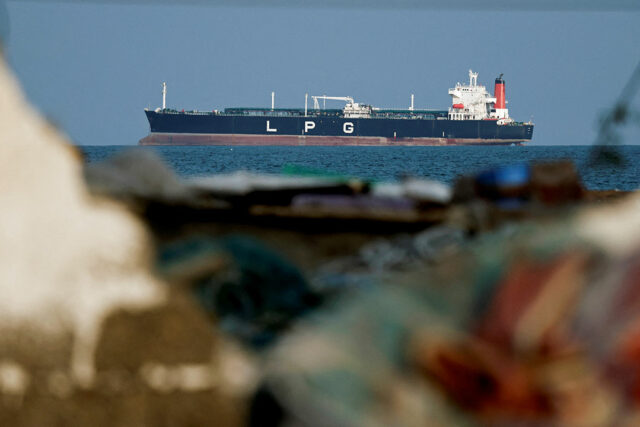
An LPG gas tanker at anchor as traffic is down in the Strait of Hormuz, amid the US-Israeli conflict with Iran, in Shinas, Oman, March 11, 2026. — REUTERS

WASHINGTON/SINGAPORE —The US military said it will begin a blockade of all maritime traffic entering and exiting Iranian ports and coastal areas on Monday, after weekend talks failed to reach a deal to end the war with Iran, jeopardizing a fragile two-week ceasefire.

The talks in Islamabad, which ran from Saturday into early Sunday, were the first direct US-Iranian meeting in more than a decade and the highest-level discussions since Iran’s 1979 Islamic Revolution. The negotiations came days after a ceasefire began on Tuesday, aimed at ending six weeks of fighting that has killed thousands of people across the Gulf, throttled vital supplies of energy and sparked fears of a wider regional conflict.

The US Central Command said that the US blockade, starting at 10 a.m. ET on Monday (1400 GMT), would be “enforced impartially against vessels of all nations entering or departing Iranian ports and coastal areas, including all Iranian ports on the Arabian Gulf and Gulf of Oman.”

Vessels transiting the Strait of Hormuz to and from non-Iranian ports will not be impeded, the US military said. Additional information would be provided to commercial mariners through a formal notice prior to the start of the blockade, it said.

President Donald J. Trump said on Sunday US forces would also intercept every vessel in international waters that had paid a toll to Iran.

“No one who pays an illegal toll will have safe passage on the high seas,” Mr. Trump wrote on social media, adding: “Any Iranian who fires at us, or at peaceful vessels, will be BLOWN TO HELL!”

He added that the US Navy will begin destroying mines that the Iranians had dropped in the Strait of Hormuz, a chokepoint for about 20% of global energy supplies.

While shipping data showed three supertankers fully laden with oil passed through the Strait on Saturday, tankers were steering clear of the waterway on Monday, ahead of the US blockade.

Benchmark crude oil prices surged more than 7% to top $100 per barrel in Monday morning trade in Asia, while the dollar jumped and US stock futures fell following the blockade announcement.

“Trump wants a quick fix,” said Dana Stroul, a former senior Pentagon official during the Biden administration now at The Washington Institute for Near East Policy. “The reality is, this mission is difficult to execute alone and likely unsustainable over the medium to long-term.”

IRAN SAYS ‘ZERO LESSONS LEARNED’
After Mr. Trump’s initial remarks on Sunday, Iran’s Islamic Revolutionary Guards warned that military vessels approaching the Strait will be considered a ceasefire breach and dealt with harshly and decisively, underlining the risk of a dangerous escalation.

A US official said Iran rejected Washington’s call for an end to all uranium enrichment, the dismantling of all major enrichment facilities and the transfer of highly enriched uranium.

Iran also refused US demands that Iran cease funding for Hamas, Hezbollah and the Houthis, as well as fully open the Strait of Hormuz, the official added.

Iranian media said there was agreement on a number of issues, but the Strait and Iran’s nuclear program were the main sticking points.

Iranian Foreign Minister Abbas Araghchi said Iran had “encountered maximalism, shifting goalposts, and blockade” when just inches away from an “Islamabad MoU (memorandum of agreement).”

“Zero lessons learned,” he added. “Good will begets good will. Enmity begets enmity.”

Even if the ceasefire holds, many analysts expect it will take some time before energy flows through the Gulf return to normal, which will mean higher fuel prices and stronger inflation for the global economy.

Mr. Trump told Fox News’ Sunday Briefing program that oil and gasoline prices may remain high through November’s midterm elections, a rare acknowledgement of the potential political fallout from the war.

Iran’s Mohammad-Bagher Ghalibaf posted a map of Washington-area gasoline prices on social media with the comment: “Enjoy the current pump figures. With the so-called ‘blockade.’ Soon you’ll be nostalgic for $4-$5 gas.”

MORE NEGOTIATIONS?
Mr. Trump said he believed Iran would continue to negotiate and called the Islamabad discussions “very friendly.”

“I do believe they’re going to come to the table on this, because nobody can be so stupid as to say, ‘We want nuclear weapons,’ and they have no cards,” he said.

But several hours later, the US president said he did not care whether a “desperate” Iran returned to the negotiating table.

“If they don’t come back, I’m fine,” Mr. Trump told journalists on Sunday night after he returned to the Washington area from an overnight stay in Florida.

Mr. Ghalibaf blamed the US for not winning Tehran’s trust, despite his team offering “forward-looking initiatives.” Iran’s President Masoud Pezeshkian, who discussed the talks in a call with Russian President Vladimir Putin, said Tehran wanted “a balanced and fair agreement.”

“If the United States returns to the framework of international law, reaching an agreement is not far off,” he told Mr. Putin, Iranian state media reported. Reuters

Hungary opposition’s landslide win heralds reforms, thaw in EU ties

Peter Magyar, leader of the opposition Tisza party, waves a Hungarian flag as he celebrates, after Hungarian Prime Minister Viktor Orban conceded defeat in the parliamentary election, in Budapest, Hungary, April 12, 2026. — REUTERS/LEONHARD FOEGER TPX IMAGES OF THE DAY

BUDAPEST — Peter Magyar’s landslide victory in Sunday’s Hungarian election has handed his center-right Tisza party a sweeping mandate that will give it a free hand to enact reforms, bolster the rule of law and potentially unlock billions in European Union (EU) funding.

Economists and political analysts say the incoming government’s expected two-thirds supermajority was the most EU- and market-friendly scenario — and before Sunday, one of the most improbable — and would likely trigger a strong rally in Hungarian assets on Monday.

A number of uncertainties remain, and wary diplomats and analysts say the new government must deliver on its promises before reaping the full benefits, but the markets for now look willing to give Budapest’s new masters the benefit of the doubt.

“The result is a game changer and will allow Magyar to govern with a free hand,” said Mujtaba Rahman, a managing director at Eurasia Group. “Most importantly, he will be able to unwind Orban’s autocracy and deliver on all of the reforms the EU is demanding.

“That means at least €6.4 billion ($7.46 billion) from the resilience and recovery facility should flow quickly, shoring up the real economy and further consolidating Tisza’s win.”

MAGYAR PLEDGES TO REBUILD ALLIANCES
The election had long been anticipated as the most market-sensitive in Europe this year given the Euroskeptic Viktor Orban’s frequent clashes with Brussels during his 16-year rule, over issues ranging from immigration to his closeness to Russia.

Mr. Orban had expressed confidence throughout the election campaign despite lagging in opinion polls, saying his goal was to protect Hungary’s national identity and traditional Christian values within the EU, while denying any wrongdoing.

But the markets had been signaling for weeks that investors expected change. The share prices of companies linked to Mr. Orban fell sharply, while market volatility gauges indicated that big currency moves were likely after the election.

Mr. Magyar, addressing jubilant supporters chanting “Europe, Europe” after Mr. Orban conceded defeat, pledged to make Hungary a strong EU and NATO ally and rebuild ties marred by years of conflict.

“With the two-thirds majority allowing us to amend the constitution, we will restore the system of checks and balances,” Mr. Magyar said.

“We will join the European Public Prosecutor’s Office and guarantee the democratic functioning of our country. We will never again allow anyone to hold free Hungary captive or to abandon it.”

One fundamental plank of Mr. Magyar’s plan to kick-start Hungary’s economy, which has been mired in near stagnation for the past three years, was to unlock EU funds frozen as democratic standards eroded under Mr. Orban.

“A constitutional majority is a different story entirely,” said Ian Bremmer at GZERO Media.

“That would give Magyar the power to rewrite the constitution, clear out Fidesz loyalists from captured institutions, fully access EU funding, and even adopt the euro — a core campaign pledge.”

On Sunday, Mr. Magyar called on Hungary’s chief prosecutor, the head of the top court, the head of media authority and other officials to resign, saying the country’s public institutions had been captured by Mr. Orban loyalists over the past 16 years.

DIPLOMATS AND RATING AGENCIES CAUTIOUS ON EU FUNDS
Mr. Magyar has pledged a sweeping anti-corruption drive as his party seeks to meet EU conditions, including stronger judicial independence and public procurement, to unlock the funds.

However, credit rating agencies such as S&P Global and Fitch Ratings, as well as some EU diplomats, are skeptical about whether any money still available under Hungary’s pandemic recovery funding would be released.

Diplomats and analysts say comparisons with Poland’s 2023 election, when Prime Minister Donald Tusk’s pro-EU cabinet secured a quick release of EU funding on promises to roll back his nationalist predecessor’s policies, may be misguided.

“There is no willingness to give out the money only on a promise like the EU did to Tusk in Poland, who was not able to deliver on most promises,” said an EU diplomat.

“Tisza would need to demonstrate that it can deliver. But if something is legally impossible, and that can be demonstrated, then the EU could figure out a way.”

Analysts at Capital Economics say the release of EU funding could help cut Hungary’s budget deficit towards 3.5% to 4% of national output by the end of the decade and stabilize public debt — the EU’s highest outside the euro zone.

“Overall, the election result marks a major turning point for Hungary’s economy,” Liam Peach said in a note.

“The durability of any positive market reaction will now depend on how quickly Tisza moves to rebuild relations with the EU, secure EU fund disbursements and signal a credible medium-term fiscal anchor.”Reuters

South Korea and Poland to upgrade ties as Tusk calls Seoul key ally after US

STOCK PHOTO | Image by Vitamin from Pixabay

SEOUL — South Korean President Lee Jae Myung and Polish Prime Minister Donald Tusk agreed on Monday to upgrade ties to a comprehensive strategic partnership, with the leaders placing defense cooperation at the center of the relationship.

In remarks made before talks between the leaders at the presidential Blue House, Mr. Lee said the countries would further expand defense industry cooperation under a $44.2-billion framework pact signed in 2022.

“K2 tanks, K9 self‑propelled howitzers, FA‑50 light-attack aircraft, and Chunmoo multiple rocket launchers — bearing South Korea’s technology and pride — are now safeguarding Poland’s territory and its people across its vast lands,” Mr. Lee said.

The South Korean leader said that the partnership extended beyond arms sales to include joint production, technology transfers and training.

Mr. Tusk described South Korea as Poland’s “most important ally after the United States, especially in the defense industry” and said he would personally oversee expanded defense cooperation between the countries.

He said the upgraded partnership meant the two countries would take on a shared responsibility and should play a role in contributing to global peace and international stability.

The two leaders also affirmed expanded cooperation across a wide range of fields, including energy supply chains, infrastructure, science and technology, advanced industries, space, and people‑to‑people exchanges.

South Korea has become one of Poland’s leading arms suppliers in recent years as Warsaw moves to rapidly modernize its military following Russia’s invasion of Ukraine.

In 2022, South Korea and Poland signed a defense framework agreement for South Korean companies to supply Poland with arms as well as jointly produce military equipment on Polish soil.

Since then, defense companies including Hanwha Aerospace and Hyundai Rotem have signed follow-up, multibillion-dollar contracts to supply equipment such as tanks and missile launchers. — Reuters

Australia appoints woman to lead its army for the first time

STOCK PHOTO | Image by Rebecca Lintz from Pixabay

SYDNEY — Australia on Monday said a woman would lead its army for the first time in history, as part of a reshuffle of the country’s defense force leadership.

Lieutenant General Susan Coyle, the current chief of joint capabilities, will become chief of army in July, the government said in a statement. She will replace Lieutenant General Simon Stuart.

Ms. Coyle’s appointment comes as Australia’s military seeks to boost the number of female officers in its ranks. It faces a wave of allegations of systematic sexual harassment and discrimination.

“From July, we will have the first ever female chief of army in the Australian Army’s 125-year history,” Prime Minister Anthony Albanese said in a statement.

Defense Minister Richard Marles called Ms. Coyle’s appointment a “deeply historic moment.”

“As Susan said to me, you cannot be what you cannot see,” he said.

“Susan’s achievement will be deeply significant to women who are serving in the Australian Defense Force (ADF) today and women who are thinking about serving in the Australian Defense Force in the future.”

Ms. Coyle, 55, enlisted in the military in 1987 and has held a number of senior command roles. She will be the first woman to lead any service branch of the military, Mr. Marles said.

Women currently make up around 21% of the Australian Defense Force and 18.5% of senior leadership roles. The ADF has set a target of 25% of overall participation for women by 2030.

Last October, a class action lawsuit was filed against the ADF alleging it failed to protect thousands of female officers from systematic sexual assault, harassment and discrimination.

The government on Monday also appointed Vice-Admiral Mark Hammond, the current chief of the navy, as the head of the ADF, succeeding Admiral David Johnston.

The current deputy chief of navy, Rear Admiral Matthew Buckley, will replace Mr. Hammond as head of the branch. Reuters

ACT: About 75% of teachers have debt up to P200,000

PHILSTAR FILE PHOTO

The Alliance of Concerned Teachers (ACT) Philippines on Monday said that about 75% of public school teachers are in debt of up to P200,000, reiterating calls for a nationwide salary increase.

“This is a systemic epidemic within the profession,” ACT Chairperson Ruby Bernardo told BusinessWorld in a Facebook message on Monday.  

“It is estimated that almost all or a very high percentage of public school teachers have some form of loan,” she added

Data from ACT and IBON Foundation revealed that 75% of 900,000 public school teachers nationwide are in debt through official salary-deduction schemes, private lending institutions, government loans, and informal high-interest lenders.

“Even official channels, like the GSIS, are plagued by slow processing, cumbersome requirements, and sometimes inhumane policies,” Ms. Bernardo said.

“Some school-based ‘accredited’ cooperatives also charge exorbitant interest rates,” she added.

Across different sources, loans for educators range from P100,000 to P200,000, while smaller, recurring loans for daily survival range from P5,000 to P20,000.

Teachers in remote and rural areas often fall into debt, as do urban poor communities where the cost of living is “intense”, said Ms. Bernardo.

In February, the Department of Education (DepEd) requested from the Bangko Sentral ng Pilipinas a more flexible, longer-term loan arrangement for education workers to ease financial burdens and pressure.

However, ACT argued that the government should recognize the link between teachers’ financial constraints and growing liabilities.

The entry-level wage for public school teachers is under Salary Grade (SG) 11, approximately P30,000. Ms. Bernardo described it as inadequate and not livable for a family of five that spends about P1,200 per day in Metro Manila.

“The entry-level Salary Grade 11 is far below the family living wage …This fundamental gap forces teachers to borrow for essential needs.”

College tuition for children, buying a house, home repairs, hospitalization fees, and instructional materials such as laptops and printers are among the major expenses that push teachers to take out loans.

“The detailed reasons for teacher debt from tuition and hospital bills to home repairs and teaching tools prove that current wages are a catastrophic failure,” Ms. Bernardo said.

“Each bullet point is evidence that pay has not kept pace with the actual cost of living and professional demands,” she added.

ACT continues to urge the DepEd to grant a “substantial increase” in the entry-level salary of teachers, raising it to P50,000, for both the public and private sectors.

“It’s time for a P50,000 salary; they call us professionals, but it doesn’t reflect in our wages,” Ms. Bernardo said in Filipino.

“The demand for a P50,000 entry-level salary for all teachers is not just a call but an urgent necessity,” she added. — Almira Louise S. Martinez

China urges restraint over US blockade of Strait of Hormuz, backs talks

An employee at a business center watches the Chinese national flag being raised, in Beijing, China Aug. 26, 2025. — REUTERS/MAXIM SHEMETOV

BEIJING — China urged calm and restraint by all sides on Monday, following US President Donald Trump’s threat to blockade the Strait of Hormuz after the failure of weekend talks in Islamabad aimed at ending the Iran war.

Before the war, most Iranian oil exports were shipped to China, the top global importer of crude.

Keeping the key Strait of Hormuz waterway safe, stable and unimpeded served the interest of the international community, foreign ministry spokesperson Guo Jiakun told a regular press conference, when asked about the blockade threat.

“China hopes the relevant parties will abide by the temporary ceasefire arrangements, remain committed to resolving disputes through political and diplomatic means, and avoid a resumption of hostilities,” he said.

China stood ready to “play a positive and constructive role” in resolving the crisis, Mr. Guo added, calling the opening talks in the Pakistani capital a step in a direction conducive to easing tension.

After the marathon talks failed, the US Central Command said its forces would begin a blockade of all maritime traffic with Iranian ports from 10 a.m. ET (1400 GMT) on Monday.

China and Pakistan had backed peace talks in March while urging an immediate ceasefire in the Iran war and restoration of normal navigation in the Strait of Hormuz, a conduit for about a fifth of global oil and gas supplies.

Mr. Guo rejected reports that China had plans to supply weapons to Iran as “groundless smears and malicious associations”.

Last week, Mr. Trump threatened immediate tariffs of 50%, with no exemptions, on imports from countries supplying Iran with military weapons.

“China has consistently taken a prudent and responsible approach to arms exports,” Mr. Guo said, adding that its strict controls were in line with domestic laws and international obligations. — Reuters

Swedish government boosts energy, fuel subsidies in election year spring budget

A SWEDISH FLAG hangs outside a store on a busy street in Stockholm, Sweden, July 14, 2023. — REUTERS

STOCKHOLM — Sweden’s government will cut fuel taxes and hike electricity subsidies in its spring mini-budget, it said on Monday, as it strives to ease the pain for households of higher energy bills driven by the war in Iran.

The extra spending, coming ahead of a parliamentary election in September, will total 7.7 billion crowns ($825 million) and comes on top of a bumper 80 billion in new spending already announced in September last year in the full-year budget bill for 2026.

“It is a signal that we will do whatever it takes to … dampen the blow to households of what is happening now,” Finance Minister Elisabeth Svantesson told reporters.

Oil prices have soared since the United States and Israel launched attacks on Iran and there are concerns a long-lasting conflict could push up inflation, hit growth and lead to higher interest rates.

The temporary boost to electricity subsidies for households in the spring budget will cost 2.4 billion crowns and the cut to fuel taxes 1.6 billion. The government has asked the EU to approve a further cut in fuel taxes worth around 8 billion crowns.

Other measures include more money for Sweden’s space program, healthcare, and job creation.

ELECTION BOOST
Swedes go to the polls in September and the ruling coalition currently trails the left bloc in the polls despite promises of tax cuts and more money for schools, healthcare and defense this year.

Households are still feeling the effects of the period of high inflation sparked by the pandemic and the war in Ukraine, alongside US President Donald Trump’s tariffs, with the Iran war now convincing many to hold on to their savings.

While the government can afford to be generous — Sweden’s public finances are rock-solid — Ms. Svantesson said the next administration would need to be careful not to push debt too high.

A right-of-center government — which could include the populist, anti-immigration Sweden Democrats for the first time — would continue to focus on supporting households and on policies to boost jobs and businesses while keeping a lid on new spending. The left plans major tax hikes, she said.

“I hope that Swedes see that what we need is calm, not a four-year experiment by a left bloc with doesn’t agree on anything,” Svantesson said.

“Higher taxes … are not the way to get more growth.” — Reuters